 by
Tom Gurney
Tom Gurney BSc (Hons) is an art history expert with over 20 years experience
Published on June 19, 2020 / Updated on October 22, 2026
Email:
tomgurney1@gmail.com
/ Phone:
+44 7429 011000
House and Farm at the Jas de Bouffan by Paul Cézanne: Introduction
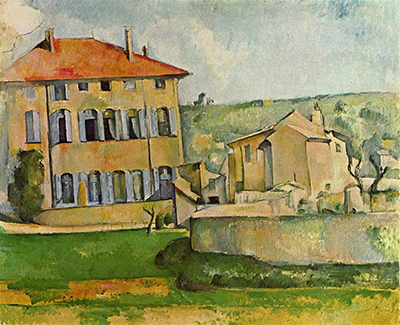
An orange roof cuts across a pale sky; below it, a tall house leans almost imperceptibly into the rest of the picture. To its right, the farm buildings are lower and harder to separate from one another. The eye crosses an unusually crowded space between them. Their outlines are familiar enough to name, but the way they connect takes longer to resolve.
Paul Cézanne's House and Farm at the Jas de Bouffan is the oil on canvas catalogued as FWN 238, now in the National Gallery Prague. The French catalogue title is Maison et ferme du Jas de Bouffan . [1]
The Prague gallery calls it The House in Aix and dates it 1885–87. [2]
At a Glance
- Artist Paul Cézanne.
- Work House and Farm at the Jas de Bouffan ; Maison et ferme du Jas de Bouffan , FWN 238. [1]
- Date About 1887 in the current catalogue; 1885–87 in the Prague gallery's account. [1] [2]
- Medium and size Oil on canvas, approximately 60 × 73 cm. [1]
- Collection National Gallery Prague, inventory O 3203. [1]
- Subject The family bastide, adjacent farm buildings, lawn and dividing wall at Jas de Bouffan, near Aix-en-Provence. [3]
This work across Paul Cézanne’s career
The Kiss of the Muse
c.1860The Artist’s Father, Reading L’Événement
autumn 1866The Hanged Man’s House
c.1873A Modern Olympia
1873–74Maincy Bridge
1879–80House and Farm at the Jas de Bouffan by Paul Cézanne (current article)
c. 1887 (catalogue); 1885–87 (Prague)The Blue Vase
1889–90The Basket of Apples
c.1893Apples and Oranges
c.1899The Large Bathers (Philadelphia)
1900–1906 (Philadelphia Museum dating)Château Noir (MoMA)
1903–04Contents
- The house and its working neighbour
- A wall that changes the depth
- Colour, tilt and a familiar place
- From Aix to Prague
The house and its working neighbour
The composition seems simple at first: house left, farm right, grass below, sky above. Its proportions quickly complicate that reading. The red roof reaches toward the centre as if to join the two building groups, but their walls do not align into one continuous front. A narrow, busy passage of angled surfaces, shadows and small rooflines interrupts them. In the reproduction, the distant green ridge runs behind both groups; it gives them a shared horizon without ironing out the awkward connection between them. The buildings are close in place and separate in pictorial character.
Jas de Bouffan included a bastide and a farm on the Cézanne family estate. François Chédeville's reconstruction places the farm east of the main house and identifies the meadow to the south. His account of the site helps make sense of the two buildings' proximity in this view, but the painting itself should still be read as a chosen frame rather than a plan of the property. Cézanne leaves most of the estate out. He concentrates on the exposed fronts, the space between them and the strip of ground that holds them in place. [4]
Look closely at the main house. Its upper storey is pale and sunlit, with dark window openings that do not form a perfectly regular row. Blue-grey shutters and greenish shadows break the façade into small vertical beats. At ground level, arches and doorways are partly absorbed into darker paint. The roof is much more assertive: a broad red-orange wedge whose upper and lower edges seem to move at slightly different angles. The eye alternates between treating the house as a solid volume and reading its front as a pattern of colour patches.
The farm makes the opposite demand. Its ochre walls appear plainer, but the overlapping roofs and projections resist quick description. A roof rises behind another wall; a bright triangular face meets a darker side; a small opening becomes visible only after the larger masses have been sorted. Where the bastide offers repeated windows, the farm offers irregular edges. The contrast is more than a difference in scale. It sets a recognisable, almost frontal building beside a group that has to be pieced together by looking.
A wall that changes the depth
Across the right foreground, the pale boundary wall enters the picture with unexpected force. It covers the bases of the farm buildings and draws a strong horizontal band across the green. Yet it does not simply seal the scene. The dark passage beside the house, the angled forms at the centre and the little changes in the wall's height all suggest routes behind it. The eye moves inward, meets a barrier, then searches for another way through. The foreground lawn, with its yellow and green strokes, is spacious enough to make that interruption felt.
Pavel Machotka has compared this particular canvas with John Rewald's photograph of the motif from about 1935. He challenges the easy conclusion that Cézanne merely flattened the scene by altering the wall's angle: a higher camera position could itself make the photographic wall descend more steeply. Machotka instead gives weight to the crowded middle and the farm's outward-spreading planes, while acknowledging the striking tilt of the architecture. That reading is useful because it separates a visible tension from a claim about exactly how the painter departed from what stood before him. [5]
Colour, tilt and a familiar place
The red roof is the most saturated warm area in the upper half of the painting. It gains its strength from the cool blue of the sky and the cooler grey-blue marks on the façade, while the ground answers with yellow-green and olive. The Musée Granet's 2025 account singles out this work for the vivid roof set against the meadow and distinguishes it from Jas landscapes where the bastide is largely hidden by trees. Here the large house is exposed enough to command attention, yet the colour does not make the farm disappear: ochres and pale yellows carry the eye across to the right. [6]
The painting's slight instability is especially clear along straight edges. The main roof projects outward, the façade's windows seem to shift in relation to one another, and the farm walls do not settle into a single neat perspective system. This does not make the scene illegible. It asks the viewer to keep adjusting the relation between one part and the next. The buildings still read as habitable structures; the wall remains a wall; the lawn remains open ground. Their geometry simply refuses to become a diagram that could be taken in at one glance.
Denis Coutagne argues that the Jas was a place Cézanne received through his father's purchase in 1859, rather than a landscape the artist selected or arranged from scratch. He also stresses the difference between identifying familiar motifs in later photographs and understanding the frames Cézanne chose. That distinction fits this canvas particularly well. The subject was available at home, but familiarity did not dictate a conventional view: the house is pushed left, the farm is set behind a wall, and the ambiguous join between them receives almost as much attention as either building. [7]
There is a useful limit to calling this a picture of the family home. The image contains no family member and offers no anecdote about life inside the bastide. The shutters, doorways and farm roofs tell us where people might move, but the painting gives its energy to the relation of these built forms. The estate becomes visible as a set of neighbours: formal residence, lower service buildings, enclosing wall and cultivated ground. Cézanne's sustained attention to these ordinary adjacencies makes the scene more searching than a view centred only on the house's recognisable façade.
From Aix to Prague
The catalogue traces the canvas through Ambroise Vollard, Gottlieb Friedrich Reber and Paul Rosenberg before it entered Prague's Modern Gallery in 1923. It records a 1923 Prague exhibition under Nakloněný dům —“The Leaning House”—and a 1936 Paris exhibition under La Maison du Jas de Bouffan . [1]
The titles direct attention to different features: the house’s tilt, its location, or its relationship with the farm. Calling it ‘The Leaning House’ makes the roofline and windows a natural starting point.
The National Gallery Prague describes the painting as part of a major 1923 state purchase of French art for the new Czechoslovakia. It also describes the composition in terms of geometric forms and colour planes. [2]
That history carried a landscape rooted in the grounds near Aix into a Central European public collection. Looking back at the canvas, the gallery's geometric emphasis is understandable, but its shapes remain particular objects: roof, shutters, farm fronts and wall. Their recognisability gives the shifting arrangement something to work against.
Cézanne artworks directory
Browse 217 identified works in this researched selection, including paintings, drawings and watercolours. This is a bounded selection, not a complete catalogue of Cézanne’s surviving oeuvre. Unlinked titles have no confirmed article in this collection.
| Name | Date | Medium |
|---|---|---|
| A Head, a Cup, and a Bread Roll | 1891/1894 | Drawing |
| A Man seen from Behind | 1880/1883 | Drawing |
| A Modern Olympia | 1873–74 | Painting |
| A Nude and Foliage | 1879/1882 | Drawing |
| A Smoking Man | 1892–96 (catalogue); c.1890–92 (museum) | Drawing |
| Afternoon in Naples | 1876–77 | Painting |
| An Old Woman with a Rosary | about 1895–96 | Painting |
| Apples and Oranges | c.1899 | Painting |
| Auvers, Panoramic View | 1873–75 | Painting |
| Avenue at Chantilly | 1888 | Painting |
| Banks of the Marne | 1888–94 | Painting |
| Basket | 1877/1900 | Drawing |
| Bather with Outstretched Arms | 1877–78 | Painting |
| Bellows in Front of a Fireplace | 1887/1892 | Drawing |
| Bibémus Quarry | c.1895 | Painting |
| Boy in a Red Vest, Barnes Foundation | 1888–90 | Painting |
| Boy in a Red Vest, MoMA | 1888–90 | Painting |
| Boy in a Red Waistcoat, National Gallery of Art | 1888–90 | Painting |
| Branch in Flower | 1886/1889 | Drawing |
| Carnival Scene | 1885/1888 | Drawing |
| Chair and Dresser | 1880/1883 | Drawing |
| Chateau Noir | 1903–04 | Painting |
| Chestnut Trees and Farm at Jas de Bouffan | c.1885 | Painting |
| Chestnut Trees and Farm at Jas de Bouffan, Pushkin | c.1886 | Painting |
| Chestnut Trees at Jas de Bouffan in Winter | 1885–86 | Painting |
| Château Noir | 1900–04 | Painting |
| Cistern in the Park of Château Noir | c.1900 | Painting |
| Curtain, Jug and Fruit | 1893–94 | Painting |
| Cushion of an Armchair | 1886/1889 | Drawing |
| Draft Letter and Studies of Bathers | c.1878 | Drawing |
| Farmhouse and Chestnut Trees at Jas de Bouffan | 1884–85 | Painting |
| Figure Resting Head on Hand | c. 1889 | Drawing |
| Fireplace Tongs and Poker | 1887/1892 | Drawing |
| Forest Interior, San Francisco | c.1898–99 | Painting |
| Four Bathers | 1888–90 | Painting |
| Fruit and a Jug on a Table | 1893–94 | Painting |
| Gardanne | 1885–86 | Painting |
| Gardanne, Barnes Foundation | c.1885 | Painting |
| Hand and Shoulder of a Boy | c. 1885 | Drawing |
| Harlequin, National Gallery of Art | 1888–90 | Painting |
| Head of a Boy | 1887/1889 | Drawing |
| Head of a Boy Seen from Behind | c. 1885 | Drawing |
| Head of a Young Woman | c. 1880 | Drawing |
| Head of the Artist's Son | 1888/1889 | Drawing |
| Hillside in Provence | c.1890–92 | Painting |
| Horse Chestnut Trees at Jas de Bouffan | c.1885 | Painting |
| House and Farm at the Jas de Bouffan | c.1887 | Painting |
| House in a Park | 1883/1886 | Drawing |
| House in Provence | c.1885 | Painting |
| House of Père Lacroix | 1873 | Painting |
| House Surrounded by Vegetation | 1889/1892 | Drawing |
| Houses in Provence The Riaux Valley near L’Estaque | c.1883 | Painting |
| Jas de Bouffan, the Pool | c.1876 | Painting |
| Kerosene Lamp | 1878/1881 | Drawing |
| L'Estaque, Melting Snow | c.1870 | Painting |
| Lake Annecy | 1896 | Painting |
| Landscape in Provence, Pola Museum | 1879–82 | Painting |
| Landscape Near Aix-en-Provence | 1877/1880 | Drawing |
| Landscape Seen from the Inside of a Cave | 1889/1892 | Drawing |
| Landscape with Poplars | c.1885–87 | Painting |
| Landscape with Trees | 1895/1898 | Drawing |
| Leda and the Swan | c.1880 (possibly later) | Painting |
| Little Girl with a Doll | 1902–04 | Painting |
| Louis Guillaume | 1879–1890 | Painting |
| Madame Cezanne | 1888/1891 | Drawing |
| Madame Cezanne | 1886/1889 | Drawing |
| Madame Cezanne | 1882/1887 | Drawing |
| Madame Cezanne | 1897/1900 | Drawing |
| Madame Cezanne with her Head Lowered | 1893/1896 | Drawing |
| Madame Cézanne in a Red Armchair | c.1877 | Painting |
| Madame Cézanne in a Red Dress, Metropolitan Museum of Art | 1888–90 | Painting |
| Madame Cézanne in a Yellow Chair | 1888–90 | Painting |
| Madame Cézanne in a Yellow Chair, Fondation Beyeler | 1888–90 | Painting |
| Madame Cézanne in the Conservatory | 1891 | Painting |
| Maincy Bridge | 1879–80 | Painting |
| Maison Maria with a View of Château Noir | c.1895 | Painting |
| Man Bending Forward | 1883/1886 | Drawing |
| Man Smoking a Pipe, Pushkin | c.1891, possibly later | Painting |
| Man with a Pipe | 1891–96 | Painting |
| Man with a Pipe, Nelson-Atkins | 1890–92 | Painting |
| Man with a Straw Hat (Gustave Boyer) | c.1871 | Painting |
| Man with Crossed Arms | c.1899 | Painting |
| Man with Pipe, National Gallery of Art | 1892–96 | Painting |
| Mont Sainte-Victoire | c.1902–06 | Painting |
| Mont Sainte-Victoire | 1900–02 | Painting |
| Mont Sainte-Victoire (recto) | c.1895 | Watercolour |
| Mont Sainte-Victoire and the Viaduct of the Arc River Valley | 1882–85 | Painting |
| Mont Sainte-Victoire Seen beyond the Wall of the Jas de Bouffan | c.1885/1888 | Watercolour |
| Mont Sainte-Victoire Seen from Bibémus Quarry | c.1897 | Painting |
| Mont Sainte-Victoire, Barnes Foundation | 1892–95 | Painting |
| Near the Pool at Jas de Bouffan | 1883/1887 | Drawing |
| Pelicans | 1877/1880 | Drawing |
| Peonies | 1890/1893 | Drawing |
| Pierrot and Harlequin | 1888 | Painting |
| Pine Tree | 1882/1885 | Drawing |
| Pont des Trois Sautets | 1906 | Watercolour |
| Poplars | 1879–80 | Painting |
| Portrait of Ambroise Vollard | 1899 | Painting |
| Portrait of Gustave Geffroy | 1895–96 | Painting |
| Portrait of Madame Cezanne with Loosened Hair | 1885–86 | Painting |
| Portrait of the Artist Looking Over His Shoulder | 1883–84 | Painting |
| Portrait of the Gardener Vallier | 1906 | Painting |
| Portrait of Victor Chocquet | 1876–77 | Painting |
| Portrait Of Victor Chocquet Seated | 1877 | Painting |
| Provençal Manor | c.1885 | Painting |
| Pyramid of Skulls | 1898–1900 | Painting |
| Reclining Nude (Leda?) | c.1887 | Painting |
| Scipio | 1866–68 | Painting |
| Seated Man, Oslo | 1898–1900 | Painting |
| Seated Peasant | c.1892–96 | Painting |
| Seated Peasant, Hiroshima | c.1897 | Painting |
| Seated Peasant, Orsay | c.1900 | Painting |
| Self-Portrait | c. 1895 | Drawing |
| Self-Portrait in a Bowler Hat, Ny Carlsberg Glyptotek | 1885–86 | Painting |
| Self-Portrait in a Casquette | c.1875 | Painting |
| Self-Portrait with a Beret | 1898–1900 | Painting |
| Self-Portrait with a Hat, Artizon Museum | c.1890–94 | Painting |
| Self-Portrait with a Pink Background | c.1875 | Painting |
| Self-Portrait with Olive-Coloured Wallpaper | about 1880–81 | Painting |
| Self-Portrait with Palette | 1886–87 | Painting |
| Self-Portrait with White Turban | c.1878–80 | Painting |
| Self-Portrait, c.1895 | c.1895 | Painting |
| Self-Portrait, Pushkin Museum | c.1882 | Painting |
| Spanish Dancers | 1883/1886 | Drawing |
| Still Life with a Curtain | 1892–94 | Painting |
| Still Life with Apples | c.1890 | Painting |
| Still Life with Apples | 1893–94 | Painting |
| Still Life with Apples and a Pot of Primroses | about 1890 | Painting |
| Still Life with Milk Jug and Fruit | c.1900 | Painting |
| Still Life with Open Drawer | 1877–79 | Painting |
| Still Life with Plaster Cupid | about 1894 | Painting |
| Still Life with Skull | 1890–93 | Painting |
| Still Life with Soup Tureen | 1877 | Painting |
| Still Life, Pitcher and Fruit | 1893–94 | Painting |
| Studies Including a Straw Hat | 1895/1898 | Drawing |
| Studies Including Madame Cezanne | 1884/1887 | Drawing |
| Study for "The Judgement of Paris" or "The Amorous Shepherd" | 1883/1886 | Drawing |
| Study for Woman with a Coffee Pot | c.1895 | Painting |
| Study of "The Roman Orator (Germanicus)" | 1883/1886 | Drawing |
| Study of "Venus de Milo" | 1881/1884 | Drawing |
| Study of a Decorative Ornament | 1879/1882 | Drawing |
| Study of a Standing Male Figure after the Antique | c. 1895 | Drawing |
| Study of an Angel in Rubens' "The Prophet Elijah" | 1892/1895 | Drawing |
| Study of Desiderio da Settignano's "Bust of a Child" | c. 1895 | Drawing |
| Study of Houses | 1879/1882 | Drawing |
| Study of Puget's "Hercules Resting" | c. 1879 | Drawing |
| Study of Puget's "Milo of Crotona" | 1895/1898 | Drawing |
| Study of Puget's "Milo of Crotona" | 1880/1883 | Drawing |
| Study of the Allegorical Figure Bellona in Rubens' "The Apotheosis of Henri IV" | 1883/1886 | Drawing |
| Study of the Allegorical Figure Bellona in Rubens' "The Apotheosis of Henri IV" | 1879/1882 | Drawing |
| Study of the Allegorical Figure France in Rubens' "The Exchange of the Two Princesses" | 1882/1885 | Drawing |
| Study of the Allegorical Figure of Health in Rubens' "The Birth of Louis XIII" | 1880/1883 | Drawing |
| Study of the Allegorical Figure of the Genius of Health from Rubens' "The Birth of Louis XIII at Fontainbleau" | 1895/1898 | Drawing |
| Sugar Bowl, Pears and Blue Cup | 1865–66 | Painting |
| The Aqueduct, Pushkin Museum | Dating differs between museum records | Painting |
| The Artist's Father, Reading L'Evenement | autumn 1866 | Painting |
| The Artist's Son | c. 1887 | Drawing |
| The Artist's Son Leaning on his Elbow | c. 1887 | Drawing |
| The Artist's Son Reading | c. 1887 | Drawing |
| The Artist's Son Writing | c. 1887 | Drawing |
| The Artist’s Son, Paul | 1886–87 | Painting |
| The Avenue at Jas de Bouffan | 1868–70 (possibly later) | Painting |
| The Avenue at Jas de Bouffan, Geneva | c.1890 | Painting |
| The Basket of Apples | c.1893 | Painting |
| The Bather, Museum of Modern Art | c.1885 | Painting |
| The Bay of Marseille seen from L'Estaque | c.1885 | Painting |
| The Blue Vase | 1889–90 | Painting |
| The Boy in the Red Vest, Bührle | 1888–90 | Painting |
| The Buffet | 1877–79 | Painting |
| The Card Players, Barnes Foundation | 1890–92 | Painting |
| The Card Players, Courtauld Gallery | 1892–96 | Painting |
| The Card Players, Metropolitan Museum of Art | 1890–92 | Painting |
| The Card Players, Musée d’Orsay | 1893–96 | Painting |
| The Card Players, Qatar | 1892–96 | Painting |
| The Eternal Feminine | c.1877 | Painting |
| The Gardener Vallier | 1906 | Painting |
| The Gardener Vallier, Tate | 1905–06 | Painting |
| The Grounds of the Château Noir | c.1900–04 | Painting |
| The Gulf of Marseille Seen from L’Estaque | c.1885 | Painting |
| The Hanged Man's House in Auvers | c.1873 | Painting |
| The House of Doctor Gachet at Auvers | 1872–73 | Painting |
| The House with the Cracked Walls | 1892–94 | Painting |
| The Kiss of the Muse | c.1860 | Painting |
| The Large Bathers, Barnes Foundation | 1895–1906 | Painting |
| The Large Bathers, National Gallery | 1895–1905 | Painting |
| The Large Bathers, Philadelphia Museum of Art | 1900–06 | Painting |
| The Mill | 1889/1892 | Drawing |
| The Painter’s Father, Louis-Auguste Cézanne | c.1865 | Painting |
| The Peasant | 1890–92 | Painting |
| The Plaster Mill (La Moulin à plâtre) | 1889/1892 | Drawing |
| The Smoker, Hermitage | c.1891 | Painting |
| The Smoker, Mannheim | c.1891 | Painting |
| The Stove in the Studio | c.1865 | Painting |
| The Vase of Tulips | c.1890 | Painting |
| Thistle | 1893/1896 | Drawing |
| Three Heads, One of Madame Cezanne | 1882/1885 | Drawing |
| Three Skulls | c.1898 | Painting |
| Three Skulls on a Patterned Carpet | 1904 | Painting |
| Trees and Shrubs | 1883/1887 | Drawing |
| Turning Road at Montgeroult | 1898 | Painting |
| Two Bathers | 1884/1887 | Drawing |
| Two Heads | 1888 | Drawing |
| Two Heads | 1890/1896 | Drawing |
| Two Heads of Women | 1890/1894 | Drawing |
| Two Studies for "The Judgement of Paris" or "The Amorous Shepherd" | 1883/1886 | Drawing |
| Uncle Dominique in a Tasseled Cap | 1866 | Painting |
| Uncle Dominique in a Turban | 1866–67 | Painting |
| Victor Chocquet and an Angel for "The Apotheosis of Delacroix" | 1878/1880 | Drawing |
| Woman in Blue | c.1904 | Painting |
| Woman Leaning Forward | 1888/1891 | Drawing |
| Woman Leaning Forward | 1890/1894 | Drawing |
| Woman Leaning Forward | 1890/1894 | Drawing |
| Woman with a Coffee Pot | c.1895 | Painting |
| Women Bathers and a Roll of Paper | 1882/1885 | Drawing |
| Young Girl with a Doll | c.1895 | Painting |
| Young Italian Woman at a Table | c.1895–1900 | Painting |
| Young Man and Skull | 1896–98 | Painting |
Frequently Asked Questions
It is the farm group adjoining the family bastide. In this view its walls and roofs are partly screened by the low boundary wall in the foreground. [4]
The tilt is visible in the painted architecture, though it should not be treated as proof that Cézanne simply copied a tilted building or randomly discarded perspective. Machotka's comparison with a later site photograph shows how viewpoint and Cézanne's own arrangement both matter. [5]
Discussion
Look again at the images and ideas explored in House and Farm at the Jas de Bouffan by Paul Cézanne. These editorial prompts invite your observations.
Reader Insights
Start with the roof and then cover it with a hand. How much of the composition's weight shifts to the farm and the pale wall?
Trace the top of the foreground wall before looking at the buildings behind it. Where does the view seem to open, and where does it become crowded?
Compare the orderly expectation set by the house's shutters with the irregular farm roofs. The painting keeps both ways of seeing active at once.
Join the Conversation
Share a detail, comparison or question about House and Farm at the Jas de Bouffan by Paul Cézanne below.
References
- Société Paul Cezanne , “Maison et ferme du Jas de Bouffan, c.1887 (FWN 238),” The Paintings, Watercolors and Drawings of Paul Cezanne: An Online Catalogue Raisonné , updated February 21, 2025. View source .
- National Gallery Prague , “115th death anniversary of Paul Cézanne,” 2021. View source .
- Musée Granet / Les Paysages de Cezanne , “Jas de Bouffan,” 2025 (in French). View source .
- Société Paul Cezanne , François Chédeville, “Promenade dans le parc du Jas de Bouffan: le regard de Cezanne,” January 13, 2020 (in French). View source .
- Société Paul Cezanne , Pavel Machotka, “Maison et ferme du Jas de Bouffan, vers 1887 (R600-FWN238),” January 10, 2017, excerpt from Cézanne: Landscape into Art . View source .
- Musée Granet , Cezanne at Jas de Bouffan , English press pack, 2025, “The Landscape,” p. 15. View source .
- Société Paul Cezanne , Denis Coutagne, “Au lieu de Cezanne,” January 12, 2020 (in French). View source .
- Le Baiser de la muse, d'après Frillié (FWN 572). View source.
- Louis-Auguste Cezanne, père de l'artiste, lisant L'Événement (FWN 402). View source.
- La Maison du pendu, Auvers-sur-Oise (FWN 81). View source.
- Une moderne Olympia (FWN 628). View source.
- Le Pont de Maincy (FWN 143). View source.
- La Montagne Sainte-Victoire vue de Montbriand (FWN 185). View source.
- Gardanne (vue horizontale) (FWN 224). View source.
- Le Vase bleu (FWN 823). View source.
- Les Joueurs de cartes (FWN 681). View source.
- La Montagne Sainte-Victoire (FWN 296). View source.
- La Corbeille de pommes (FWN 860). View source.
- Pommes et oranges (FWN 871). View source.
- Portrait d'Ambroise Vollard (FWN 531). View source.
- Philadelphia Museum of Art,The Large Bathers,W1937-1-1. View source.
- Château Noir (FWN 360). View source.
- Société Paul Cezanne,online catalogue structure and objectidentification. View source.
- National Gallery of Art,Cezanne Sketchbook,1992.51.9. View source.
- Splash image, An orange roof marks the tall house; lower farm buildings stand beyond the pale foreground wall.