 by
Tom Gurney
Tom Gurney BSc (Hons) is an art history expert with over 20 years experience
Published on June 19, 2020 / Updated on October 22, 2026
Email:
tomgurney1@gmail.com
/ Phone:
+44 7429 011000
The Eternal Feminine by Paul Cézanne: Introduction
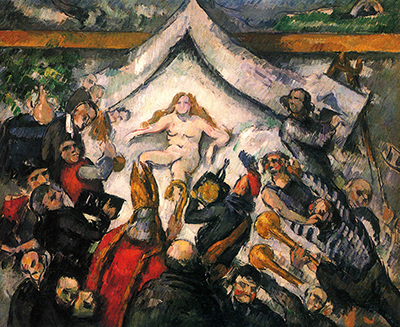
A nude woman sits under a pale canopy while a crowd presses toward her. One visitor wears a bishop’s mitre; a painter works at an easel beside her. The encounter in Paul Cézanne’s The Eternal Feminine is theatrical and hard to explain. The Getty Museum leaves open whether the woman welcomes the attention or is trapped by it. [1]
Look first at the woman’s position rather than the title. She is the brightest area in a field of dark coats, hats and faces, yet her expression offers little answer to the crowd. The canopy resembles a stage curtain and a shelter. It lifts her above the onlookers while fixing her in place. Cézanne makes the spectator part of an audience already gathered around her.
At a Glance
- Artist and work Paul Cézanne, The Eternal Feminine ( L’Éternel Féminin ), FWN 649. [2]
- Date and medium About 1877; oil on canvas. [2]
- Collection J. Paul Getty Museum, Los Angeles, accession 87.PA.79. [3]
- Size The Getty’s CONA record gives 43.2 × 53 cm unframed; its online catalogue raisonné records 45 × 53 cm. [3] [2]
This work across Paul Cézanne’s career
The Kiss of the Muse
c.1860The Artist’s Father, Reading L’Événement
autumn 1866The Hanged Man’s House
c.1873A Modern Olympia
1873–74Maincy Bridge
1879–80The Blue Vase
1889–90The Basket of Apples
c.1893Apples and Oranges
c.1899The Large Bathers (Philadelphia)
1900–1906 (Philadelphia Museum dating)Château Noir (MoMA)
1903–04Contents
- A crowd arranged around one figure
- Why the names keep changing
- A painted scene about painting
- Another reading: woman as France
- From Vollard’s gallery to the Getty
A crowd arranged around one figure
The woman’s pale body forms a clearing in the middle of the composition. Dark shapes run along the bottom edge and rise on both sides, so that the eye has to move through the crowd to reach her. At the lower left a red patch cuts across the black clothing; toward the middle, a larger red and orange shape helps hold the ring of people together. The canopy’s two sloping sides lead upward from the seated figure, giving her a frame that no one else receives.
The positions of the figures matter as much as their costumes. Some faces turn inward; others are shown in profile, partly covered by a neighbouring head or shoulder. The front row partly blocks the view, making the scene feel observed from among the onlookers rather than from a clear, ceremonial distance. The near-black backs in the foreground have more weight than many of the small faces farther away. They make the woman visible and inaccessible at the same time.
The Getty describes devotees from different occupations and notes that the painter at the easel has sometimes been identified as Eugène Delacroix. The bald foreground figure may represent Cézanne. Neither identification is secure, and the woman’s response remains unsettled. The scene invites recognition without supplying a labelled cast. [1]
Colour gives the encounter its uneven emotional temperature. Pink and cream in the canopy echo the woman’s skin, while green and brown flecks above suggest a setting beyond the improvised enclosure. Warm reds and yellows appear again among the spectators, but in fragments rather than as a second centre. No single face dominates the lower half. The painting lets the gaze move repeatedly from an individual gesture back to the collective pressure of the crowd.
Why the names keep changing
The catalogue raisonné records the work at Vollard’s 1899 Paris exhibition as La belle Impéria , at the 1907 Salon d’Automne as Le Veau d’or (“The Golden Calf”), and at a Brussels exhibition in 1935 as L’Éternel féminin . It also lists Le Triomphe de la femme . These labels show successive viewers framing the same scene differently. [2]
Wayne Andersen’s study begins with the problem those names create. He argues that a label can steer attention toward worship, temptation, satire or a literary heroine before a viewer has properly examined the figures. In the first chapter of his book, he disputes a recurring description of the picture on the small easel as Mont Sainte-Victoire: he sees the artist within the painting making a version of the very spectacle before us. His reading makes the easel a question about representation, though the small painted surface remains difficult to settle beyond doubt. [4]
A painted scene about painting
Carol Armstrong identifies a worked-out watercolour study for this oil and places it at a moment when Cézanne was moving from fantasy subjects toward painting directly from observed motifs. The change was never absolute. She treats this picture as an imagined composition, developed from a study, within a much longer engagement with the nude. Armstrong also proposes an allegory of the studio as one way of approaching it, recalling the tradition of paintings that show artists and their subjects together. [5]
The easel makes that possibility visible without requiring every person in the crowd to stand for a profession. A painter has entered the spectacle and is turning it into another picture while we watch. He stands almost against the woman’s platform, so close that he seems caught in the event he records. Between the woman, the easel and the outer picture, Cézanne stages three positions: being looked at, making an image, and looking at an image. The compressed space lets those positions almost collide. [5]
Andersen compares the approaching group with older images of an elevated woman receiving homage, but he also asks whether the bishop is arriving to join the ceremony or to interrupt it. He reads the letters “BAN” on a dark object at the left as uncertain, rejecting a confident expansion to banque . Such hesitation matters. A bishop’s mitre is legible; a full account of the object he approaches is not. Turning partial marks into a complete allegorical script would flatten the painting’s strangeness. [4]
On the canvas, figures at the right coalesce out of dark strokes; individual hands, hats and instruments are harder to isolate than the canopy or the woman’s legs. The eye can keep finding possible incidents without arranging them into a single sequence. The uncertainty is part of the viewing experience.
Another reading: woman as France
A later scholarly interpretation places the image in the visual culture that followed the Franco-Prussian War and the Paris Commune. An essay published by the Société Cézanne compares it with illustrated allegories of a wounded or recovering Paris, especially an 1871 image from La Vie parisienne in which a female figure rises above men from different occupations. The author proposes that Cézanne’s composition could speak to national recovery as well as to the worship of woman. The essay presents this as an interpretive connection, not a documented source copied directly for the oil. [6]
That proposal changes how the crowd might be read. Its many kinds of dress could suggest a public gathering around an emblem of the nation rather than a private group around a model. But the woman here is neither a straightforward Marianne nor a conventional victor. Her lowered, open posture and indistinct face resist the confidence expected of a triumphant national symbol. The political comparison adds a historical possibility while leaving the picture’s uncomfortable intimacy intact. [6]
From Vollard’s gallery to the Getty
The catalogue raisonné traces the canvas through Vollard, the Pellerin collections, Wildenstein, Stavros Niarchos and later owners before the Getty acquired it in 1987. The sequence shows how widely the small, enigmatic work travelled. [2]
The whole gathering fits into a glance, yet its crowded edges reward closer looking. At the bottom, a small face appears between the great black back at the left and the red coat beside it. Farther right, pale hands punctuate another mass of dark clothing. These short light marks create a second, broken path beneath the long pale slope of the canopy. Following that lower path brings the foreground into view as more than a border around the central figure.
Cézanne artworks directory
Browse 217 identified works in this researched selection, including paintings, drawings and watercolours. This is a bounded selection, not a complete catalogue of Cézanne’s surviving oeuvre. Unlinked titles have no confirmed article in this collection.
| Name | Date | Medium |
|---|---|---|
| A Head, a Cup, and a Bread Roll | 1891/1894 | Drawing |
| A Man seen from Behind | 1880/1883 | Drawing |
| A Modern Olympia | 1873–74 | Painting |
| A Nude and Foliage | 1879/1882 | Drawing |
| A Smoking Man | 1892–96 (catalogue); c.1890–92 (museum) | Drawing |
| Afternoon in Naples | 1876–77 | Painting |
| An Old Woman with a Rosary | about 1895–96 | Painting |
| Apples and Oranges | c.1899 | Painting |
| Auvers, Panoramic View | 1873–75 | Painting |
| Avenue at Chantilly | 1888 | Painting |
| Banks of the Marne | 1888–94 | Painting |
| Basket | 1877/1900 | Drawing |
| Bather with Outstretched Arms | 1877–78 | Painting |
| Bellows in Front of a Fireplace | 1887/1892 | Drawing |
| Bibémus Quarry | c.1895 | Painting |
| Boy in a Red Vest, Barnes Foundation | 1888–90 | Painting |
| Boy in a Red Vest, MoMA | 1888–90 | Painting |
| Boy in a Red Waistcoat, National Gallery of Art | 1888–90 | Painting |
| Branch in Flower | 1886/1889 | Drawing |
| Carnival Scene | 1885/1888 | Drawing |
| Chair and Dresser | 1880/1883 | Drawing |
| Chateau Noir | 1903–04 | Painting |
| Chestnut Trees and Farm at Jas de Bouffan | c.1885 | Painting |
| Chestnut Trees and Farm at Jas de Bouffan, Pushkin | c.1886 | Painting |
| Chestnut Trees at Jas de Bouffan in Winter | 1885–86 | Painting |
| Château Noir | 1900–04 | Painting |
| Cistern in the Park of Château Noir | c.1900 | Painting |
| Curtain, Jug and Fruit | 1893–94 | Painting |
| Cushion of an Armchair | 1886/1889 | Drawing |
| Draft Letter and Studies of Bathers | c.1878 | Drawing |
| Farmhouse and Chestnut Trees at Jas de Bouffan | 1884–85 | Painting |
| Figure Resting Head on Hand | c. 1889 | Drawing |
| Fireplace Tongs and Poker | 1887/1892 | Drawing |
| Forest Interior, San Francisco | c.1898–99 | Painting |
| Four Bathers | 1888–90 | Painting |
| Fruit and a Jug on a Table | 1893–94 | Painting |
| Gardanne | 1885–86 | Painting |
| Gardanne, Barnes Foundation | c.1885 | Painting |
| Hand and Shoulder of a Boy | c. 1885 | Drawing |
| Harlequin, National Gallery of Art | 1888–90 | Painting |
| Head of a Boy | 1887/1889 | Drawing |
| Head of a Boy Seen from Behind | c. 1885 | Drawing |
| Head of a Young Woman | c. 1880 | Drawing |
| Head of the Artist's Son | 1888/1889 | Drawing |
| Hillside in Provence | c.1890–92 | Painting |
| Horse Chestnut Trees at Jas de Bouffan | c.1885 | Painting |
| House and Farm at the Jas de Bouffan | c.1887 | Painting |
| House in a Park | 1883/1886 | Drawing |
| House in Provence | c.1885 | Painting |
| House of Père Lacroix | 1873 | Painting |
| House Surrounded by Vegetation | 1889/1892 | Drawing |
| Houses in Provence The Riaux Valley near L’Estaque | c.1883 | Painting |
| Jas de Bouffan, the Pool | c.1876 | Painting |
| Kerosene Lamp | 1878/1881 | Drawing |
| L'Estaque, Melting Snow | c.1870 | Painting |
| Lake Annecy | 1896 | Painting |
| Landscape in Provence, Pola Museum | 1879–82 | Painting |
| Landscape Near Aix-en-Provence | 1877/1880 | Drawing |
| Landscape Seen from the Inside of a Cave | 1889/1892 | Drawing |
| Landscape with Poplars | c.1885–87 | Painting |
| Landscape with Trees | 1895/1898 | Drawing |
| Leda and the Swan | c.1880 (possibly later) | Painting |
| Little Girl with a Doll | 1902–04 | Painting |
| Louis Guillaume | 1879–1890 | Painting |
| Madame Cezanne | 1888/1891 | Drawing |
| Madame Cezanne | 1886/1889 | Drawing |
| Madame Cezanne | 1882/1887 | Drawing |
| Madame Cezanne | 1897/1900 | Drawing |
| Madame Cezanne with her Head Lowered | 1893/1896 | Drawing |
| Madame Cézanne in a Red Armchair | c.1877 | Painting |
| Madame Cézanne in a Red Dress, Metropolitan Museum of Art | 1888–90 | Painting |
| Madame Cézanne in a Yellow Chair | 1888–90 | Painting |
| Madame Cézanne in a Yellow Chair, Fondation Beyeler | 1888–90 | Painting |
| Madame Cézanne in the Conservatory | 1891 | Painting |
| Maincy Bridge | 1879–80 | Painting |
| Maison Maria with a View of Château Noir | c.1895 | Painting |
| Man Bending Forward | 1883/1886 | Drawing |
| Man Smoking a Pipe, Pushkin | c.1891, possibly later | Painting |
| Man with a Pipe | 1891–96 | Painting |
| Man with a Pipe, Nelson-Atkins | 1890–92 | Painting |
| Man with a Straw Hat (Gustave Boyer) | c.1871 | Painting |
| Man with Crossed Arms | c.1899 | Painting |
| Man with Pipe, National Gallery of Art | 1892–96 | Painting |
| Mont Sainte-Victoire | c.1902–06 | Painting |
| Mont Sainte-Victoire | 1900–02 | Painting |
| Mont Sainte-Victoire (recto) | c.1895 | Watercolour |
| Mont Sainte-Victoire and the Viaduct of the Arc River Valley | 1882–85 | Painting |
| Mont Sainte-Victoire Seen beyond the Wall of the Jas de Bouffan | c.1885/1888 | Watercolour |
| Mont Sainte-Victoire Seen from Bibémus Quarry | c.1897 | Painting |
| Mont Sainte-Victoire, Barnes Foundation | 1892–95 | Painting |
| Near the Pool at Jas de Bouffan | 1883/1887 | Drawing |
| Pelicans | 1877/1880 | Drawing |
| Peonies | 1890/1893 | Drawing |
| Pierrot and Harlequin | 1888 | Painting |
| Pine Tree | 1882/1885 | Drawing |
| Pont des Trois Sautets | 1906 | Watercolour |
| Poplars | 1879–80 | Painting |
| Portrait of Ambroise Vollard | 1899 | Painting |
| Portrait of Gustave Geffroy | 1895–96 | Painting |
| Portrait of Madame Cezanne with Loosened Hair | 1885–86 | Painting |
| Portrait of the Artist Looking Over His Shoulder | 1883–84 | Painting |
| Portrait of the Gardener Vallier | 1906 | Painting |
| Portrait of Victor Chocquet | 1876–77 | Painting |
| Portrait Of Victor Chocquet Seated | 1877 | Painting |
| Provençal Manor | c.1885 | Painting |
| Pyramid of Skulls | 1898–1900 | Painting |
| Reclining Nude (Leda?) | c.1887 | Painting |
| Scipio | 1866–68 | Painting |
| Seated Man, Oslo | 1898–1900 | Painting |
| Seated Peasant | c.1892–96 | Painting |
| Seated Peasant, Hiroshima | c.1897 | Painting |
| Seated Peasant, Orsay | c.1900 | Painting |
| Self-Portrait | c. 1895 | Drawing |
| Self-Portrait in a Bowler Hat, Ny Carlsberg Glyptotek | 1885–86 | Painting |
| Self-Portrait in a Casquette | c.1875 | Painting |
| Self-Portrait with a Beret | 1898–1900 | Painting |
| Self-Portrait with a Hat, Artizon Museum | c.1890–94 | Painting |
| Self-Portrait with a Pink Background | c.1875 | Painting |
| Self-Portrait with Olive-Coloured Wallpaper | about 1880–81 | Painting |
| Self-Portrait with Palette | 1886–87 | Painting |
| Self-Portrait with White Turban | c.1878–80 | Painting |
| Self-Portrait, c.1895 | c.1895 | Painting |
| Self-Portrait, Pushkin Museum | c.1882 | Painting |
| Spanish Dancers | 1883/1886 | Drawing |
| Still Life with a Curtain | 1892–94 | Painting |
| Still Life with Apples | c.1890 | Painting |
| Still Life with Apples | 1893–94 | Painting |
| Still Life with Apples and a Pot of Primroses | about 1890 | Painting |
| Still Life with Milk Jug and Fruit | c.1900 | Painting |
| Still Life with Open Drawer | 1877–79 | Painting |
| Still Life with Plaster Cupid | about 1894 | Painting |
| Still Life with Skull | 1890–93 | Painting |
| Still Life with Soup Tureen | 1877 | Painting |
| Still Life, Pitcher and Fruit | 1893–94 | Painting |
| Studies Including a Straw Hat | 1895/1898 | Drawing |
| Studies Including Madame Cezanne | 1884/1887 | Drawing |
| Study for "The Judgement of Paris" or "The Amorous Shepherd" | 1883/1886 | Drawing |
| Study for Woman with a Coffee Pot | c.1895 | Painting |
| Study of "The Roman Orator (Germanicus)" | 1883/1886 | Drawing |
| Study of "Venus de Milo" | 1881/1884 | Drawing |
| Study of a Decorative Ornament | 1879/1882 | Drawing |
| Study of a Standing Male Figure after the Antique | c. 1895 | Drawing |
| Study of an Angel in Rubens' "The Prophet Elijah" | 1892/1895 | Drawing |
| Study of Desiderio da Settignano's "Bust of a Child" | c. 1895 | Drawing |
| Study of Houses | 1879/1882 | Drawing |
| Study of Puget's "Hercules Resting" | c. 1879 | Drawing |
| Study of Puget's "Milo of Crotona" | 1895/1898 | Drawing |
| Study of Puget's "Milo of Crotona" | 1880/1883 | Drawing |
| Study of the Allegorical Figure Bellona in Rubens' "The Apotheosis of Henri IV" | 1883/1886 | Drawing |
| Study of the Allegorical Figure Bellona in Rubens' "The Apotheosis of Henri IV" | 1879/1882 | Drawing |
| Study of the Allegorical Figure France in Rubens' "The Exchange of the Two Princesses" | 1882/1885 | Drawing |
| Study of the Allegorical Figure of Health in Rubens' "The Birth of Louis XIII" | 1880/1883 | Drawing |
| Study of the Allegorical Figure of the Genius of Health from Rubens' "The Birth of Louis XIII at Fontainbleau" | 1895/1898 | Drawing |
| Sugar Bowl, Pears and Blue Cup | 1865–66 | Painting |
| The Aqueduct, Pushkin Museum | Dating differs between museum records | Painting |
| The Artist's Father, Reading L'Evenement | autumn 1866 | Painting |
| The Artist's Son | c. 1887 | Drawing |
| The Artist's Son Leaning on his Elbow | c. 1887 | Drawing |
| The Artist's Son Reading | c. 1887 | Drawing |
| The Artist's Son Writing | c. 1887 | Drawing |
| The Artist’s Son, Paul | 1886–87 | Painting |
| The Avenue at Jas de Bouffan | 1868–70 (possibly later) | Painting |
| The Avenue at Jas de Bouffan, Geneva | c.1890 | Painting |
| The Basket of Apples | c.1893 | Painting |
| The Bather, Museum of Modern Art | c.1885 | Painting |
| The Bay of Marseille seen from L'Estaque | c.1885 | Painting |
| The Blue Vase | 1889–90 | Painting |
| The Boy in the Red Vest, Bührle | 1888–90 | Painting |
| The Buffet | 1877–79 | Painting |
| The Card Players, Barnes Foundation | 1890–92 | Painting |
| The Card Players, Courtauld Gallery | 1892–96 | Painting |
| The Card Players, Metropolitan Museum of Art | 1890–92 | Painting |
| The Card Players, Musée d’Orsay | 1893–96 | Painting |
| The Card Players, Qatar | 1892–96 | Painting |
| The Eternal Feminine | c.1877 | Painting |
| The Gardener Vallier | 1906 | Painting |
| The Gardener Vallier, Tate | 1905–06 | Painting |
| The Grounds of the Château Noir | c.1900–04 | Painting |
| The Gulf of Marseille Seen from L’Estaque | c.1885 | Painting |
| The Hanged Man's House in Auvers | c.1873 | Painting |
| The House of Doctor Gachet at Auvers | 1872–73 | Painting |
| The House with the Cracked Walls | 1892–94 | Painting |
| The Kiss of the Muse | c.1860 | Painting |
| The Large Bathers, Barnes Foundation | 1895–1906 | Painting |
| The Large Bathers, National Gallery | 1895–1905 | Painting |
| The Large Bathers, Philadelphia Museum of Art | 1900–06 | Painting |
| The Mill | 1889/1892 | Drawing |
| The Painter’s Father, Louis-Auguste Cézanne | c.1865 | Painting |
| The Peasant | 1890–92 | Painting |
| The Plaster Mill (La Moulin à plâtre) | 1889/1892 | Drawing |
| The Smoker, Hermitage | c.1891 | Painting |
| The Smoker, Mannheim | c.1891 | Painting |
| The Stove in the Studio | c.1865 | Painting |
| The Vase of Tulips | c.1890 | Painting |
| Thistle | 1893/1896 | Drawing |
| Three Heads, One of Madame Cezanne | 1882/1885 | Drawing |
| Three Skulls | c.1898 | Painting |
| Three Skulls on a Patterned Carpet | 1904 | Painting |
| Trees and Shrubs | 1883/1887 | Drawing |
| Turning Road at Montgeroult | 1898 | Painting |
| Two Bathers | 1884/1887 | Drawing |
| Two Heads | 1888 | Drawing |
| Two Heads | 1890/1896 | Drawing |
| Two Heads of Women | 1890/1894 | Drawing |
| Two Studies for "The Judgement of Paris" or "The Amorous Shepherd" | 1883/1886 | Drawing |
| Uncle Dominique in a Tasseled Cap | 1866 | Painting |
| Uncle Dominique in a Turban | 1866–67 | Painting |
| Victor Chocquet and an Angel for "The Apotheosis of Delacroix" | 1878/1880 | Drawing |
| Woman in Blue | c.1904 | Painting |
| Woman Leaning Forward | 1888/1891 | Drawing |
| Woman Leaning Forward | 1890/1894 | Drawing |
| Woman Leaning Forward | 1890/1894 | Drawing |
| Woman with a Coffee Pot | c.1895 | Painting |
| Women Bathers and a Roll of Paper | 1882/1885 | Drawing |
| Young Girl with a Doll | c.1895 | Painting |
| Young Italian Woman at a Table | c.1895–1900 | Painting |
| Young Man and Skull | 1896–98 | Painting |
Frequently Asked Questions
The catalogue raisonné dates FWN 649 to about 1877, while recording some earlier and later scholarly proposals. A Vollard archive photograph was annotated “1877” by Cézanne’s son. [2]
The bald foreground figure has been proposed as Cézanne, and the painter at the easel has sometimes been called Delacroix. Both remain tentative identifications. [1]
Yes. Armstrong discusses a worked-out watercolour study related to the Getty oil. It helps show how Cézanne developed the crowded composition before painting it on canvas. [5]
Discussion
Look again at the images and ideas explored in The Eternal Feminine by Paul Cézanne. These editorial prompts invite your observations.
Reader Insights
Start with the figure at the centre, then look at the backs along the bottom edge. How does the crowd change your sense of her position?
Compare the sheltering canopy with the exposed position of the woman. Which feature has the stronger effect on your reading?
Find the easel at the right of the canopy. How does its small pale surface affect where your eye goes?
Join the Conversation
Share a detail, comparison or question about The Eternal Feminine by Paul Cézanne below.
References
- J. Paul Getty Museum , “The Eternal Feminine,” collection description syndicated on Google Arts & Culture;. View source .
- Société Paul Cézanne , “L’Éternel Féminin; Le Veau d’or; Le Triomphe de la femme; La Belle Impéria,” FWN 649, The Paintings, Watercolors and Drawings of Paul Cezanne: An Online Catalogue Raisonné ;. View source .
- Getty Research Institute , “The Eternal Feminine (L’Éternel Féminin),” Cultural Objects Name Authority, record 700002199;. View source .
- Wayne Andersen , Cézanne and the Eternal Feminine (Cambridge University Press, 2004), sample chapter 1, pp. 1–10;. View source .
- Carol Armstrong , Cézanne in the Studio: Still Life in Watercolors (Getty Publications, 2004), pp. 87–89 and note 9;. View source .
- André Dombrowski , “Cezanne, Paris, l’année terrible and The Eternal Feminine,” Société Cézanne (2013);. View source .
- Le Baiser de la muse, d'après Frillié (FWN 572). View source.
- Louis-Auguste Cezanne, père de l'artiste, lisant L'Événement (FWN 402). View source.
- La Maison du pendu, Auvers-sur-Oise (FWN 81). View source.
- Une moderne Olympia (FWN 628). View source.
- Le Pont de Maincy (FWN 143). View source.
- La Montagne Sainte-Victoire vue de Montbriand (FWN 185). View source.
- Gardanne (vue horizontale) (FWN 224). View source.
- Le Vase bleu (FWN 823). View source.
- Les Joueurs de cartes (FWN 681). View source.
- La Montagne Sainte-Victoire (FWN 296). View source.
- La Corbeille de pommes (FWN 860). View source.
- Pommes et oranges (FWN 871). View source.
- Portrait d'Ambroise Vollard (FWN 531). View source.
- Philadelphia Museum of Art,The Large Bathers,W1937-1-1. View source.
- Château Noir (FWN 360). View source.
- Société Paul Cezanne,online catalogue structure and objectidentification. View source.
- National Gallery of Art,Cezanne Sketchbook,1992.51.9. View source.
- Splash image, Paul Cézanne, The Eternal Feminine.