 by
Tom Gurney
Tom Gurney BSc (Hons) is an art history expert with over 20 years experience
Published on June 19, 2020 / Updated on October 22, 2026
Email:
tomgurney1@gmail.com
/ Phone:
+44 7429 011000
Four Bathers by Paul Cézanne: Introduction
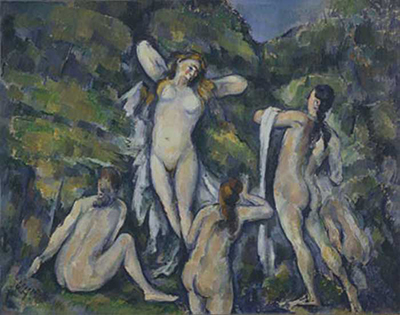
Four women occupy a surprisingly crowded patch of woodland. One sits low at the left, another rises against a pale strip of cloth, a third turns her back to us in the foreground, and the fourth stands at the right. Cézanne gives each body a different direction, then presses them into the same shallow space. The work often called Women Bathing appears in the catalogue raisonné as Quatre baigneuses ( Four Bathers ). [1]
The title invites us to imagine an activity, yet the water is difficult to locate. What holds the eye is the encounter between bodies, pale fabric, and dark foliage. The women's positions suggest actions just begun or interrupted; no single gesture explains the whole scene. This tension makes the painting rewarding to examine on its own terms, apart from Cézanne's much larger and later bather pictures.
At a Glance
- Artist Paul Cézanne. [1]
- Title Four Bathers ( Quatre baigneuses ). [1]
- Date 1888–90 (catalogue). [1]
- Medium and size Oil on board, 72 × 92 cm. [1]
- Collection Ny Carlsberg Glyptotek, Copenhagen. [1]
This work across Paul Cézanne’s career
The Kiss of the Muse
c.1860The Artist’s Father, Reading L’Événement
autumn 1866The Hanged Man’s House
c.1873A Modern Olympia
1873–74Maincy Bridge
1879–80The Blue Vase
1889–90The Basket of Apples
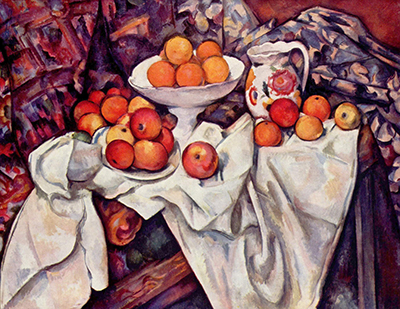
c.1893Apples and Oranges
c.1899The Large Bathers (Philadelphia)
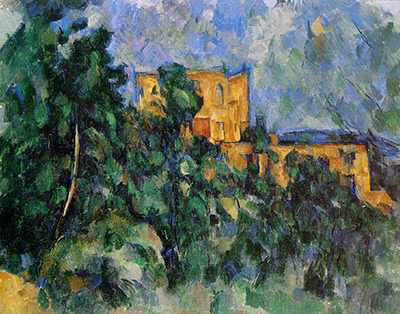
1900–1906 (Philadelphia Museum dating)Château Noir (MoMA)
1903–04Contents
- Four figures, four directions
- A landscape that presses forward
- When was it painted?
- How this picture relates to the large bathers
- A history of damage and display
- Why the scene stays open
Four figures, four directions
The seated woman at lower left offers a firm starting point. Her bent leg and extended arm spread across the foreground, while her head turns inward. The upright woman near the centre-left makes the strongest vertical accent. Both arms rise behind her head, opening the upper body into a broad shape against the dark trees. The woman closest to us, seen from behind, interrupts that vertical with a compact, turning posture. At the right, another standing figure faces partly toward us, turns her head left, and extends an arm across the pale cloth. From left to right the sequence moves through sitting, standing, turning, and standing again. It feels less like a line of models than a set of poses being tested against one another.
That variety is held together by repeated curves. The seated bather's back rounds toward the central woman's hip; the foreground figure's shoulders and lifted arm lead the eye toward the right woman's reaching gesture. Even where two figures are near each other, their heads point in different directions. Looking from one to the next produces a small delay: the eye expects an exchange, then finds another turn away. The grouping is intimate in scale without supplying an obvious conversation or shared task.
The pale areas matter as much as the flesh. A length of light fabric beside the central woman cuts between body and vegetation. Another pale passage appears near the right figure. Such shapes can be read as drapery within the bathing scene, but they also divide the painting into narrow zones. The central nude seems to advance because a bright edge separates her from the thicket; the bather at the right recedes and merges with it. Cézanne makes the surroundings alternately support and absorb the women.
A landscape that presses forward
The setting has no broad, open horizon. Dark green and blue-green masses fill the upper half, with patches of lighter green crossing them. A low bank or ground plane holds the seated figure, while the middle distance rises quickly behind the others. The eye can move between the bodies but has little room to escape beyond them. This closeness is one reason the image differs so strongly from a placid riverside idyll.
The figures are built with some of the same abrupt changes of tone as the trees. Warm ochres and muted pinks mark their bodies, yet cool blues and greens enter the shadows and edges. In the seated bather, darker strokes make the curve of the back leg more emphatic than the detail of a foot or face. In the central figure, a relatively light torso catches attention before the head does. The treatment encourages us to read weight, direction, and intervals between forms before asking who these people are.
There is also a visual ambiguity around depth. The foreground woman's back overlaps the standing figure, but her lower body is close to the bottom edge, where the ground is hard to measure. The woman at the right appears farther away, although she is nearly as tall as the central one. These shifts keep the four bodies from settling into a neat row across a stage. Cézanne's construction is legible enough to invite spatial reading and unsettled enough to keep that reading active.
When was it painted?
The catalogue dates the work to 1888–90 and lists it at Les XX in Brussels in January 1890 as Esquisse de Baigneuses . [1]
Theodore Reff made the later case in the 1977 Museum of Modern Art exhibition catalogue. He compared the raised-arm woman with a figure study of 1898–99 and with bathers in the large Barnes painting. He also found echoes of the seated and standing poses in the Barnes and London compositions. On those formal relationships, he judged a date around 1900 likely. Reff's comparison is valuable because it asks us to look across Cézanne's recurring vocabulary of bodies; it does not by itself explain the catalogue's 1890 exhibition record. [2]
The disagreement also sharpens a visual question. What changes when a pose moves from one grouping to another? Here the raised arms create a patch of open space beneath the canopy, while the seated figure pulls the composition toward the lower edge. A related gesture in a wider scene could work differently. The Copenhagen grouping is worth studying as an arrangement of its own, even while the shared figures invite comparison across the bathers.
How this picture relates to the large bathers
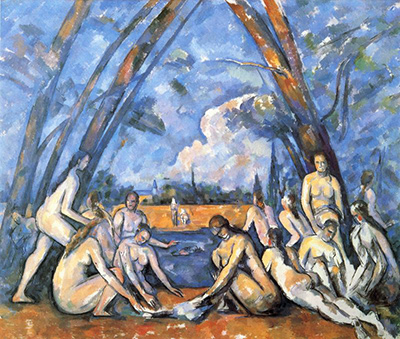
Scale provides a first distinction. The London Bathers is a much larger oil on canvas, 127.2 × 196.1 cm, with eleven women; the Philadelphia Large Bathers is another major late composition. The National Gallery describes London and Philadelphia as two of three large female bather paintings undertaken in Cézanne's final decade. They are separate objects with separate histories. [1] [3] [4]
What links them is a persistent compositional question: how can several nude bodies belong to one landscape while retaining the particularity of each pose? In the Copenhagen picture, the question is compressed. Four figures nearly fill the available width. The central raised-arm posture offers a focal point, while the backs of the seated and foreground women turn our gaze through the group rather than holding it on a single frontal figure. In the London picture, by contrast, a larger company occupies a more expansive setting. The comparison clarifies the small painting's distinctive pressure and density, rather than reducing it to a preliminary step toward a famous canvas.
Another Four Bathers , now at the Barnes Foundation, was painted in 1876–77 on canvas and measures only 27.1 × 35 cm. Its similar English title refers to a different arrangement and a different object. [5] The repeated title is a reminder that Cézanne returned to groups of women across decades. Number alone does not establish a study, a sequel, or a precise order of invention. Here, the strongest connections are visible: the use of four varied postures, a wooded enclosure, and figures that seem at once grouped and withdrawn.
A history of damage and display
The painting passed from Vollard through collections associated with Alexander Lewin, Alix Kurz, and Walter Feilchenfeldt before the Glyptotek acquired it in 1956. [1] Its movement from dealer to private owners to a public museum is part of the reason the same small painting has accumulated several titles and dates. The image itself remains recognisable through those changes: the lifted arms, the two turned backs, and the dark grove bind its identity more securely for a reader than a generic name such as Bathers .
Vollard recorded serious damage and said Cézanne cut the work with a palette knife before resuming it. That account establishes no motive. [1]
The image offers another way into this history. The figures vary in definition, from the relatively clear central torso to the bather at the right whose side dissolves into vegetation. Those differences produce a sense of movement across the board. The eye alternates between bodies that appear firm and bodies that seem to break apart into surrounding colour. The painting's compositional energy does not depend on a dramatic story about the painter's feelings toward it.
Why the scene stays open
Reff described this setting as unusually dark and read the poses as emotionally charged. His interpretation draws attention to something visible: the women occupy a confined grove and do not settle into easy companionship. Yet the image does not supply a narrative that fixes their relationship. The central figure's raised arms might be part of dressing, stretching, or a conventional nude pose. The turned backs can suggest privacy, compositional counterweight, or both. Reff's reading remains an interpretation, one that prompts a closer look without exhausting what the painting can mean. [2]
The work's achievement lies in that openness. A conventional subject, bathers among trees, becomes a testing ground for competing movements. One woman sits and extends; the central bather lifts both arms; the right-hand figure reaches left; a fourth turns between them. The surrounding greens neither dissolve the bodies nor offer a neutral backdrop. At every point Cézanne makes the viewer negotiate an edge: between fabric and skin, figure and foliage, proximity and separation. The result feels less like a witnessed afternoon than a scene continually being assembled through paint.
Cézanne artworks directory
Browse 217 identified works in this researched selection, including paintings, drawings and watercolours. This is a bounded selection, not a complete catalogue of Cézanne’s surviving oeuvre. Unlinked titles have no confirmed article in this collection.
| Name | Date | Medium |
|---|---|---|
| A Head, a Cup, and a Bread Roll | 1891/1894 | Drawing |
| A Man seen from Behind | 1880/1883 | Drawing |
| A Modern Olympia | 1873–74 | Painting |
| A Nude and Foliage | 1879/1882 | Drawing |
| A Smoking Man | 1892–96 (catalogue); c.1890–92 (museum) | Drawing |
| Afternoon in Naples | 1876–77 | Painting |
| An Old Woman with a Rosary | about 1895–96 | Painting |
| Apples and Oranges | c.1899 | Painting |
| Auvers, Panoramic View | 1873–75 | Painting |
| Avenue at Chantilly | 1888 | Painting |
| Banks of the Marne | 1888–94 | Painting |
| Basket | 1877/1900 | Drawing |
| Bather with Outstretched Arms | 1877–78 | Painting |
| Bellows in Front of a Fireplace | 1887/1892 | Drawing |
| Bibémus Quarry | c.1895 | Painting |
| Boy in a Red Vest, Barnes Foundation | 1888–90 | Painting |
| Boy in a Red Vest, MoMA | 1888–90 | Painting |
| Boy in a Red Waistcoat, National Gallery of Art | 1888–90 | Painting |
| Branch in Flower | 1886/1889 | Drawing |
| Carnival Scene | 1885/1888 | Drawing |
| Chair and Dresser | 1880/1883 | Drawing |
| Chateau Noir | 1903–04 | Painting |
| Chestnut Trees and Farm at Jas de Bouffan | c.1885 | Painting |
| Chestnut Trees and Farm at Jas de Bouffan, Pushkin | c.1886 | Painting |
| Chestnut Trees at Jas de Bouffan in Winter | 1885–86 | Painting |
| Château Noir | 1900–04 | Painting |
| Cistern in the Park of Château Noir | c.1900 | Painting |
| Curtain, Jug and Fruit | 1893–94 | Painting |
| Cushion of an Armchair | 1886/1889 | Drawing |
| Draft Letter and Studies of Bathers | c.1878 | Drawing |
| Farmhouse and Chestnut Trees at Jas de Bouffan | 1884–85 | Painting |
| Figure Resting Head on Hand | c. 1889 | Drawing |
| Fireplace Tongs and Poker | 1887/1892 | Drawing |
| Forest Interior, San Francisco | c.1898–99 | Painting |
| Four Bathers | 1888–90 | Painting |
| Fruit and a Jug on a Table | 1893–94 | Painting |
| Gardanne | 1885–86 | Painting |
| Gardanne, Barnes Foundation | c.1885 | Painting |
| Hand and Shoulder of a Boy | c. 1885 | Drawing |
| Harlequin, National Gallery of Art | 1888–90 | Painting |
| Head of a Boy | 1887/1889 | Drawing |
| Head of a Boy Seen from Behind | c. 1885 | Drawing |
| Head of a Young Woman | c. 1880 | Drawing |
| Head of the Artist's Son | 1888/1889 | Drawing |
| Hillside in Provence | c.1890–92 | Painting |
| Horse Chestnut Trees at Jas de Bouffan | c.1885 | Painting |
| House and Farm at the Jas de Bouffan | c.1887 | Painting |
| House in a Park | 1883/1886 | Drawing |
| House in Provence | c.1885 | Painting |
| House of Père Lacroix | 1873 | Painting |
| House Surrounded by Vegetation | 1889/1892 | Drawing |
| Houses in Provence The Riaux Valley near L’Estaque | c.1883 | Painting |
| Jas de Bouffan, the Pool | c.1876 | Painting |
| Kerosene Lamp | 1878/1881 | Drawing |
| L'Estaque, Melting Snow | c.1870 | Painting |
| Lake Annecy | 1896 | Painting |
| Landscape in Provence, Pola Museum | 1879–82 | Painting |
| Landscape Near Aix-en-Provence | 1877/1880 | Drawing |
| Landscape Seen from the Inside of a Cave | 1889/1892 | Drawing |
| Landscape with Poplars | c.1885–87 | Painting |
| Landscape with Trees | 1895/1898 | Drawing |
| Leda and the Swan | c.1880 (possibly later) | Painting |
| Little Girl with a Doll | 1902–04 | Painting |
| Louis Guillaume | 1879–1890 | Painting |
| Madame Cezanne | 1888/1891 | Drawing |
| Madame Cezanne | 1886/1889 | Drawing |
| Madame Cezanne | 1882/1887 | Drawing |
| Madame Cezanne | 1897/1900 | Drawing |
| Madame Cezanne with her Head Lowered | 1893/1896 | Drawing |
| Madame Cézanne in a Red Armchair | c.1877 | Painting |
| Madame Cézanne in a Red Dress, Metropolitan Museum of Art | 1888–90 | Painting |
| Madame Cézanne in a Yellow Chair | 1888–90 | Painting |
| Madame Cézanne in a Yellow Chair, Fondation Beyeler | 1888–90 | Painting |
| Madame Cézanne in the Conservatory | 1891 | Painting |
| Maincy Bridge | 1879–80 | Painting |
| Maison Maria with a View of Château Noir | c.1895 | Painting |
| Man Bending Forward | 1883/1886 | Drawing |
| Man Smoking a Pipe, Pushkin | c.1891, possibly later | Painting |
| Man with a Pipe | 1891–96 | Painting |
| Man with a Pipe, Nelson-Atkins | 1890–92 | Painting |
| Man with a Straw Hat (Gustave Boyer) | c.1871 | Painting |
| Man with Crossed Arms | c.1899 | Painting |
| Man with Pipe, National Gallery of Art | 1892–96 | Painting |
| Mont Sainte-Victoire | c.1902–06 | Painting |
| Mont Sainte-Victoire | 1900–02 | Painting |
| Mont Sainte-Victoire (recto) | c.1895 | Watercolour |
| Mont Sainte-Victoire and the Viaduct of the Arc River Valley | 1882–85 | Painting |
| Mont Sainte-Victoire Seen beyond the Wall of the Jas de Bouffan | c.1885/1888 | Watercolour |
| Mont Sainte-Victoire Seen from Bibémus Quarry | c.1897 | Painting |
| Mont Sainte-Victoire, Barnes Foundation | 1892–95 | Painting |
| Near the Pool at Jas de Bouffan | 1883/1887 | Drawing |
| Pelicans | 1877/1880 | Drawing |
| Peonies | 1890/1893 | Drawing |
| Pierrot and Harlequin | 1888 | Painting |
| Pine Tree | 1882/1885 | Drawing |
| Pont des Trois Sautets | 1906 | Watercolour |
| Poplars | 1879–80 | Painting |
| Portrait of Ambroise Vollard | 1899 | Painting |
| Portrait of Gustave Geffroy | 1895–96 | Painting |
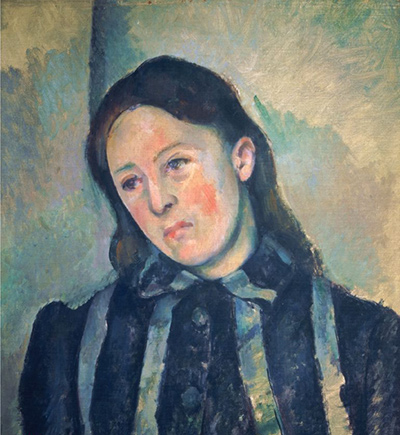
| Portrait of Madame Cezanne with Loosened Hair | 1885–86 | Painting |
| Portrait of the Artist Looking Over His Shoulder | 1883–84 | Painting |
| Portrait of the Gardener Vallier | 1906 | Painting |
| Portrait of Victor Chocquet | 1876–77 | Painting |
| Portrait Of Victor Chocquet Seated | 1877 | Painting |
| Provençal Manor | c.1885 | Painting |
| Pyramid of Skulls | 1898–1900 | Painting |
| Reclining Nude (Leda?) | c.1887 | Painting |
| Scipio | 1866–68 | Painting |
| Seated Man, Oslo | 1898–1900 | Painting |
| Seated Peasant | c.1892–96 | Painting |
| Seated Peasant, Hiroshima | c.1897 | Painting |
| Seated Peasant, Orsay | c.1900 | Painting |
| Self-Portrait | c. 1895 | Drawing |
| Self-Portrait in a Bowler Hat, Ny Carlsberg Glyptotek | 1885–86 | Painting |
| Self-Portrait in a Casquette | c.1875 | Painting |
| Self-Portrait with a Beret | 1898–1900 | Painting |
| Self-Portrait with a Hat, Artizon Museum | c.1890–94 | Painting |
| Self-Portrait with a Pink Background | c.1875 | Painting |
| Self-Portrait with Olive-Coloured Wallpaper | about 1880–81 | Painting |
| Self-Portrait with Palette | 1886–87 | Painting |
| Self-Portrait with White Turban | c.1878–80 | Painting |
| Self-Portrait, c.1895 | c.1895 | Painting |
| Self-Portrait, Pushkin Museum | c.1882 | Painting |
| Spanish Dancers | 1883/1886 | Drawing |
| Still Life with a Curtain | 1892–94 | Painting |
| Still Life with Apples | c.1890 | Painting |
| Still Life with Apples | 1893–94 | Painting |
| Still Life with Apples and a Pot of Primroses | about 1890 | Painting |
| Still Life with Milk Jug and Fruit | c.1900 | Painting |
| Still Life with Open Drawer | 1877–79 | Painting |
| Still Life with Plaster Cupid | about 1894 | Painting |
| Still Life with Skull | 1890–93 | Painting |
| Still Life with Soup Tureen | 1877 | Painting |
| Still Life, Pitcher and Fruit | 1893–94 | Painting |
| Studies Including a Straw Hat | 1895/1898 | Drawing |
| Studies Including Madame Cezanne | 1884/1887 | Drawing |
| Study for "The Judgement of Paris" or "The Amorous Shepherd" | 1883/1886 | Drawing |
| Study for Woman with a Coffee Pot | c.1895 | Painting |
| Study of "The Roman Orator (Germanicus)" | 1883/1886 | Drawing |
| Study of "Venus de Milo" | 1881/1884 | Drawing |
| Study of a Decorative Ornament | 1879/1882 | Drawing |
| Study of a Standing Male Figure after the Antique | c. 1895 | Drawing |
| Study of an Angel in Rubens' "The Prophet Elijah" | 1892/1895 | Drawing |
| Study of Desiderio da Settignano's "Bust of a Child" | c. 1895 | Drawing |
| Study of Houses | 1879/1882 | Drawing |
| Study of Puget's "Hercules Resting" | c. 1879 | Drawing |
| Study of Puget's "Milo of Crotona" | 1895/1898 | Drawing |
| Study of Puget's "Milo of Crotona" | 1880/1883 | Drawing |
| Study of the Allegorical Figure Bellona in Rubens' "The Apotheosis of Henri IV" | 1883/1886 | Drawing |
| Study of the Allegorical Figure Bellona in Rubens' "The Apotheosis of Henri IV" | 1879/1882 | Drawing |
| Study of the Allegorical Figure France in Rubens' "The Exchange of the Two Princesses" | 1882/1885 | Drawing |
| Study of the Allegorical Figure of Health in Rubens' "The Birth of Louis XIII" | 1880/1883 | Drawing |
| Study of the Allegorical Figure of the Genius of Health from Rubens' "The Birth of Louis XIII at Fontainbleau" | 1895/1898 | Drawing |
| Sugar Bowl, Pears and Blue Cup | 1865–66 | Painting |
| The Aqueduct, Pushkin Museum | Dating differs between museum records | Painting |
| The Artist's Father, Reading L'Evenement | autumn 1866 | Painting |
| The Artist's Son | c. 1887 | Drawing |
| The Artist's Son Leaning on his Elbow | c. 1887 | Drawing |
| The Artist's Son Reading | c. 1887 | Drawing |
| The Artist's Son Writing | c. 1887 | Drawing |
| The Artist’s Son, Paul | 1886–87 | Painting |
| The Avenue at Jas de Bouffan | 1868–70 (possibly later) | Painting |
| The Avenue at Jas de Bouffan, Geneva | c.1890 | Painting |
| The Basket of Apples | c.1893 | Painting |
| The Bather, Museum of Modern Art | c.1885 | Painting |
| The Bay of Marseille seen from L'Estaque | c.1885 | Painting |
| The Blue Vase | 1889–90 | Painting |
| The Boy in the Red Vest, Bührle | 1888–90 | Painting |
| The Buffet | 1877–79 | Painting |
| The Card Players, Barnes Foundation | 1890–92 | Painting |
| The Card Players, Courtauld Gallery | 1892–96 | Painting |
| The Card Players, Metropolitan Museum of Art | 1890–92 | Painting |
| The Card Players, Musée d’Orsay | 1893–96 | Painting |
| The Card Players, Qatar | 1892–96 | Painting |
| The Eternal Feminine | c.1877 | Painting |
| The Gardener Vallier | 1906 | Painting |
| The Gardener Vallier, Tate | 1905–06 | Painting |
| The Grounds of the Château Noir | c.1900–04 | Painting |
| The Gulf of Marseille Seen from L’Estaque | c.1885 | Painting |
| The Hanged Man's House in Auvers | c.1873 | Painting |
| The House of Doctor Gachet at Auvers | 1872–73 | Painting |
| The House with the Cracked Walls | 1892–94 | Painting |
| The Kiss of the Muse | c.1860 | Painting |
| The Large Bathers, Barnes Foundation | 1895–1906 | Painting |
| The Large Bathers, National Gallery | 1895–1905 | Painting |
| The Large Bathers, Philadelphia Museum of Art | 1900–06 | Painting |
| The Mill | 1889/1892 | Drawing |
| The Painter’s Father, Louis-Auguste Cézanne | c.1865 | Painting |
| The Peasant | 1890–92 | Painting |
| The Plaster Mill (La Moulin à plâtre) | 1889/1892 | Drawing |
| The Smoker, Hermitage | c.1891 | Painting |
| The Smoker, Mannheim | c.1891 | Painting |
| The Stove in the Studio | c.1865 | Painting |
| The Vase of Tulips | c.1890 | Painting |
| Thistle | 1893/1896 | Drawing |
| Three Heads, One of Madame Cezanne | 1882/1885 | Drawing |
| Three Skulls | c.1898 | Painting |
| Three Skulls on a Patterned Carpet | 1904 | Painting |
| Trees and Shrubs | 1883/1887 | Drawing |
| Turning Road at Montgeroult | 1898 | Painting |
| Two Bathers | 1884/1887 | Drawing |
| Two Heads | 1888 | Drawing |
| Two Heads | 1890/1896 | Drawing |
| Two Heads of Women | 1890/1894 | Drawing |
| Two Studies for "The Judgement of Paris" or "The Amorous Shepherd" | 1883/1886 | Drawing |
| Uncle Dominique in a Tasseled Cap | 1866 | Painting |
| Uncle Dominique in a Turban | 1866–67 | Painting |
| Victor Chocquet and an Angel for "The Apotheosis of Delacroix" | 1878/1880 | Drawing |
| Woman in Blue | c.1904 | Painting |
| Woman Leaning Forward | 1888/1891 | Drawing |
| Woman Leaning Forward | 1890/1894 | Drawing |
| Woman Leaning Forward | 1890/1894 | Drawing |
| Woman with a Coffee Pot | c.1895 | Painting |
| Women Bathers and a Roll of Paper | 1882/1885 | Drawing |
| Young Girl with a Doll | c.1895 | Painting |
| Young Italian Woman at a Table | c.1895–1900 | Painting |
| Young Man and Skull | 1896–98 | Painting |
Frequently Asked Questions
The standing women rise into the same dark foliage, while the seated figure and the turned foreground bather fill much of the lower edge. Little open ground separates them.
It is difficult to isolate a clear body of water in the image. Cézanne gives greater visual emphasis to the women, light fabric, ground, and enclosing trees.
Discussion
Look again at the images and ideas explored in Four Bathers by Paul Cézanne. These editorial prompts invite your observations.
Reader Insights
Start with the woman seated at the left. How does her low, outward-spreading pose change the scale of the standing bodies?
Follow the light fabric around the central figure. Where does it separate her from the trees, and where does it complicate her outline?
Compare the seated woman's turned back with the foreground woman's. How does each lead your eye into the group?
Join the Conversation
Share a detail, comparison or question about Four Bathers by Paul Cézanne below.
References
- Société Paul Cezanne , “Quatre baigneuses, 1888–90 (FWN 956),” The Paintings, Watercolors and Drawings of Paul Cezanne: An Online Catalogue Raisonné , updated 18 February 2020. View source .
- Theodore Reff , “Painting and Theory in the Final Decade,” in Cézanne: The Late Work , Museum of Modern Art, 1977, especially pp. 39–41. View source .
- The National Gallery, London , “Paul Cezanne: Bathers (Les Grandes Baigneuses),” current collection record. View source .
- Philadelphia Museum of Art , “The Large Bathers,” current collection record. View source .
- Barnes Foundation , “Four Bathers (Quatre baigneuses),” current collection record. View source .
- Le Baiser de la muse, d'après Frillié (FWN 572). View source.
- Louis-Auguste Cezanne, père de l'artiste, lisant L'Événement (FWN 402). View source.
- La Maison du pendu, Auvers-sur-Oise (FWN 81). View source.
- Une moderne Olympia (FWN 628). View source.
- Le Pont de Maincy (FWN 143). View source.
- La Montagne Sainte-Victoire vue de Montbriand (FWN 185). View source.
- Gardanne (vue horizontale) (FWN 224). View source.
- Le Vase bleu (FWN 823). View source.
- Les Joueurs de cartes (FWN 681). View source.
- La Montagne Sainte-Victoire (FWN 296). View source.
- La Corbeille de pommes (FWN 860). View source.
- Pommes et oranges (FWN 871). View source.
- Portrait d'Ambroise Vollard (FWN 531). View source.
- Château Noir (FWN 360). View source.
- Société Paul Cezanne,online catalogue structure and objectidentification. View source.
- National Gallery of Art,Cezanne Sketchbook,1992.51.9. View source.
- Splash image, Paul Cézanne, Four Bathers (Quatre baigneuses), 1888–90, oil on board, 72 × 92 cm, Ny Carlsberg Glyptotek, Copenhagen.