


 by
Tom Gurney
Tom Gurney BSc (Hons) is an art history expert with over 20 years experience
Email:
tomgurney1@gmail.com
/ Phone:
+44 7429 011000
Cézanne, Pissarro and the Impressionist Years: Introduction
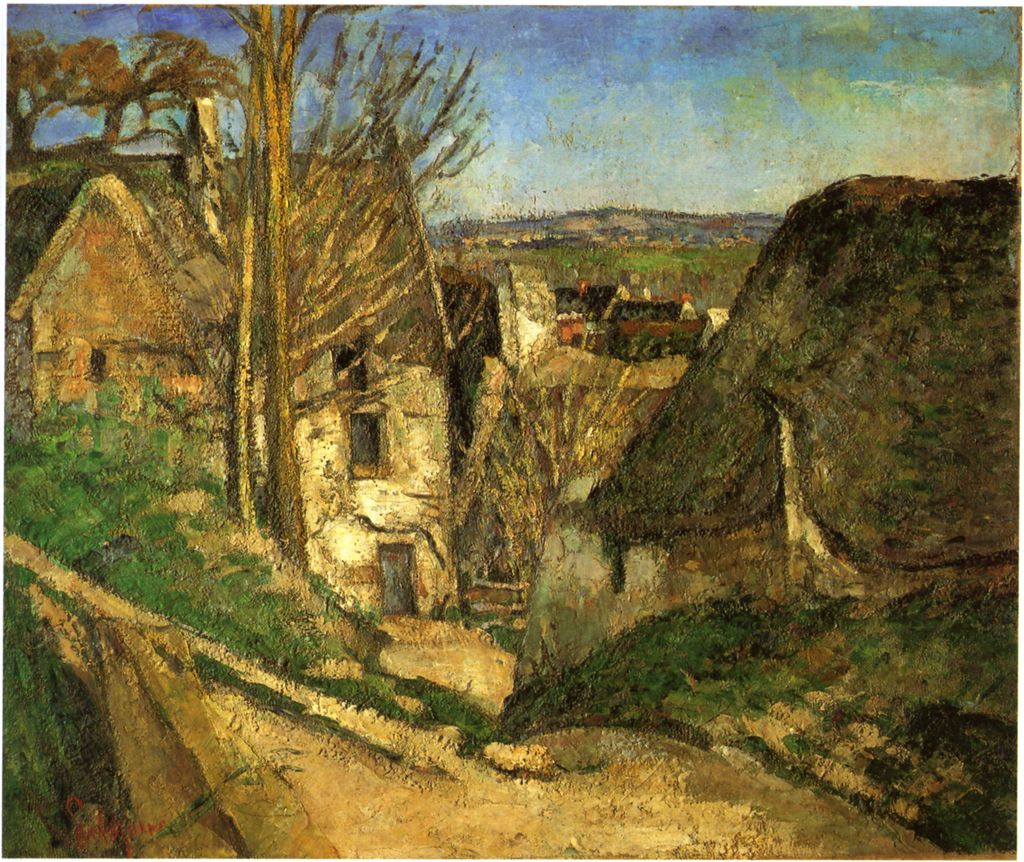
In 1873, Paul Cézanne painted among the roads, fields and houses between Pontoise and Auvers-sur-Oise. Camille Pissarro was working nearby. Their contact was already years old, but painting side by side made a new kind of exchange possible: each artist could face the same outdoor conditions and see how the other turned light, land and buildings into a picture. Cézanne had come from a decade of often dark, heavily worked paintings. The landscapes of this period brought brighter colour and a closer reckoning with observed daylight, while retaining his appetite for densely built forms. [1] [2]
The change was public as well as pictorial. Cézanne joined the first independent exhibition now known as the Impressionist exhibition in 1874, missed the second in 1876, and returned with a substantial display in 1877. His participation places him within the group’s history; the works themselves show why a single stylistic label is less revealing than looking closely at what he painted. [3] [4]
At a Glance
- Working relationship Cézanne and Camille Pissarro painted in the Pontoise and Auvers area in the early 1870s; their friendship and contact continued later. [1]
- Family and place Cézanne lived in Auvers with Hortense Fiquet and their son Paul in 1873. [1]
- First group exhibition 15 April–15 May 1874, 35 boulevard des Capucines, Paris; Cézanne listed three works. [3]
- Third group exhibition April 1877, 6 rue Le Peletier, Paris; sixteen Cézannes appeared in the catalogue and one more was reported unlisted. [4]
- Key works The Hanged Man’s House in Auvers , House of Père Lacroix , A Modern Olympia , and the varied still lifes, landscapes, figures and watercolours shown in 1877. [3] [4]
Contents
- From an acquaintance to a shared working landscape
- A circle of artists, households and supporters
- Three works at the first exhibition, 1874
- The missing year and the return of 1877
- What continued after the exhibitions
From an acquaintance to a shared working landscape
Cézanne met Pissarro during his Paris stays in the early 1860s, in a circle that also included Armand Guillaumin. A decade later their connection took on the practical intensity of painting in the countryside northwest of Paris. The Musée Granet’s chronology places Cézanne between Auvers, Pontoise and Valhermeil, while also recording his continued stays in Provence. In 1873 he worked beside Pissarro between Pontoise and Auvers, where Hortense and their young son were living. The geography matters: this was no abstract conversion to an art movement, but repeated encounters with lanes, slopes, orchards and village buildings at particular sites. [1]
Pissarro had a sustained outdoor practice and helped Cézanne attend to the effects of light in colour. The Metropolitan Museum of Art describes the contrast with Cézanne’s 1860s paintings, where strong dark-light opposition and thick pigment often carried dramatic subjects. In the 1870s, outdoor painting and a lighter palette became more prominent. Yet the comparison should not turn Pissarro into the sole author of Cézanne’s development. Cézanne had painted landscape earlier, remained attached to Provençal places, and could respond to a common motif with a more compact, weighty arrangement than Pissarro’s. Their relationship supplied working conditions, conversation and example; each canvas still has to be judged on its own terms. [2] [1]
A dated Auvers house
In House of Père Lacroix , a pale house with a warm tiled roof sits among trees above a narrow stretch of water. Short yellow and green marks gather around the wall; longer, multicoloured strokes carry the reflection downward. Blue and mauve shade the sunlit building, so light appears through neighbouring colours rather than a hard outline. The National Gallery of Art’s account draws attention to this contrast with Cézanne’s earlier dark painting. The house remains a firm block within the broken colour of leaves and water, showing how outdoor light and architectural weight could occupy the same small canvas. [5]
Cézanne signed and dated the Auvers painting “73”; the current catalogue identifies it as FWN 77. That rare firm date makes it a useful point of comparison with less securely dated works of the period. The catalogue associates it with the 1874 show’s broadly titled Auvers landscape study, an identification taken up below. [6]
The nearby Hanged Man’s House in Auvers offers a different spatial problem. Its steep paths divide and reconnect around roofs and walls; lightened earth colours sit in notably thick, worked paint. A viewer can sense outdoor observation and, at the same time, the pressure Cézanne places on the relations between parts of the scene. The 1874 catalogue listed it as no. 42. Those details help make the term “Impressionist years” useful without making all of the paintings look or behave alike. [7] [3]
A circle of artists, households and supporters
The Auvers period had a domestic setting. Hortense and Paul were with Cézanne there in 1873, while Pissarro’s home and practice centred on nearby Pontoise. Dr Paul Gachet, who lived in Auvers and supported artists, owned Cézanne’s A Modern Olympia : the 1874 exhibition catalogue explicitly says that the picture belonged to him. This is firmer evidence for a real local network than a story in which two painters simply set up easels in isolation. Works moved between studios and sympathetic owners before they reached a broad public. [1] [8] [3]
The subjects moving through that circle were varied. The Cézanne catalogue dates the Orsay still life Nature morte à la soupière (FWN 726) to 1877 and places its making in Pissarro’s Pontoise studio; the work later belonged to Pissarro. The picture contains a landscape by Pissarro dated 1873 in its background. A painting inside a painting thus gives this studio scene another layer of exchange, while the earlier date belongs to the depicted landscape. [9]
Three works at the first exhibition, 1874
The first independent group exhibition opened in the former studio rooms of the photographer Nadar at 35 boulevard des Capucines on 15 April 1874. It was organised by artists seeking a way to show work outside the official Salon system. Cézanne’s catalogue entries offer a compact account of his range: no. 42, La maison du Pendu, à Auvers-sur-Oise ; no. 43, Une moderne Olympia , described as a sketch and lent by Dr Gachet; and no. 44, Étude: Paysage à Auvers . The original title of no. 44 names the place without identifying the house; the current catalogue considers House of Père Lacroix its match. [3] [6]
The three works were not a matched set of quick landscape impressions. The Hanged Man’s House dealt with a village view and thick paint. A Modern Olympia , dated 1873–74 in the current catalogue, reworked the modern nude and the act of looking in a compact, theatrical figure scene. Showing these together exposed the span of Cézanne’s practice at a moment when he was learning from outdoor observation. An exhibition label can identify a group; it cannot erase the distance between a charged studio composition and a road through Auvers. [8] [7]
The reviews took different sides. Léon de Lora included The Hanged Man’s House among the excellent landscapes in Le Gaulois on 18 April; Émile Zola, writing in Le Sémaphore de Marseille the same day, singled out a Cézanne landscape for originality. Louis Leroy’s satirical review in Le Charivari mocked the dense paint of The Hanged Man’s House and made A Modern Olympia a joke. These notices disagree about works being seen at the same event. Count Armand Doria acquired The Hanged Man’s House , probably during the exhibition, although the sale does not appear in the exhibition society’s surviving receipts. The purchase shows that hostile press was not the whole of its first public life. [3]
The missing year and the return of 1877
Cézanne did not exhibit in the second group show, held at Durand-Ruel’s premises in 1876. The omission is clear; the motive is less so. Georges Rivière later explained it as Cézanne’s reluctance to show in a dealer’s space, while the Société Paul Cezanne’s chronology points to a contemporary letter suggesting he may not have been invited. Neither piece of evidence lets us state a settled private reason. His April 1876 letter to Pissarro is more direct evidence of continuing contact: from Aix he discussed the exhibition’s reviews, Chocquet’s news, weather that threatened fruit and vines, and Pissarro’s prospects for sales. Granet translates one short turn in the letter as “painting endures.” The phrase belongs to a practical, affectionate letter, not a declaration that Cézanne had left the group. [10] [1]
At the third exhibition, from 4 to 30 April 1877 at 6 rue Le Peletier, the name “Impressionist” appeared at the entrance. The catalogue lists sixteen works by Cézanne, and a contemporary account records one further seashore scene outside it. The entries included still lifes, flowers, four landscape studies, The Bathers , a tiger, a woman figure, a man’s head and three watercolours. This was much more than a repeat of the two Auvers landscapes and figure painting shown in 1874. It placed his investigation of observed nature beside invented or studied figures and arrangements of objects. [4]
The catalogue’s generic titles create limits for anyone reconstructing exactly which canvas hung where. Some landscape entries have competing later identifications, and the woman figure is associated only tentatively with a particular portrait. What is secure is the breadth of the display. It also exposes an important development across subjects: in still life, the Met sees Cézanne beginning to replace heavy contrast and encrusted pigment with subtler neighbouring tones that give objects dimension. In the landscapes, the same years involved a closer study of outdoor colour. The change did not happen identically or all at once on every canvas. [4] [2]
The 1877 press again disagreed. Georges Rivière defended the strength of Cézanne’s work in L’Impressionniste , while other writers mocked his bathers and portraits. A contemporary commentator even described Pissarro and Cézanne as forming distinct “schools” within the larger school, an awkward compliment to their difference. Cézanne’s place in the show was visible, but visibility did not produce agreement. The group offered a public framework broad enough to contain divergent approaches to colour, figures and landscape. [4]
What continued after the exhibitions
The 1877 display was Cézanne’s last in the Impressionist group’s exhibitions. Granet records continued movement between northern France and Provence, including later time in Pontoise with Hortense and Paul and travel with Pissarro. The exhibitions ended for Cézanne; working contact and outdoor painting continued. [1]
An undated draft to Marius Roux, placed around 1878 by the current catalogue, refers to Cézanne’s “petite personnalité de peintre impressionniste”—his small identity as an Impressionist painter. Because it is a draft, it cannot prove that Roux received this self-description. It does show that the label was available to Cézanne himself after the 1877 exhibition, even as his practice exceeded any single formula attached to it. He continued to work between places and genres, carrying lessons in outdoor light into the slower construction of colour and form that later viewers associate with his name. [11] [1] [2]
For a wider account of those movements and relationships, see the Cézanne biography . The paintings of the 1870s are especially rewarding when read beside their exhibition records: the same period could produce an Auvers house, a modern figure scene, a tureen in a studio and a watercolour study. Their differences make the Pissarro years more vivid than a simple before-and-after story.
Cézanne artworks directory
Browse 217 identified works in this researched selection, including paintings, drawings and watercolours. This is a bounded selection, not a complete catalogue of Cézanne’s surviving oeuvre. Unlinked titles have no confirmed article in this collection.
| Name | Date | Medium |
|---|---|---|
| A Head, a Cup, and a Bread Roll | 1891/1894 | Drawing |
| A Man seen from Behind | 1880/1883 | Drawing |
| A Modern Olympia | 1873–74 | Painting |
| A Nude and Foliage | 1879/1882 | Drawing |
| A Smoking Man | 1892–96 (catalogue); c.1890–92 (museum) | Drawing |
| Afternoon in Naples | 1876–77 | Painting |
| An Old Woman with a Rosary | about 1895–96 | Painting |
| Apples and Oranges | c.1899 | Painting |
| Auvers, Panoramic View | 1873–75 | Painting |
| Avenue at Chantilly | 1888 | Painting |
| Banks of the Marne | 1888–94 | Painting |
| Basket | 1877/1900 | Drawing |
| Bather with Outstretched Arms | 1877–78 | Painting |
| Bellows in Front of a Fireplace | 1887/1892 | Drawing |
| Bibémus Quarry | c.1895 | Painting |
| Boy in a Red Vest, Barnes Foundation | 1888–90 | Painting |
| Boy in a Red Vest, MoMA | 1888–90 | Painting |
| Boy in a Red Waistcoat, National Gallery of Art | 1888–90 | Painting |
| Branch in Flower | 1886/1889 | Drawing |
| Carnival Scene | 1885/1888 | Drawing |
| Chair and Dresser | 1880/1883 | Drawing |
| Chateau Noir | 1903–04 | Painting |
| Chestnut Trees and Farm at Jas de Bouffan | c.1885 | Painting |
| Chestnut Trees and Farm at Jas de Bouffan, Pushkin | c.1886 | Painting |
| Chestnut Trees at Jas de Bouffan in Winter | 1885–86 | Painting |
| Château Noir | 1900–04 | Painting |
| Cistern in the Park of Château Noir | c.1900 | Painting |
| Curtain, Jug and Fruit | 1893–94 | Painting |
| Cushion of an Armchair | 1886/1889 | Drawing |
| Draft Letter and Studies of Bathers | c.1878 | Drawing |
| Farmhouse and Chestnut Trees at Jas de Bouffan | 1884–85 | Painting |
| Figure Resting Head on Hand | c. 1889 | Drawing |
| Fireplace Tongs and Poker | 1887/1892 | Drawing |
| Forest Interior, San Francisco | c.1898–99 | Painting |
| Four Bathers | 1888–90 | Painting |
| Fruit and a Jug on a Table | 1893–94 | Painting |
| Gardanne | 1885–86 | Painting |
| Gardanne, Barnes Foundation | c.1885 | Painting |
| Hand and Shoulder of a Boy | c. 1885 | Drawing |
| Harlequin, National Gallery of Art | 1888–90 | Painting |
| Head of a Boy | 1887/1889 | Drawing |
| Head of a Boy Seen from Behind | c. 1885 | Drawing |
| Head of a Young Woman | c. 1880 | Drawing |
| Head of the Artist's Son | 1888/1889 | Drawing |
| Hillside in Provence | c.1890–92 | Painting |
| Horse Chestnut Trees at Jas de Bouffan | c.1885 | Painting |
| House and Farm at the Jas de Bouffan | c.1887 | Painting |
| House in a Park | 1883/1886 | Drawing |
| House in Provence | c.1885 | Painting |
| House of Père Lacroix | 1873 | Painting |
| House Surrounded by Vegetation | 1889/1892 | Drawing |
| Houses in Provence The Riaux Valley near L’Estaque | c.1883 | Painting |
| Jas de Bouffan, the Pool | c.1876 | Painting |
| Kerosene Lamp | 1878/1881 | Drawing |
| L'Estaque, Melting Snow | c.1870 | Painting |
| Lake Annecy | 1896 | Painting |
| Landscape in Provence, Pola Museum | 1879–82 | Painting |
| Landscape Near Aix-en-Provence | 1877/1880 | Drawing |
| Landscape Seen from the Inside of a Cave | 1889/1892 | Drawing |
| Landscape with Poplars | c.1885–87 | Painting |
| Landscape with Trees | 1895/1898 | Drawing |
| Leda and the Swan | c.1880 (possibly later) | Painting |
| Little Girl with a Doll | 1902–04 | Painting |
| Louis Guillaume | 1879–1890 | Painting |
| Madame Cezanne | 1888/1891 | Drawing |
| Madame Cezanne | 1886/1889 | Drawing |
| Madame Cezanne | 1882/1887 | Drawing |
| Madame Cezanne | 1897/1900 | Drawing |
| Madame Cezanne with her Head Lowered | 1893/1896 | Drawing |
| Madame Cézanne in a Red Armchair | c.1877 | Painting |
| Madame Cézanne in a Red Dress, Metropolitan Museum of Art | 1888–90 | Painting |
| Madame Cézanne in a Yellow Chair | 1888–90 | Painting |
| Madame Cézanne in a Yellow Chair, Fondation Beyeler | 1888–90 | Painting |
| Madame Cézanne in the Conservatory | 1891 | Painting |
| Maincy Bridge | 1879–80 | Painting |
| Maison Maria with a View of Château Noir | c.1895 | Painting |
| Man Bending Forward | 1883/1886 | Drawing |
| Man Smoking a Pipe, Pushkin | c.1891, possibly later | Painting |
| Man with a Pipe | 1891–96 | Painting |
| Man with a Pipe, Nelson-Atkins | 1890–92 | Painting |
| Man with a Straw Hat (Gustave Boyer) | c.1871 | Painting |
| Man with Crossed Arms | c.1899 | Painting |
| Man with Pipe, National Gallery of Art | 1892–96 | Painting |
| Mont Sainte-Victoire | c.1902–06 | Painting |
| Mont Sainte-Victoire | 1900–02 | Painting |
| Mont Sainte-Victoire (recto) | c.1895 | Watercolour |
| Mont Sainte-Victoire and the Viaduct of the Arc River Valley | 1882–85 | Painting |
| Mont Sainte-Victoire Seen beyond the Wall of the Jas de Bouffan | c.1885/1888 | Watercolour |
| Mont Sainte-Victoire Seen from Bibémus Quarry | c.1897 | Painting |
| Mont Sainte-Victoire, Barnes Foundation | 1892–95 | Painting |
| Near the Pool at Jas de Bouffan | 1883/1887 | Drawing |
| Pelicans | 1877/1880 | Drawing |
| Peonies | 1890/1893 | Drawing |
| Pierrot and Harlequin | 1888 | Painting |
| Pine Tree | 1882/1885 | Drawing |
| Pont des Trois Sautets | 1906 | Watercolour |
| Poplars | 1879–80 | Painting |
| Portrait of Ambroise Vollard | 1899 | Painting |
| Portrait of Gustave Geffroy | 1895–96 | Painting |
| Portrait of Madame Cezanne with Loosened Hair | 1885–86 | Painting |
| Portrait of the Artist Looking Over His Shoulder | 1883–84 | Painting |
| Portrait of the Gardener Vallier | 1906 | Painting |
| Portrait of Victor Chocquet | 1876–77 | Painting |
| Portrait Of Victor Chocquet Seated | 1877 | Painting |
| Provençal Manor | c.1885 | Painting |
| Pyramid of Skulls | 1898–1900 | Painting |
| Reclining Nude (Leda?) | c.1887 | Painting |
| Scipio | 1866–68 | Painting |
| Seated Man, Oslo | 1898–1900 | Painting |
| Seated Peasant | c.1892–96 | Painting |
| Seated Peasant, Hiroshima | c.1897 | Painting |
| Seated Peasant, Orsay | c.1900 | Painting |
| Self-Portrait | c. 1895 | Drawing |
| Self-Portrait in a Bowler Hat, Ny Carlsberg Glyptotek | 1885–86 | Painting |
| Self-Portrait in a Casquette | c.1875 | Painting |
| Self-Portrait with a Beret | 1898–1900 | Painting |
| Self-Portrait with a Hat, Artizon Museum | c.1890–94 | Painting |
| Self-Portrait with a Pink Background | c.1875 | Painting |
| Self-Portrait with Olive-Coloured Wallpaper | about 1880–81 | Painting |
| Self-Portrait with Palette | 1886–87 | Painting |
| Self-Portrait with White Turban | c.1878–80 | Painting |
| Self-Portrait, c.1895 | c.1895 | Painting |
| Self-Portrait, Pushkin Museum | c.1882 | Painting |
| Spanish Dancers | 1883/1886 | Drawing |
| Still Life with a Curtain | 1892–94 | Painting |
| Still Life with Apples | c.1890 | Painting |
| Still Life with Apples | 1893–94 | Painting |
| Still Life with Apples and a Pot of Primroses | about 1890 | Painting |
| Still Life with Milk Jug and Fruit | c.1900 | Painting |
| Still Life with Open Drawer | 1877–79 | Painting |
| Still Life with Plaster Cupid | about 1894 | Painting |
| Still Life with Skull | 1890–93 | Painting |
| Still Life with Soup Tureen | 1877 | Painting |
| Still Life, Pitcher and Fruit | 1893–94 | Painting |
| Studies Including a Straw Hat | 1895/1898 | Drawing |
| Studies Including Madame Cezanne | 1884/1887 | Drawing |
| Study for "The Judgement of Paris" or "The Amorous Shepherd" | 1883/1886 | Drawing |
| Study for Woman with a Coffee Pot | c.1895 | Painting |
| Study of "The Roman Orator (Germanicus)" | 1883/1886 | Drawing |
| Study of "Venus de Milo" | 1881/1884 | Drawing |
| Study of a Decorative Ornament | 1879/1882 | Drawing |
| Study of a Standing Male Figure after the Antique | c. 1895 | Drawing |
| Study of an Angel in Rubens' "The Prophet Elijah" | 1892/1895 | Drawing |
| Study of Desiderio da Settignano's "Bust of a Child" | c. 1895 | Drawing |
| Study of Houses | 1879/1882 | Drawing |
| Study of Puget's "Hercules Resting" | c. 1879 | Drawing |
| Study of Puget's "Milo of Crotona" | 1895/1898 | Drawing |
| Study of Puget's "Milo of Crotona" | 1880/1883 | Drawing |
| Study of the Allegorical Figure Bellona in Rubens' "The Apotheosis of Henri IV" | 1883/1886 | Drawing |
| Study of the Allegorical Figure Bellona in Rubens' "The Apotheosis of Henri IV" | 1879/1882 | Drawing |
| Study of the Allegorical Figure France in Rubens' "The Exchange of the Two Princesses" | 1882/1885 | Drawing |
| Study of the Allegorical Figure of Health in Rubens' "The Birth of Louis XIII" | 1880/1883 | Drawing |
| Study of the Allegorical Figure of the Genius of Health from Rubens' "The Birth of Louis XIII at Fontainbleau" | 1895/1898 | Drawing |
| Sugar Bowl, Pears and Blue Cup | 1865–66 | Painting |
| The Aqueduct, Pushkin Museum | Dating differs between museum records | Painting |
| The Artist's Father, Reading L'Evenement | autumn 1866 | Painting |
| The Artist's Son | c. 1887 | Drawing |
| The Artist's Son Leaning on his Elbow | c. 1887 | Drawing |
| The Artist's Son Reading | c. 1887 | Drawing |
| The Artist's Son Writing | c. 1887 | Drawing |
| The Artist’s Son, Paul | 1886–87 | Painting |
| The Avenue at Jas de Bouffan | 1868–70 (possibly later) | Painting |
| The Avenue at Jas de Bouffan, Geneva | c.1890 | Painting |
| The Basket of Apples | c.1893 | Painting |
| The Bather, Museum of Modern Art | c.1885 | Painting |
| The Bay of Marseille seen from L'Estaque | c.1885 | Painting |
| The Blue Vase | 1889–90 | Painting |
| The Boy in the Red Vest, Bührle | 1888–90 | Painting |
| The Buffet | 1877–79 | Painting |
| The Card Players, Barnes Foundation | 1890–92 | Painting |
| The Card Players, Courtauld Gallery | 1892–96 | Painting |
| The Card Players, Metropolitan Museum of Art | 1890–92 | Painting |
| The Card Players, Musée d’Orsay | 1893–96 | Painting |
| The Card Players, Qatar | 1892–96 | Painting |
| The Eternal Feminine | c.1877 | Painting |
| The Gardener Vallier | 1906 | Painting |
| The Gardener Vallier, Tate | 1905–06 | Painting |
| The Grounds of the Château Noir | c.1900–04 | Painting |
| The Gulf of Marseille Seen from L’Estaque | c.1885 | Painting |
| The Hanged Man's House in Auvers | c.1873 | Painting |
| The House of Doctor Gachet at Auvers | 1872–73 | Painting |
| The House with the Cracked Walls | 1892–94 | Painting |
| The Kiss of the Muse | c.1860 | Painting |
| The Large Bathers, Barnes Foundation | 1895–1906 | Painting |
| The Large Bathers, National Gallery | 1895–1905 | Painting |
| The Large Bathers, Philadelphia Museum of Art | 1900–06 | Painting |
| The Mill | 1889/1892 | Drawing |
| The Painter’s Father, Louis-Auguste Cézanne | c.1865 | Painting |
| The Peasant | 1890–92 | Painting |
| The Plaster Mill (La Moulin à plâtre) | 1889/1892 | Drawing |
| The Smoker, Hermitage | c.1891 | Painting |
| The Smoker, Mannheim | c.1891 | Painting |
| The Stove in the Studio | c.1865 | Painting |
| The Vase of Tulips | c.1890 | Painting |
| Thistle | 1893/1896 | Drawing |
| Three Heads, One of Madame Cezanne | 1882/1885 | Drawing |
| Three Skulls | c.1898 | Painting |
| Three Skulls on a Patterned Carpet | 1904 | Painting |
| Trees and Shrubs | 1883/1887 | Drawing |
| Turning Road at Montgeroult | 1898 | Painting |
| Two Bathers | 1884/1887 | Drawing |
| Two Heads | 1888 | Drawing |
| Two Heads | 1890/1896 | Drawing |
| Two Heads of Women | 1890/1894 | Drawing |
| Two Studies for "The Judgement of Paris" or "The Amorous Shepherd" | 1883/1886 | Drawing |
| Uncle Dominique in a Tasseled Cap | 1866 | Painting |
| Uncle Dominique in a Turban | 1866–67 | Painting |
| Victor Chocquet and an Angel for "The Apotheosis of Delacroix" | 1878/1880 | Drawing |
| Woman in Blue | c.1904 | Painting |
| Woman Leaning Forward | 1888/1891 | Drawing |
| Woman Leaning Forward | 1890/1894 | Drawing |
| Woman Leaning Forward | 1890/1894 | Drawing |
| Woman with a Coffee Pot | c.1895 | Painting |
| Women Bathers and a Roll of Paper | 1882/1885 | Drawing |
| Young Girl with a Doll | c.1895 | Painting |
| Young Italian Woman at a Table | c.1895–1900 | Painting |
| Young Man and Skull | 1896–98 | Painting |
Frequently Asked Questions
The surviving evidence does not settle one motive. A later account says he objected to showing in a dealer’s premises; the Société’s chronology points to a contemporary indication that he may not have been invited. He remained in correspondence with Pissarro during the exhibition. [10]
Sixteen works appear under his name in the third exhibition catalogue, including three watercolours. A contemporary review also identifies one work that was outside the catalogue. [4]
Discussion
Look again at the images and ideas explored in Cézanne, Pissarro and the Impressionist Years. These editorial prompts invite your observations.
Reader Insights
In House of Père Lacroix, compare the solid wall and roof with the shifting greens and reflections. Where does the eye pause?
Compare the titles of Cézanne’s 1874 entries with the 1877 catalogue. What can an exhibition title tell you about a picture, and what remains uncertain until the object itself is identified?
Set a Cézanne still life beside one of his landscapes from the decade. How does colour give weight to an apple or vessel differently from the way it describes daylight on a road?
Join the Conversation
Share a detail, comparison or question about Cézanne, Pissarro and the Impressionist Years below.
References
- Musée Granet , Cezanne au Jas de Bouffan , bilingual visitor booklet, 2025, especially pp. 9, 16, 18–19. View source .
- The Metropolitan Museum of Art , James Voorhies, “Paul Cézanne (1839–1906),” 2004. View source .
- Société Paul Cezanne , François Chédeville, “1874,” chronology reproducing the first exhibition catalogue and contemporary notices, 2016. (in French). View source .
- Société Paul Cezanne , François Chédeville, “1877,” chronology reproducing the third exhibition catalogue and contemporary notices, 2016. (in French). View source .
- National Gallery of Art , “House of Père Lacroix,” 1873, collection record and visual description. View source .
- Société Paul Cezanne , The Paintings, Watercolors and Drawings of Paul Cezanne: An Online Catalogue Raisonné , “La Maison du père Lacroix, Auvers-sur-Oise,” FWN 77, current online entry. View source .
- Société Paul Cezanne , The Paintings, Watercolors and Drawings of Paul Cezanne: An Online Catalogue Raisonné , “La Maison du pendu, Auvers-sur-Oise,” FWN 81, current online entry. View source .
- Société Paul Cezanne , The Paintings, Watercolors and Drawings of Paul Cezanne: An Online Catalogue Raisonné , “Une moderne Olympia,” FWN 628, current online entry. View source .
- Société Paul Cezanne , The Paintings, Watercolors and Drawings of Paul Cezanne: An Online Catalogue Raisonné , “Nature morte à la soupière,” FWN 726, current online entry. View source .
- Société Paul Cezanne , François Chédeville, “1876,” chronology reproducing Cézanne’s April letter to Camille Pissarro and exhibition evidence, 2016. (in French). View source .
- Société Paul Cezanne , The Paintings, Watercolors and Drawings of Paul Cezanne: An Online Catalogue Raisonné , “Brouillon de lettre et études de baigneurs,” FWN 2263, current online entry. (in French). View source .
- Société Paul Cezanne,online catalogue structure and objectidentification. View source.
- National Gallery of Art,Cezanne Sketchbook,1992.51.9. View source.
- Splash image, Paul Cézanne, The Hanged Man’s House, Auvers-sur-Oise, 1873, oil on canvas, 55.5 × 66.3 cm, Musée d’Orsay, Paris (RF 1970; FWN 81). Image source. Public domain. Proportional web export only; master unchanged.


