Pen and Brown Ink Paul Cezanne.jpg)
 by
Tom Gurney
Tom Gurney BSc (Hons) is an art history expert with over 20 years experience
Published on June 19, 2020 / Updated on October 22, 2026
Email:
tomgurney1@gmail.com
/ Phone:
+44 7429 011000
Two Bathers by Paul Cézanne: Introduction
Two figures occupy the left side of Cézanne’s small sketchbook page. One sits low, turning upward; the other stands with his back toward us and one arm bent near his head. Writing crosses the upper margin and runs at a different angle beside them. The drawing is easy to miss if we expect bathers to fill a landscape. Here the bodies are compact, the paper remains conspicuously open, and the written marks are part of the page we actually see.
The sheet belongs to the National Gallery of Art’s Cézanne sketchbook in Washington and is generally dated 1884–87. Its title, Two Bathers , identifies the figures without supplying a specific river, visit, or finished painting. [1]
At a Glance
- Artist Paul Cézanne. [1]
- Title Two Bathers ; Deux baigneurs et annotations in the online catalogue. [2]
- Date 1884–87. [1] [2]
- Medium The National Gallery describes pen and brown ink on end papers; the online catalogue describes graphite and ink on wove paper. [1] [2]
- Size 15.2 × 23.7 cm. [2]
- Identity NGA 1992.51.9.sss; FWN 3015-54b; Chappuis 684; Venturi 1315-03. [1] [2]
This work across Paul Cézanne’s career
The Kiss of the Muse
c.1860The Artist’s Father, Reading L’Événement
autumn 1866The Hanged Man’s House
c.1873A Modern Olympia
1873–74Maincy Bridge
1879–80The Blue Vase
1889–90The Basket of Apples
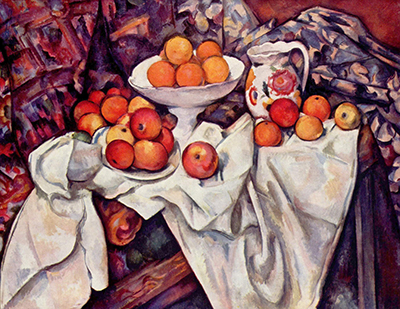
c.1893Apples and Oranges
c.1899The Large Bathers (Philadelphia)
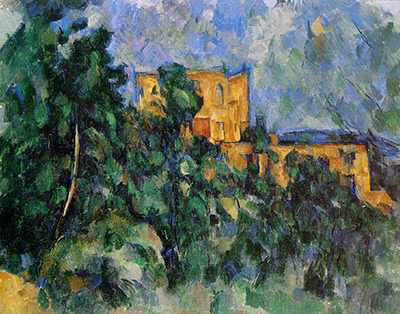
1900–1906 (Philadelphia Museum dating)Château Noir (MoMA)
1903–04Contents
- Two bodies in a narrow space
- Annotations, rather than a mapped bathing place
- A sketchbook used across years
- A recurring bather arrangement
- The poem on another endpaper
- Where the page survives
Two bodies in a narrow space
The seated figure begins close to the left edge. The head tips back toward the companion, while an arm comes down beside the torso and a leg folds into a rough angle below it. Cézanne does not separate each limb with the same degree of care. Some strokes are decisive arcs; others cross, stop short, or leave a joint to be completed by the viewer. The figure seems to balance between the firmness of a seated pose and the restlessness of marks still looking for it.
The taller bather turns away. A line climbs from the leg through the back and into the neck, while the raised arm bends toward the head. The second arm, shoulder and flank do not lock into a smooth silhouette. They are made by quick changes of direction that keep the body turning in space. The two figures share a patch of paper, yet neither receives a clear shoreline or pool. The standing back supplies an axis for the group; the seated body pulls the eye down and outward.
Their scale is modest against the sheet. To the right, a long vertical stroke and several lines of handwriting take up as much visual territory as the figures. This makes the drawing feel less like a cropped scene than a working page where several kinds of mark coexist. The blank stretches do useful work: they prevent the bodies from becoming a dense knot and allow the extended arm, the bent knees and the vertical stroke to register separately. Looking from left to right is almost like moving between a compressed figure study and a second, written activity.
The heads are particularly economical. A few short curves indicate the seated bather’s face; the standing one is largely turned from view. The page offers gesture more readily than identity. Nor does it tell us whether these poses came from a model, another image, memory, or Cézanne’s invention. The visible evidence is the relation between two bodies: one low, one high, each angled toward the other while their exact interaction remains unresolved.
Annotations, rather than a mapped bathing place
The catalogue transcribes an address to Léon Robert at Bas-Samois, via Fontainebleau, and records weekdays and “salsepareille.” These notations do not identify a bathing site or date the writing and drawing together. [2]
In the reproduction, writing cuts across the top and turns down the right. Its direction differs from the bodies’ upright orientation. A viewer can read the page by rotating it mentally, but doing so shifts attention away from the figures. This friction is a feature of the whole sheet. The standing bather’s curved back and the written lines ask for different kinds of attention, and neither has to be treated as an illustration of the other.
A sketchbook used across years
Charles S. Moffett described the Mellon sketchbook as a book Cézanne used from about 1877 to about 1900. It holds portraits, landscapes, plants, ordinary objects, figure studies and copies after earlier art. Moffett counted forty-six surviving sheets and observed that Cézanne appears to have opened the book at different places rather than filling it in chronological order. The later Roman folio numerals therefore locate pages; they are not a timeline. [3]
The catalogue identifies this drawing as page LIIII verso. [2]
On this page, the writing is not an inconvenience to crop out. It changes the visual rhythm. The cluster of bodies demands close looking at contour, while the long marks to the right make us aware of the paper’s breadth. The title singles out the figures, but the whole image lets the viewer linger over the drawn and written areas in turn.
A recurring bather arrangement
Paul Smith, writing about the Art Institute of Chicago’s Standing Bather, Seen from the Back , identifies this Washington drawing as one of three drawings that place a standing back-view bather with a seated figure at his left. His figure 3.5 pairs the drawing, FWN 3015-54b, with a separate draft poem, FWN 3015-55. Smith relates the standing type to a larger family of Cézanne bather compositions. [4]
The visible forms also resist being collapsed into one repeated type. The standing figure has more vertical reach, but its contour is far from closed. The seated one is not merely a scale marker: its upward head and projecting limbs give the pairing a counterforce. If the taller bather organizes the page, the lower bather complicates that order. That tension remains legible even without recognizing any later or earlier composition.
The poem on another endpaper
FWN 3015-55 is a separate, undated draft poem on a back endpaper. A son requests verses; later, a book-carrying son enters an imagined scene beside a shaded fountain. Its lines and unspecified date cannot simply be transferred to the drawn page. [5]
Smith reads the poem’s riverbank encounter as coyly erotic and voyeuristic. That is his interpretation of the text in relation to Cézanne’s wider bathing imagery. It is a useful way to ask what an unseen “picture” might imply, but the drawing itself shows no hidden spectator, fountain or book. The interpretive link becomes strongest when we keep the physical distinction between the two endpapers clear. [4]
Where the page survives
The page survives within the Mellon sketchbook at the National Gallery of Art. [1]
Moffett’s provenance traces the book from Cézanne’s son through the dealer Paul Guillaume to Adrien Chappuis, who owned it until 1967. Published in 1991, his account describes it as one of the last Cézanne sketchbooks still privately owned before its arrival at the Gallery. [3]
The page’s appeal is precise. It joins two unequal bodies without finishing a landscape around them, then lets handwriting occupy the remaining paper. For a final look, follow the seated bather’s curved arm and bent legs into the taller figure’s spine. The movement of those lines feels concentrated, while the right half of the sheet stays visibly available for another use.
Cézanne artworks directory
Browse 217 identified works in this researched selection, including paintings, drawings and watercolours. This is a bounded selection, not a complete catalogue of Cézanne’s surviving oeuvre. Unlinked titles have no confirmed article in this collection.
| Name | Date | Medium |
|---|---|---|
| A Head, a Cup, and a Bread Roll | 1891/1894 | Drawing |
| A Man seen from Behind | 1880/1883 | Drawing |
| A Modern Olympia | 1873–74 | Painting |
| A Nude and Foliage | 1879/1882 | Drawing |
| A Smoking Man | 1892–96 (catalogue); c.1890–92 (museum) | Drawing |
| Afternoon in Naples | 1876–77 | Painting |
| An Old Woman with a Rosary | about 1895–96 | Painting |
| Apples and Oranges | c.1899 | Painting |
| Auvers, Panoramic View | 1873–75 | Painting |
| Avenue at Chantilly | 1888 | Painting |
| Banks of the Marne | 1888–94 | Painting |
| Basket | 1877/1900 | Drawing |
| Bather with Outstretched Arms | 1877–78 | Painting |
| Bellows in Front of a Fireplace | 1887/1892 | Drawing |
| Bibémus Quarry | c.1895 | Painting |
| Boy in a Red Vest, Barnes Foundation | 1888–90 | Painting |
| Boy in a Red Vest, MoMA | 1888–90 | Painting |
| Boy in a Red Waistcoat, National Gallery of Art | 1888–90 | Painting |
| Branch in Flower | 1886/1889 | Drawing |
| Carnival Scene | 1885/1888 | Drawing |
| Chair and Dresser | 1880/1883 | Drawing |
| Chateau Noir | 1903–04 | Painting |
| Chestnut Trees and Farm at Jas de Bouffan | c.1885 | Painting |
| Chestnut Trees and Farm at Jas de Bouffan, Pushkin | c.1886 | Painting |
| Chestnut Trees at Jas de Bouffan in Winter | 1885–86 | Painting |
| Château Noir | 1900–04 | Painting |
| Cistern in the Park of Château Noir | c.1900 | Painting |
| Curtain, Jug and Fruit | 1893–94 | Painting |
| Cushion of an Armchair | 1886/1889 | Drawing |
| Draft Letter and Studies of Bathers | c.1878 | Drawing |
| Farmhouse and Chestnut Trees at Jas de Bouffan | 1884–85 | Painting |
| Figure Resting Head on Hand | c. 1889 | Drawing |
| Fireplace Tongs and Poker | 1887/1892 | Drawing |
| Forest Interior, San Francisco | c.1898–99 | Painting |
| Four Bathers | 1888–90 | Painting |
| Fruit and a Jug on a Table | 1893–94 | Painting |
| Gardanne | 1885–86 | Painting |
| Gardanne, Barnes Foundation | c.1885 | Painting |
| Hand and Shoulder of a Boy | c. 1885 | Drawing |
| Harlequin, National Gallery of Art | 1888–90 | Painting |
| Head of a Boy | 1887/1889 | Drawing |
| Head of a Boy Seen from Behind | c. 1885 | Drawing |
| Head of a Young Woman | c. 1880 | Drawing |
| Head of the Artist's Son | 1888/1889 | Drawing |
| Hillside in Provence | c.1890–92 | Painting |
| Horse Chestnut Trees at Jas de Bouffan | c.1885 | Painting |
| House and Farm at the Jas de Bouffan | c.1887 | Painting |
| House in a Park | 1883/1886 | Drawing |
| House in Provence | c.1885 | Painting |
| House of Père Lacroix | 1873 | Painting |
| House Surrounded by Vegetation | 1889/1892 | Drawing |
| Houses in Provence The Riaux Valley near L’Estaque | c.1883 | Painting |
| Jas de Bouffan, the Pool | c.1876 | Painting |
| Kerosene Lamp | 1878/1881 | Drawing |
| L'Estaque, Melting Snow | c.1870 | Painting |
| Lake Annecy | 1896 | Painting |
| Landscape in Provence, Pola Museum | 1879–82 | Painting |
| Landscape Near Aix-en-Provence | 1877/1880 | Drawing |
| Landscape Seen from the Inside of a Cave | 1889/1892 | Drawing |
| Landscape with Poplars | c.1885–87 | Painting |
| Landscape with Trees | 1895/1898 | Drawing |
| Leda and the Swan | c.1880 (possibly later) | Painting |
| Little Girl with a Doll | 1902–04 | Painting |
| Louis Guillaume | 1879–1890 | Painting |
| Madame Cezanne | 1888/1891 | Drawing |
| Madame Cezanne | 1886/1889 | Drawing |
| Madame Cezanne | 1882/1887 | Drawing |
| Madame Cezanne | 1897/1900 | Drawing |
| Madame Cezanne with her Head Lowered | 1893/1896 | Drawing |
| Madame Cézanne in a Red Armchair | c.1877 | Painting |
| Madame Cézanne in a Red Dress, Metropolitan Museum of Art | 1888–90 | Painting |
| Madame Cézanne in a Yellow Chair | 1888–90 | Painting |
| Madame Cézanne in a Yellow Chair, Fondation Beyeler | 1888–90 | Painting |
| Madame Cézanne in the Conservatory | 1891 | Painting |
| Maincy Bridge | 1879–80 | Painting |
| Maison Maria with a View of Château Noir | c.1895 | Painting |
| Man Bending Forward | 1883/1886 | Drawing |
| Man Smoking a Pipe, Pushkin | c.1891, possibly later | Painting |
| Man with a Pipe | 1891–96 | Painting |
| Man with a Pipe, Nelson-Atkins | 1890–92 | Painting |
| Man with a Straw Hat (Gustave Boyer) | c.1871 | Painting |
| Man with Crossed Arms | c.1899 | Painting |
| Man with Pipe, National Gallery of Art | 1892–96 | Painting |
| Mont Sainte-Victoire | c.1902–06 | Painting |
| Mont Sainte-Victoire | 1900–02 | Painting |
| Mont Sainte-Victoire (recto) | c.1895 | Watercolour |
| Mont Sainte-Victoire and the Viaduct of the Arc River Valley | 1882–85 | Painting |
| Mont Sainte-Victoire Seen beyond the Wall of the Jas de Bouffan | c.1885/1888 | Watercolour |
| Mont Sainte-Victoire Seen from Bibémus Quarry | c.1897 | Painting |
| Mont Sainte-Victoire, Barnes Foundation | 1892–95 | Painting |
| Near the Pool at Jas de Bouffan | 1883/1887 | Drawing |
| Pelicans | 1877/1880 | Drawing |
| Peonies | 1890/1893 | Drawing |
| Pierrot and Harlequin | 1888 | Painting |
| Pine Tree | 1882/1885 | Drawing |
| Pont des Trois Sautets | 1906 | Watercolour |
| Poplars | 1879–80 | Painting |
| Portrait of Ambroise Vollard | 1899 | Painting |
| Portrait of Gustave Geffroy | 1895–96 | Painting |
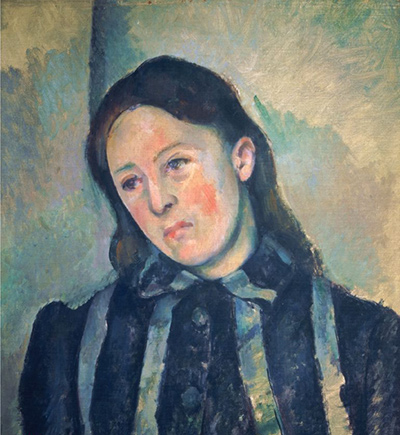
| Portrait of Madame Cezanne with Loosened Hair | 1885–86 | Painting |
| Portrait of the Artist Looking Over His Shoulder | 1883–84 | Painting |
| Portrait of the Gardener Vallier | 1906 | Painting |
| Portrait of Victor Chocquet | 1876–77 | Painting |
| Portrait Of Victor Chocquet Seated | 1877 | Painting |
| Provençal Manor | c.1885 | Painting |
| Pyramid of Skulls | 1898–1900 | Painting |
| Reclining Nude (Leda?) | c.1887 | Painting |
| Scipio | 1866–68 | Painting |
| Seated Man, Oslo | 1898–1900 | Painting |
| Seated Peasant | c.1892–96 | Painting |
| Seated Peasant, Hiroshima | c.1897 | Painting |
| Seated Peasant, Orsay | c.1900 | Painting |
| Self-Portrait | c. 1895 | Drawing |
| Self-Portrait in a Bowler Hat, Ny Carlsberg Glyptotek | 1885–86 | Painting |
| Self-Portrait in a Casquette | c.1875 | Painting |
| Self-Portrait with a Beret | 1898–1900 | Painting |
| Self-Portrait with a Hat, Artizon Museum | c.1890–94 | Painting |
| Self-Portrait with a Pink Background | c.1875 | Painting |
| Self-Portrait with Olive-Coloured Wallpaper | about 1880–81 | Painting |
| Self-Portrait with Palette | 1886–87 | Painting |
| Self-Portrait with White Turban | c.1878–80 | Painting |
| Self-Portrait, c.1895 | c.1895 | Painting |
| Self-Portrait, Pushkin Museum | c.1882 | Painting |
| Spanish Dancers | 1883/1886 | Drawing |
| Still Life with a Curtain | 1892–94 | Painting |
| Still Life with Apples | c.1890 | Painting |
| Still Life with Apples | 1893–94 | Painting |
| Still Life with Apples and a Pot of Primroses | about 1890 | Painting |
| Still Life with Milk Jug and Fruit | c.1900 | Painting |
| Still Life with Open Drawer | 1877–79 | Painting |
| Still Life with Plaster Cupid | about 1894 | Painting |
| Still Life with Skull | 1890–93 | Painting |
| Still Life with Soup Tureen | 1877 | Painting |
| Still Life, Pitcher and Fruit | 1893–94 | Painting |
| Studies Including a Straw Hat | 1895/1898 | Drawing |
| Studies Including Madame Cezanne | 1884/1887 | Drawing |
| Study for "The Judgement of Paris" or "The Amorous Shepherd" | 1883/1886 | Drawing |
| Study for Woman with a Coffee Pot | c.1895 | Painting |
| Study of "The Roman Orator (Germanicus)" | 1883/1886 | Drawing |
| Study of "Venus de Milo" | 1881/1884 | Drawing |
| Study of a Decorative Ornament | 1879/1882 | Drawing |
| Study of a Standing Male Figure after the Antique | c. 1895 | Drawing |
| Study of an Angel in Rubens' "The Prophet Elijah" | 1892/1895 | Drawing |
| Study of Desiderio da Settignano's "Bust of a Child" | c. 1895 | Drawing |
| Study of Houses | 1879/1882 | Drawing |
| Study of Puget's "Hercules Resting" | c. 1879 | Drawing |
| Study of Puget's "Milo of Crotona" | 1895/1898 | Drawing |
| Study of Puget's "Milo of Crotona" | 1880/1883 | Drawing |
| Study of the Allegorical Figure Bellona in Rubens' "The Apotheosis of Henri IV" | 1883/1886 | Drawing |
| Study of the Allegorical Figure Bellona in Rubens' "The Apotheosis of Henri IV" | 1879/1882 | Drawing |
| Study of the Allegorical Figure France in Rubens' "The Exchange of the Two Princesses" | 1882/1885 | Drawing |
| Study of the Allegorical Figure of Health in Rubens' "The Birth of Louis XIII" | 1880/1883 | Drawing |
| Study of the Allegorical Figure of the Genius of Health from Rubens' "The Birth of Louis XIII at Fontainbleau" | 1895/1898 | Drawing |
| Sugar Bowl, Pears and Blue Cup | 1865–66 | Painting |
| The Aqueduct, Pushkin Museum | Dating differs between museum records | Painting |
| The Artist's Father, Reading L'Evenement | autumn 1866 | Painting |
| The Artist's Son | c. 1887 | Drawing |
| The Artist's Son Leaning on his Elbow | c. 1887 | Drawing |
| The Artist's Son Reading | c. 1887 | Drawing |
| The Artist's Son Writing | c. 1887 | Drawing |
| The Artist’s Son, Paul | 1886–87 | Painting |
| The Avenue at Jas de Bouffan | 1868–70 (possibly later) | Painting |
| The Avenue at Jas de Bouffan, Geneva | c.1890 | Painting |
| The Basket of Apples | c.1893 | Painting |
| The Bather, Museum of Modern Art | c.1885 | Painting |
| The Bay of Marseille seen from L'Estaque | c.1885 | Painting |
| The Blue Vase | 1889–90 | Painting |
| The Boy in the Red Vest, Bührle | 1888–90 | Painting |
| The Buffet | 1877–79 | Painting |
| The Card Players, Barnes Foundation | 1890–92 | Painting |
| The Card Players, Courtauld Gallery | 1892–96 | Painting |
| The Card Players, Metropolitan Museum of Art | 1890–92 | Painting |
| The Card Players, Musée d’Orsay | 1893–96 | Painting |
| The Card Players, Qatar | 1892–96 | Painting |
| The Eternal Feminine | c.1877 | Painting |
| The Gardener Vallier | 1906 | Painting |
| The Gardener Vallier, Tate | 1905–06 | Painting |
| The Grounds of the Château Noir | c.1900–04 | Painting |
| The Gulf of Marseille Seen from L’Estaque | c.1885 | Painting |
| The Hanged Man's House in Auvers | c.1873 | Painting |
| The House of Doctor Gachet at Auvers | 1872–73 | Painting |
| The House with the Cracked Walls | 1892–94 | Painting |
| The Kiss of the Muse | c.1860 | Painting |
| The Large Bathers, Barnes Foundation | 1895–1906 | Painting |
| The Large Bathers, National Gallery | 1895–1905 | Painting |
| The Large Bathers, Philadelphia Museum of Art | 1900–06 | Painting |
| The Mill | 1889/1892 | Drawing |
| The Painter’s Father, Louis-Auguste Cézanne | c.1865 | Painting |
| The Peasant | 1890–92 | Painting |
| The Plaster Mill (La Moulin à plâtre) | 1889/1892 | Drawing |
| The Smoker, Hermitage | c.1891 | Painting |
| The Smoker, Mannheim | c.1891 | Painting |
| The Stove in the Studio | c.1865 | Painting |
| The Vase of Tulips | c.1890 | Painting |
| Thistle | 1893/1896 | Drawing |
| Three Heads, One of Madame Cezanne | 1882/1885 | Drawing |
| Three Skulls | c.1898 | Painting |
| Three Skulls on a Patterned Carpet | 1904 | Painting |
| Trees and Shrubs | 1883/1887 | Drawing |
| Turning Road at Montgeroult | 1898 | Painting |
| Two Bathers | 1884/1887 | Drawing |
| Two Heads | 1888 | Drawing |
| Two Heads | 1890/1896 | Drawing |
| Two Heads of Women | 1890/1894 | Drawing |
| Two Studies for "The Judgement of Paris" or "The Amorous Shepherd" | 1883/1886 | Drawing |
| Uncle Dominique in a Tasseled Cap | 1866 | Painting |
| Uncle Dominique in a Turban | 1866–67 | Painting |
| Victor Chocquet and an Angel for "The Apotheosis of Delacroix" | 1878/1880 | Drawing |
| Woman in Blue | c.1904 | Painting |
| Woman Leaning Forward | 1888/1891 | Drawing |
| Woman Leaning Forward | 1890/1894 | Drawing |
| Woman Leaning Forward | 1890/1894 | Drawing |
| Woman with a Coffee Pot | c.1895 | Painting |
| Women Bathers and a Roll of Paper | 1882/1885 | Drawing |
| Young Girl with a Doll | c.1895 | Painting |
| Young Italian Woman at a Table | c.1895–1900 | Painting |
| Young Man and Skull | 1896–98 | Painting |
Frequently Asked Questions
It belongs to the National Gallery of Art, Washington, DC, as accession 1992.51.9.sss in the Mellon Cézanne sketchbook. [1]
One sits at left; the other stands with his back toward the viewer and an arm raised. The drawing gives them no defined shoreline.
Discussion
Look again at the images and ideas explored in Two Bathers by Paul Cézanne. These editorial prompts invite your observations.
Reader Insights
Begin with the two heads. How much of their relationship comes from where they face, and how much do you supply from the gaps in the drawing?
Follow the standing figure’s back down to the feet, then return by way of the seated figure. Where does the loose contour make you slow down?
Let the written lines enter your view of the whole sheet. Do they make the pair seem smaller, or make the page feel more actively used?
Join the Conversation
Share a detail, comparison or question about Two Bathers by Paul Cézanne below.
References
- National Gallery of Art. “Two Bathers,” object record, accession 1992.51.9.sss. View source .
- Société Paul Cézanne. “Deux baigneurs et annotations,” The Paintings, Watercolors and Drawings of Paul Cezanne: An Online Catalogue Raisonné , FWN 3015-54b. View source .
- Charles S. Moffett, National Gallery of Art. “Sketchbook,” in Art for the Nation: Gifts in Honor of the 50th Anniversary of the National Gallery of Art (1991), p. 176. View source .
- Paul Smith. “Standing Bather, Seen from the Back,” in Cezanne Paintings and Watercolors at the Art Institute of Chicago (2026), cat. 3, paragraphs 3 and 11–13, fig. 3.5. View source .
- Société Paul Cézanne. “Brouillon de poème,” The Paintings, Watercolors and Drawings of Paul Cezanne: An Online Catalogue Raisonné , FWN 3015-55. View source .
- Le Baiser de la muse, d'après Frillié (FWN 572). View source.
- Louis-Auguste Cezanne, père de l'artiste, lisant L'Événement (FWN 402). View source.
- La Maison du pendu, Auvers-sur-Oise (FWN 81). View source.
- Une moderne Olympia (FWN 628). View source.
- Le Pont de Maincy (FWN 143). View source.
- La Montagne Sainte-Victoire vue de Montbriand (FWN 185). View source.
- Gardanne (vue horizontale) (FWN 224). View source.
- Le Vase bleu (FWN 823). View source.
- Les Joueurs de cartes (FWN 681). View source.
- La Montagne Sainte-Victoire (FWN 296). View source.
- La Corbeille de pommes (FWN 860). View source.
- Pommes et oranges (FWN 871). View source.
- Portrait d'Ambroise Vollard (FWN 531). View source.
- Philadelphia Museum of Art,The Large Bathers,W1937-1-1. View source.
- Château Noir (FWN 360). View source.
- Société Paul Cezanne,online catalogue structure and objectidentification. View source.
- National Gallery of Art,Cezanne Sketchbook,1992.51.9. View source.
- Splash image, Two figures beside handwritten notes.