



 by
Tom Gurney
Tom Gurney BSc (Hons) is an art history expert with over 20 years experience
Published on June 19, 2020 / Updated on October 22, 2026
Email:
tomgurney1@gmail.com
/ Phone:
+44 7429 011000
Curtain, Jug and Dish of Fruit by Paul Cézanne: Introduction
A dark blue curtain drops across the left edge of Cézanne’s Curtain, Jug and Dish of Fruit . Beside it stands a round grey jug. Across the table, a white cloth pitches forward, carrying fruit towards us; at the right, a shallow dish bears a remarkably high pile. The painting offers enough familiar things to make the scene legible at once, then makes their positions harder to settle. Does the dish rest securely on the table? Where does the cloth fold under the fruit, and where does it rise? The jug has a firm swelling body, yet a few green marks near the middle of the composition lack a fully defined object to contain them. These different degrees of solidity give the still life its energy. [1] [2] [3]
The painting is catalogued in French as Rideau, cruchon et compotier and dated 1893–94. It is an oil painting on canvas, 59 × 72.4 cm, now in the Kenneth C. Griffin Collection. The National Gallery in London lists it as Curtain, Jug and Dish of Fruit , reference L1345: that number identifies its institutional loan record for the same privately owned picture. The French compotier names the raised fruit dish, an object whose position is crucial to the picture’s precarious balance. [1] [2]
At a Glance
- Artist Paul Cézanne. [1]
- Title Curtain, Jug and Dish of Fruit ; catalogue title Rideau, cruchon et compotier . [1] [2]
- Date 1893–94, the dating used by the current catalogue and the National Gallery. [1] [2]
- Medium and size Oil on canvas, 59 × 72.4 cm. [1]
- Collection Kenneth C. Griffin Collection; recorded by the National Gallery, London, as L1345. [1] [2]
- Catalogue identity FWN 854; Rewald 739; Venturi 601. [1]
This work across Paul Cézanne’s career
The Kiss of the Muse
c.1860The Artist’s Father, Reading L’Événement
autumn 1866The Hanged Man’s House
c.1873A Modern Olympia
1873–74Maincy Bridge
1879–80The Blue Vase
1889–90The Basket of Apples
c.1893Apples and Oranges
c.1899The Large Bathers (Philadelphia)
1900–1906 (Philadelphia Museum dating)Château Noir (MoMA)
1903–04Contents
- A still life held together by the jug
- The surface under examination
- One jug, several distinct paintings
- A painting that moved through collections
- Annotated details
A still life held together by the jug
From curtain to fruit dish
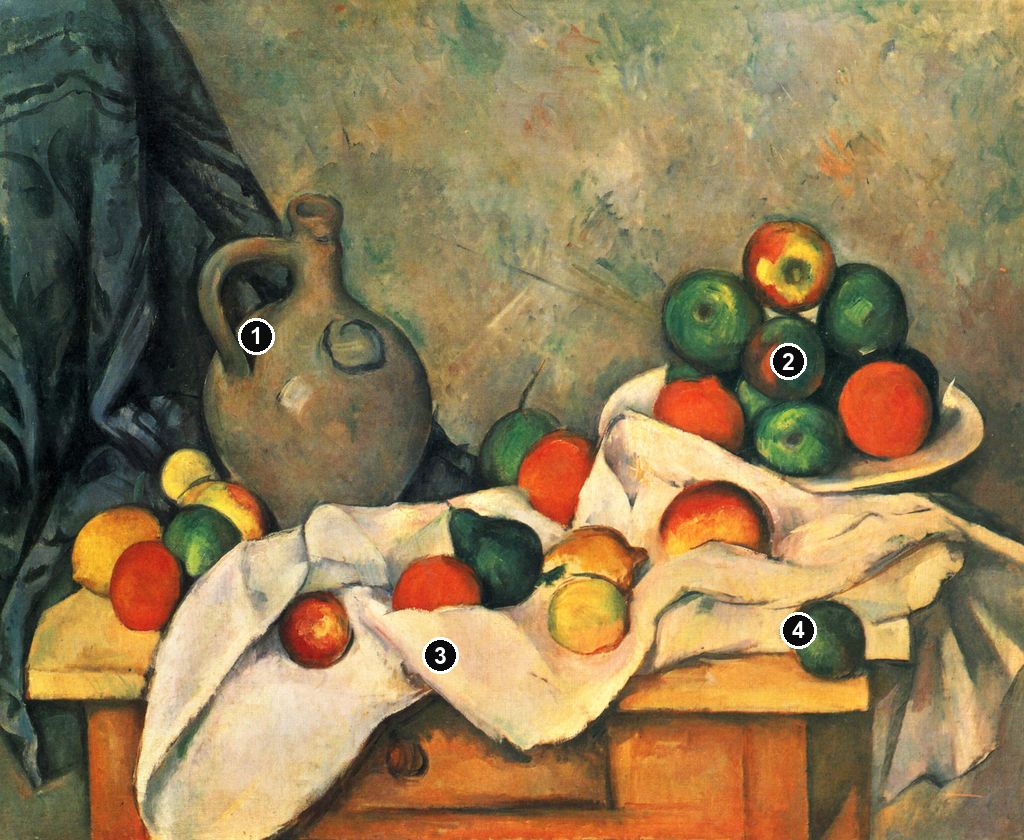
The curtain forms a deep, cool boundary on the left. Its folds and pattern are substantial enough to feel like fabric, but its dark mass also gives the pale wall and bright fruit a place to push against. A small cluster of fruit sits low beside it, partly on the exposed wooden surface. Higher up, the jug’s handle curls against the dark cloth; the body spreads into the lighter centre, where grey, tan, green and blue touches describe its rounded volume. At the far right, green and red fruit accumulate above a low white rim. This sequence moves the eye across the canvas through changes of weight and colour: dark vertical fabric, solid vessel, tumbling white cloth, concentrated fruit. [3] [4]
The jug is quiet beside the saturated oranges and greens, but quiet does not mean colourless. Art historian Paul Smith identifies the kind of vessel as Betschdorf stoneware, with a cobalt-blue spiral, and describes how warm and cool paint touches make its apparently neutral body respond to the colours around it. He illustrates a comparable jug, dated around 1900; the photographed example has not been established as an object Cézanne owned. His observation is most useful when looking at this painted vessel itself: its grey is built from changing colours and looks more unified as the eye steps back. [5]
The Fondation Beyeler’s guide to its 2026 exhibition reads the jug as the composition’s most stable form. Its account draws attention to the improbable drape of the cloth and the dish that seems ready to tip, while the vessel retains a carefully modelled presence. The stability is relative. The jug appears to lean slightly, and its rounded base is not pinned to the table by a hard outline. Yet against the disrupted support of the dish and the steep folds below it, the vessel gives the eye a place to return. [3] [2]
What supports the fruit?
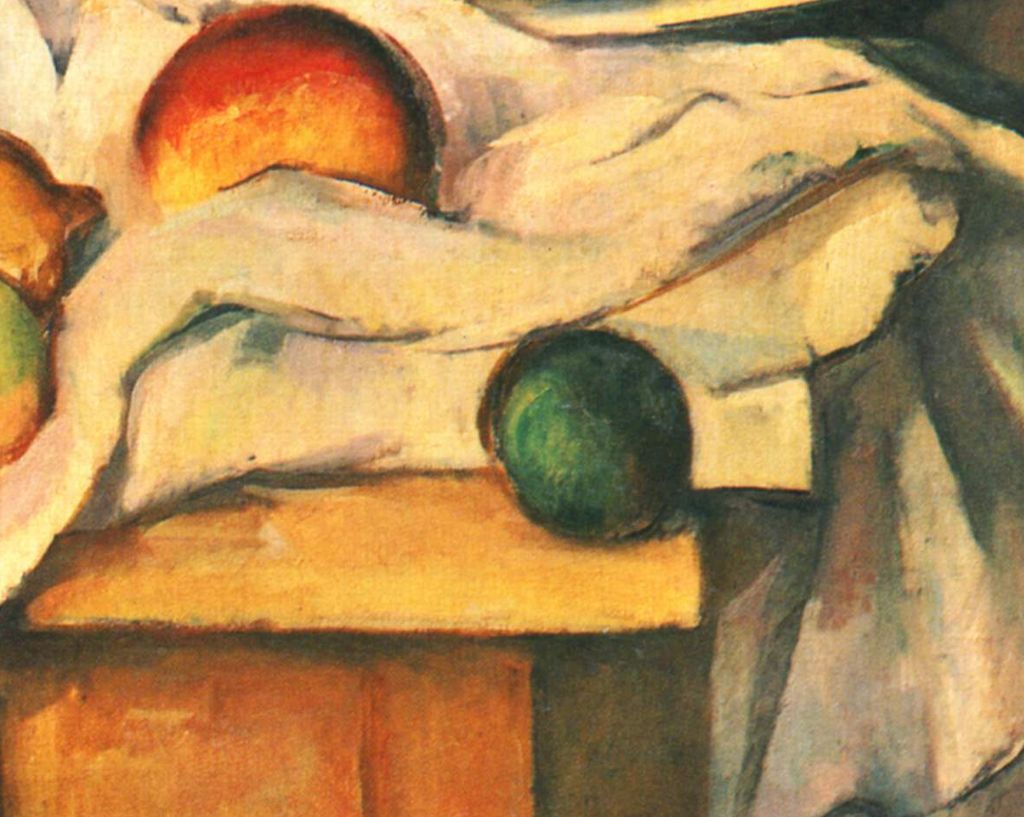
Across the front, the cloth does more than decorate the table. Its nearest fold crosses the drawer front in a broad diagonal, turning a piece of fabric into a strong direction through the painting. A red fruit sits low on the left fold; another green one seems lodged in the cloth near the centre. At the right, a separate green fruit lies at the edge where cloth, table and foreground compete for space. Each has a local position, but no single, uninterrupted tabletop plane accounts easily for all of them. The visible drawer front supplies a solid piece of furniture, while the cloth breaks up the surface that furniture ought to support. [2] [3]
The National Gallery describes several effects of unstable support: fruit in the foreground seems to hover on the folds, the laden dish appears unusually high, and the jug seems slanted. It proposes that the different treatments of the objects may bring several moments or perspectives of looking into one picture. That is a persuasive way to experience the painting, but it is an interpretation of the visible result, not a documented record of the order in which Cézanne observed or painted each item. The dislocations matter because they coexist with convincing local forms. A piece of fruit can feel round and weighty even where the larger arrangement refuses to lock into a neat diagram. [2]
The raised dish is the most dramatic test. Its rim reads as a shallow oval beneath the fruit, curving up at the right and partly disappearing behind the pile. The white of the dish meets the white cloth below it, so its base is harder to separate from its support than its rim is from the fruit. Red and green rounds are stacked into a compact crown, but one or two at the front seem to press forward beyond a comfortably secure edge. A viewer can read a plausible tabletop arrangement, then lose confidence in the precise place where the dish meets the table. [3] [4]
The surface under examination
An unresolved green passage
Technical study of this very canvas makes the contrast between resolved and unresolved passages unusually concrete. In the centre, between the jug and the dish, researchers at the Art Institute of Chicago found a few disconnected green brushstrokes whose form was never fully developed. They propose several possible readings: a piece of fruit, an earlier position for the green pear just to the left, or something else. They cannot determine which. Their close examination shows that the surrounding area was reserved, while the adjoining lemon was only partly realised. The green marks therefore remain visible within the composition, although they never acquire an agreed name. [4]
The piled fruit at the upper right is worked densely, with successive strokes covering the ground layer even in the spaces between the fruit. Against it, the central green marks remain tentative. The nearby lemon, discernible by colour and position yet thinly specified, sits between those extremes. The three passages let us see very different levels of definition in one painting. [4]
At the lower right edge of the dish, microscopy found a fruit that was first painted a vivid reddish orange. Cézanne then covered part of it with dark green, leaving the emerging edge in shadow. The researchers argue that this change helps ground the pile and its white dish, which otherwise seem to float beyond the table surface. An initially bright fruit became a darker counterweight, revising the apparent balance of the image. [4]
The wall is active paint
From a distance the backdrop can look like a muted, almost neutral wall. Up close it is a field of blue, green, red and ochre touches, ranging from short crossings to larger zigzags. In ultraviolet-induced luminescence images, some strokes shine bright orange; together with hyperspectral imaging, this is consistent with a plant-derived red lake, likely madder. In ordinary viewing, those strokes contribute to a complex overall hue rather than declaring themselves as a separate red pattern. [4]
The wall therefore does visual work. Its colours recur around the fruit, jug and curtain, giving an active setting to objects that might otherwise seem isolated against a flat backdrop. This is what the Beyeler guide means when it calls attention to the wall as a composition of brushstrokes in its own right. The pale ground is also a useful foil for the dark curtain: where one side of the painting closes behind the jug, the other opens behind the raised dish. The background does not offer architectural clues to fix the table in a room. It holds the still life together through colour and touch. [3] [4]
The central marks sit in paint that the examination shows to be reserved around them. Elsewhere, even narrow spaces between apples are dense with colour. Seen close, these passages have different textures as well as different degrees of definition: separate green touches in one place, overlapping layers in the other. [4]
Annotated Details from Curtain, Jug and Fruit
The numbered points identify visible features discussed in this article. Return from each detail to the whole composition. Paul Cézanne, Curtain, Jug and Fruit Image source. Public domain.
Details from CURTAIN, JUG AND FRUIT
Compare the cropped details with the complete images above. Notice how their colours, shapes and positions contribute to the larger compositions.
Curtain and decorated jug
The dark folded curtain meets the broad jug, whose blue loop-like decoration repeats the handle’s curve.
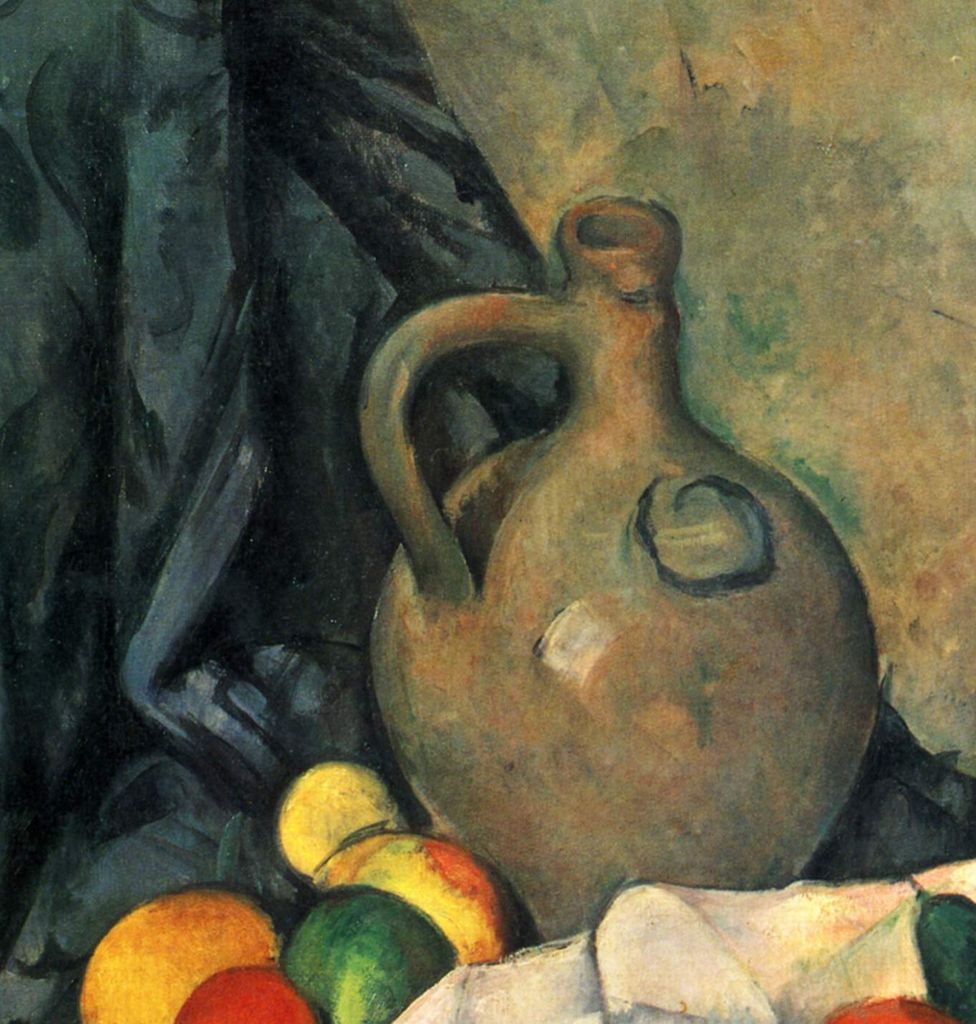
Fruit stacked in a white dish
Rounded green and red forms rise in a compact pile. The pale rim below them turns sharply upward on the right.
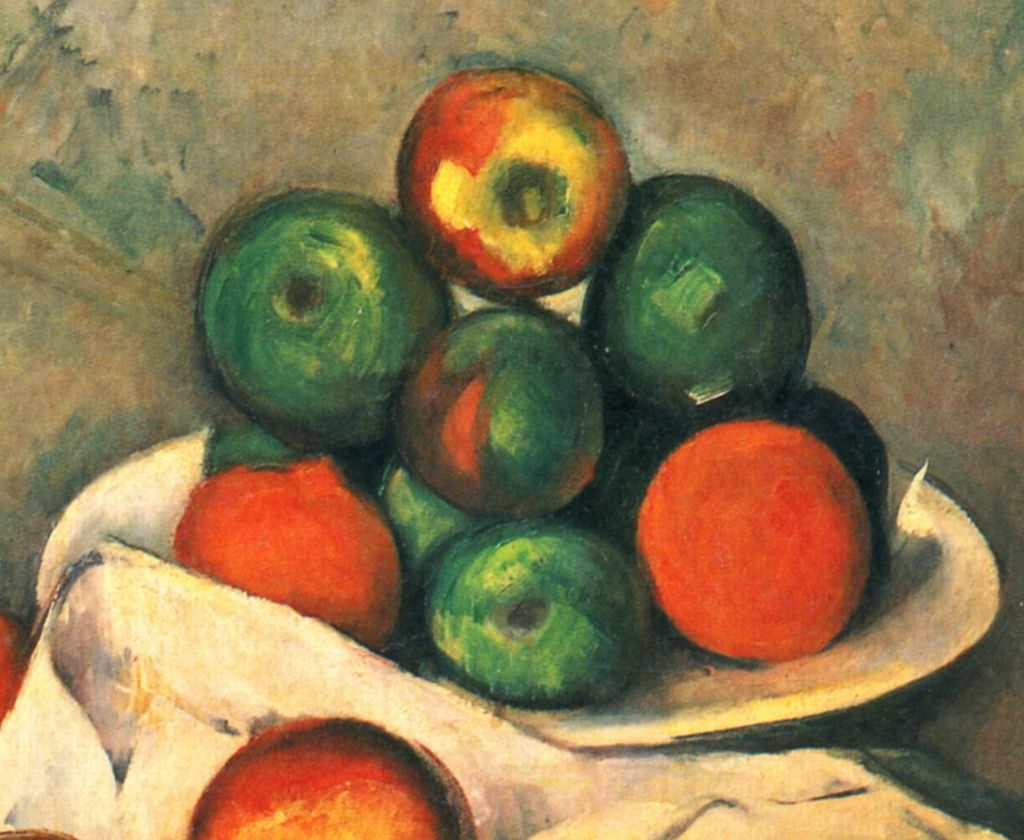
Cloth crossing the drawer
Broad white folds descend over the furniture and partly conceal its drawer. Blue-grey lines divide the cloth into changing planes.
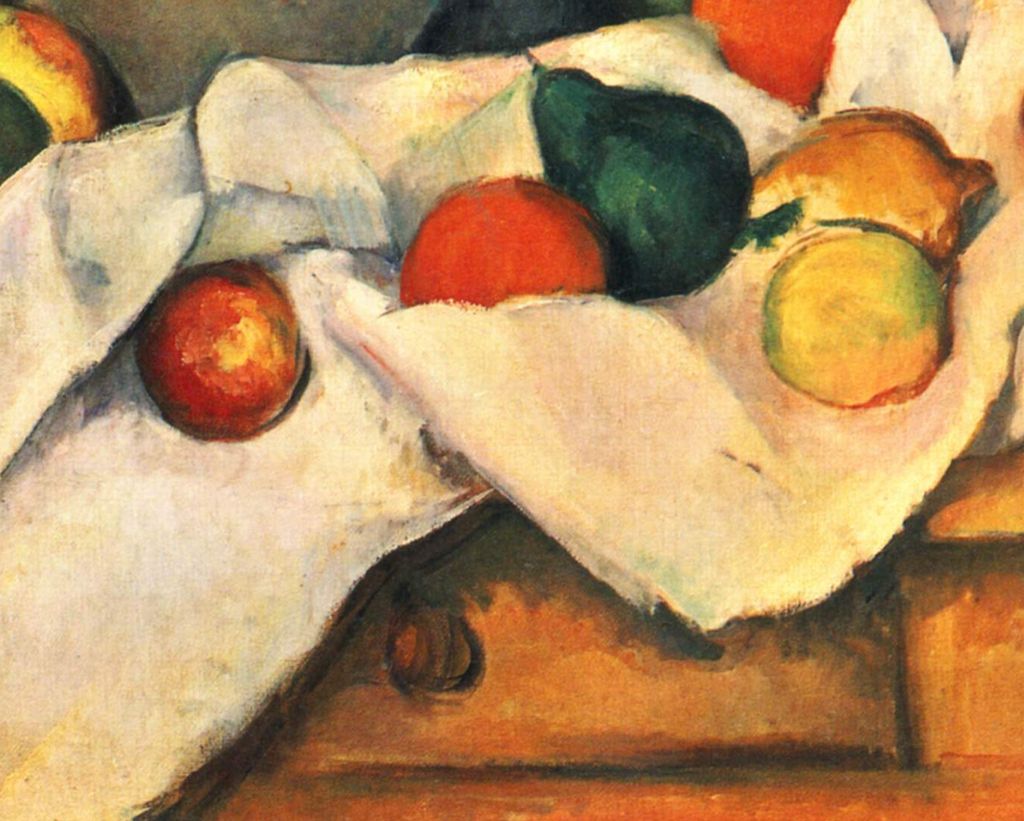
Fruit at the table edge
A green fruit sits close to the exposed wooden edge. Compare its dark contour with the nearby folded cloth and the slant of the tabletop.
One jug, several distinct paintings
Cézanne returned to fruit, cloth, dishes and a grey jug in related still lifes. The Fondation Beyeler displayed a smaller arrangement with a jug and fruit near this canvas in 2026; its room guide invites comparison of how familiar objects take different positions and degrees of finish. In Curtain, Jug and Dish of Fruit , the curtain anchors the left, the white cloth spills over the front, and the fruit dish rises on the right. [3] [1]
A particularly useful comparison appears in Sotheby’s 2010 catalogue essay for Pichet et fruits sur une table . That separate painting is on paper laid down on panel, with a longer, lower format. Sotheby’s points to a decisive difference: its objects sit directly on the wooden tabletop, without the broad white cloth that carries so much of the composition here. The recurrent jug and fruit thus occupy sharply different structures. [6] [1]
The catalogue raisonné lists this picture as FWN 854, with Rewald number 739 and Venturi number 601. Its alternate English titles include Curtain, Jug and Compotier and Curtain, Pitcher, and Compotier . The National Gallery’s Curtain, Jug and Dish of Fruit names the same canvas under its record L1345. Other jug and fruit paintings carry different catalogue numbers. [1] [2]
The current catalogue and National Gallery both date the painting 1893–94. The catalogue also records broader earlier and revised datings, including Venturi’s revised 1893–95. That difference leaves a margin around its year of execution within a group of closely related studio paintings. [1] [2]
A painting that moved through collections
The catalogue traces the canvas from the Paris dealer Ambroise Vollard to Cornelis Hoogendijk in Amsterdam, then to Paul Rosenberg in 1920. In July of that year Albert C. Barnes acquired it; it was later held by the Barnes Foundation. Through New York dealers in 1950 it passed to John Hay Whitney and his family. Its subsequent chain includes Steven Wynn and the present Kenneth C. Griffin Collection. This route matters because the picture was seen, discussed and reproduced in different settings long before its London loan record. It also explains why a past caption naming Barnes or Whitney is historical provenance rather than evidence of present ownership. [1]
Herbert Henkels’s archival study of Hoogendijk’s collection illustrates this picture under its Venturi number 601. His account describes a larger moment in 1920: 27 Cézannes from the former Hoogendijk collection were withdrawn from the Rijksmuseum’s care and moved through dealers to Paris; thirteen were sold to Barnes. The catalogue raisonné separately places this canvas in the Hoogendijk–Rosenberg–Barnes chain. The painting’s passage from Amsterdam access to a series of separate private collections becomes part of its viewing history. [7] [1]
The exhibition record shows how often a privately owned work has entered public view. It appeared in a Museum of Modern Art selection of New York private collections in 1951, in the Chicago and Metropolitan Museum of Art Cézanne loan exhibition in 1952, and in the major 1995–96 Cézanne survey in Paris, London and Philadelphia. More recently it was included in the Art Institute of Chicago and Tate Modern exhibition of 2022–23 and at the Fondation Beyeler in 2026. Each occasion offers a different context for looking; none changes the owner named in the current catalogue. [1] [3]
The catalogue lists the canvas at Sotheby’s New York on 10 May 1999, with the sale marked cancelled. It later belonged to Wynn and is now recorded in the Griffin Collection. The National Gallery’s L1345 record identifies that privately owned canvas in London. [1] [2]
Cézanne artworks directory
Browse 217 identified works in this researched selection, including paintings, drawings and watercolours. This is a bounded selection, not a complete catalogue of Cézanne’s surviving oeuvre. Unlinked titles have no confirmed article in this collection.
| Name | Date | Medium |
|---|---|---|
| A Head, a Cup, and a Bread Roll | 1891/1894 | Drawing |
| A Man seen from Behind | 1880/1883 | Drawing |
| A Modern Olympia | 1873–74 | Painting |
| A Nude and Foliage | 1879/1882 | Drawing |
| A Smoking Man | 1892–96 (catalogue); c.1890–92 (museum) | Drawing |
| Afternoon in Naples | 1876–77 | Painting |
| An Old Woman with a Rosary | about 1895–96 | Painting |
| Apples and Oranges | c.1899 | Painting |
| Auvers, Panoramic View | 1873–75 | Painting |
| Avenue at Chantilly | 1888 | Painting |
| Banks of the Marne | 1888–94 | Painting |
| Basket | 1877/1900 | Drawing |
| Bather with Outstretched Arms | 1877–78 | Painting |
| Bellows in Front of a Fireplace | 1887/1892 | Drawing |
| Bibémus Quarry | c.1895 | Painting |
| Boy in a Red Vest, Barnes Foundation | 1888–90 | Painting |
| Boy in a Red Vest, MoMA | 1888–90 | Painting |
| Boy in a Red Waistcoat, National Gallery of Art | 1888–90 | Painting |
| Branch in Flower | 1886/1889 | Drawing |
| Carnival Scene | 1885/1888 | Drawing |
| Chair and Dresser | 1880/1883 | Drawing |
| Chateau Noir | 1903–04 | Painting |
| Chestnut Trees and Farm at Jas de Bouffan | c.1885 | Painting |
| Chestnut Trees and Farm at Jas de Bouffan, Pushkin | c.1886 | Painting |
| Chestnut Trees at Jas de Bouffan in Winter | 1885–86 | Painting |
| Château Noir | 1900–04 | Painting |
| Cistern in the Park of Château Noir | c.1900 | Painting |
| Curtain, Jug and Fruit | 1893–94 | Painting |
| Cushion of an Armchair | 1886/1889 | Drawing |
| Draft Letter and Studies of Bathers | c.1878 | Drawing |
| Farmhouse and Chestnut Trees at Jas de Bouffan | 1884–85 | Painting |
| Figure Resting Head on Hand | c. 1889 | Drawing |
| Fireplace Tongs and Poker | 1887/1892 | Drawing |
| Forest Interior, San Francisco | c.1898–99 | Painting |
| Four Bathers | 1888–90 | Painting |
| Fruit and a Jug on a Table | 1893–94 | Painting |
| Gardanne | 1885–86 | Painting |
| Gardanne, Barnes Foundation | c.1885 | Painting |
| Hand and Shoulder of a Boy | c. 1885 | Drawing |
| Harlequin, National Gallery of Art | 1888–90 | Painting |
| Head of a Boy | 1887/1889 | Drawing |
| Head of a Boy Seen from Behind | c. 1885 | Drawing |
| Head of a Young Woman | c. 1880 | Drawing |
| Head of the Artist's Son | 1888/1889 | Drawing |
| Hillside in Provence | c.1890–92 | Painting |
| Horse Chestnut Trees at Jas de Bouffan | c.1885 | Painting |
| House and Farm at the Jas de Bouffan | c.1887 | Painting |
| House in a Park | 1883/1886 | Drawing |
| House in Provence | c.1885 | Painting |
| House of Père Lacroix | 1873 | Painting |
| House Surrounded by Vegetation | 1889/1892 | Drawing |
| Houses in Provence The Riaux Valley near L’Estaque | c.1883 | Painting |
| Jas de Bouffan, the Pool | c.1876 | Painting |
| Kerosene Lamp | 1878/1881 | Drawing |
| L'Estaque, Melting Snow | c.1870 | Painting |
| Lake Annecy | 1896 | Painting |
| Landscape in Provence, Pola Museum | 1879–82 | Painting |
| Landscape Near Aix-en-Provence | 1877/1880 | Drawing |
| Landscape Seen from the Inside of a Cave | 1889/1892 | Drawing |
| Landscape with Poplars | c.1885–87 | Painting |
| Landscape with Trees | 1895/1898 | Drawing |
| Leda and the Swan | c.1880 (possibly later) | Painting |
| Little Girl with a Doll | 1902–04 | Painting |
| Louis Guillaume | 1879–1890 | Painting |
| Madame Cezanne | 1888/1891 | Drawing |
| Madame Cezanne | 1886/1889 | Drawing |
| Madame Cezanne | 1882/1887 | Drawing |
| Madame Cezanne | 1897/1900 | Drawing |
| Madame Cezanne with her Head Lowered | 1893/1896 | Drawing |
| Madame Cézanne in a Red Armchair | c.1877 | Painting |
| Madame Cézanne in a Red Dress, Metropolitan Museum of Art | 1888–90 | Painting |
| Madame Cézanne in a Yellow Chair | 1888–90 | Painting |
| Madame Cézanne in a Yellow Chair, Fondation Beyeler | 1888–90 | Painting |
| Madame Cézanne in the Conservatory | 1891 | Painting |
| Maincy Bridge | 1879–80 | Painting |
| Maison Maria with a View of Château Noir | c.1895 | Painting |
| Man Bending Forward | 1883/1886 | Drawing |
| Man Smoking a Pipe, Pushkin | c.1891, possibly later | Painting |
| Man with a Pipe | 1891–96 | Painting |
| Man with a Pipe, Nelson-Atkins | 1890–92 | Painting |
| Man with a Straw Hat (Gustave Boyer) | c.1871 | Painting |
| Man with Crossed Arms | c.1899 | Painting |
| Man with Pipe, National Gallery of Art | 1892–96 | Painting |
| Mont Sainte-Victoire | c.1902–06 | Painting |
| Mont Sainte-Victoire | 1900–02 | Painting |
| Mont Sainte-Victoire (recto) | c.1895 | Watercolour |
| Mont Sainte-Victoire and the Viaduct of the Arc River Valley | 1882–85 | Painting |
| Mont Sainte-Victoire Seen beyond the Wall of the Jas de Bouffan | c.1885/1888 | Watercolour |
| Mont Sainte-Victoire Seen from Bibémus Quarry | c.1897 | Painting |
| Mont Sainte-Victoire, Barnes Foundation | 1892–95 | Painting |
| Near the Pool at Jas de Bouffan | 1883/1887 | Drawing |
| Pelicans | 1877/1880 | Drawing |
| Peonies | 1890/1893 | Drawing |
| Pierrot and Harlequin | 1888 | Painting |
| Pine Tree | 1882/1885 | Drawing |
| Pont des Trois Sautets | 1906 | Watercolour |
| Poplars | 1879–80 | Painting |
| Portrait of Ambroise Vollard | 1899 | Painting |
| Portrait of Gustave Geffroy | 1895–96 | Painting |
| Portrait of Madame Cezanne with Loosened Hair | 1885–86 | Painting |
| Portrait of the Artist Looking Over His Shoulder | 1883–84 | Painting |
| Portrait of the Gardener Vallier | 1906 | Painting |
| Portrait of Victor Chocquet | 1876–77 | Painting |
| Portrait Of Victor Chocquet Seated | 1877 | Painting |
| Provençal Manor | c.1885 | Painting |
| Pyramid of Skulls | 1898–1900 | Painting |
| Reclining Nude (Leda?) | c.1887 | Painting |
| Scipio | 1866–68 | Painting |
| Seated Man, Oslo | 1898–1900 | Painting |
| Seated Peasant | c.1892–96 | Painting |
| Seated Peasant, Hiroshima | c.1897 | Painting |
| Seated Peasant, Orsay | c.1900 | Painting |
| Self-Portrait | c. 1895 | Drawing |
| Self-Portrait in a Bowler Hat, Ny Carlsberg Glyptotek | 1885–86 | Painting |
| Self-Portrait in a Casquette | c.1875 | Painting |
| Self-Portrait with a Beret | 1898–1900 | Painting |
| Self-Portrait with a Hat, Artizon Museum | c.1890–94 | Painting |
| Self-Portrait with a Pink Background | c.1875 | Painting |
| Self-Portrait with Olive-Coloured Wallpaper | about 1880–81 | Painting |
| Self-Portrait with Palette | 1886–87 | Painting |
| Self-Portrait with White Turban | c.1878–80 | Painting |
| Self-Portrait, c.1895 | c.1895 | Painting |
| Self-Portrait, Pushkin Museum | c.1882 | Painting |
| Spanish Dancers | 1883/1886 | Drawing |
| Still Life with a Curtain | 1892–94 | Painting |
| Still Life with Apples | c.1890 | Painting |
| Still Life with Apples | 1893–94 | Painting |
| Still Life with Apples and a Pot of Primroses | about 1890 | Painting |
| Still Life with Milk Jug and Fruit | c.1900 | Painting |
| Still Life with Open Drawer | 1877–79 | Painting |
| Still Life with Plaster Cupid | about 1894 | Painting |
| Still Life with Skull | 1890–93 | Painting |
| Still Life with Soup Tureen | 1877 | Painting |
| Still Life, Pitcher and Fruit | 1893–94 | Painting |
| Studies Including a Straw Hat | 1895/1898 | Drawing |
| Studies Including Madame Cezanne | 1884/1887 | Drawing |
| Study for "The Judgement of Paris" or "The Amorous Shepherd" | 1883/1886 | Drawing |
| Study for Woman with a Coffee Pot | c.1895 | Painting |
| Study of "The Roman Orator (Germanicus)" | 1883/1886 | Drawing |
| Study of "Venus de Milo" | 1881/1884 | Drawing |
| Study of a Decorative Ornament | 1879/1882 | Drawing |
| Study of a Standing Male Figure after the Antique | c. 1895 | Drawing |
| Study of an Angel in Rubens' "The Prophet Elijah" | 1892/1895 | Drawing |
| Study of Desiderio da Settignano's "Bust of a Child" | c. 1895 | Drawing |
| Study of Houses | 1879/1882 | Drawing |
| Study of Puget's "Hercules Resting" | c. 1879 | Drawing |
| Study of Puget's "Milo of Crotona" | 1895/1898 | Drawing |
| Study of Puget's "Milo of Crotona" | 1880/1883 | Drawing |
| Study of the Allegorical Figure Bellona in Rubens' "The Apotheosis of Henri IV" | 1883/1886 | Drawing |
| Study of the Allegorical Figure Bellona in Rubens' "The Apotheosis of Henri IV" | 1879/1882 | Drawing |
| Study of the Allegorical Figure France in Rubens' "The Exchange of the Two Princesses" | 1882/1885 | Drawing |
| Study of the Allegorical Figure of Health in Rubens' "The Birth of Louis XIII" | 1880/1883 | Drawing |
| Study of the Allegorical Figure of the Genius of Health from Rubens' "The Birth of Louis XIII at Fontainbleau" | 1895/1898 | Drawing |
| Sugar Bowl, Pears and Blue Cup | 1865–66 | Painting |
| The Aqueduct, Pushkin Museum | Dating differs between museum records | Painting |
| The Artist's Father, Reading L'Evenement | autumn 1866 | Painting |
| The Artist's Son | c. 1887 | Drawing |
| The Artist's Son Leaning on his Elbow | c. 1887 | Drawing |
| The Artist's Son Reading | c. 1887 | Drawing |
| The Artist's Son Writing | c. 1887 | Drawing |
| The Artist’s Son, Paul | 1886–87 | Painting |
| The Avenue at Jas de Bouffan | 1868–70 (possibly later) | Painting |
| The Avenue at Jas de Bouffan, Geneva | c.1890 | Painting |
| The Basket of Apples | c.1893 | Painting |
| The Bather, Museum of Modern Art | c.1885 | Painting |
| The Bay of Marseille seen from L'Estaque | c.1885 | Painting |
| The Blue Vase | 1889–90 | Painting |
| The Boy in the Red Vest, Bührle | 1888–90 | Painting |
| The Buffet | 1877–79 | Painting |
| The Card Players, Barnes Foundation | 1890–92 | Painting |
| The Card Players, Courtauld Gallery | 1892–96 | Painting |
| The Card Players, Metropolitan Museum of Art | 1890–92 | Painting |
| The Card Players, Musée d’Orsay | 1893–96 | Painting |
| The Card Players, Qatar | 1892–96 | Painting |
| The Eternal Feminine | c.1877 | Painting |
| The Gardener Vallier | 1906 | Painting |
| The Gardener Vallier, Tate | 1905–06 | Painting |
| The Grounds of the Château Noir | c.1900–04 | Painting |
| The Gulf of Marseille Seen from L’Estaque | c.1885 | Painting |
| The Hanged Man's House in Auvers | c.1873 | Painting |
| The House of Doctor Gachet at Auvers | 1872–73 | Painting |
| The House with the Cracked Walls | 1892–94 | Painting |
| The Kiss of the Muse | c.1860 | Painting |
| The Large Bathers, Barnes Foundation | 1895–1906 | Painting |
| The Large Bathers, National Gallery | 1895–1905 | Painting |
| The Large Bathers, Philadelphia Museum of Art | 1900–06 | Painting |
| The Mill | 1889/1892 | Drawing |
| The Painter’s Father, Louis-Auguste Cézanne | c.1865 | Painting |
| The Peasant | 1890–92 | Painting |
| The Plaster Mill (La Moulin à plâtre) | 1889/1892 | Drawing |
| The Smoker, Hermitage | c.1891 | Painting |
| The Smoker, Mannheim | c.1891 | Painting |
| The Stove in the Studio | c.1865 | Painting |
| The Vase of Tulips | c.1890 | Painting |
| Thistle | 1893/1896 | Drawing |
| Three Heads, One of Madame Cezanne | 1882/1885 | Drawing |
| Three Skulls | c.1898 | Painting |
| Three Skulls on a Patterned Carpet | 1904 | Painting |
| Trees and Shrubs | 1883/1887 | Drawing |
| Turning Road at Montgeroult | 1898 | Painting |
| Two Bathers | 1884/1887 | Drawing |
| Two Heads | 1888 | Drawing |
| Two Heads | 1890/1896 | Drawing |
| Two Heads of Women | 1890/1894 | Drawing |
| Two Studies for "The Judgement of Paris" or "The Amorous Shepherd" | 1883/1886 | Drawing |
| Uncle Dominique in a Tasseled Cap | 1866 | Painting |
| Uncle Dominique in a Turban | 1866–67 | Painting |
| Victor Chocquet and an Angel for "The Apotheosis of Delacroix" | 1878/1880 | Drawing |
| Woman in Blue | c.1904 | Painting |
| Woman Leaning Forward | 1888/1891 | Drawing |
| Woman Leaning Forward | 1890/1894 | Drawing |
| Woman Leaning Forward | 1890/1894 | Drawing |
| Woman with a Coffee Pot | c.1895 | Painting |
| Women Bathers and a Roll of Paper | 1882/1885 | Drawing |
| Young Girl with a Doll | c.1895 | Painting |
| Young Italian Woman at a Table | c.1895–1900 | Painting |
| Young Man and Skull | 1896–98 | Painting |
Frequently Asked Questions
The current catalogue names the Kenneth C. Griffin Collection as the holder. The National Gallery, London, lists the same painting under reference L1345 and credits that collection. L1345 is an institutional record for the privately owned canvas, not a second Cézanne painting or evidence that the Gallery owns it. [1] [2]
It might be. Researchers studying this canvas also consider an independent piece of fruit or something else. They cannot identify the intended form with certainty; the marks remain visible beside an only partly developed lemon. [4]
Discussion
Look again at the images and ideas explored in Curtain, Jug and Dish of Fruit by Paul Cézanne. These editorial prompts invite your observations.
Reader Insights
Follow the white cloth from the left fold over the drawer to the dish. At which point does it help you understand the table, and at which point does it make the table harder to picture?
Look first at the jug from a distance, then closer. How many colours can you find inside what initially reads as grey?
Compare the few green marks beside the lemon with the dense fruit pile at the right. What does each degree of finish ask you to supply for yourself?
Join the Conversation
Share a detail, comparison or question about Curtain, Jug and Dish of Fruit by Paul Cézanne below.
References
- Société Paul Cezanne , “ Rideau, cruchon et compotier , 1893–94 (FWN 854),” The Paintings, Watercolors and Drawings of Paul Cezanne: An Online Catalogue Raisonné . View source .
- The National Gallery, London , “Paul Cezanne, Curtain, Jug and Dish of Fruit ,” collection record L1345. View source .
- Fondation Beyeler , Cezanne: Exhibition Room Guide (2026), room 2, p. 8. View source .
- Kimberly Muir, Kristi Dahm, Giovanni Verri, Maria Kokkori and Clara Granzotto , “A Harmony Parallel to Nature: Color, Form, and Space in Cezanne’s Watercolors and Oil Paintings,” in Cezanne (Art Institute of Chicago exhibition catalogue, 2022), especially PDF pp. 10–12, 20–22 and note 38; article posted online in 2025. View source .
- Paul Smith , “Looking Slowly with Cezanne,” The Burlington Magazine 165, no. 1441 (April 2023), pp. 422–435, especially p. 429. View source .
- Sotheby’s , “Paul Cézanne, Pichet et fruits sur une table ,” Impressionist and Modern Art Evening Sale , London, 2010, lot 5. View source .
- Herbert Henkels , “Cézanne en Van Gogh in het Rijksmuseum voor Moderne Kunst in Amsterdam: de collectie van Cornelis Hoogendijk (1866–1911),” Bulletin van het Rijksmuseum 41, nos. 3–4 (1993), pp. 155–287, especially pp. 185, 266–267 and fig. 45 (in Dutch). View source .
- Le Baiser de la muse, d'après Frillié (FWN 572). View source.
- Louis-Auguste Cezanne, père de l'artiste, lisant L'Événement (FWN 402). View source.
- La Maison du pendu, Auvers-sur-Oise (FWN 81). View source.
- Une moderne Olympia (FWN 628). View source.
- Le Pont de Maincy (FWN 143). View source.
- La Montagne Sainte-Victoire vue de Montbriand (FWN 185). View source.
- Gardanne (vue horizontale) (FWN 224). View source.
- Le Vase bleu (FWN 823). View source.
- Les Joueurs de cartes (FWN 681). View source.
- La Montagne Sainte-Victoire (FWN 296). View source.
- La Corbeille de pommes (FWN 860). View source.
- Pommes et oranges (FWN 871). View source.
- Portrait d'Ambroise Vollard (FWN 531). View source.
- Philadelphia Museum of Art,The Large Bathers,W1937-1-1. View source.
- Château Noir (FWN 360). View source.
- Société Paul Cezanne,online catalogue structure and objectidentification. View source.
- National Gallery of Art,Cezanne Sketchbook,1992.51.9. View source.
- Splash image, Paul Cézanne, Curtain, Jug and Dish of Fruit (Rideau, cruchon et compotier), 1893–94, oil on canvas, 59 × 72.4 cm, Kenneth C. Griffin Collection (FWN 854).


