 by
Tom Gurney
Tom Gurney BSc (Hons) is an art history expert with over 20 years experience
Published on June 19, 2020 / Updated on October 22, 2026
Email:
tomgurney1@gmail.com
/ Phone:
+44 7429 011000
Bather with Outstretched Arms by Paul Cézanne: Introduction
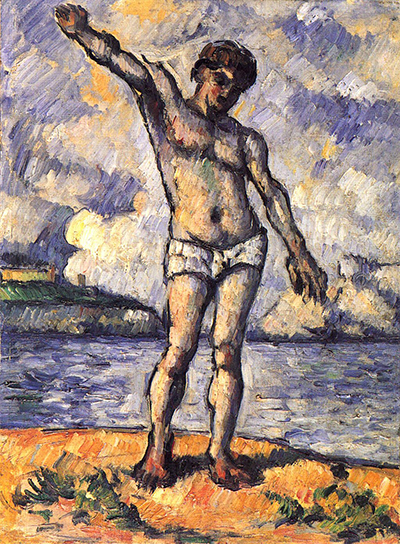
A man stands at the edge of water with one arm lifted toward the top corner of a small canvas. His other arm hangs outward, his head tips down, and his feet remain planted on a strip of orange shore. The reach looks expansive, yet the body is hemmed in by the picture's edges. Cézanne has made a figure that seems both ready to move and oddly fixed in place.
The online Cézanne catalogue identifies this painting as Baigneur aux bras écartés , FWN 913, and dates it to 1877–78. The title Bather with Outstretched Arms has also appeared in English. The Metropolitan Museum's 1997 catalogue reproduces the same canvas as entry 111. [1] [2]
At a Glance
- Artist Paul Cézanne. [1]
- Date 1877–78 in the current online catalogue; older publications propose later dates. [1]
- Medium and size Oil on canvas, 33 × 24 cm. [1]
- Identification FWN 913, Rewald 369 and Venturi 544. [1]
- Collection Jasper Johns, according to the current catalogue. [1]
This work across Paul Cézanne’s career
The Kiss of the Muse
c.1860The Artist’s Father, Reading L’Événement
autumn 1866The Hanged Man’s House
c.1873A Modern Olympia
1873–74Bather with Outstretched Arms by Paul Cézanne (current article)
1877–78 (current catalogue)Maincy Bridge
1879–80The Blue Vase
1889–90The Basket of Apples
c.1893Apples and Oranges
c.1899The Large Bathers (Philadelphia)
1900–1906 (Philadelphia Museum dating)Château Noir (MoMA)
1903–04Contents
- A pose drawn across a narrow canvas
- Shore, water and sky
- Paint marks and bodily weight
- A bather among related figures
- Dates and a painter's collection
A pose drawn across a narrow canvas
The raised arm cuts a steep path from the shoulder to the upper left. It almost reaches the corner, while the lowered hand approaches the right edge. Between those extremities, the torso bends slightly and the head tips diagonally above the shoulder. The feet point in different directions. No single line tells us whether he is stretching, balancing or beginning a step. What the painting makes certain is the range of the gesture within a very tight frame.
The arms are not mirror images. The upper one is muscular and dark along its underside, its fist compressed near the corner. The other descends in a looser series of bends and ends with separated fingers. The asymmetry stops the figure from reading like a diagram of a pose. The raised arm reaches beyond the head; the lowered one holds space open beside the hip. Each pulls the eye away from the centre, but the weight of the torso brings it back.
Look at the line of the shoulders. One side lifts toward the outstretched arm; the other falls toward the hanging hand. Cézanne repeats that unevenness in the legs: one appears more vertical, while the other angles across it before arriving at the ground. The bather is upright, but the body's parts do not stack into a stable pillar. They counterbalance each other across the canvas.
His pale trunks form a sharp band between the darker torso and paler thighs. The cloth is lightly marked, yet it matters to the body's shape. A dark seam runs across the hips, a small fold projects near the centre, and the edges tuck against the upper legs. These few marks make the clothing legible without changing the painting into an account of costume. The pose remains its chief subject.
The head is small relative to the broad chest and long legs. Dark hair and facial shadow merge into a compact patch, while the face turns down and sideways. Cézanne does not give us a clear expression that would settle what the gesture means. The tension is carried instead by the tilt of the neck, the opposing arms and the uncertain distribution of weight.
Shore, water and sky
The shore is a narrow, bright platform. Orange and yellow strokes surround the feet, interrupted by small green plants near the lower edge. Their marks are larger and more emphatic than the pebbles or blades of a precisely described beach would be. The foreground gives the body somewhere to stand, but it also pushes colour forward as an active part of the composition.
Behind it, a band of blue water crosses the picture. Short horizontal strokes suggest a moving surface without defining individual waves. The line of the far shore darkens at left, passes behind the thighs and becomes more broken toward the right. The viewer can read a waterside setting immediately, yet the geography remains unspecific. There is no named coast, building or landmark to locate this bather in a documented place.
The sky is busier than the water. Large cream and yellow patches collide with blue and violet strokes; some seem like clouds, while others act as a field of brushmarks behind the body. The lifted arm passes in front of this activity, its dark underside gaining force against the pale upper left. On the opposite side, the hand is edged against a softer and more scattered background. The setting changes how each limb appears, without becoming a separate scenic spectacle.
Paint marks and bodily weight
The torso is built from adjoining patches rather than a smooth transition from light to dark. Grey, peach, ochre and blue lie around the chest and belly. The dark contour of one side is firm, while the other opens into coloured marks close to those in the sky. Seen close, the body can look assembled from separate decisions. Seen from farther away, those decisions gather into an unusually solid chest and abdomen.
The thighs are brighter and more continuous than the arms. Their light colour draws the eye downward from the shadowed head and upper body, while the dark feet anchor the form on the orange strip. This change in emphasis matters: the dramatic gesture is high in the frame, but the visual weight of the legs keeps it from carrying the whole painting away.
Some contours are doubled or interrupted. Around the shoulder, belly and knee, one can follow a dark edge, lose it among strokes of colour, then recover it elsewhere. The body is never merely outlined and filled in. Its position is negotiated against sky, water and ground at each boundary. That is especially clear where the lowered arm passes the pale background: patches of light and dark must do the work of separating hand from landscape.
A bather among related figures
In a 1934 Museum of Modern Art catalogue, Jerome Klein reproduced four standing bather paintings to trace what he saw as Cézanne's changing treatment of this motif. This canvas was his Figure 2 . He read it as firmer and more compact than the earlier Figure 1, with a figure placed higher against a broader rectangle and a clearer horizontal shore. His caption dated Figure 2 to about 1880–82. That is a historical interpretation of the sequence. [3]
Klein's Figure 4 was the later Bather in the Bliss Collection, a different and much larger painting. Keeping those works distinct matters because their similar titles can make a discussion of one sound like a description of another. The extended arm, small upright canvas, trunks and orange shore identify the Degas and Johns painting rather than the Bliss bather. [3]
Dates and a painter's collection
The dating of this small canvas has changed across catalogues. The current entry gives 1877–78 and records Venturi's earlier circa 1883 date as well as a later revision to 1888–90. The National Gallery's 2016 exhibition material listed 1883–85. These are competing published datings for the same painting, not evidence of separate objects. [1] [4]
Its later ownership is unusually well documented. The Société Paul Cezanne's chronology transcribes an entry in Vollard's commercial diary for 20 November 1895: Degas owed 200 francs for one Cézanne “baigneur” measuring 32 by 24 centimetres, identified there as FWN 913. The Met's 1997 catalogue likewise records Degas acquiring the painting from Vollard that day for 200 francs. [5] [2]
After Degas's death, the painting appeared as lot 12 in the first sale of his collection in March 1918. The Met records its sale to Léon Bollag for 23,100 francs under the title Baigneur au bord de l'eau . [2]
In 2016 the National Gallery included it in Painters' Paintings , an exhibition about works owned by artists. Its appearance there lets a viewer place the canvas within Degas's activity as a collector. It does not tell us why he chose this particular bather, nor prove that its pose changed his own art. [4]
Cézanne artworks directory
Browse 217 identified works in this researched selection, including paintings, drawings and watercolours. This is a bounded selection, not a complete catalogue of Cézanne’s surviving oeuvre. Unlinked titles have no confirmed article in this collection.
| Name | Date | Medium |
|---|---|---|
| A Head, a Cup, and a Bread Roll | 1891/1894 | Drawing |
| A Man seen from Behind | 1880/1883 | Drawing |
| A Modern Olympia | 1873–74 | Painting |
| A Nude and Foliage | 1879/1882 | Drawing |
| A Smoking Man | 1892–96 (catalogue); c.1890–92 (museum) | Drawing |
| Afternoon in Naples | 1876–77 | Painting |
| An Old Woman with a Rosary | about 1895–96 | Painting |
| Apples and Oranges | c.1899 | Painting |
| Auvers, Panoramic View | 1873–75 | Painting |
| Avenue at Chantilly | 1888 | Painting |
| Banks of the Marne | 1888–94 | Painting |
| Basket | 1877/1900 | Drawing |
| Bather with Outstretched Arms | 1877–78 | Painting |
| Bellows in Front of a Fireplace | 1887/1892 | Drawing |
| Bibémus Quarry | c.1895 | Painting |
| Boy in a Red Vest, Barnes Foundation | 1888–90 | Painting |
| Boy in a Red Vest, MoMA | 1888–90 | Painting |
| Boy in a Red Waistcoat, National Gallery of Art | 1888–90 | Painting |
| Branch in Flower | 1886/1889 | Drawing |
| Carnival Scene | 1885/1888 | Drawing |
| Chair and Dresser | 1880/1883 | Drawing |
| Chateau Noir | 1903–04 | Painting |
| Chestnut Trees and Farm at Jas de Bouffan | c.1885 | Painting |
| Chestnut Trees and Farm at Jas de Bouffan, Pushkin | c.1886 | Painting |
| Chestnut Trees at Jas de Bouffan in Winter | 1885–86 | Painting |
| Château Noir | 1900–04 | Painting |
| Cistern in the Park of Château Noir | c.1900 | Painting |
| Curtain, Jug and Fruit | 1893–94 | Painting |
| Cushion of an Armchair | 1886/1889 | Drawing |
| Draft Letter and Studies of Bathers | c.1878 | Drawing |
| Farmhouse and Chestnut Trees at Jas de Bouffan | 1884–85 | Painting |
| Figure Resting Head on Hand | c. 1889 | Drawing |
| Fireplace Tongs and Poker | 1887/1892 | Drawing |
| Forest Interior, San Francisco | c.1898–99 | Painting |
| Four Bathers | 1888–90 | Painting |
| Fruit and a Jug on a Table | 1893–94 | Painting |
| Gardanne | 1885–86 | Painting |
| Gardanne, Barnes Foundation | c.1885 | Painting |
| Hand and Shoulder of a Boy | c. 1885 | Drawing |
| Harlequin, National Gallery of Art | 1888–90 | Painting |
| Head of a Boy | 1887/1889 | Drawing |
| Head of a Boy Seen from Behind | c. 1885 | Drawing |
| Head of a Young Woman | c. 1880 | Drawing |
| Head of the Artist's Son | 1888/1889 | Drawing |
| Hillside in Provence | c.1890–92 | Painting |
| Horse Chestnut Trees at Jas de Bouffan | c.1885 | Painting |
| House and Farm at the Jas de Bouffan | c.1887 | Painting |
| House in a Park | 1883/1886 | Drawing |
| House in Provence | c.1885 | Painting |
| House of Père Lacroix | 1873 | Painting |
| House Surrounded by Vegetation | 1889/1892 | Drawing |
| Houses in Provence The Riaux Valley near L’Estaque | c.1883 | Painting |
| Jas de Bouffan, the Pool | c.1876 | Painting |
| Kerosene Lamp | 1878/1881 | Drawing |
| L'Estaque, Melting Snow | c.1870 | Painting |
| Lake Annecy | 1896 | Painting |
| Landscape in Provence, Pola Museum | 1879–82 | Painting |
| Landscape Near Aix-en-Provence | 1877/1880 | Drawing |
| Landscape Seen from the Inside of a Cave | 1889/1892 | Drawing |
| Landscape with Poplars | c.1885–87 | Painting |
| Landscape with Trees | 1895/1898 | Drawing |
| Leda and the Swan | c.1880 (possibly later) | Painting |
| Little Girl with a Doll | 1902–04 | Painting |
| Louis Guillaume | 1879–1890 | Painting |
| Madame Cezanne | 1888/1891 | Drawing |
| Madame Cezanne | 1886/1889 | Drawing |
| Madame Cezanne | 1882/1887 | Drawing |
| Madame Cezanne | 1897/1900 | Drawing |
| Madame Cezanne with her Head Lowered | 1893/1896 | Drawing |
| Madame Cézanne in a Red Armchair | c.1877 | Painting |
| Madame Cézanne in a Red Dress, Metropolitan Museum of Art | 1888–90 | Painting |
| Madame Cézanne in a Yellow Chair | 1888–90 | Painting |
| Madame Cézanne in a Yellow Chair, Fondation Beyeler | 1888–90 | Painting |
| Madame Cézanne in the Conservatory | 1891 | Painting |
| Maincy Bridge | 1879–80 | Painting |
| Maison Maria with a View of Château Noir | c.1895 | Painting |
| Man Bending Forward | 1883/1886 | Drawing |
| Man Smoking a Pipe, Pushkin | c.1891, possibly later | Painting |
| Man with a Pipe | 1891–96 | Painting |
| Man with a Pipe, Nelson-Atkins | 1890–92 | Painting |
| Man with a Straw Hat (Gustave Boyer) | c.1871 | Painting |
| Man with Crossed Arms | c.1899 | Painting |
| Man with Pipe, National Gallery of Art | 1892–96 | Painting |
| Mont Sainte-Victoire | c.1902–06 | Painting |
| Mont Sainte-Victoire | 1900–02 | Painting |
| Mont Sainte-Victoire (recto) | c.1895 | Watercolour |
| Mont Sainte-Victoire and the Viaduct of the Arc River Valley | 1882–85 | Painting |
| Mont Sainte-Victoire Seen beyond the Wall of the Jas de Bouffan | c.1885/1888 | Watercolour |
| Mont Sainte-Victoire Seen from Bibémus Quarry | c.1897 | Painting |
| Mont Sainte-Victoire, Barnes Foundation | 1892–95 | Painting |
| Near the Pool at Jas de Bouffan | 1883/1887 | Drawing |
| Pelicans | 1877/1880 | Drawing |
| Peonies | 1890/1893 | Drawing |
| Pierrot and Harlequin | 1888 | Painting |
| Pine Tree | 1882/1885 | Drawing |
| Pont des Trois Sautets | 1906 | Watercolour |
| Poplars | 1879–80 | Painting |
| Portrait of Ambroise Vollard | 1899 | Painting |
| Portrait of Gustave Geffroy | 1895–96 | Painting |
| Portrait of Madame Cezanne with Loosened Hair | 1885–86 | Painting |
| Portrait of the Artist Looking Over His Shoulder | 1883–84 | Painting |
| Portrait of the Gardener Vallier | 1906 | Painting |
| Portrait of Victor Chocquet | 1876–77 | Painting |
| Portrait Of Victor Chocquet Seated | 1877 | Painting |
| Provençal Manor | c.1885 | Painting |
| Pyramid of Skulls | 1898–1900 | Painting |
| Reclining Nude (Leda?) | c.1887 | Painting |
| Scipio | 1866–68 | Painting |
| Seated Man, Oslo | 1898–1900 | Painting |
| Seated Peasant | c.1892–96 | Painting |
| Seated Peasant, Hiroshima | c.1897 | Painting |
| Seated Peasant, Orsay | c.1900 | Painting |
| Self-Portrait | c. 1895 | Drawing |
| Self-Portrait in a Bowler Hat, Ny Carlsberg Glyptotek | 1885–86 | Painting |
| Self-Portrait in a Casquette | c.1875 | Painting |
| Self-Portrait with a Beret | 1898–1900 | Painting |
| Self-Portrait with a Hat, Artizon Museum | c.1890–94 | Painting |
| Self-Portrait with a Pink Background | c.1875 | Painting |
| Self-Portrait with Olive-Coloured Wallpaper | about 1880–81 | Painting |
| Self-Portrait with Palette | 1886–87 | Painting |
| Self-Portrait with White Turban | c.1878–80 | Painting |
| Self-Portrait, c.1895 | c.1895 | Painting |
| Self-Portrait, Pushkin Museum | c.1882 | Painting |
| Spanish Dancers | 1883/1886 | Drawing |
| Still Life with a Curtain | 1892–94 | Painting |
| Still Life with Apples | c.1890 | Painting |
| Still Life with Apples | 1893–94 | Painting |
| Still Life with Apples and a Pot of Primroses | about 1890 | Painting |
| Still Life with Milk Jug and Fruit | c.1900 | Painting |
| Still Life with Open Drawer | 1877–79 | Painting |
| Still Life with Plaster Cupid | about 1894 | Painting |
| Still Life with Skull | 1890–93 | Painting |
| Still Life with Soup Tureen | 1877 | Painting |
| Still Life, Pitcher and Fruit | 1893–94 | Painting |
| Studies Including a Straw Hat | 1895/1898 | Drawing |
| Studies Including Madame Cezanne | 1884/1887 | Drawing |
| Study for "The Judgement of Paris" or "The Amorous Shepherd" | 1883/1886 | Drawing |
| Study for Woman with a Coffee Pot | c.1895 | Painting |
| Study of "The Roman Orator (Germanicus)" | 1883/1886 | Drawing |
| Study of "Venus de Milo" | 1881/1884 | Drawing |
| Study of a Decorative Ornament | 1879/1882 | Drawing |
| Study of a Standing Male Figure after the Antique | c. 1895 | Drawing |
| Study of an Angel in Rubens' "The Prophet Elijah" | 1892/1895 | Drawing |
| Study of Desiderio da Settignano's "Bust of a Child" | c. 1895 | Drawing |
| Study of Houses | 1879/1882 | Drawing |
| Study of Puget's "Hercules Resting" | c. 1879 | Drawing |
| Study of Puget's "Milo of Crotona" | 1895/1898 | Drawing |
| Study of Puget's "Milo of Crotona" | 1880/1883 | Drawing |
| Study of the Allegorical Figure Bellona in Rubens' "The Apotheosis of Henri IV" | 1883/1886 | Drawing |
| Study of the Allegorical Figure Bellona in Rubens' "The Apotheosis of Henri IV" | 1879/1882 | Drawing |
| Study of the Allegorical Figure France in Rubens' "The Exchange of the Two Princesses" | 1882/1885 | Drawing |
| Study of the Allegorical Figure of Health in Rubens' "The Birth of Louis XIII" | 1880/1883 | Drawing |
| Study of the Allegorical Figure of the Genius of Health from Rubens' "The Birth of Louis XIII at Fontainbleau" | 1895/1898 | Drawing |
| Sugar Bowl, Pears and Blue Cup | 1865–66 | Painting |
| The Aqueduct, Pushkin Museum | Dating differs between museum records | Painting |
| The Artist's Father, Reading L'Evenement | autumn 1866 | Painting |
| The Artist's Son | c. 1887 | Drawing |
| The Artist's Son Leaning on his Elbow | c. 1887 | Drawing |
| The Artist's Son Reading | c. 1887 | Drawing |
| The Artist's Son Writing | c. 1887 | Drawing |
| The Artist’s Son, Paul | 1886–87 | Painting |
| The Avenue at Jas de Bouffan | 1868–70 (possibly later) | Painting |
| The Avenue at Jas de Bouffan, Geneva | c.1890 | Painting |
| The Basket of Apples | c.1893 | Painting |
| The Bather, Museum of Modern Art | c.1885 | Painting |
| The Bay of Marseille seen from L'Estaque | c.1885 | Painting |
| The Blue Vase | 1889–90 | Painting |
| The Boy in the Red Vest, Bührle | 1888–90 | Painting |
| The Buffet | 1877–79 | Painting |
| The Card Players, Barnes Foundation | 1890–92 | Painting |
| The Card Players, Courtauld Gallery | 1892–96 | Painting |
| The Card Players, Metropolitan Museum of Art | 1890–92 | Painting |
| The Card Players, Musée d’Orsay | 1893–96 | Painting |
| The Card Players, Qatar | 1892–96 | Painting |
| The Eternal Feminine | c.1877 | Painting |
| The Gardener Vallier | 1906 | Painting |
| The Gardener Vallier, Tate | 1905–06 | Painting |
| The Grounds of the Château Noir | c.1900–04 | Painting |
| The Gulf of Marseille Seen from L’Estaque | c.1885 | Painting |
| The Hanged Man's House in Auvers | c.1873 | Painting |
| The House of Doctor Gachet at Auvers | 1872–73 | Painting |
| The House with the Cracked Walls | 1892–94 | Painting |
| The Kiss of the Muse | c.1860 | Painting |
| The Large Bathers, Barnes Foundation | 1895–1906 | Painting |
| The Large Bathers, National Gallery | 1895–1905 | Painting |
| The Large Bathers, Philadelphia Museum of Art | 1900–06 | Painting |
| The Mill | 1889/1892 | Drawing |
| The Painter’s Father, Louis-Auguste Cézanne | c.1865 | Painting |
| The Peasant | 1890–92 | Painting |
| The Plaster Mill (La Moulin à plâtre) | 1889/1892 | Drawing |
| The Smoker, Hermitage | c.1891 | Painting |
| The Smoker, Mannheim | c.1891 | Painting |
| The Stove in the Studio | c.1865 | Painting |
| The Vase of Tulips | c.1890 | Painting |
| Thistle | 1893/1896 | Drawing |
| Three Heads, One of Madame Cezanne | 1882/1885 | Drawing |
| Three Skulls | c.1898 | Painting |
| Three Skulls on a Patterned Carpet | 1904 | Painting |
| Trees and Shrubs | 1883/1887 | Drawing |
| Turning Road at Montgeroult | 1898 | Painting |
| Two Bathers | 1884/1887 | Drawing |
| Two Heads | 1888 | Drawing |
| Two Heads | 1890/1896 | Drawing |
| Two Heads of Women | 1890/1894 | Drawing |
| Two Studies for "The Judgement of Paris" or "The Amorous Shepherd" | 1883/1886 | Drawing |
| Uncle Dominique in a Tasseled Cap | 1866 | Painting |
| Uncle Dominique in a Turban | 1866–67 | Painting |
| Victor Chocquet and an Angel for "The Apotheosis of Delacroix" | 1878/1880 | Drawing |
| Woman in Blue | c.1904 | Painting |
| Woman Leaning Forward | 1888/1891 | Drawing |
| Woman Leaning Forward | 1890/1894 | Drawing |
| Woman Leaning Forward | 1890/1894 | Drawing |
| Woman with a Coffee Pot | c.1895 | Painting |
| Women Bathers and a Roll of Paper | 1882/1885 | Drawing |
| Young Girl with a Doll | c.1895 | Painting |
| Young Italian Woman at a Table | c.1895–1900 | Painting |
| Young Man and Skull | 1896–98 | Painting |
Frequently Asked Questions
No. Jerome Klein's 1934 catalogue reproduces this small Degas and Johns canvas as Figure 2 and the Bliss Collection's different Bather as Figure 4. [3]
Discussion
Look again at the images and ideas explored in Bather with Outstretched Arms by Paul Cézanne. These editorial prompts invite your observations.
Reader Insights
Begin with the two hands. Does the lowered hand make the raised fist seem more forceful, or does it make the gesture feel less certain?
Follow the waterline behind the legs, then follow the lifted arm. The painting asks those two directions to coexist within a remarkably small space.
The bather's expression is hard to read. Which visual details lead you to call the pose a stretch, a step or a moment of balance?
Join the Conversation
Share a detail, comparison or question about Bather with Outstretched Arms by Paul Cézanne below.
References
- The Paintings, Watercolors and Drawings of Paul Cezanne: An Online Catalogue Raisonné. “Baigneur aux bras écartés,” FWN 913, catalogue entry, accessed 2026. View source .
- The Metropolitan Museum of Art. The Private Collection of Edgar Degas: A Summary Catalogue , 1997, entry 111, printed pp. 16–17. View source .
- Jerome Klein. “Cézanne,” in The Lillie P. Bliss Collection , Museum of Modern Art, 1934, printed pp. 26–28, especially Figure 2 on p. 27. View source .
- The National Gallery, London. “Painters' Paintings,” press release, April 2016. View source .
- Société Paul Cezanne. “1895,” chronology, 2016, entry for 20 November; transcription of the Vollard commercial diary. View source .
- Le Baiser de la muse, d'après Frillié (FWN 572). View source.
- Louis-Auguste Cezanne, père de l'artiste, lisant L'Événement (FWN 402). View source.
- La Maison du pendu, Auvers-sur-Oise (FWN 81). View source.
- Une moderne Olympia (FWN 628). View source.
- Le Pont de Maincy (FWN 143). View source.
- La Montagne Sainte-Victoire vue de Montbriand (FWN 185). View source.
- Gardanne (vue horizontale) (FWN 224). View source.
- Le Vase bleu (FWN 823). View source.
- Les Joueurs de cartes (FWN 681). View source.
- La Montagne Sainte-Victoire (FWN 296). View source.
- La Corbeille de pommes (FWN 860). View source.
- Pommes et oranges (FWN 871). View source.
- Portrait d'Ambroise Vollard (FWN 531). View source.
- Philadelphia Museum of Art,The Large Bathers,W1937-1-1. View source.
- Château Noir (FWN 360). View source.
- Société Paul Cezanne,online catalogue structure and objectidentification. View source.
- National Gallery of Art,Cezanne Sketchbook,1992.51.9. View source.
- Splash image, Bather with Outstretched Arms. Collection of Jasper Johns.