


 by
Tom Gurney
Tom Gurney BSc (Hons) is an art history expert with over 20 years experience
Email:
tomgurney1@gmail.com
/ Phone:
+44 7429 011000
How Cézanne Painted: Colour, Drawing and the Work of Seeing: Introduction
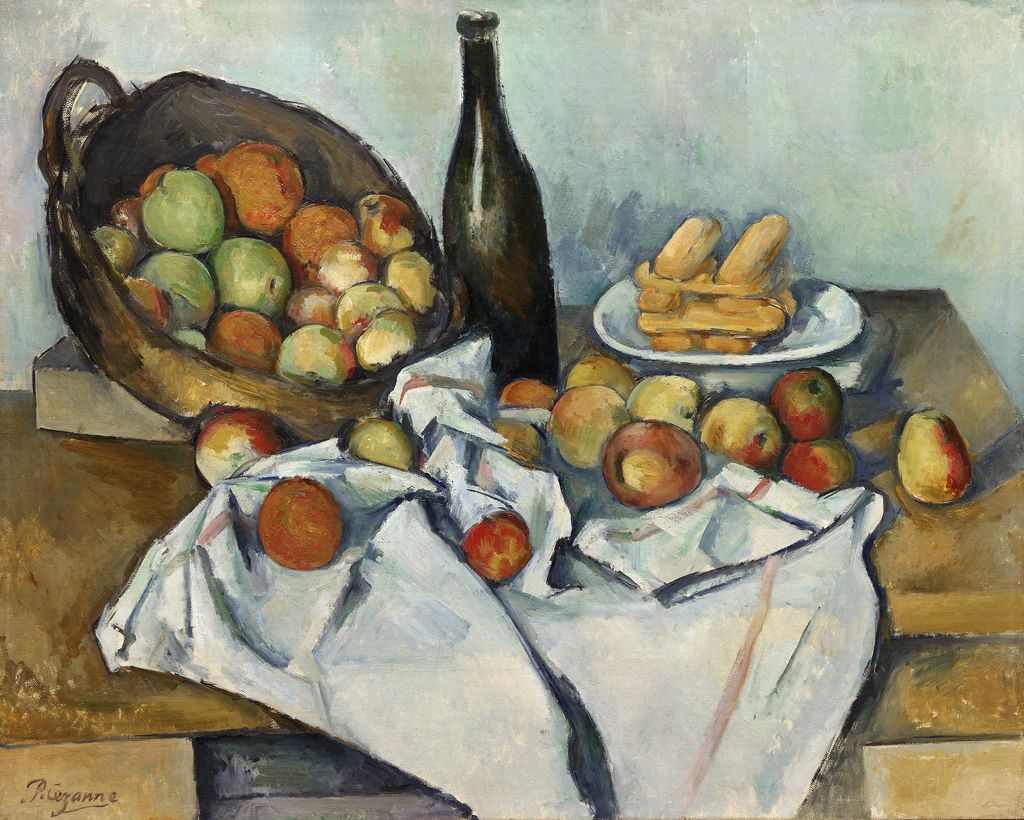
A white cloth is rarely simply white in a painting by Paul Cézanne. In The Basket of Apples , pale pink, yellow, blue, green and grey patches turn the cloth into a succession of sloping planes. A blue-grey line catches one fold, then slips a little way from its edge. The fruit in front seems heavy enough to roll, while the tabletop refuses to align neatly across the canvas. The painting lets us see an arrangement of things and the decisions through which an arrangement became a picture. Close examination of the Chicago canvas shows that Cézanne drew the misaligned table edges and the leaning bottle at an early stage, then adjusted them in paint. Their oddness belongs to the making of this particular work. [1]
Cézanne's own letters give a larger purpose to such labour. Writing to Émile Bernard on 15 April 1904, he urged the younger painter to treat nature through “the cylinder, the sphere, the cone” (our translation). His next lines concern perspective, depth and the use of blue to suggest air. The familiar three shapes were part of advice about translating observed space into painting, rather than a recipe for reducing every apple or mountain to a solid. In a letter of 26 May, he described the painter as giving concrete expression to perceptions through drawing and colour. Both letters describe demanding work in front of a motif; neither supplies a fixed procedure for each canvas. [2] [3]
At a Glance
- Central tools Drawing, colour relationships, varied brush marks and the exposed support. [4]
- Early change Painting alongside Camille Pissarro in the 1870s helped Cézanne move from dark, earthy paint towards brighter colour. [4]
- Close technical examples London National Gallery paintings studied by Elisabeth Reissner and Chicago's The Basket of Apples reveal different ways of beginning and revising a work. [4] [1]
- Works on paper Graphite, watercolour and open paper could each remain active in the finished image. [5]
Contents
- From a dark surface to a brighter palette
- A beginning that could change
- Colour makes volume and holds the surface together
- Space that asks us to keep looking
- Paper, watercolour and the freedom of an open support
- How much painting is enough?
- Variations beside one another
- A lasting way to think with paint
From a dark surface to a brighter palette
Cézanne did not arrive at his best-known broken touch in one leap. In his early The Artist's Father Reading L'Événement and other works of the 1860s, dark fields, broad contrasts and emphatic handling make paint feel dense. Reissner's examination of The Stove in the Studio , a small National Gallery picture of about 1865, finds wet paint worked into wet paint and some straight-edged deposits suggesting a palette knife. The later National Gallery paintings in her study generally use brighter reds, greens, yellows and blues in mixtures with white. She connects that change to Cézanne's work alongside Pissarro in the 1870s, while stressing how much material practice continued to vary afterward. [4]
The contrast matters because “Cézanne's technique” can sound like one recognizable brushstroke repeated for forty years. The marks in his mature works include short diagonals, long curves, zigzags, lines that taper and broad patches. Even the regularly angled marks often called his constructive stroke occur with other kinds of touch. In Hillside in Provence , Reissner finds a range from wavy and curving marks to flat-edged ones; in Landscape with Poplars , a zigzag movement makes larger masses. The visible stroke is a means of testing a relation in a particular passage, rather than a stamp of authenticity or a measure of how finished the painting is. [4]
This change of palette was substantial without requiring exotic new materials. Reissner found that six analysed London paintings broadly correspond to the pigment colours Bernard later listed from Cézanne's palette, although names in historical accounts do not always identify a chemical substance unambiguously. The study documents common reds, greens and blues, lead white and black, along with differences between individual canvases. An Old Woman with a Rosary bears a Chabod canvas stamp; letters and other records point to several suppliers. Neither a supplier's name nor a pigment list explains the look of a painting by itself. Cézanne's originality lies partly in what he made those available materials do. [4]
A support also gives a painter a starting colour and texture. Reissner found commercial canvas sizes and differently prepared grounds among the London works. Her study suggests a tendency towards larger canvases and finer woven supports late in Cézanne's career, without a clean break from earlier habits. The grey ground of Avenue at Chantilly participates in its final colour relationships; elsewhere a light ground can shine between strokes. Looking at what remains uncovered is therefore a way of seeing one of the materials with which Cézanne painted, as well as the marks he put upon it. [4]
Nor does every late painting become uniformly thin or airy. The National Gallery's An Old Woman with a Rosary has major changes around the sitter's shoulder and bonnet, and paint gathered thickly around the face. The London Bathers accumulated revisions over a long period. In contrast, other passages of the same pictures allow underlayers to remain in view. They make Cézanne's career difficult to divide into a “heavy early” and “light late” style: density and openness can answer different local problems within a single work. [4]
A beginning that could change
Some paintings began with dry drawing. Infrared examination of the National Gallery's Self Portrait , Avenue at Chantilly and Hillside in Provence revealed pencil or Conté lines beneath and sometimes within the visible image. In Self Portrait , early lines establish the head, features and the division between patterned wallpaper and pale background. The wallpaper's lozenges appear to have gained their pictorial role during painting. In Hillside , the painted edge of a road rises above the first drawn position. Such traces let us follow a proposal and its revision rather than assume the drawing was a plan to be filled in. [4]
The Basket of Apples offers an especially vivid still-life case. Chicago conservators found a fairly extensive loose drawing in a dry carbon-based material, possibly charcoal. Cézanne also drew in black paint, notably around apples, cloth folds and biscuits. Infrared images show the disjointed table edges and the bottle's lean already present in the early arrangement, though both changed as he painted. The basket, bottle, plate and cloth remain recognizable, while their precise boundaries could move. A slanted object may register sustained pictorial choice as well as observation; the imaging cannot tell us the single motive for every deviation from conventional perspective. [1]
The London works add another kind of beginning. Reissner describes dilute blue or grey painted lines and washes that loosely locate motifs. These are patchy beginnings, often with light ground left visible. Later colour can depart from those first indications. On Avenue at Chantilly , for example, Cézanne lowered the painted base of a tree from its drawn position, joining the trees more strongly into an arch. The finding belongs to that canvas; it helps us recognize why a Cézanne contour can look provisional even where the picture has received long attention. [4]
The distinction between dry line, painted line and the edge formed by two patches of colour is crucial. On several London canvases, Cézanne let adjoining passages stop a little short of one another. The narrow gap can reveal a first wash or drawing and can itself read as a contour. Elsewhere he placed a thin blue line over thicker paint late in the process. In the London Bathers , blue lines redraw a figure's arm after adjacent areas had been painted. A visible blue edge is therefore no automatic clue to the first stage: one line may place a motif, another may reconsider it near the end. [4]
Colour makes volume and holds the surface together
In Cézanne's paintings, modelling often happens through shifts between neighbouring hues rather than a smooth progression from light to dark. The blue and yellow beside each other in a trunk in Avenue at Chantilly give it body and light. A mixed green beside a warm red can make both colours feel more active. Reissner calls attention to the relation among patches across the whole picture: the value of one touch may change as another appears nearby. This helps explain why a fold, a face or a rock often seems to gather its shape slowly as we look. [4]
Émile Bernard told his mother in 1904 that Cézanne proceeded by finishing discrete areas before joining them. Reissner finds that the London paintings she examined do not support that sequence: colour relationships develop across the surface, and later marks return to places already worked. Bernard's account remains valuable testimony about what he thought he saw, while the layered paintings show a less orderly process. [4]
Chicago's Basket makes this process unusually legible. The cloth's pale planes are coloured, with darker lines used selectively along folds. The oranges are built with denser, more compact touches that evoke rough peel; the apples receive flatter, gently curved strokes. Beneath the immediate still-life description, Cézanne is also adjusting how each patch meets the next. Light grey-green strokes of cloth overlap fruit near the bottle without completely hiding it. Later dark lines sit a little off the cloth's apparent edge, while the red border passes across a peak as if it followed a course of its own. These details keep the fabric, fruit and painted surface in active relation. [1]
Technical study also complicates the appealing story that Cézanne laid pure colour straight from the tube in separate tiles. Microscopic samples from Reissner's London group commonly contain several pigments mixed with white. In the background of the National Gallery Self Portrait , some colours were only partly blended within a single stroke. The painting retains the physical trace of a mixture made for a local need. A viewer sees distinct touches, but the colour within a touch may already be complex. [4]
Colour does not abolish drawing. Cézanne's line can surround a form, cut across it, or be inferred from a slim interval left between colours. In An Old Woman with a Rosary , accumulated paint at the face gives a contour real thickness; elsewhere freely painted dark lines seek a new edge. Reissner's close study of the National Gallery pictures therefore gives practical force to the May 1904 letter's pairing of drawing and colour. The two acts keep affecting one another as the picture develops. [4] [3]
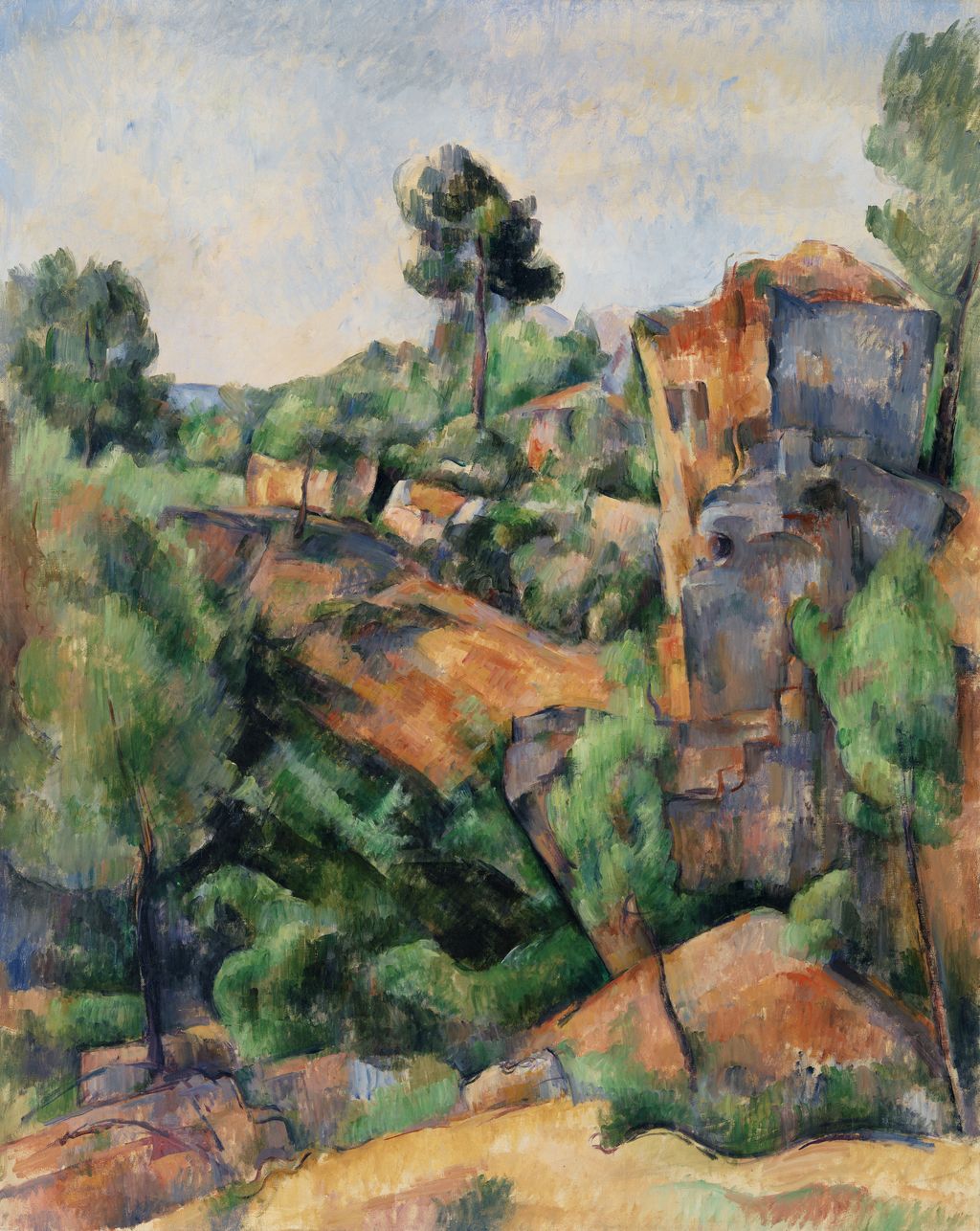
Paul Cézanne, Bibémus Quarry, c.1895, oil on canvas, Barnes Foundation, Philadelphia (BF34).
Image source
.
CC0 / Public domain
. Proportional web export only; master unchanged.
Space that asks us to keep looking
A Cézanne tabletop can rise toward us, then split or turn unexpectedly. In the Chicago Basket , the front edge cannot be carried as one reassuring straight line across the canvas. The high viewpoint lets us see the plate and the fruit while the bottle stands in a space that feels shallower than a conventional room. The painting has a coherent presence despite local inconsistencies. Art historian Paul Smith discusses several explanations of this effect, including formal design and theories about the way a moving eye sees. The conservation evidence establishes an early disjunction and subsequent changes; it does not prove that Cézanne physically walked around the still life or combined a measured set of viewpoints. [1]
The 1904 letter's instruction to place the cylinder, sphere and cone “in perspective” deserves to be read here in full context. Cézanne described depth, a horizon, and blue interposed among red and yellow light effects to give the feeling of air. He was concerned with making space convincing on a flat surface even as his paintings complicated the usual geometric solution. A mountain and its valley, for instance, may be articulated in successive bands of colour and broken outlines without losing their sense of distance. Mont Sainte-Victoire was a recurring subject in which changes of site, format and touch gave that problem many different answers. [2]
Close technical accounts resist the idea of deliberate distortion as the only explanation. Reissner distinguishes changes made for pictorial organisation from shifts that might arise through repeated adjustment; perception may contribute as well. In the National Gallery Self Portrait , the relationship of wallpaper pattern to head is made in paint rather than fully fixed in the first drawing. In The Grounds of the Château Noir , a visible red patch near the lower centre remains a strong pictorial hinge as adjacent paint develops. The late MoMA Château Noir is a different canvas, whose building and trees offer another way to see colour masses knit a place together. [4]
Paper, watercolour and the freedom of an open support
Cézanne's practice on paper clarifies why exposed support can be visually active. In the Chicago watercolour The Three Skulls , graphite lines establish heads, carpet pattern and the table beneath. Transparent washes lie over some of them while ivory paper shines through others. The pencil can indicate a skull's turn while pale colour and untouched paper give its bone light. Technical researchers found that line, wash and the paper itself each carry information; the sheet is more than a preliminary sketch waiting for oil paint. Many mature watercolours were made as independent works, even when their motifs also appear in oils. [5]
Geneviève Monnier's study of the late watercolours stresses the variation in their construction. Some colour appears directly on paper without visible preliminary pencil; on other sheets graphite is laid over wash or forms a shifting second outline. Her reading of landscapes attends to networks of vertical trees, diagonal roofs or rock edges, and reserves of blank paper that contribute light and spaciousness. She cautions through her examples against a simple progression from firm drawing to liberated colour: methods alternate, and still lifes can be hard to date by appearance alone. [6]
Monnier argues that experiments in watercolour helped open Cézanne's late oils to lighter, more fluid handling. That is a useful visual comparison, though an oil painting's physical layers need their own evidence. Reissner found thin and sometimes translucent passages in the London oils, alongside mostly more opaque paint, local reworking and occasional glazes. She also found that their current varnished surfaces cannot establish Cézanne's original preference for matte or glossy areas. A watercolour reserve and a light gap in an oil may play related visual roles without sharing a single material process. [6] [4]
Printmaking adds a smaller, distinct chapter to this story. Douglas Druick identifies three late lithograph designs, made in the context of Ambroise Vollard's print publishing, alongside Cézanne's earlier etchings. The black printed image, a watercoloured impression prepared as a guide, and a colour lithograph printed from several stones are materially different things. Druick argues that a printer's contribution to the colour versions was substantial, challenging testimony that gave Cézanne the whole task of preparing the colour stones. His account lets us see collaboration and translation between media, while leaving the exact contribution to each impression open. Druick also distinguishes how he thinks the designs were transferred into print. He argues that the Large Bathers and Self-Portrait lithographs began as drawings on transfer paper, whereas Small Bathers was drawn directly on stone. His proposed sequence depends on material and stylistic comparisons, since a publication date alone cannot establish when Cézanne drew a design. A print may therefore carry several histories at once: the drawing, its transfer or printing, a watercoloured guide, and the later colour impression. [7]
The lithographic Large Bathers adapts an earlier bather composition; it should be distinguished from the later monumental Philadelphia Large Bathers . [7]
How much painting is enough?
An open surface can show hesitation, an intended interval, or a decision to stop. Cézanne left white priming visible in some oils and paper unpainted in watercolours. In the National Gallery Hillside in Provence , a greenish underwash can stand for moss at the base of rocks; elsewhere denser green gives the same subject another degree of definition. A patch of bare ground in the London Bathers helps bring a reclining figure's thigh forward. These effects are visible and purposeful within the pictures, but they do not by themselves tell us when the artist considered every work complete. [4]
Some works were repeatedly revised. Reissner found substantial accumulated paint and shifted contours in An Old Woman with a Rosary and the London Bathers . She also found that such heavy reworking is not a rule for the whole oeuvre, nor a reliable sign that a picture is nearer completion. The Philadelphia Large Bathers has a thinner, more open surface than the London and Barnes monumental versions. Philadelphia's museum calls its work unfinished, while critics have argued that the openness gives it a powerful form of resolution. Those judgements answer different questions: how far physical painting proceeded, and whether the resulting image feels complete to a viewer. [4] [8]
The painter used the French word réalisation for the difficult arrival at a satisfactory pictorial result. The Chicago researchers emphasize that his pictures can sit at different points on that search, with bare or sketched passages that resist a tidy finished/unfinished division. A missing signature is no verdict. Nor can the evenness of diagonally arranged brushstrokes serve as a finish test. It is better to ask what a passage currently does: does a reserve bring air into the scene, preserve a bright value, expose an earlier drawing, or leave a relation unresolved? [5] [4]
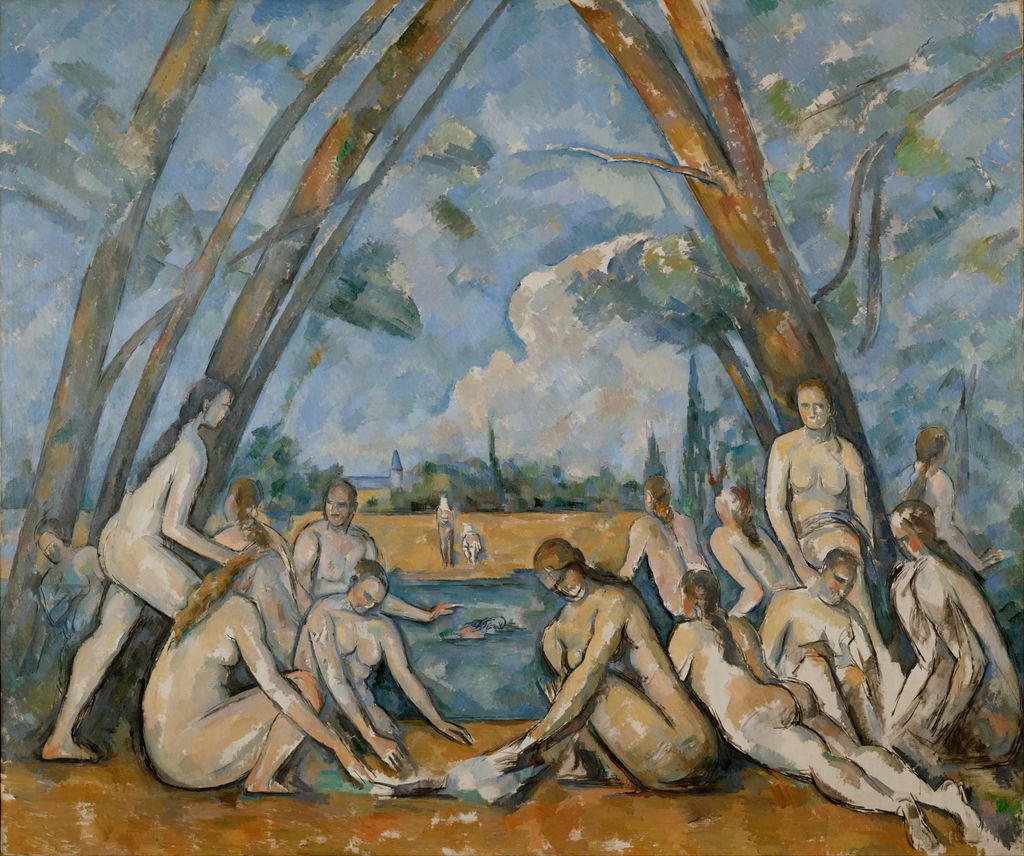
Cézanne’s Philadelphia Large Bathers has a more open surface than London’s monumental version;Philadelphia Museum of Art,W1937-1-1.
Image source
.
Public domain
. Proportional web export only; original bytes andmetadata unchanged.
Variations beside one another
Monnier finds a striking contrast among watercolours made late in Cézanne's life: the Mont Sainte-Victoire views spread dilute, pale washes across broad areas, while portraits of the gardener Vallier concentrate stronger colour in fine, curving marks. The comparison interrupts any story in which his late style simply became lighter and less defined year by year. The demands of a mountain seen across distance and a person close at hand brought out different capacities of the same medium. It also suggests a useful way to compare recurring motifs: attend to the particular weight of a line, the extent of untouched paper and the relation between colour and space in each version. [6]
A lasting way to think with paint
Cézanne's later importance has often been compressed into a story about geometric forms leading directly to Cubism. Monnier reads some late watercolour structures as anticipating abstraction, and later artists did find ways forward in Cézanne's fractured planes and open surfaces. Yet the dated letter to Bernard places the three solids inside advice about perspective and atmospheric colour. Cézanne's practice also involved repeated observation of particular apples, people, trees and hills, and constant revisions of the picture growing from them. His legacy includes the freedom to make those revisions visible. [6] [2]
That is why his work still rewards slow looking. A brushstroke can describe a leaf and establish a rhythm across a canvas; a contour can identify a bottle while showing an earlier position beneath it. The picture's objects may hold together even when the spaces between them remain unstable. What we watch is a painter using ordinary pigment, brush, pencil, oil, water and paper to test how a seen world might acquire shape on a surface. The technical studies make that labour more legible, while the paintings retain their capacity to surprise. [4] [5]
Cézanne artworks directory
Browse 217 identified works in this researched selection, including paintings, drawings and watercolours. This is a bounded selection, not a complete catalogue of Cézanne’s surviving oeuvre. Unlinked titles have no confirmed article in this collection.
| Name | Date | Medium |
|---|---|---|
| A Head, a Cup, and a Bread Roll | 1891/1894 | Drawing |
| A Man seen from Behind | 1880/1883 | Drawing |
| A Modern Olympia | 1873–74 | Painting |
| A Nude and Foliage | 1879/1882 | Drawing |
| A Smoking Man | 1892–96 (catalogue); c.1890–92 (museum) | Drawing |
| Afternoon in Naples | 1876–77 | Painting |
| An Old Woman with a Rosary | about 1895–96 | Painting |
| Apples and Oranges | c.1899 | Painting |
| Auvers, Panoramic View | 1873–75 | Painting |
| Avenue at Chantilly | 1888 | Painting |
| Banks of the Marne | 1888–94 | Painting |
| Basket | 1877/1900 | Drawing |
| Bather with Outstretched Arms | 1877–78 | Painting |
| Bellows in Front of a Fireplace | 1887/1892 | Drawing |
| Bibémus Quarry | c.1895 | Painting |
| Boy in a Red Vest, Barnes Foundation | 1888–90 | Painting |
| Boy in a Red Vest, MoMA | 1888–90 | Painting |
| Boy in a Red Waistcoat, National Gallery of Art | 1888–90 | Painting |
| Branch in Flower | 1886/1889 | Drawing |
| Carnival Scene | 1885/1888 | Drawing |
| Chair and Dresser | 1880/1883 | Drawing |
| Chateau Noir | 1903–04 | Painting |
| Chestnut Trees and Farm at Jas de Bouffan | c.1885 | Painting |
| Chestnut Trees and Farm at Jas de Bouffan, Pushkin | c.1886 | Painting |
| Chestnut Trees at Jas de Bouffan in Winter | 1885–86 | Painting |
| Château Noir | 1900–04 | Painting |
| Cistern in the Park of Château Noir | c.1900 | Painting |
| Curtain, Jug and Fruit | 1893–94 | Painting |
| Cushion of an Armchair | 1886/1889 | Drawing |
| Draft Letter and Studies of Bathers | c.1878 | Drawing |
| Farmhouse and Chestnut Trees at Jas de Bouffan | 1884–85 | Painting |
| Figure Resting Head on Hand | c. 1889 | Drawing |
| Fireplace Tongs and Poker | 1887/1892 | Drawing |
| Forest Interior, San Francisco | c.1898–99 | Painting |
| Four Bathers | 1888–90 | Painting |
| Fruit and a Jug on a Table | 1893–94 | Painting |
| Gardanne | 1885–86 | Painting |
| Gardanne, Barnes Foundation | c.1885 | Painting |
| Hand and Shoulder of a Boy | c. 1885 | Drawing |
| Harlequin, National Gallery of Art | 1888–90 | Painting |
| Head of a Boy | 1887/1889 | Drawing |
| Head of a Boy Seen from Behind | c. 1885 | Drawing |
| Head of a Young Woman | c. 1880 | Drawing |
| Head of the Artist's Son | 1888/1889 | Drawing |
| Hillside in Provence | c.1890–92 | Painting |
| Horse Chestnut Trees at Jas de Bouffan | c.1885 | Painting |
| House and Farm at the Jas de Bouffan | c.1887 | Painting |
| House in a Park | 1883/1886 | Drawing |
| House in Provence | c.1885 | Painting |
| House of Père Lacroix | 1873 | Painting |
| House Surrounded by Vegetation | 1889/1892 | Drawing |
| Houses in Provence The Riaux Valley near L’Estaque | c.1883 | Painting |
| Jas de Bouffan, the Pool | c.1876 | Painting |
| Kerosene Lamp | 1878/1881 | Drawing |
| L'Estaque, Melting Snow | c.1870 | Painting |
| Lake Annecy | 1896 | Painting |
| Landscape in Provence, Pola Museum | 1879–82 | Painting |
| Landscape Near Aix-en-Provence | 1877/1880 | Drawing |
| Landscape Seen from the Inside of a Cave | 1889/1892 | Drawing |
| Landscape with Poplars | c.1885–87 | Painting |
| Landscape with Trees | 1895/1898 | Drawing |
| Leda and the Swan | c.1880 (possibly later) | Painting |
| Little Girl with a Doll | 1902–04 | Painting |
| Louis Guillaume | 1879–1890 | Painting |
| Madame Cezanne | 1888/1891 | Drawing |
| Madame Cezanne | 1886/1889 | Drawing |
| Madame Cezanne | 1882/1887 | Drawing |
| Madame Cezanne | 1897/1900 | Drawing |
| Madame Cezanne with her Head Lowered | 1893/1896 | Drawing |
| Madame Cézanne in a Red Armchair | c.1877 | Painting |
| Madame Cézanne in a Red Dress, Metropolitan Museum of Art | 1888–90 | Painting |
| Madame Cézanne in a Yellow Chair | 1888–90 | Painting |
| Madame Cézanne in a Yellow Chair, Fondation Beyeler | 1888–90 | Painting |
| Madame Cézanne in the Conservatory | 1891 | Painting |
| Maincy Bridge | 1879–80 | Painting |
| Maison Maria with a View of Château Noir | c.1895 | Painting |
| Man Bending Forward | 1883/1886 | Drawing |
| Man Smoking a Pipe, Pushkin | c.1891, possibly later | Painting |
| Man with a Pipe | 1891–96 | Painting |
| Man with a Pipe, Nelson-Atkins | 1890–92 | Painting |
| Man with a Straw Hat (Gustave Boyer) | c.1871 | Painting |
| Man with Crossed Arms | c.1899 | Painting |
| Man with Pipe, National Gallery of Art | 1892–96 | Painting |
| Mont Sainte-Victoire | c.1902–06 | Painting |
| Mont Sainte-Victoire | 1900–02 | Painting |
| Mont Sainte-Victoire (recto) | c.1895 | Watercolour |
| Mont Sainte-Victoire and the Viaduct of the Arc River Valley | 1882–85 | Painting |
| Mont Sainte-Victoire Seen beyond the Wall of the Jas de Bouffan | c.1885/1888 | Watercolour |
| Mont Sainte-Victoire Seen from Bibémus Quarry | c.1897 | Painting |
| Mont Sainte-Victoire, Barnes Foundation | 1892–95 | Painting |
| Near the Pool at Jas de Bouffan | 1883/1887 | Drawing |
| Pelicans | 1877/1880 | Drawing |
| Peonies | 1890/1893 | Drawing |
| Pierrot and Harlequin | 1888 | Painting |
| Pine Tree | 1882/1885 | Drawing |
| Pont des Trois Sautets | 1906 | Watercolour |
| Poplars | 1879–80 | Painting |
| Portrait of Ambroise Vollard | 1899 | Painting |
| Portrait of Gustave Geffroy | 1895–96 | Painting |
| Portrait of Madame Cezanne with Loosened Hair | 1885–86 | Painting |
| Portrait of the Artist Looking Over His Shoulder | 1883–84 | Painting |
| Portrait of the Gardener Vallier | 1906 | Painting |
| Portrait of Victor Chocquet | 1876–77 | Painting |
| Portrait Of Victor Chocquet Seated | 1877 | Painting |
| Provençal Manor | c.1885 | Painting |
| Pyramid of Skulls | 1898–1900 | Painting |
| Reclining Nude (Leda?) | c.1887 | Painting |
| Scipio | 1866–68 | Painting |
| Seated Man, Oslo | 1898–1900 | Painting |
| Seated Peasant | c.1892–96 | Painting |
| Seated Peasant, Hiroshima | c.1897 | Painting |
| Seated Peasant, Orsay | c.1900 | Painting |
| Self-Portrait | c. 1895 | Drawing |
| Self-Portrait in a Bowler Hat, Ny Carlsberg Glyptotek | 1885–86 | Painting |
| Self-Portrait in a Casquette | c.1875 | Painting |
| Self-Portrait with a Beret | 1898–1900 | Painting |
| Self-Portrait with a Hat, Artizon Museum | c.1890–94 | Painting |
| Self-Portrait with a Pink Background | c.1875 | Painting |
| Self-Portrait with Olive-Coloured Wallpaper | about 1880–81 | Painting |
| Self-Portrait with Palette | 1886–87 | Painting |
| Self-Portrait with White Turban | c.1878–80 | Painting |
| Self-Portrait, c.1895 | c.1895 | Painting |
| Self-Portrait, Pushkin Museum | c.1882 | Painting |
| Spanish Dancers | 1883/1886 | Drawing |
| Still Life with a Curtain | 1892–94 | Painting |
| Still Life with Apples | c.1890 | Painting |
| Still Life with Apples | 1893–94 | Painting |
| Still Life with Apples and a Pot of Primroses | about 1890 | Painting |
| Still Life with Milk Jug and Fruit | c.1900 | Painting |
| Still Life with Open Drawer | 1877–79 | Painting |
| Still Life with Plaster Cupid | about 1894 | Painting |
| Still Life with Skull | 1890–93 | Painting |
| Still Life with Soup Tureen | 1877 | Painting |
| Still Life, Pitcher and Fruit | 1893–94 | Painting |
| Studies Including a Straw Hat | 1895/1898 | Drawing |
| Studies Including Madame Cezanne | 1884/1887 | Drawing |
| Study for "The Judgement of Paris" or "The Amorous Shepherd" | 1883/1886 | Drawing |
| Study for Woman with a Coffee Pot | c.1895 | Painting |
| Study of "The Roman Orator (Germanicus)" | 1883/1886 | Drawing |
| Study of "Venus de Milo" | 1881/1884 | Drawing |
| Study of a Decorative Ornament | 1879/1882 | Drawing |
| Study of a Standing Male Figure after the Antique | c. 1895 | Drawing |
| Study of an Angel in Rubens' "The Prophet Elijah" | 1892/1895 | Drawing |
| Study of Desiderio da Settignano's "Bust of a Child" | c. 1895 | Drawing |
| Study of Houses | 1879/1882 | Drawing |
| Study of Puget's "Hercules Resting" | c. 1879 | Drawing |
| Study of Puget's "Milo of Crotona" | 1895/1898 | Drawing |
| Study of Puget's "Milo of Crotona" | 1880/1883 | Drawing |
| Study of the Allegorical Figure Bellona in Rubens' "The Apotheosis of Henri IV" | 1883/1886 | Drawing |
| Study of the Allegorical Figure Bellona in Rubens' "The Apotheosis of Henri IV" | 1879/1882 | Drawing |
| Study of the Allegorical Figure France in Rubens' "The Exchange of the Two Princesses" | 1882/1885 | Drawing |
| Study of the Allegorical Figure of Health in Rubens' "The Birth of Louis XIII" | 1880/1883 | Drawing |
| Study of the Allegorical Figure of the Genius of Health from Rubens' "The Birth of Louis XIII at Fontainbleau" | 1895/1898 | Drawing |
| Sugar Bowl, Pears and Blue Cup | 1865–66 | Painting |
| The Aqueduct, Pushkin Museum | Dating differs between museum records | Painting |
| The Artist's Father, Reading L'Evenement | autumn 1866 | Painting |
| The Artist's Son | c. 1887 | Drawing |
| The Artist's Son Leaning on his Elbow | c. 1887 | Drawing |
| The Artist's Son Reading | c. 1887 | Drawing |
| The Artist's Son Writing | c. 1887 | Drawing |
| The Artist’s Son, Paul | 1886–87 | Painting |
| The Avenue at Jas de Bouffan | 1868–70 (possibly later) | Painting |
| The Avenue at Jas de Bouffan, Geneva | c.1890 | Painting |
| The Basket of Apples | c.1893 | Painting |
| The Bather, Museum of Modern Art | c.1885 | Painting |
| The Bay of Marseille seen from L'Estaque | c.1885 | Painting |
| The Blue Vase | 1889–90 | Painting |
| The Boy in the Red Vest, Bührle | 1888–90 | Painting |
| The Buffet | 1877–79 | Painting |
| The Card Players, Barnes Foundation | 1890–92 | Painting |
| The Card Players, Courtauld Gallery | 1892–96 | Painting |
| The Card Players, Metropolitan Museum of Art | 1890–92 | Painting |
| The Card Players, Musée d’Orsay | 1893–96 | Painting |
| The Card Players, Qatar | 1892–96 | Painting |
| The Eternal Feminine | c.1877 | Painting |
| The Gardener Vallier | 1906 | Painting |
| The Gardener Vallier, Tate | 1905–06 | Painting |
| The Grounds of the Château Noir | c.1900–04 | Painting |
| The Gulf of Marseille Seen from L’Estaque | c.1885 | Painting |
| The Hanged Man's House in Auvers | c.1873 | Painting |
| The House of Doctor Gachet at Auvers | 1872–73 | Painting |
| The House with the Cracked Walls | 1892–94 | Painting |
| The Kiss of the Muse | c.1860 | Painting |
| The Large Bathers, Barnes Foundation | 1895–1906 | Painting |
| The Large Bathers, National Gallery | 1895–1905 | Painting |
| The Large Bathers, Philadelphia Museum of Art | 1900–06 | Painting |
| The Mill | 1889/1892 | Drawing |
| The Painter’s Father, Louis-Auguste Cézanne | c.1865 | Painting |
| The Peasant | 1890–92 | Painting |
| The Plaster Mill (La Moulin à plâtre) | 1889/1892 | Drawing |
| The Smoker, Hermitage | c.1891 | Painting |
| The Smoker, Mannheim | c.1891 | Painting |
| The Stove in the Studio | c.1865 | Painting |
| The Vase of Tulips | c.1890 | Painting |
| Thistle | 1893/1896 | Drawing |
| Three Heads, One of Madame Cezanne | 1882/1885 | Drawing |
| Three Skulls | c.1898 | Painting |
| Three Skulls on a Patterned Carpet | 1904 | Painting |
| Trees and Shrubs | 1883/1887 | Drawing |
| Turning Road at Montgeroult | 1898 | Painting |
| Two Bathers | 1884/1887 | Drawing |
| Two Heads | 1888 | Drawing |
| Two Heads | 1890/1896 | Drawing |
| Two Heads of Women | 1890/1894 | Drawing |
| Two Studies for "The Judgement of Paris" or "The Amorous Shepherd" | 1883/1886 | Drawing |
| Uncle Dominique in a Tasseled Cap | 1866 | Painting |
| Uncle Dominique in a Turban | 1866–67 | Painting |
| Victor Chocquet and an Angel for "The Apotheosis of Delacroix" | 1878/1880 | Drawing |
| Woman in Blue | c.1904 | Painting |
| Woman Leaning Forward | 1888/1891 | Drawing |
| Woman Leaning Forward | 1890/1894 | Drawing |
| Woman Leaning Forward | 1890/1894 | Drawing |
| Woman with a Coffee Pot | c.1895 | Painting |
| Women Bathers and a Roll of Paper | 1882/1885 | Drawing |
| Young Girl with a Doll | c.1895 | Painting |
| Young Italian Woman at a Table | c.1895–1900 | Painting |
| Young Man and Skull | 1896–98 | Painting |
Frequently Asked Questions
The term is commonly used for short, often diagonal brush marks that help build a form or connect areas of a picture. Cézanne used them alongside curved, tapering, zigzag and broader marks, and their prominence varied by work and period. A canvas need not be covered in matching diagonals to count as resolved. [4]
A painting such as The Basket of Apples includes sloping and misaligned elements. Those features have inspired theories about changing vision and multiple viewpoints, but Chicago's technical study shows some were present in its initial drawing and were revised as painting continued. The physical evidence does not establish a fixed routine of moving around the arrangement. [1]
Some subjects recur across media, and a particular sheet may relate to an oil. Many mature watercolours also function as independent images, using graphite, transparent colour and reserved paper in ways an oil painting cannot simply duplicate. See Cézanne's drawings for the wider paper practice. [5]
Discussion
Look again at the images and ideas explored in How Cézanne Painted: Colour, Drawing and the Work of Seeing. These editorial prompts invite your observations.
Reader Insights
Return to the cloth in The Basket of Apples. Which fold seems most solid, and which painted line makes you doubt where its edge really lies?
In a Cézanne landscape, try following one colour across distant and near objects. Where does it make space, and where does it remind you of the picture's flat surface?
Look at an exposed patch of paper or primed canvas before deciding it is incomplete. What is that light area doing for the colours around it?
Join the Conversation
Share a detail, comparison or question about How Cézanne Painted: Colour, Drawing and the Work of Seeing below.
References
- Art Institute of Chicago , Paul Smith, “Cat. 10: The Basket of Apples , c. 1893,” with technical report by Kim Muir and Giovanni Verri, Cezanne Paintings and Watercolors at the Art Institute of Chicago , online catalogue, 2025. View source .
- Courtauld Gallery , Paul Cézanne, letter to Émile Bernard, 15 April 1904, MS.1932.SC.1.1, French transcription. (in French). View source .
- Courtauld Gallery , Paul Cézanne, letter to Émile Bernard, 26 May 1904, MS.1932.SC.1.3, French transcription. (in French). View source .
- National Gallery, London , Elisabeth Reissner, “Ways of Making: Practice and Innovation in Cézanne's Paintings in the National Gallery,” National Gallery Technical Bulletin 29 (2008), pp. 4–30. View source .
- Art Institute of Chicago , Kim Muir, Kristi Dahm, Giovanni Verri, Maria Kokkori and Clara Granzotto, “A Harmony Parallel to Nature: Color, Form, and Space in Cezanne's Watercolors and Oil Paintings,” Cezanne Paintings and Watercolors at the Art Institute of Chicago , online catalogue, 2025. View source .
- Museum of Modern Art , Geneviève Monnier, “The Late Watercolors,” translated by Frances Frenaye, in Cézanne: The Late Work , ed. William Rubin (1977), pp. 113–18. View source .
- Museum of Modern Art , Douglas Druick, “Cézanne's Lithographs,” in Cézanne: The Late Work , ed. William Rubin (1977), pp. 119–37. View source .
- Philadelphia Museum of Art , “The Large Bathers,” collection record, current museum entry. View source .
- Société Paul Cezanne,online catalogue structure and objectidentification. View source.
- National Gallery of Art,Cezanne Sketchbook,1992.51.9. View source.
- Splash image, In Cézanne’s The Basket of Apples,coloured strokes shape the white cloth and its red border; Art Institute of Chicago,1926.252. Image source. CC0 / Public domain. Proportional web export only; actual master kept unchanged.


