 by
Tom Gurney
Tom Gurney BSc (Hons) is an art history expert with over 20 years experience
Published on June 19, 2020 / Updated on October 22, 2026
Email:
tomgurney1@gmail.com
/ Phone:
+44 7429 011000
An Old Woman with a Rosary by Paul Cézanne: Introduction
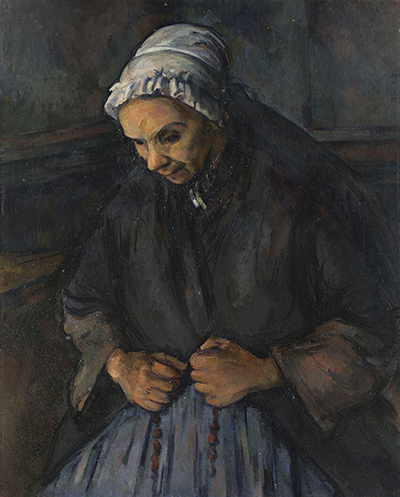
An elderly woman sits against a nearly bare wall, her head lowered and her hands occupied by a rosary. The beads disappear into the shadow of her clothing and reappear below her fists. Paul Cézanne gives the face a little light, but neither her eyes nor the room offers an easy way into a story. What holds our attention is the relation between the small, repeated action of her fingers and the weight of the body around it. The painting, made around 1895–96, belongs to the National Gallery in London. [1]
The picture is close enough to make us conscious of the sitter’s presence, yet its dark surface keeps her apart from us. Her pale cap stands out against the wall; her shoulders spread across most of the canvas; two hands meet at the centre. Looking longer, we find that the apparent stillness contains many unsettled edges. A cuff changes colour as it turns, a dark stroke crosses a hand, and the border of face and scarf is repeatedly tested. This portrait makes the work of looking as tangible as the woman it depicts. [2]
At a Glance
- Artist Paul Cézanne. [1]
- Date About 1895–96; earlier writers proposed other dates. [3]
- Medium Oil on unlined canvas. [1]
- Size 80.6 × 65.5 cm. [1]
- Collection National Gallery, London, NG6195; purchased in 1953. [1]
- Catalogue identification FWN 515, titled La Vieille au chapelet in the online catalogue raisonné. [3]
This work across Paul Cézanne’s career
The Kiss of the Muse
c.1860The Artist’s Father, Reading L’Événement
autumn 1866The Hanged Man’s House
c.1873A Modern Olympia
1873–74Maincy Bridge
1879–80The Blue Vase
1889–90The Basket of Apples
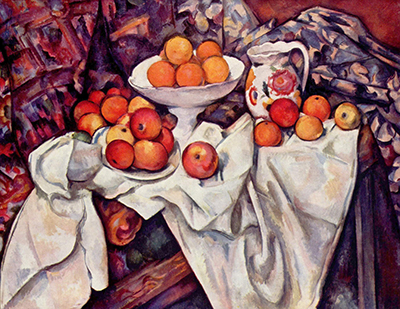
c.1893Apples and Oranges
c.1899The Large Bathers (Philadelphia)
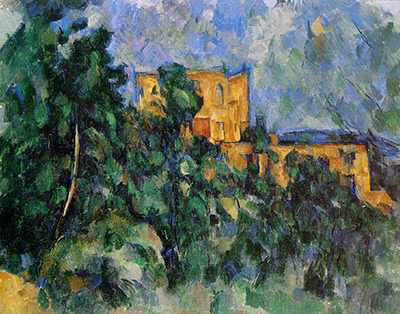
1900–1906 (Philadelphia Museum dating)Château Noir (MoMA)
1903–04Contents
- The woman, the room and the beads
- A sitter known through a story
- How the portrait was made
- Prayer, age and the limits of a portrait
- From Aix to London
The woman, the room and the beads
The composition gives almost all its height to a seated figure. A horizontal strip behind her suggests a chair rail or dado, enough architecture to establish an interior without describing a particular household. Below it, the space around the woman is dark and shallow. There is no window, table or second person to turn the scene into an episode. Her cap, forehead and nose are the strongest patches of light in the upper half; the hands make another warm group below. The eye travels between those two centres, then follows the falling beads into the lower edge of the picture.
The cap is built from irregular bands of ivory, grey and blue. Its ruffled front frames the forehead, while the rest of the fabric rises into a rounded shape. Under it, the head bends forward and slightly to one side. The near eye is edged by shadow, but the direction of her gaze remains hard to settle. It may be lowered toward her hands; it does not meet ours. The face has a sharp nose, a small mouth, flushed flesh and dark recesses, each marked with quite different pressure. Cézanne gives age visible form through the arrangement of planes and shadows rather than through a catalogue of wrinkles.
The clothing is more varied than its first impression of black. A heavy, dark upper garment meets sleeves with warmer brown and grey passages. Near the neck, a few little light marks interrupt the dark mass. At the bottom, the blue-grey skirt opens into broad vertical folds. Its cooler colour lifts the hands and beads out of the almost continuous shadow above. The seated body does not read as a clean silhouette: at the shoulders and elbows it spreads, contracts and seems to shift as one follows the paint.
The hands are emphatic but difficult to separate. One closes around the string while the other passes near it; their knuckles are broad, and dark touches keep interrupting the light flesh. The beads form two hanging runs rather than a prominently displayed cross. Their small intervals are a visual measure: as the eye moves from bead to bead it slows down in a picture otherwise dominated by large masses. Prayer is the evident association of the object, but the image cannot tell us which words she says, whether she speaks at all, or what she feels. The gesture supports attention without supplying a private confession.
The narrow setting matters for the same reason. A strip across the wall marks a place in ordinary space, yet offers little evidence for a specific room. Light reaches the cap and face without a depicted source. The woman occupies a recognisable human posture while the picture withholds the props that might make her a character in a scene. This concentration encourages us to look at the act of holding and at the pressure of the body, rather than search the room for a plot.
A sitter known through a story
The sitter’s name is unknown. The online catalogue raisonné identifies her only as an unidentified sitter. The familiar account of a former nun who fled a convent, wandered and became Cézanne’s servant comes from the writer Joachim Gasquet. It is a story about her, not independent proof of her life. The National Gallery reports it with that attribution, and art historian Theodore Reff has explicitly questioned whether she was quite the tragic figure Gasquet later made of her. [3] [1] [4]
Gasquet was not simply a remote commentator. He knew Cézanne in Aix, owned the painting and wrote about it as early as July 1896 in his magazine Les Mois dorés . There he called the woman a servant and described her blue clothes, old hands and beads, but the elaborate convent story belongs to his later memoir. His early paragraph also says Cézanne had just completed the canvas. That contemporary wording deserves to stand beside the later tale of a picture left on the studio floor beneath a leaking pipe: both come through Gasquet, and they serve different kinds of narrative. [5] [1]
The story of the pipe may help explain damage at the lower left, where the National Gallery notes traces of splashed water or steam. It cannot alone date every stage of the painting, establish Cézanne’s judgement of it, or identify the woman’s past. The surface itself, however, does show sustained work. Later material evidence supports a long process without requiring us to take the memoir’s exact timetable as a measured fact. [1] [2]
Gasquet’s own language altered how the work could be read. His 1896 description gives the woman fervour and resignation; the later account intensifies those qualities into a life of flight, suffering and charity. Such words have helped make this portrait seem like a religious tragedy. They also risk replacing the person Cézanne painted with a literary character. The rosary remains a religious object whatever her identity, but it does not verify the later biography. We can acknowledge the force of Gasquet’s response while allowing the painting’s more guarded account of her to remain open. [5]
How the portrait was made
The canvas is unlined, so its back remains visible. A supplier’s stamp names Chabod of the Rue Jacob in Paris. Examination found a fine weave and two ground layers, with chalk below a lead-white preparation. These details locate the physical support in Cézanne’s working world; they tell us nothing certain about the sitter’s life. [2]
Analysis also found cobalt blue, red earth and a cochineal lake. These identifications complicate the first impression of a nearly colourless portrait. The cap, skirt, flesh and sleeves disclose a range of cool and warm notes within the subdued whole. [2]
Cézanne returned to large areas of the portrait, changing the shoulder and cap. Accumulated paint around the face has wrinkled, and dark lines revise the arm and a hand. Small dried fragments embedded in the surface suggest work across separate drying stages. The marks reveal successive decisions on this canvas. They should not be flattened into either effortless spontaneity or a simple story of struggle. [2]
Try following the edge of the near hand. A dark stroke interrupts it precisely where a more conventional portrait might secure a smooth boundary. The hand remains a hand because the larger shapes and colour relations hold, yet the line makes us aware of the act of finding that shape. Similar uncertainty operates at the clothing’s perimeter. A shoulder is broad enough to convey weight, but its exact edge does not remain equally firm all the way round. These are places where the portrait’s human presence and its painted construction are most closely joined.
The technical study did not detect dry underdrawing, but warns that dense paint may conceal it. Reworking cannot settle whether Cézanne considered the painting “finished.” He asked Gasquet to lend it for an Aix exhibition in 1902: its searching surface was compatible with being seen. [2]
Prayer, age and the limits of a portrait
The rosary gives the painting an unmistakable devotional reference. It also makes the hands an active centre of the composition. The viewer can infer the repetitive motion by which beads pass through fingers, although no movement is literally shown. Against that possible rhythm, the bowed head and broad shoulders seem to pause. The two conditions coexist: action small enough to be private, posture large enough to occupy nearly the whole field.
Interpretations have taken this balance in different directions. Reff placed the portrait among the darker figure paintings of the mid-1890s and connected its solemn tone with the memory of Baroque painting, especially Rembrandt. Liliane Brion-Guerry, writing in the same 1977 Museum of Modern Art catalogue, saw the beads and surrounding space as a way of expressing a life moving through time. These are readings, not information recovered from the sitter. Their common insight is that the depth of the picture does not depend on knowing her name. [4]
The Rembrandt comparison is tempting because light concentrates on an aged face and hands while much of the body emerges from dark paint. Yet Cézanne’s treatment is unlike a seamless theatrical spotlight. The light does not simply expose a stable character inside a stable room. It breaks against a cap constructed from short, differently angled marks, catches the planes of a face, then meets the disruptive drawing around the hands. The changes in paint keep the woman from becoming only an emblem of age or faith.
John Elderfield has argued that this portrait tests how feeling can appear without becoming sentimental. That is a useful way to approach the image. A bowed figure and rosary can invite pity; the canvas gives us no tears, no dramatic gesture and no explanatory witness. Its reserve leaves room for the woman’s independence from the stories told about her. At the same time, the large scale of her body and the care spent on its revisions resist indifference. The encounter is emotionally strong because the sitter remains particular without being fully knowable. [6]
The title itself helps us see the balance. “An old woman” acknowledges that we cannot securely call her by name, while “with a rosary” points to something present and specific. The catalogue raisonné’s French title, La Vieille au chapelet , and the many historical variants show that institutions and writers have repeatedly named her by age and beads. These titles make no claim that the painting depicts a saint. Looking at the canvas, one can register devotion, endurance, habit or worry as possible associations while declining to choose a single inner state on her behalf. [3]
From Aix to London
Gasquet owned the portrait after Cézanne, and an early record makes clear that it was seen in his home. By February 1910 it was with the Paris dealer Émile Druet; Jacques Doucet owned it by 1917, and it remained with Doucet’s widow decades later. The National Gallery bought it in 1953. A claim that it had belonged to Henry Bernstein is treated as unlikely by the Gallery’s provenance record. A recently studied 1905 letter shows Gasquet wondering what a sale of “the old woman” might bring; it documents a possibility he considered, not the completed sale or its price. The chain from Gasquet to London is more useful than a romantic discovery story for understanding how the picture moved into public view. [1] [7]
Its exhibition history began early. The catalogue raisonné lists it in the 1907 Salon d’Automne retrospective, and records later appearances under several French, German and English titles. It was shown in London at the 1910–11 Post-Impressionist exhibition, then in New York, Chicago and Boston as part of the 1913 Armory Show. After acquisition, it appeared in the 1954 Cézanne exhibition. More recent displays have brought it into discussions of Cézanne’s relation to older art and of his portraiture, including Cézanne Portraits in 2017–18. Those changing contexts can emphasise different things—religious image, daring paint surface, or sustained encounter with an elderly model—without changing the marks Cézanne left on the canvas. [3] [1]
This painting asks for a pace close to that implied by its beads. At a distance, we meet a bowed figure against a dark wall. Nearer, the face, cap, sleeves and hands cease to be settled blocks and become a record of alterations. Neither viewpoint cancels the other. The woman’s quiet action remains clear even as the paint around it makes us pause over what, exactly, we can know.
Cézanne artworks directory
Browse 217 identified works in this researched selection, including paintings, drawings and watercolours. This is a bounded selection, not a complete catalogue of Cézanne’s surviving oeuvre. Unlinked titles have no confirmed article in this collection.
| Name | Date | Medium |
|---|---|---|
| A Head, a Cup, and a Bread Roll | 1891/1894 | Drawing |
| A Man seen from Behind | 1880/1883 | Drawing |
| A Modern Olympia | 1873–74 | Painting |
| A Nude and Foliage | 1879/1882 | Drawing |
| A Smoking Man | 1892–96 (catalogue); c.1890–92 (museum) | Drawing |
| Afternoon in Naples | 1876–77 | Painting |
| An Old Woman with a Rosary | about 1895–96 | Painting |
| Apples and Oranges | c.1899 | Painting |
| Auvers, Panoramic View | 1873–75 | Painting |
| Avenue at Chantilly | 1888 | Painting |
| Banks of the Marne | 1888–94 | Painting |
| Basket | 1877/1900 | Drawing |
| Bather with Outstretched Arms | 1877–78 | Painting |
| Bellows in Front of a Fireplace | 1887/1892 | Drawing |
| Bibémus Quarry | c.1895 | Painting |
| Boy in a Red Vest, Barnes Foundation | 1888–90 | Painting |
| Boy in a Red Vest, MoMA | 1888–90 | Painting |
| Boy in a Red Waistcoat, National Gallery of Art | 1888–90 | Painting |
| Branch in Flower | 1886/1889 | Drawing |
| Carnival Scene | 1885/1888 | Drawing |
| Chair and Dresser | 1880/1883 | Drawing |
| Chateau Noir | 1903–04 | Painting |
| Chestnut Trees and Farm at Jas de Bouffan | c.1885 | Painting |
| Chestnut Trees and Farm at Jas de Bouffan, Pushkin | c.1886 | Painting |
| Chestnut Trees at Jas de Bouffan in Winter | 1885–86 | Painting |
| Château Noir | 1900–04 | Painting |
| Cistern in the Park of Château Noir | c.1900 | Painting |
| Curtain, Jug and Fruit | 1893–94 | Painting |
| Cushion of an Armchair | 1886/1889 | Drawing |
| Draft Letter and Studies of Bathers | c.1878 | Drawing |
| Farmhouse and Chestnut Trees at Jas de Bouffan | 1884–85 | Painting |
| Figure Resting Head on Hand | c. 1889 | Drawing |
| Fireplace Tongs and Poker | 1887/1892 | Drawing |
| Forest Interior, San Francisco | c.1898–99 | Painting |
| Four Bathers | 1888–90 | Painting |
| Fruit and a Jug on a Table | 1893–94 | Painting |
| Gardanne | 1885–86 | Painting |
| Gardanne, Barnes Foundation | c.1885 | Painting |
| Hand and Shoulder of a Boy | c. 1885 | Drawing |
| Harlequin, National Gallery of Art | 1888–90 | Painting |
| Head of a Boy | 1887/1889 | Drawing |
| Head of a Boy Seen from Behind | c. 1885 | Drawing |
| Head of a Young Woman | c. 1880 | Drawing |
| Head of the Artist's Son | 1888/1889 | Drawing |
| Hillside in Provence | c.1890–92 | Painting |
| Horse Chestnut Trees at Jas de Bouffan | c.1885 | Painting |
| House and Farm at the Jas de Bouffan | c.1887 | Painting |
| House in a Park | 1883/1886 | Drawing |
| House in Provence | c.1885 | Painting |
| House of Père Lacroix | 1873 | Painting |
| House Surrounded by Vegetation | 1889/1892 | Drawing |
| Houses in Provence The Riaux Valley near L’Estaque | c.1883 | Painting |
| Jas de Bouffan, the Pool | c.1876 | Painting |
| Kerosene Lamp | 1878/1881 | Drawing |
| L'Estaque, Melting Snow | c.1870 | Painting |
| Lake Annecy | 1896 | Painting |
| Landscape in Provence, Pola Museum | 1879–82 | Painting |
| Landscape Near Aix-en-Provence | 1877/1880 | Drawing |
| Landscape Seen from the Inside of a Cave | 1889/1892 | Drawing |
| Landscape with Poplars | c.1885–87 | Painting |
| Landscape with Trees | 1895/1898 | Drawing |
| Leda and the Swan | c.1880 (possibly later) | Painting |
| Little Girl with a Doll | 1902–04 | Painting |
| Louis Guillaume | 1879–1890 | Painting |
| Madame Cezanne | 1888/1891 | Drawing |
| Madame Cezanne | 1886/1889 | Drawing |
| Madame Cezanne | 1882/1887 | Drawing |
| Madame Cezanne | 1897/1900 | Drawing |
| Madame Cezanne with her Head Lowered | 1893/1896 | Drawing |
| Madame Cézanne in a Red Armchair | c.1877 | Painting |
| Madame Cézanne in a Red Dress, Metropolitan Museum of Art | 1888–90 | Painting |
| Madame Cézanne in a Yellow Chair | 1888–90 | Painting |
| Madame Cézanne in a Yellow Chair, Fondation Beyeler | 1888–90 | Painting |
| Madame Cézanne in the Conservatory | 1891 | Painting |
| Maincy Bridge | 1879–80 | Painting |
| Maison Maria with a View of Château Noir | c.1895 | Painting |
| Man Bending Forward | 1883/1886 | Drawing |
| Man Smoking a Pipe, Pushkin | c.1891, possibly later | Painting |
| Man with a Pipe | 1891–96 | Painting |
| Man with a Pipe, Nelson-Atkins | 1890–92 | Painting |
| Man with a Straw Hat (Gustave Boyer) | c.1871 | Painting |
| Man with Crossed Arms | c.1899 | Painting |
| Man with Pipe, National Gallery of Art | 1892–96 | Painting |
| Mont Sainte-Victoire | c.1902–06 | Painting |
| Mont Sainte-Victoire | 1900–02 | Painting |
| Mont Sainte-Victoire (recto) | c.1895 | Watercolour |
| Mont Sainte-Victoire and the Viaduct of the Arc River Valley | 1882–85 | Painting |
| Mont Sainte-Victoire Seen beyond the Wall of the Jas de Bouffan | c.1885/1888 | Watercolour |
| Mont Sainte-Victoire Seen from Bibémus Quarry | c.1897 | Painting |
| Mont Sainte-Victoire, Barnes Foundation | 1892–95 | Painting |
| Near the Pool at Jas de Bouffan | 1883/1887 | Drawing |
| Pelicans | 1877/1880 | Drawing |
| Peonies | 1890/1893 | Drawing |
| Pierrot and Harlequin | 1888 | Painting |
| Pine Tree | 1882/1885 | Drawing |
| Pont des Trois Sautets | 1906 | Watercolour |
| Poplars | 1879–80 | Painting |
| Portrait of Ambroise Vollard | 1899 | Painting |
| Portrait of Gustave Geffroy | 1895–96 | Painting |
| Portrait of Madame Cezanne with Loosened Hair | 1885–86 | Painting |
| Portrait of the Artist Looking Over His Shoulder | 1883–84 | Painting |
| Portrait of the Gardener Vallier | 1906 | Painting |
| Portrait of Victor Chocquet | 1876–77 | Painting |
| Portrait Of Victor Chocquet Seated | 1877 | Painting |
| Provençal Manor | c.1885 | Painting |
| Pyramid of Skulls | 1898–1900 | Painting |
| Reclining Nude (Leda?) | c.1887 | Painting |
| Scipio | 1866–68 | Painting |
| Seated Man, Oslo | 1898–1900 | Painting |
| Seated Peasant | c.1892–96 | Painting |
| Seated Peasant, Hiroshima | c.1897 | Painting |
| Seated Peasant, Orsay | c.1900 | Painting |
| Self-Portrait | c. 1895 | Drawing |
| Self-Portrait in a Bowler Hat, Ny Carlsberg Glyptotek | 1885–86 | Painting |
| Self-Portrait in a Casquette | c.1875 | Painting |
| Self-Portrait with a Beret | 1898–1900 | Painting |
| Self-Portrait with a Hat, Artizon Museum | c.1890–94 | Painting |
| Self-Portrait with a Pink Background | c.1875 | Painting |
| Self-Portrait with Olive-Coloured Wallpaper | about 1880–81 | Painting |
| Self-Portrait with Palette | 1886–87 | Painting |
| Self-Portrait with White Turban | c.1878–80 | Painting |
| Self-Portrait, c.1895 | c.1895 | Painting |
| Self-Portrait, Pushkin Museum | c.1882 | Painting |
| Spanish Dancers | 1883/1886 | Drawing |
| Still Life with a Curtain | 1892–94 | Painting |
| Still Life with Apples | c.1890 | Painting |
| Still Life with Apples | 1893–94 | Painting |
| Still Life with Apples and a Pot of Primroses | about 1890 | Painting |
| Still Life with Milk Jug and Fruit | c.1900 | Painting |
| Still Life with Open Drawer | 1877–79 | Painting |
| Still Life with Plaster Cupid | about 1894 | Painting |
| Still Life with Skull | 1890–93 | Painting |
| Still Life with Soup Tureen | 1877 | Painting |
| Still Life, Pitcher and Fruit | 1893–94 | Painting |
| Studies Including a Straw Hat | 1895/1898 | Drawing |
| Studies Including Madame Cezanne | 1884/1887 | Drawing |
| Study for "The Judgement of Paris" or "The Amorous Shepherd" | 1883/1886 | Drawing |
| Study for Woman with a Coffee Pot | c.1895 | Painting |
| Study of "The Roman Orator (Germanicus)" | 1883/1886 | Drawing |
| Study of "Venus de Milo" | 1881/1884 | Drawing |
| Study of a Decorative Ornament | 1879/1882 | Drawing |
| Study of a Standing Male Figure after the Antique | c. 1895 | Drawing |
| Study of an Angel in Rubens' "The Prophet Elijah" | 1892/1895 | Drawing |
| Study of Desiderio da Settignano's "Bust of a Child" | c. 1895 | Drawing |
| Study of Houses | 1879/1882 | Drawing |
| Study of Puget's "Hercules Resting" | c. 1879 | Drawing |
| Study of Puget's "Milo of Crotona" | 1895/1898 | Drawing |
| Study of Puget's "Milo of Crotona" | 1880/1883 | Drawing |
| Study of the Allegorical Figure Bellona in Rubens' "The Apotheosis of Henri IV" | 1883/1886 | Drawing |
| Study of the Allegorical Figure Bellona in Rubens' "The Apotheosis of Henri IV" | 1879/1882 | Drawing |
| Study of the Allegorical Figure France in Rubens' "The Exchange of the Two Princesses" | 1882/1885 | Drawing |
| Study of the Allegorical Figure of Health in Rubens' "The Birth of Louis XIII" | 1880/1883 | Drawing |
| Study of the Allegorical Figure of the Genius of Health from Rubens' "The Birth of Louis XIII at Fontainbleau" | 1895/1898 | Drawing |
| Sugar Bowl, Pears and Blue Cup | 1865–66 | Painting |
| The Aqueduct, Pushkin Museum | Dating differs between museum records | Painting |
| The Artist's Father, Reading L'Evenement | autumn 1866 | Painting |
| The Artist's Son | c. 1887 | Drawing |
| The Artist's Son Leaning on his Elbow | c. 1887 | Drawing |
| The Artist's Son Reading | c. 1887 | Drawing |
| The Artist's Son Writing | c. 1887 | Drawing |
| The Artist’s Son, Paul | 1886–87 | Painting |
| The Avenue at Jas de Bouffan | 1868–70 (possibly later) | Painting |
| The Avenue at Jas de Bouffan, Geneva | c.1890 | Painting |
| The Basket of Apples | c.1893 | Painting |
| The Bather, Museum of Modern Art | c.1885 | Painting |
| The Bay of Marseille seen from L'Estaque | c.1885 | Painting |
| The Blue Vase | 1889–90 | Painting |
| The Boy in the Red Vest, Bührle | 1888–90 | Painting |
| The Buffet | 1877–79 | Painting |
| The Card Players, Barnes Foundation | 1890–92 | Painting |
| The Card Players, Courtauld Gallery | 1892–96 | Painting |
| The Card Players, Metropolitan Museum of Art | 1890–92 | Painting |
| The Card Players, Musée d’Orsay | 1893–96 | Painting |
| The Card Players, Qatar | 1892–96 | Painting |
| The Eternal Feminine | c.1877 | Painting |
| The Gardener Vallier | 1906 | Painting |
| The Gardener Vallier, Tate | 1905–06 | Painting |
| The Grounds of the Château Noir | c.1900–04 | Painting |
| The Gulf of Marseille Seen from L’Estaque | c.1885 | Painting |
| The Hanged Man's House in Auvers | c.1873 | Painting |
| The House of Doctor Gachet at Auvers | 1872–73 | Painting |
| The House with the Cracked Walls | 1892–94 | Painting |
| The Kiss of the Muse | c.1860 | Painting |
| The Large Bathers, Barnes Foundation | 1895–1906 | Painting |
| The Large Bathers, National Gallery | 1895–1905 | Painting |
| The Large Bathers, Philadelphia Museum of Art | 1900–06 | Painting |
| The Mill | 1889/1892 | Drawing |
| The Painter’s Father, Louis-Auguste Cézanne | c.1865 | Painting |
| The Peasant | 1890–92 | Painting |
| The Plaster Mill (La Moulin à plâtre) | 1889/1892 | Drawing |
| The Smoker, Hermitage | c.1891 | Painting |
| The Smoker, Mannheim | c.1891 | Painting |
| The Stove in the Studio | c.1865 | Painting |
| The Vase of Tulips | c.1890 | Painting |
| Thistle | 1893/1896 | Drawing |
| Three Heads, One of Madame Cezanne | 1882/1885 | Drawing |
| Three Skulls | c.1898 | Painting |
| Three Skulls on a Patterned Carpet | 1904 | Painting |
| Trees and Shrubs | 1883/1887 | Drawing |
| Turning Road at Montgeroult | 1898 | Painting |
| Two Bathers | 1884/1887 | Drawing |
| Two Heads | 1888 | Drawing |
| Two Heads | 1890/1896 | Drawing |
| Two Heads of Women | 1890/1894 | Drawing |
| Two Studies for "The Judgement of Paris" or "The Amorous Shepherd" | 1883/1886 | Drawing |
| Uncle Dominique in a Tasseled Cap | 1866 | Painting |
| Uncle Dominique in a Turban | 1866–67 | Painting |
| Victor Chocquet and an Angel for "The Apotheosis of Delacroix" | 1878/1880 | Drawing |
| Woman in Blue | c.1904 | Painting |
| Woman Leaning Forward | 1888/1891 | Drawing |
| Woman Leaning Forward | 1890/1894 | Drawing |
| Woman Leaning Forward | 1890/1894 | Drawing |
| Woman with a Coffee Pot | c.1895 | Painting |
| Women Bathers and a Roll of Paper | 1882/1885 | Drawing |
| Young Girl with a Doll | c.1895 | Painting |
| Young Italian Woman at a Table | c.1895–1900 | Painting |
| Young Man and Skull | 1896–98 | Painting |
Frequently Asked Questions
It belongs to the National Gallery, London, which purchased it in 1953. Its inventory number is NG6195. [1]
Its surface includes revisions and open-looking contours. Technical examination cannot turn these into a simple verdict about finish. Cézanne asked Gasquet to lend the painting for an Aix exhibition in 1902, evidence that it was fit to be seen during his lifetime. [2]
Discussion
Look again at the images and ideas explored in An Old Woman with a Rosary by Paul Cézanne. These editorial prompts invite your observations.
Reader Insights
When you move between the woman’s face and her hands, where does the painting ask you to spend more time?
How does the rosary alter your reading of her posture without telling you what she is thinking?
Which part of the painted surface feels most settled, and which edge seems still in the process of being found?
Join the Conversation
Share a detail, comparison or question about An Old Woman with a Rosary by Paul Cézanne below.
References
- The National Gallery, London , “Paul Cezanne: An Old Woman with a Rosary,” current collection record, including overview, object details, provenance, exhibition history and bibliography. View source .
- The National Gallery, London , Elisabeth Reissner, “Ways of Making: Practice and Innovation in Cézanne’s Paintings in the National Gallery,” National Gallery Technical Bulletin 29 (2008), pp. 4–30. View source .
- Société Paul Cezanne , The Paintings, Watercolors and Drawings of Paul Cezanne: An Online Catalogue Raisonné , FWN 515, “La Vieille au chapelet,” current entry. View source .
- The Museum of Modern Art , William Rubin, ed., Cézanne: The Late Work (1977), Theodore Reff, “Painting and Theory in the Final Decade,” and Liliane Brion-Guerry, “The Elusive Goal.”. View source .
- Société Paul Cezanne , “1896,” chronology, transcribing Joachim Gasquet, “Juillet,” Les Mois dorés (July 1896), pp. 93–98 (in French). View source .
- Princeton University Press , John Elderfield, Cézanne Portraits (2017), introduction, pp. 31, 35. View source .
- Société Paul Cezanne , Paul Smith, “Cezanne in the Joachim Gasquet archives in the Bibliothèque Méjanes” (2026), section “Letters from Joachim to Marie Gasquet.”. View source .
- Le Baiser de la muse, d'après Frillié (FWN 572). View source.
- Louis-Auguste Cezanne, père de l'artiste, lisant L'Événement (FWN 402). View source.
- La Maison du pendu, Auvers-sur-Oise (FWN 81). View source.
- Une moderne Olympia (FWN 628). View source.
- Le Pont de Maincy (FWN 143). View source.
- La Montagne Sainte-Victoire vue de Montbriand (FWN 185). View source.
- Gardanne (vue horizontale) (FWN 224). View source.
- Le Vase bleu (FWN 823). View source.
- Les Joueurs de cartes (FWN 681). View source.
- La Montagne Sainte-Victoire (FWN 296). View source.
- La Corbeille de pommes (FWN 860). View source.
- Pommes et oranges (FWN 871). View source.
- Portrait d'Ambroise Vollard (FWN 531). View source.
- Philadelphia Museum of Art,The Large Bathers,W1937-1-1. View source.
- Château Noir (FWN 360). View source.
- Société Paul Cezanne,online catalogue structure and objectidentification. View source.
- National Gallery of Art,Cezanne Sketchbook,1992.51.9. View source.
- Splash image, Paul Cézanne, An Old Woman with a Rosary.