 by
Tom Gurney
Tom Gurney BSc (Hons) is an art history expert with over 20 years experience
Published on June 19, 2020 / Updated on October 22, 2026
Email:
tomgurney1@gmail.com
/ Phone:
+44 7429 011000
The House of Doctor Gachet at Auvers: Introduction
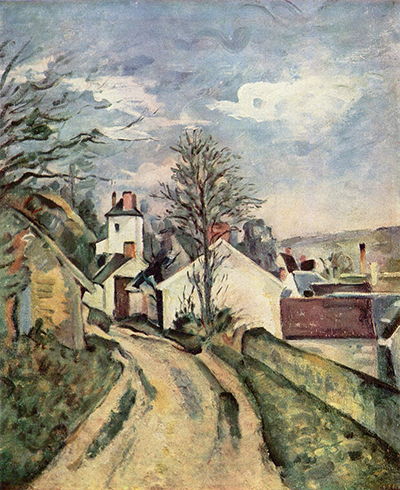
A road climbs into a cluster of houses, then disappears just where the eye expects to arrive. In Paul Cézanne’s The House of Doctor Gachet at Auvers , the doctor’s property is a distant part of that cluster, rather than an isolated house posed for inspection.
The Musée d’Orsay identifies the small oil on canvas as La Maison du docteur Gachet à Auvers , dates it to about 1873, and records its gift by Gachet’s son in 1951. [1]
That title offers a destination, but the painted route is more interesting than a simple arrival. A deep wheel mark pulls us from the lower edge towards the center. The road turns between a heavy green bank and a lower wall, while roofs and trunks interrupt any clear view ahead. The house can be located, yet it remains one element in a shifting arrangement of paths, masonry, branches and sky. Cézanne turns a familiar local approach into a study of how buildings gather and separate as one moves through a village.
At a Glance
- Artist Paul Cézanne. [1]
- Date about 1873 in the Musée d’Orsay record; 1872–73 in the online catalogue raisonné. [1] [2]
- Medium and size oil on canvas, 46 × 38 cm. [1]
- Collection Musée d’Orsay, Paris, RF 1951 32. [1]
- Catalogue identity FWN 70, Rewald 192, Venturi 145. [2]
This work across Paul Cézanne’s career
The Kiss of the Muse
c.1860The Artist’s Father, Reading L’Événement
autumn 1866The Hanged Man’s House
c.1873A Modern Olympia
1873–74The House of Doctor Gachet at Auvers (current article)
c. 1873 (Orsay); 1872–73 (catalogue)Maincy Bridge
1879–80The Blue Vase
1889–90The Basket of Apples
c.1893Apples and Oranges
c.1899The Large Bathers (Philadelphia)
1900–1906 (Philadelphia Museum dating)Château Noir (MoMA)
1903–04Contents
- Following the road
- The house behind the title
- A working neighborhood in Auvers
- Three views, one recurring name
- Date, surface and later life
Following the road
The road occupies almost the entire lower half of the narrow canvas. Its pale surface is broad at the bottom, pinched in the middle, and briefly visible again beside the buildings. Two dark ruts do different jobs: one bends inward from the left edge, while the other rises sharply near the middle before breaking apart. They prevent the foreground from reading as a smooth corridor. Cézanne leaves small changes of ochre, gray and green within the earth, so the route feels worked over by traffic and weather rather than filled with a single color.
The banks make that movement less certain. At left, a steep, irregular mass appears to push into the road. A pale patch near its center suggests exposed stone or plaster, but the surrounding brush marks keep the surface rough. At right, a diagonal wall runs uphill from the corner, its top edge catching light and its face turning green in shadow. The two sides do not meet as a tidy funnel. Their changing widths create a sequence of slight obstructions, and the road has to thread between them.
Notice how the rooftops enter after this demanding foreground. The first low roof at left nearly touches the road; a tall white block rises behind it. Farther right, a larger cream gable faces us, its surface crossed by a thin, dark trunk. The separate buildings are easy to name, yet Cézanne lets their edges overlap. The result is a place understood by stages, through the gaps left between nearby walls and more distant roofs.
The house behind the title
The painting’s traditional name can mislead a viewer looking for a single central façade. In the 1999 Gachet collection catalogue, Anne Distel identifies the doctor’s house as the light-colored building higher up and a little left of center, showing its western side. An old photograph of the site accompanies her discussion. The named house is reached visually only after the road and nearer houses have led us into the scene. [3]
The named house stands back from the road. A nearer cream gable and the central tree compete for attention, while the low roof at left screens the road’s final stretch. Familiarity with the address does not produce an unobstructed view of it.
The sky opens the composition just as the road narrows. A large bank of blue-gray cloud spreads over the upper left, and a bright, irregular break appears to the right of center. The bare branches at left cut across the cloud like quick dark strokes; the upright tree below reaches into a paler part of the sky. Its branches are not a symmetrical crown. They divide and rejoin in front of buildings and atmosphere, binding those layers without flattening them into one plane.
A working neighborhood in Auvers
Doctor Paul-Ferdinand Gachet bought his Auvers property in April 1872. A recent Art Institute of Chicago study places Cézanne, Hortense Fiquet and their infant son in modest accommodation on the same street. Gachet, already connected to Pissarro, made his attic studio available to Cézanne. That proximity matters to this painting: its subject was part of Cézanne’s daily working landscape, not a landmark he encountered only as a visitor. [4]
Pissarro’s letter to Antoine Guillemet of 3 September 1872 gives a near-contemporary measure of the move. He expected Cézanne to settle at Auvers and wrote with enthusiasm about the strength of paintings he had already seen. The letter supports the existence of a close artistic exchange at this moment, although it does not identify The House of Doctor Gachet or date any particular stroke in it. Later descriptions of Gachet’s hospitality fill out the setting; Pissarro’s own words show what one colleague thought while the move was taking shape. [5]
The picture is especially attentive to a modest bit of village infrastructure: the road, its banks, the walls that contain it, the houses added at different heights. One can imagine a route taken repeatedly without needing to claim that the painting records a particular journey. Cézanne has kept the ordinary unevenness that makes the site recognizable as inhabited. At the same time, he has organized that unevenness into strong diagonals and a compressed stack of building forms. The painting’s interest lies in the pressure between those two things: the local detail one might pass by and the deliberate structure that makes one stop.
Three views, one recurring name
There are three Cézanne oils catalogued under versions of the Gachet-house title. The Orsay painting is FWN 70, a 46 × 38 cm canvas from the Gachet family collection. FWN 71 is the larger Yale painting, with a different ownership history; FWN 75 is the 56 × 47 cm picture associated with the Rudolf Staechelin collection. The catalogue lists them separately, with Rewald numbers 192, 193 and 194. Their shared title is therefore a guide to the motif, not proof that a reproduction of one can stand for another. [2]
The Orsay version is distinctive even before a close comparison: its vertical format gives more room to the rising road and unsettled sky than a conventional horizontal village view would allow. The square white building, bare central tree and broad cream gable form a middle band between those zones. The eye can move quickly up the road, but the stacked architecture slows it down. Looking back from the clouds, the branches appear to repeat the same irregular turns as the wheel ruts below. This is a visual relationship within this canvas, rather than a claim that all three versions were painted from identical positions or in a known order.
Date, surface and later life
The Musée d’Orsay’s “about 1873” and the catalogue raisonné’s “1872–73” express useful caution. [1] [2]
Distel reports a stamp on the original canvas, visible before its 1986 relining. She links it to Paris supplier Chabod, whose address appears in commercial directories for 1870–72. That clue helps situate the material without dating the painting precisely. She also notes visible canvas in places. [3]
The color does not simply brighten every part of the scene. The pale walls can look almost white, but brown roofs and green-black vegetation hold them in a darker neighborhood. The roadway is warm, though streaks of cool gray keep it from becoming a sunny strip. Above, the opening in the clouds is brilliant without clearing the whole sky. These contrasts let the small canvas carry several kinds of light at once. The pale gaps in the branches and slight shifts at the margins of the buildings also allow the viewer to sense the painting as worked surface, not just as a diagram of the village.
Gachet owned the painting, and it passed to his son Paul-Louis, who gave it to the French national museums in 1951. Assigned to the Louvre and shown at the Jeu de Paume, it moved to the Musée d’Orsay in 1986. Later exhibitions included Orangerie shows in the 1950s, the 1999 Gachet collection exhibition, and the Cézanne and Pissarro exhibition in 2006. [1]
Cézanne artworks directory
Browse 217 identified works in this researched selection, including paintings, drawings and watercolours. This is a bounded selection, not a complete catalogue of Cézanne’s surviving oeuvre. Unlinked titles have no confirmed article in this collection.
| Name | Date | Medium |
|---|---|---|
| A Head, a Cup, and a Bread Roll | 1891/1894 | Drawing |
| A Man seen from Behind | 1880/1883 | Drawing |
| A Modern Olympia | 1873–74 | Painting |
| A Nude and Foliage | 1879/1882 | Drawing |
| A Smoking Man | 1892–96 (catalogue); c.1890–92 (museum) | Drawing |
| Afternoon in Naples | 1876–77 | Painting |
| An Old Woman with a Rosary | about 1895–96 | Painting |
| Apples and Oranges | c.1899 | Painting |
| Auvers, Panoramic View | 1873–75 | Painting |
| Avenue at Chantilly | 1888 | Painting |
| Banks of the Marne | 1888–94 | Painting |
| Basket | 1877/1900 | Drawing |
| Bather with Outstretched Arms | 1877–78 | Painting |
| Bellows in Front of a Fireplace | 1887/1892 | Drawing |
| Bibémus Quarry | c.1895 | Painting |
| Boy in a Red Vest, Barnes Foundation | 1888–90 | Painting |
| Boy in a Red Vest, MoMA | 1888–90 | Painting |
| Boy in a Red Waistcoat, National Gallery of Art | 1888–90 | Painting |
| Branch in Flower | 1886/1889 | Drawing |
| Carnival Scene | 1885/1888 | Drawing |
| Chair and Dresser | 1880/1883 | Drawing |
| Chateau Noir | 1903–04 | Painting |
| Chestnut Trees and Farm at Jas de Bouffan | c.1885 | Painting |
| Chestnut Trees and Farm at Jas de Bouffan, Pushkin | c.1886 | Painting |
| Chestnut Trees at Jas de Bouffan in Winter | 1885–86 | Painting |
| Château Noir | 1900–04 | Painting |
| Cistern in the Park of Château Noir | c.1900 | Painting |
| Curtain, Jug and Fruit | 1893–94 | Painting |
| Cushion of an Armchair | 1886/1889 | Drawing |
| Draft Letter and Studies of Bathers | c.1878 | Drawing |
| Farmhouse and Chestnut Trees at Jas de Bouffan | 1884–85 | Painting |
| Figure Resting Head on Hand | c. 1889 | Drawing |
| Fireplace Tongs and Poker | 1887/1892 | Drawing |
| Forest Interior, San Francisco | c.1898–99 | Painting |
| Four Bathers | 1888–90 | Painting |
| Fruit and a Jug on a Table | 1893–94 | Painting |
| Gardanne | 1885–86 | Painting |
| Gardanne, Barnes Foundation | c.1885 | Painting |
| Hand and Shoulder of a Boy | c. 1885 | Drawing |
| Harlequin, National Gallery of Art | 1888–90 | Painting |
| Head of a Boy | 1887/1889 | Drawing |
| Head of a Boy Seen from Behind | c. 1885 | Drawing |
| Head of a Young Woman | c. 1880 | Drawing |
| Head of the Artist's Son | 1888/1889 | Drawing |
| Hillside in Provence | c.1890–92 | Painting |
| Horse Chestnut Trees at Jas de Bouffan | c.1885 | Painting |
| House and Farm at the Jas de Bouffan | c.1887 | Painting |
| House in a Park | 1883/1886 | Drawing |
| House in Provence | c.1885 | Painting |
| House of Père Lacroix | 1873 | Painting |
| House Surrounded by Vegetation | 1889/1892 | Drawing |
| Houses in Provence The Riaux Valley near L’Estaque | c.1883 | Painting |
| Jas de Bouffan, the Pool | c.1876 | Painting |
| Kerosene Lamp | 1878/1881 | Drawing |
| L'Estaque, Melting Snow | c.1870 | Painting |
| Lake Annecy | 1896 | Painting |
| Landscape in Provence, Pola Museum | 1879–82 | Painting |
| Landscape Near Aix-en-Provence | 1877/1880 | Drawing |
| Landscape Seen from the Inside of a Cave | 1889/1892 | Drawing |
| Landscape with Poplars | c.1885–87 | Painting |
| Landscape with Trees | 1895/1898 | Drawing |
| Leda and the Swan | c.1880 (possibly later) | Painting |
| Little Girl with a Doll | 1902–04 | Painting |
| Louis Guillaume | 1879–1890 | Painting |
| Madame Cezanne | 1888/1891 | Drawing |
| Madame Cezanne | 1886/1889 | Drawing |
| Madame Cezanne | 1882/1887 | Drawing |
| Madame Cezanne | 1897/1900 | Drawing |
| Madame Cezanne with her Head Lowered | 1893/1896 | Drawing |
| Madame Cézanne in a Red Armchair | c.1877 | Painting |
| Madame Cézanne in a Red Dress, Metropolitan Museum of Art | 1888–90 | Painting |
| Madame Cézanne in a Yellow Chair | 1888–90 | Painting |
| Madame Cézanne in a Yellow Chair, Fondation Beyeler | 1888–90 | Painting |
| Madame Cézanne in the Conservatory | 1891 | Painting |
| Maincy Bridge | 1879–80 | Painting |
| Maison Maria with a View of Château Noir | c.1895 | Painting |
| Man Bending Forward | 1883/1886 | Drawing |
| Man Smoking a Pipe, Pushkin | c.1891, possibly later | Painting |
| Man with a Pipe | 1891–96 | Painting |
| Man with a Pipe, Nelson-Atkins | 1890–92 | Painting |
| Man with a Straw Hat (Gustave Boyer) | c.1871 | Painting |
| Man with Crossed Arms | c.1899 | Painting |
| Man with Pipe, National Gallery of Art | 1892–96 | Painting |
| Mont Sainte-Victoire | c.1902–06 | Painting |
| Mont Sainte-Victoire | 1900–02 | Painting |
| Mont Sainte-Victoire (recto) | c.1895 | Watercolour |
| Mont Sainte-Victoire and the Viaduct of the Arc River Valley | 1882–85 | Painting |
| Mont Sainte-Victoire Seen beyond the Wall of the Jas de Bouffan | c.1885/1888 | Watercolour |
| Mont Sainte-Victoire Seen from Bibémus Quarry | c.1897 | Painting |
| Mont Sainte-Victoire, Barnes Foundation | 1892–95 | Painting |
| Near the Pool at Jas de Bouffan | 1883/1887 | Drawing |
| Pelicans | 1877/1880 | Drawing |
| Peonies | 1890/1893 | Drawing |
| Pierrot and Harlequin | 1888 | Painting |
| Pine Tree | 1882/1885 | Drawing |
| Pont des Trois Sautets | 1906 | Watercolour |
| Poplars | 1879–80 | Painting |
| Portrait of Ambroise Vollard | 1899 | Painting |
| Portrait of Gustave Geffroy | 1895–96 | Painting |
| Portrait of Madame Cezanne with Loosened Hair | 1885–86 | Painting |
| Portrait of the Artist Looking Over His Shoulder | 1883–84 | Painting |
| Portrait of the Gardener Vallier | 1906 | Painting |
| Portrait of Victor Chocquet | 1876–77 | Painting |
| Portrait Of Victor Chocquet Seated | 1877 | Painting |
| Provençal Manor | c.1885 | Painting |
| Pyramid of Skulls | 1898–1900 | Painting |
| Reclining Nude (Leda?) | c.1887 | Painting |
| Scipio | 1866–68 | Painting |
| Seated Man, Oslo | 1898–1900 | Painting |
| Seated Peasant | c.1892–96 | Painting |
| Seated Peasant, Hiroshima | c.1897 | Painting |
| Seated Peasant, Orsay | c.1900 | Painting |
| Self-Portrait | c. 1895 | Drawing |
| Self-Portrait in a Bowler Hat, Ny Carlsberg Glyptotek | 1885–86 | Painting |
| Self-Portrait in a Casquette | c.1875 | Painting |
| Self-Portrait with a Beret | 1898–1900 | Painting |
| Self-Portrait with a Hat, Artizon Museum | c.1890–94 | Painting |
| Self-Portrait with a Pink Background | c.1875 | Painting |
| Self-Portrait with Olive-Coloured Wallpaper | about 1880–81 | Painting |
| Self-Portrait with Palette | 1886–87 | Painting |
| Self-Portrait with White Turban | c.1878–80 | Painting |
| Self-Portrait, c.1895 | c.1895 | Painting |
| Self-Portrait, Pushkin Museum | c.1882 | Painting |
| Spanish Dancers | 1883/1886 | Drawing |
| Still Life with a Curtain | 1892–94 | Painting |
| Still Life with Apples | c.1890 | Painting |
| Still Life with Apples | 1893–94 | Painting |
| Still Life with Apples and a Pot of Primroses | about 1890 | Painting |
| Still Life with Milk Jug and Fruit | c.1900 | Painting |
| Still Life with Open Drawer | 1877–79 | Painting |
| Still Life with Plaster Cupid | about 1894 | Painting |
| Still Life with Skull | 1890–93 | Painting |
| Still Life with Soup Tureen | 1877 | Painting |
| Still Life, Pitcher and Fruit | 1893–94 | Painting |
| Studies Including a Straw Hat | 1895/1898 | Drawing |
| Studies Including Madame Cezanne | 1884/1887 | Drawing |
| Study for "The Judgement of Paris" or "The Amorous Shepherd" | 1883/1886 | Drawing |
| Study for Woman with a Coffee Pot | c.1895 | Painting |
| Study of "The Roman Orator (Germanicus)" | 1883/1886 | Drawing |
| Study of "Venus de Milo" | 1881/1884 | Drawing |
| Study of a Decorative Ornament | 1879/1882 | Drawing |
| Study of a Standing Male Figure after the Antique | c. 1895 | Drawing |
| Study of an Angel in Rubens' "The Prophet Elijah" | 1892/1895 | Drawing |
| Study of Desiderio da Settignano's "Bust of a Child" | c. 1895 | Drawing |
| Study of Houses | 1879/1882 | Drawing |
| Study of Puget's "Hercules Resting" | c. 1879 | Drawing |
| Study of Puget's "Milo of Crotona" | 1895/1898 | Drawing |
| Study of Puget's "Milo of Crotona" | 1880/1883 | Drawing |
| Study of the Allegorical Figure Bellona in Rubens' "The Apotheosis of Henri IV" | 1883/1886 | Drawing |
| Study of the Allegorical Figure Bellona in Rubens' "The Apotheosis of Henri IV" | 1879/1882 | Drawing |
| Study of the Allegorical Figure France in Rubens' "The Exchange of the Two Princesses" | 1882/1885 | Drawing |
| Study of the Allegorical Figure of Health in Rubens' "The Birth of Louis XIII" | 1880/1883 | Drawing |
| Study of the Allegorical Figure of the Genius of Health from Rubens' "The Birth of Louis XIII at Fontainbleau" | 1895/1898 | Drawing |
| Sugar Bowl, Pears and Blue Cup | 1865–66 | Painting |
| The Aqueduct, Pushkin Museum | Dating differs between museum records | Painting |
| The Artist's Father, Reading L'Evenement | autumn 1866 | Painting |
| The Artist's Son | c. 1887 | Drawing |
| The Artist's Son Leaning on his Elbow | c. 1887 | Drawing |
| The Artist's Son Reading | c. 1887 | Drawing |
| The Artist's Son Writing | c. 1887 | Drawing |
| The Artist’s Son, Paul | 1886–87 | Painting |
| The Avenue at Jas de Bouffan | 1868–70 (possibly later) | Painting |
| The Avenue at Jas de Bouffan, Geneva | c.1890 | Painting |
| The Basket of Apples | c.1893 | Painting |
| The Bather, Museum of Modern Art | c.1885 | Painting |
| The Bay of Marseille seen from L'Estaque | c.1885 | Painting |
| The Blue Vase | 1889–90 | Painting |
| The Boy in the Red Vest, Bührle | 1888–90 | Painting |
| The Buffet | 1877–79 | Painting |
| The Card Players, Barnes Foundation | 1890–92 | Painting |
| The Card Players, Courtauld Gallery | 1892–96 | Painting |
| The Card Players, Metropolitan Museum of Art | 1890–92 | Painting |
| The Card Players, Musée d’Orsay | 1893–96 | Painting |
| The Card Players, Qatar | 1892–96 | Painting |
| The Eternal Feminine | c.1877 | Painting |
| The Gardener Vallier | 1906 | Painting |
| The Gardener Vallier, Tate | 1905–06 | Painting |
| The Grounds of the Château Noir | c.1900–04 | Painting |
| The Gulf of Marseille Seen from L’Estaque | c.1885 | Painting |
| The Hanged Man's House in Auvers | c.1873 | Painting |
| The House of Doctor Gachet at Auvers | 1872–73 | Painting |
| The House with the Cracked Walls | 1892–94 | Painting |
| The Kiss of the Muse | c.1860 | Painting |
| The Large Bathers, Barnes Foundation | 1895–1906 | Painting |
| The Large Bathers, National Gallery | 1895–1905 | Painting |
| The Large Bathers, Philadelphia Museum of Art | 1900–06 | Painting |
| The Mill | 1889/1892 | Drawing |
| The Painter’s Father, Louis-Auguste Cézanne | c.1865 | Painting |
| The Peasant | 1890–92 | Painting |
| The Plaster Mill (La Moulin à plâtre) | 1889/1892 | Drawing |
| The Smoker, Hermitage | c.1891 | Painting |
| The Smoker, Mannheim | c.1891 | Painting |
| The Stove in the Studio | c.1865 | Painting |
| The Vase of Tulips | c.1890 | Painting |
| Thistle | 1893/1896 | Drawing |
| Three Heads, One of Madame Cezanne | 1882/1885 | Drawing |
| Three Skulls | c.1898 | Painting |
| Three Skulls on a Patterned Carpet | 1904 | Painting |
| Trees and Shrubs | 1883/1887 | Drawing |
| Turning Road at Montgeroult | 1898 | Painting |
| Two Bathers | 1884/1887 | Drawing |
| Two Heads | 1888 | Drawing |
| Two Heads | 1890/1896 | Drawing |
| Two Heads of Women | 1890/1894 | Drawing |
| Two Studies for "The Judgement of Paris" or "The Amorous Shepherd" | 1883/1886 | Drawing |
| Uncle Dominique in a Tasseled Cap | 1866 | Painting |
| Uncle Dominique in a Turban | 1866–67 | Painting |
| Victor Chocquet and an Angel for "The Apotheosis of Delacroix" | 1878/1880 | Drawing |
| Woman in Blue | c.1904 | Painting |
| Woman Leaning Forward | 1888/1891 | Drawing |
| Woman Leaning Forward | 1890/1894 | Drawing |
| Woman Leaning Forward | 1890/1894 | Drawing |
| Woman with a Coffee Pot | c.1895 | Painting |
| Women Bathers and a Roll of Paper | 1882/1885 | Drawing |
| Young Girl with a Doll | c.1895 | Painting |
| Young Italian Woman at a Table | c.1895–1900 | Painting |
| Young Man and Skull | 1896–98 | Painting |
Frequently Asked Questions
This is RF 1951 32, catalogued as FWN 70, Rewald 192 and Venturi 145. Yale FWN 71 and Staechelin FWN 75 are separate paintings. [2]
The 1999 catalogue places his house higher up, a little left of center. [3]
Discussion
Look again at the images and ideas explored in The House of Doctor Gachet at Auvers. These editorial prompts invite your observations.
Reader Insights
Begin at the bottom edge and follow each wheel rut separately. Where does each stop guiding your eye?
Find the house named in the title only after looking at the buildings nearest the road. How does its position change the painting’s emphasis?
Look from the dark branches into the bright gap in the clouds, then back to the pale road. Which part of the scene feels most open?
Join the Conversation
Share a detail, comparison or question about The House of Doctor Gachet at Auvers below.
References
- Musée d’Orsay. “La Maison du docteur Gachet à Auvers,” collection record, accession RF 1951 32. (in French). View source .
- Société Paul Cezanne. “La Maison du docteur Gachet à Auvers-sur-Oise, 1872–73 (FWN 70),” The Paintings, Watercolors and Drawings of Paul Cezanne: An Online Catalogue Raisonné , with related entries FWN 71 and FWN 75. View source .
- The Metropolitan Museum of Art. Anne Distel and Susan Alyson Stein, Cézanne to Van Gogh: The Collection of Doctor Gachet (1999), catalogue no. 2, pp. 44–45. View source .
- The Art Institute of Chicago. Paul Smith, with Kim Muir and Giovanni Verri, “Auvers, Panoramic View,” cat. 1, Cézanne Paintings and Watercolors at the Art Institute of Chicago (2026), introductory and “The Motif” sections. View source .
- Société Cézanne. “1872,” chronology, reproducing Camille Pissarro’s letter to Antoine Guillemet of 3 September 1872. (in French). View source .
- Le Baiser de la muse, d'après Frillié (FWN 572). View source.
- Louis-Auguste Cezanne, père de l'artiste, lisant L'Événement (FWN 402). View source.
- La Maison du pendu, Auvers-sur-Oise (FWN 81). View source.
- Une moderne Olympia (FWN 628). View source.
- Le Pont de Maincy (FWN 143). View source.
- La Montagne Sainte-Victoire vue de Montbriand (FWN 185). View source.
- Gardanne (vue horizontale) (FWN 224). View source.
- Le Vase bleu (FWN 823). View source.
- Les Joueurs de cartes (FWN 681). View source.
- La Montagne Sainte-Victoire (FWN 296). View source.
- La Corbeille de pommes (FWN 860). View source.
- Pommes et oranges (FWN 871). View source.
- Portrait d'Ambroise Vollard (FWN 531). View source.
- Philadelphia Museum of Art,The Large Bathers,W1937-1-1. View source.
- Château Noir (FWN 360). View source.
- Société Paul Cezanne,online catalogue structure and objectidentification. View source.
- National Gallery of Art,Cezanne Sketchbook,1992.51.9. View source.
- Splash image, A rutted road rises between banks and walls towards clustered buildings beneath a broken cloudy sky.