 by
Tom Gurney
Tom Gurney BSc (Hons) is an art history expert with over 20 years experience
Published on June 19, 2020 / Updated on October 22, 2026
Email:
tomgurney1@gmail.com
/ Phone:
+44 7429 011000
View of Auvers: Cézanne’s Panoramic View: Introduction
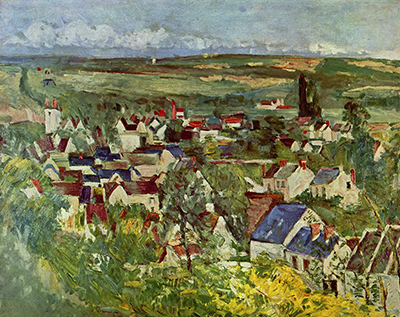
Houses jostle against trees in Cézanne’s View of Auvers . Strips of cultivated land stretch behind them, while a long, low sky presses down on the horizon. The village seems almost too crowded to survey.
This is FWN 83, the Art Institute of Chicago’s Auvers, Panoramic View . The catalogue raisonné dates it 1873–74; Chicago uses 1873–75. [1] [2]
At a Glance
- Artist Paul Cézanne. [1]
- Work Auvers, Panoramic View (also known as View of Auvers ), FWN 83. [1]
- Date 1873–74 in the catalogue raisonné; 1873–75 at the Art Institute of Chicago. [1] [2]
- Medium and size Oil on canvas, approximately 65.2 × 81.3 cm. [1]
- Collection Art Institute of Chicago, accession 1933.422. [1]
This work across Paul Cézanne’s career
The Kiss of the Muse
c.1860The Artist’s Father, Reading L’Événement
autumn 1866The Hanged Man’s House
c.1873A Modern Olympia
1873–74View of Auvers: Cézanne’s Panoramic View (current article)
1873–74 (catalogue); 1873–75 (Chicago)Maincy Bridge
1879–80The Blue Vase
1889–90The Basket of Apples
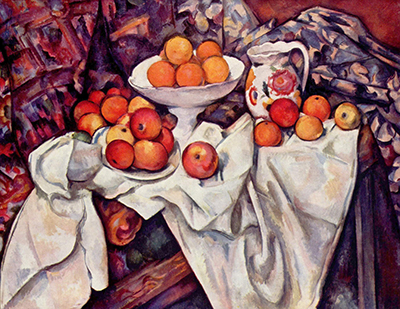
c.1893Apples and Oranges
c.1899The Large Bathers (Philadelphia)
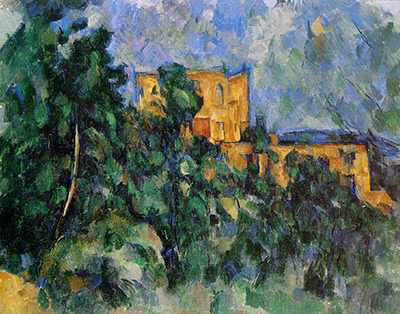
1900–1906 (Philadelphia Museum dating)Château Noir (MoMA)
1903–04Contents
- A village made of competing distances
- Why this place matters
- How the paint holds the scene together
- A documented painting with a complicated afterlife
A village made of competing distances
Start at the skyline. A pale blue-gray band of sky occupies relatively little space, but its cloud forms spread almost the whole width of the canvas. Immediately beneath it the far fields run horizontally. These restrained bands offer the nearest thing to a conventional long view. They give the eye room to travel before it reaches the village below. Their quieter marks also make the compressed activity of the middle of the painting more noticeable.
The village has no single, clean route through it. White walls form small bright interruptions among red, brown and blue roofs. One roof points toward the horizon; another seems to turn across the viewer’s path. Chimneys rise as sharp accents, while irregular green forms interrupt the outlines of houses. A viewer can pick out individual buildings, but their edges rarely make a complete map. That tension between recognition and uncertainty is part of the experience of looking, rather than a defect that must be corrected by finding a photograph of the site.
The strongest interruption is the broad, dark tree below the centre. Its mass separates the houses to either side without opening a neat window into the distance. A narrower, taller form rises farther back near the right. Together they keep the horizontal town from becoming a flat strip. They also set different tempos for the eye: the central tree asks for slow inspection of many small touches, while the upright beyond can be grasped almost at once.
On the lower right, a large blue roof and its adjoining light walls are comparatively easy to read as a building. Elsewhere, short strokes give the roofs enough direction to suggest a village without making every junction explicit. The eye repeatedly has to decide whether a patch belongs to a wall, foliage or the space between them. From a distance these marks cohere. Close up they retain the separateness of applied paint.
The clouds deserve more than a passing glance. At the far left they gather into rounded, pale forms; over the centre they become a thinner broken cover. Their scale is much broader than the short angular marks beneath them. The sky therefore has its own pattern rather than simply serving as empty space above the town. A dark thread along the horizon keeps its underside connected to the cultivated land, even where the buildings below pull attention away.
Why this place matters
The Art Institute identifies Dr. Gachet’s house at upper left, the House of the Hanged Man lower down, and a former factory chimney near the centre. None dominates the view. [2]
The Musée d’Orsay describes The House of the Hanged Man , another Auvers painting, as a scene built around several strong paths and close-set planes. It was among Cézanne’s contributions to the first Impressionist exhibition in 1874. Here, a town rather than one house fills the canvas. The comparison helps explain why the broader picture feels less like a destination and more like a place through which the eye keeps moving. [3]
The museum’s Village Road, Auvers , dated 1872–73, offers a second measure of Cézanne’s interest in uncelebrated local subjects. Orsay notes its shut houses and road that narrows behind a wall, and connects the work to Cézanne’s time painting with Pissarro. The Chicago panorama also refuses a dramatic episode. But where the road picture channels attention through a lane, this canvas scatters it among several clusters of roofs. These are different answers to the problem of making ordinary buildings hold a viewer’s attention. [4]
How the paint holds the scene together
The Art Institute found visible brownish-gray ground in thin passages and denser paint below. Some strokes cover dried layers. No underdrawing was observed, though thick paint might hide it; no major composition change was detected. [2]
Paul Smith’s study of Cézanne’s perspective argues that a nearby Auvers painting, The Quartier Four , makes houses perceptually unsettled through their relations with neighboring forms. That is a comparison, not a technical finding about this canvas. It offers a useful way to test one’s own looking here: the town is built from local encounters, and a wall or roof may change its apparent alignment as attention moves to the next shape. [5]
The foreground is especially resistant to a quick reading. It contains bright strokes that can be followed individually, but not assembled into a precise botanical inventory. Near the lower edge, the grass seems to turn into marks of yellow, white and green before becoming vegetation again when seen from farther away. This shift gives the view its unusual vitality. The village can be seen both as a settled place and as a field of relationships being found in paint.
At the lower corners the painted forms meet the frame in different ways. On the left, sloping greens lead inward toward pale houses; on the right, the blue roof sits so close to the edge that part of its setting lies beyond it. The composition does not give either side a matching border. That imbalance makes the middle tree seem less like a fixed centre and more like a point from which the eye can choose divergent routes. The picture remains active even when one stops trying to identify its buildings.
A documented painting with a complicated afterlife
Dr. Gachet and then his son owned the painting; later holders included Vollard, Strölin and the Coburns. Older claims for Chocquet and Viau confused it with another Auvers canvas. A shared place-name cannot establish shared ownership. [2]
The documented exhibition record reaches back to a Paris modern-art show in 1912, where Vollard lent it under a title already close to Panoramic View . Its public name thus belongs to the painting’s later circulation as well as to its subject. [1]
The Metropolitan Museum of Art’s 1999 Gachet collection catalogue illustrated this work as Panoramic View of Auvers-sur-Oise and noted the uncertainty surrounding an identification with a Cézanne village view admired by Vincent van Gogh. It considered several Auvers landscapes viable candidates. That caution is preferable to turning a later admirer’s mention of a village painting into a secure reference to this canvas. [6]
The same catalogue records a copy made by Gachet’s son in February 1900 and a Vollard archive photograph annotated “Auvers 1875” by Cézanne’s son. Those traces show the picture being copied, photographed and dated by people close to its early history. They do not settle the year in which every passage of the original was painted. In particular, an annotation on a photograph is evidence of a later dating judgment, not a dated signature on the canvas. [6]
Cézanne artworks directory
Browse 217 identified works in this researched selection, including paintings, drawings and watercolours. This is a bounded selection, not a complete catalogue of Cézanne’s surviving oeuvre. Unlinked titles have no confirmed article in this collection.
| Name | Date | Medium |
|---|---|---|
| A Head, a Cup, and a Bread Roll | 1891/1894 | Drawing |
| A Man seen from Behind | 1880/1883 | Drawing |
| A Modern Olympia | 1873–74 | Painting |
| A Nude and Foliage | 1879/1882 | Drawing |
| A Smoking Man | 1892–96 (catalogue); c.1890–92 (museum) | Drawing |
| Afternoon in Naples | 1876–77 | Painting |
| An Old Woman with a Rosary | about 1895–96 | Painting |
| Apples and Oranges | c.1899 | Painting |
| Auvers, Panoramic View | 1873–75 | Painting |
| Avenue at Chantilly | 1888 | Painting |
| Banks of the Marne | 1888–94 | Painting |
| Basket | 1877/1900 | Drawing |
| Bather with Outstretched Arms | 1877–78 | Painting |
| Bellows in Front of a Fireplace | 1887/1892 | Drawing |
| Bibémus Quarry | c.1895 | Painting |
| Boy in a Red Vest, Barnes Foundation | 1888–90 | Painting |
| Boy in a Red Vest, MoMA | 1888–90 | Painting |
| Boy in a Red Waistcoat, National Gallery of Art | 1888–90 | Painting |
| Branch in Flower | 1886/1889 | Drawing |
| Carnival Scene | 1885/1888 | Drawing |
| Chair and Dresser | 1880/1883 | Drawing |
| Chateau Noir | 1903–04 | Painting |
| Chestnut Trees and Farm at Jas de Bouffan | c.1885 | Painting |
| Chestnut Trees and Farm at Jas de Bouffan, Pushkin | c.1886 | Painting |
| Chestnut Trees at Jas de Bouffan in Winter | 1885–86 | Painting |
| Château Noir | 1900–04 | Painting |
| Cistern in the Park of Château Noir | c.1900 | Painting |
| Curtain, Jug and Fruit | 1893–94 | Painting |
| Cushion of an Armchair | 1886/1889 | Drawing |
| Draft Letter and Studies of Bathers | c.1878 | Drawing |
| Farmhouse and Chestnut Trees at Jas de Bouffan | 1884–85 | Painting |
| Figure Resting Head on Hand | c. 1889 | Drawing |
| Fireplace Tongs and Poker | 1887/1892 | Drawing |
| Forest Interior, San Francisco | c.1898–99 | Painting |
| Four Bathers | 1888–90 | Painting |
| Fruit and a Jug on a Table | 1893–94 | Painting |
| Gardanne | 1885–86 | Painting |
| Gardanne, Barnes Foundation | c.1885 | Painting |
| Hand and Shoulder of a Boy | c. 1885 | Drawing |
| Harlequin, National Gallery of Art | 1888–90 | Painting |
| Head of a Boy | 1887/1889 | Drawing |
| Head of a Boy Seen from Behind | c. 1885 | Drawing |
| Head of a Young Woman | c. 1880 | Drawing |
| Head of the Artist's Son | 1888/1889 | Drawing |
| Hillside in Provence | c.1890–92 | Painting |
| Horse Chestnut Trees at Jas de Bouffan | c.1885 | Painting |
| House and Farm at the Jas de Bouffan | c.1887 | Painting |
| House in a Park | 1883/1886 | Drawing |
| House in Provence | c.1885 | Painting |
| House of Père Lacroix | 1873 | Painting |
| House Surrounded by Vegetation | 1889/1892 | Drawing |
| Houses in Provence The Riaux Valley near L’Estaque | c.1883 | Painting |
| Jas de Bouffan, the Pool | c.1876 | Painting |
| Kerosene Lamp | 1878/1881 | Drawing |
| L'Estaque, Melting Snow | c.1870 | Painting |
| Lake Annecy | 1896 | Painting |
| Landscape in Provence, Pola Museum | 1879–82 | Painting |
| Landscape Near Aix-en-Provence | 1877/1880 | Drawing |
| Landscape Seen from the Inside of a Cave | 1889/1892 | Drawing |
| Landscape with Poplars | c.1885–87 | Painting |
| Landscape with Trees | 1895/1898 | Drawing |
| Leda and the Swan | c.1880 (possibly later) | Painting |
| Little Girl with a Doll | 1902–04 | Painting |
| Louis Guillaume | 1879–1890 | Painting |
| Madame Cezanne | 1888/1891 | Drawing |
| Madame Cezanne | 1886/1889 | Drawing |
| Madame Cezanne | 1882/1887 | Drawing |
| Madame Cezanne | 1897/1900 | Drawing |
| Madame Cezanne with her Head Lowered | 1893/1896 | Drawing |
| Madame Cézanne in a Red Armchair | c.1877 | Painting |
| Madame Cézanne in a Red Dress, Metropolitan Museum of Art | 1888–90 | Painting |
| Madame Cézanne in a Yellow Chair | 1888–90 | Painting |
| Madame Cézanne in a Yellow Chair, Fondation Beyeler | 1888–90 | Painting |
| Madame Cézanne in the Conservatory | 1891 | Painting |
| Maincy Bridge | 1879–80 | Painting |
| Maison Maria with a View of Château Noir | c.1895 | Painting |
| Man Bending Forward | 1883/1886 | Drawing |
| Man Smoking a Pipe, Pushkin | c.1891, possibly later | Painting |
| Man with a Pipe | 1891–96 | Painting |
| Man with a Pipe, Nelson-Atkins | 1890–92 | Painting |
| Man with a Straw Hat (Gustave Boyer) | c.1871 | Painting |
| Man with Crossed Arms | c.1899 | Painting |
| Man with Pipe, National Gallery of Art | 1892–96 | Painting |
| Mont Sainte-Victoire | c.1902–06 | Painting |
| Mont Sainte-Victoire | 1900–02 | Painting |
| Mont Sainte-Victoire (recto) | c.1895 | Watercolour |
| Mont Sainte-Victoire and the Viaduct of the Arc River Valley | 1882–85 | Painting |
| Mont Sainte-Victoire Seen beyond the Wall of the Jas de Bouffan | c.1885/1888 | Watercolour |
| Mont Sainte-Victoire Seen from Bibémus Quarry | c.1897 | Painting |
| Mont Sainte-Victoire, Barnes Foundation | 1892–95 | Painting |
| Near the Pool at Jas de Bouffan | 1883/1887 | Drawing |
| Pelicans | 1877/1880 | Drawing |
| Peonies | 1890/1893 | Drawing |
| Pierrot and Harlequin | 1888 | Painting |
| Pine Tree | 1882/1885 | Drawing |
| Pont des Trois Sautets | 1906 | Watercolour |
| Poplars | 1879–80 | Painting |
| Portrait of Ambroise Vollard | 1899 | Painting |
| Portrait of Gustave Geffroy | 1895–96 | Painting |
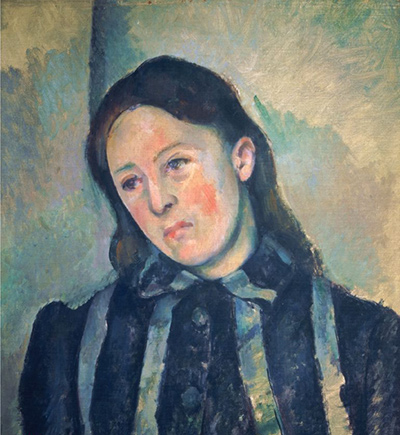
| Portrait of Madame Cezanne with Loosened Hair | 1885–86 | Painting |
| Portrait of the Artist Looking Over His Shoulder | 1883–84 | Painting |
| Portrait of the Gardener Vallier | 1906 | Painting |
| Portrait of Victor Chocquet | 1876–77 | Painting |
| Portrait Of Victor Chocquet Seated | 1877 | Painting |
| Provençal Manor | c.1885 | Painting |
| Pyramid of Skulls | 1898–1900 | Painting |
| Reclining Nude (Leda?) | c.1887 | Painting |
| Scipio | 1866–68 | Painting |
| Seated Man, Oslo | 1898–1900 | Painting |
| Seated Peasant | c.1892–96 | Painting |
| Seated Peasant, Hiroshima | c.1897 | Painting |
| Seated Peasant, Orsay | c.1900 | Painting |
| Self-Portrait | c. 1895 | Drawing |
| Self-Portrait in a Bowler Hat, Ny Carlsberg Glyptotek | 1885–86 | Painting |
| Self-Portrait in a Casquette | c.1875 | Painting |
| Self-Portrait with a Beret | 1898–1900 | Painting |
| Self-Portrait with a Hat, Artizon Museum | c.1890–94 | Painting |
| Self-Portrait with a Pink Background | c.1875 | Painting |
| Self-Portrait with Olive-Coloured Wallpaper | about 1880–81 | Painting |
| Self-Portrait with Palette | 1886–87 | Painting |
| Self-Portrait with White Turban | c.1878–80 | Painting |
| Self-Portrait, c.1895 | c.1895 | Painting |
| Self-Portrait, Pushkin Museum | c.1882 | Painting |
| Spanish Dancers | 1883/1886 | Drawing |
| Still Life with a Curtain | 1892–94 | Painting |
| Still Life with Apples | c.1890 | Painting |
| Still Life with Apples | 1893–94 | Painting |
| Still Life with Apples and a Pot of Primroses | about 1890 | Painting |
| Still Life with Milk Jug and Fruit | c.1900 | Painting |
| Still Life with Open Drawer | 1877–79 | Painting |
| Still Life with Plaster Cupid | about 1894 | Painting |
| Still Life with Skull | 1890–93 | Painting |
| Still Life with Soup Tureen | 1877 | Painting |
| Still Life, Pitcher and Fruit | 1893–94 | Painting |
| Studies Including a Straw Hat | 1895/1898 | Drawing |
| Studies Including Madame Cezanne | 1884/1887 | Drawing |
| Study for "The Judgement of Paris" or "The Amorous Shepherd" | 1883/1886 | Drawing |
| Study for Woman with a Coffee Pot | c.1895 | Painting |
| Study of "The Roman Orator (Germanicus)" | 1883/1886 | Drawing |
| Study of "Venus de Milo" | 1881/1884 | Drawing |
| Study of a Decorative Ornament | 1879/1882 | Drawing |
| Study of a Standing Male Figure after the Antique | c. 1895 | Drawing |
| Study of an Angel in Rubens' "The Prophet Elijah" | 1892/1895 | Drawing |
| Study of Desiderio da Settignano's "Bust of a Child" | c. 1895 | Drawing |
| Study of Houses | 1879/1882 | Drawing |
| Study of Puget's "Hercules Resting" | c. 1879 | Drawing |
| Study of Puget's "Milo of Crotona" | 1895/1898 | Drawing |
| Study of Puget's "Milo of Crotona" | 1880/1883 | Drawing |
| Study of the Allegorical Figure Bellona in Rubens' "The Apotheosis of Henri IV" | 1883/1886 | Drawing |
| Study of the Allegorical Figure Bellona in Rubens' "The Apotheosis of Henri IV" | 1879/1882 | Drawing |
| Study of the Allegorical Figure France in Rubens' "The Exchange of the Two Princesses" | 1882/1885 | Drawing |
| Study of the Allegorical Figure of Health in Rubens' "The Birth of Louis XIII" | 1880/1883 | Drawing |
| Study of the Allegorical Figure of the Genius of Health from Rubens' "The Birth of Louis XIII at Fontainbleau" | 1895/1898 | Drawing |
| Sugar Bowl, Pears and Blue Cup | 1865–66 | Painting |
| The Aqueduct, Pushkin Museum | Dating differs between museum records | Painting |
| The Artist's Father, Reading L'Evenement | autumn 1866 | Painting |
| The Artist's Son | c. 1887 | Drawing |
| The Artist's Son Leaning on his Elbow | c. 1887 | Drawing |
| The Artist's Son Reading | c. 1887 | Drawing |
| The Artist's Son Writing | c. 1887 | Drawing |
| The Artist’s Son, Paul | 1886–87 | Painting |
| The Avenue at Jas de Bouffan | 1868–70 (possibly later) | Painting |
| The Avenue at Jas de Bouffan, Geneva | c.1890 | Painting |
| The Basket of Apples | c.1893 | Painting |
| The Bather, Museum of Modern Art | c.1885 | Painting |
| The Bay of Marseille seen from L'Estaque | c.1885 | Painting |
| The Blue Vase | 1889–90 | Painting |
| The Boy in the Red Vest, Bührle | 1888–90 | Painting |
| The Buffet | 1877–79 | Painting |
| The Card Players, Barnes Foundation | 1890–92 | Painting |
| The Card Players, Courtauld Gallery | 1892–96 | Painting |
| The Card Players, Metropolitan Museum of Art | 1890–92 | Painting |
| The Card Players, Musée d’Orsay | 1893–96 | Painting |
| The Card Players, Qatar | 1892–96 | Painting |
| The Eternal Feminine | c.1877 | Painting |
| The Gardener Vallier | 1906 | Painting |
| The Gardener Vallier, Tate | 1905–06 | Painting |
| The Grounds of the Château Noir | c.1900–04 | Painting |
| The Gulf of Marseille Seen from L’Estaque | c.1885 | Painting |
| The Hanged Man's House in Auvers | c.1873 | Painting |
| The House of Doctor Gachet at Auvers | 1872–73 | Painting |
| The House with the Cracked Walls | 1892–94 | Painting |
| The Kiss of the Muse | c.1860 | Painting |
| The Large Bathers, Barnes Foundation | 1895–1906 | Painting |
| The Large Bathers, National Gallery | 1895–1905 | Painting |
| The Large Bathers, Philadelphia Museum of Art | 1900–06 | Painting |
| The Mill | 1889/1892 | Drawing |
| The Painter’s Father, Louis-Auguste Cézanne | c.1865 | Painting |
| The Peasant | 1890–92 | Painting |
| The Plaster Mill (La Moulin à plâtre) | 1889/1892 | Drawing |
| The Smoker, Hermitage | c.1891 | Painting |
| The Smoker, Mannheim | c.1891 | Painting |
| The Stove in the Studio | c.1865 | Painting |
| The Vase of Tulips | c.1890 | Painting |
| Thistle | 1893/1896 | Drawing |
| Three Heads, One of Madame Cezanne | 1882/1885 | Drawing |
| Three Skulls | c.1898 | Painting |
| Three Skulls on a Patterned Carpet | 1904 | Painting |
| Trees and Shrubs | 1883/1887 | Drawing |
| Turning Road at Montgeroult | 1898 | Painting |
| Two Bathers | 1884/1887 | Drawing |
| Two Heads | 1888 | Drawing |
| Two Heads | 1890/1896 | Drawing |
| Two Heads of Women | 1890/1894 | Drawing |
| Two Studies for "The Judgement of Paris" or "The Amorous Shepherd" | 1883/1886 | Drawing |
| Uncle Dominique in a Tasseled Cap | 1866 | Painting |
| Uncle Dominique in a Turban | 1866–67 | Painting |
| Victor Chocquet and an Angel for "The Apotheosis of Delacroix" | 1878/1880 | Drawing |
| Woman in Blue | c.1904 | Painting |
| Woman Leaning Forward | 1888/1891 | Drawing |
| Woman Leaning Forward | 1890/1894 | Drawing |
| Woman Leaning Forward | 1890/1894 | Drawing |
| Woman with a Coffee Pot | c.1895 | Painting |
| Women Bathers and a Roll of Paper | 1882/1885 | Drawing |
| Young Girl with a Doll | c.1895 | Painting |
| Young Italian Woman at a Table | c.1895–1900 | Painting |
| Young Man and Skull | 1896–98 | Painting |
Frequently Asked Questions
Yes. The catalogue raisonné lists View of Auvers among the alternate titles for FWN 83, the Art Institute of Chicago’s painting numbered 1933.422. [1]
Yes. The catalogue raisonné lists Dr. Paul Gachet and his son in its provenance. [1]
Discussion
Look again at the images and ideas explored in View of Auvers: Cézanne’s Panoramic View. These editorial prompts invite your observations.
Reader Insights
Which part of the painting first makes you feel that you are above the town: the far fields, the rooftops or the strip of sky?
Notice how often a tree or another roof interrupts a house just as its shape becomes clear. Does that interruption bring the village closer or push it away?
Trace one blue across the painting, then one red. Do those two journeys produce the same sense of space?
Join the Conversation
Share a detail, comparison or question about View of Auvers: Cézanne’s Panoramic View below.
References
- Société Paul Cézanne , “Vue panoramique d’Auvers-sur-Oise,” The Paintings, Watercolors and Drawings of Paul Cezanne: An Online Catalogue Raisonné , FWN 83, current online entry. View source .
- Art Institute of Chicago , Paul Smith, entry, and Kim Muir with Giovanni Verri, technical report, “Cat. 1 Auvers, Panoramic View, 1873–75,” in Cezanne Paintings and Watercolors at the Art Institute of Chicago , ed. Gloria Groom and Kim Muir (2026). View source .
- Musée d’Orsay , “La Maison du pendu, Auvers-sur-Oise,” collection entry, accessed 22 October 2026. View source .
- Musée d’Orsay , “Route de village, Auvers,” collection entry, accessed 22 October 2026. View source .
- The Art Bulletin , Paul Smith, “Cézanne’s ‘Primitive’ Perspective, or the ‘View from Everywhere’,” vol. 95, no. 1 (March 2013), pp. 102–119. View source .
- The Metropolitan Museum of Art , Susan Alyson Stein, “Summary Catalogue of Works by Major Artists: Cézanne,” in Cézanne to Van Gogh: The Collection of Doctor Gachet (1999), pp. 199–200, P.G. II-4. View source .
- Le Baiser de la muse, d'après Frillié (FWN 572). View source.
- Louis-Auguste Cezanne, père de l'artiste, lisant L'Événement (FWN 402). View source.
- La Maison du pendu, Auvers-sur-Oise (FWN 81). View source.
- Une moderne Olympia (FWN 628). View source.
- Le Pont de Maincy (FWN 143). View source.
- La Montagne Sainte-Victoire vue de Montbriand (FWN 185). View source.
- Gardanne (vue horizontale) (FWN 224). View source.
- Le Vase bleu (FWN 823). View source.
- Les Joueurs de cartes (FWN 681). View source.
- La Montagne Sainte-Victoire (FWN 296). View source.
- La Corbeille de pommes (FWN 860). View source.
- Pommes et oranges (FWN 871). View source.
- Portrait d'Ambroise Vollard (FWN 531). View source.
- Philadelphia Museum of Art,The Large Bathers,W1937-1-1. View source.
- Château Noir (FWN 360). View source.
- Société Paul Cezanne,online catalogue structure and objectidentification. View source.
- National Gallery of Art,Cezanne Sketchbook,1992.51.9. View source.
- Splash image, Pale walls, blue roofs and red chimneys cluster below long bands of fields and sky.