 by
Tom Gurney
Tom Gurney BSc (Hons) is an art history expert with over 20 years experience
Published on June 19, 2020 / Updated on October 22, 2026
Email:
tomgurney1@gmail.com
/ Phone:
+44 7429 011000
Madame Cézanne in a Red Dress: Introduction
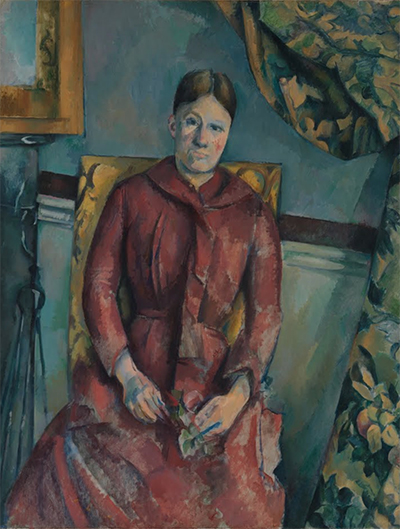
Hortense Fiquet sits almost straight before us, her red dress spreading across the lower half of a tall canvas. A yellow chair catches the outline of her shoulders. Around her, a mirror, a fireplace, a strip of dark panelling and two expanses of patterned fabric refuse to settle into a quiet backdrop. This is the largest and most elaborate of four closely related portraits of Hortense in the same red dress, painted around 1888–90. The Metropolitan Museum of Art owns this version, catalogued as FWN 493. [1] [2]
The painting rewards a slow passage from face to hands and then out into the room. Hortense appears still, yet the objects beside her are unusually mobile. The mirror's frame presses in from the upper left; heavy printed cloth bulges into the upper right. A dark band runs behind the chair, but its direction does little to make the wall feel level. Cézanne gives us enough furnishings to recognize a particular interior while allowing their painted alignments to disturb any simple map of it.
At a Glance
- Artist Paul Cézanne. [1]
- Sitter Hortense Fiquet Cézanne (1850–1922). [1]
- Date and medium 1888–90; oil on canvas. [1]
- Size 116.5 × 89.5 cm. [1]
- Collection The Metropolitan Museum of Art, New York; accession 62.45, acquired in 1962. [1]
- Catalogue identity FWN 493, Rewald 655, Venturi 570. [2]
This work across Paul Cézanne’s career
The Kiss of the Muse
c.1860The Artist’s Father, Reading L’Événement
autumn 1866The Hanged Man’s House
c.1873A Modern Olympia
1873–74Maincy Bridge
1879–80The Blue Vase
1889–90The Basket of Apples
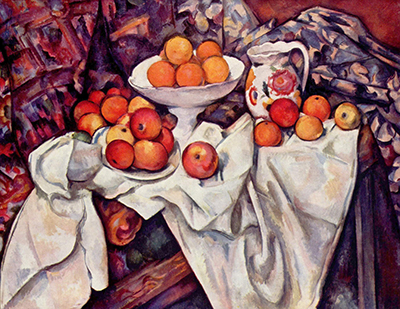
c.1893Apples and Oranges
c.1899The Large Bathers (Philadelphia)
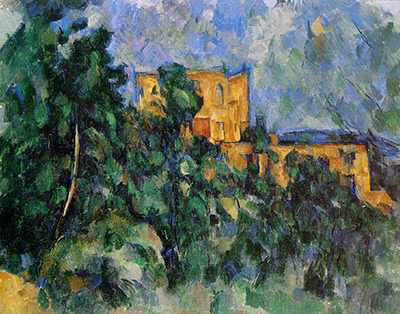
1900–1906 (Philadelphia Museum dating)Château Noir (MoMA)
1903–04Contents
- A figure held within a shifting room
- The apartment and the four red dress portraits
- What the portrait can and cannot tell us about Hortense
- From private collection to public display
A figure held within a shifting room
The dress supplies the picture's broadest continuous colour. Its red is neither a uniform fill nor a simple silhouette. Dark seams and shadows run through the bodice, while the lower skirt opens into a loose assembly of pink, rust, plum and grey. The shawl collar makes a dark V around the neck; below it, the fabric folds down the centre as though one strip has been laid over another. A pale hand on either side interrupts this large field. Between the hands, a small light form—read as a flower in discussions of the four portraits—almost disappears into the surrounding paint. The object is easy to miss because Cézanne makes the hands, the dress and the held form share broken contours. [3]
Her face is comparably economical. Dark hair, parted in the middle, encloses a head tilted slightly toward our left. One side seems broad and firmly modelled; around the other cheek, light blue and rose flecks unsettle the edge. The eyes do not meet ours with the emphatic clarity of a formal likeness. Nor is their direction entirely closed off. Small differences of colour around brow, cheek and mouth begin to emerge after the room's bright contrasts have caught the eye. Susan Sidlauskas singles out this Met painting as a portrait whose first impression of remoteness changes under prolonged looking. That is a useful invitation to look again, rather than a verdict on Hortense's feelings. [4]
The chair's yellow back appears in two narrow wings around her shoulders. Its visible surface is patterned, though the design is much less assertive than the cloth at the right edge. This reduced glimpse makes the chair seem at once supportive and partly consumed by the red figure. The skirt extends almost to the canvas edges below, leaving little floor to explain where the chair stands. Our sense of her weight comes from the broad red base and the hands resting low, not from a fully described seat or a measured view of the ground.
Looking outward, the fireplace and mirror on the left provide one vertical register, while hanging fabric takes over the right. A pale greenish area behind Hortense's right arm appears to retreat, but the curtain on that side comes forward with thick dark outlines and leafy shapes. The room alternately encloses and crowds her. The colour relationships are equally active: red dress against blue wall, yellow chair between them, then quieter red and blue notes dispersed across face, hands and drapery. These exchanges hold the canvas together even as its components pull in different directions.
The apartment and the four red dress portraits
The Met identifies the mottled blue wall, red edge of the wainscoting and mirror above the fireplace with Cézanne's apartment at 15 quai d’Anjou in Paris, rented from 1888 to 1890. That setting anchors the catalogue date. It does not turn the canvas into a precise architectural record: in the painting, the mirror and wall bands seem adjusted for the portrait's balance. Nor does the apartment establish a day on which Hortense sat, or the order in which the related canvases were made. [1]
The other three paintings show why the Met canvas should be identified by more than its dress. Fondation Beyeler owns FWN 490, and the Art Institute of Chicago owns FWN 492, a smaller work titled Madame Cézanne in a Yellow Chair . MASP in São Paulo owns FWN 491, where Hortense also wears red but appears against a much simpler field. The Met's FWN 493 alone carries this full arrangement of mirror, fireplace and large patterned drapery. The catalogue numbers and collections prevent the recurring titles— in a Red Dress , in a Yellow Chair and their French equivalents—from collapsing four physical paintings into one. [5] [6] [7]
The differences are formal as well as documentary. In the Beyeler and Chicago pictures, chair and wall take a more compact role. Hortense's joined hands make a tighter centre. In the São Paulo canvas, the green-blue backdrop leaves the red form far less interrupted by furniture. Here, by contrast, the flower brings a tiny point of attention into a broad and unsettled interior. A comparison of their arrangements can show Cézanne trying different relations between figure and room without requiring us to call any one canvas a preliminary sketch for another. The four works share a time frame; a secure sequence of execution is a harder claim. [3] [7]
John Elderfield argues that Cézanne worked in short sets of related portraits of Hortense and that the final red dress group makes changes in the head itself especially conspicuous. He also proposes that one or perhaps two of the four may have been developed from another portrait rather than directly from a sitting. The possibility sharpens a question the works themselves raise: when the same sitter, garment and chair return, how much of a portrait's identity lies in likeness, and how much in the changing structure of paint around it? [8]
What the portrait can and cannot tell us about Hortense
Hortense was Cézanne's partner from 1869 and the mother of their son Paul, born in 1872. They married in 1886. The Met recounts that Cézanne concealed their early relationship from his family and that they sometimes lived apart, even after marriage. The circumstances of their first meeting are unknown. Living apart did not mean they divorced. [9]
It is tempting to make the sitter's quiet expression into a report on the marriage. Yet a painted look cannot tell us whether Hortense was sad, bored, patient, irritated or simply concentrating during a sitting. The portrait is a collaboration in the minimal, material sense that the person depicted had to be present for at least some of Cézanne's sustained practice, while the painter selected and reworked what appeared on canvas. Dita Amory notes both the many portraits Hortense sat for and the difficulty of reconstructing the couple's private life from surviving evidence. She cautions against treating difficult expressions in the pictures as proof of Hortense's character. [10]
The painting itself gives a richer account than a single mood word. The head inclines while the torso remains frontal. The hands are separated yet gather around the small form in her lap. The face is built from cool and warm patches; the dress from strokes that alternately solidify and loosen its outline. An apparently contained pose therefore coexists with a surface full of adjustments. Hortense is unmistakably the named sitter, but the picture does not lock her into one legible emotion. That tension belongs to the experience of seeing the work, not to a diagnosis of the woman.
From private collection to public display
The painting passed through Ambroise Vollard and Galerie Bernheim-Jeune to Auguste Pellerin by July 1904, then to Jean-Victor Pellerin and, in 1962, to the Met. Vollard’s stockbook described a woman in red beneath drapery, an apt shorthand for the imposing cloth at the right. An archival photograph bears an “1887” annotation, while the catalogue dates the canvas 1888–90. Venturi first proposed 1890–94 and later revised his date to about 1890. Those differing dates show how the work’s chronology has been reconstructed from incomplete traces. [2]
The portrait was lent by Pellerin to Cézanne's 1907 Salon d'Automne retrospective. It appeared again in the 1936 Orangerie Cézanne exhibition, and later in the Met's 2014–15 exhibition devoted to Hortense. Its return in exhibitions separated by decades moved a large private portrait into changing public conversations about Cézanne, and the 2014–15 display placed Hortense herself at the centre of the conversation. [2] [9]
Today the small form at the centre of Hortense's hands can draw the eye back from the dramatic furniture. The decorated fabrics and unstable room make this a striking experiment in pictorial space. The portrait remains equally a record of sustained attention to one person: the measured tilt of a head, the uneven skin tones, the resting hands, and the red garment returning in several canvases. Looking across the four versions makes the Met painting's crowded setting newly vivid; looking closely at this one keeps Hortense from vanishing into a story told only about the room.
Cézanne artworks directory
Browse 217 identified works in this researched selection, including paintings, drawings and watercolours. This is a bounded selection, not a complete catalogue of Cézanne’s surviving oeuvre. Unlinked titles have no confirmed article in this collection.
| Name | Date | Medium |
|---|---|---|
| A Head, a Cup, and a Bread Roll | 1891/1894 | Drawing |
| A Man seen from Behind | 1880/1883 | Drawing |
| A Modern Olympia | 1873–74 | Painting |
| A Nude and Foliage | 1879/1882 | Drawing |
| A Smoking Man | 1892–96 (catalogue); c.1890–92 (museum) | Drawing |
| Afternoon in Naples | 1876–77 | Painting |
| An Old Woman with a Rosary | about 1895–96 | Painting |
| Apples and Oranges | c.1899 | Painting |
| Auvers, Panoramic View | 1873–75 | Painting |
| Avenue at Chantilly | 1888 | Painting |
| Banks of the Marne | 1888–94 | Painting |
| Basket | 1877/1900 | Drawing |
| Bather with Outstretched Arms | 1877–78 | Painting |
| Bellows in Front of a Fireplace | 1887/1892 | Drawing |
| Bibémus Quarry | c.1895 | Painting |
| Boy in a Red Vest, Barnes Foundation | 1888–90 | Painting |
| Boy in a Red Vest, MoMA | 1888–90 | Painting |
| Boy in a Red Waistcoat, National Gallery of Art | 1888–90 | Painting |
| Branch in Flower | 1886/1889 | Drawing |
| Carnival Scene | 1885/1888 | Drawing |
| Chair and Dresser | 1880/1883 | Drawing |
| Chateau Noir | 1903–04 | Painting |
| Chestnut Trees and Farm at Jas de Bouffan | c.1885 | Painting |
| Chestnut Trees and Farm at Jas de Bouffan, Pushkin | c.1886 | Painting |
| Chestnut Trees at Jas de Bouffan in Winter | 1885–86 | Painting |
| Château Noir | 1900–04 | Painting |
| Cistern in the Park of Château Noir | c.1900 | Painting |
| Curtain, Jug and Fruit | 1893–94 | Painting |
| Cushion of an Armchair | 1886/1889 | Drawing |
| Draft Letter and Studies of Bathers | c.1878 | Drawing |
| Farmhouse and Chestnut Trees at Jas de Bouffan | 1884–85 | Painting |
| Figure Resting Head on Hand | c. 1889 | Drawing |
| Fireplace Tongs and Poker | 1887/1892 | Drawing |
| Forest Interior, San Francisco | c.1898–99 | Painting |
| Four Bathers | 1888–90 | Painting |
| Fruit and a Jug on a Table | 1893–94 | Painting |
| Gardanne | 1885–86 | Painting |
| Gardanne, Barnes Foundation | c.1885 | Painting |
| Hand and Shoulder of a Boy | c. 1885 | Drawing |
| Harlequin, National Gallery of Art | 1888–90 | Painting |
| Head of a Boy | 1887/1889 | Drawing |
| Head of a Boy Seen from Behind | c. 1885 | Drawing |
| Head of a Young Woman | c. 1880 | Drawing |
| Head of the Artist's Son | 1888/1889 | Drawing |
| Hillside in Provence | c.1890–92 | Painting |
| Horse Chestnut Trees at Jas de Bouffan | c.1885 | Painting |
| House and Farm at the Jas de Bouffan | c.1887 | Painting |
| House in a Park | 1883/1886 | Drawing |
| House in Provence | c.1885 | Painting |
| House of Père Lacroix | 1873 | Painting |
| House Surrounded by Vegetation | 1889/1892 | Drawing |
| Houses in Provence The Riaux Valley near L’Estaque | c.1883 | Painting |
| Jas de Bouffan, the Pool | c.1876 | Painting |
| Kerosene Lamp | 1878/1881 | Drawing |
| L'Estaque, Melting Snow | c.1870 | Painting |
| Lake Annecy | 1896 | Painting |
| Landscape in Provence, Pola Museum | 1879–82 | Painting |
| Landscape Near Aix-en-Provence | 1877/1880 | Drawing |
| Landscape Seen from the Inside of a Cave | 1889/1892 | Drawing |
| Landscape with Poplars | c.1885–87 | Painting |
| Landscape with Trees | 1895/1898 | Drawing |
| Leda and the Swan | c.1880 (possibly later) | Painting |
| Little Girl with a Doll | 1902–04 | Painting |
| Louis Guillaume | 1879–1890 | Painting |
| Madame Cezanne | 1888/1891 | Drawing |
| Madame Cezanne | 1886/1889 | Drawing |
| Madame Cezanne | 1882/1887 | Drawing |
| Madame Cezanne | 1897/1900 | Drawing |
| Madame Cezanne with her Head Lowered | 1893/1896 | Drawing |
| Madame Cézanne in a Red Armchair | c.1877 | Painting |
| Madame Cézanne in a Red Dress, Metropolitan Museum of Art | 1888–90 | Painting |
| Madame Cézanne in a Yellow Chair | 1888–90 | Painting |
| Madame Cézanne in a Yellow Chair, Fondation Beyeler | 1888–90 | Painting |
| Madame Cézanne in the Conservatory | 1891 | Painting |
| Maincy Bridge | 1879–80 | Painting |
| Maison Maria with a View of Château Noir | c.1895 | Painting |
| Man Bending Forward | 1883/1886 | Drawing |
| Man Smoking a Pipe, Pushkin | c.1891, possibly later | Painting |
| Man with a Pipe | 1891–96 | Painting |
| Man with a Pipe, Nelson-Atkins | 1890–92 | Painting |
| Man with a Straw Hat (Gustave Boyer) | c.1871 | Painting |
| Man with Crossed Arms | c.1899 | Painting |
| Man with Pipe, National Gallery of Art | 1892–96 | Painting |
| Mont Sainte-Victoire | c.1902–06 | Painting |
| Mont Sainte-Victoire | 1900–02 | Painting |
| Mont Sainte-Victoire (recto) | c.1895 | Watercolour |
| Mont Sainte-Victoire and the Viaduct of the Arc River Valley | 1882–85 | Painting |
| Mont Sainte-Victoire Seen beyond the Wall of the Jas de Bouffan | c.1885/1888 | Watercolour |
| Mont Sainte-Victoire Seen from Bibémus Quarry | c.1897 | Painting |
| Mont Sainte-Victoire, Barnes Foundation | 1892–95 | Painting |
| Near the Pool at Jas de Bouffan | 1883/1887 | Drawing |
| Pelicans | 1877/1880 | Drawing |
| Peonies | 1890/1893 | Drawing |
| Pierrot and Harlequin | 1888 | Painting |
| Pine Tree | 1882/1885 | Drawing |
| Pont des Trois Sautets | 1906 | Watercolour |
| Poplars | 1879–80 | Painting |
| Portrait of Ambroise Vollard | 1899 | Painting |
| Portrait of Gustave Geffroy | 1895–96 | Painting |
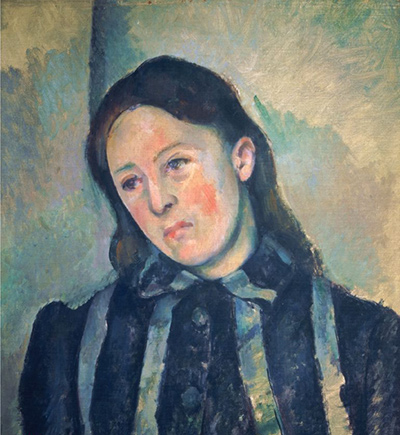
| Portrait of Madame Cezanne with Loosened Hair | 1885–86 | Painting |
| Portrait of the Artist Looking Over His Shoulder | 1883–84 | Painting |
| Portrait of the Gardener Vallier | 1906 | Painting |
| Portrait of Victor Chocquet | 1876–77 | Painting |
| Portrait Of Victor Chocquet Seated | 1877 | Painting |
| Provençal Manor | c.1885 | Painting |
| Pyramid of Skulls | 1898–1900 | Painting |
| Reclining Nude (Leda?) | c.1887 | Painting |
| Scipio | 1866–68 | Painting |
| Seated Man, Oslo | 1898–1900 | Painting |
| Seated Peasant | c.1892–96 | Painting |
| Seated Peasant, Hiroshima | c.1897 | Painting |
| Seated Peasant, Orsay | c.1900 | Painting |
| Self-Portrait | c. 1895 | Drawing |
| Self-Portrait in a Bowler Hat, Ny Carlsberg Glyptotek | 1885–86 | Painting |
| Self-Portrait in a Casquette | c.1875 | Painting |
| Self-Portrait with a Beret | 1898–1900 | Painting |
| Self-Portrait with a Hat, Artizon Museum | c.1890–94 | Painting |
| Self-Portrait with a Pink Background | c.1875 | Painting |
| Self-Portrait with Olive-Coloured Wallpaper | about 1880–81 | Painting |
| Self-Portrait with Palette | 1886–87 | Painting |
| Self-Portrait with White Turban | c.1878–80 | Painting |
| Self-Portrait, c.1895 | c.1895 | Painting |
| Self-Portrait, Pushkin Museum | c.1882 | Painting |
| Spanish Dancers | 1883/1886 | Drawing |
| Still Life with a Curtain | 1892–94 | Painting |
| Still Life with Apples | c.1890 | Painting |
| Still Life with Apples | 1893–94 | Painting |
| Still Life with Apples and a Pot of Primroses | about 1890 | Painting |
| Still Life with Milk Jug and Fruit | c.1900 | Painting |
| Still Life with Open Drawer | 1877–79 | Painting |
| Still Life with Plaster Cupid | about 1894 | Painting |
| Still Life with Skull | 1890–93 | Painting |
| Still Life with Soup Tureen | 1877 | Painting |
| Still Life, Pitcher and Fruit | 1893–94 | Painting |
| Studies Including a Straw Hat | 1895/1898 | Drawing |
| Studies Including Madame Cezanne | 1884/1887 | Drawing |
| Study for "The Judgement of Paris" or "The Amorous Shepherd" | 1883/1886 | Drawing |
| Study for Woman with a Coffee Pot | c.1895 | Painting |
| Study of "The Roman Orator (Germanicus)" | 1883/1886 | Drawing |
| Study of "Venus de Milo" | 1881/1884 | Drawing |
| Study of a Decorative Ornament | 1879/1882 | Drawing |
| Study of a Standing Male Figure after the Antique | c. 1895 | Drawing |
| Study of an Angel in Rubens' "The Prophet Elijah" | 1892/1895 | Drawing |
| Study of Desiderio da Settignano's "Bust of a Child" | c. 1895 | Drawing |
| Study of Houses | 1879/1882 | Drawing |
| Study of Puget's "Hercules Resting" | c. 1879 | Drawing |
| Study of Puget's "Milo of Crotona" | 1895/1898 | Drawing |
| Study of Puget's "Milo of Crotona" | 1880/1883 | Drawing |
| Study of the Allegorical Figure Bellona in Rubens' "The Apotheosis of Henri IV" | 1883/1886 | Drawing |
| Study of the Allegorical Figure Bellona in Rubens' "The Apotheosis of Henri IV" | 1879/1882 | Drawing |
| Study of the Allegorical Figure France in Rubens' "The Exchange of the Two Princesses" | 1882/1885 | Drawing |
| Study of the Allegorical Figure of Health in Rubens' "The Birth of Louis XIII" | 1880/1883 | Drawing |
| Study of the Allegorical Figure of the Genius of Health from Rubens' "The Birth of Louis XIII at Fontainbleau" | 1895/1898 | Drawing |
| Sugar Bowl, Pears and Blue Cup | 1865–66 | Painting |
| The Aqueduct, Pushkin Museum | Dating differs between museum records | Painting |
| The Artist's Father, Reading L'Evenement | autumn 1866 | Painting |
| The Artist's Son | c. 1887 | Drawing |
| The Artist's Son Leaning on his Elbow | c. 1887 | Drawing |
| The Artist's Son Reading | c. 1887 | Drawing |
| The Artist's Son Writing | c. 1887 | Drawing |
| The Artist’s Son, Paul | 1886–87 | Painting |
| The Avenue at Jas de Bouffan | 1868–70 (possibly later) | Painting |
| The Avenue at Jas de Bouffan, Geneva | c.1890 | Painting |
| The Basket of Apples | c.1893 | Painting |
| The Bather, Museum of Modern Art | c.1885 | Painting |
| The Bay of Marseille seen from L'Estaque | c.1885 | Painting |
| The Blue Vase | 1889–90 | Painting |
| The Boy in the Red Vest, Bührle | 1888–90 | Painting |
| The Buffet | 1877–79 | Painting |
| The Card Players, Barnes Foundation | 1890–92 | Painting |
| The Card Players, Courtauld Gallery | 1892–96 | Painting |
| The Card Players, Metropolitan Museum of Art | 1890–92 | Painting |
| The Card Players, Musée d’Orsay | 1893–96 | Painting |
| The Card Players, Qatar | 1892–96 | Painting |
| The Eternal Feminine | c.1877 | Painting |
| The Gardener Vallier | 1906 | Painting |
| The Gardener Vallier, Tate | 1905–06 | Painting |
| The Grounds of the Château Noir | c.1900–04 | Painting |
| The Gulf of Marseille Seen from L’Estaque | c.1885 | Painting |
| The Hanged Man's House in Auvers | c.1873 | Painting |
| The House of Doctor Gachet at Auvers | 1872–73 | Painting |
| The House with the Cracked Walls | 1892–94 | Painting |
| The Kiss of the Muse | c.1860 | Painting |
| The Large Bathers, Barnes Foundation | 1895–1906 | Painting |
| The Large Bathers, National Gallery | 1895–1905 | Painting |
| The Large Bathers, Philadelphia Museum of Art | 1900–06 | Painting |
| The Mill | 1889/1892 | Drawing |
| The Painter’s Father, Louis-Auguste Cézanne | c.1865 | Painting |
| The Peasant | 1890–92 | Painting |
| The Plaster Mill (La Moulin à plâtre) | 1889/1892 | Drawing |
| The Smoker, Hermitage | c.1891 | Painting |
| The Smoker, Mannheim | c.1891 | Painting |
| The Stove in the Studio | c.1865 | Painting |
| The Vase of Tulips | c.1890 | Painting |
| Thistle | 1893/1896 | Drawing |
| Three Heads, One of Madame Cezanne | 1882/1885 | Drawing |
| Three Skulls | c.1898 | Painting |
| Three Skulls on a Patterned Carpet | 1904 | Painting |
| Trees and Shrubs | 1883/1887 | Drawing |
| Turning Road at Montgeroult | 1898 | Painting |
| Two Bathers | 1884/1887 | Drawing |
| Two Heads | 1888 | Drawing |
| Two Heads | 1890/1896 | Drawing |
| Two Heads of Women | 1890/1894 | Drawing |
| Two Studies for "The Judgement of Paris" or "The Amorous Shepherd" | 1883/1886 | Drawing |
| Uncle Dominique in a Tasseled Cap | 1866 | Painting |
| Uncle Dominique in a Turban | 1866–67 | Painting |
| Victor Chocquet and an Angel for "The Apotheosis of Delacroix" | 1878/1880 | Drawing |
| Woman in Blue | c.1904 | Painting |
| Woman Leaning Forward | 1888/1891 | Drawing |
| Woman Leaning Forward | 1890/1894 | Drawing |
| Woman Leaning Forward | 1890/1894 | Drawing |
| Woman with a Coffee Pot | c.1895 | Painting |
| Women Bathers and a Roll of Paper | 1882/1885 | Drawing |
| Young Girl with a Doll | c.1895 | Painting |
| Young Italian Woman at a Table | c.1895–1900 | Painting |
| Young Man and Skull | 1896–98 | Painting |
Frequently Asked Questions
Discussion
Look again at the images and ideas explored in Madame Cézanne in a Red Dress. These editorial prompts invite your observations.
Reader Insights
Where does your eye settle first: on Hortense's face, the small form in her hands, or the patterned curtain?
Follow the dark horizontal band behind the chair. Does it make the room feel stable, or does its relation to the figure make the space harder to measure?
Compare this crowded canvas with another red dress portrait. Which change in the setting most affects how present Hortense seems to you?
Join the Conversation
Share a detail, comparison or question about Madame Cézanne in a Red Dress below.
References
- The Metropolitan Museum of Art. “Madame Cézanne (Hortense Fiquet, 1850–1922) in a Red Dress,” collection record, accession 62.45. View source .
- Société Paul Cézanne. “Madame Cezanne en robe rouge, 1888–90 (FWN 493),” The Paintings, Watercolors and Drawings of Paul Cezanne: An Online Catalogue Raisonné . View source .
- Christie's. “Paul Cézanne, Madame Cézanne au fauteuil jaune,” lot essay, sale record. View source .
- Susan Sidlauskas. Cézanne's Other: The Portraits of Hortense , introduction, University of California Press, 2009, pp. 1–22. View source .
- Société Paul Cézanne. “Madame Cezanne en robe rouge, 1888–90 (FWN 492),” online catalogue raisonné. View source .
- Fondation Beyeler. “Madame Cézanne à la chaise jaune,” collection discussion in 25 Jahre Fondation Beyeler , 2022, p. 13 (in German). View source .
- Museu de Arte de São Paulo Assis Chateaubriand. “Madame Cézanne in Red,” collection record and curatorial texts, 1998/2021. View source .
- John Elderfield. “Introduction: The Reading of the Model,” in Cézanne Portraits , 2017, pp. 11–39. View source .
- The Metropolitan Museum of Art. “Madame Cézanne,” exhibition overview, 2014–15. View source .
- Rachel High and Dita Amory. “Interview with Dita Amory, Curator and Co-author of Madame Cézanne,” The Metropolitan Museum of Art, December 1, 2014. View source .
- Le Baiser de la muse, d'après Frillié (FWN 572). View source.
- Louis-Auguste Cezanne, père de l'artiste, lisant L'Événement (FWN 402). View source.
- La Maison du pendu, Auvers-sur-Oise (FWN 81). View source.
- Une moderne Olympia (FWN 628). View source.
- Le Pont de Maincy (FWN 143). View source.
- La Montagne Sainte-Victoire vue de Montbriand (FWN 185). View source.
- Gardanne (vue horizontale) (FWN 224). View source.
- Le Vase bleu (FWN 823). View source.
- Les Joueurs de cartes (FWN 681). View source.
- La Montagne Sainte-Victoire (FWN 296). View source.
- La Corbeille de pommes (FWN 860). View source.
- Pommes et oranges (FWN 871). View source.
- Portrait d'Ambroise Vollard (FWN 531). View source.
- Philadelphia Museum of Art,The Large Bathers,W1937-1-1. View source.
- Château Noir (FWN 360). View source.
- Société Paul Cezanne,online catalogue structure and objectidentification. View source.
- National Gallery of Art,Cezanne Sketchbook,1992.51.9. View source.
- Splash image, Paul Cézanne, Madame Cézanne in a Red Dress, 1888–90. The Metropolitan Museum of Art, 62.45.