 by
Tom Gurney
Tom Gurney BSc (Hons) is an art history expert with over 20 years experience
Published on June 19, 2020 / Updated on October 22, 2026
Email:
tomgurney1@gmail.com
/ Phone:
+44 7429 011000
Madame Cézanne in a Red Armchair: Introduction
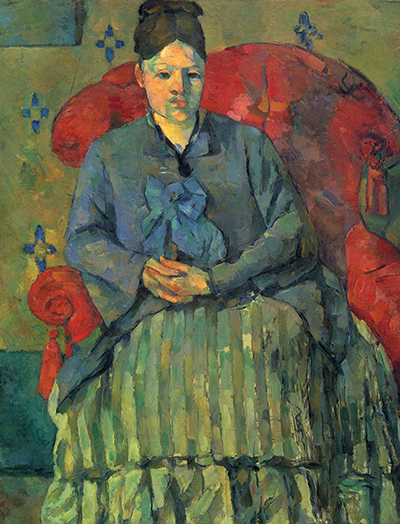
Hortense Fiquet sits almost from edge to edge of Madame Cézanne in a Red Armchair . Her dark hair rises above a pale, carefully modelled face; a blue jacket gathers into a large bow; folded hands rest where the jacket meets a broad striped skirt. Around her, the upholstered chair spreads in a startling red arc.
The catalogue raisonné identifies the Boston painting as FWN 443, dates it to about 1877, and also calls it Madame Cezanne à la jupe rayée —“Madame Cézanne in a Striped Skirt.” [1]
The English title invites a viewer to start with the chair; the French one with the skirt. Either route leads into the same puzzle. What initially seems an image of one seated person becomes a negotiation among several nearly equal presences: the red upholstery, blue clothing, green and cream stripes, ochre wall and small blue ornaments on it. Hortense is recognisable, yet her likeness never floats free of those surrounding shapes. The painting asks for attention to her and to the room that gives her form.
At a Glance
- Artist Paul Cézanne. [1]
- Sitter Hortense Fiquet, later Madame Cézanne. [1]
- Date About 1877. [1]
- Medium and size Oil on canvas, 72.4 × 55.9 cm. [1]
- Collection Museum of Fine Arts, Boston, accession 44.776. [1]
This work across Paul Cézanne’s career
The Kiss of the Muse
c.1860The Artist’s Father, Reading L’Événement
autumn 1866The Hanged Man’s House
c.1873A Modern Olympia
1873–74Maincy Bridge
1879–80The Blue Vase
1889–90The Basket of Apples
c.1893Apples and Oranges
c.1899The Large Bathers (Philadelphia)
1900–1906 (Philadelphia Museum dating)Château Noir (MoMA)
1903–04Contents
- How the figure holds the canvas
- A room shared with still lifes
- Colour that makes form
- The sitter and the chair in later eyes
How the figure holds the canvas
The sitter’s narrow shoulders and comparatively small head give way to an expanding skirt. Its upper edge begins beneath the compressed knot of the hands, then fans toward both lower corners. Down its surface, light vertical bands make a second rhythm beside the upright strokes in the jacket. At the bottom, a broad flounce changes that rhythm: marks bend, overlap and become less regular. Because the cloth reaches the picture edge, the viewer cannot see how far the skirt extends into real space. Its painted breadth, rather than an imagined measurement of her body, determines the portrait’s base.
Above that base, the chair does an unexpected job. Its rounded back is offset to the sitter’s right, leaving more red visible on that side, while the left side presses in around her shoulder. The armrests curve forward in bright red coils and end in tassels, details that might ordinarily mark depth. Here their shapes also hold the jacket and skirt inside a loose frame. Pavel Machotka sees the slightly displaced chair and the pyramidal skirt as part of a calculated balance; he argues that the chair’s wings lie flatter than an illusionistic rendering would suggest. His reading helps explain why the figure’s small lean does not make the composition tip. [2]
Look at the hands after looking at the whole figure. They are neither a gesture addressed to us nor a prop used to tell a story. One hand crosses the other in a compact patch of pale, yellow and green tones. The knot they form interrupts the jacket’s downward flow just before the skirt opens out. Their placement lets the eye move between the little oval of the face, the bow at the chest and this second point of concentration. These intervals make the still pose active as a design without requiring a story about what Hortense feels.
A room shared with still lifes
The yellow-green wall is dotted with blue shapes that resemble small crosses within a repeating lozenge design. It is more than a decorative backdrop. Lawrence Gowing connected this wallpaper with a group of Cézanne still lifes and portraits associated with an apartment at 67 rue de l’Ouest in Paris. He placed the Boston portrait among works of about 1877 on stylistic grounds, while distinguishing them from another group using related room patterns and a more developed system of parallel brushstrokes. The wallpaper thus offers a concrete comparison across genres, though a repeated furnishing cannot by itself prove an exact day or sequence of painting. [3]
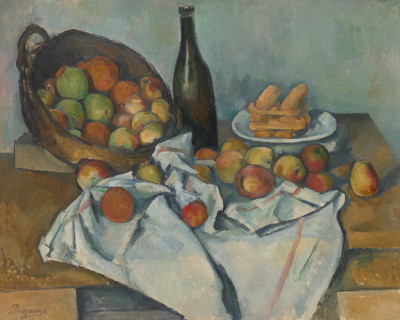
Art Institute of Chicago research likewise identifies the blue lozenge wallpaper in this portrait alongside examples in Cézanne’s still lifes. In its study of The Plate of Apples , the Boston canvas provides a comparison for the room pattern recurring behind different subjects. [4]
In this portrait the pattern is intermittent. A blue ornament appears above each side of the chair and another at the far left beside her shoulder; others are partly lost at the edges. The red back cuts across the wallpaper rather than neatly revealing a complete repeat. This cropping is useful to the painting. The fragments establish a measured surface behind the sitter, while the chair hides enough of it to bring her forward. The lower wall shifts into a darker turquoise band. Against it, the hanging red tassels become sharp punctuation marks, making the chair seem both attached to the room and insistently present before it.
Colour that makes form
The chair’s red is not a single flat block. It ranges from coral and scarlet at the arms to wine-dark areas behind Hortense’s right shoulder. Small green and blue strokes enter the red, just as ochre and green enter the blue-grey jacket. The transitions are easiest to follow around her face. Its yellow lights, cooler blue shadow and touches of green do not isolate the head in a separate flesh-colour scheme. They bind it to the rest of the canvas. Even the bow, apparently a simple blue accent, moves through several blues and greens before dissolving into the jacket.
Paul Smith reads these relationships as an especially resolved use of closely related tones. Comparing the Boston painting with an earlier portrait in Stockholm, he argues that the Boston image models face and clothing with subtler transitions and reduces the stark separation between sitter and chair. In his account, warm and cool contrasts make the forms legible while allowing them to occupy a tightly joined pictorial space. That is a stronger claim than simply calling the red “bright”: the colour gains its force because nearby blues, greens and ochres repeatedly alter how it looks. His proposed order of the two portraits remains an interpretation, rather than a date written on either canvas. [5]
Susan Sidlauskas describes the paint in the Boston portrait as substantial in the face and at transitions in the clothing, despite an initial impression of thinness. She also draws attention to the skirt’s interrupted bands and unsettled lower edge. Her close account makes a useful correction to viewing the canvas only as a set of broad colour masses: passages that look quiet from afar are materially busy. Sidlauskas is more inclined than Machotka to ask what the portrait withholds from an encounter with its sitter. Neither reading needs to turn a painted gaze into a diagnosis of Hortense herself. [6]
The sitter and the chair in later eyes
Rainer Maria Rilke saw the painting at the 1907 Salon d’Automne retrospective and wrote about it to his wife, Clara. As Sidlauskas notes, his description gave the chair an unusually strong role, almost a character in its own right. That response is understandable in front of a red shape that reaches around the sitter’s body and occupies so much of the upper canvas. Yet Rilke’s encounter is evidence of how one early viewer understood the work, not a key to Hortense’s thoughts. [6]
The catalogue lists titles referring to Madame Cézanne, the red armchair and the striped skirt. Its provenance runs through Vollard, Fabbri, Paul Rosenberg and Robert Treat Paine before the 1944 bequest to Boston. [1]
Cézanne artworks directory
Browse 217 identified works in this researched selection, including paintings, drawings and watercolours. This is a bounded selection, not a complete catalogue of Cézanne’s surviving oeuvre. Unlinked titles have no confirmed article in this collection.
| Name | Date | Medium |
|---|---|---|
| A Head, a Cup, and a Bread Roll | 1891/1894 | Drawing |
| A Man seen from Behind | 1880/1883 | Drawing |
| A Modern Olympia | 1873–74 | Painting |
| A Nude and Foliage | 1879/1882 | Drawing |
| A Smoking Man | 1892–96 (catalogue); c.1890–92 (museum) | Drawing |
| Afternoon in Naples | 1876–77 | Painting |
| An Old Woman with a Rosary | about 1895–96 | Painting |
| Apples and Oranges | c.1899 | Painting |
| Auvers, Panoramic View | 1873–75 | Painting |
| Avenue at Chantilly | 1888 | Painting |
| Banks of the Marne | 1888–94 | Painting |
| Basket | 1877/1900 | Drawing |
| Bather with Outstretched Arms | 1877–78 | Painting |
| Bellows in Front of a Fireplace | 1887/1892 | Drawing |
| Bibémus Quarry | c.1895 | Painting |
| Boy in a Red Vest, Barnes Foundation | 1888–90 | Painting |
| Boy in a Red Vest, MoMA | 1888–90 | Painting |
| Boy in a Red Waistcoat, National Gallery of Art | 1888–90 | Painting |
| Branch in Flower | 1886/1889 | Drawing |
| Carnival Scene | 1885/1888 | Drawing |
| Chair and Dresser | 1880/1883 | Drawing |
| Chateau Noir | 1903–04 | Painting |
| Chestnut Trees and Farm at Jas de Bouffan | c.1885 | Painting |
| Chestnut Trees and Farm at Jas de Bouffan, Pushkin | c.1886 | Painting |
| Chestnut Trees at Jas de Bouffan in Winter | 1885–86 | Painting |
| Château Noir | 1900–04 | Painting |
| Cistern in the Park of Château Noir | c.1900 | Painting |
| Curtain, Jug and Fruit | 1893–94 | Painting |
| Cushion of an Armchair | 1886/1889 | Drawing |
| Draft Letter and Studies of Bathers | c.1878 | Drawing |
| Farmhouse and Chestnut Trees at Jas de Bouffan | 1884–85 | Painting |
| Figure Resting Head on Hand | c. 1889 | Drawing |
| Fireplace Tongs and Poker | 1887/1892 | Drawing |
| Forest Interior, San Francisco | c.1898–99 | Painting |
| Four Bathers | 1888–90 | Painting |
| Fruit and a Jug on a Table | 1893–94 | Painting |
| Gardanne | 1885–86 | Painting |
| Gardanne, Barnes Foundation | c.1885 | Painting |
| Hand and Shoulder of a Boy | c. 1885 | Drawing |
| Harlequin, National Gallery of Art | 1888–90 | Painting |
| Head of a Boy | 1887/1889 | Drawing |
| Head of a Boy Seen from Behind | c. 1885 | Drawing |
| Head of a Young Woman | c. 1880 | Drawing |
| Head of the Artist's Son | 1888/1889 | Drawing |
| Hillside in Provence | c.1890–92 | Painting |
| Horse Chestnut Trees at Jas de Bouffan | c.1885 | Painting |
| House and Farm at the Jas de Bouffan | c.1887 | Painting |
| House in a Park | 1883/1886 | Drawing |
| House in Provence | c.1885 | Painting |
| House of Père Lacroix | 1873 | Painting |
| House Surrounded by Vegetation | 1889/1892 | Drawing |
| Houses in Provence The Riaux Valley near L’Estaque | c.1883 | Painting |
| Jas de Bouffan, the Pool | c.1876 | Painting |
| Kerosene Lamp | 1878/1881 | Drawing |
| L'Estaque, Melting Snow | c.1870 | Painting |
| Lake Annecy | 1896 | Painting |
| Landscape in Provence, Pola Museum | 1879–82 | Painting |
| Landscape Near Aix-en-Provence | 1877/1880 | Drawing |
| Landscape Seen from the Inside of a Cave | 1889/1892 | Drawing |
| Landscape with Poplars | c.1885–87 | Painting |
| Landscape with Trees | 1895/1898 | Drawing |
| Leda and the Swan | c.1880 (possibly later) | Painting |
| Little Girl with a Doll | 1902–04 | Painting |
| Louis Guillaume | 1879–1890 | Painting |
| Madame Cezanne | 1888/1891 | Drawing |
| Madame Cezanne | 1886/1889 | Drawing |
| Madame Cezanne | 1882/1887 | Drawing |
| Madame Cezanne | 1897/1900 | Drawing |
| Madame Cezanne with her Head Lowered | 1893/1896 | Drawing |
| Madame Cézanne in a Red Armchair | c.1877 | Painting |
| Madame Cézanne in a Red Dress, Metropolitan Museum of Art | 1888–90 | Painting |
| Madame Cézanne in a Yellow Chair | 1888–90 | Painting |
| Madame Cézanne in a Yellow Chair, Fondation Beyeler | 1888–90 | Painting |
| Madame Cézanne in the Conservatory | 1891 | Painting |
| Maincy Bridge | 1879–80 | Painting |
| Maison Maria with a View of Château Noir | c.1895 | Painting |
| Man Bending Forward | 1883/1886 | Drawing |
| Man Smoking a Pipe, Pushkin | c.1891, possibly later | Painting |
| Man with a Pipe | 1891–96 | Painting |
| Man with a Pipe, Nelson-Atkins | 1890–92 | Painting |
| Man with a Straw Hat (Gustave Boyer) | c.1871 | Painting |
| Man with Crossed Arms | c.1899 | Painting |
| Man with Pipe, National Gallery of Art | 1892–96 | Painting |
| Mont Sainte-Victoire | c.1902–06 | Painting |
| Mont Sainte-Victoire | 1900–02 | Painting |
| Mont Sainte-Victoire (recto) | c.1895 | Watercolour |
| Mont Sainte-Victoire and the Viaduct of the Arc River Valley | 1882–85 | Painting |
| Mont Sainte-Victoire Seen beyond the Wall of the Jas de Bouffan | c.1885/1888 | Watercolour |
| Mont Sainte-Victoire Seen from Bibémus Quarry | c.1897 | Painting |
| Mont Sainte-Victoire, Barnes Foundation | 1892–95 | Painting |
| Near the Pool at Jas de Bouffan | 1883/1887 | Drawing |
| Pelicans | 1877/1880 | Drawing |
| Peonies | 1890/1893 | Drawing |
| Pierrot and Harlequin | 1888 | Painting |
| Pine Tree | 1882/1885 | Drawing |
| Pont des Trois Sautets | 1906 | Watercolour |
| Poplars | 1879–80 | Painting |
| Portrait of Ambroise Vollard | 1899 | Painting |
| Portrait of Gustave Geffroy | 1895–96 | Painting |
| Portrait of Madame Cezanne with Loosened Hair | 1885–86 | Painting |
| Portrait of the Artist Looking Over His Shoulder | 1883–84 | Painting |
| Portrait of the Gardener Vallier | 1906 | Painting |
| Portrait of Victor Chocquet | 1876–77 | Painting |
| Portrait Of Victor Chocquet Seated | 1877 | Painting |
| Provençal Manor | c.1885 | Painting |
| Pyramid of Skulls | 1898–1900 | Painting |
| Reclining Nude (Leda?) | c.1887 | Painting |
| Scipio | 1866–68 | Painting |
| Seated Man, Oslo | 1898–1900 | Painting |
| Seated Peasant | c.1892–96 | Painting |
| Seated Peasant, Hiroshima | c.1897 | Painting |
| Seated Peasant, Orsay | c.1900 | Painting |
| Self-Portrait | c. 1895 | Drawing |
| Self-Portrait in a Bowler Hat, Ny Carlsberg Glyptotek | 1885–86 | Painting |
| Self-Portrait in a Casquette | c.1875 | Painting |
| Self-Portrait with a Beret | 1898–1900 | Painting |
| Self-Portrait with a Hat, Artizon Museum | c.1890–94 | Painting |
| Self-Portrait with a Pink Background | c.1875 | Painting |
| Self-Portrait with Olive-Coloured Wallpaper | about 1880–81 | Painting |
| Self-Portrait with Palette | 1886–87 | Painting |
| Self-Portrait with White Turban | c.1878–80 | Painting |
| Self-Portrait, c.1895 | c.1895 | Painting |
| Self-Portrait, Pushkin Museum | c.1882 | Painting |
| Spanish Dancers | 1883/1886 | Drawing |
| Still Life with a Curtain | 1892–94 | Painting |
| Still Life with Apples | c.1890 | Painting |
| Still Life with Apples | 1893–94 | Painting |
| Still Life with Apples and a Pot of Primroses | about 1890 | Painting |
| Still Life with Milk Jug and Fruit | c.1900 | Painting |
| Still Life with Open Drawer | 1877–79 | Painting |
| Still Life with Plaster Cupid | about 1894 | Painting |
| Still Life with Skull | 1890–93 | Painting |
| Still Life with Soup Tureen | 1877 | Painting |
| Still Life, Pitcher and Fruit | 1893–94 | Painting |
| Studies Including a Straw Hat | 1895/1898 | Drawing |
| Studies Including Madame Cezanne | 1884/1887 | Drawing |
| Study for "The Judgement of Paris" or "The Amorous Shepherd" | 1883/1886 | Drawing |
| Study for Woman with a Coffee Pot | c.1895 | Painting |
| Study of "The Roman Orator (Germanicus)" | 1883/1886 | Drawing |
| Study of "Venus de Milo" | 1881/1884 | Drawing |
| Study of a Decorative Ornament | 1879/1882 | Drawing |
| Study of a Standing Male Figure after the Antique | c. 1895 | Drawing |
| Study of an Angel in Rubens' "The Prophet Elijah" | 1892/1895 | Drawing |
| Study of Desiderio da Settignano's "Bust of a Child" | c. 1895 | Drawing |
| Study of Houses | 1879/1882 | Drawing |
| Study of Puget's "Hercules Resting" | c. 1879 | Drawing |
| Study of Puget's "Milo of Crotona" | 1895/1898 | Drawing |
| Study of Puget's "Milo of Crotona" | 1880/1883 | Drawing |
| Study of the Allegorical Figure Bellona in Rubens' "The Apotheosis of Henri IV" | 1883/1886 | Drawing |
| Study of the Allegorical Figure Bellona in Rubens' "The Apotheosis of Henri IV" | 1879/1882 | Drawing |
| Study of the Allegorical Figure France in Rubens' "The Exchange of the Two Princesses" | 1882/1885 | Drawing |
| Study of the Allegorical Figure of Health in Rubens' "The Birth of Louis XIII" | 1880/1883 | Drawing |
| Study of the Allegorical Figure of the Genius of Health from Rubens' "The Birth of Louis XIII at Fontainbleau" | 1895/1898 | Drawing |
| Sugar Bowl, Pears and Blue Cup | 1865–66 | Painting |
| The Aqueduct, Pushkin Museum | Dating differs between museum records | Painting |
| The Artist's Father, Reading L'Evenement | autumn 1866 | Painting |
| The Artist's Son | c. 1887 | Drawing |
| The Artist's Son Leaning on his Elbow | c. 1887 | Drawing |
| The Artist's Son Reading | c. 1887 | Drawing |
| The Artist's Son Writing | c. 1887 | Drawing |
| The Artist’s Son, Paul | 1886–87 | Painting |
| The Avenue at Jas de Bouffan | 1868–70 (possibly later) | Painting |
| The Avenue at Jas de Bouffan, Geneva | c.1890 | Painting |
| The Basket of Apples | c.1893 | Painting |
| The Bather, Museum of Modern Art | c.1885 | Painting |
| The Bay of Marseille seen from L'Estaque | c.1885 | Painting |
| The Blue Vase | 1889–90 | Painting |
| The Boy in the Red Vest, Bührle | 1888–90 | Painting |
| The Buffet | 1877–79 | Painting |
| The Card Players, Barnes Foundation | 1890–92 | Painting |
| The Card Players, Courtauld Gallery | 1892–96 | Painting |
| The Card Players, Metropolitan Museum of Art | 1890–92 | Painting |
| The Card Players, Musée d’Orsay | 1893–96 | Painting |
| The Card Players, Qatar | 1892–96 | Painting |
| The Eternal Feminine | c.1877 | Painting |
| The Gardener Vallier | 1906 | Painting |
| The Gardener Vallier, Tate | 1905–06 | Painting |
| The Grounds of the Château Noir | c.1900–04 | Painting |
| The Gulf of Marseille Seen from L’Estaque | c.1885 | Painting |
| The Hanged Man's House in Auvers | c.1873 | Painting |
| The House of Doctor Gachet at Auvers | 1872–73 | Painting |
| The House with the Cracked Walls | 1892–94 | Painting |
| The Kiss of the Muse | c.1860 | Painting |
| The Large Bathers, Barnes Foundation | 1895–1906 | Painting |
| The Large Bathers, National Gallery | 1895–1905 | Painting |
| The Large Bathers, Philadelphia Museum of Art | 1900–06 | Painting |
| The Mill | 1889/1892 | Drawing |
| The Painter’s Father, Louis-Auguste Cézanne | c.1865 | Painting |
| The Peasant | 1890–92 | Painting |
| The Plaster Mill (La Moulin à plâtre) | 1889/1892 | Drawing |
| The Smoker, Hermitage | c.1891 | Painting |
| The Smoker, Mannheim | c.1891 | Painting |
| The Stove in the Studio | c.1865 | Painting |
| The Vase of Tulips | c.1890 | Painting |
| Thistle | 1893/1896 | Drawing |
| Three Heads, One of Madame Cezanne | 1882/1885 | Drawing |
| Three Skulls | c.1898 | Painting |
| Three Skulls on a Patterned Carpet | 1904 | Painting |
| Trees and Shrubs | 1883/1887 | Drawing |
| Turning Road at Montgeroult | 1898 | Painting |
| Two Bathers | 1884/1887 | Drawing |
| Two Heads | 1888 | Drawing |
| Two Heads | 1890/1896 | Drawing |
| Two Heads of Women | 1890/1894 | Drawing |
| Two Studies for "The Judgement of Paris" or "The Amorous Shepherd" | 1883/1886 | Drawing |
| Uncle Dominique in a Tasseled Cap | 1866 | Painting |
| Uncle Dominique in a Turban | 1866–67 | Painting |
| Victor Chocquet and an Angel for "The Apotheosis of Delacroix" | 1878/1880 | Drawing |
| Woman in Blue | c.1904 | Painting |
| Woman Leaning Forward | 1888/1891 | Drawing |
| Woman Leaning Forward | 1890/1894 | Drawing |
| Woman Leaning Forward | 1890/1894 | Drawing |
| Woman with a Coffee Pot | c.1895 | Painting |
| Women Bathers and a Roll of Paper | 1882/1885 | Drawing |
| Young Girl with a Doll | c.1895 | Painting |
| Young Italian Woman at a Table | c.1895–1900 | Painting |
| Young Man and Skull | 1896–98 | Painting |
Frequently Asked Questions
It belongs to the Museum of Fine Arts, Boston, accession 44.776. [1]
About 1877. Gowing connects its wallpaper and handling with paintings of that period. [3]
The catalogue lists both titles for FWN 443; each names a prominent painted shape. [1]
No. The Met’s red-dress portrait is FWN 493, a later work. [7]
Discussion
Look again at the images and ideas explored in Madame Cézanne in a Red Armchair. These editorial prompts invite your observations.
Reader Insights
Start with the small clasp of the hands, then follow the skirt outward. Where does your eye come to rest?
Compare the blue wallpaper ornaments on either side of the chair. How much of the room can the painting establish with only those fragments?
Look again at the red armrests and tassels against the cooler lower wall. Does the chair feel like a setting, a frame for Hortense, or an equal presence?
Join the Conversation
Share a detail, comparison or question about Madame Cézanne in a Red Armchair below.
References
- Société Paul Cezanne , “Madame Cezanne à la jupe rayée,” FWN 443, The Paintings, Watercolors and Drawings of Paul Cezanne: An Online Catalogue Raisonné . View source .
- Société Paul Cézanne / Pavel Machotka , “Madame Cézanne à la jupe rayée, vers 1877 (R324–FWN443),” 2017, excerpt from Cézanne: The Eye and the Mind . (in French and English). View source .
- Lawrence Gowing , “Notes on the Development of Cézanne,” The Burlington Magazine 98, no. 639 (June 1956), pp. 185–191. View source .
- Art Institute of Chicago / Kim Muir, Kristi Dahm, Giovanni Verri, Maria Kokkori and Clara Granzotto , “‘A Harmony Parallel to Nature’: Color, Form, and Space in Cezanne’s Watercolors and Oil Paintings,” in Cezanne Paintings and Watercolors at the Art Institute of Chicago , online publication. View source .
- Paul Smith / Warwick Research Archive Portal , “Vermilion: matière and what matters in Cézanne’s paintings,” accepted manuscript, 2019, pp. 16–19. View source .
- Susan Sidlauskas / University of California Press , Cézanne’s Other: The Portraits of Hortense , introduction, “Seeing Cézanne,” 2009, pp. 10–12. View source .
- Société Paul Cezanne , “Madame Cezanne en robe rouge,” FWN 493, The Paintings, Watercolors and Drawings of Paul Cezanne: An Online Catalogue Raisonné . View source .
- Le Baiser de la muse, d'après Frillié (FWN 572). View source.
- Louis-Auguste Cezanne, père de l'artiste, lisant L'Événement (FWN 402). View source.
- La Maison du pendu, Auvers-sur-Oise (FWN 81). View source.
- Une moderne Olympia (FWN 628). View source.
- Le Pont de Maincy (FWN 143). View source.
- La Montagne Sainte-Victoire vue de Montbriand (FWN 185). View source.
- Gardanne (vue horizontale) (FWN 224). View source.
- Le Vase bleu (FWN 823). View source.
- Les Joueurs de cartes (FWN 681). View source.
- La Montagne Sainte-Victoire (FWN 296). View source.
- La Corbeille de pommes (FWN 860). View source.
- Pommes et oranges (FWN 871). View source.
- Portrait d'Ambroise Vollard (FWN 531). View source.
- Philadelphia Museum of Art,The Large Bathers,W1937-1-1. View source.
- Château Noir (FWN 360). View source.
- Société Paul Cezanne,online catalogue structure and objectidentification. View source.
- National Gallery of Art,Cezanne Sketchbook,1992.51.9. View source.
- Splash image, Madame Cézanne in a Red Armchair.