



 by
Tom Gurney
Tom Gurney BSc (Hons) is an art history expert with over 20 years experience
Published on June 19, 2020 / Updated on October 22, 2026
Email:
tomgurney1@gmail.com
/ Phone:
+44 7429 011000
The Artist’s Father, Reading L’Événement: Cézanne’s Portrait of Louis-Auguste: Introduction
An elderly man fills a high-backed armchair. His crossed legs project toward us, while his head tips toward the newspaper held between both hands. The paper’s title, L’Événement , is legible; almost nothing else in it is. Behind him, a small still life glows above the chair, and a dark red-brown door closes the right side of the room. Cézanne gives his father the scale of a public figure and the ordinary occupation of a man reading at home. He also makes the paint insistently visible: thick white strokes build the floral upholstery, grey sweeps cross the trousers and angular marks model the hands. The viewer meets a person absorbed in print and a painter equally absorbed in the material act of portraying him. [1]
Painted in 1866, The Artist’s Father, Reading “L’Événement” is among Cézanne’s largest early portraits. Its subject is Louis-Auguste Cezanne, whose work as a hatter and later banker helped establish the family’s position in Aix-en-Provence. The newspaper links the image to Émile Zola, the painter’s friend and an outspoken art critic for L’Événement that year. The small Cézanne still life above the sitter adds another work of the son’s to the scene. Together with the painting’s exceptional scale, these details make a domestic portrait speak to the artistic debates of its moment. [1] [2] [3]
At a Glance
- Artist Paul Cezanne. [1]
- Subject His father, Louis-Auguste Cezanne. [1]
- Date 1866; the online catalogue specifies autumn 1866. [1] [4]
- Medium and size Oil on canvas, 198.5 × 119.3 cm (78⅛ × 46¹⁵⁄₁₆ in.). [4]
- Collection National Gallery of Art, Washington, accession 1970.5.1. [1]
- Catalogue identity FWN 402; Rewald 101; Venturi 91. [4]
This work across Paul Cézanne’s career
The Kiss of the Muse
c.1860The Hanged Man’s House
c.1873A Modern Olympia
1873–74Maincy Bridge
1879–80The Blue Vase
1889–90The Basket of Apples
c.1893Apples and Oranges
c.1899The Large Bathers (Philadelphia)
1900–1906 (Philadelphia Museum dating)Château Noir (MoMA)
1903–04Contents
- A reader who occupies the room
- Who was Louis-Auguste Cezanne?
- A newspaper with a readable name
- A painting inside the painting
- Scale, handling and the 1860s
- From private portrait to public exhibition
- Looking again
- Annotated details
A reader who occupies the room
The chair takes up nearly the full width of the narrow canvas. Its crest rises behind Louis-Auguste’s black cap; its arms surround his torso; its legs and his shoes press into the foreground. This is a portrait in which furniture does much of the work of establishing a sitter’s presence. The figure remains seated, but the diagonal from the tilted newspaper through the crossed knees gives him physical reach. He is contained by the chair and still seems to occupy more room than it can comfortably hold. The door on the right supplies a solid vertical against that spread of upholstery and limbs. [1]
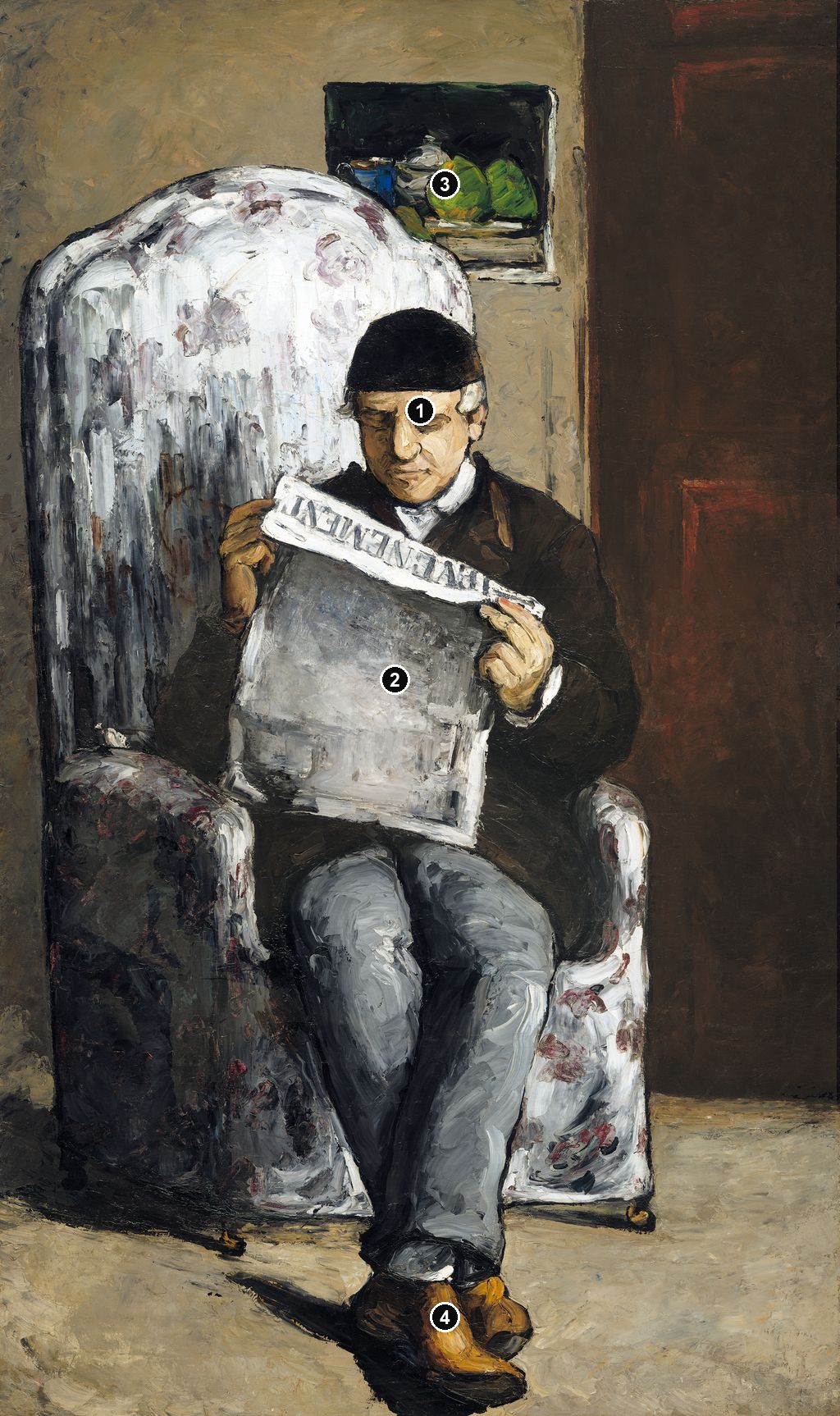
The sitter’s face is relatively small within the canvas. His eyes are directed down, away from the viewer. A black cap fixes the upper edge of the head, and the nose, cheek and mouth emerge from warm, bluntly applied strokes. There is no reciprocal gaze to guide us toward an easy judgment of character. Instead, the newspaper creates a screen between father and painter, and between father and us. We can watch the act of attention without entering the thought behind it. That is why the portrait can feel both intimate and withheld: we have been brought into a domestic room, but the person in it continues his own task. [1]
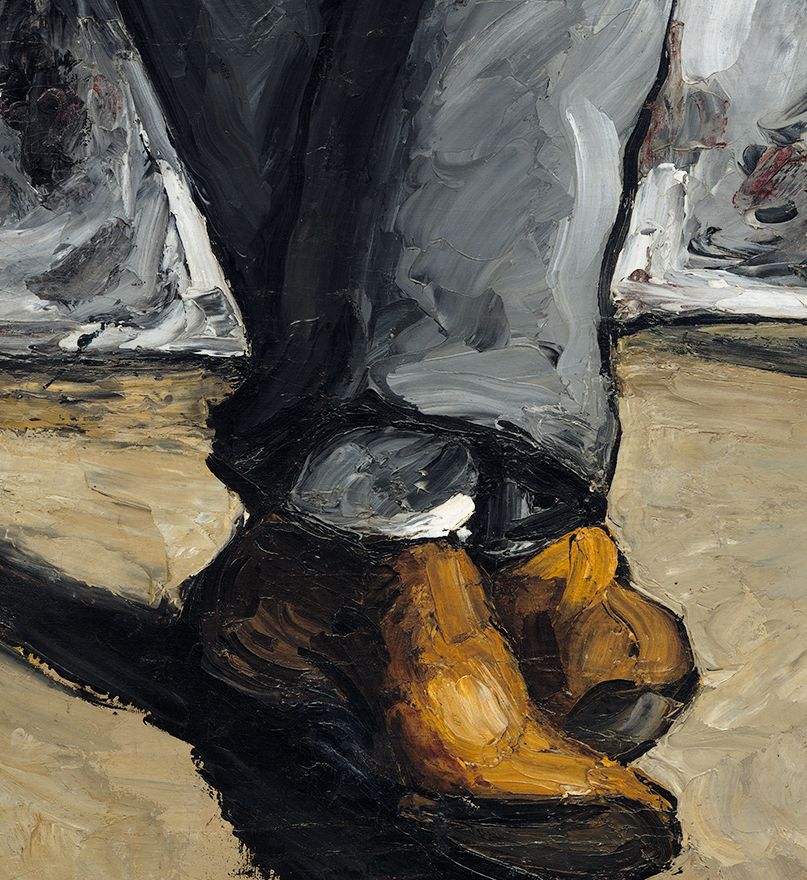
The shoes are particularly telling at the other end of this tall composition. Their golden brown is among the strongest warm notes below the face, and the nearer shoe pushes across the dark base of the chair onto the pale floor. These shapes keep the sitter from dissolving into a generalized mass of dark clothes. White socks, grey trousers, brown jacket and black cap separate him into carefully weighted parts even as the broad brushwork makes those parts vibrate against the patterned chair. Cézanne could have made a sober likeness from the waist up. He chose a full figure whose body, clothes and furniture must all be read together. [1]
The chair as a painted surface
The floral fabric is recognizable but never tidily described. On its high back, white paint changes direction in broad, dragged bands; pink and grey suggestions of flowers appear, then break apart. The two arms repeat the pattern more thickly, with dark blue-black passages rubbing against red and white. The chair makes a bright enclosure around the dark jacket, so that the father becomes visually prominent without being isolated from his surroundings. It also lets Cézanne display paint that refuses the smooth finish expected of many formal portraits. Look closely and the upholstery is both a plausible piece of domestic furnishing and a record of brushes changing pressure and direction. [1]
This material force belongs to Cézanne’s early work. In his introduction to Cézanne Portraits , John Elderfield describes the mid-1860s portraits of family and friends as experiments in a visibly physical manner, indebted to the example of Gustave Courbet yet unlike polished photographic or Salon surfaces. That account helps explain what the father’s chair, trousers and hands do on this canvas: they do not simply identify fabrics or anatomy. Their substantial marks declare how a likeness is made. The Washington gallery likewise points to the heavy application of paint in both this portrait and the small still life behind it. [5] [1]
Who was Louis-Auguste Cezanne?
Louis-Auguste was already a working hatter when Paul was born in Aix on 19 January 1839. The civil birth declaration, transcribed by the Société Paul Cezanne, names him as such; it also records his acknowledgment of the child. Paul’s parents married five years later. By the time this portrait was painted, Louis-Auguste had entered banking and acquired Jas de Bouffan, the family property outside Aix. Those changes matter because the sitter’s domestic comfort had a material history. The upholstered chair and room thus represent a household shaped by his changing fortunes. [2] [6]
Louis-Auguste sat for his son more than once. A different, earlier portrait of him was painted directly on a plaster wall at Jas de Bouffan, then removed and mounted on canvas; it is now in the National Gallery, London. In that work he also sits with crossed legs and lowered head. The London wall painting, dated about 1865, is FWN 398 and measures 167.6 × 114.3 cm. The Washington newspaper portrait is the later oil on canvas, FWN 402, and it is considerably taller. Comparison shows an artist returning to a familiar sitter and seated pose while changing the scale, setting and pictorial argument. [7] [8] [4]
In the London version, a figure painted on an alcove wall participated in the decoration of the family house. In the Washington canvas, the father’s surroundings are represented within a movable painting. A small picture hangs in that painted room; the newspaper crosses the figure; the door makes the room feel shut off to the right. The shift is substantial. The earlier image placed a portrait in the architecture of the house. The later one turns domestic space into an arranged scene in which a person reads, a son’s art appears and a news sheet carries a conspicuous name. Even without proving the sitter’s thoughts, these elements give the viewer more to compare than a likeness alone. [7] [1]
Annotated Details from The Artist’s Father Reading L’Événement
The numbered points identify visible features discussed in this article. Return from each detail to the whole composition. Paul Cézanne, The Artist’s Father, Reading L’Événement, 1866, oil on canvas, National Gallery of Art, Washington (1970.5.1; FWN402). Image source. CC0 / Public domain.
Details from THE ARTIST’S FATHER READING L’ÉVÉNEMENT
Compare the cropped details with the complete images above. Notice how their colours, shapes and positions contribute to the larger compositions.
Face and dark cap
The dark cap meets pale, angular strokes in the face. The lowered eyes direct attention towards the newspaper.
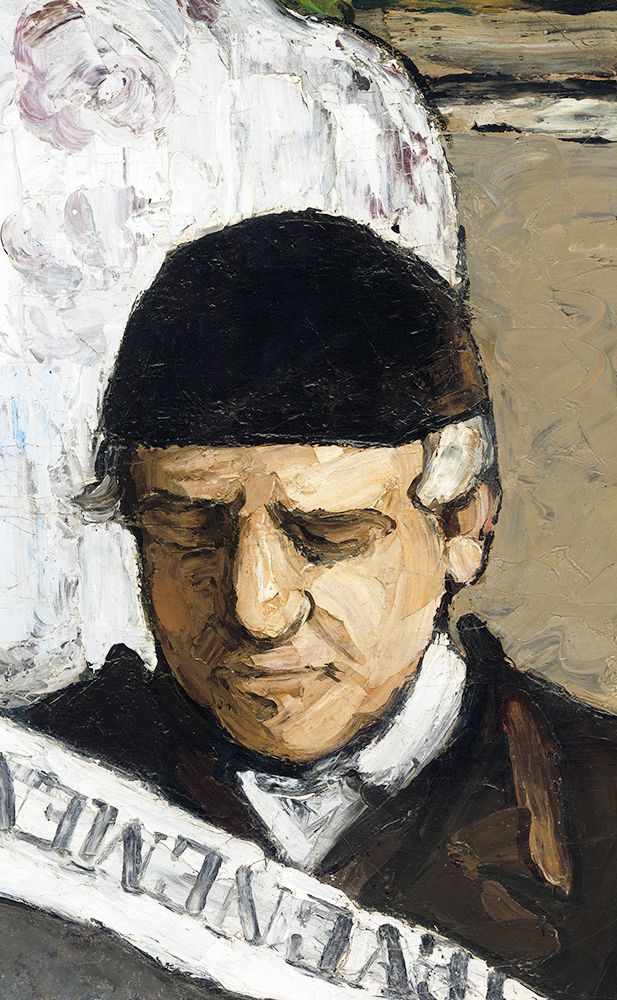
The newspaper and hands
The bright newspaper spreads between the hands. Its large title is visible, while the smaller columns remain sketchier.
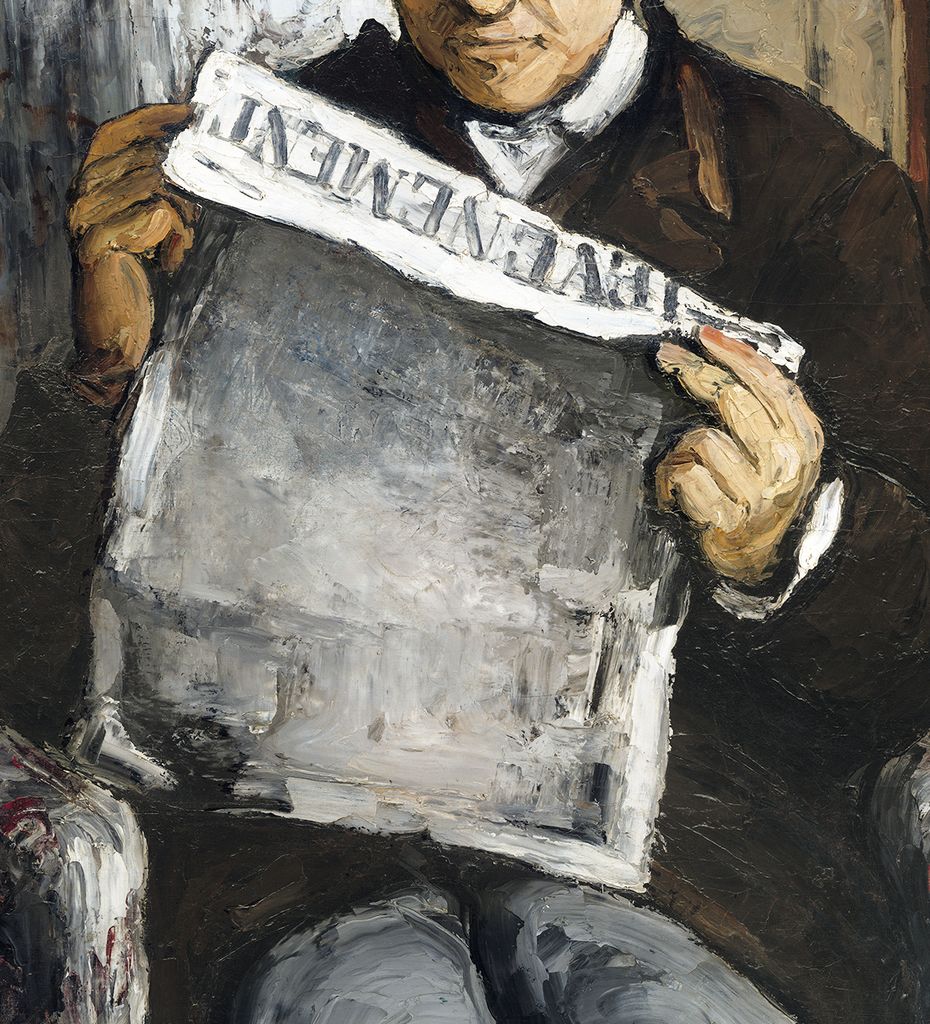
The small still life behind the chair
A separate still life appears above the chair. Rounded green forms and small vessels introduce another kind of painted subject.
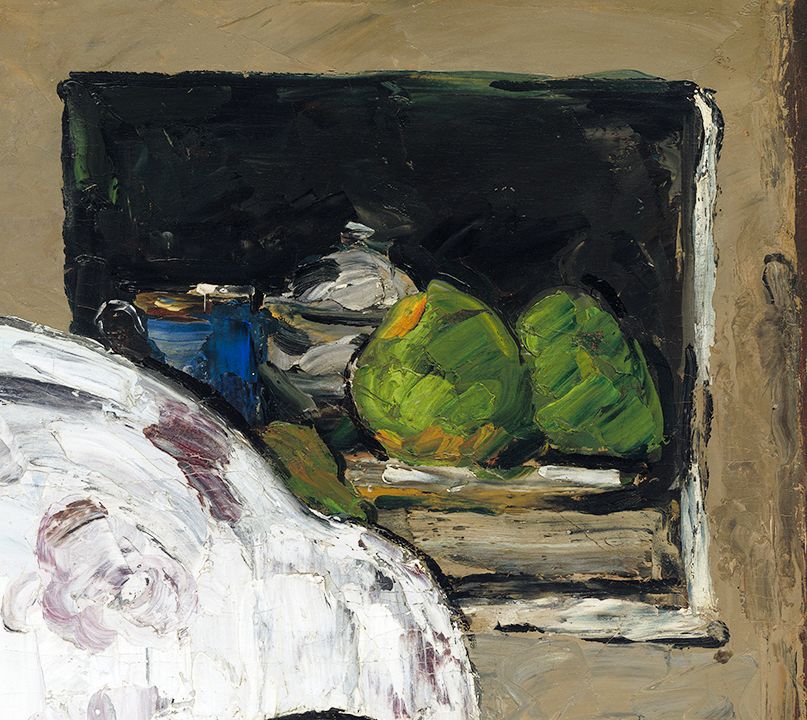
Crossed feet and shadow
Warm shoes emerge beneath the grey trousers. Follow the dark shapes that connect the feet with the floor.
A newspaper with a readable name
The folded top edge of the paper turns its masthead toward us. Cézanne has made the letters of L’Événement large enough to carry across the composition, while the body of the news remains a block of grey and white strokes. The effect is selective. We know what paper the man is shown reading, but no article or edition can be read from the painted sheet. The title points to a live debate in 1866 without fixing the day on which Cézanne painted the portrait. [1] [4]
Between late April and May 1866, Zola wrote a series of Salon articles for L’Événement under the pseudonym Claude. He attacked the Salon jury and defended painters including Manet. He then gathered the pieces as Mon Salon and dedicated the booklet to Cézanne. This gives the legible masthead a specific significance for the painter and his circle. The painting does not identify a particular Zola article on the sheet in Louis-Auguste’s hands; it places the newspaper associated with his friend’s public campaign before the father. [3]
A letter to Zola dated 2 November 1866 adds a revealing contemporary response. Their friend Antoine Guillemet admired the large father portrait and described Louis-Auguste in the armchair, but called the newspaper Le Siècle . The surviving painting plainly says L’Événement . Guillemet may simply have named the wrong paper; the discrepancy does not establish an earlier painted masthead. It does show that the choice of newspaper mattered enough for a friend to mention it when reporting on Cézanne’s new work. [3]
The paper enters the portrait at an angle. Its bright folded edge cuts across the dark torso, so the name is seen before the mass of grey below it is understood as newsprint. Arrouye notes how deliberately the word is exposed: the newspaper is folded and the letters are made large, while the rest of the interior is structured mainly by uprights. This is a painted decision with a historical consequence. The masthead would have called up Zola’s recent defence of new art for those who knew the articles, and it continues to explain why a quiet image of reading can feel pointed. The father remains absorbed in his page; it is the painter who ensures that spectators can identify it. [9] [3]
The newspaper also alters how we look at the hands. The hand at the viewer’s left grips a thick fold; the other pinches the edge of a turned page. They give the father an action rather than a ceremonious pose, yet that action can be sustained for a sitting. Elderfield observes that active tasks are relatively rare in Cézanne’s portraits: the newspaper-reading father is one of his exceptions. Here the task makes stillness credible. The reader may pause over a page while the painter studies him; the paper supplies a reason for the lowered eyes and bent neck. [5] [1]
A painting inside the painting
Above and behind the chair, a small dark rectangle contains a blue cup, pale sugar bowl and green pears. The father’s head and the chair obscure its lower part. This is generally identified as Cézanne’s Sugar Bowl, Pears and Blue Cup , FWN 706, now held by the Musée d’Orsay and deposited at the Musée Granet. The separate catalogue dates that still life to 1865–66, making its appearance in the portrait a tightly contemporary pairing of the artist’s own works. [3] [10]
The inset creates a quiet complication in the hierarchy of a traditional portrait. Louis-Auguste dominates the canvas through his size, and the furniture establishes his domestic position. Yet a second work, small but saturated in blue and green, pulls the eye upward. Scholar Jean Arrouye has observed how the angled newspaper and curve of the chair lead a viewer’s gaze toward it. His suggestion that this arrangement concerns a father’s acceptance of his son’s art is an interpretation; the visual route he describes is there to test by looking. [9]
Two rectangles now face each other within the portrait. The newspaper is large, tilted and momentarily held; the little still life is upright and fixed to the wall. The reading figure lies between them. Arrouye draws attention to this formal kinship, and it makes the painting’s arrangement more persuasive than a single emblem would be. Printed criticism and painted still life both enter the father’s field, while his body binds the two areas of the canvas. The cup’s blue and the pears’ green also give the upper corner a sharper colour than the room’s ochre wall. This small concentration stops the inset picture from functioning as a vague background token: it has its own visual force, even though much of it disappears behind the chair. [9] [10]
The door provides another kind of frame. Thick red-brown and near-black strokes carry it from the upper edge almost to the floor, where a thin light threshold interrupts the dark mass. It gives the right side unusual weight. In the left half, the chair’s broken whites and greys are restless; on the right, a closed planar field steadies them. The small still life sits close to the point where those zones meet. This balance of crowded surface and simplified architecture matters as much to the portrait as any story about its subject. Cézanne presents a man in a particular room, then makes the room’s different surfaces answer each other through colour and pressure of paint. [1]
Scale, handling and the 1860s
At almost two metres high, the canvas gives a seated reader the physical scale often reserved for grand standing portraits. Yet its detail remains uneven by design. The newspaper’s headline is legible, but its columns are not; the face is relatively succinct, while the broad chair is worked over with conspicuous strokes. That distribution of attention can initially seem paradoxical. A portrait usually promises a face as its principal site of knowledge. Cézanne disperses the event of looking across the hands, printed paper, upholstery, inset painting, door, floor and shoes. None is a mere prop. Each is a place where the painter’s decisions become visible. [4] [1]
Elderfield places the early family portraits within Cézanne’s effort to make a personal painting language in the 1860s. He describes a preference for familiar sitters and a refusal of smooth finish, and he contrasts that material experiment with the comparatively conventional fact that sitters continued to pose in rooms or studios. The father reading is especially useful for understanding this combination. Nothing fantastical happens; a man sits and reads. The radical energy is in how forcefully the familiar event is constructed on canvas. The picture’s domestic subject and abrasive surface need to be held together rather than treated as competing explanations. [5]
From private portrait to public exhibition
Although painted in 1866, the picture later entered a public setting with a different meaning. The online catalogue lists it at the Paris Salon of 1882 as Portrait de M. L. A... , no. 520. The National Gallery of Art treats identification of that exhibited work with this canvas as probable. If the identification is right, an intensely worked family portrait from the 1860s became the picture through which Cézanne appeared at the official Salon sixteen years later. [4] [1]
After Cézanne’s death, the recorded chain takes the canvas from his estate through the dealer Ambroise Vollard and the collector Auguste Pellerin to later private owners. The catalogue records René Lecomte, Louis de Chaisemartin, the dealer Hector Brame and acquisition by the National Gallery of Art in 1970; the gallery identifies the acquisition with the collection of Mr. and Mrs. Paul Mellon. A family image had become a publicly exhibited and collected work, now viewed through its striking newspaper title as well as its portrait subject. [4] [1]
The catalogue records many alternative titles, from simple versions of The Artist’s Father to names stressing his reading. The current title preserves the word Cézanne made legible. It also asks us to look beyond that word: the sitter’s body, the small still life and the paint handling turn a named newspaper into one part of a larger family and artistic scene. [4]
Looking again
Start at the bright paper and follow its upper edge into the fingers. From there, look up to the lowered face, across to the green still life, then down the dark door and back along the pale floor to the shoes. The circuit crosses a figure whose attention never leaves the newspaper. It also crosses a sequence of painted textures that keep changing: crisp dark outline, thick white fabric, scraped grey paper, soft ochre wall, abrupt red-brown door. The father is held still within that movement. This tension gives the portrait its lasting presence. It neither releases Louis-Auguste into a simple anecdote nor freezes him into an impersonal emblem of paternal power. [1]
Cézanne’s father reads an unseen article while the viewer reads the visible masthead. The newspaper’s connection to Zola gives that act a historical charge; the small still life places Cézanne’s painting in the same room. Neither object diminishes Louis-Auguste’s imposing presence. The work holds these claims on attention together, and its bold paint makes the encounter physical rather than merely literary. [1] [3]
Cézanne artworks directory
Browse 217 identified works in this researched selection, including paintings, drawings and watercolours. This is a bounded selection, not a complete catalogue of Cézanne’s surviving oeuvre. Unlinked titles have no confirmed article in this collection.
| Name | Date | Medium |
|---|---|---|
| A Head, a Cup, and a Bread Roll | 1891/1894 | Drawing |
| A Man seen from Behind | 1880/1883 | Drawing |
| A Modern Olympia | 1873–74 | Painting |
| A Nude and Foliage | 1879/1882 | Drawing |
| A Smoking Man | 1892–96 (catalogue); c.1890–92 (museum) | Drawing |
| Afternoon in Naples | 1876–77 | Painting |
| An Old Woman with a Rosary | about 1895–96 | Painting |
| Apples and Oranges | c.1899 | Painting |
| Auvers, Panoramic View | 1873–75 | Painting |
| Avenue at Chantilly | 1888 | Painting |
| Banks of the Marne | 1888–94 | Painting |
| Basket | 1877/1900 | Drawing |
| Bather with Outstretched Arms | 1877–78 | Painting |
| Bellows in Front of a Fireplace | 1887/1892 | Drawing |
| Bibémus Quarry | c.1895 | Painting |
| Boy in a Red Vest, Barnes Foundation | 1888–90 | Painting |
| Boy in a Red Vest, MoMA | 1888–90 | Painting |
| Boy in a Red Waistcoat, National Gallery of Art | 1888–90 | Painting |
| Branch in Flower | 1886/1889 | Drawing |
| Carnival Scene | 1885/1888 | Drawing |
| Chair and Dresser | 1880/1883 | Drawing |
| Chateau Noir | 1903–04 | Painting |
| Chestnut Trees and Farm at Jas de Bouffan | c.1885 | Painting |
| Chestnut Trees and Farm at Jas de Bouffan, Pushkin | c.1886 | Painting |
| Chestnut Trees at Jas de Bouffan in Winter | 1885–86 | Painting |
| Château Noir | 1900–04 | Painting |
| Cistern in the Park of Château Noir | c.1900 | Painting |
| Curtain, Jug and Fruit | 1893–94 | Painting |
| Cushion of an Armchair | 1886/1889 | Drawing |
| Draft Letter and Studies of Bathers | c.1878 | Drawing |
| Farmhouse and Chestnut Trees at Jas de Bouffan | 1884–85 | Painting |
| Figure Resting Head on Hand | c. 1889 | Drawing |
| Fireplace Tongs and Poker | 1887/1892 | Drawing |
| Forest Interior, San Francisco | c.1898–99 | Painting |
| Four Bathers | 1888–90 | Painting |
| Fruit and a Jug on a Table | 1893–94 | Painting |
| Gardanne | 1885–86 | Painting |
| Gardanne, Barnes Foundation | c.1885 | Painting |
| Hand and Shoulder of a Boy | c. 1885 | Drawing |
| Harlequin, National Gallery of Art | 1888–90 | Painting |
| Head of a Boy | 1887/1889 | Drawing |
| Head of a Boy Seen from Behind | c. 1885 | Drawing |
| Head of a Young Woman | c. 1880 | Drawing |
| Head of the Artist's Son | 1888/1889 | Drawing |
| Hillside in Provence | c.1890–92 | Painting |
| Horse Chestnut Trees at Jas de Bouffan | c.1885 | Painting |
| House and Farm at the Jas de Bouffan | c.1887 | Painting |
| House in a Park | 1883/1886 | Drawing |
| House in Provence | c.1885 | Painting |
| House of Père Lacroix | 1873 | Painting |
| House Surrounded by Vegetation | 1889/1892 | Drawing |
| Houses in Provence The Riaux Valley near L’Estaque | c.1883 | Painting |
| Jas de Bouffan, the Pool | c.1876 | Painting |
| Kerosene Lamp | 1878/1881 | Drawing |
| L'Estaque, Melting Snow | c.1870 | Painting |
| Lake Annecy | 1896 | Painting |
| Landscape in Provence, Pola Museum | 1879–82 | Painting |
| Landscape Near Aix-en-Provence | 1877/1880 | Drawing |
| Landscape Seen from the Inside of a Cave | 1889/1892 | Drawing |
| Landscape with Poplars | c.1885–87 | Painting |
| Landscape with Trees | 1895/1898 | Drawing |
| Leda and the Swan | c.1880 (possibly later) | Painting |
| Little Girl with a Doll | 1902–04 | Painting |
| Louis Guillaume | 1879–1890 | Painting |
| Madame Cezanne | 1888/1891 | Drawing |
| Madame Cezanne | 1886/1889 | Drawing |
| Madame Cezanne | 1882/1887 | Drawing |
| Madame Cezanne | 1897/1900 | Drawing |
| Madame Cezanne with her Head Lowered | 1893/1896 | Drawing |
| Madame Cézanne in a Red Armchair | c.1877 | Painting |
| Madame Cézanne in a Red Dress, Metropolitan Museum of Art | 1888–90 | Painting |
| Madame Cézanne in a Yellow Chair | 1888–90 | Painting |
| Madame Cézanne in a Yellow Chair, Fondation Beyeler | 1888–90 | Painting |
| Madame Cézanne in the Conservatory | 1891 | Painting |
| Maincy Bridge | 1879–80 | Painting |
| Maison Maria with a View of Château Noir | c.1895 | Painting |
| Man Bending Forward | 1883/1886 | Drawing |
| Man Smoking a Pipe, Pushkin | c.1891, possibly later | Painting |
| Man with a Pipe | 1891–96 | Painting |
| Man with a Pipe, Nelson-Atkins | 1890–92 | Painting |
| Man with a Straw Hat (Gustave Boyer) | c.1871 | Painting |
| Man with Crossed Arms | c.1899 | Painting |
| Man with Pipe, National Gallery of Art | 1892–96 | Painting |
| Mont Sainte-Victoire | c.1902–06 | Painting |
| Mont Sainte-Victoire | 1900–02 | Painting |
| Mont Sainte-Victoire (recto) | c.1895 | Watercolour |
| Mont Sainte-Victoire and the Viaduct of the Arc River Valley | 1882–85 | Painting |
| Mont Sainte-Victoire Seen beyond the Wall of the Jas de Bouffan | c.1885/1888 | Watercolour |
| Mont Sainte-Victoire Seen from Bibémus Quarry | c.1897 | Painting |
| Mont Sainte-Victoire, Barnes Foundation | 1892–95 | Painting |
| Near the Pool at Jas de Bouffan | 1883/1887 | Drawing |
| Pelicans | 1877/1880 | Drawing |
| Peonies | 1890/1893 | Drawing |
| Pierrot and Harlequin | 1888 | Painting |
| Pine Tree | 1882/1885 | Drawing |
| Pont des Trois Sautets | 1906 | Watercolour |
| Poplars | 1879–80 | Painting |
| Portrait of Ambroise Vollard | 1899 | Painting |
| Portrait of Gustave Geffroy | 1895–96 | Painting |
| Portrait of Madame Cezanne with Loosened Hair | 1885–86 | Painting |
| Portrait of the Artist Looking Over His Shoulder | 1883–84 | Painting |
| Portrait of the Gardener Vallier | 1906 | Painting |
| Portrait of Victor Chocquet | 1876–77 | Painting |
| Portrait Of Victor Chocquet Seated | 1877 | Painting |
| Provençal Manor | c.1885 | Painting |
| Pyramid of Skulls | 1898–1900 | Painting |
| Reclining Nude (Leda?) | c.1887 | Painting |
| Scipio | 1866–68 | Painting |
| Seated Man, Oslo | 1898–1900 | Painting |
| Seated Peasant | c.1892–96 | Painting |
| Seated Peasant, Hiroshima | c.1897 | Painting |
| Seated Peasant, Orsay | c.1900 | Painting |
| Self-Portrait | c. 1895 | Drawing |
| Self-Portrait in a Bowler Hat, Ny Carlsberg Glyptotek | 1885–86 | Painting |
| Self-Portrait in a Casquette | c.1875 | Painting |
| Self-Portrait with a Beret | 1898–1900 | Painting |
| Self-Portrait with a Hat, Artizon Museum | c.1890–94 | Painting |
| Self-Portrait with a Pink Background | c.1875 | Painting |
| Self-Portrait with Olive-Coloured Wallpaper | about 1880–81 | Painting |
| Self-Portrait with Palette | 1886–87 | Painting |
| Self-Portrait with White Turban | c.1878–80 | Painting |
| Self-Portrait, c.1895 | c.1895 | Painting |
| Self-Portrait, Pushkin Museum | c.1882 | Painting |
| Spanish Dancers | 1883/1886 | Drawing |
| Still Life with a Curtain | 1892–94 | Painting |
| Still Life with Apples | c.1890 | Painting |
| Still Life with Apples | 1893–94 | Painting |
| Still Life with Apples and a Pot of Primroses | about 1890 | Painting |
| Still Life with Milk Jug and Fruit | c.1900 | Painting |
| Still Life with Open Drawer | 1877–79 | Painting |
| Still Life with Plaster Cupid | about 1894 | Painting |
| Still Life with Skull | 1890–93 | Painting |
| Still Life with Soup Tureen | 1877 | Painting |
| Still Life, Pitcher and Fruit | 1893–94 | Painting |
| Studies Including a Straw Hat | 1895/1898 | Drawing |
| Studies Including Madame Cezanne | 1884/1887 | Drawing |
| Study for "The Judgement of Paris" or "The Amorous Shepherd" | 1883/1886 | Drawing |
| Study for Woman with a Coffee Pot | c.1895 | Painting |
| Study of "The Roman Orator (Germanicus)" | 1883/1886 | Drawing |
| Study of "Venus de Milo" | 1881/1884 | Drawing |
| Study of a Decorative Ornament | 1879/1882 | Drawing |
| Study of a Standing Male Figure after the Antique | c. 1895 | Drawing |
| Study of an Angel in Rubens' "The Prophet Elijah" | 1892/1895 | Drawing |
| Study of Desiderio da Settignano's "Bust of a Child" | c. 1895 | Drawing |
| Study of Houses | 1879/1882 | Drawing |
| Study of Puget's "Hercules Resting" | c. 1879 | Drawing |
| Study of Puget's "Milo of Crotona" | 1895/1898 | Drawing |
| Study of Puget's "Milo of Crotona" | 1880/1883 | Drawing |
| Study of the Allegorical Figure Bellona in Rubens' "The Apotheosis of Henri IV" | 1883/1886 | Drawing |
| Study of the Allegorical Figure Bellona in Rubens' "The Apotheosis of Henri IV" | 1879/1882 | Drawing |
| Study of the Allegorical Figure France in Rubens' "The Exchange of the Two Princesses" | 1882/1885 | Drawing |
| Study of the Allegorical Figure of Health in Rubens' "The Birth of Louis XIII" | 1880/1883 | Drawing |
| Study of the Allegorical Figure of the Genius of Health from Rubens' "The Birth of Louis XIII at Fontainbleau" | 1895/1898 | Drawing |
| Sugar Bowl, Pears and Blue Cup | 1865–66 | Painting |
| The Aqueduct, Pushkin Museum | Dating differs between museum records | Painting |
| The Artist's Father, Reading L'Evenement | autumn 1866 | Painting |
| The Artist's Son | c. 1887 | Drawing |
| The Artist's Son Leaning on his Elbow | c. 1887 | Drawing |
| The Artist's Son Reading | c. 1887 | Drawing |
| The Artist's Son Writing | c. 1887 | Drawing |
| The Artist’s Son, Paul | 1886–87 | Painting |
| The Avenue at Jas de Bouffan | 1868–70 (possibly later) | Painting |
| The Avenue at Jas de Bouffan, Geneva | c.1890 | Painting |
| The Basket of Apples | c.1893 | Painting |
| The Bather, Museum of Modern Art | c.1885 | Painting |
| The Bay of Marseille seen from L'Estaque | c.1885 | Painting |
| The Blue Vase | 1889–90 | Painting |
| The Boy in the Red Vest, Bührle | 1888–90 | Painting |
| The Buffet | 1877–79 | Painting |
| The Card Players, Barnes Foundation | 1890–92 | Painting |
| The Card Players, Courtauld Gallery | 1892–96 | Painting |
| The Card Players, Metropolitan Museum of Art | 1890–92 | Painting |
| The Card Players, Musée d’Orsay | 1893–96 | Painting |
| The Card Players, Qatar | 1892–96 | Painting |
| The Eternal Feminine | c.1877 | Painting |
| The Gardener Vallier | 1906 | Painting |
| The Gardener Vallier, Tate | 1905–06 | Painting |
| The Grounds of the Château Noir | c.1900–04 | Painting |
| The Gulf of Marseille Seen from L’Estaque | c.1885 | Painting |
| The Hanged Man's House in Auvers | c.1873 | Painting |
| The House of Doctor Gachet at Auvers | 1872–73 | Painting |
| The House with the Cracked Walls | 1892–94 | Painting |
| The Kiss of the Muse | c.1860 | Painting |
| The Large Bathers, Barnes Foundation | 1895–1906 | Painting |
| The Large Bathers, National Gallery | 1895–1905 | Painting |
| The Large Bathers, Philadelphia Museum of Art | 1900–06 | Painting |
| The Mill | 1889/1892 | Drawing |
| The Painter’s Father, Louis-Auguste Cézanne | c.1865 | Painting |
| The Peasant | 1890–92 | Painting |
| The Plaster Mill (La Moulin à plâtre) | 1889/1892 | Drawing |
| The Smoker, Hermitage | c.1891 | Painting |
| The Smoker, Mannheim | c.1891 | Painting |
| The Stove in the Studio | c.1865 | Painting |
| The Vase of Tulips | c.1890 | Painting |
| Thistle | 1893/1896 | Drawing |
| Three Heads, One of Madame Cezanne | 1882/1885 | Drawing |
| Three Skulls | c.1898 | Painting |
| Three Skulls on a Patterned Carpet | 1904 | Painting |
| Trees and Shrubs | 1883/1887 | Drawing |
| Turning Road at Montgeroult | 1898 | Painting |
| Two Bathers | 1884/1887 | Drawing |
| Two Heads | 1888 | Drawing |
| Two Heads | 1890/1896 | Drawing |
| Two Heads of Women | 1890/1894 | Drawing |
| Two Studies for "The Judgement of Paris" or "The Amorous Shepherd" | 1883/1886 | Drawing |
| Uncle Dominique in a Tasseled Cap | 1866 | Painting |
| Uncle Dominique in a Turban | 1866–67 | Painting |
| Victor Chocquet and an Angel for "The Apotheosis of Delacroix" | 1878/1880 | Drawing |
| Woman in Blue | c.1904 | Painting |
| Woman Leaning Forward | 1888/1891 | Drawing |
| Woman Leaning Forward | 1890/1894 | Drawing |
| Woman Leaning Forward | 1890/1894 | Drawing |
| Woman with a Coffee Pot | c.1895 | Painting |
| Women Bathers and a Roll of Paper | 1882/1885 | Drawing |
| Young Girl with a Doll | c.1895 | Painting |
| Young Italian Woman at a Table | c.1895–1900 | Painting |
| Young Man and Skull | 1896–98 | Painting |
Frequently Asked Questions
Discussion
Look again at the images and ideas explored in The Artist’s Father, Reading L’Événement: Cézanne’s Portrait of Louis-Auguste. These editorial prompts invite your observations.
Reader Insights
Follow the shapes of the newspaper before reading its title. How do its folds and the father’s fingers make a moment of concentration visible?
Compare the small still life with the enormous chair beneath it. Which object seems to command the room when you stand back, and which draws you in when you look closely?
The sitter does not meet your gaze. Does that make the portrait feel more private, or does the painted masthead make you feel addressed as a viewer?
Join the Conversation
Share a detail, comparison or question about The Artist’s Father, Reading L’Événement: Cézanne’s Portrait of Louis-Auguste below.
References
- National Gallery of Art, Washington. “The Artist’s Father, Reading ‘L’Événement’,” collection record, 1866, accession 1970.5.1. View source .
- Société Paul Cezanne. “1839,” chronology entry with transcription of Paul Cezanne’s civil birth declaration, published 2016 (in French). View source .
- Société Paul Cezanne. “1866,” chronology with transcriptions of Zola’s writing and Antoine Guillemet’s letter of 2 November, published 2016 (in French). View source .
- The Paintings, Watercolors and Drawings of Paul Cezanne: An Online Catalogue Raisonné. “Louis-Auguste Cezanne, père de l’artiste, lisant L’Événement,” FWN 402, catalogue entry, autumn 1866 (in French and English). View source .
- John Elderfield / Princeton University Press. “Introduction: The Reading of the Model,” in Cézanne Portraits , 2017, pp. 11–39. View source .
- Musée Granet. Cezanne au Jas de Bouffan / Cezanne at Jas de Bouffan , visitor booklet, 2025 (in French and English). View source .
- National Gallery, London. “The Painter’s Father, Louis-Auguste Cezanne,” collection record, NG6385, about 1865. View source .
- The Paintings, Watercolors and Drawings of Paul Cezanne: An Online Catalogue Raisonné. “Portrait de Louis-Auguste Cezanne, père de l’artiste,” FWN 398, catalogue entry, about 1865 (in French and English). View source .
- Jean Arrouye / Société Paul Cezanne. “Louis-Auguste Cezanne, père de l’artiste, lisant L’Événement,” commentary first published in Éloquence de la peinture , 2013; online 2016 (in French). View source .
- The Paintings, Watercolors and Drawings of Paul Cezanne: An Online Catalogue Raisonné. “Sucrier, poires et tasse bleue,” FWN 706, catalogue entry, 1865–66 (in French and English). View source .
- Le Baiser de la muse, d'après Frillié (FWN 572). View source.
- La Maison du pendu, Auvers-sur-Oise (FWN 81). View source.
- Une moderne Olympia (FWN 628). View source.
- Le Pont de Maincy (FWN 143). View source.
- La Montagne Sainte-Victoire vue de Montbriand (FWN 185). View source.
- Gardanne (vue horizontale) (FWN 224). View source.
- Le Vase bleu (FWN 823). View source.
- Les Joueurs de cartes (FWN 681). View source.
- La Montagne Sainte-Victoire (FWN 296). View source.
- La Corbeille de pommes (FWN 860). View source.
- Pommes et oranges (FWN 871). View source.
- Portrait d'Ambroise Vollard (FWN 531). View source.
- Philadelphia Museum of Art,The Large Bathers,W1937-1-1. View source.
- Château Noir (FWN 360). View source.
- Société Paul Cezanne,online catalogue structure and objectidentification. View source.
- National Gallery of Art,Cezanne Sketchbook,1992.51.9. View source.
- Splash image, Paul Cézanne, The Artist’s Father,Reading L’Événement,1866,oil on canvas,National Gallery of Art,Washington,1970.5.1;FWN402.


