Paul Cezanne.jpg)
 by
Tom Gurney
Tom Gurney BSc (Hons) is an art history expert with over 20 years experience
Published on June 19, 2020 / Updated on October 22, 2026
Email:
tomgurney1@gmail.com
/ Phone:
+44 7429 011000
Man with a Pipe by Paul Cézanne: Introduction
A man in a high, weathered hat faces us with a white pipe between his lips. Cézanne gives him almost the whole narrow canvas: there is little room for setting, gesture or anecdote. The man's eyes, reddish face and layered work clothes have to carry the encounter.
This is Man with a Pipe , the Courtauld Gallery painting catalogued as FWN 504. Its familiar “1892” label is approximate: the current catalogue raisonné dates it 1891–96. [1]
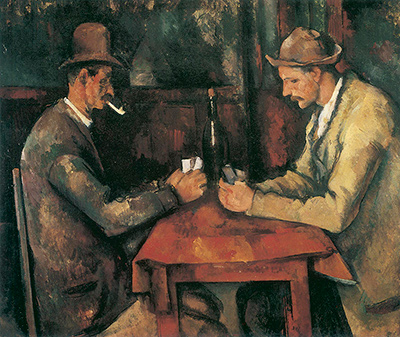
The sitter worked on Cézanne's family estate, the Jas de Bouffan; his name is not recorded. He also appears at the left of the Courtauld's two-person Card Players . [2]
That connection explains why the painting is often considered with Cézanne's card-player series . Seen alone, however, he is neither a cropped game scene nor an interchangeable type. Cézanne has made one person, one face and a quiet confrontation with the viewer into the whole subject.
At a Glance
- Artist Paul Cézanne. [1]
- Title Man with a Pipe ; catalogued as L'Homme à la pipe , FWN 504. [1]
- Date 1891–96 in the catalogue raisonné; circa 1892–96 in the Courtauld record. [1] [2]
- Medium and size Oil on canvas, 73 × 60 cm. [2]
- Collection The Courtauld Gallery, London, Samuel Courtauld Trust; object P.1932.SC.58. [2]
- Sitter An unnamed worker from the Cézanne family estate. [2]
This work across Paul Cézanne’s career
The Kiss of the Muse
c.1860The Artist’s Father, Reading L’Événement
autumn 1866The Hanged Man’s House
c.1873A Modern Olympia
1873–74Maincy Bridge
1879–80The Blue Vase
1889–90Man with a Pipe by Paul Cézanne (current article)
1891–96; Courtauld c.1892–96The Basket of Apples
c.1893Apples and Oranges
c.1899The Large Bathers (Philadelphia)
1900–1906 (Philadelphia Museum dating)Château Noir (MoMA)
1903–04Contents
- A face set against the dark
- Clothes, colour and construction
- A worker, a portrait and a card player
- Date, other smokers and the Courtauld collection
A face set against the dark
The pipe is a tiny, bright interruption in a painting ruled by brown. Its stem points diagonally across the lower face; its bowl catches the eye near the right edge of the moustache. A lighter wedge of shirt or neckcloth opens below the chin. These few pale shapes stop the head from dissolving into the deep, mottled surround. They also make the act of smoking present without making it an event. There is no raised hand, visible plume or conversational partner. The pipe belongs to a held pose.
Look at the hat as a form before reading it as clothing. Its uneven ochre crown rises almost to the top of the canvas; its dark brim runs across the forehead and turns up at the sides. The crown is rough with greens, yellow ochres and darker flecks. The large form above the small face lends the sitter height, yet Cézanne leaves it visibly ordinary, an object worn and handled rather than a grand costume. The body below widens into the corners. Hat and shoulders together make a compact, almost architectural silhouette.
The face has a different density from the jacket. Yellow and orange lift the forehead and cheeks, while darker marks hold the brows, moustache and hollows beside the nose. Both ears are conspicuous against the hat and the dark field. The eyes meet us, but their unequal shadows resist an easy reading of expression. The man can appear severe at first, then watchful or simply absorbed in the task of sitting. None of those impressions needs to become a claim about his private thoughts. The painter gives visible features, not a written biography.
Clothes, colour and construction
Across the torso, jacket, waistcoat and pale inner garment overlap without crisp tailor's edges. A line of small dark buttons draws the gaze down from the face. Broad sloping lapels repeat the angle of the shoulders, while warmer marks along the sleeve interrupt the near-black lower corners. Cézanne varies how strongly each boundary speaks: the hat stands sharply against the upper field, but parts of the jacket seem to merge with it. This uneven separation gives weight to the figure without making him look cut out and pasted onto a background.
The browns are less uniform than a quick glance suggests. Rust moves through the wall behind the hat; olive and grey appear in the clothing; ochre warms the cheeks and crown. Theodore Reff singled out this painting, identified in the older Venturi system as no. 564, when discussing Cézanne's layering of reddish brown and reddish green tones. He also described the body as having a sculptural pose and parallel folds. [3] These observations help explain why the low-key palette does not feel flat: close tones carry changes of plane and texture.
There is little usable depth behind the sitter. The darker horizontal band near his shoulders suggests a division in the setting, but the picture never invites us to explore a room. Broad, irregular touches across the upper background keep that surface active. The effect is important to the portrait's scale. The body does not recede through a furnished interior; it presses toward the front plane. The small, light pipe and the thin strip at the throat make the face seem still closer. A plain backdrop has become an instrument for directing attention.
A worker, a portrait and a card player
The Courtauld's portrait resource describes Man with a Pipe as poised between portraiture and a scene of everyday life: the face is particular, but the same man also takes a role in the card-player compositions. [4]
Here his body squares toward us. The hat and pipe identify him, but the frontal arrangement changes what we can see. The set of his mouth, the spacing of his eyes and the layered clothes become the drama. Little in the portrait moves except the viewer's attention, travelling between those details and the large, steady outline of the body. The stillness of the sitting persists despite the small sign of activity at his lips.
The two-person game and the single-figure painting were among a larger group of workers, smokers and drawings developed over several years. The Courtauld's 2010–11 exhibition brought the works together and stressed the unusually sustained preparation for the series. [5]
Calling the present canvas a “study” can help trace those connections, but it can make its achievements sound provisional. With a figure that dominates the field, this is a substantial resolved image in its own right. The hat, shoulders and dark surround are composed to hold together without the game as a destination.
John Elderfield has argued that the rural sitters of Cézanne's early 1890s portraits increasingly went unnamed, while the card-player compositions pictured a community rather than a single known person. [6] This canvas sits at the hinge of those approaches. It has a single body and a direct encounter associated with portraiture, but it also belongs to a set of repeated figures. To recognize that double life is more useful than deciding that it must be exclusively either a named likeness or a generic peasant image.
Date, other smokers and the Courtauld collection
Earlier cataloguers placed the painting variously around 1890–94, about 1892, about 1893 or about 1896. A Vollard archive photograph bears an “1895” annotation by Cézanne's son; that inscription does not by itself establish a painting date. [1]
Several Cézanne smokers have overlapping titles. The Courtauld picture is FWN 504; the Hermitage's larger, leaning smoker is FWN 506, and the Pushkin's larger smoker is FWN 507. [1] [7] [8]
The painting reached Samuel Courtauld in October 1927; he gave it to the Courtauld collection in 1932. Later exhibitions include Cézanne's Card Players in 2010–11 and Cézanne Portraits in 2017–18. [2]
Cézanne artworks directory
Browse 217 identified works in this researched selection, including paintings, drawings and watercolours. This is a bounded selection, not a complete catalogue of Cézanne’s surviving oeuvre. Unlinked titles have no confirmed article in this collection.
| Name | Date | Medium |
|---|---|---|
| A Head, a Cup, and a Bread Roll | 1891/1894 | Drawing |
| A Man seen from Behind | 1880/1883 | Drawing |
| A Modern Olympia | 1873–74 | Painting |
| A Nude and Foliage | 1879/1882 | Drawing |
| A Smoking Man | 1892–96 (catalogue); c.1890–92 (museum) | Drawing |
| Afternoon in Naples | 1876–77 | Painting |
| An Old Woman with a Rosary | about 1895–96 | Painting |
| Apples and Oranges | c.1899 | Painting |
| Auvers, Panoramic View | 1873–75 | Painting |
| Avenue at Chantilly | 1888 | Painting |
| Banks of the Marne | 1888–94 | Painting |
| Basket | 1877/1900 | Drawing |
| Bather with Outstretched Arms | 1877–78 | Painting |
| Bellows in Front of a Fireplace | 1887/1892 | Drawing |
| Bibémus Quarry | c.1895 | Painting |
| Boy in a Red Vest, Barnes Foundation | 1888–90 | Painting |
| Boy in a Red Vest, MoMA | 1888–90 | Painting |
| Boy in a Red Waistcoat, National Gallery of Art | 1888–90 | Painting |
| Branch in Flower | 1886/1889 | Drawing |
| Carnival Scene | 1885/1888 | Drawing |
| Chair and Dresser | 1880/1883 | Drawing |
| Chateau Noir | 1903–04 | Painting |
| Chestnut Trees and Farm at Jas de Bouffan | c.1885 | Painting |
| Chestnut Trees and Farm at Jas de Bouffan, Pushkin | c.1886 | Painting |
| Chestnut Trees at Jas de Bouffan in Winter | 1885–86 | Painting |
| Château Noir | 1900–04 | Painting |
| Cistern in the Park of Château Noir | c.1900 | Painting |
| Curtain, Jug and Fruit | 1893–94 | Painting |
| Cushion of an Armchair | 1886/1889 | Drawing |
| Draft Letter and Studies of Bathers | c.1878 | Drawing |
| Farmhouse and Chestnut Trees at Jas de Bouffan | 1884–85 | Painting |
| Figure Resting Head on Hand | c. 1889 | Drawing |
| Fireplace Tongs and Poker | 1887/1892 | Drawing |
| Forest Interior, San Francisco | c.1898–99 | Painting |
| Four Bathers | 1888–90 | Painting |
| Fruit and a Jug on a Table | 1893–94 | Painting |
| Gardanne | 1885–86 | Painting |
| Gardanne, Barnes Foundation | c.1885 | Painting |
| Hand and Shoulder of a Boy | c. 1885 | Drawing |
| Harlequin, National Gallery of Art | 1888–90 | Painting |
| Head of a Boy | 1887/1889 | Drawing |
| Head of a Boy Seen from Behind | c. 1885 | Drawing |
| Head of a Young Woman | c. 1880 | Drawing |
| Head of the Artist's Son | 1888/1889 | Drawing |
| Hillside in Provence | c.1890–92 | Painting |
| Horse Chestnut Trees at Jas de Bouffan | c.1885 | Painting |
| House and Farm at the Jas de Bouffan | c.1887 | Painting |
| House in a Park | 1883/1886 | Drawing |
| House in Provence | c.1885 | Painting |
| House of Père Lacroix | 1873 | Painting |
| House Surrounded by Vegetation | 1889/1892 | Drawing |
| Houses in Provence The Riaux Valley near L’Estaque | c.1883 | Painting |
| Jas de Bouffan, the Pool | c.1876 | Painting |
| Kerosene Lamp | 1878/1881 | Drawing |
| L'Estaque, Melting Snow | c.1870 | Painting |
| Lake Annecy | 1896 | Painting |
| Landscape in Provence, Pola Museum | 1879–82 | Painting |
| Landscape Near Aix-en-Provence | 1877/1880 | Drawing |
| Landscape Seen from the Inside of a Cave | 1889/1892 | Drawing |
| Landscape with Poplars | c.1885–87 | Painting |
| Landscape with Trees | 1895/1898 | Drawing |
| Leda and the Swan | c.1880 (possibly later) | Painting |
| Little Girl with a Doll | 1902–04 | Painting |
| Louis Guillaume | 1879–1890 | Painting |
| Madame Cezanne | 1888/1891 | Drawing |
| Madame Cezanne | 1886/1889 | Drawing |
| Madame Cezanne | 1882/1887 | Drawing |
| Madame Cezanne | 1897/1900 | Drawing |
| Madame Cezanne with her Head Lowered | 1893/1896 | Drawing |
| Madame Cézanne in a Red Armchair | c.1877 | Painting |
| Madame Cézanne in a Red Dress, Metropolitan Museum of Art | 1888–90 | Painting |
| Madame Cézanne in a Yellow Chair | 1888–90 | Painting |
| Madame Cézanne in a Yellow Chair, Fondation Beyeler | 1888–90 | Painting |
| Madame Cézanne in the Conservatory | 1891 | Painting |
| Maincy Bridge | 1879–80 | Painting |
| Maison Maria with a View of Château Noir | c.1895 | Painting |
| Man Bending Forward | 1883/1886 | Drawing |
| Man Smoking a Pipe, Pushkin | c.1891, possibly later | Painting |
| Man with a Pipe | 1891–96 | Painting |
| Man with a Pipe, Nelson-Atkins | 1890–92 | Painting |
| Man with a Straw Hat (Gustave Boyer) | c.1871 | Painting |
| Man with Crossed Arms | c.1899 | Painting |
| Man with Pipe, National Gallery of Art | 1892–96 | Painting |
| Mont Sainte-Victoire | c.1902–06 | Painting |
| Mont Sainte-Victoire | 1900–02 | Painting |
| Mont Sainte-Victoire (recto) | c.1895 | Watercolour |
| Mont Sainte-Victoire and the Viaduct of the Arc River Valley | 1882–85 | Painting |
| Mont Sainte-Victoire Seen beyond the Wall of the Jas de Bouffan | c.1885/1888 | Watercolour |
| Mont Sainte-Victoire Seen from Bibémus Quarry | c.1897 | Painting |
| Mont Sainte-Victoire, Barnes Foundation | 1892–95 | Painting |
| Near the Pool at Jas de Bouffan | 1883/1887 | Drawing |
| Pelicans | 1877/1880 | Drawing |
| Peonies | 1890/1893 | Drawing |
| Pierrot and Harlequin | 1888 | Painting |
| Pine Tree | 1882/1885 | Drawing |
| Pont des Trois Sautets | 1906 | Watercolour |
| Poplars | 1879–80 | Painting |
| Portrait of Ambroise Vollard | 1899 | Painting |
| Portrait of Gustave Geffroy | 1895–96 | Painting |
| Portrait of Madame Cezanne with Loosened Hair | 1885–86 | Painting |
| Portrait of the Artist Looking Over His Shoulder | 1883–84 | Painting |
| Portrait of the Gardener Vallier | 1906 | Painting |
| Portrait of Victor Chocquet | 1876–77 | Painting |
| Portrait Of Victor Chocquet Seated | 1877 | Painting |
| Provençal Manor | c.1885 | Painting |
| Pyramid of Skulls | 1898–1900 | Painting |
| Reclining Nude (Leda?) | c.1887 | Painting |
| Scipio | 1866–68 | Painting |
| Seated Man, Oslo | 1898–1900 | Painting |
| Seated Peasant | c.1892–96 | Painting |
| Seated Peasant, Hiroshima | c.1897 | Painting |
| Seated Peasant, Orsay | c.1900 | Painting |
| Self-Portrait | c. 1895 | Drawing |
| Self-Portrait in a Bowler Hat, Ny Carlsberg Glyptotek | 1885–86 | Painting |
| Self-Portrait in a Casquette | c.1875 | Painting |
| Self-Portrait with a Beret | 1898–1900 | Painting |
| Self-Portrait with a Hat, Artizon Museum | c.1890–94 | Painting |
| Self-Portrait with a Pink Background | c.1875 | Painting |
| Self-Portrait with Olive-Coloured Wallpaper | about 1880–81 | Painting |
| Self-Portrait with Palette | 1886–87 | Painting |
| Self-Portrait with White Turban | c.1878–80 | Painting |
| Self-Portrait, c.1895 | c.1895 | Painting |
| Self-Portrait, Pushkin Museum | c.1882 | Painting |
| Spanish Dancers | 1883/1886 | Drawing |
| Still Life with a Curtain | 1892–94 | Painting |
| Still Life with Apples | c.1890 | Painting |
| Still Life with Apples | 1893–94 | Painting |
| Still Life with Apples and a Pot of Primroses | about 1890 | Painting |
| Still Life with Milk Jug and Fruit | c.1900 | Painting |
| Still Life with Open Drawer | 1877–79 | Painting |
| Still Life with Plaster Cupid | about 1894 | Painting |
| Still Life with Skull | 1890–93 | Painting |
| Still Life with Soup Tureen | 1877 | Painting |
| Still Life, Pitcher and Fruit | 1893–94 | Painting |
| Studies Including a Straw Hat | 1895/1898 | Drawing |
| Studies Including Madame Cezanne | 1884/1887 | Drawing |
| Study for "The Judgement of Paris" or "The Amorous Shepherd" | 1883/1886 | Drawing |
| Study for Woman with a Coffee Pot | c.1895 | Painting |
| Study of "The Roman Orator (Germanicus)" | 1883/1886 | Drawing |
| Study of "Venus de Milo" | 1881/1884 | Drawing |
| Study of a Decorative Ornament | 1879/1882 | Drawing |
| Study of a Standing Male Figure after the Antique | c. 1895 | Drawing |
| Study of an Angel in Rubens' "The Prophet Elijah" | 1892/1895 | Drawing |
| Study of Desiderio da Settignano's "Bust of a Child" | c. 1895 | Drawing |
| Study of Houses | 1879/1882 | Drawing |
| Study of Puget's "Hercules Resting" | c. 1879 | Drawing |
| Study of Puget's "Milo of Crotona" | 1895/1898 | Drawing |
| Study of Puget's "Milo of Crotona" | 1880/1883 | Drawing |
| Study of the Allegorical Figure Bellona in Rubens' "The Apotheosis of Henri IV" | 1883/1886 | Drawing |
| Study of the Allegorical Figure Bellona in Rubens' "The Apotheosis of Henri IV" | 1879/1882 | Drawing |
| Study of the Allegorical Figure France in Rubens' "The Exchange of the Two Princesses" | 1882/1885 | Drawing |
| Study of the Allegorical Figure of Health in Rubens' "The Birth of Louis XIII" | 1880/1883 | Drawing |
| Study of the Allegorical Figure of the Genius of Health from Rubens' "The Birth of Louis XIII at Fontainbleau" | 1895/1898 | Drawing |
| Sugar Bowl, Pears and Blue Cup | 1865–66 | Painting |
| The Aqueduct, Pushkin Museum | Dating differs between museum records | Painting |
| The Artist's Father, Reading L'Evenement | autumn 1866 | Painting |
| The Artist's Son | c. 1887 | Drawing |
| The Artist's Son Leaning on his Elbow | c. 1887 | Drawing |
| The Artist's Son Reading | c. 1887 | Drawing |
| The Artist's Son Writing | c. 1887 | Drawing |
| The Artist’s Son, Paul | 1886–87 | Painting |
| The Avenue at Jas de Bouffan | 1868–70 (possibly later) | Painting |
| The Avenue at Jas de Bouffan, Geneva | c.1890 | Painting |
| The Basket of Apples | c.1893 | Painting |
| The Bather, Museum of Modern Art | c.1885 | Painting |
| The Bay of Marseille seen from L'Estaque | c.1885 | Painting |
| The Blue Vase | 1889–90 | Painting |
| The Boy in the Red Vest, Bührle | 1888–90 | Painting |
| The Buffet | 1877–79 | Painting |
| The Card Players, Barnes Foundation | 1890–92 | Painting |
| The Card Players, Courtauld Gallery | 1892–96 | Painting |
| The Card Players, Metropolitan Museum of Art | 1890–92 | Painting |
| The Card Players, Musée d’Orsay | 1893–96 | Painting |
| The Card Players, Qatar | 1892–96 | Painting |
| The Eternal Feminine | c.1877 | Painting |
| The Gardener Vallier | 1906 | Painting |
| The Gardener Vallier, Tate | 1905–06 | Painting |
| The Grounds of the Château Noir | c.1900–04 | Painting |
| The Gulf of Marseille Seen from L’Estaque | c.1885 | Painting |
| The Hanged Man's House in Auvers | c.1873 | Painting |
| The House of Doctor Gachet at Auvers | 1872–73 | Painting |
| The House with the Cracked Walls | 1892–94 | Painting |
| The Kiss of the Muse | c.1860 | Painting |
| The Large Bathers, Barnes Foundation | 1895–1906 | Painting |
| The Large Bathers, National Gallery | 1895–1905 | Painting |
| The Large Bathers, Philadelphia Museum of Art | 1900–06 | Painting |
| The Mill | 1889/1892 | Drawing |
| The Painter’s Father, Louis-Auguste Cézanne | c.1865 | Painting |
| The Peasant | 1890–92 | Painting |
| The Plaster Mill (La Moulin à plâtre) | 1889/1892 | Drawing |
| The Smoker, Hermitage | c.1891 | Painting |
| The Smoker, Mannheim | c.1891 | Painting |
| The Stove in the Studio | c.1865 | Painting |
| The Vase of Tulips | c.1890 | Painting |
| Thistle | 1893/1896 | Drawing |
| Three Heads, One of Madame Cezanne | 1882/1885 | Drawing |
| Three Skulls | c.1898 | Painting |
| Three Skulls on a Patterned Carpet | 1904 | Painting |
| Trees and Shrubs | 1883/1887 | Drawing |
| Turning Road at Montgeroult | 1898 | Painting |
| Two Bathers | 1884/1887 | Drawing |
| Two Heads | 1888 | Drawing |
| Two Heads | 1890/1896 | Drawing |
| Two Heads of Women | 1890/1894 | Drawing |
| Two Studies for "The Judgement of Paris" or "The Amorous Shepherd" | 1883/1886 | Drawing |
| Uncle Dominique in a Tasseled Cap | 1866 | Painting |
| Uncle Dominique in a Turban | 1866–67 | Painting |
| Victor Chocquet and an Angel for "The Apotheosis of Delacroix" | 1878/1880 | Drawing |
| Woman in Blue | c.1904 | Painting |
| Woman Leaning Forward | 1888/1891 | Drawing |
| Woman Leaning Forward | 1890/1894 | Drawing |
| Woman Leaning Forward | 1890/1894 | Drawing |
| Woman with a Coffee Pot | c.1895 | Painting |
| Women Bathers and a Roll of Paper | 1882/1885 | Drawing |
| Young Girl with a Doll | c.1895 | Painting |
| Young Italian Woman at a Table | c.1895–1900 | Painting |
| Young Man and Skull | 1896–98 | Painting |
Frequently Asked Questions
“1892” is a convenient short label. The current catalogue raisonné dates the Courtauld painting 1891–96, while the Courtauld gives circa 1892–96. [1]
He was a worker on Cézanne's family estate at the Jas de Bouffan. The Courtauld says his name is not recorded. The same sitter appears at the left of its two-person Card Players . [2]
Discussion
Look again at the images and ideas explored in Man with a Pipe by Paul Cézanne. These editorial prompts invite your observations.
Reader Insights
Start at the pipe, then let your eye move to the two pale areas beneath it. How much of the face's force depends on these small breaks in the brown field?
Compare the hat's uneven crown with the jacket's broad shoulders. Do they make the sitter feel imposing, vulnerable, or simply present? Which visible details support your answer?
Imagine the same man at the card table. What changes when Cézanne removes the other player and places this sitter directly before you?
Join the Conversation
Share a detail, comparison or question about Man with a Pipe by Paul Cézanne below.
References
- Société Paul Cezanne , “L'Homme à la pipe, 1891–96 (FWN 504),” The Paintings, Watercolors and Drawings of Paul Cezanne: An Online Catalogue Raisonné . View source .
- The Courtauld Gallery , “Man with a Pipe,” collection record, object P.1932.SC.58, with related highlight text. ; highlight. View source 1 . View source 2 .
- Theodore Reff , “Painting and Theory in the Final Decade,” in Cézanne: The Late Work , edited by William Rubin, Museum of Modern Art, 1977, pp. 12–19, 49. View source .
- The Courtauld Gallery , Face to Face: Portraiture in the Courtauld Collection , teacher resource, 2016, pp. 18–19. View source .
- The Courtauld Gallery , “Cézanne's Card Players,” exhibition page for the 2010–11 exhibition. View source .
- John Elderfield , “Introduction: The Reading of the Model,” in Cézanne Portraits , 2017, especially pp. 26–27. View source .
- Société Paul Cezanne , “Le Fumeur accoudé, c. 1891 (FWN 506),” online catalogue entry. View source .
- Société Paul Cezanne , “Le Fumeur, c. 1891, possibly later (FWN 507),” online catalogue entry. View source .
- Le Baiser de la muse, d'après Frillié (FWN 572). View source.
- Louis-Auguste Cezanne, père de l'artiste, lisant L'Événement (FWN 402). View source.
- La Maison du pendu, Auvers-sur-Oise (FWN 81). View source.
- Une moderne Olympia (FWN 628). View source.
- Le Pont de Maincy (FWN 143). View source.
- La Montagne Sainte-Victoire vue de Montbriand (FWN 185). View source.
- Gardanne (vue horizontale) (FWN 224). View source.
- Le Vase bleu (FWN 823). View source.
- Les Joueurs de cartes (FWN 681). View source.
- La Montagne Sainte-Victoire (FWN 296). View source.
- La Corbeille de pommes (FWN 860). View source.
- Pommes et oranges (FWN 871). View source.
- Portrait d'Ambroise Vollard (FWN 531). View source.
- Philadelphia Museum of Art,The Large Bathers,W1937-1-1. View source.
- Château Noir (FWN 360). View source.
- Société Paul Cezanne,online catalogue structure and objectidentification. View source.
- National Gallery of Art,Cezanne Sketchbook,1992.51.9. View source.
- Splash image, A high hat, white pipe and layered browns concentrate attention on the sitter's face.