 by
Tom Gurney
Tom Gurney BSc (Hons) is an art history expert with over 20 years experience
Published on June 19, 2020 / Updated on October 22, 2026
Email:
tomgurney1@gmail.com
/ Phone:
+44 7429 011000
Young Girl with a Doll by Paul Cézanne: Introduction
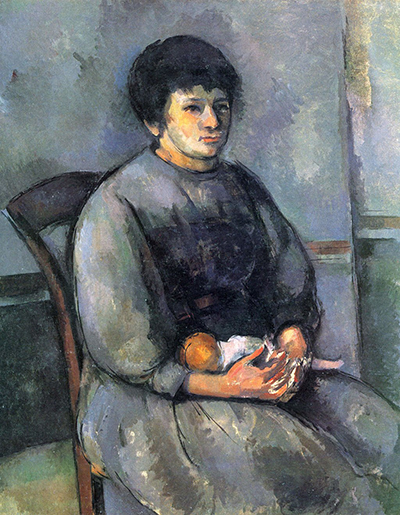
A dark-haired sitter occupies almost the full height of Paul Cézanne’s Young Girl with a Doll . Her grey dress spreads across the lower canvas, while her hands gather around a tiny figure in her lap. The doll’s small scale is startling beside the broad sleeves, sturdy chair and concentrated face. Cézanne’s portrait asks the eye to move between the weight of a person and the few quick strokes that make a toy appear.
At a Glance
- Artist Paul Cézanne. [1]
- Title Jeune fille à la poupée . [1]
- Date About 1895. [1]
- Medium and size Oil on canvas, 92 × 73 cm. [1]
This work across Paul Cézanne’s career
The Kiss of the Muse
c.1860The Artist’s Father, Reading L’Événement
autumn 1866The Hanged Man’s House
c.1873A Modern Olympia
1873–74Maincy Bridge
1879–80The Blue Vase
1889–90The Basket of Apples
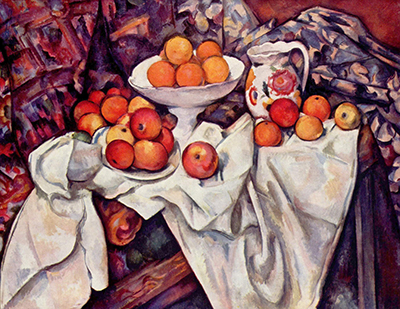
c.1893Apples and Oranges
c.1899The Large Bathers (Philadelphia)
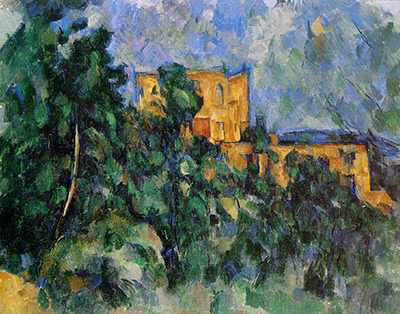
1900–1906 (Philadelphia Museum dating)Château Noir (MoMA)
1903–04Contents
- A sitter nearly as large as the canvas
- The doll in the hands
- Chair, wall and shallow room
- Another portrait, and the problem of a name
- From Vollard’s records to later exhibitions
- Looking again
A sitter nearly as large as the canvas
The head sits high in the picture, with little open space above the dark mass of hair. From there, the figure widens through the rounded sleeves before narrowing towards the joined hands. The dress then expands again into the great grey shape of the skirt. That sequence gives the seated person an unusually solid silhouette. She is firmly placed, even though we cannot see her feet or trace every edge of the chair beneath her.
Her face is the most sharply differentiated part of the image. A patch of yellow light catches the forehead and cheek; cooler blue and grey marks interrupt that warmth around the eyes and jaw. The gaze turns away from us, following the slight turn of the head rather than engaging an imagined visitor. Across the lower face, short dark marks hold the mouth in place. They also show how economical the description is: a few changes of tone make a likeness without smoothing the skin into a continuous surface.
The hands have enough room to become a second focus. The sleeves swell on either side of the central dark bodice. Their paler paint gives the arms the breadth of supporting pillars, while the upper body forms a compact mass above the spreading skirt. The figure seems assembled from adjacent shapes that remain visible as paint. Yet none of those shapes quite cancels the sense of an individual sitting before the painter.
The doll in the hands
The doll is easy to miss. It lies among the sitter’s fingers and pale fabric, its tiny body partly swallowed by the meeting of pink, white, orange and grey. The hands, by contrast, are insistently large and warm. One forearm crosses the lap; fingers from both sides turn toward the toy. Their changing outlines do not give us a neat diagram of which finger is in front. They make the middle of the canvas a knot of contact, where holding, looking and painting meet.
John Elderfield has pointed out the doll’s apparently single leg and the unexpectedly broad band across the sitter’s waist. [2]
The doll cannot be read as a carefully itemised accessory. Its small pale body flashes out of the dark dress and sinks back into it. The title supplies a name for that flash, while the paint preserves the difficulty of seeing it whole.
A doll conventionally signals childhood. Here its relation to the sitter is less tidy. It is almost lost against a figure whose dark bodice and composed seating take up so much of the canvas. The object does establish what she is doing with her hands; it does not explain who she was or what she felt. The painting’s interest lies in this difference of scale. We can follow a modest action in the lap while the surrounding portrait gives that action a surprisingly monumental setting.
Chair, wall and shallow room
The chair enters at the sitter’s left as a dark curved back, then descends beside her body in a narrow brown strip. It gives a clear reason for her seated position, although it does not form a complete piece of furniture. A horizontal line of wall trim runs behind her and crosses the right edge. Below it, green-grey paint becomes darker and denser. Above it, the wall opens into a cool field of broken blue and lilac. The room is legible from these fragments without becoming a detailed domestic interior.
The upper right corner is particularly active. A narrow warm vertical patch interrupts the cooler wall, while the horizontal trim meets the side of the canvas. Those lines could have made a rigid grid. Cézanne softens their authority through changing paint and unequal edges. The sitter’s rounded sleeve and skirt press against them, so that the background feels close rather than distant. There is little intervening air, and the person seems to take possession of the available surface.
Another portrait, and the problem of a name
Acquavella Galleries identifies a smaller portrait of the same sitter at the National Museum of Art in Bucharest. [3]
The two pictures therefore offer different scales for looking at a related face. In this larger canvas, hands, toy, chair and room share attention with the head. The existence of another portrait suggests sustained attention to this sitter, though neither picture supplies her name or establishes which was begun first.
Vollard’s stockbooks described FWN 518 both as a young girl with a doll and as a seated woman holding one. [1]
The wording allows no secure age. The substantial seated figure and the tiny toy belong to different scales within the same portrait.
John Elderfield, introducing the 2017 portrait exhibition, stressed how Cézanne’s portraits often disclose little about a sitter’s social position or inner life. [4]
From Vollard’s records to later exhibitions
The catalogue places the painting at the Jas de Bouffan and tentatively identifies it with a work shown by Vollard in Paris in 1895. [1]
Vollard later named a Jeune fille à la poupée among works seen at that exhibition. [5]
The recorded ownership chain includes Alphonse Kann, Walter P. Chrysler Jr and Heinz Berggruen before a New York private collection. [1]
Exhibitions included Paris displays in 1930 and 1936, a mid-century Chrysler collection tour, and the 2017–18 Cézanne Portraits exhibition in Paris, London and Washington. [1]
In a review of the London exhibition, Richard Shone judged this portrait harshly and questioned the title’s designation of the sitter as a girl. [6] Elderfield, discussing the same work, valued its odd proportions. [2] Their disagreement gives viewers a reason to inspect how an apparently plain portrait resists a quick reading.
Looking again
Return to the narrow space between the hands. The pale doll does not simply sit on top of a completed grey dress; it is made through the interruptions of that dress, the orange notes of skin and the small white areas that catch the eye. Then look upward. The face is more clearly separated from its background than the toy is from the lap, yet its contours also depend on neighbouring colours. The painting connects its two points of attention through the same working method, varying how much certainty each receives.
Cézanne artworks directory
Browse 217 identified works in this researched selection, including paintings, drawings and watercolours. This is a bounded selection, not a complete catalogue of Cézanne’s surviving oeuvre. Unlinked titles have no confirmed article in this collection.
| Name | Date | Medium |
|---|---|---|
| A Head, a Cup, and a Bread Roll | 1891/1894 | Drawing |
| A Man seen from Behind | 1880/1883 | Drawing |
| A Modern Olympia | 1873–74 | Painting |
| A Nude and Foliage | 1879/1882 | Drawing |
| A Smoking Man | 1892–96 (catalogue); c.1890–92 (museum) | Drawing |
| Afternoon in Naples | 1876–77 | Painting |
| An Old Woman with a Rosary | about 1895–96 | Painting |
| Apples and Oranges | c.1899 | Painting |
| Auvers, Panoramic View | 1873–75 | Painting |
| Avenue at Chantilly | 1888 | Painting |
| Banks of the Marne | 1888–94 | Painting |
| Basket | 1877/1900 | Drawing |
| Bather with Outstretched Arms | 1877–78 | Painting |
| Bellows in Front of a Fireplace | 1887/1892 | Drawing |
| Bibémus Quarry | c.1895 | Painting |
| Boy in a Red Vest, Barnes Foundation | 1888–90 | Painting |
| Boy in a Red Vest, MoMA | 1888–90 | Painting |
| Boy in a Red Waistcoat, National Gallery of Art | 1888–90 | Painting |
| Branch in Flower | 1886/1889 | Drawing |
| Carnival Scene | 1885/1888 | Drawing |
| Chair and Dresser | 1880/1883 | Drawing |
| Chateau Noir | 1903–04 | Painting |
| Chestnut Trees and Farm at Jas de Bouffan | c.1885 | Painting |
| Chestnut Trees and Farm at Jas de Bouffan, Pushkin | c.1886 | Painting |
| Chestnut Trees at Jas de Bouffan in Winter | 1885–86 | Painting |
| Château Noir | 1900–04 | Painting |
| Cistern in the Park of Château Noir | c.1900 | Painting |
| Curtain, Jug and Fruit | 1893–94 | Painting |
| Cushion of an Armchair | 1886/1889 | Drawing |
| Draft Letter and Studies of Bathers | c.1878 | Drawing |
| Farmhouse and Chestnut Trees at Jas de Bouffan | 1884–85 | Painting |
| Figure Resting Head on Hand | c. 1889 | Drawing |
| Fireplace Tongs and Poker | 1887/1892 | Drawing |
| Forest Interior, San Francisco | c.1898–99 | Painting |
| Four Bathers | 1888–90 | Painting |
| Fruit and a Jug on a Table | 1893–94 | Painting |
| Gardanne | 1885–86 | Painting |
| Gardanne, Barnes Foundation | c.1885 | Painting |
| Hand and Shoulder of a Boy | c. 1885 | Drawing |
| Harlequin, National Gallery of Art | 1888–90 | Painting |
| Head of a Boy | 1887/1889 | Drawing |
| Head of a Boy Seen from Behind | c. 1885 | Drawing |
| Head of a Young Woman | c. 1880 | Drawing |
| Head of the Artist's Son | 1888/1889 | Drawing |
| Hillside in Provence | c.1890–92 | Painting |
| Horse Chestnut Trees at Jas de Bouffan | c.1885 | Painting |
| House and Farm at the Jas de Bouffan | c.1887 | Painting |
| House in a Park | 1883/1886 | Drawing |
| House in Provence | c.1885 | Painting |
| House of Père Lacroix | 1873 | Painting |
| House Surrounded by Vegetation | 1889/1892 | Drawing |
| Houses in Provence The Riaux Valley near L’Estaque | c.1883 | Painting |
| Jas de Bouffan, the Pool | c.1876 | Painting |
| Kerosene Lamp | 1878/1881 | Drawing |
| L'Estaque, Melting Snow | c.1870 | Painting |
| Lake Annecy | 1896 | Painting |
| Landscape in Provence, Pola Museum | 1879–82 | Painting |
| Landscape Near Aix-en-Provence | 1877/1880 | Drawing |
| Landscape Seen from the Inside of a Cave | 1889/1892 | Drawing |
| Landscape with Poplars | c.1885–87 | Painting |
| Landscape with Trees | 1895/1898 | Drawing |
| Leda and the Swan | c.1880 (possibly later) | Painting |
| Little Girl with a Doll | 1902–04 | Painting |
| Louis Guillaume | 1879–1890 | Painting |
| Madame Cezanne | 1888/1891 | Drawing |
| Madame Cezanne | 1886/1889 | Drawing |
| Madame Cezanne | 1882/1887 | Drawing |
| Madame Cezanne | 1897/1900 | Drawing |
| Madame Cezanne with her Head Lowered | 1893/1896 | Drawing |
| Madame Cézanne in a Red Armchair | c.1877 | Painting |
| Madame Cézanne in a Red Dress, Metropolitan Museum of Art | 1888–90 | Painting |
| Madame Cézanne in a Yellow Chair | 1888–90 | Painting |
| Madame Cézanne in a Yellow Chair, Fondation Beyeler | 1888–90 | Painting |
| Madame Cézanne in the Conservatory | 1891 | Painting |
| Maincy Bridge | 1879–80 | Painting |
| Maison Maria with a View of Château Noir | c.1895 | Painting |
| Man Bending Forward | 1883/1886 | Drawing |
| Man Smoking a Pipe, Pushkin | c.1891, possibly later | Painting |
| Man with a Pipe | 1891–96 | Painting |
| Man with a Pipe, Nelson-Atkins | 1890–92 | Painting |
| Man with a Straw Hat (Gustave Boyer) | c.1871 | Painting |
| Man with Crossed Arms | c.1899 | Painting |
| Man with Pipe, National Gallery of Art | 1892–96 | Painting |
| Mont Sainte-Victoire | c.1902–06 | Painting |
| Mont Sainte-Victoire | 1900–02 | Painting |
| Mont Sainte-Victoire (recto) | c.1895 | Watercolour |
| Mont Sainte-Victoire and the Viaduct of the Arc River Valley | 1882–85 | Painting |
| Mont Sainte-Victoire Seen beyond the Wall of the Jas de Bouffan | c.1885/1888 | Watercolour |
| Mont Sainte-Victoire Seen from Bibémus Quarry | c.1897 | Painting |
| Mont Sainte-Victoire, Barnes Foundation | 1892–95 | Painting |
| Near the Pool at Jas de Bouffan | 1883/1887 | Drawing |
| Pelicans | 1877/1880 | Drawing |
| Peonies | 1890/1893 | Drawing |
| Pierrot and Harlequin | 1888 | Painting |
| Pine Tree | 1882/1885 | Drawing |
| Pont des Trois Sautets | 1906 | Watercolour |
| Poplars | 1879–80 | Painting |
| Portrait of Ambroise Vollard | 1899 | Painting |
| Portrait of Gustave Geffroy | 1895–96 | Painting |
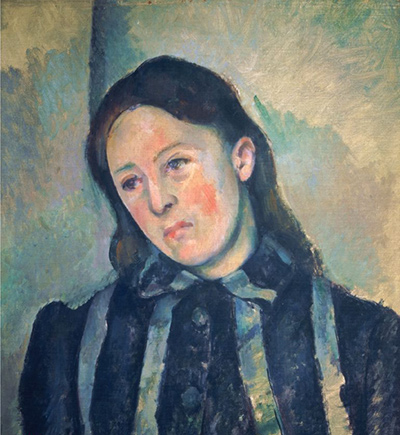
| Portrait of Madame Cezanne with Loosened Hair | 1885–86 | Painting |
| Portrait of the Artist Looking Over His Shoulder | 1883–84 | Painting |
| Portrait of the Gardener Vallier | 1906 | Painting |
| Portrait of Victor Chocquet | 1876–77 | Painting |
| Portrait Of Victor Chocquet Seated | 1877 | Painting |
| Provençal Manor | c.1885 | Painting |
| Pyramid of Skulls | 1898–1900 | Painting |
| Reclining Nude (Leda?) | c.1887 | Painting |
| Scipio | 1866–68 | Painting |
| Seated Man, Oslo | 1898–1900 | Painting |
| Seated Peasant | c.1892–96 | Painting |
| Seated Peasant, Hiroshima | c.1897 | Painting |
| Seated Peasant, Orsay | c.1900 | Painting |
| Self-Portrait | c. 1895 | Drawing |
| Self-Portrait in a Bowler Hat, Ny Carlsberg Glyptotek | 1885–86 | Painting |
| Self-Portrait in a Casquette | c.1875 | Painting |
| Self-Portrait with a Beret | 1898–1900 | Painting |
| Self-Portrait with a Hat, Artizon Museum | c.1890–94 | Painting |
| Self-Portrait with a Pink Background | c.1875 | Painting |
| Self-Portrait with Olive-Coloured Wallpaper | about 1880–81 | Painting |
| Self-Portrait with Palette | 1886–87 | Painting |
| Self-Portrait with White Turban | c.1878–80 | Painting |
| Self-Portrait, c.1895 | c.1895 | Painting |
| Self-Portrait, Pushkin Museum | c.1882 | Painting |
| Spanish Dancers | 1883/1886 | Drawing |
| Still Life with a Curtain | 1892–94 | Painting |
| Still Life with Apples | c.1890 | Painting |
| Still Life with Apples | 1893–94 | Painting |
| Still Life with Apples and a Pot of Primroses | about 1890 | Painting |
| Still Life with Milk Jug and Fruit | c.1900 | Painting |
| Still Life with Open Drawer | 1877–79 | Painting |
| Still Life with Plaster Cupid | about 1894 | Painting |
| Still Life with Skull | 1890–93 | Painting |
| Still Life with Soup Tureen | 1877 | Painting |
| Still Life, Pitcher and Fruit | 1893–94 | Painting |
| Studies Including a Straw Hat | 1895/1898 | Drawing |
| Studies Including Madame Cezanne | 1884/1887 | Drawing |
| Study for "The Judgement of Paris" or "The Amorous Shepherd" | 1883/1886 | Drawing |
| Study for Woman with a Coffee Pot | c.1895 | Painting |
| Study of "The Roman Orator (Germanicus)" | 1883/1886 | Drawing |
| Study of "Venus de Milo" | 1881/1884 | Drawing |
| Study of a Decorative Ornament | 1879/1882 | Drawing |
| Study of a Standing Male Figure after the Antique | c. 1895 | Drawing |
| Study of an Angel in Rubens' "The Prophet Elijah" | 1892/1895 | Drawing |
| Study of Desiderio da Settignano's "Bust of a Child" | c. 1895 | Drawing |
| Study of Houses | 1879/1882 | Drawing |
| Study of Puget's "Hercules Resting" | c. 1879 | Drawing |
| Study of Puget's "Milo of Crotona" | 1895/1898 | Drawing |
| Study of Puget's "Milo of Crotona" | 1880/1883 | Drawing |
| Study of the Allegorical Figure Bellona in Rubens' "The Apotheosis of Henri IV" | 1883/1886 | Drawing |
| Study of the Allegorical Figure Bellona in Rubens' "The Apotheosis of Henri IV" | 1879/1882 | Drawing |
| Study of the Allegorical Figure France in Rubens' "The Exchange of the Two Princesses" | 1882/1885 | Drawing |
| Study of the Allegorical Figure of Health in Rubens' "The Birth of Louis XIII" | 1880/1883 | Drawing |
| Study of the Allegorical Figure of the Genius of Health from Rubens' "The Birth of Louis XIII at Fontainbleau" | 1895/1898 | Drawing |
| Sugar Bowl, Pears and Blue Cup | 1865–66 | Painting |
| The Aqueduct, Pushkin Museum | Dating differs between museum records | Painting |
| The Artist's Father, Reading L'Evenement | autumn 1866 | Painting |
| The Artist's Son | c. 1887 | Drawing |
| The Artist's Son Leaning on his Elbow | c. 1887 | Drawing |
| The Artist's Son Reading | c. 1887 | Drawing |
| The Artist's Son Writing | c. 1887 | Drawing |
| The Artist’s Son, Paul | 1886–87 | Painting |
| The Avenue at Jas de Bouffan | 1868–70 (possibly later) | Painting |
| The Avenue at Jas de Bouffan, Geneva | c.1890 | Painting |
| The Basket of Apples | c.1893 | Painting |
| The Bather, Museum of Modern Art | c.1885 | Painting |
| The Bay of Marseille seen from L'Estaque | c.1885 | Painting |
| The Blue Vase | 1889–90 | Painting |
| The Boy in the Red Vest, Bührle | 1888–90 | Painting |
| The Buffet | 1877–79 | Painting |
| The Card Players, Barnes Foundation | 1890–92 | Painting |
| The Card Players, Courtauld Gallery | 1892–96 | Painting |
| The Card Players, Metropolitan Museum of Art | 1890–92 | Painting |
| The Card Players, Musée d’Orsay | 1893–96 | Painting |
| The Card Players, Qatar | 1892–96 | Painting |
| The Eternal Feminine | c.1877 | Painting |
| The Gardener Vallier | 1906 | Painting |
| The Gardener Vallier, Tate | 1905–06 | Painting |
| The Grounds of the Château Noir | c.1900–04 | Painting |
| The Gulf of Marseille Seen from L’Estaque | c.1885 | Painting |
| The Hanged Man's House in Auvers | c.1873 | Painting |
| The House of Doctor Gachet at Auvers | 1872–73 | Painting |
| The House with the Cracked Walls | 1892–94 | Painting |
| The Kiss of the Muse | c.1860 | Painting |
| The Large Bathers, Barnes Foundation | 1895–1906 | Painting |
| The Large Bathers, National Gallery | 1895–1905 | Painting |
| The Large Bathers, Philadelphia Museum of Art | 1900–06 | Painting |
| The Mill | 1889/1892 | Drawing |
| The Painter’s Father, Louis-Auguste Cézanne | c.1865 | Painting |
| The Peasant | 1890–92 | Painting |
| The Plaster Mill (La Moulin à plâtre) | 1889/1892 | Drawing |
| The Smoker, Hermitage | c.1891 | Painting |
| The Smoker, Mannheim | c.1891 | Painting |
| The Stove in the Studio | c.1865 | Painting |
| The Vase of Tulips | c.1890 | Painting |
| Thistle | 1893/1896 | Drawing |
| Three Heads, One of Madame Cezanne | 1882/1885 | Drawing |
| Three Skulls | c.1898 | Painting |
| Three Skulls on a Patterned Carpet | 1904 | Painting |
| Trees and Shrubs | 1883/1887 | Drawing |
| Turning Road at Montgeroult | 1898 | Painting |
| Two Bathers | 1884/1887 | Drawing |
| Two Heads | 1888 | Drawing |
| Two Heads | 1890/1896 | Drawing |
| Two Heads of Women | 1890/1894 | Drawing |
| Two Studies for "The Judgement of Paris" or "The Amorous Shepherd" | 1883/1886 | Drawing |
| Uncle Dominique in a Tasseled Cap | 1866 | Painting |
| Uncle Dominique in a Turban | 1866–67 | Painting |
| Victor Chocquet and an Angel for "The Apotheosis of Delacroix" | 1878/1880 | Drawing |
| Woman in Blue | c.1904 | Painting |
| Woman Leaning Forward | 1888/1891 | Drawing |
| Woman Leaning Forward | 1890/1894 | Drawing |
| Woman Leaning Forward | 1890/1894 | Drawing |
| Woman with a Coffee Pot | c.1895 | Painting |
| Women Bathers and a Roll of Paper | 1882/1885 | Drawing |
| Young Girl with a Doll | c.1895 | Painting |
| Young Italian Woman at a Table | c.1895–1900 | Painting |
| Young Man and Skull | 1896–98 | Painting |
Frequently Asked Questions
The catalogue dates FWN 518 to about 1895 and records other proposed dates within the 1890s. [1]
She has not been securely identified. Acquavella Galleries identifies a smaller portrait of the same sitter in Bucharest. [3]
No. This is the circa-1895 canvas FWN 518, measuring 92 × 73 cm. [1] Little Girl with a Doll is FWN 538, dated 1902–04 and measuring 73 × 60 cm. [7]
Discussion
Look again at the images and ideas explored in Young Girl with a Doll by Paul Cézanne. These editorial prompts invite your observations.
Reader Insights
The doll first appears as a pale interruption in the sitter’s hands. Look at how much of it you can actually make out before the title supplies the object’s identity.
Follow the chairback and the wall trim toward the canvas edges. Those few lines establish a room, but they also push attention back toward the sitter’s body.
The portrait leaves the person unnamed while making her physical presence unmistakable. Which painted detail holds your attention longest: her face, the hands, or the broad grey skirt?
Join the Conversation
Share a detail, comparison or question about Young Girl with a Doll by Paul Cézanne below.
References
- Société Paul Cezanne , “Jeune fille à la poupée, c.1895 (FWN 518),” The Paintings, Watercolors and Drawings of Paul Cezanne: An Online Catalogue Raisonné . View source .
- The Brooklyn Rail , Phong Bui, “John Elderfield with Phong Bui,” June 2018. View source .
- Acquavella Galleries , “Paul Cézanne: Jeune fille à la poupée [Girl with a Doll], 1894–96,” viewing room, 2020. View source .
- National Portrait Gallery , John Elderfield, “An Introduction to Cézanne Portraits,” 23 October 2017. View source .
- Société Cézanne , “1895,” 27 July 2016. (in French). View source .
- The Burlington Magazine , Richard Shone, “Cézanne’s portraits, London,” exhibition review, 2018. View source .
- Société Paul Cezanne , “Fillette à la poupée, 1902–04 (FWN 538),” The Paintings, Watercolors and Drawings of Paul Cezanne: An Online Catalogue Raisonné . View source .
- Le Baiser de la muse, d'après Frillié (FWN 572). View source.
- Louis-Auguste Cezanne, père de l'artiste, lisant L'Événement (FWN 402). View source.
- La Maison du pendu, Auvers-sur-Oise (FWN 81). View source.
- Une moderne Olympia (FWN 628). View source.
- Le Pont de Maincy (FWN 143). View source.
- La Montagne Sainte-Victoire vue de Montbriand (FWN 185). View source.
- Gardanne (vue horizontale) (FWN 224). View source.
- Le Vase bleu (FWN 823). View source.
- Les Joueurs de cartes (FWN 681). View source.
- La Montagne Sainte-Victoire (FWN 296). View source.
- La Corbeille de pommes (FWN 860). View source.
- Pommes et oranges (FWN 871). View source.
- Portrait d'Ambroise Vollard (FWN 531). View source.
- Philadelphia Museum of Art,The Large Bathers,W1937-1-1. View source.
- Château Noir (FWN 360). View source.
- Société Paul Cezanne,online catalogue structure and objectidentification. View source.
- National Gallery of Art,Cezanne Sketchbook,1992.51.9. View source.
- Splash image, The sitter’s hands enclose a small pale doll against her grey dress.