 by
Tom Gurney
Tom Gurney BSc (Hons) is an art history expert with over 20 years experience
Published on June 19, 2020 / Updated on October 22, 2026
Email:
tomgurney1@gmail.com
/ Phone:
+44 7429 011000
Madame Cézanne in a Yellow Armchair: The Beyeler Portrait: Introduction
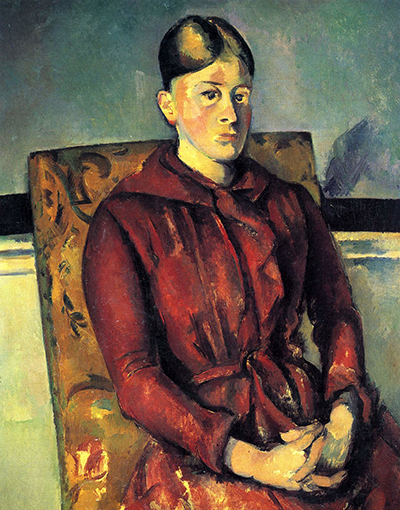
Hortense Fiquet sits in a golden upholstered chair, wearing a deep red dress. Her shoulders and folded hands give the pose a quiet, compact shape. Yet the room around her will not quite hold still: a dark band crosses the wall behind the chair, and the pale surface below it seems to change direction. Colour secures the figure even as the construction of the space invites a second look.
The online catalogue identifies this particular canvas as FWN 490 and calls it Madame Cezanne en robe rouge . It also records “Yellow Armchair” among its alternative titles. [1]
Fondation Beyeler presents this oil painting as Madame Cézanne à la chaise jaune , dating it 1888–90. Its English title, Madame Cézanne in a Yellow Chair , identifies the furnishing that gives the seated figure her strongest frame. [2]
At a Glance
- Artist Paul Cézanne. [2]
- Sitter Hortense Fiquet Cézanne. [3]
- Date 1888–90, according to Fondation Beyeler. [2]
- Medium Oil on canvas. [2]
- Size 80.3 × 64.3 cm in Beyeler's 2022 documentation; the catalogue gives a rounded 81 × 65 cm. [2] [1]
- Collection Fondation Beyeler, Riehen/Basel; FWN 490, Rewald 651. [1]
This work across Paul Cézanne’s career
The Kiss of the Muse
c.1860The Artist’s Father, Reading L’Événement
autumn 1866The Hanged Man’s House
c.1873A Modern Olympia
1873–74Maincy Bridge
1879–80The Blue Vase
1889–90The Basket of Apples
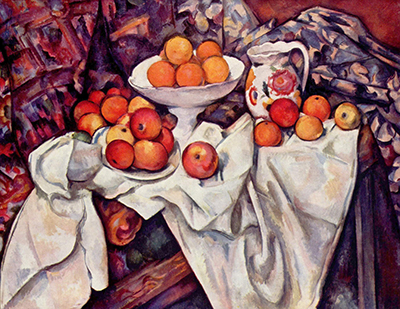
c.1893Apples and Oranges
c.1899The Large Bathers (Philadelphia)
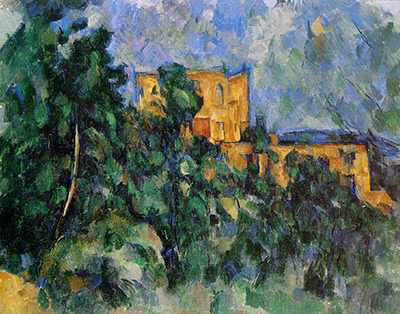
1900–1906 (Philadelphia Museum dating)Château Noir (MoMA)
1903–04Contents
- A seated figure held by colour
- The wall that shifts behind the chair
- A face that resists a fixed likeness
- One painting among four red-dress portraits
- Names, owners and renewed encounters
A seated figure held by colour
The chair rises behind Hortense's shoulders like a second outline of her body. Its patterned yellow and ochre upholstery remains visible on both sides of her torso, broad enough to form a frame but narrow enough that she seems to fill it. The dress has a shawl collar and a belt or fastening at the waist. Dark purples cut through its red; warmer passages gather on the sleeves and across the lap. The division between garment and chair is sometimes a firm dark edge and sometimes a meeting of strokes that leaves the boundary less certain.
Her hands rest together low in the picture. Around them, dark contours turn sharply through the red skirt, then meet pale areas where paint has not completely covered the ground. A viewer can read a pair of hands and still see the canvas participating in their shape. The chair's pattern, meanwhile, is more insistently marked than parts of the face. The painting distributes attention unevenly: an ornament may be emphatic while an expected anatomical boundary stays provisional.
Fondation Beyeler draws attention to that contrast. Its 2022 gallery text singles out the exposed ground around the joined hands and lap, treating it as part of Cézanne's approach to an unfinished image rather than as a detail to overlook. The museum's later room guide similarly places finely modelled passages beside a face assembled from brief touches of colour. [3] [4]
The wall that shifts behind the chair
A dark horizontal strip divides the upper blue-green wall from the paler lower area. On the left, the strip appears to continue behind the upholstery. To the right it becomes heavier and meets a slanting, darker passage. The lower pale plane rises toward that point, so the same band can seem both like a level moulding and like a line turning away. No corner is plainly described. The seat remains legible while the room's geometry stays open to revision.
The Beyeler guide calls attention to this apparent change of direction behind the chair and to the unusually close appearance of Hortense's upper body for a seated pose. Its account treats figure and room as constructions made with colour, with the usual rules of perspective loosened. The point becomes concrete at the shoulder: dark red nearly touches the warm upholstery, which in turn stands against cool blue-green. These adjoining areas give the body weight without requiring a smoothly receding room. [4]
There is also a rhythm of enclosure and escape. The chair's straight upper edge almost boxes in the head, while the slant on the right opens a route away from it. The torso widens below the narrow neck, but the elbows draw inward again around the clasped hands. The painting thus keeps gathering its forms toward the centre, then lets a line or colour passage pull them outward. This balance can make the sitter look settled at first and more precariously placed after longer looking.
A face that resists a fixed likeness
The face is pale against the dark hair and collar. Yellow, greenish and rose-coloured touches form cheek, forehead and chin without polishing them into a single smooth surface. One eye seems more sharply directed than the other, and the mouth is a small, compressed meeting of warmer and cooler marks. The head is recognisably human and particular, but its expression is difficult to name. Looking at the face as paint reveals more than assigning Hortense a mood.
Susan Sidlauskas uses this very Beyeler canvas in the introduction to Cézanne's Other to demonstrate how sharply Hortense's appearance changes across the portraits. She compares its spare red dress and fragile, interrupted facial construction with the more lushly staged Madame Cézanne in the Conservatory . Her larger question concerns what a portrait can preserve of likeness when its subject is remade so differently from one version to another. The Beyeler work is especially clear evidence for that question because the solid red body and framed seat coexist with a head that seems to be resolving in front of us. [5]
John Elderfield's account of Cézanne's portraiture places such work within a wider nineteenth-century debate over whether a painted portrait must give a social or psychological likeness. In this picture the conventional pose remains, yet likeness cannot be reduced to an inventory of facial features. [6]
One painting among four red-dress portraits
The Beyeler picture belongs to a group of four portraits in which Hortense wears a shawl-collared red dress. The other canvases are now associated with the Art Institute of Chicago (FWN 492), the Museu de Arte de São Paulo (FWN 491), and the Metropolitan Museum of Art (FWN 493). The repeated garment and chair make the group easy to confuse, especially since historical titles such as Madame Cézanne au fauteuil jaune were applied to more than one painting. Collection and catalogue numbers are the surest way to tell the records apart. [7]
The Chicago painting is a separate canvas, FWN 492, accession 1948.54. It is close to the Beyeler picture in size and seated arrangement. [8]
The São Paulo work places the red-clad figure in a simpler setting; the Met's much larger version surrounds her with a fireplace, mirror and patterned drapery. The Met associates that detailed interior with the Paris apartment at 15 quai d'Anjou, rented from 1888 to 1890. [9] [10]
Christie's 1997 account of the Beyeler canvas compares all four, observing that this work and the Chicago portrait join Hortense's hands while the Met and São Paulo versions show a flower. It also relates the Beyeler painting to the quai d'Anjou setting. That proposed setting is plausible in the context of the group, but the Beyeler image itself offers only a spare wall and chair, not the Met picture's fuller collection of identifying furnishings. [11]
Names, owners and renewed encounters
Christie's 1997 sale record traces the picture through Ambroise Vollard, Paul Cassirer, Lucie Ceconi and several galleries before its passage into American private collections. Adolph and Samuel Lewisohn, Millicent Rogers, Peter Salm and the Loeb family appear in that route. The path from European dealers to American owners helps explain why this portrait acquired a public history beyond the studio before it entered the Beyeler collection. [11]
The work's movement is also visible in its exhibition titles: La femme au fauteuil in Marseille in 1912, Damenbildnis in Munich that year, and Portrait of Mme Cézanne in Red in Detroit in 1931. These are changes of presentation around one physical canvas, not evidence of different paintings. [1]
Fondation Beyeler states that Ernst and Hildy Beyeler acquired it in 1997 as the museum was about to open. In the museum's 2022 anniversary presentation, it appeared beside Duane Hanson's Old Lady in Folding Chair and Picasso's Femme en vert (Dora) . The display placed three seated figures in conversation across different media and decades; it offered a fresh context for this painting's still pose and unsettled space. [3]
Cézanne artworks directory
Browse 217 identified works in this researched selection, including paintings, drawings and watercolours. This is a bounded selection, not a complete catalogue of Cézanne’s surviving oeuvre. Unlinked titles have no confirmed article in this collection.
| Name | Date | Medium |
|---|---|---|
| A Head, a Cup, and a Bread Roll | 1891/1894 | Drawing |
| A Man seen from Behind | 1880/1883 | Drawing |
| A Modern Olympia | 1873–74 | Painting |
| A Nude and Foliage | 1879/1882 | Drawing |
| A Smoking Man | 1892–96 (catalogue); c.1890–92 (museum) | Drawing |
| Afternoon in Naples | 1876–77 | Painting |
| An Old Woman with a Rosary | about 1895–96 | Painting |
| Apples and Oranges | c.1899 | Painting |
| Auvers, Panoramic View | 1873–75 | Painting |
| Avenue at Chantilly | 1888 | Painting |
| Banks of the Marne | 1888–94 | Painting |
| Basket | 1877/1900 | Drawing |
| Bather with Outstretched Arms | 1877–78 | Painting |
| Bellows in Front of a Fireplace | 1887/1892 | Drawing |
| Bibémus Quarry | c.1895 | Painting |
| Boy in a Red Vest, Barnes Foundation | 1888–90 | Painting |
| Boy in a Red Vest, MoMA | 1888–90 | Painting |
| Boy in a Red Waistcoat, National Gallery of Art | 1888–90 | Painting |
| Branch in Flower | 1886/1889 | Drawing |
| Carnival Scene | 1885/1888 | Drawing |
| Chair and Dresser | 1880/1883 | Drawing |
| Chateau Noir | 1903–04 | Painting |
| Chestnut Trees and Farm at Jas de Bouffan | c.1885 | Painting |
| Chestnut Trees and Farm at Jas de Bouffan, Pushkin | c.1886 | Painting |
| Chestnut Trees at Jas de Bouffan in Winter | 1885–86 | Painting |
| Château Noir | 1900–04 | Painting |
| Cistern in the Park of Château Noir | c.1900 | Painting |
| Curtain, Jug and Fruit | 1893–94 | Painting |
| Cushion of an Armchair | 1886/1889 | Drawing |
| Draft Letter and Studies of Bathers | c.1878 | Drawing |
| Farmhouse and Chestnut Trees at Jas de Bouffan | 1884–85 | Painting |
| Figure Resting Head on Hand | c. 1889 | Drawing |
| Fireplace Tongs and Poker | 1887/1892 | Drawing |
| Forest Interior, San Francisco | c.1898–99 | Painting |
| Four Bathers | 1888–90 | Painting |
| Fruit and a Jug on a Table | 1893–94 | Painting |
| Gardanne | 1885–86 | Painting |
| Gardanne, Barnes Foundation | c.1885 | Painting |
| Hand and Shoulder of a Boy | c. 1885 | Drawing |
| Harlequin, National Gallery of Art | 1888–90 | Painting |
| Head of a Boy | 1887/1889 | Drawing |
| Head of a Boy Seen from Behind | c. 1885 | Drawing |
| Head of a Young Woman | c. 1880 | Drawing |
| Head of the Artist's Son | 1888/1889 | Drawing |
| Hillside in Provence | c.1890–92 | Painting |
| Horse Chestnut Trees at Jas de Bouffan | c.1885 | Painting |
| House and Farm at the Jas de Bouffan | c.1887 | Painting |
| House in a Park | 1883/1886 | Drawing |
| House in Provence | c.1885 | Painting |
| House of Père Lacroix | 1873 | Painting |
| House Surrounded by Vegetation | 1889/1892 | Drawing |
| Houses in Provence The Riaux Valley near L’Estaque | c.1883 | Painting |
| Jas de Bouffan, the Pool | c.1876 | Painting |
| Kerosene Lamp | 1878/1881 | Drawing |
| L'Estaque, Melting Snow | c.1870 | Painting |
| Lake Annecy | 1896 | Painting |
| Landscape in Provence, Pola Museum | 1879–82 | Painting |
| Landscape Near Aix-en-Provence | 1877/1880 | Drawing |
| Landscape Seen from the Inside of a Cave | 1889/1892 | Drawing |
| Landscape with Poplars | c.1885–87 | Painting |
| Landscape with Trees | 1895/1898 | Drawing |
| Leda and the Swan | c.1880 (possibly later) | Painting |
| Little Girl with a Doll | 1902–04 | Painting |
| Louis Guillaume | 1879–1890 | Painting |
| Madame Cezanne | 1888/1891 | Drawing |
| Madame Cezanne | 1886/1889 | Drawing |
| Madame Cezanne | 1882/1887 | Drawing |
| Madame Cezanne | 1897/1900 | Drawing |
| Madame Cezanne with her Head Lowered | 1893/1896 | Drawing |
| Madame Cézanne in a Red Armchair | c.1877 | Painting |
| Madame Cézanne in a Red Dress, Metropolitan Museum of Art | 1888–90 | Painting |
| Madame Cézanne in a Yellow Chair | 1888–90 | Painting |
| Madame Cézanne in a Yellow Chair, Fondation Beyeler | 1888–90 | Painting |
| Madame Cézanne in the Conservatory | 1891 | Painting |
| Maincy Bridge | 1879–80 | Painting |
| Maison Maria with a View of Château Noir | c.1895 | Painting |
| Man Bending Forward | 1883/1886 | Drawing |
| Man Smoking a Pipe, Pushkin | c.1891, possibly later | Painting |
| Man with a Pipe | 1891–96 | Painting |
| Man with a Pipe, Nelson-Atkins | 1890–92 | Painting |
| Man with a Straw Hat (Gustave Boyer) | c.1871 | Painting |
| Man with Crossed Arms | c.1899 | Painting |
| Man with Pipe, National Gallery of Art | 1892–96 | Painting |
| Mont Sainte-Victoire | c.1902–06 | Painting |
| Mont Sainte-Victoire | 1900–02 | Painting |
| Mont Sainte-Victoire (recto) | c.1895 | Watercolour |
| Mont Sainte-Victoire and the Viaduct of the Arc River Valley | 1882–85 | Painting |
| Mont Sainte-Victoire Seen beyond the Wall of the Jas de Bouffan | c.1885/1888 | Watercolour |
| Mont Sainte-Victoire Seen from Bibémus Quarry | c.1897 | Painting |
| Mont Sainte-Victoire, Barnes Foundation | 1892–95 | Painting |
| Near the Pool at Jas de Bouffan | 1883/1887 | Drawing |
| Pelicans | 1877/1880 | Drawing |
| Peonies | 1890/1893 | Drawing |
| Pierrot and Harlequin | 1888 | Painting |
| Pine Tree | 1882/1885 | Drawing |
| Pont des Trois Sautets | 1906 | Watercolour |
| Poplars | 1879–80 | Painting |
| Portrait of Ambroise Vollard | 1899 | Painting |
| Portrait of Gustave Geffroy | 1895–96 | Painting |
| Portrait of Madame Cezanne with Loosened Hair | 1885–86 | Painting |
| Portrait of the Artist Looking Over His Shoulder | 1883–84 | Painting |
| Portrait of the Gardener Vallier | 1906 | Painting |
| Portrait of Victor Chocquet | 1876–77 | Painting |
| Portrait Of Victor Chocquet Seated | 1877 | Painting |
| Provençal Manor | c.1885 | Painting |
| Pyramid of Skulls | 1898–1900 | Painting |
| Reclining Nude (Leda?) | c.1887 | Painting |
| Scipio | 1866–68 | Painting |
| Seated Man, Oslo | 1898–1900 | Painting |
| Seated Peasant | c.1892–96 | Painting |
| Seated Peasant, Hiroshima | c.1897 | Painting |
| Seated Peasant, Orsay | c.1900 | Painting |
| Self-Portrait | c. 1895 | Drawing |
| Self-Portrait in a Bowler Hat, Ny Carlsberg Glyptotek | 1885–86 | Painting |
| Self-Portrait in a Casquette | c.1875 | Painting |
| Self-Portrait with a Beret | 1898–1900 | Painting |
| Self-Portrait with a Hat, Artizon Museum | c.1890–94 | Painting |
| Self-Portrait with a Pink Background | c.1875 | Painting |
| Self-Portrait with Olive-Coloured Wallpaper | about 1880–81 | Painting |
| Self-Portrait with Palette | 1886–87 | Painting |
| Self-Portrait with White Turban | c.1878–80 | Painting |
| Self-Portrait, c.1895 | c.1895 | Painting |
| Self-Portrait, Pushkin Museum | c.1882 | Painting |
| Spanish Dancers | 1883/1886 | Drawing |
| Still Life with a Curtain | 1892–94 | Painting |
| Still Life with Apples | c.1890 | Painting |
| Still Life with Apples | 1893–94 | Painting |
| Still Life with Apples and a Pot of Primroses | about 1890 | Painting |
| Still Life with Milk Jug and Fruit | c.1900 | Painting |
| Still Life with Open Drawer | 1877–79 | Painting |
| Still Life with Plaster Cupid | about 1894 | Painting |
| Still Life with Skull | 1890–93 | Painting |
| Still Life with Soup Tureen | 1877 | Painting |
| Still Life, Pitcher and Fruit | 1893–94 | Painting |
| Studies Including a Straw Hat | 1895/1898 | Drawing |
| Studies Including Madame Cezanne | 1884/1887 | Drawing |
| Study for "The Judgement of Paris" or "The Amorous Shepherd" | 1883/1886 | Drawing |
| Study for Woman with a Coffee Pot | c.1895 | Painting |
| Study of "The Roman Orator (Germanicus)" | 1883/1886 | Drawing |
| Study of "Venus de Milo" | 1881/1884 | Drawing |
| Study of a Decorative Ornament | 1879/1882 | Drawing |
| Study of a Standing Male Figure after the Antique | c. 1895 | Drawing |
| Study of an Angel in Rubens' "The Prophet Elijah" | 1892/1895 | Drawing |
| Study of Desiderio da Settignano's "Bust of a Child" | c. 1895 | Drawing |
| Study of Houses | 1879/1882 | Drawing |
| Study of Puget's "Hercules Resting" | c. 1879 | Drawing |
| Study of Puget's "Milo of Crotona" | 1895/1898 | Drawing |
| Study of Puget's "Milo of Crotona" | 1880/1883 | Drawing |
| Study of the Allegorical Figure Bellona in Rubens' "The Apotheosis of Henri IV" | 1883/1886 | Drawing |
| Study of the Allegorical Figure Bellona in Rubens' "The Apotheosis of Henri IV" | 1879/1882 | Drawing |
| Study of the Allegorical Figure France in Rubens' "The Exchange of the Two Princesses" | 1882/1885 | Drawing |
| Study of the Allegorical Figure of Health in Rubens' "The Birth of Louis XIII" | 1880/1883 | Drawing |
| Study of the Allegorical Figure of the Genius of Health from Rubens' "The Birth of Louis XIII at Fontainbleau" | 1895/1898 | Drawing |
| Sugar Bowl, Pears and Blue Cup | 1865–66 | Painting |
| The Aqueduct, Pushkin Museum | Dating differs between museum records | Painting |
| The Artist's Father, Reading L'Evenement | autumn 1866 | Painting |
| The Artist's Son | c. 1887 | Drawing |
| The Artist's Son Leaning on his Elbow | c. 1887 | Drawing |
| The Artist's Son Reading | c. 1887 | Drawing |
| The Artist's Son Writing | c. 1887 | Drawing |
| The Artist’s Son, Paul | 1886–87 | Painting |
| The Avenue at Jas de Bouffan | 1868–70 (possibly later) | Painting |
| The Avenue at Jas de Bouffan, Geneva | c.1890 | Painting |
| The Basket of Apples | c.1893 | Painting |
| The Bather, Museum of Modern Art | c.1885 | Painting |
| The Bay of Marseille seen from L'Estaque | c.1885 | Painting |
| The Blue Vase | 1889–90 | Painting |
| The Boy in the Red Vest, Bührle | 1888–90 | Painting |
| The Buffet | 1877–79 | Painting |
| The Card Players, Barnes Foundation | 1890–92 | Painting |
| The Card Players, Courtauld Gallery | 1892–96 | Painting |
| The Card Players, Metropolitan Museum of Art | 1890–92 | Painting |
| The Card Players, Musée d’Orsay | 1893–96 | Painting |
| The Card Players, Qatar | 1892–96 | Painting |
| The Eternal Feminine | c.1877 | Painting |
| The Gardener Vallier | 1906 | Painting |
| The Gardener Vallier, Tate | 1905–06 | Painting |
| The Grounds of the Château Noir | c.1900–04 | Painting |
| The Gulf of Marseille Seen from L’Estaque | c.1885 | Painting |
| The Hanged Man's House in Auvers | c.1873 | Painting |
| The House of Doctor Gachet at Auvers | 1872–73 | Painting |
| The House with the Cracked Walls | 1892–94 | Painting |
| The Kiss of the Muse | c.1860 | Painting |
| The Large Bathers, Barnes Foundation | 1895–1906 | Painting |
| The Large Bathers, National Gallery | 1895–1905 | Painting |
| The Large Bathers, Philadelphia Museum of Art | 1900–06 | Painting |
| The Mill | 1889/1892 | Drawing |
| The Painter’s Father, Louis-Auguste Cézanne | c.1865 | Painting |
| The Peasant | 1890–92 | Painting |
| The Plaster Mill (La Moulin à plâtre) | 1889/1892 | Drawing |
| The Smoker, Hermitage | c.1891 | Painting |
| The Smoker, Mannheim | c.1891 | Painting |
| The Stove in the Studio | c.1865 | Painting |
| The Vase of Tulips | c.1890 | Painting |
| Thistle | 1893/1896 | Drawing |
| Three Heads, One of Madame Cezanne | 1882/1885 | Drawing |
| Three Skulls | c.1898 | Painting |
| Three Skulls on a Patterned Carpet | 1904 | Painting |
| Trees and Shrubs | 1883/1887 | Drawing |
| Turning Road at Montgeroult | 1898 | Painting |
| Two Bathers | 1884/1887 | Drawing |
| Two Heads | 1888 | Drawing |
| Two Heads | 1890/1896 | Drawing |
| Two Heads of Women | 1890/1894 | Drawing |
| Two Studies for "The Judgement of Paris" or "The Amorous Shepherd" | 1883/1886 | Drawing |
| Uncle Dominique in a Tasseled Cap | 1866 | Painting |
| Uncle Dominique in a Turban | 1866–67 | Painting |
| Victor Chocquet and an Angel for "The Apotheosis of Delacroix" | 1878/1880 | Drawing |
| Woman in Blue | c.1904 | Painting |
| Woman Leaning Forward | 1888/1891 | Drawing |
| Woman Leaning Forward | 1890/1894 | Drawing |
| Woman Leaning Forward | 1890/1894 | Drawing |
| Woman with a Coffee Pot | c.1895 | Painting |
| Women Bathers and a Roll of Paper | 1882/1885 | Drawing |
| Young Girl with a Doll | c.1895 | Painting |
| Young Italian Woman at a Table | c.1895–1900 | Painting |
| Young Man and Skull | 1896–98 | Painting |
Frequently Asked Questions
Some pale ground remains visible around the hands and lap. Beyeler's interpretation treats that openness as part of the picture's visual construction; the visible surface itself lets the hands emerge through both paint and exposed ground. [3]
Discussion
Look again at the images and ideas explored in Madame Cézanne in a Yellow Armchair: The Beyeler Portrait. These editorial prompts invite your observations.
Reader Insights
Follow the dark band behind the chair from left to right. At what point does the wall seem to turn?
Compare the sharply patterned upholstery with the lighter treatment of Hortense's face. Which area first holds your attention, and which keeps it?
Look at this canvas beside the Chicago and Met red-dress portraits. Notice what remains recognisable when the surrounding room changes.
Join the Conversation
Share a detail, comparison or question about Madame Cézanne in a Yellow Armchair: The Beyeler Portrait below.
References
- Société Paul Cezanne , “Madame Cezanne en robe rouge, 1888–90 (FWN 490),” The Paintings, Watercolors and Drawings of Paul Cezanne: An Online Catalogue Raisonné . View source .
- Fondation Beyeler , Exposition Anniversaire – Special Guest Duane Hanson , French press dossier, 28 October 2022, p. 4. (in French). View source .
- Fondation Beyeler , Anniversary Exhibition: Fondation Beyeler, 25 Years , gallery guide, 2022, room 15. View source .
- Fondation Beyeler , Cezanne , gallery guide, 2026, room 3. View source .
- Susan Sidlauskas , Cézanne's Other: The Portraits of Hortense , introduction, University of California Press, 2009, pp. 1–10, especially pp. 6–8. View source .
- John Elderfield , “Introduction: The Reading of the Model,” in Cézanne Portraits , National Portrait Gallery / Princeton University Press, 2017, pp. 11–15. View source .
- Société Paul Cezanne , François Chédeville, “Madame Cezanne en robe rouge, 1888–1890 (R651 à 653–FWN490 à 492, R655–FWN493),” 7 May 2017. (in French). View source .
- Société Paul Cezanne , “Madame Cezanne en robe rouge, 1888–90 (FWN 492),” online catalogue raisonné. View source .
- Museu de Arte de São Paulo Assis Chateaubriand , “Madame Cézanne in Red,” collection record, 1888–90. View source .
- The Metropolitan Museum of Art , “Madame Cézanne (Hortense Fiquet, 1850–1922) in a Red Dress,” collection record, accession 62.45. View source .
- Christie's , “Paul Cézanne, Madame Cézanne au fauteuil jaune ,” lot essay and sale record, 12 May 1997. View source .
- Le Baiser de la muse, d'après Frillié (FWN 572). View source.
- Louis-Auguste Cezanne, père de l'artiste, lisant L'Événement (FWN 402). View source.
- La Maison du pendu, Auvers-sur-Oise (FWN 81). View source.
- Une moderne Olympia (FWN 628). View source.
- Le Pont de Maincy (FWN 143). View source.
- La Montagne Sainte-Victoire vue de Montbriand (FWN 185). View source.
- Gardanne (vue horizontale) (FWN 224). View source.
- Le Vase bleu (FWN 823). View source.
- Les Joueurs de cartes (FWN 681). View source.
- La Montagne Sainte-Victoire (FWN 296). View source.
- La Corbeille de pommes (FWN 860). View source.
- Pommes et oranges (FWN 871). View source.
- Portrait d'Ambroise Vollard (FWN 531). View source.
- Philadelphia Museum of Art,The Large Bathers,W1937-1-1. View source.
- Château Noir (FWN 360). View source.
- Société Paul Cezanne,online catalogue structure and objectidentification. View source.
- National Gallery of Art,Cezanne Sketchbook,1992.51.9. View source.
- Splash image, Paul Cézanne, Madame Cézanne à la chaise jaune (Madame Cézanne in a Yellow Chair), 1888–90, oil on canvas, 80.3 × 64.3 cm, Fondation Beyeler, Riehen/Basel.