


 Metropolitan Museum of Art Paul Cezanne.jpg)
 by
Tom Gurney
Tom Gurney BSc (Hons) is an art history expert with over 20 years experience
Published on June 19, 2020 / Updated on October 22, 2026
Email:
tomgurney1@gmail.com
/ Phone:
+44 7429 011000
Cézanne’s Card Players at the Metropolitan Museum of Art: Introduction
Three men sit at a narrow table. A fourth stands behind them, smoking. The cards are small, the faces intent, and the pale blue wall seems to leave no opening into another room. Cézanne’s The Card Players at the Metropolitan Museum of Art makes a familiar pastime into an exacting encounter among bodies, furniture, colour and paint. The player at the right fills almost the entire height of the canvas; the man facing him bends so far towards the table that his hat and shoulders become one dark, compact shape. Between them, a third man holds his cards close. The standing smoker sees the game from above, but his downward gaze does not tell us what anyone is thinking.
This is the four-figure Met painting, accession 61.101.1, dated 1890–92 by both the museum and the current online catalogue raisonné. The series also includes a far larger five-figure canvas at the Barnes Foundation and three compositions with just two players. Similar titles make exact identification important: this picture has three seated players, one standing smoker, four pipes on the wall and a gold curtain at the right. [1] [2]
At a Glance
- Artist Paul Cézanne. [1]
- Title The Card Players ; catalogued in French as Les Joueurs de cartes . [1] [2]
- Date 1890–92, the current Met and catalogue raisonné dating. [1] [2]
- Medium and size Oil on canvas, 65.4 × 81.9 cm. [1]
- Collection The Metropolitan Museum of Art, New York; bequest of Stephen C. Clark, 1960; accession 61.101.1. [1]
- Catalogue identity FWN 680; Rewald 707; Venturi 559. [2]
This work across Paul Cézanne’s career
The Kiss of the Muse
c.1860The Artist’s Father, Reading L’Événement
autumn 1866The Hanged Man’s House
c.1873A Modern Olympia
1873–74Maincy Bridge
1879–80The Blue Vase
1889–90The Basket of Apples
c.1893Apples and Oranges
c.1899The Large Bathers (Philadelphia)
1900–1906 (Philadelphia Museum dating)Château Noir (MoMA)
1903–04Contents
- Four people and a small game
- The painting beneath the finished arrangement
- Studies, models and uncertain names
- One painting within five
- From dealer to museum
- What the work leaves open
- Annotated details
Four people and a small game
Reading the table
The table is modest: a light-coloured top, a shallow drawer, legs that make a square opening below. Yet it organizes everything around it. The brown-coated player on the left leans inward with his hat tipped low and his left arm drawn along the tabletop. At the centre, the younger-looking man is almost frontal. His hands and the pale rectangles of the cards gather attention at the midpoint, while his broad white sleeves press outward against the two darker coats. At right, the blue-coated player turns into the group, his back and arm giving him a weight disproportionate to the small patch of table he reaches. His dark hat cuts across the ochre curtain. The standing smoker rises behind the man on the left; his red neckerchief is a bright interruption among the blues and browns.
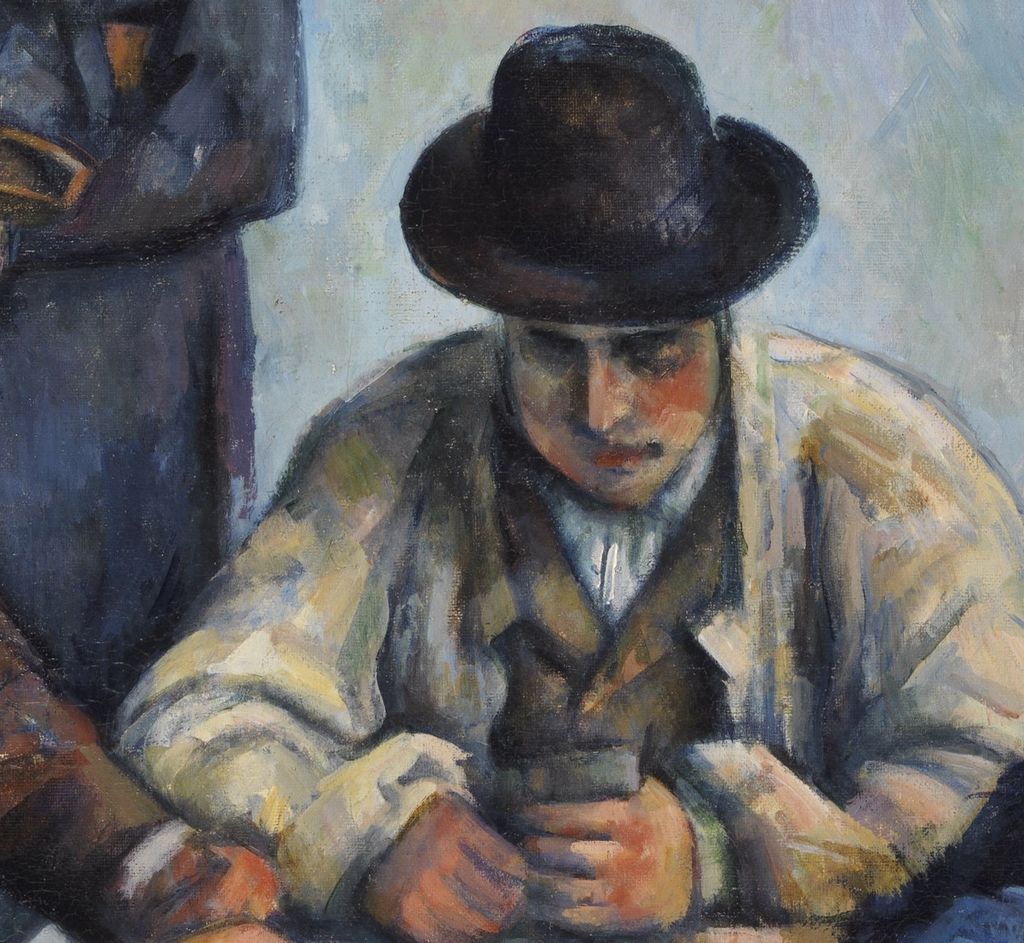
We can see cards on the tabletop and cards in the central man’s hand, but the arrangement does not let us name the game or infer a winner. Each player looks down. Their concentration creates an event without the theatrical exchange of glances or gestures that might tell a story of triumph, cheating or disappointment. André Dombrowski’s reading of the series treats cards as small images that become handled objects during play, a useful way to attend to their double role here. They provide the pictured activity, while their flat, coloured shapes also punctuate the worked surface of the table. [3]
The card table draws the three seated men together without making them a single mass. Their hats are three separate dark shapes, aligned at different heights. The left player’s brown coat blends into the chair and dim lower corner; the central player’s light sleeves spread across the middle; the right player’s blue coat swells towards the frame. This succession moves the eye from one participant to another, and it resists a simple division into two opponents. The smoker stands close enough to look on, yet he does not appear to hold cards. His pipe points into the blue wall, while the rack of four more pipes hovers to his right. The repeated pipes give the quiet room another sign of its occupants.
There is no reliable evidence that the four models sat together for one observed game. The Met’s audio account explains that Cézanne made separate studies of local farmhands and assembled the figures on the canvas; conservator Charlotte Hale points to repeated changes in their positions. The finished scene thus joins observed people and a constructed group. That distinction matters when looking at the central player’s hands, the angled arms, and the slight tensions where the bodies meet the small table. The picture feels collective, but its unity had to be made. [1]
The room around them
The blue wall occupies a surprisingly large and active area. Greenish, lilac and warm strokes alter its colour from place to place. On the left, a darker horizontal line suggests a baseboard and gives the chair an interior setting; farther up, the wall remains open and mottled. On the right, a heavy curtain gathers into ochre folds. Its colour answers the warmth of the left player’s coat and the smoker’s face, but its scale competes with the blue player’s broad back. The right edge therefore feels crowded even though the middle of the wall is comparatively bare. The table’s white front, by contrast, has a few clear divisions: edge, drawer and legs. It offers a temporary measure of straightness amid the figures’ sloping hats, shoulders and sleeves.
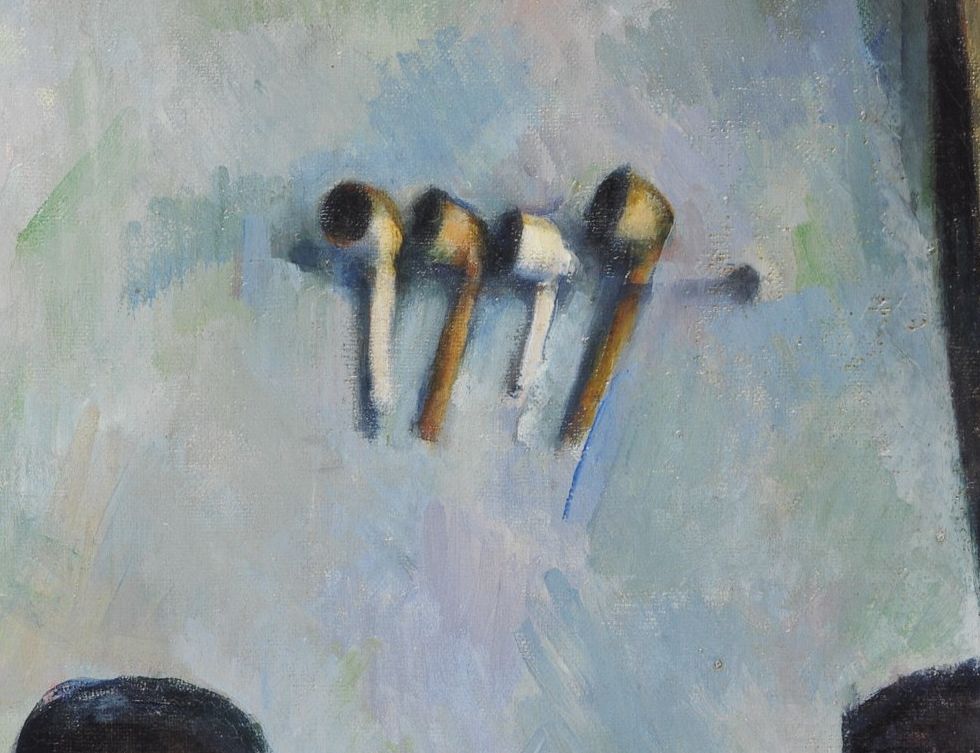
The four pipes on their rack are more than a quaint detail. High on the wall, they establish a rhythm of short hanging forms where the room might otherwise be blank. Their stems echo the downward pulls of the men’s arms and the legs below the table, while their dark bowls pick up the hats. The rack and curtain also distinguish the Met canvas from the pared-down two-player versions. When the setting recedes in those pictures, the relationship between the opposing figures has to carry a different weight. In the Met painting, the wall, rack and curtain help sustain the sense that these workers occupy a room extending beyond the game. [2]
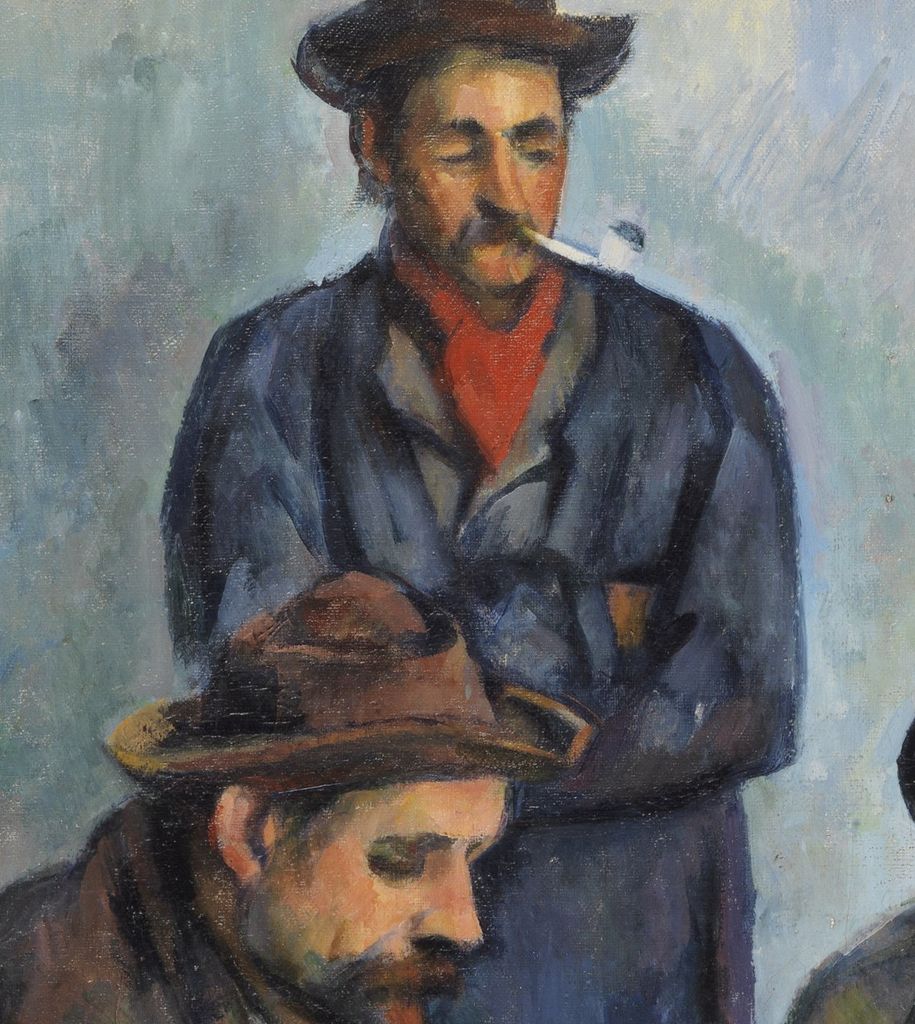
T. J. Clark has argued that the series tests how a room is made by people sitting together, waiting and concentrating. He sees the Met smoker as more engaged with the game than the more remote standing observer in the Barnes canvas. Here the smoker’s lowered head and position immediately behind the left player place him near the action; the blue wall and the dark divide of his jacket also keep him outside the seated triangle. His place between the room and the players gives the composition an additional point of attention. [4]
The painting beneath the finished arrangement
The Met’s technical study makes the visible arrangement more interesting because it shows how much was changed while Cézanne worked. For the 2011 exhibition of the series, museum conservators examined the painting’s surface and studied it with X-radiography and infrared reflectography. The X-radiograph records multiple adjusted outlines, or “haloes,” around figures. Hale’s audio account describes changes to the contours of the figures, the table and the chairs. What now looks firm and settled is therefore the result of reworking, rather than a single transfer of a fully fixed design to canvas. [5] [1]
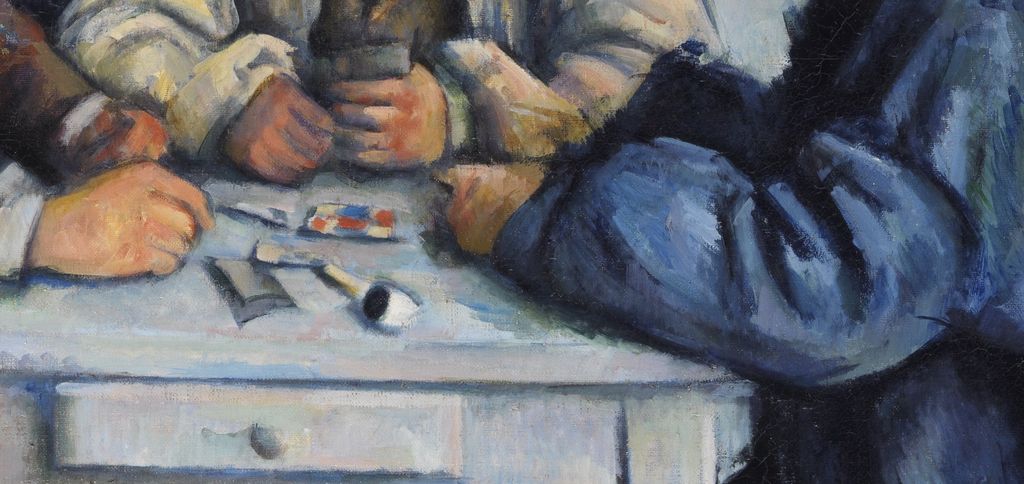
One small difficulty survives in plain sight. The Met’s conservation essay draws attention to the absent hand of the man on the right, an issue also left unresolved in preparatory drawings. Looking at the canvas, his blue sleeve and forearm advance heavily across the table, but the expected hand does not emerge with the clarity of the left player’s near hand or the central player’s fingers. It is possible to overlook this because the dark sleeve, cards and tabletop keep the eye moving. Once noticed, the omission changes how one sees the right figure’s apparent solidity: a massive shoulder and back coexist with a local uncertainty at the very point where he should touch the game. [5]
The audio account mentions another adjustment: in a study, the blue-coated man’s head was larger and broader, while in the assembled canvas it became small above his substantial body. The size difference helps explain the painting’s particular balance. The right player’s coat has immense area and strongly striped strokes, but his small, bent head brings him back towards the cards. The left and middle players are built through other proportions and directions, so the group has neither a uniform scale of bodies nor a simple row of portraits. Hale connects the smaller head with the figures’ monumental character. [1]
Visible brushwork keeps the surface from becoming rigid. The blue coat includes dark, slanting strokes that pull down its back; light marks strike across the central man’s sleeve; warmer and cooler touches model the faces without erasing the painted marks. Keith Christiansen, speaking in the Met’s audio, contrasts firm contours and calm figures with varied brushwork that makes relationships shift as the eye travels. That observation is useful because the painting’s stillness is not the same as a smooth finish. The figures hold their positions, while small changes of tone and direction continually reanimate their edges. [1]
Margaret Iversen has made a broader argument that Cézanne’s discrete marks allowed a measure of chance within sustained choices about a painting. Here the marks and repeated outlines reward attention to decisions still perceptible within a settled group. [6]
Annotated Details from The Card Players, Metropolitan version
The numbered points identify visible features discussed in this article. Return from each detail to the whole composition. Paul Cézanne, The Card Players, 1890–92, oil on canvas, 65.4 × 81.9 cm, Metropolitan Museum of Art, New York (61.101.1). Image source. CC0 / Public domain.
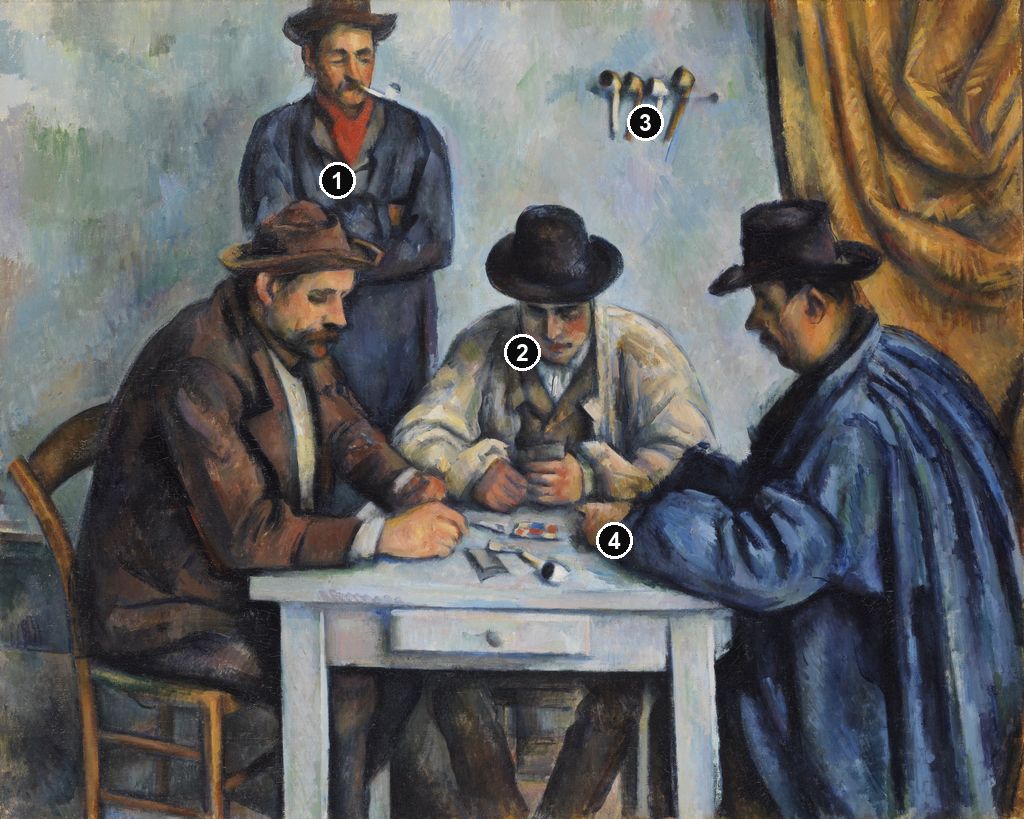
Details from THE CARD PLAYERS, METROPOLITAN VERSION
Compare the cropped details with the complete images above. Notice how their colours, shapes and positions contribute to the larger compositions.
The standing observer
A standing man watches from behind the left player. His pipe and red neckcloth recur in the larger Barnes composition.
The central player and his cards
The dark hat lowers the central player’s face towards his hands. Compare this covered head with the bareheaded central figure at the Barnes.
The row of pipes
Pipes hang on the pale wall beside the curtain, separated from the pipe held by the observer.
The table and the right player’s hand
The right player’s hand approaches the tabletop and its scattered cards. The Met’s technical examination found revisions here; the reproduction alone does not show their full sequence.
Studies, models and uncertain names
Cézanne’s subjects were connected with the Jas de Bouffan, the family estate near Aix-en-Provence. The Met says he used local farmhands as models, studying them individually before bringing them into the card-playing compositions. A related Man with a Pipe in the Nelson-Atkins Museum, also dated 1890–92, shows how an individual smoker could become a subject in his own right. Brigid Boyle’s catalogue essay notes a proposal that this study may actually have followed the Met composition. A “study” label therefore does not by itself establish a neat order in which every separate figure image necessarily came before every group canvas. [1] [7]
Names attached to the sitters require equal care. Michel Fraisset’s study separates a worker called Paulin Paulet from the model known as père Alexandre , showing how later accounts confused the names into “Alexandre Paulin.” He examines testimony from Cézanne’s son, later family accounts and photographs. Fraisset associates père Alexandre with the standing smoker in the Met and Barnes compositions, but those retrospective identifications do not make every sitter in this painted group secure. The available names still leave the man at the centre and other identifications uncertain. [8] [2]
The uncertainty becomes especially important across the series. Fraisset discusses Léontine Paulet, Paulin’s daughter, as the child in the Barnes composition through later testimony. The Met picture has no child. The added child alters the balance between participants and onlookers in that larger scene. [8]
An early written glimpse of the working circumstances is also less definite than it can sound. Clark cites a letter from Paul Alexis to Émile Zola dated 13 February 1891, reporting that Cézanne was painting at the Jas de Bouffan with a worker as model. Alexis refers to one worker and relays news rather than saying he saw this particular painting. The letter helps place figure modelling within the period; it does not date the completion of the Met Card Players or identify the man involved. [4] [3]
One painting within five
The Met and Barnes compositions belong together in subject but differ decisively in scale and people. The Barnes work, FWN 681, measures 135.3 × 181.9 cm—more than twice the Met canvas’s height—and adds a child to three seated players and a standing observer. Its wider, taller setting gives the watchers and surrounding objects much more room. The Met work is tighter: the player at right presses against the edge, the curtain descends just behind him, and the central man’s pale clothes provide the principal interval between the darker coats. Calling the Barnes canvas merely a bigger copy would miss how adding a fifth person changes the encounter. Readers interested in that painting can see the separate Barnes Card Players article . [9]
The other three paintings are two-player compositions, now associated with the Musée d’Orsay, the Courtauld Gallery and a private collection in Qatar. Taken together, the five paintings show repeated decisions about how many people to include, how much room to show, and how near the viewer should stand to the table. A broader comparison belongs in the Card Players series overview ; the point here is how the four-person design makes the observer and the room indispensable to this particular picture. [10] [11] [12]
The exact order of making those paintings remains disputed. The Met’s brief 2022 account reports both a broad view that the multi-figure works preceded the paired compositions and technical evidence that challenged the assumed order of the smallest paintings. It leaves the full five-work sequence open. From visual comparison, Clark proposes the Met canvas before the Barnes and then the paired pictures, while acknowledging that his order is hypothetical. Satish Padiyar likewise questions a simple progression from many figures to few. Their debate shows how the series changes when sequence is treated as a question, rather than read off the number of players. [5] [4] [13]
There is a further complication in the dates themselves. Both the Met and the current catalogue raisonné give this canvas 1890–92. The catalogue also records earlier catalogue and archival datings, including 1890–91 on a photograph annotated by Cézanne’s son. Those are historical assessments, not documentary proof of a day or year when the canvas was finished. The 1890–92 range therefore remains the clearest date for this canvas, while its exact place among the five is open. [1] [2]
From dealer to museum
The painting’s later history is unusually traceable. The catalogue raisonné records it with dealer Ambroise Vollard, then Josse and Gaston Bernheim-Jeune in Paris by February 1900, later Galerie E. Bignou and Knoedler Galleries, and Stephen C. Clark in New York from August 1931. It reached the Metropolitan Museum through Clark’s bequest, recorded by the museum as a 1960 bequest and given accession number 61.101.1. [2] [1]
Exhibition records show the canvas entering public discussion long before it entered the Met. It appeared in Vollard’s Cézanne exhibition in Paris in 1899, in Berlin in 1904, and at later European and American shows. In New York it was lent by Clark to several exhibitions before the bequest. The 2010–11 Courtauld and Met exhibition brought it together with other versions and associated drawings, prompting the technical investigation that now helps us see its changes. Such exhibitions did more than move a familiar image between walls: seeing versions and studies together made questions of scale, arrangement and order especially pointed. [2] [5]
The dealer record preserves one unusually concrete early description. Vollard’s stockbook identifies four peasants playing cards around a small table, a pipe rack on the wall and a curtain at the right. The rack and right-hand curtain make the description especially useful for recognizing this canvas among paintings with the same title. [2]
What the work leaves open
The painting gives the ordinary game a remarkable gravity without revealing its rules, stakes or outcome. The men’s attention is serious; that does not prove that the game is solemn, ceremonial, or even competitive in the way a modern viewer might imagine. Their clothing and the accounts of farmworker models connect the subject to local working people, while the separate studies and revisions show Cézanne building a deliberate group image. The two facts belong together. Observation supplied people and poses; painting made a new relation among them. [1] [5]
The unresolved hand at the right is a fitting place to end a closer look. We might first experience the blue coat as an enormous, unshakeable form. Then the interrupted action of the arm makes the image less seamless. Nothing about that uncertainty dissolves the player’s presence; instead it lets us see the decisions and revisions beneath his apparent stillness. The small cards, the cramped table and the bodies gathered around it remain vivid because Cézanne gave them a force that can accommodate such visible incompletion. [5]
Cézanne artworks directory
Browse 217 identified works in this researched selection, including paintings, drawings and watercolours. This is a bounded selection, not a complete catalogue of Cézanne’s surviving oeuvre. Unlinked titles have no confirmed article in this collection.
| Name | Date | Medium |
|---|---|---|
| A Head, a Cup, and a Bread Roll | 1891/1894 | Drawing |
| A Man seen from Behind | 1880/1883 | Drawing |
| A Modern Olympia | 1873–74 | Painting |
| A Nude and Foliage | 1879/1882 | Drawing |
| A Smoking Man | 1892–96 (catalogue); c.1890–92 (museum) | Drawing |
| Afternoon in Naples | 1876–77 | Painting |
| An Old Woman with a Rosary | about 1895–96 | Painting |
| Apples and Oranges | c.1899 | Painting |
| Auvers, Panoramic View | 1873–75 | Painting |
| Avenue at Chantilly | 1888 | Painting |
| Banks of the Marne | 1888–94 | Painting |
| Basket | 1877/1900 | Drawing |
| Bather with Outstretched Arms | 1877–78 | Painting |
| Bellows in Front of a Fireplace | 1887/1892 | Drawing |
| Bibémus Quarry | c.1895 | Painting |
| Boy in a Red Vest, Barnes Foundation | 1888–90 | Painting |
| Boy in a Red Vest, MoMA | 1888–90 | Painting |
| Boy in a Red Waistcoat, National Gallery of Art | 1888–90 | Painting |
| Branch in Flower | 1886/1889 | Drawing |
| Carnival Scene | 1885/1888 | Drawing |
| Chair and Dresser | 1880/1883 | Drawing |
| Chateau Noir | 1903–04 | Painting |
| Chestnut Trees and Farm at Jas de Bouffan | c.1885 | Painting |
| Chestnut Trees and Farm at Jas de Bouffan, Pushkin | c.1886 | Painting |
| Chestnut Trees at Jas de Bouffan in Winter | 1885–86 | Painting |
| Château Noir | 1900–04 | Painting |
| Cistern in the Park of Château Noir | c.1900 | Painting |
| Curtain, Jug and Fruit | 1893–94 | Painting |
| Cushion of an Armchair | 1886/1889 | Drawing |
| Draft Letter and Studies of Bathers | c.1878 | Drawing |
| Farmhouse and Chestnut Trees at Jas de Bouffan | 1884–85 | Painting |
| Figure Resting Head on Hand | c. 1889 | Drawing |
| Fireplace Tongs and Poker | 1887/1892 | Drawing |
| Forest Interior, San Francisco | c.1898–99 | Painting |
| Four Bathers | 1888–90 | Painting |
| Fruit and a Jug on a Table | 1893–94 | Painting |
| Gardanne | 1885–86 | Painting |
| Gardanne, Barnes Foundation | c.1885 | Painting |
| Hand and Shoulder of a Boy | c. 1885 | Drawing |
| Harlequin, National Gallery of Art | 1888–90 | Painting |
| Head of a Boy | 1887/1889 | Drawing |
| Head of a Boy Seen from Behind | c. 1885 | Drawing |
| Head of a Young Woman | c. 1880 | Drawing |
| Head of the Artist's Son | 1888/1889 | Drawing |
| Hillside in Provence | c.1890–92 | Painting |
| Horse Chestnut Trees at Jas de Bouffan | c.1885 | Painting |
| House and Farm at the Jas de Bouffan | c.1887 | Painting |
| House in a Park | 1883/1886 | Drawing |
| House in Provence | c.1885 | Painting |
| House of Père Lacroix | 1873 | Painting |
| House Surrounded by Vegetation | 1889/1892 | Drawing |
| Houses in Provence The Riaux Valley near L’Estaque | c.1883 | Painting |
| Jas de Bouffan, the Pool | c.1876 | Painting |
| Kerosene Lamp | 1878/1881 | Drawing |
| L'Estaque, Melting Snow | c.1870 | Painting |
| Lake Annecy | 1896 | Painting |
| Landscape in Provence, Pola Museum | 1879–82 | Painting |
| Landscape Near Aix-en-Provence | 1877/1880 | Drawing |
| Landscape Seen from the Inside of a Cave | 1889/1892 | Drawing |
| Landscape with Poplars | c.1885–87 | Painting |
| Landscape with Trees | 1895/1898 | Drawing |
| Leda and the Swan | c.1880 (possibly later) | Painting |
| Little Girl with a Doll | 1902–04 | Painting |
| Louis Guillaume | 1879–1890 | Painting |
| Madame Cezanne | 1888/1891 | Drawing |
| Madame Cezanne | 1886/1889 | Drawing |
| Madame Cezanne | 1882/1887 | Drawing |
| Madame Cezanne | 1897/1900 | Drawing |
| Madame Cezanne with her Head Lowered | 1893/1896 | Drawing |
| Madame Cézanne in a Red Armchair | c.1877 | Painting |
| Madame Cézanne in a Red Dress, Metropolitan Museum of Art | 1888–90 | Painting |
| Madame Cézanne in a Yellow Chair | 1888–90 | Painting |
| Madame Cézanne in a Yellow Chair, Fondation Beyeler | 1888–90 | Painting |
| Madame Cézanne in the Conservatory | 1891 | Painting |
| Maincy Bridge | 1879–80 | Painting |
| Maison Maria with a View of Château Noir | c.1895 | Painting |
| Man Bending Forward | 1883/1886 | Drawing |
| Man Smoking a Pipe, Pushkin | c.1891, possibly later | Painting |
| Man with a Pipe | 1891–96 | Painting |
| Man with a Pipe, Nelson-Atkins | 1890–92 | Painting |
| Man with a Straw Hat (Gustave Boyer) | c.1871 | Painting |
| Man with Crossed Arms | c.1899 | Painting |
| Man with Pipe, National Gallery of Art | 1892–96 | Painting |
| Mont Sainte-Victoire | c.1902–06 | Painting |
| Mont Sainte-Victoire | 1900–02 | Painting |
| Mont Sainte-Victoire (recto) | c.1895 | Watercolour |
| Mont Sainte-Victoire and the Viaduct of the Arc River Valley | 1882–85 | Painting |
| Mont Sainte-Victoire Seen beyond the Wall of the Jas de Bouffan | c.1885/1888 | Watercolour |
| Mont Sainte-Victoire Seen from Bibémus Quarry | c.1897 | Painting |
| Mont Sainte-Victoire, Barnes Foundation | 1892–95 | Painting |
| Near the Pool at Jas de Bouffan | 1883/1887 | Drawing |
| Pelicans | 1877/1880 | Drawing |
| Peonies | 1890/1893 | Drawing |
| Pierrot and Harlequin | 1888 | Painting |
| Pine Tree | 1882/1885 | Drawing |
| Pont des Trois Sautets | 1906 | Watercolour |
| Poplars | 1879–80 | Painting |
| Portrait of Ambroise Vollard | 1899 | Painting |
| Portrait of Gustave Geffroy | 1895–96 | Painting |
| Portrait of Madame Cezanne with Loosened Hair | 1885–86 | Painting |
| Portrait of the Artist Looking Over His Shoulder | 1883–84 | Painting |
| Portrait of the Gardener Vallier | 1906 | Painting |
| Portrait of Victor Chocquet | 1876–77 | Painting |
| Portrait Of Victor Chocquet Seated | 1877 | Painting |
| Provençal Manor | c.1885 | Painting |
| Pyramid of Skulls | 1898–1900 | Painting |
| Reclining Nude (Leda?) | c.1887 | Painting |
| Scipio | 1866–68 | Painting |
| Seated Man, Oslo | 1898–1900 | Painting |
| Seated Peasant | c.1892–96 | Painting |
| Seated Peasant, Hiroshima | c.1897 | Painting |
| Seated Peasant, Orsay | c.1900 | Painting |
| Self-Portrait | c. 1895 | Drawing |
| Self-Portrait in a Bowler Hat, Ny Carlsberg Glyptotek | 1885–86 | Painting |
| Self-Portrait in a Casquette | c.1875 | Painting |
| Self-Portrait with a Beret | 1898–1900 | Painting |
| Self-Portrait with a Hat, Artizon Museum | c.1890–94 | Painting |
| Self-Portrait with a Pink Background | c.1875 | Painting |
| Self-Portrait with Olive-Coloured Wallpaper | about 1880–81 | Painting |
| Self-Portrait with Palette | 1886–87 | Painting |
| Self-Portrait with White Turban | c.1878–80 | Painting |
| Self-Portrait, c.1895 | c.1895 | Painting |
| Self-Portrait, Pushkin Museum | c.1882 | Painting |
| Spanish Dancers | 1883/1886 | Drawing |
| Still Life with a Curtain | 1892–94 | Painting |
| Still Life with Apples | c.1890 | Painting |
| Still Life with Apples | 1893–94 | Painting |
| Still Life with Apples and a Pot of Primroses | about 1890 | Painting |
| Still Life with Milk Jug and Fruit | c.1900 | Painting |
| Still Life with Open Drawer | 1877–79 | Painting |
| Still Life with Plaster Cupid | about 1894 | Painting |
| Still Life with Skull | 1890–93 | Painting |
| Still Life with Soup Tureen | 1877 | Painting |
| Still Life, Pitcher and Fruit | 1893–94 | Painting |
| Studies Including a Straw Hat | 1895/1898 | Drawing |
| Studies Including Madame Cezanne | 1884/1887 | Drawing |
| Study for "The Judgement of Paris" or "The Amorous Shepherd" | 1883/1886 | Drawing |
| Study for Woman with a Coffee Pot | c.1895 | Painting |
| Study of "The Roman Orator (Germanicus)" | 1883/1886 | Drawing |
| Study of "Venus de Milo" | 1881/1884 | Drawing |
| Study of a Decorative Ornament | 1879/1882 | Drawing |
| Study of a Standing Male Figure after the Antique | c. 1895 | Drawing |
| Study of an Angel in Rubens' "The Prophet Elijah" | 1892/1895 | Drawing |
| Study of Desiderio da Settignano's "Bust of a Child" | c. 1895 | Drawing |
| Study of Houses | 1879/1882 | Drawing |
| Study of Puget's "Hercules Resting" | c. 1879 | Drawing |
| Study of Puget's "Milo of Crotona" | 1895/1898 | Drawing |
| Study of Puget's "Milo of Crotona" | 1880/1883 | Drawing |
| Study of the Allegorical Figure Bellona in Rubens' "The Apotheosis of Henri IV" | 1883/1886 | Drawing |
| Study of the Allegorical Figure Bellona in Rubens' "The Apotheosis of Henri IV" | 1879/1882 | Drawing |
| Study of the Allegorical Figure France in Rubens' "The Exchange of the Two Princesses" | 1882/1885 | Drawing |
| Study of the Allegorical Figure of Health in Rubens' "The Birth of Louis XIII" | 1880/1883 | Drawing |
| Study of the Allegorical Figure of the Genius of Health from Rubens' "The Birth of Louis XIII at Fontainbleau" | 1895/1898 | Drawing |
| Sugar Bowl, Pears and Blue Cup | 1865–66 | Painting |
| The Aqueduct, Pushkin Museum | Dating differs between museum records | Painting |
| The Artist's Father, Reading L'Evenement | autumn 1866 | Painting |
| The Artist's Son | c. 1887 | Drawing |
| The Artist's Son Leaning on his Elbow | c. 1887 | Drawing |
| The Artist's Son Reading | c. 1887 | Drawing |
| The Artist's Son Writing | c. 1887 | Drawing |
| The Artist’s Son, Paul | 1886–87 | Painting |
| The Avenue at Jas de Bouffan | 1868–70 (possibly later) | Painting |
| The Avenue at Jas de Bouffan, Geneva | c.1890 | Painting |
| The Basket of Apples | c.1893 | Painting |
| The Bather, Museum of Modern Art | c.1885 | Painting |
| The Bay of Marseille seen from L'Estaque | c.1885 | Painting |
| The Blue Vase | 1889–90 | Painting |
| The Boy in the Red Vest, Bührle | 1888–90 | Painting |
| The Buffet | 1877–79 | Painting |
| The Card Players, Barnes Foundation | 1890–92 | Painting |
| The Card Players, Courtauld Gallery | 1892–96 | Painting |
| The Card Players, Metropolitan Museum of Art | 1890–92 | Painting |
| The Card Players, Musée d’Orsay | 1893–96 | Painting |
| The Card Players, Qatar | 1892–96 | Painting |
| The Eternal Feminine | c.1877 | Painting |
| The Gardener Vallier | 1906 | Painting |
| The Gardener Vallier, Tate | 1905–06 | Painting |
| The Grounds of the Château Noir | c.1900–04 | Painting |
| The Gulf of Marseille Seen from L’Estaque | c.1885 | Painting |
| The Hanged Man's House in Auvers | c.1873 | Painting |
| The House of Doctor Gachet at Auvers | 1872–73 | Painting |
| The House with the Cracked Walls | 1892–94 | Painting |
| The Kiss of the Muse | c.1860 | Painting |
| The Large Bathers, Barnes Foundation | 1895–1906 | Painting |
| The Large Bathers, National Gallery | 1895–1905 | Painting |
| The Large Bathers, Philadelphia Museum of Art | 1900–06 | Painting |
| The Mill | 1889/1892 | Drawing |
| The Painter’s Father, Louis-Auguste Cézanne | c.1865 | Painting |
| The Peasant | 1890–92 | Painting |
| The Plaster Mill (La Moulin à plâtre) | 1889/1892 | Drawing |
| The Smoker, Hermitage | c.1891 | Painting |
| The Smoker, Mannheim | c.1891 | Painting |
| The Stove in the Studio | c.1865 | Painting |
| The Vase of Tulips | c.1890 | Painting |
| Thistle | 1893/1896 | Drawing |
| Three Heads, One of Madame Cezanne | 1882/1885 | Drawing |
| Three Skulls | c.1898 | Painting |
| Three Skulls on a Patterned Carpet | 1904 | Painting |
| Trees and Shrubs | 1883/1887 | Drawing |
| Turning Road at Montgeroult | 1898 | Painting |
| Two Bathers | 1884/1887 | Drawing |
| Two Heads | 1888 | Drawing |
| Two Heads | 1890/1896 | Drawing |
| Two Heads of Women | 1890/1894 | Drawing |
| Two Studies for "The Judgement of Paris" or "The Amorous Shepherd" | 1883/1886 | Drawing |
| Uncle Dominique in a Tasseled Cap | 1866 | Painting |
| Uncle Dominique in a Turban | 1866–67 | Painting |
| Victor Chocquet and an Angel for "The Apotheosis of Delacroix" | 1878/1880 | Drawing |
| Woman in Blue | c.1904 | Painting |
| Woman Leaning Forward | 1888/1891 | Drawing |
| Woman Leaning Forward | 1890/1894 | Drawing |
| Woman Leaning Forward | 1890/1894 | Drawing |
| Woman with a Coffee Pot | c.1895 | Painting |
| Women Bathers and a Roll of Paper | 1882/1885 | Drawing |
| Young Girl with a Doll | c.1895 | Painting |
| Young Italian Woman at a Table | c.1895–1900 | Painting |
| Young Man and Skull | 1896–98 | Painting |
Frequently Asked Questions
The Met describes the models as local farmhands. Later accounts associate père Alexandre and Paulin Paulet with the series, though the identifications are not secure for every figure here. The child sometimes mentioned in connection with The Card Players appears in the Barnes composition, not this one. [1] [8] [2]
Discussion
Look again at the images and ideas explored in Cézanne’s Card Players at the Metropolitan Museum of Art. These editorial prompts invite your observations.
Reader Insights
Look from the left player’s clearly described hand to the blue sleeve at the right. How does noticing the missing hand alter your sense of an otherwise solid group?
Compare the four pipes on the wall with the four heads below. Do they make the room feel more inhabited, or do they draw attention to how carefully its details have been arranged?
The central player holds cards close while the standing smoker looks down from behind. Where does your eye settle first, and does that change who seems most involved in the game?
Join the Conversation
Share a detail, comparison or question about Cézanne’s Card Players at the Metropolitan Museum of Art below.
References
- The Metropolitan Museum of Art. “The Card Players,” collection record 61.101.1, including audio transcript. View source .
- Société Paul Cezanne. “Les Joueurs de cartes,” FWN 680, The Paintings, Watercolors and Drawings of Paul Cezanne: An Online Catalogue Raisonné . View source .
- André Dombrowski. “The Cut and Shuffle,” in Satish Padiyar, ed., Modernist Games: Cézanne and His Card Players (2013), pp. 35–67. View source .
- T. J. Clark. “A House of Cards,” in Satish Padiyar, ed., Modernist Games: Cézanne and His Card Players (2013), pp. 15–33. View source .
- The Metropolitan Museum of Art, Paintings Conservation. “Cezanne’s Card Players,” 1 August 2022. View source .
- Margaret Iversen. “Chance and Choice in Cézanne,” in Satish Padiyar, ed., Modernist Games: Cézanne and His Card Players (2013), pp. 151–160. View source .
- Brigid M. Boyle, The Nelson-Atkins Museum of Art. “Man with a Pipe,” catalogue entry written 2020 in French Paintings and Pastels, 1600–1945 (2022). View source .
- Michel Fraisset, Société Paul Cezanne. “Joueurs de cartes et fumeurs dans l’oeuvre de Cezanne,” 21 May 2020. (in French). View source .
- Société Paul Cezanne. “Les Joueurs de cartes,” FWN 681, Online Catalogue Raisonné . View source .
- Société Paul Cezanne. “Les Joueurs de cartes,” FWN 684, Online Catalogue Raisonné . View source .
- Société Paul Cezanne. “Les Joueurs de cartes,” FWN 686, Online Catalogue Raisonné . View source .
- Société Paul Cezanne. “Les Joueurs de cartes,” FWN 685, Online Catalogue Raisonné . View source .
- Satish Padiyar. “Building a World Between Men (or Cézanne with Arendt),” in Modernist Games: Cézanne and His Card Players (2013), pp. 123–148. View source .
- Le Baiser de la muse, d'après Frillié (FWN 572). View source.
- Louis-Auguste Cezanne, père de l'artiste, lisant L'Événement (FWN 402). View source.
- La Maison du pendu, Auvers-sur-Oise (FWN 81). View source.
- Une moderne Olympia (FWN 628). View source.
- Le Pont de Maincy (FWN 143). View source.
- La Montagne Sainte-Victoire vue de Montbriand (FWN 185). View source.
- Gardanne (vue horizontale) (FWN 224). View source.
- Le Vase bleu (FWN 823). View source.
- La Montagne Sainte-Victoire (FWN 296). View source.
- La Corbeille de pommes (FWN 860). View source.
- Pommes et oranges (FWN 871). View source.
- Portrait d'Ambroise Vollard (FWN 531). View source.
- Philadelphia Museum of Art,The Large Bathers,W1937-1-1. View source.
- Château Noir (FWN 360). View source.
- Société Paul Cezanne,online catalogue structure and objectidentification. View source.
- National Gallery of Art,Cezanne Sketchbook,1992.51.9. View source.
- Splash image, Paul Cézanne, The Card Players, 1890–92, oil on canvas, 65.4 × 81.9 cm, The Metropolitan Museum of Art, New York (61.101.1; FWN 680).


