 by
Tom Gurney
Tom Gurney BSc (Hons) is an art history expert with over 20 years experience
Published on June 19, 2020 / Updated on October 22, 2026
Email:
tomgurney1@gmail.com
/ Phone:
+44 7429 011000
Chestnut Trees and Farm at Jas de Bouffan: Introduction
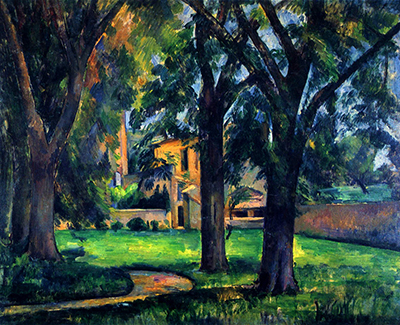
A farmhouse appears through a stand of chestnut trees, but the route toward it is anything but straightforward. Dark trunks interrupt the view, a low wall cuts across the right, and a warm strip of path curls through a field of green.
Paul Cézanne made the oil painting now catalogued as Marronniers et ferme du Jas de Bouffan (FWN 202) around 1885. The catalogue places it in a New York private collection. [1]
The English title names two subjects, trees and farm, yet neither can be isolated from the other. The buildings give the eye a destination; the trees control how much of that destination can be seen. What first looks like a familiar estate view becomes an exercise in crossings, partial concealment and changes of colour from shade to sun.
At a Glance
- Artist Paul Cézanne. [1]
- Catalogue identity FWN 202; Rewald 538; Venturi 467. [1]
- Date About 1885 in the current catalogue; earlier catalogue dates range from 1885–87 to 1886–88. [1]
- Medium and size Oil on canvas, 65.5 × 81.3 cm. [1]
- Location Private collection, New York, according to the current catalogue. [1]
- Setting The grounds of Jas de Bouffan, the Cézanne family estate near Aix-en-Provence. [2]
This work across Paul Cézanne’s career
The Kiss of the Muse
c.1860The Artist’s Father, Reading L’Événement
autumn 1866The Hanged Man’s House
c.1873A Modern Olympia
1873–74Maincy Bridge
1879–80The Blue Vase
1889–90The Basket of Apples
c.1893Apples and Oranges
c.1899The Large Bathers (Philadelphia)
1900–1906 (Philadelphia Museum dating)Château Noir (MoMA)
1903–04Contents
- Finding the farm through the trees
- A particular place within a recurring motif
- Colour, interval and the sense of depth
- A painting seen under different names
Finding the farm through the trees
The painting starts almost at the viewer's feet. A deep blue-green band closes its lower edge, and a patch of ochre earth rises just behind it. The path seems to turn rather than run straight ahead. That bend matters: it delays entry into the bright grass beyond, making the sunlit middle ground appear as a discovery between two darker zones. The largest trunk at left stands so close that the picture cuts off its crown. Another trunk near the centre rises through the strip of buildings; a third, darker one divides the right half of the canvas. Their different widths and intervals keep the foreground from becoming a tidy colonnade.
The middle of the image is unusually open for a picture so full of trees. Acid yellow-green glows across the grass. Short marks of darker green interrupt it, especially where the shade meets the path and beneath the buildings. The grass is therefore neither a single flat carpet nor a fully described botanical field. It carries the eye laterally, while the trunks pull it upward. At the far right the long mauve-grey wall repeats that sideways motion on a firmer line. It appears to hold the open ground in place even as the foliage above it dissolves into scattered touches.
The small architecture rewards a slower look. A warm yellow-orange upright near the centre-left suggests a sunlit wall; a darker opening below it pulls the eye inward. A low roof and another wall emerge to its right, partly screened by the central trunk. No single building is presented as an immaculate façade. Edges are sometimes crisp enough to name a structure, then loosen where branches and leaves cross them. The built forms gain presence from their colour and geometry, but they remain one component of the view rather than an isolated portrait of the family home.
Higher up, the branches make a second network across the canvas. A heavy diagonal from the left and the forked upper portions of the right-hand trees close much of the sky. Blue and pale openings remain visible in fragments. The result is a canopy that feels dense without sealing the painting shut. Bright leaf strokes sit against dark limbs, while some blue marks seem to belong alternately to foliage or sky. The visual uncertainty is productive: the eye keeps sorting nearby forms instead of passing quickly through a transparent window toward the farm.
A particular place within a recurring motif
Jas de Bouffan was a working property as well as a family residence. The estate included a bastide, farm buildings, meadow, basin and an avenue of chestnut trees. Cézanne's father acquired it in 1859; the property passed to family members after his death in 1886 and was sold in 1899. Cézanne returned to these grounds repeatedly while also working elsewhere in Provence. These dates place the painting amid an extended investigation of one site, rather than at the beginning or end of his connection with it. [2]
François Chédeville's reconstruction of the park locates a group of trees near the southern end of the chestnut avenue, beside a small circular fountain area. He includes FWN 202 among several works that use this group and points to the circular path visible in this painting. His comparison shows how a shift of viewpoint can make the same trunks alternately frame, obstruct or dominate the farm. It also gives the curved ochre form in the foreground a topographical role: it belongs to a particular corner of the estate, even as Cézanne turns it into a strong pictorial shape. [3]
A reconstruction of the site need not turn the image into a plan. The painting compresses much of its middle distance between large foreground trunks and the small, bright farm. From one spot, the viewer may recognise a path, a wall and buildings; from another, the same marks form a balance of verticals, horizontals and diagonals. Denis Coutagne argues that the farm recurs as a major motif at Jas de Bouffan without always being treated as a subject in its own right. That observation suits this canvas particularly well: the farm is unmistakable, but every route toward it passes through trees. [4]
The Musée Granet's account of Cézanne's Jas landscapes places the farm, ranked trunks and estate wall among the constructive elements he returned to during these years. It contrasts a view in Prague, where the bastide and its red roof become a dominant focus, with later views in which buildings are veiled by trees. FWN 202 invites a related comparison, but its orange architecture is glimpsed from within a deep band of shade. The picture's energy depends on the distance between that warm glimpse and the cool, weighty foreground. [2]
Colour, interval and the sense of depth
The canvas is built around a few striking changes of temperature. The near trunks are blue-black, violet and brown; the canopy mixes dark blue-green with sharp yellow touches; the meadow runs into luminous greens; the farm introduces concentrated orange. These colours do more than label separate things. A green mark within the trunk's shadow links tree to ground, while a blue flicker in the upper foliage links branch to sky. The painting holds its parts together by recurring colour across places where a conventional landscape might insist on a hard boundary.
Its light is similarly distributed rather than explained by one dramatic source. The brightest grass sits between the foreground trees and the farm, yet light also catches leaves high above and the building's vertical face. The shadow at the front has its own internal variation: it is never simply black. Notice how the ochre turn of the path gains force because it sits beside those dark greens. The eye can move from that narrow, warm curve to the orange wall in the distance, making a connection through colour across the intervening lawn.
One can see why repeated views of the avenue did not amount to copies. In the Norton Simon Museum's Farmhouse and Chestnut Trees at Jas de Bouffan (FWN 200), the farmhouse and upright trees are organised in a taller canvas, and the museum notes its short, parallel leaf strokes and geometric farm forms. Here the wide format allows the meadow and boundary wall to spread, while the path bends across the foreground. The different framing changes the question from how a farm rises among trees to how it is reached visually through them. [5]
A painting seen under different names
The painting appeared at Ambroise Vollard's Cézanne exhibition in Paris in 1895. Gustave Geffroy acquired it through Vollard in 1896, and lent it to a 1903 exhibition under the title La maison de Cézanne . [1]
That title history changes the emphasis. La maison de Cézanne directs attention to the dwelling; Chestnut Trees and Farm gives the screening trees equal weight. The small orange building remains partly withheld by trunks.
Cézanne artworks directory
Browse 217 identified works in this researched selection, including paintings, drawings and watercolours. This is a bounded selection, not a complete catalogue of Cézanne’s surviving oeuvre. Unlinked titles have no confirmed article in this collection.
| Name | Date | Medium |
|---|---|---|
| A Head, a Cup, and a Bread Roll | 1891/1894 | Drawing |
| A Man seen from Behind | 1880/1883 | Drawing |
| A Modern Olympia | 1873–74 | Painting |
| A Nude and Foliage | 1879/1882 | Drawing |
| A Smoking Man | 1892–96 (catalogue); c.1890–92 (museum) | Drawing |
| Afternoon in Naples | 1876–77 | Painting |
| An Old Woman with a Rosary | about 1895–96 | Painting |
| Apples and Oranges | c.1899 | Painting |
| Auvers, Panoramic View | 1873–75 | Painting |
| Avenue at Chantilly | 1888 | Painting |
| Banks of the Marne | 1888–94 | Painting |
| Basket | 1877/1900 | Drawing |
| Bather with Outstretched Arms | 1877–78 | Painting |
| Bellows in Front of a Fireplace | 1887/1892 | Drawing |
| Bibémus Quarry | c.1895 | Painting |
| Boy in a Red Vest, Barnes Foundation | 1888–90 | Painting |
| Boy in a Red Vest, MoMA | 1888–90 | Painting |
| Boy in a Red Waistcoat, National Gallery of Art | 1888–90 | Painting |
| Branch in Flower | 1886/1889 | Drawing |
| Carnival Scene | 1885/1888 | Drawing |
| Chair and Dresser | 1880/1883 | Drawing |
| Chateau Noir | 1903–04 | Painting |
| Chestnut Trees and Farm at Jas de Bouffan | c.1885 | Painting |
| Chestnut Trees and Farm at Jas de Bouffan, Pushkin | c.1886 | Painting |
| Chestnut Trees at Jas de Bouffan in Winter | 1885–86 | Painting |
| Château Noir | 1900–04 | Painting |
| Cistern in the Park of Château Noir | c.1900 | Painting |
| Curtain, Jug and Fruit | 1893–94 | Painting |
| Cushion of an Armchair | 1886/1889 | Drawing |
| Draft Letter and Studies of Bathers | c.1878 | Drawing |
| Farmhouse and Chestnut Trees at Jas de Bouffan | 1884–85 | Painting |
| Figure Resting Head on Hand | c. 1889 | Drawing |
| Fireplace Tongs and Poker | 1887/1892 | Drawing |
| Forest Interior, San Francisco | c.1898–99 | Painting |
| Four Bathers | 1888–90 | Painting |
| Fruit and a Jug on a Table | 1893–94 | Painting |
| Gardanne | 1885–86 | Painting |
| Gardanne, Barnes Foundation | c.1885 | Painting |
| Hand and Shoulder of a Boy | c. 1885 | Drawing |
| Harlequin, National Gallery of Art | 1888–90 | Painting |
| Head of a Boy | 1887/1889 | Drawing |
| Head of a Boy Seen from Behind | c. 1885 | Drawing |
| Head of a Young Woman | c. 1880 | Drawing |
| Head of the Artist's Son | 1888/1889 | Drawing |
| Hillside in Provence | c.1890–92 | Painting |
| Horse Chestnut Trees at Jas de Bouffan | c.1885 | Painting |
| House and Farm at the Jas de Bouffan | c.1887 | Painting |
| House in a Park | 1883/1886 | Drawing |
| House in Provence | c.1885 | Painting |
| House of Père Lacroix | 1873 | Painting |
| House Surrounded by Vegetation | 1889/1892 | Drawing |
| Houses in Provence The Riaux Valley near L’Estaque | c.1883 | Painting |
| Jas de Bouffan, the Pool | c.1876 | Painting |
| Kerosene Lamp | 1878/1881 | Drawing |
| L'Estaque, Melting Snow | c.1870 | Painting |
| Lake Annecy | 1896 | Painting |
| Landscape in Provence, Pola Museum | 1879–82 | Painting |
| Landscape Near Aix-en-Provence | 1877/1880 | Drawing |
| Landscape Seen from the Inside of a Cave | 1889/1892 | Drawing |
| Landscape with Poplars | c.1885–87 | Painting |
| Landscape with Trees | 1895/1898 | Drawing |
| Leda and the Swan | c.1880 (possibly later) | Painting |
| Little Girl with a Doll | 1902–04 | Painting |
| Louis Guillaume | 1879–1890 | Painting |
| Madame Cezanne | 1888/1891 | Drawing |
| Madame Cezanne | 1886/1889 | Drawing |
| Madame Cezanne | 1882/1887 | Drawing |
| Madame Cezanne | 1897/1900 | Drawing |
| Madame Cezanne with her Head Lowered | 1893/1896 | Drawing |
| Madame Cézanne in a Red Armchair | c.1877 | Painting |
| Madame Cézanne in a Red Dress, Metropolitan Museum of Art | 1888–90 | Painting |
| Madame Cézanne in a Yellow Chair | 1888–90 | Painting |
| Madame Cézanne in a Yellow Chair, Fondation Beyeler | 1888–90 | Painting |
| Madame Cézanne in the Conservatory | 1891 | Painting |
| Maincy Bridge | 1879–80 | Painting |
| Maison Maria with a View of Château Noir | c.1895 | Painting |
| Man Bending Forward | 1883/1886 | Drawing |
| Man Smoking a Pipe, Pushkin | c.1891, possibly later | Painting |
| Man with a Pipe | 1891–96 | Painting |
| Man with a Pipe, Nelson-Atkins | 1890–92 | Painting |
| Man with a Straw Hat (Gustave Boyer) | c.1871 | Painting |
| Man with Crossed Arms | c.1899 | Painting |
| Man with Pipe, National Gallery of Art | 1892–96 | Painting |
| Mont Sainte-Victoire | c.1902–06 | Painting |
| Mont Sainte-Victoire | 1900–02 | Painting |
| Mont Sainte-Victoire (recto) | c.1895 | Watercolour |
| Mont Sainte-Victoire and the Viaduct of the Arc River Valley | 1882–85 | Painting |
| Mont Sainte-Victoire Seen beyond the Wall of the Jas de Bouffan | c.1885/1888 | Watercolour |
| Mont Sainte-Victoire Seen from Bibémus Quarry | c.1897 | Painting |
| Mont Sainte-Victoire, Barnes Foundation | 1892–95 | Painting |
| Near the Pool at Jas de Bouffan | 1883/1887 | Drawing |
| Pelicans | 1877/1880 | Drawing |
| Peonies | 1890/1893 | Drawing |
| Pierrot and Harlequin | 1888 | Painting |
| Pine Tree | 1882/1885 | Drawing |
| Pont des Trois Sautets | 1906 | Watercolour |
| Poplars | 1879–80 | Painting |
| Portrait of Ambroise Vollard | 1899 | Painting |
| Portrait of Gustave Geffroy | 1895–96 | Painting |
| Portrait of Madame Cezanne with Loosened Hair | 1885–86 | Painting |
| Portrait of the Artist Looking Over His Shoulder | 1883–84 | Painting |
| Portrait of the Gardener Vallier | 1906 | Painting |
| Portrait of Victor Chocquet | 1876–77 | Painting |
| Portrait Of Victor Chocquet Seated | 1877 | Painting |
| Provençal Manor | c.1885 | Painting |
| Pyramid of Skulls | 1898–1900 | Painting |
| Reclining Nude (Leda?) | c.1887 | Painting |
| Scipio | 1866–68 | Painting |
| Seated Man, Oslo | 1898–1900 | Painting |
| Seated Peasant | c.1892–96 | Painting |
| Seated Peasant, Hiroshima | c.1897 | Painting |
| Seated Peasant, Orsay | c.1900 | Painting |
| Self-Portrait | c. 1895 | Drawing |
| Self-Portrait in a Bowler Hat, Ny Carlsberg Glyptotek | 1885–86 | Painting |
| Self-Portrait in a Casquette | c.1875 | Painting |
| Self-Portrait with a Beret | 1898–1900 | Painting |
| Self-Portrait with a Hat, Artizon Museum | c.1890–94 | Painting |
| Self-Portrait with a Pink Background | c.1875 | Painting |
| Self-Portrait with Olive-Coloured Wallpaper | about 1880–81 | Painting |
| Self-Portrait with Palette | 1886–87 | Painting |
| Self-Portrait with White Turban | c.1878–80 | Painting |
| Self-Portrait, c.1895 | c.1895 | Painting |
| Self-Portrait, Pushkin Museum | c.1882 | Painting |
| Spanish Dancers | 1883/1886 | Drawing |
| Still Life with a Curtain | 1892–94 | Painting |
| Still Life with Apples | c.1890 | Painting |
| Still Life with Apples | 1893–94 | Painting |
| Still Life with Apples and a Pot of Primroses | about 1890 | Painting |
| Still Life with Milk Jug and Fruit | c.1900 | Painting |
| Still Life with Open Drawer | 1877–79 | Painting |
| Still Life with Plaster Cupid | about 1894 | Painting |
| Still Life with Skull | 1890–93 | Painting |
| Still Life with Soup Tureen | 1877 | Painting |
| Still Life, Pitcher and Fruit | 1893–94 | Painting |
| Studies Including a Straw Hat | 1895/1898 | Drawing |
| Studies Including Madame Cezanne | 1884/1887 | Drawing |
| Study for "The Judgement of Paris" or "The Amorous Shepherd" | 1883/1886 | Drawing |
| Study for Woman with a Coffee Pot | c.1895 | Painting |
| Study of "The Roman Orator (Germanicus)" | 1883/1886 | Drawing |
| Study of "Venus de Milo" | 1881/1884 | Drawing |
| Study of a Decorative Ornament | 1879/1882 | Drawing |
| Study of a Standing Male Figure after the Antique | c. 1895 | Drawing |
| Study of an Angel in Rubens' "The Prophet Elijah" | 1892/1895 | Drawing |
| Study of Desiderio da Settignano's "Bust of a Child" | c. 1895 | Drawing |
| Study of Houses | 1879/1882 | Drawing |
| Study of Puget's "Hercules Resting" | c. 1879 | Drawing |
| Study of Puget's "Milo of Crotona" | 1895/1898 | Drawing |
| Study of Puget's "Milo of Crotona" | 1880/1883 | Drawing |
| Study of the Allegorical Figure Bellona in Rubens' "The Apotheosis of Henri IV" | 1883/1886 | Drawing |
| Study of the Allegorical Figure Bellona in Rubens' "The Apotheosis of Henri IV" | 1879/1882 | Drawing |
| Study of the Allegorical Figure France in Rubens' "The Exchange of the Two Princesses" | 1882/1885 | Drawing |
| Study of the Allegorical Figure of Health in Rubens' "The Birth of Louis XIII" | 1880/1883 | Drawing |
| Study of the Allegorical Figure of the Genius of Health from Rubens' "The Birth of Louis XIII at Fontainbleau" | 1895/1898 | Drawing |
| Sugar Bowl, Pears and Blue Cup | 1865–66 | Painting |
| The Aqueduct, Pushkin Museum | Dating differs between museum records | Painting |
| The Artist's Father, Reading L'Evenement | autumn 1866 | Painting |
| The Artist's Son | c. 1887 | Drawing |
| The Artist's Son Leaning on his Elbow | c. 1887 | Drawing |
| The Artist's Son Reading | c. 1887 | Drawing |
| The Artist's Son Writing | c. 1887 | Drawing |
| The Artist’s Son, Paul | 1886–87 | Painting |
| The Avenue at Jas de Bouffan | 1868–70 (possibly later) | Painting |
| The Avenue at Jas de Bouffan, Geneva | c.1890 | Painting |
| The Basket of Apples | c.1893 | Painting |
| The Bather, Museum of Modern Art | c.1885 | Painting |
| The Bay of Marseille seen from L'Estaque | c.1885 | Painting |
| The Blue Vase | 1889–90 | Painting |
| The Boy in the Red Vest, Bührle | 1888–90 | Painting |
| The Buffet | 1877–79 | Painting |
| The Card Players, Barnes Foundation | 1890–92 | Painting |
| The Card Players, Courtauld Gallery | 1892–96 | Painting |
| The Card Players, Metropolitan Museum of Art | 1890–92 | Painting |
| The Card Players, Musée d’Orsay | 1893–96 | Painting |
| The Card Players, Qatar | 1892–96 | Painting |
| The Eternal Feminine | c.1877 | Painting |
| The Gardener Vallier | 1906 | Painting |
| The Gardener Vallier, Tate | 1905–06 | Painting |
| The Grounds of the Château Noir | c.1900–04 | Painting |
| The Gulf of Marseille Seen from L’Estaque | c.1885 | Painting |
| The Hanged Man's House in Auvers | c.1873 | Painting |
| The House of Doctor Gachet at Auvers | 1872–73 | Painting |
| The House with the Cracked Walls | 1892–94 | Painting |
| The Kiss of the Muse | c.1860 | Painting |
| The Large Bathers, Barnes Foundation | 1895–1906 | Painting |
| The Large Bathers, National Gallery | 1895–1905 | Painting |
| The Large Bathers, Philadelphia Museum of Art | 1900–06 | Painting |
| The Mill | 1889/1892 | Drawing |
| The Painter’s Father, Louis-Auguste Cézanne | c.1865 | Painting |
| The Peasant | 1890–92 | Painting |
| The Plaster Mill (La Moulin à plâtre) | 1889/1892 | Drawing |
| The Smoker, Hermitage | c.1891 | Painting |
| The Smoker, Mannheim | c.1891 | Painting |
| The Stove in the Studio | c.1865 | Painting |
| The Vase of Tulips | c.1890 | Painting |
| Thistle | 1893/1896 | Drawing |
| Three Heads, One of Madame Cezanne | 1882/1885 | Drawing |
| Three Skulls | c.1898 | Painting |
| Three Skulls on a Patterned Carpet | 1904 | Painting |
| Trees and Shrubs | 1883/1887 | Drawing |
| Turning Road at Montgeroult | 1898 | Painting |
| Two Bathers | 1884/1887 | Drawing |
| Two Heads | 1888 | Drawing |
| Two Heads | 1890/1896 | Drawing |
| Two Heads of Women | 1890/1894 | Drawing |
| Two Studies for "The Judgement of Paris" or "The Amorous Shepherd" | 1883/1886 | Drawing |
| Uncle Dominique in a Tasseled Cap | 1866 | Painting |
| Uncle Dominique in a Turban | 1866–67 | Painting |
| Victor Chocquet and an Angel for "The Apotheosis of Delacroix" | 1878/1880 | Drawing |
| Woman in Blue | c.1904 | Painting |
| Woman Leaning Forward | 1888/1891 | Drawing |
| Woman Leaning Forward | 1890/1894 | Drawing |
| Woman Leaning Forward | 1890/1894 | Drawing |
| Woman with a Coffee Pot | c.1895 | Painting |
| Women Bathers and a Roll of Paper | 1882/1885 | Drawing |
| Young Girl with a Doll | c.1895 | Painting |
| Young Italian Woman at a Table | c.1895–1900 | Painting |
| Young Man and Skull | 1896–98 | Painting |
Frequently Asked Questions
The current catalogue dates FWN 202 to about 1885, approximately. [1]
The trunks and branches occupy much of the foreground and canopy. Their placement makes the buildings appear in separated openings. Chédeville's site study also places this view among Cézanne's varying approaches to the tree group near the end of the avenue. [3]
Discussion
Look again at the images and ideas explored in Chestnut Trees and Farm at Jas de Bouffan. These editorial prompts invite your observations.
Reader Insights
The curved strip of earth is easy to miss beside the bright lawn. Follow it first, then look for a second warm accent in the farm wall: the two marks connect near ground and distance.
Try covering the architecture with a hand. The trees and wall still make a balanced composition. Reveal the farm again and its small orange shape changes the whole temperature of the centre.
The title has changed with the painting's exhibition history. Which element seems to command the view for you: the farm, the chestnut trunks or the passage of light between them?
Join the Conversation
Share a detail, comparison or question about Chestnut Trees and Farm at Jas de Bouffan below.
References
- The Paintings, Watercolors and Drawings of Paul Cezanne: An Online Catalogue Raisonné. “Marronniers et ferme du Jas de Bouffan,” FWN 202, current online entry. View source .
- Musée Granet, Aix-en-Provence. Cézanne at Jas de Bouffan , 2025 press pack, especially “The Landscape” and estate history. View source .
- Société Paul Cezanne. François Chédeville, “Promenade dans le parc du Jas de Bouffan: le regard de Cezanne,” 13 January 2020 (in French). View source .
- Société Paul Cezanne. Denis Coutagne, “Au lieu de Cezanne,” 12 January 2020 (in French). View source .
- Norton Simon Museum. “Farmhouse and Chestnut Trees at Jas de Bouffan,” object record, FWN 200. View source .
- Le Baiser de la muse, d'après Frillié (FWN 572). View source.
- Louis-Auguste Cezanne, père de l'artiste, lisant L'Événement (FWN 402). View source.
- La Maison du pendu, Auvers-sur-Oise (FWN 81). View source.
- Une moderne Olympia (FWN 628). View source.
- Le Pont de Maincy (FWN 143). View source.
- La Montagne Sainte-Victoire vue de Montbriand (FWN 185). View source.
- Gardanne (vue horizontale) (FWN 224). View source.
- Le Vase bleu (FWN 823). View source.
- Les Joueurs de cartes (FWN 681). View source.
- La Montagne Sainte-Victoire (FWN 296). View source.
- La Corbeille de pommes (FWN 860). View source.
- Pommes et oranges (FWN 871). View source.
- Portrait d'Ambroise Vollard (FWN 531). View source.
- Philadelphia Museum of Art,The Large Bathers,W1937-1-1. View source.
- Château Noir (FWN 360). View source.
- Société Paul Cezanne,online catalogue structure and objectidentification. View source.
- National Gallery of Art,Cezanne Sketchbook,1992.51.9. View source.
- Splash image, Dark chestnut trunks frame bright grass, a curving ochre path and glimpses of orange farm buildings.