 by
Tom Gurney
Tom Gurney BSc (Hons) is an art history expert with over 20 years experience
Published on June 19, 2020 / Updated on October 22, 2026
Email:
tomgurney1@gmail.com
/ Phone:
+44 7429 011000
Uncle Dominique in a Tasseled Cap by Paul Cézanne: Introduction
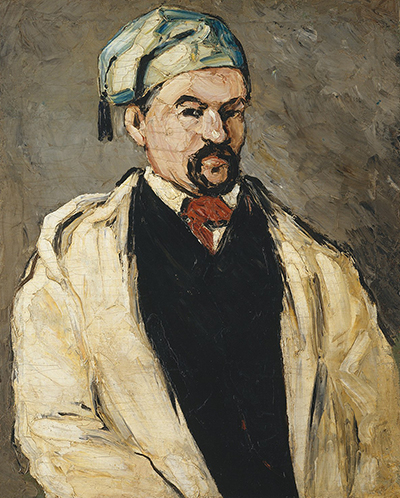
A blue cap leans across the top of this portrait, its dark tassel hanging beside Dominique Aubert’s face. Below it, a pale, loosely drawn smock opens around a dense black waistcoat, while a small red cravat catches the eye at the throat. The man is recognisable, but his clothes have almost the force of a second subject: their broad shapes make the portrait move before we begin to examine his expression.
The sitter was Cézanne’s maternal uncle. The Metropolitan Museum of Art dates this painting to 1866 and identifies its blue tasseled cap and robe. Its portrait of Dominique dressed as a monk is a separate canvas. [1]
At a Glance
- Artist Paul Cézanne. [1]
- Sitter Antoine Dominique Sauveur Aubert, the artist’s maternal uncle. [1]
- Date 1866 according to the Met; 1866–67 in the online catalogue raisonné. [1] [2]
- Medium Oil on canvas. [1]
- Collection The Metropolitan Museum of Art, New York, accession 53.140.1; catalogue raisonné FWN 412. [1] [2]
This work across Paul Cézanne’s career
The Kiss of the Muse
c.1860The Artist’s Father, Reading L’Événement
autumn 1866The Hanged Man’s House
c.1873A Modern Olympia
1873–74Maincy Bridge
1879–80The Blue Vase
1889–90The Basket of Apples
c.1893Apples and Oranges
c.1899The Large Bathers (Philadelphia)
1900–1906 (Philadelphia Museum dating)Château Noir (MoMA)
1903–04Contents
- A costume built from opposing shapes
- The surface makes its own argument
- One sitter, many appearances
- A portrait with changing names
A costume built from opposing shapes
The cap sits at a conspicuous angle. A bright band curves over the forehead, a blue-green strip follows its upper edge, and the tassel ends in a small black weight. Across the lower half of the canvas, the smock moves in the opposite direction: its right side slopes outward and down, making the seated body seem wider than the head. The two movements hold the figure in place without a chair, tabletop or architectural setting. Even the neutral background takes part, pressing close to the silhouette rather than opening a room behind him.
Pavel Machotka reads this portrait as one of the two largest in the Uncle Dominique group. In his object-specific commentary, the plain black-and-white foundation lets the red neckcloth register against the green in the cap. He also sees the cap’s leftward inclination balanced by the movement of the white coat toward the right. That reading helps explain why the apparent speed of the strokes does not dissolve the composition: the strong directions of clothing and head remain legible across the entire canvas. [3]
Look closely at the face and the economy becomes more intricate. A dark eyebrow and eye socket arrive as abrupt, compact marks; a patch of light seems to catch the bridge and tip of the nose. The moustache and pointed beard produce a broken dark ring around mouth and chin. These areas are visibly more compressed than the wide pale passages of the garment. Cézanne gives the viewer enough separate features to identify a person, then makes those features compete with the broad, almost abstract construction of his clothes.
The smock is especially active near the left shoulder, where bright folded planes come forward against the gray. Its lower portions are less tidy: thick short strokes gather and separate, leaving the edge of the black central shape irregular. The waistcoat absorbs light and makes the neckcloth more vivid. This is a portrait in which a tiny patch of red can command attention because so much of the surrounding area is held to black, cream and gray. The result depends as much on distribution as on colour itself.
The surface makes its own argument
The Met describes Cézanne applying paint to coarse canvas with a palette knife; its audio commentary associates the soft cap with local peasants. The garment’s uneven ridges and scraped edges are visible paint as well as depicted fabric. [1]
Some areas seem carved into shape by light arriving at the edge of a stroke. The face is neither smoothly blended nor uniformly rough: flat pale marks sit beside dark cuts, while the neck and garment are assembled at another scale. That change of scale gives the head its intensity. It also keeps the viewer moving between a convincing human presence and the separate pieces that create it. The gray ground, dragged in varying directions, refuses to be a blank backdrop; it shares the hand-worked character of the figure.
John Elderfield places the Uncle Dominique portraits among Cézanne’s forceful studio portraits of 1866–67. He argues that their restricted tones and abrupt contrasts have something in common with contemporary photographs, even though the swollen paint and conspicuously unsmoothed surface resist photography’s finish. His comparison opens a useful way of seeing this canvas: the direct encounter with one sitter is repeated as an image, while each new surface makes a different pictorial event from that encounter. [4]
Where the cap crosses the forehead, its pale edge nearly joins the lit flesh beneath. The boundary is perceptible because hue, direction and texture shift, rather than because a continuous drawn line seals it. Under the chin, by contrast, the black vest and beard almost merge. Cézanne can make one border porous and another emphatic within a few inches of canvas. This varying pressure is one reason the figure looks substantial despite the speed suggested by the marks.
One sitter, many appearances
A contemporary witness helps fix the pace of this experiment. In a letter to Émile Zola dated 2 October 1866, Antony Valabrègue joked about Cézanne’s heavily worked painting and said that the uncle served more often as a model; a new portrait appeared each afternoon. The Société Paul Cezanne’s chronology transcribes the letter and lists nine portraits associated with Dominique, while noting that one sitter identification bears a question mark. [5]
The recurring sitter made costume unusually consequential. In this painting the tasseled cap and loose light garment broaden Dominique into a working figure; elsewhere he appears in a monk’s habit, a turban or other headwear. A Christie’s essay on a different Uncle Dominique portrait names this canvas specifically as the example with a tasseled hat and smock. It also notes that the ownership of the various garments is unknown. [6]
Each change of clothing alters the proportions available to the painter. A close cap confines the top of a head; this expansive one gives it a sloping extension. A dark habit can unify a body; here the pale outer garment splits apart around the central black. The portrait therefore tests likeness against alteration. Dominique’s eyes, nose and beard hold his identity while the surrounding structure proposes another social appearance. Looking from one version to another, we can follow what stays constant and what Cézanne is willing to remake. [6]
The National Gallery of Art places the Uncle Dominique pictures among the family portraits through which Cézanne began to paint sitters in earnest in 1866. It identifies Aubert as a bailiff. That occupation gives the light smock an added ambiguity: it can suggest an artisan without documenting what Dominique wore at work. The apparent worker is a staged appearance whose credibility comes from paint, pose and the sitter’s unmistakable face. [7]
A portrait with changing names
The work has not always been labelled as the artist’s uncle. The online catalogue raisonné records titles including L’Homme à la blouse blanche , Man in a Blue Cap (Uncle Dominic) and Self Portrait . It also records different proposed dates. Each title directs the first glance toward clothing, identity or supposed self-representation. [2]
At the 1907 Salon d’Automne retrospective it appeared as L’Homme à la blouse blanche ; a 1921 Met exhibition listed it as Portrait of the Artist , and a 1929 MoMA exhibition called it Self Portrait . The catalogue traces it through Ambroise Vollard, Auguste Pellerin, Marius de Zayas and Lillie P. Bliss before its passage through MoMA to the Met. The likeness circulated while its sitter’s identity remained unsettled. [2]
Cézanne artworks directory
Browse 217 identified works in this researched selection, including paintings, drawings and watercolours. This is a bounded selection, not a complete catalogue of Cézanne’s surviving oeuvre. Unlinked titles have no confirmed article in this collection.
| Name | Date | Medium |
|---|---|---|
| A Head, a Cup, and a Bread Roll | 1891/1894 | Drawing |
| A Man seen from Behind | 1880/1883 | Drawing |
| A Modern Olympia | 1873–74 | Painting |
| A Nude and Foliage | 1879/1882 | Drawing |
| A Smoking Man | 1892–96 (catalogue); c.1890–92 (museum) | Drawing |
| Afternoon in Naples | 1876–77 | Painting |
| An Old Woman with a Rosary | about 1895–96 | Painting |
| Apples and Oranges | c.1899 | Painting |
| Auvers, Panoramic View | 1873–75 | Painting |
| Avenue at Chantilly | 1888 | Painting |
| Banks of the Marne | 1888–94 | Painting |
| Basket | 1877/1900 | Drawing |
| Bather with Outstretched Arms | 1877–78 | Painting |
| Bellows in Front of a Fireplace | 1887/1892 | Drawing |
| Bibémus Quarry | c.1895 | Painting |
| Boy in a Red Vest, Barnes Foundation | 1888–90 | Painting |
| Boy in a Red Vest, MoMA | 1888–90 | Painting |
| Boy in a Red Waistcoat, National Gallery of Art | 1888–90 | Painting |
| Branch in Flower | 1886/1889 | Drawing |
| Carnival Scene | 1885/1888 | Drawing |
| Chair and Dresser | 1880/1883 | Drawing |
| Chateau Noir | 1903–04 | Painting |
| Chestnut Trees and Farm at Jas de Bouffan | c.1885 | Painting |
| Chestnut Trees and Farm at Jas de Bouffan, Pushkin | c.1886 | Painting |
| Chestnut Trees at Jas de Bouffan in Winter | 1885–86 | Painting |
| Château Noir | 1900–04 | Painting |
| Cistern in the Park of Château Noir | c.1900 | Painting |
| Curtain, Jug and Fruit | 1893–94 | Painting |
| Cushion of an Armchair | 1886/1889 | Drawing |
| Draft Letter and Studies of Bathers | c.1878 | Drawing |
| Farmhouse and Chestnut Trees at Jas de Bouffan | 1884–85 | Painting |
| Figure Resting Head on Hand | c. 1889 | Drawing |
| Fireplace Tongs and Poker | 1887/1892 | Drawing |
| Forest Interior, San Francisco | c.1898–99 | Painting |
| Four Bathers | 1888–90 | Painting |
| Fruit and a Jug on a Table | 1893–94 | Painting |
| Gardanne | 1885–86 | Painting |
| Gardanne, Barnes Foundation | c.1885 | Painting |
| Hand and Shoulder of a Boy | c. 1885 | Drawing |
| Harlequin, National Gallery of Art | 1888–90 | Painting |
| Head of a Boy | 1887/1889 | Drawing |
| Head of a Boy Seen from Behind | c. 1885 | Drawing |
| Head of a Young Woman | c. 1880 | Drawing |
| Head of the Artist's Son | 1888/1889 | Drawing |
| Hillside in Provence | c.1890–92 | Painting |
| Horse Chestnut Trees at Jas de Bouffan | c.1885 | Painting |
| House and Farm at the Jas de Bouffan | c.1887 | Painting |
| House in a Park | 1883/1886 | Drawing |
| House in Provence | c.1885 | Painting |
| House of Père Lacroix | 1873 | Painting |
| House Surrounded by Vegetation | 1889/1892 | Drawing |
| Houses in Provence The Riaux Valley near L’Estaque | c.1883 | Painting |
| Jas de Bouffan, the Pool | c.1876 | Painting |
| Kerosene Lamp | 1878/1881 | Drawing |
| L'Estaque, Melting Snow | c.1870 | Painting |
| Lake Annecy | 1896 | Painting |
| Landscape in Provence, Pola Museum | 1879–82 | Painting |
| Landscape Near Aix-en-Provence | 1877/1880 | Drawing |
| Landscape Seen from the Inside of a Cave | 1889/1892 | Drawing |
| Landscape with Poplars | c.1885–87 | Painting |
| Landscape with Trees | 1895/1898 | Drawing |
| Leda and the Swan | c.1880 (possibly later) | Painting |
| Little Girl with a Doll | 1902–04 | Painting |
| Louis Guillaume | 1879–1890 | Painting |
| Madame Cezanne | 1888/1891 | Drawing |
| Madame Cezanne | 1886/1889 | Drawing |
| Madame Cezanne | 1882/1887 | Drawing |
| Madame Cezanne | 1897/1900 | Drawing |
| Madame Cezanne with her Head Lowered | 1893/1896 | Drawing |
| Madame Cézanne in a Red Armchair | c.1877 | Painting |
| Madame Cézanne in a Red Dress, Metropolitan Museum of Art | 1888–90 | Painting |
| Madame Cézanne in a Yellow Chair | 1888–90 | Painting |
| Madame Cézanne in a Yellow Chair, Fondation Beyeler | 1888–90 | Painting |
| Madame Cézanne in the Conservatory | 1891 | Painting |
| Maincy Bridge | 1879–80 | Painting |
| Maison Maria with a View of Château Noir | c.1895 | Painting |
| Man Bending Forward | 1883/1886 | Drawing |
| Man Smoking a Pipe, Pushkin | c.1891, possibly later | Painting |
| Man with a Pipe | 1891–96 | Painting |
| Man with a Pipe, Nelson-Atkins | 1890–92 | Painting |
| Man with a Straw Hat (Gustave Boyer) | c.1871 | Painting |
| Man with Crossed Arms | c.1899 | Painting |
| Man with Pipe, National Gallery of Art | 1892–96 | Painting |
| Mont Sainte-Victoire | c.1902–06 | Painting |
| Mont Sainte-Victoire | 1900–02 | Painting |
| Mont Sainte-Victoire (recto) | c.1895 | Watercolour |
| Mont Sainte-Victoire and the Viaduct of the Arc River Valley | 1882–85 | Painting |
| Mont Sainte-Victoire Seen beyond the Wall of the Jas de Bouffan | c.1885/1888 | Watercolour |
| Mont Sainte-Victoire Seen from Bibémus Quarry | c.1897 | Painting |
| Mont Sainte-Victoire, Barnes Foundation | 1892–95 | Painting |
| Near the Pool at Jas de Bouffan | 1883/1887 | Drawing |
| Pelicans | 1877/1880 | Drawing |
| Peonies | 1890/1893 | Drawing |
| Pierrot and Harlequin | 1888 | Painting |
| Pine Tree | 1882/1885 | Drawing |
| Pont des Trois Sautets | 1906 | Watercolour |
| Poplars | 1879–80 | Painting |
| Portrait of Ambroise Vollard | 1899 | Painting |
| Portrait of Gustave Geffroy | 1895–96 | Painting |
| Portrait of Madame Cezanne with Loosened Hair | 1885–86 | Painting |
| Portrait of the Artist Looking Over His Shoulder | 1883–84 | Painting |
| Portrait of the Gardener Vallier | 1906 | Painting |
| Portrait of Victor Chocquet | 1876–77 | Painting |
| Portrait Of Victor Chocquet Seated | 1877 | Painting |
| Provençal Manor | c.1885 | Painting |
| Pyramid of Skulls | 1898–1900 | Painting |
| Reclining Nude (Leda?) | c.1887 | Painting |
| Scipio | 1866–68 | Painting |
| Seated Man, Oslo | 1898–1900 | Painting |
| Seated Peasant | c.1892–96 | Painting |
| Seated Peasant, Hiroshima | c.1897 | Painting |
| Seated Peasant, Orsay | c.1900 | Painting |
| Self-Portrait | c. 1895 | Drawing |
| Self-Portrait in a Bowler Hat, Ny Carlsberg Glyptotek | 1885–86 | Painting |
| Self-Portrait in a Casquette | c.1875 | Painting |
| Self-Portrait with a Beret | 1898–1900 | Painting |
| Self-Portrait with a Hat, Artizon Museum | c.1890–94 | Painting |
| Self-Portrait with a Pink Background | c.1875 | Painting |
| Self-Portrait with Olive-Coloured Wallpaper | about 1880–81 | Painting |
| Self-Portrait with Palette | 1886–87 | Painting |
| Self-Portrait with White Turban | c.1878–80 | Painting |
| Self-Portrait, c.1895 | c.1895 | Painting |
| Self-Portrait, Pushkin Museum | c.1882 | Painting |
| Spanish Dancers | 1883/1886 | Drawing |
| Still Life with a Curtain | 1892–94 | Painting |
| Still Life with Apples | c.1890 | Painting |
| Still Life with Apples | 1893–94 | Painting |
| Still Life with Apples and a Pot of Primroses | about 1890 | Painting |
| Still Life with Milk Jug and Fruit | c.1900 | Painting |
| Still Life with Open Drawer | 1877–79 | Painting |
| Still Life with Plaster Cupid | about 1894 | Painting |
| Still Life with Skull | 1890–93 | Painting |
| Still Life with Soup Tureen | 1877 | Painting |
| Still Life, Pitcher and Fruit | 1893–94 | Painting |
| Studies Including a Straw Hat | 1895/1898 | Drawing |
| Studies Including Madame Cezanne | 1884/1887 | Drawing |
| Study for "The Judgement of Paris" or "The Amorous Shepherd" | 1883/1886 | Drawing |
| Study for Woman with a Coffee Pot | c.1895 | Painting |
| Study of "The Roman Orator (Germanicus)" | 1883/1886 | Drawing |
| Study of "Venus de Milo" | 1881/1884 | Drawing |
| Study of a Decorative Ornament | 1879/1882 | Drawing |
| Study of a Standing Male Figure after the Antique | c. 1895 | Drawing |
| Study of an Angel in Rubens' "The Prophet Elijah" | 1892/1895 | Drawing |
| Study of Desiderio da Settignano's "Bust of a Child" | c. 1895 | Drawing |
| Study of Houses | 1879/1882 | Drawing |
| Study of Puget's "Hercules Resting" | c. 1879 | Drawing |
| Study of Puget's "Milo of Crotona" | 1895/1898 | Drawing |
| Study of Puget's "Milo of Crotona" | 1880/1883 | Drawing |
| Study of the Allegorical Figure Bellona in Rubens' "The Apotheosis of Henri IV" | 1883/1886 | Drawing |
| Study of the Allegorical Figure Bellona in Rubens' "The Apotheosis of Henri IV" | 1879/1882 | Drawing |
| Study of the Allegorical Figure France in Rubens' "The Exchange of the Two Princesses" | 1882/1885 | Drawing |
| Study of the Allegorical Figure of Health in Rubens' "The Birth of Louis XIII" | 1880/1883 | Drawing |
| Study of the Allegorical Figure of the Genius of Health from Rubens' "The Birth of Louis XIII at Fontainbleau" | 1895/1898 | Drawing |
| Sugar Bowl, Pears and Blue Cup | 1865–66 | Painting |
| The Aqueduct, Pushkin Museum | Dating differs between museum records | Painting |
| The Artist's Father, Reading L'Evenement | autumn 1866 | Painting |
| The Artist's Son | c. 1887 | Drawing |
| The Artist's Son Leaning on his Elbow | c. 1887 | Drawing |
| The Artist's Son Reading | c. 1887 | Drawing |
| The Artist's Son Writing | c. 1887 | Drawing |
| The Artist’s Son, Paul | 1886–87 | Painting |
| The Avenue at Jas de Bouffan | 1868–70 (possibly later) | Painting |
| The Avenue at Jas de Bouffan, Geneva | c.1890 | Painting |
| The Basket of Apples | c.1893 | Painting |
| The Bather, Museum of Modern Art | c.1885 | Painting |
| The Bay of Marseille seen from L'Estaque | c.1885 | Painting |
| The Blue Vase | 1889–90 | Painting |
| The Boy in the Red Vest, Bührle | 1888–90 | Painting |
| The Buffet | 1877–79 | Painting |
| The Card Players, Barnes Foundation | 1890–92 | Painting |
| The Card Players, Courtauld Gallery | 1892–96 | Painting |
| The Card Players, Metropolitan Museum of Art | 1890–92 | Painting |
| The Card Players, Musée d’Orsay | 1893–96 | Painting |
| The Card Players, Qatar | 1892–96 | Painting |
| The Eternal Feminine | c.1877 | Painting |
| The Gardener Vallier | 1906 | Painting |
| The Gardener Vallier, Tate | 1905–06 | Painting |
| The Grounds of the Château Noir | c.1900–04 | Painting |
| The Gulf of Marseille Seen from L’Estaque | c.1885 | Painting |
| The Hanged Man's House in Auvers | c.1873 | Painting |
| The House of Doctor Gachet at Auvers | 1872–73 | Painting |
| The House with the Cracked Walls | 1892–94 | Painting |
| The Kiss of the Muse | c.1860 | Painting |
| The Large Bathers, Barnes Foundation | 1895–1906 | Painting |
| The Large Bathers, National Gallery | 1895–1905 | Painting |
| The Large Bathers, Philadelphia Museum of Art | 1900–06 | Painting |
| The Mill | 1889/1892 | Drawing |
| The Painter’s Father, Louis-Auguste Cézanne | c.1865 | Painting |
| The Peasant | 1890–92 | Painting |
| The Plaster Mill (La Moulin à plâtre) | 1889/1892 | Drawing |
| The Smoker, Hermitage | c.1891 | Painting |
| The Smoker, Mannheim | c.1891 | Painting |
| The Stove in the Studio | c.1865 | Painting |
| The Vase of Tulips | c.1890 | Painting |
| Thistle | 1893/1896 | Drawing |
| Three Heads, One of Madame Cezanne | 1882/1885 | Drawing |
| Three Skulls | c.1898 | Painting |
| Three Skulls on a Patterned Carpet | 1904 | Painting |
| Trees and Shrubs | 1883/1887 | Drawing |
| Turning Road at Montgeroult | 1898 | Painting |
| Two Bathers | 1884/1887 | Drawing |
| Two Heads | 1888 | Drawing |
| Two Heads | 1890/1896 | Drawing |
| Two Heads of Women | 1890/1894 | Drawing |
| Two Studies for "The Judgement of Paris" or "The Amorous Shepherd" | 1883/1886 | Drawing |
| Uncle Dominique in a Tasseled Cap | 1866 | Painting |
| Uncle Dominique in a Turban | 1866–67 | Painting |
| Victor Chocquet and an Angel for "The Apotheosis of Delacroix" | 1878/1880 | Drawing |
| Woman in Blue | c.1904 | Painting |
| Woman Leaning Forward | 1888/1891 | Drawing |
| Woman Leaning Forward | 1890/1894 | Drawing |
| Woman Leaning Forward | 1890/1894 | Drawing |
| Woman with a Coffee Pot | c.1895 | Painting |
| Women Bathers and a Roll of Paper | 1882/1885 | Drawing |
| Young Girl with a Doll | c.1895 | Painting |
| Young Italian Woman at a Table | c.1895–1900 | Painting |
| Young Man and Skull | 1896–98 | Painting |
Frequently Asked Questions
Antoine Dominique Sauveur Aubert, Cézanne’s maternal uncle. [1]
Discussion
Look again at the images and ideas explored in Uncle Dominique in a Tasseled Cap by Paul Cézanne. These editorial prompts invite your observations.
Reader Insights
Which element first fixes your eye: Dominique’s face, the tilted cap or the red cravat?
How does the portrait change when you imagine the pale garment removed and the dark center left visible?
Where does a stroke describe fabric or flesh, and where does it remain most insistently a stroke of paint?
Join the Conversation
Share a detail, comparison or question about Uncle Dominique in a Tasseled Cap by Paul Cézanne below.
References
- The Metropolitan Museum of Art. “Antoine Dominique Sauveur Aubert (born 1817), the Artist’s Uncle,” collection record and audio transcript, accession 53.140.1. View source .
- Société Paul Cezanne. “L’Homme au bonnet de coton (l’Oncle Dominique), 1866–67 (FWN 412),” The Paintings, Watercolors and Drawings of Paul Cezanne: An Online Catalogue Raisonné . View source .
- Pavel Machotka / Société Paul Cezanne. “L’homme au bonnet de coton (l’oncle Dominique), vers 1866 (R107-FWN412),” 2017; text attributed to Cézanne: The Eye and the Mind . View source .
- John Elderfield. “Introduction: The Reading of the Model,” in Cézanne Portraits , 2017, pp. 15–17. View source .
- Société Paul Cezanne. “1866,” chronology, October–November entries, including transcription of Antony Valabrègue’s letter to Émile Zola, 2 October 1866 (in French). View source .
- Christie’s. “Paul Cézanne, L’Oncle Dominique ,” lot essay for a distinct portrait, with comparison to the tasseled-cap canvas. View source .
- National Gallery of Art. “Major Exhibition of Paul Cézanne’s Portraits at the National Gallery of Art,” press release, published 2017, updated 2018. View source .
- Le Baiser de la muse, d'après Frillié (FWN 572). View source.
- Louis-Auguste Cezanne, père de l'artiste, lisant L'Événement (FWN 402). View source.
- La Maison du pendu, Auvers-sur-Oise (FWN 81). View source.
- Une moderne Olympia (FWN 628). View source.
- Le Pont de Maincy (FWN 143). View source.
- La Montagne Sainte-Victoire vue de Montbriand (FWN 185). View source.
- Gardanne (vue horizontale) (FWN 224). View source.
- Le Vase bleu (FWN 823). View source.
- Les Joueurs de cartes (FWN 681). View source.
- La Montagne Sainte-Victoire (FWN 296). View source.
- La Corbeille de pommes (FWN 860). View source.
- Pommes et oranges (FWN 871). View source.
- Portrait d'Ambroise Vollard (FWN 531). View source.
- Philadelphia Museum of Art,The Large Bathers,W1937-1-1. View source.
- Château Noir (FWN 360). View source.
- Société Paul Cezanne,online catalogue structure and objectidentification. View source.
- National Gallery of Art,Cezanne Sketchbook,1992.51.9. View source.
- Splash image, A sloping cap, pale smock and red neckcloth organize the portrait.