


 Paul Cezanne.jpg)
 by
Tom Gurney
Tom Gurney BSc (Hons) is an art history expert with over 20 years experience
Published on June 19, 2020 / Updated on October 22, 2026
Email:
tomgurney1@gmail.com
/ Phone:
+44 7429 011000
The Card Players at the Barnes Foundation: Cézanne’s Five-Figure Painting: Introduction
A small white table stands in front of us. Three men lean over a game, a fourth watches with a pipe, and a child appears between the players. Paul Cézanne gives their ordinary gathering a canvas more than 1.8 metres wide. The table is close enough for us to see the scattered cards and a pipe laid across it, yet the people remain absorbed in a space we cannot quite enter. This is the five-figure Card Players at the Barnes Foundation, painted around 1890–92 and the largest of Cézanne’s five canvases on the subject. [1] [2]
The distinction matters. Another multi-figure Card Players at the Metropolitan Museum has four people; the three remaining principal paintings show two players. A reproduction of one version can easily stand in for another when all share a title. Here, the extra child, the high wall with a framed dark rectangle and hanging pipes, and the great ochre curtain at right belong to the Barnes painting. Its scale and crowded, carefully spaced company make the room itself part of the subject. [3]
At a Glance
- Artist and title Paul Cézanne, Les Joueurs de cartes ( The Card Players ). [1]
- Date 1890–92, the current catalogue range, rather than a documented start and finish on the easel. [1]
- Medium and size Oil on canvas, 135.3 × 181.9 cm (53¼ × 71⅝ in.). [1]
- Collection Barnes Foundation, Philadelphia, BF564; catalogue FWN 681, Rewald 706, Venturi 560. [1]
- Composition Three seated players, one standing smoker and a child. [1]
This work across Paul Cézanne’s career
The Kiss of the Muse
c.1860The Artist’s Father, Reading L’Événement
autumn 1866The Hanged Man’s House
c.1873A Modern Olympia
1873–74Maincy Bridge
1879–80The Blue Vase
1889–90The Basket of Apples
c.1893Apples and Oranges
c.1899The Large Bathers (Philadelphia)
1900–1906 (Philadelphia Museum dating)Château Noir (MoMA)
1903–04Contents
- Five People, One Table
- A Room Built from Objects and Colour
- Who Sat for the Painting?
- One Canvas Among Five
- From Cézanne’s Family to the Barnes
- Annotated details
Five People, One Table
The circle of hands
Begin at the centre. The youngest-looking seated player bends low over a close-held hand. His pale jacket spreads across the middle of the picture in angled sections, while dark hair, red cheeks and the small cards draw the eye inward. The man on the left, broad in a brown coat, turns down toward the table; the man on the right, wrapped in blue, holds his cards close to his chest. None announces a winner or even reveals which game is being played. The action is measured through attention: bowed faces, hands occupied with paper, the pause before a move. Cézanne makes the slight cards hold together three much larger bodies. [1]
The table is hardly a neutral platform. Its white front and single drawer face us squarely, while its dark playing surface tilts into a shallow wedge of red, black and green. Cards lie at different angles; a pale pipe rests near the edge. The tabletop seems near enough to touch, but the arrangement of hands prevents our eye from settling on a simple, uninterrupted view of the game. At the left, the player’s sleeve and forearm make a firm corner above it. At the right, the blue sleeve swells toward the table and the cards. The central player hunches into the gap between them. The bodies give the table its human scale, while its straight edges and legs give their poses a measured frame. [1]
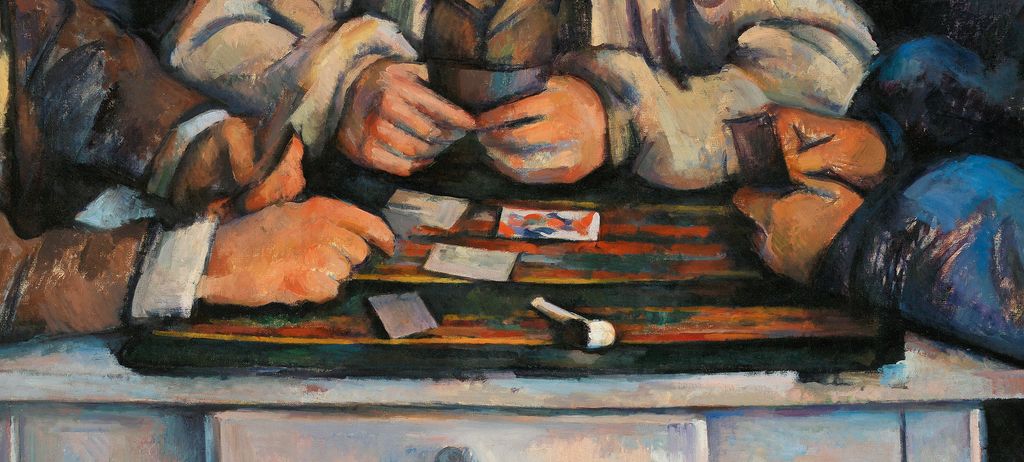
The visible cards deserve more than a quick glance. Art historian André Dombrowski observes that cards in these paintings can register as coloured images, thin edges, pale backs or almost indistinct touches in a hand. He draws particular attention to the Barnes player on the left, whose cards are difficult to separate from fingers and coat, and to the turned card on the table. His larger argument is that playing cards let Cézanne work with flat images that become objects when people handle them. The painting gives that idea a concrete test: we read the card faces as signs of a game while also seeing small rectangles of paint trying to occupy the same space as knuckles, cuffs and boards. [4]
Look below the drawer as well. The table’s upright legs divide the lower canvas while the seated players’ trousered legs run diagonally behind and across them. The neat front face of the furniture gives way to an interlacing of bodies and wood. Satish Padiyar’s reading of the Barnes picture begins from this contact: he sees the table as an object that gathers people into a shared world while keeping each person distinct. All three seated men depend on a common surface, but the table neither merges them into a group portrait nor tells us what they say to one another. [5]
The two who watch
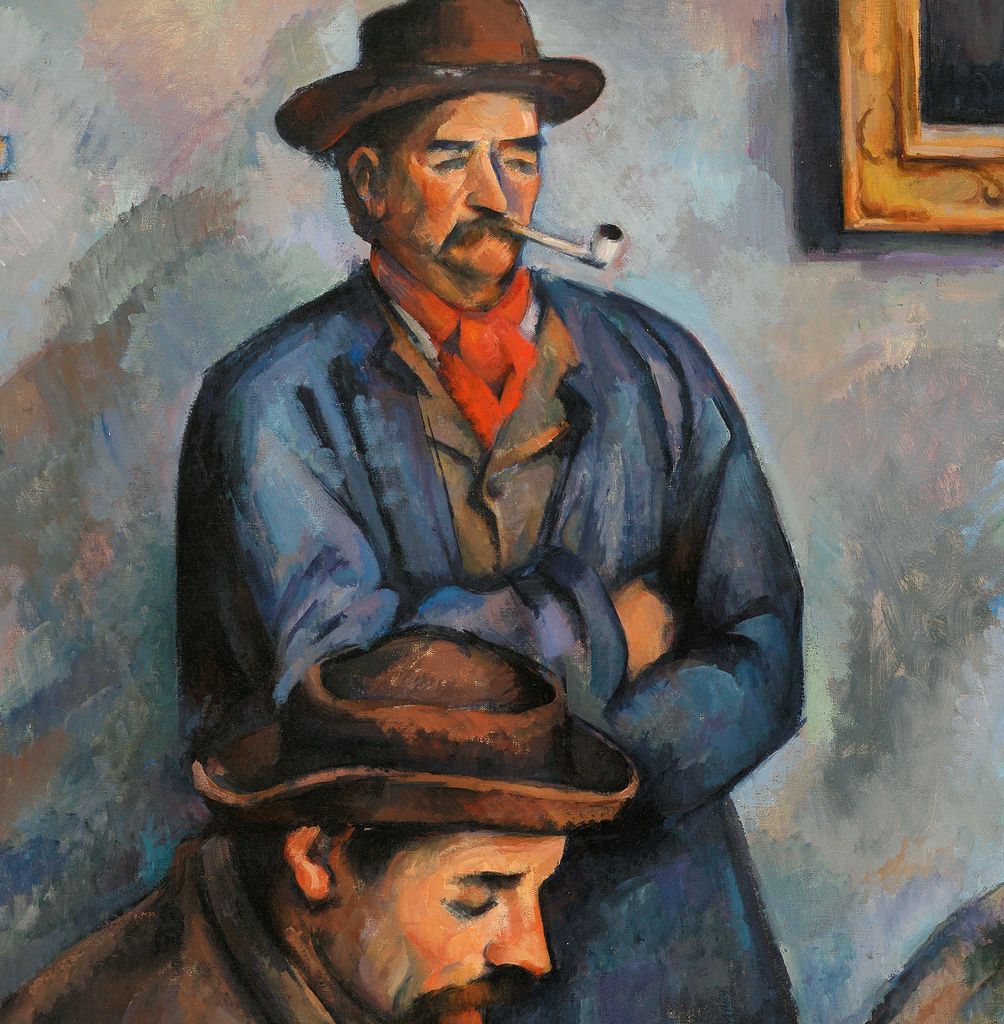
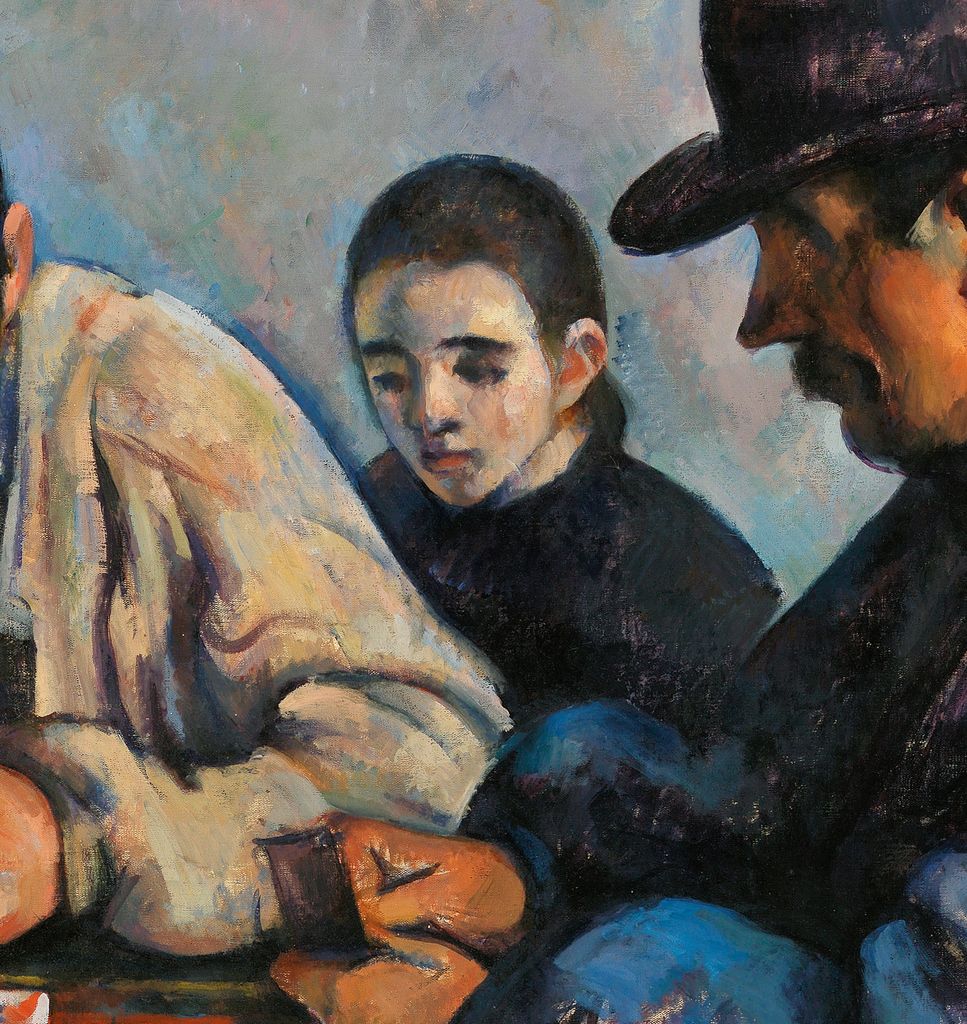
Behind the game, a man in a dark hat stands with arms folded. A pipe crosses his mouth. His blue coat echoes the player at right, but his upright body belongs to a different rhythm from the bent trio. His eyes appear lowered toward the gathering, although the exact object of his gaze is difficult to fix. The child beside the central player is smaller, set back and partly sheltered by the adult figures. Their pale face and black clothing interrupt the heavy blues and browns around the table. These two presences turn a game between three participants into a scene of looking as well as playing. They also make it hard to reduce the painting to a simple duel between opponents. [1]
T. J. Clark describes a separation between the space of the players and that of the watchers in this version. He finds the standing smoker unusually remote and the child unsettling, while the foreground table remains solid and near. His account makes a visible difference precise: the standing man and child are neither merely decorative background nor participants with cards of their own. [6]
The canvas makes room for that ambiguity by giving the watchers different kinds of distance. The standing smoker is large and almost touches the upper edge of the pictorial world; the child is close to the table but enclosed between adults. Neither seems to meet our eye. Their relative positions make a quiet question recur as we look: who is inside this activity, and who can only observe it? The answer changes as the eye moves from the outwardly impassive man to the child’s face and back to the working hands.
A Room Built from Objects and Colour
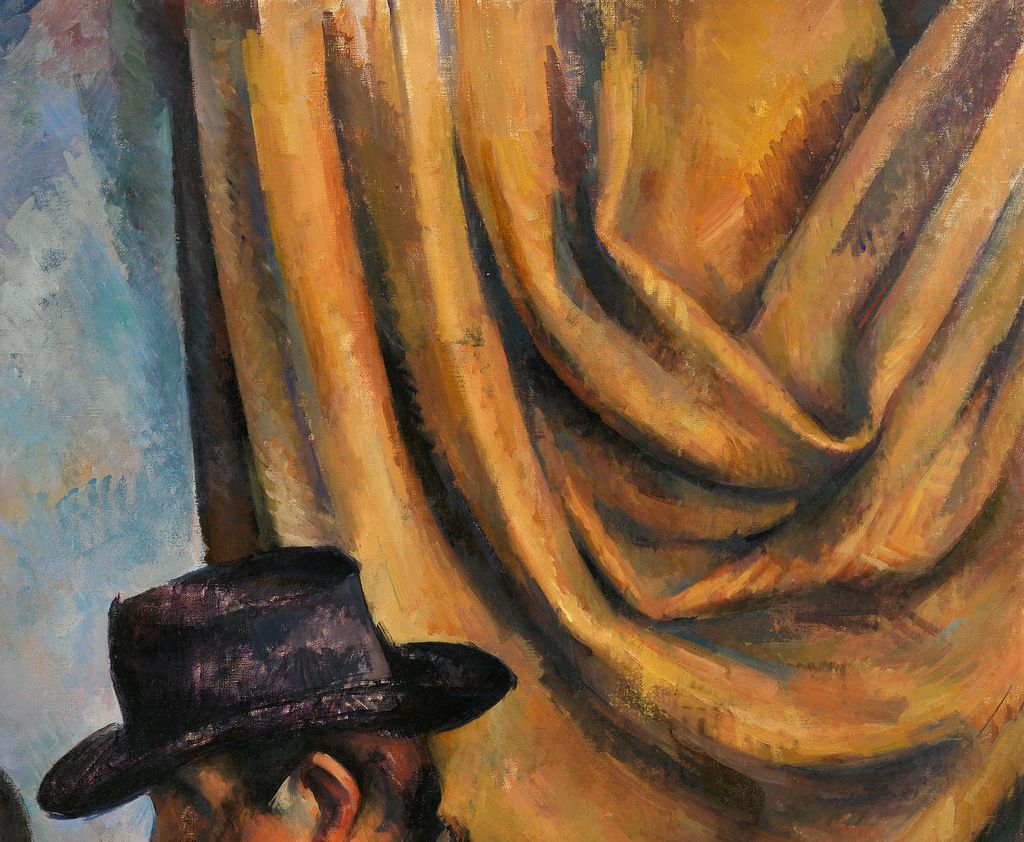
The back wall has a life of its own. A green-and-earth-coloured pot sits high on a short shelf at the far left. Above the players is a dark framed rectangle, plausibly a picture or mirror rather than a view we can identify. Four pipes hang along the wall near it. At the right, a vast yellow-ochre curtain gathers into deep folds. These details could suggest a familiar interior, yet the painting supplies no verified address and no documentary account of a sitting in a café. The objects anchor a room while leaving its exact location open. [1] [6]
The curtain is the largest visual counterweight to the figures. Its warm folds descend behind the right-hand player, then seem to continue in the blue ridges of his coat. His shoulder pushes toward us, but its shape also has something of the drape’s weight and rhythm. On the other side, the wall opens into cooler blue-greys around the standing smoker. Orange and red gather in faces and hands, precisely where the players’ concentration is visible. The central pale jacket links the warmer human circle to the cool wall. Rather than a single light source explaining every patch, colour relationships move us through the painting: ochre curtain to blue coat, blue coat to blue wall, warm hand to red and black table. [1]
Clark reads the curtain, framed dark shape, pipes and pot as a set of pictorial questions about a wall that both closes off and activates the room. That is a critic’s way of describing how insistently these objects hover around the figures. It need not mean that each item bears a fixed symbol. The pot at the upper left seems unusually isolated; the hanging pipes repeat the smoker’s small white pipe; the framed rectangle gives the group a dark centre above the bright, busy centre on the table. Their spacing matters at least as much as their possible names. [6]
This expansive room helps explain the Barnes Foundation’s description of the canvas as unusually ambitious. Three workers at play might have belonged to a modest genre scene. Cézanne has instead given them a format associated with subjects such as history and mythology. At this size, the seated men and their ordinary activity become physically imposing. [2]
The scale also changes the pace of looking. From across a room, the figures and tabletop form a strong horizontal mass under the curtain and wall. Up close, the small cards, uncertain edges of hands, varied marks in the jackets and interruptions along the tabletop require slow inspection. Cézanne’s largest treatment of the theme holds together those two experiences: an almost public, commanding arrangement and a private action concentrated in a few centimetres of painted paper. The five-figure canvas is therefore best encountered on its own terms, rather than as a bigger illustration of a supposedly final two-player design.
Annotated Details from The Card Players, Barnes version
The numbered points identify visible features discussed in this article. Return from each detail to the whole composition. Paul Cézanne, The Card Players, 1890–92, oil on canvas, 135.3 × 181.9 cm, Barnes Foundation, Philadelphia (BF564). Image source. CC0 / Public domain.
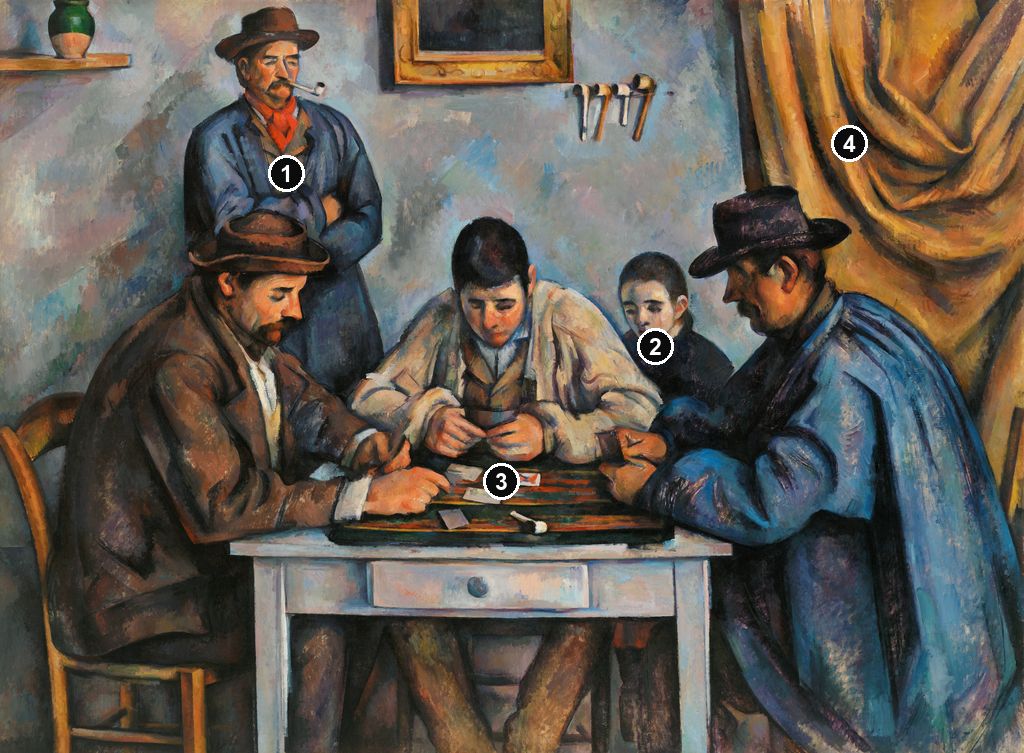
Details from THE CARD PLAYERS, BARNES VERSION
Compare the cropped details with the complete images above. Notice how their colours, shapes and positions contribute to the larger compositions.
The standing observer
The observer stands behind the seated player, his folded arms and pipe setting him apart from the hands at the table.
The fifth figure
A smaller figure watches beside the central player. This fifth participant is absent from the Metropolitan canvas.
Cards and hands above the striped cloth
The players hold their cards upright while other cards lie on the striped cloth. Their pale surfaces punctuate the darker table.
The curtain and wall
The heavy curtain overlaps the cool wall. Compare its broad folds with the small pipes displayed beside the framed picture.
Who Sat for the Painting?
The Barnes Foundation calls the pictured people farmhands, a description consistent with the rural world around Cézanne’s family estate, the Jas de Bouffan, near Aix-en-Provence. There is documentary evidence of Cézanne using a worker as a model around this period. In a letter of 13 February 1891 to Émile Zola, Paul Alexis reported that a worker was posing for Cézanne at the Jas. Alexis was repeating news; he neither named the worker nor identified a finished canvas. The letter cannot assign that sitting to this exact Barnes composition. [2] [4]
Names attached to the figures have a more complicated history. Michel Fraisset has traced a confusion between a gardener called Paulin Paulet and a second model known as père Alexandre. Earlier accounts combined a forename and surname into “Alexandre Paulin”; Fraisset argues that this conflation obscures two different people. The standing pipe smoker in the Barnes and Met compositions has been associated with père Alexandre, while Paulet is connected with one of the players. Other figures remain unidentified. [7] [1]
The child’s possible name comes through memory rather than a contemporary inscription on the painting. Fraisset recounts Cézanne’s son’s identification of the child as the gardener’s daughter, though with the confused name “Léontine Paulin.” He also cites an interview Léontine Paulet gave in 1955, when she recalled sitting for Cézanne and being paid three francs, while her father received five. Fraisset uses later family photographs to support the distinction between Paulet and père Alexandre. This is significant testimony, but it was recorded decades after the sitting and reaches us through subsequent accounts. It supports a cautious identification of the child as Léontine Paulet; it cannot make every adult assignment certain. [7]
The payments bring the social encounter into focus. These were working people who could be asked, and paid, to hold poses for an artist from a wealthier family. Brigid Boyle, writing about a related Man with a Pipe study at the Nelson-Atkins Museum, emphasizes that class difference and the practical exchange behind the sittings. Her discussion challenges the sentimental picture of effortless intimacy between painter and models. The Barnes canvas turns those separate sittings into a shared scene of play and observation. [8]
One Canvas Among Five
The five principal Card Players paintings are variations, not five interchangeable copies. The Met canvas has three seated players and the standing smoker, but no child, and measures 65.4 × 81.9 cm. The Barnes version more than doubles both its height and its width. Its broader room accommodates the shelf, hanging pipes, framed dark shape and curtain with a different force. The two multi-figure canvases are related, but the child and the changed scale alter the relationships among the people. [3] [1]
The three other principal paintings concentrate on two facing players. Their current catalogue entries distinguish the Musée d’Orsay canvas (FWN 684, 1893–96), the private-collection canvas in Qatar (FWN 685, 1892–96) and the Courtauld canvas (FWN 686, 1891–96); the Courtauld’s own label narrows its date to 1892–96. Their different sizes and details matter. None contains this child or the standing smoker, and their closer pairings ask the viewer to attend to a different balance of bodies, hands and table. The series overview compares the five; the question here is what the largest painting gains from its company of five. [9] [10] [11]
It is tempting to arrange the canvases as a certain path from crowded scene to reduced pair. The catalogue dates overlap, and the surviving testimony does not supply a dated sequence of working sessions. Clark proposes that the four-figure Met painting came before the larger Barnes canvas, but calls his order hypothetical. The Met’s 2022 conservation summary says technical examination challenged earlier views of the series’ order, without spelling out this pair’s order in its brief account. [6] [12]
Related single-figure paintings complicate the familiar idea that every portrait study necessarily came before the group picture. Boyle reports Nancy Ireson’s proposal that the Nelson-Atkins Man with a Pipe , which resembles the standing observer, may postdate the Met composition. Differences in the smoker’s angle and pipe placement inform that proposal. Cézanne could return to a model and motif while exploring a larger ensemble. [8]
The painting’s social meaning has also prompted contrasting readings. Dombrowski stresses the card as a handled picture, useful to think with when studying Cézanne’s painted space. Padiyar treats the Barnes table as a shared object that connects and separates the players, bringing later political philosophy to bear on their relations. Clark is more alert to the distance between those at the table and the observers behind them. Taken together, they direct attention back to a simple, stubborn fact of the image: everyone occupies the same room, yet only three can play. [4] [5] [6]
From Cézanne’s Family to the Barnes
The current catalogue traces the Barnes canvas from Paul Cézanne fils to the dealer Ambroise Vollard, documenting Vollard’s ownership on 18 June 1913, and then to the Barnes Foundation on 22 December 1925. Vollard’s stockbooks describe a large Joueurs de cartes and also record the alternate title Scène de cabaret . That title is evidence of how a dealer catalogued the work, not independent proof that Cézanne set the models in a real cabaret. The painting is now Barnes Foundation BF564 in Philadelphia. [1]
Its exhibition history needs equally careful reading. The catalogue lists a possible identification with a work lent by Vollard to the 1923 Salon d’Automne, explicitly marking it tentative. There is firmer documentation for its presence in the Barnes collection exhibition that travelled from Washington, DC, to Paris, Tokyo, Fort Worth, Toronto, Philadelphia and Munich in 1993–95. The 2010–11 Cézanne’s Card Players exhibition catalogue included the Barnes work, but the catalogue says it was not shown . A reader who sees it listed there should not infer that visitors saw this canvas beside every other version. [1]
The breadth of its later reproduction is itself part of the painting’s history. The catalogue records an image of this exact version in a 1907 publication and in successive early twentieth-century books. These images carried its composition far beyond the audiences who could encounter the canvas. The present 1890–92 range rests on the current catalogue assessment. The work’s path into the Barnes and its subsequent travel help explain how a painting whose sitters were connected to a local estate became available for comparison by much wider audiences. [1]
Return at last to the table. Its drawer, legs and pale front seem steady enough to hold the whole picture together. Above it, a few cards occupy the smallest, most consequential area; around it the coats, faces, the two white pipes, a child’s head and the engulfing curtain pull in different directions. The figures share an activity, but their relationships remain open for the viewer to examine. That balance between communal action and individual distance is what makes this particular Card Players more than a scaled-up episode from the series. [1]
Cézanne artworks directory
Browse 217 identified works in this researched selection, including paintings, drawings and watercolours. This is a bounded selection, not a complete catalogue of Cézanne’s surviving oeuvre. Unlinked titles have no confirmed article in this collection.
| Name | Date | Medium |
|---|---|---|
| A Head, a Cup, and a Bread Roll | 1891/1894 | Drawing |
| A Man seen from Behind | 1880/1883 | Drawing |
| A Modern Olympia | 1873–74 | Painting |
| A Nude and Foliage | 1879/1882 | Drawing |
| A Smoking Man | 1892–96 (catalogue); c.1890–92 (museum) | Drawing |
| Afternoon in Naples | 1876–77 | Painting |
| An Old Woman with a Rosary | about 1895–96 | Painting |
| Apples and Oranges | c.1899 | Painting |
| Auvers, Panoramic View | 1873–75 | Painting |
| Avenue at Chantilly | 1888 | Painting |
| Banks of the Marne | 1888–94 | Painting |
| Basket | 1877/1900 | Drawing |
| Bather with Outstretched Arms | 1877–78 | Painting |
| Bellows in Front of a Fireplace | 1887/1892 | Drawing |
| Bibémus Quarry | c.1895 | Painting |
| Boy in a Red Vest, Barnes Foundation | 1888–90 | Painting |
| Boy in a Red Vest, MoMA | 1888–90 | Painting |
| Boy in a Red Waistcoat, National Gallery of Art | 1888–90 | Painting |
| Branch in Flower | 1886/1889 | Drawing |
| Carnival Scene | 1885/1888 | Drawing |
| Chair and Dresser | 1880/1883 | Drawing |
| Chateau Noir | 1903–04 | Painting |
| Chestnut Trees and Farm at Jas de Bouffan | c.1885 | Painting |
| Chestnut Trees and Farm at Jas de Bouffan, Pushkin | c.1886 | Painting |
| Chestnut Trees at Jas de Bouffan in Winter | 1885–86 | Painting |
| Château Noir | 1900–04 | Painting |
| Cistern in the Park of Château Noir | c.1900 | Painting |
| Curtain, Jug and Fruit | 1893–94 | Painting |
| Cushion of an Armchair | 1886/1889 | Drawing |
| Draft Letter and Studies of Bathers | c.1878 | Drawing |
| Farmhouse and Chestnut Trees at Jas de Bouffan | 1884–85 | Painting |
| Figure Resting Head on Hand | c. 1889 | Drawing |
| Fireplace Tongs and Poker | 1887/1892 | Drawing |
| Forest Interior, San Francisco | c.1898–99 | Painting |
| Four Bathers | 1888–90 | Painting |
| Fruit and a Jug on a Table | 1893–94 | Painting |
| Gardanne | 1885–86 | Painting |
| Gardanne, Barnes Foundation | c.1885 | Painting |
| Hand and Shoulder of a Boy | c. 1885 | Drawing |
| Harlequin, National Gallery of Art | 1888–90 | Painting |
| Head of a Boy | 1887/1889 | Drawing |
| Head of a Boy Seen from Behind | c. 1885 | Drawing |
| Head of a Young Woman | c. 1880 | Drawing |
| Head of the Artist's Son | 1888/1889 | Drawing |
| Hillside in Provence | c.1890–92 | Painting |
| Horse Chestnut Trees at Jas de Bouffan | c.1885 | Painting |
| House and Farm at the Jas de Bouffan | c.1887 | Painting |
| House in a Park | 1883/1886 | Drawing |
| House in Provence | c.1885 | Painting |
| House of Père Lacroix | 1873 | Painting |
| House Surrounded by Vegetation | 1889/1892 | Drawing |
| Houses in Provence The Riaux Valley near L’Estaque | c.1883 | Painting |
| Jas de Bouffan, the Pool | c.1876 | Painting |
| Kerosene Lamp | 1878/1881 | Drawing |
| L'Estaque, Melting Snow | c.1870 | Painting |
| Lake Annecy | 1896 | Painting |
| Landscape in Provence, Pola Museum | 1879–82 | Painting |
| Landscape Near Aix-en-Provence | 1877/1880 | Drawing |
| Landscape Seen from the Inside of a Cave | 1889/1892 | Drawing |
| Landscape with Poplars | c.1885–87 | Painting |
| Landscape with Trees | 1895/1898 | Drawing |
| Leda and the Swan | c.1880 (possibly later) | Painting |
| Little Girl with a Doll | 1902–04 | Painting |
| Louis Guillaume | 1879–1890 | Painting |
| Madame Cezanne | 1888/1891 | Drawing |
| Madame Cezanne | 1886/1889 | Drawing |
| Madame Cezanne | 1882/1887 | Drawing |
| Madame Cezanne | 1897/1900 | Drawing |
| Madame Cezanne with her Head Lowered | 1893/1896 | Drawing |
| Madame Cézanne in a Red Armchair | c.1877 | Painting |
| Madame Cézanne in a Red Dress, Metropolitan Museum of Art | 1888–90 | Painting |
| Madame Cézanne in a Yellow Chair | 1888–90 | Painting |
| Madame Cézanne in a Yellow Chair, Fondation Beyeler | 1888–90 | Painting |
| Madame Cézanne in the Conservatory | 1891 | Painting |
| Maincy Bridge | 1879–80 | Painting |
| Maison Maria with a View of Château Noir | c.1895 | Painting |
| Man Bending Forward | 1883/1886 | Drawing |
| Man Smoking a Pipe, Pushkin | c.1891, possibly later | Painting |
| Man with a Pipe | 1891–96 | Painting |
| Man with a Pipe, Nelson-Atkins | 1890–92 | Painting |
| Man with a Straw Hat (Gustave Boyer) | c.1871 | Painting |
| Man with Crossed Arms | c.1899 | Painting |
| Man with Pipe, National Gallery of Art | 1892–96 | Painting |
| Mont Sainte-Victoire | c.1902–06 | Painting |
| Mont Sainte-Victoire | 1900–02 | Painting |
| Mont Sainte-Victoire (recto) | c.1895 | Watercolour |
| Mont Sainte-Victoire and the Viaduct of the Arc River Valley | 1882–85 | Painting |
| Mont Sainte-Victoire Seen beyond the Wall of the Jas de Bouffan | c.1885/1888 | Watercolour |
| Mont Sainte-Victoire Seen from Bibémus Quarry | c.1897 | Painting |
| Mont Sainte-Victoire, Barnes Foundation | 1892–95 | Painting |
| Near the Pool at Jas de Bouffan | 1883/1887 | Drawing |
| Pelicans | 1877/1880 | Drawing |
| Peonies | 1890/1893 | Drawing |
| Pierrot and Harlequin | 1888 | Painting |
| Pine Tree | 1882/1885 | Drawing |
| Pont des Trois Sautets | 1906 | Watercolour |
| Poplars | 1879–80 | Painting |
| Portrait of Ambroise Vollard | 1899 | Painting |
| Portrait of Gustave Geffroy | 1895–96 | Painting |
| Portrait of Madame Cezanne with Loosened Hair | 1885–86 | Painting |
| Portrait of the Artist Looking Over His Shoulder | 1883–84 | Painting |
| Portrait of the Gardener Vallier | 1906 | Painting |
| Portrait of Victor Chocquet | 1876–77 | Painting |
| Portrait Of Victor Chocquet Seated | 1877 | Painting |
| Provençal Manor | c.1885 | Painting |
| Pyramid of Skulls | 1898–1900 | Painting |
| Reclining Nude (Leda?) | c.1887 | Painting |
| Scipio | 1866–68 | Painting |
| Seated Man, Oslo | 1898–1900 | Painting |
| Seated Peasant | c.1892–96 | Painting |
| Seated Peasant, Hiroshima | c.1897 | Painting |
| Seated Peasant, Orsay | c.1900 | Painting |
| Self-Portrait | c. 1895 | Drawing |
| Self-Portrait in a Bowler Hat, Ny Carlsberg Glyptotek | 1885–86 | Painting |
| Self-Portrait in a Casquette | c.1875 | Painting |
| Self-Portrait with a Beret | 1898–1900 | Painting |
| Self-Portrait with a Hat, Artizon Museum | c.1890–94 | Painting |
| Self-Portrait with a Pink Background | c.1875 | Painting |
| Self-Portrait with Olive-Coloured Wallpaper | about 1880–81 | Painting |
| Self-Portrait with Palette | 1886–87 | Painting |
| Self-Portrait with White Turban | c.1878–80 | Painting |
| Self-Portrait, c.1895 | c.1895 | Painting |
| Self-Portrait, Pushkin Museum | c.1882 | Painting |
| Spanish Dancers | 1883/1886 | Drawing |
| Still Life with a Curtain | 1892–94 | Painting |
| Still Life with Apples | c.1890 | Painting |
| Still Life with Apples | 1893–94 | Painting |
| Still Life with Apples and a Pot of Primroses | about 1890 | Painting |
| Still Life with Milk Jug and Fruit | c.1900 | Painting |
| Still Life with Open Drawer | 1877–79 | Painting |
| Still Life with Plaster Cupid | about 1894 | Painting |
| Still Life with Skull | 1890–93 | Painting |
| Still Life with Soup Tureen | 1877 | Painting |
| Still Life, Pitcher and Fruit | 1893–94 | Painting |
| Studies Including a Straw Hat | 1895/1898 | Drawing |
| Studies Including Madame Cezanne | 1884/1887 | Drawing |
| Study for "The Judgement of Paris" or "The Amorous Shepherd" | 1883/1886 | Drawing |
| Study for Woman with a Coffee Pot | c.1895 | Painting |
| Study of "The Roman Orator (Germanicus)" | 1883/1886 | Drawing |
| Study of "Venus de Milo" | 1881/1884 | Drawing |
| Study of a Decorative Ornament | 1879/1882 | Drawing |
| Study of a Standing Male Figure after the Antique | c. 1895 | Drawing |
| Study of an Angel in Rubens' "The Prophet Elijah" | 1892/1895 | Drawing |
| Study of Desiderio da Settignano's "Bust of a Child" | c. 1895 | Drawing |
| Study of Houses | 1879/1882 | Drawing |
| Study of Puget's "Hercules Resting" | c. 1879 | Drawing |
| Study of Puget's "Milo of Crotona" | 1895/1898 | Drawing |
| Study of Puget's "Milo of Crotona" | 1880/1883 | Drawing |
| Study of the Allegorical Figure Bellona in Rubens' "The Apotheosis of Henri IV" | 1883/1886 | Drawing |
| Study of the Allegorical Figure Bellona in Rubens' "The Apotheosis of Henri IV" | 1879/1882 | Drawing |
| Study of the Allegorical Figure France in Rubens' "The Exchange of the Two Princesses" | 1882/1885 | Drawing |
| Study of the Allegorical Figure of Health in Rubens' "The Birth of Louis XIII" | 1880/1883 | Drawing |
| Study of the Allegorical Figure of the Genius of Health from Rubens' "The Birth of Louis XIII at Fontainbleau" | 1895/1898 | Drawing |
| Sugar Bowl, Pears and Blue Cup | 1865–66 | Painting |
| The Aqueduct, Pushkin Museum | Dating differs between museum records | Painting |
| The Artist's Father, Reading L'Evenement | autumn 1866 | Painting |
| The Artist's Son | c. 1887 | Drawing |
| The Artist's Son Leaning on his Elbow | c. 1887 | Drawing |
| The Artist's Son Reading | c. 1887 | Drawing |
| The Artist's Son Writing | c. 1887 | Drawing |
| The Artist’s Son, Paul | 1886–87 | Painting |
| The Avenue at Jas de Bouffan | 1868–70 (possibly later) | Painting |
| The Avenue at Jas de Bouffan, Geneva | c.1890 | Painting |
| The Basket of Apples | c.1893 | Painting |
| The Bather, Museum of Modern Art | c.1885 | Painting |
| The Bay of Marseille seen from L'Estaque | c.1885 | Painting |
| The Blue Vase | 1889–90 | Painting |
| The Boy in the Red Vest, Bührle | 1888–90 | Painting |
| The Buffet | 1877–79 | Painting |
| The Card Players, Barnes Foundation | 1890–92 | Painting |
| The Card Players, Courtauld Gallery | 1892–96 | Painting |
| The Card Players, Metropolitan Museum of Art | 1890–92 | Painting |
| The Card Players, Musée d’Orsay | 1893–96 | Painting |
| The Card Players, Qatar | 1892–96 | Painting |
| The Eternal Feminine | c.1877 | Painting |
| The Gardener Vallier | 1906 | Painting |
| The Gardener Vallier, Tate | 1905–06 | Painting |
| The Grounds of the Château Noir | c.1900–04 | Painting |
| The Gulf of Marseille Seen from L’Estaque | c.1885 | Painting |
| The Hanged Man's House in Auvers | c.1873 | Painting |
| The House of Doctor Gachet at Auvers | 1872–73 | Painting |
| The House with the Cracked Walls | 1892–94 | Painting |
| The Kiss of the Muse | c.1860 | Painting |
| The Large Bathers, Barnes Foundation | 1895–1906 | Painting |
| The Large Bathers, National Gallery | 1895–1905 | Painting |
| The Large Bathers, Philadelphia Museum of Art | 1900–06 | Painting |
| The Mill | 1889/1892 | Drawing |
| The Painter’s Father, Louis-Auguste Cézanne | c.1865 | Painting |
| The Peasant | 1890–92 | Painting |
| The Plaster Mill (La Moulin à plâtre) | 1889/1892 | Drawing |
| The Smoker, Hermitage | c.1891 | Painting |
| The Smoker, Mannheim | c.1891 | Painting |
| The Stove in the Studio | c.1865 | Painting |
| The Vase of Tulips | c.1890 | Painting |
| Thistle | 1893/1896 | Drawing |
| Three Heads, One of Madame Cezanne | 1882/1885 | Drawing |
| Three Skulls | c.1898 | Painting |
| Three Skulls on a Patterned Carpet | 1904 | Painting |
| Trees and Shrubs | 1883/1887 | Drawing |
| Turning Road at Montgeroult | 1898 | Painting |
| Two Bathers | 1884/1887 | Drawing |
| Two Heads | 1888 | Drawing |
| Two Heads | 1890/1896 | Drawing |
| Two Heads of Women | 1890/1894 | Drawing |
| Two Studies for "The Judgement of Paris" or "The Amorous Shepherd" | 1883/1886 | Drawing |
| Uncle Dominique in a Tasseled Cap | 1866 | Painting |
| Uncle Dominique in a Turban | 1866–67 | Painting |
| Victor Chocquet and an Angel for "The Apotheosis of Delacroix" | 1878/1880 | Drawing |
| Woman in Blue | c.1904 | Painting |
| Woman Leaning Forward | 1888/1891 | Drawing |
| Woman Leaning Forward | 1890/1894 | Drawing |
| Woman Leaning Forward | 1890/1894 | Drawing |
| Woman with a Coffee Pot | c.1895 | Painting |
| Women Bathers and a Roll of Paper | 1882/1885 | Drawing |
| Young Girl with a Doll | c.1895 | Painting |
| Young Italian Woman at a Table | c.1895–1900 | Painting |
| Young Man and Skull | 1896–98 | Painting |
Frequently Asked Questions
Later accounts identify her as Léontine Paulet. Fraisset cites her 1955 recollection of posing for Cézanne and explains how earlier writers confused the Paulet family’s names. [7]
The cards are clear, but the game is unidentified. The painting records the players’ attention without showing enough to reconstruct its rules. [4]
Discussion
Look again at the images and ideas explored in The Card Players at the Barnes Foundation: Cézanne’s Five-Figure Painting. These editorial prompts invite your observations.
Reader Insights
Look first at the child without assigning an emotion. How does their position between the adult players affect your sense of who belongs to the game?
Follow the edge of the tabletop from the left player’s cuff to the right player’s sleeve. Where does the table seem solid, and where do hands and cards make its space less certain?
Compare the standing smoker with the seated man in blue. Their colours answer one another across the canvas, yet their roles differ. What does each add to the rhythm of the scene?
Join the Conversation
Share a detail, comparison or question about The Card Players at the Barnes Foundation: Cézanne’s Five-Figure Painting below.
References
- Société Paul Cezanne , “Les Joueurs de cartes,” FWN 681, The Paintings, Watercolors and Drawings of Paul Cezanne: An Online Catalogue Raisonné , current entry. View source .
- Barnes Foundation , “The Card Players (Les Joueurs de cartes), 1890–1892,” collection print-shop artwork note. View source .
- Société Paul Cezanne , “Les Joueurs de cartes,” FWN 680, Online Catalogue Raisonné , current entry. View source .
- André Dombrowski , “The Cut and Shuffle: Card Playing in Cézanne’s Card Players,” in Modernist Games: Cézanne and His Card Players , Courtauld Institute of Art, 2013, pp. 35–67. View source .
- Satish Padiyar , “Building a World Between Men (or Cézanne with Arendt),” in Modernist Games: Cézanne and His Card Players , Courtauld Institute of Art, 2013, pp. 123–148. View source .
- T. J. Clark , “A House of Cards,” in Modernist Games: Cézanne and His Card Players , Courtauld Institute of Art, 2013, pp. 15–33. View source .
- Michel Fraisset , “Joueurs de cartes et fumeurs dans l’oeuvre de Cezanne,” Société Paul Cezanne, 21 May 2020 (in French). View source .
- Nelson-Atkins Museum of Art , Brigid M. Boyle, “Man with a Pipe,” French Paintings and Pastels, 1600–1945 , catalogue essay dated March 2020, published 2022. View source .
- Société Paul Cezanne , “Les Joueurs de cartes,” FWN 684, Online Catalogue Raisonné , current entry. View source .
- Société Paul Cezanne , “Les Joueurs de cartes,” FWN 685, Online Catalogue Raisonné , current entry. View source .
- Société Paul Cezanne , “Les Joueurs de cartes,” FWN 686, Online Catalogue Raisonné , current entry; Courtauld Gallery , “The Card Players,” P.1932.SC.57, current collection record. View catalogue; View collection record. View source 1 . View source 2 .
- Metropolitan Museum of Art, Paintings Conservation , “Cézanne’s Card Players,” 1 August 2022. View source .
- Le Baiser de la muse, d'après Frillié (FWN 572). View source.
- Louis-Auguste Cezanne, père de l'artiste, lisant L'Événement (FWN 402). View source.
- La Maison du pendu, Auvers-sur-Oise (FWN 81). View source.
- Une moderne Olympia (FWN 628). View source.
- Le Pont de Maincy (FWN 143). View source.
- La Montagne Sainte-Victoire vue de Montbriand (FWN 185). View source.
- Gardanne (vue horizontale) (FWN 224). View source.
- Le Vase bleu (FWN 823). View source.
- La Montagne Sainte-Victoire (FWN 296). View source.
- La Corbeille de pommes (FWN 860). View source.
- Pommes et oranges (FWN 871). View source.
- Portrait d'Ambroise Vollard (FWN 531). View source.
- Philadelphia Museum of Art,The Large Bathers,W1937-1-1. View source.
- Château Noir (FWN 360). View source.
- Société Paul Cezanne,online catalogue structure and objectidentification. View source.
- National Gallery of Art,Cezanne Sketchbook,1992.51.9. View source.
- Splash image, Paul Cézanne, The Card Players (Les Joueurs de cartes), 1890–92, oil on canvas, 135.3 × 181.9 cm, Barnes Foundation, Philadelphia (BF564; FWN 681).


