 by
Tom Gurney
Tom Gurney BSc (Hons) is an art history expert with over 20 years experience
Published on June 19, 2020 / Updated on October 22, 2026
Email:
tomgurney1@gmail.com
/ Phone:
+44 7429 011000
Young Man and Skull by Paul Cézanne: Introduction
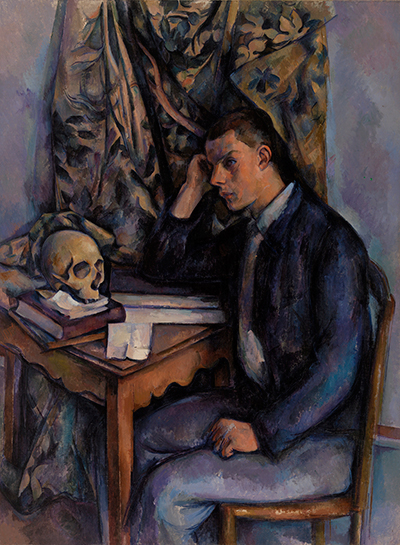
A young man sits beside a small table, his head resting against one hand. On the tabletop, a human skull faces into the room from a pile of books. The two heads occupy a single interior, yet neither quite answers the other. Cézanne gives the living face a downward tilt and the skull a pale, forward thrust; a little space between them becomes the painting’s most charged interval.
The Barnes Foundation titles this painting Young Man and Skull and dates it 1896–98. The catalogue lists it as Jeune homme à la tête de mort , FWN 693. [1] [2]
At about 130 by 97.5 centimetres, the canvas has room for a sustained encounter. Cézanne gives the figure, furniture, drapery and skull a shared space rather than isolating a small emblem. [2]
At a Glance
- Artist Paul Cézanne. [1]
- Date 1896–98 in the current catalogue and Barnes record; historical estimates differ. [1] [2]
- Medium and size Oil on canvas, 130 × 97.5 cm (51 3/16 × 38 3/8 in.). [1]
- Collection Barnes Foundation, Philadelphia, BF929. [2]
- Sitter Unidentified in the current catalogue. [1]
This work across Paul Cézanne’s career
The Kiss of the Muse
c.1860The Artist’s Father, Reading L’Événement
autumn 1866The Hanged Man’s House
c.1873A Modern Olympia
1873–74Maincy Bridge
1879–80The Blue Vase
1889–90The Basket of Apples
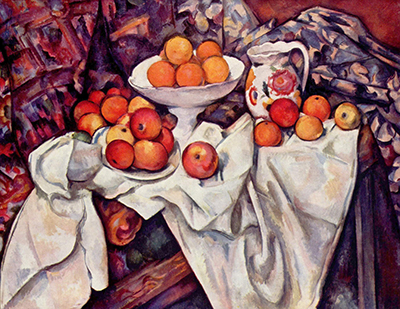
c.1893Apples and Oranges
c.1899The Large Bathers (Philadelphia)
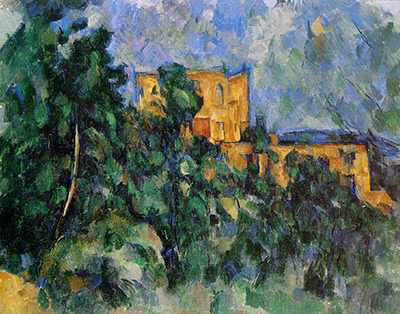
1900–1906 (Philadelphia Museum dating)Château Noir (MoMA)
1903–04Contents
- A figure held within an interior
- A title that guides, but does not settle, the reading
- Colour makes the encounter visible
- Skulls, memory and a disputed date
- From dealers to the Barnes Foundation
A figure held within an interior
The young man fills the right half of the canvas. His dark jacket forms a nearly continuous mass from shoulder to elbow, while pale trousers turn that mass outward at the knees. He is seated, but the angled forearm lifts the eye back to his face. One hand supports the side of his head; the other closes loosely over his lap. These two hands do different work in the composition. The raised arm makes a triangular shelter around the face, while the lower hand anchors the body to the chair.
Look at how tightly Cézanne packs the left half. The skull sits on books close to the table’s edge. A small pale paper lies nearer the man, on a darker section of tabletop. The table legs and the chair legs descend into the lower part of the canvas, where they compete with the broad pale shapes of his trousers. Nothing here is a neutral accessory. Each object establishes a different route through the picture: skull to face, books to paper, tabletop to resting hand. The eye can make those journeys, although the sitter’s own gaze does not trace any one of them with certainty.
The backdrop complicates the room further. A large patterned cloth hangs behind the young man and occupies much of the upper left; its brown, blue and ochre folds climb over his head. At the far right, a plain cooler wall opens a narrow strip of space. This contrast gives the figure two kinds of setting at once. The drapery crowds his shoulder and the back of his head, while the bare wall lets the outside edge of the dark coat read clearly. The sitter appears enclosed without being flattened into a silhouette.
Nor do the objects settle into one consistent depth. The skull projects beyond the book edges, the table turns sharply toward us, and the young man’s knees advance still farther. The paper seems close enough for him to pick up, but his hand remains at his face. These choices make the room feel both physically specific and carefully arranged. The table is a stage within a stage, while the chair gives the body an everyday weight that a purely allegorical figure might lack.
A title that guides, but does not settle, the reading
Vollard’s stockbooks record both a descriptive title and L’apprenti philosophe (“The Apprentice Philosopher”). The latter appeared at Vollard’s 1910 exhibition; Reber’s German exhibitions used “The Young Philosopher.” MoMA’s 1929 exhibition called it Boy with a Skull . [1]
Joachim Gasquet, writing years after the painting was made, called it Jeune homme et la Mort (“Young Man and Death”) and remembered that Cézanne liked the work. He described the model as a farmer’s son. Those are valuable recollections from someone who knew the artist, but they are not a surviving statement by Cézanne about the painting’s meaning. [3]
The current catalogue still lists the sitter as unidentified. [1]
One later account supplies another possible family connection without naming the boy. A Christie’s catalogue essay reports that Cézanne’s son told John Rewald the woman in Woman with a Coffee Pot was the mother of the adolescent model for Young Man and Skull . That report may help place the sitter among Cézanne’s working household or local models, but it does not establish his name or confirm the farmer’s-son description. [4]
Colour makes the encounter visible
Pavel Machotka argued that the work’s apparent philosophical subject can overshadow its colour in monochrome reproduction. Seeing the original, he found the dark blue jacket, mustard tones and warm flesh colours more vivid than the emblematic reading had led him to expect. He also described the many diagonals bound into the vertical and horizontal framework. His account is a reminder that the mortality reading has always had to coexist with the painting’s sensuous, constructed surface. [5]
Across the face, the brushwork is especially restless. Short shifts of red, tan and blue define a cheek, brow and temple without closing them in a single smooth outline. The skull, by comparison, is built from rounded light planes and dark openings. It is startling how much both heads depend on similar kinds of painted interruption: eye sockets, cheekbones and edges that emerge through adjacent strokes. The comparison is visual rather than literal. One head belongs to a person holding a pose; the other is an object placed on books.
Skulls, memory and a disputed date
Theodore Reff placed this figure painting beside Cézanne’s later skull still lifes and compared the seated young man, books and skull to a modern Saint Jerome. The comparison opens a historical tradition of contemplation, though this canvas has no saintly attribute that would turn the sitter into Jerome himself. Reff also used the painting to connect Cézanne’s figure work with his repeated treatment of skulls as painted objects. [6]
The skull can readily suggest mortality, and the books can suggest reflection or study. Yet the painting supplies no inscription, hourglass or action that would tell us exactly what the boy is thinking. He looks downward rather than dramatically confronting the skull. Even the distance between them matters: the skull is close on the table, but it does not touch him. A reading of youthful life placed beside death remains persuasive as an interpretation of the arrangement, not a transcription of Cézanne’s stated intention. [6]
The current catalogue gives 1896–98 and records an archival photograph annotated “1897” by Cézanne’s son. Venturi proposed 1894–96, then revised that to 1897–1900; Rivière proposed 1895. A 1925 exhibition even labelled the picture 1890. [1]
The Barnes also uses 1896–98. Taken together, these records make that a considered date rather than an exact moment of completion. [2]
From dealers to the Barnes Foundation
Paris dealers, Prince de Wagram and Reber preceded Barnes ownership in 1933. Reber lent it to MoMA in 1929; it traveled again in 1993–95. Some transfers remain uncertain. [1]
The 1993 tour belonged to an unusual moment in the collection’s history. The National Gallery of Art describes it as the first Barnes loan exhibition, made possible by a court ruling while the original building underwent renovation. Eighty French paintings traveled, with permission to raise funds for improvements to the gallery. Washington’s presentation ran from May to August 1993 before the international itinerary continued. [7]
Cézanne artworks directory
Browse 217 identified works in this researched selection, including paintings, drawings and watercolours. This is a bounded selection, not a complete catalogue of Cézanne’s surviving oeuvre. Unlinked titles have no confirmed article in this collection.
| Name | Date | Medium |
|---|---|---|
| A Head, a Cup, and a Bread Roll | 1891/1894 | Drawing |
| A Man seen from Behind | 1880/1883 | Drawing |
| A Modern Olympia | 1873–74 | Painting |
| A Nude and Foliage | 1879/1882 | Drawing |
| A Smoking Man | 1892–96 (catalogue); c.1890–92 (museum) | Drawing |
| Afternoon in Naples | 1876–77 | Painting |
| An Old Woman with a Rosary | about 1895–96 | Painting |
| Apples and Oranges | c.1899 | Painting |
| Auvers, Panoramic View | 1873–75 | Painting |
| Avenue at Chantilly | 1888 | Painting |
| Banks of the Marne | 1888–94 | Painting |
| Basket | 1877/1900 | Drawing |
| Bather with Outstretched Arms | 1877–78 | Painting |
| Bellows in Front of a Fireplace | 1887/1892 | Drawing |
| Bibémus Quarry | c.1895 | Painting |
| Boy in a Red Vest, Barnes Foundation | 1888–90 | Painting |
| Boy in a Red Vest, MoMA | 1888–90 | Painting |
| Boy in a Red Waistcoat, National Gallery of Art | 1888–90 | Painting |
| Branch in Flower | 1886/1889 | Drawing |
| Carnival Scene | 1885/1888 | Drawing |
| Chair and Dresser | 1880/1883 | Drawing |
| Chateau Noir | 1903–04 | Painting |
| Chestnut Trees and Farm at Jas de Bouffan | c.1885 | Painting |
| Chestnut Trees and Farm at Jas de Bouffan, Pushkin | c.1886 | Painting |
| Chestnut Trees at Jas de Bouffan in Winter | 1885–86 | Painting |
| Château Noir | 1900–04 | Painting |
| Cistern in the Park of Château Noir | c.1900 | Painting |
| Curtain, Jug and Fruit | 1893–94 | Painting |
| Cushion of an Armchair | 1886/1889 | Drawing |
| Draft Letter and Studies of Bathers | c.1878 | Drawing |
| Farmhouse and Chestnut Trees at Jas de Bouffan | 1884–85 | Painting |
| Figure Resting Head on Hand | c. 1889 | Drawing |
| Fireplace Tongs and Poker | 1887/1892 | Drawing |
| Forest Interior, San Francisco | c.1898–99 | Painting |
| Four Bathers | 1888–90 | Painting |
| Fruit and a Jug on a Table | 1893–94 | Painting |
| Gardanne | 1885–86 | Painting |
| Gardanne, Barnes Foundation | c.1885 | Painting |
| Hand and Shoulder of a Boy | c. 1885 | Drawing |
| Harlequin, National Gallery of Art | 1888–90 | Painting |
| Head of a Boy | 1887/1889 | Drawing |
| Head of a Boy Seen from Behind | c. 1885 | Drawing |
| Head of a Young Woman | c. 1880 | Drawing |
| Head of the Artist's Son | 1888/1889 | Drawing |
| Hillside in Provence | c.1890–92 | Painting |
| Horse Chestnut Trees at Jas de Bouffan | c.1885 | Painting |
| House and Farm at the Jas de Bouffan | c.1887 | Painting |
| House in a Park | 1883/1886 | Drawing |
| House in Provence | c.1885 | Painting |
| House of Père Lacroix | 1873 | Painting |
| House Surrounded by Vegetation | 1889/1892 | Drawing |
| Houses in Provence The Riaux Valley near L’Estaque | c.1883 | Painting |
| Jas de Bouffan, the Pool | c.1876 | Painting |
| Kerosene Lamp | 1878/1881 | Drawing |
| L'Estaque, Melting Snow | c.1870 | Painting |
| Lake Annecy | 1896 | Painting |
| Landscape in Provence, Pola Museum | 1879–82 | Painting |
| Landscape Near Aix-en-Provence | 1877/1880 | Drawing |
| Landscape Seen from the Inside of a Cave | 1889/1892 | Drawing |
| Landscape with Poplars | c.1885–87 | Painting |
| Landscape with Trees | 1895/1898 | Drawing |
| Leda and the Swan | c.1880 (possibly later) | Painting |
| Little Girl with a Doll | 1902–04 | Painting |
| Louis Guillaume | 1879–1890 | Painting |
| Madame Cezanne | 1888/1891 | Drawing |
| Madame Cezanne | 1886/1889 | Drawing |
| Madame Cezanne | 1882/1887 | Drawing |
| Madame Cezanne | 1897/1900 | Drawing |
| Madame Cezanne with her Head Lowered | 1893/1896 | Drawing |
| Madame Cézanne in a Red Armchair | c.1877 | Painting |
| Madame Cézanne in a Red Dress, Metropolitan Museum of Art | 1888–90 | Painting |
| Madame Cézanne in a Yellow Chair | 1888–90 | Painting |
| Madame Cézanne in a Yellow Chair, Fondation Beyeler | 1888–90 | Painting |
| Madame Cézanne in the Conservatory | 1891 | Painting |
| Maincy Bridge | 1879–80 | Painting |
| Maison Maria with a View of Château Noir | c.1895 | Painting |
| Man Bending Forward | 1883/1886 | Drawing |
| Man Smoking a Pipe, Pushkin | c.1891, possibly later | Painting |
| Man with a Pipe | 1891–96 | Painting |
| Man with a Pipe, Nelson-Atkins | 1890–92 | Painting |
| Man with a Straw Hat (Gustave Boyer) | c.1871 | Painting |
| Man with Crossed Arms | c.1899 | Painting |
| Man with Pipe, National Gallery of Art | 1892–96 | Painting |
| Mont Sainte-Victoire | c.1902–06 | Painting |
| Mont Sainte-Victoire | 1900–02 | Painting |
| Mont Sainte-Victoire (recto) | c.1895 | Watercolour |
| Mont Sainte-Victoire and the Viaduct of the Arc River Valley | 1882–85 | Painting |
| Mont Sainte-Victoire Seen beyond the Wall of the Jas de Bouffan | c.1885/1888 | Watercolour |
| Mont Sainte-Victoire Seen from Bibémus Quarry | c.1897 | Painting |
| Mont Sainte-Victoire, Barnes Foundation | 1892–95 | Painting |
| Near the Pool at Jas de Bouffan | 1883/1887 | Drawing |
| Pelicans | 1877/1880 | Drawing |
| Peonies | 1890/1893 | Drawing |
| Pierrot and Harlequin | 1888 | Painting |
| Pine Tree | 1882/1885 | Drawing |
| Pont des Trois Sautets | 1906 | Watercolour |
| Poplars | 1879–80 | Painting |
| Portrait of Ambroise Vollard | 1899 | Painting |
| Portrait of Gustave Geffroy | 1895–96 | Painting |
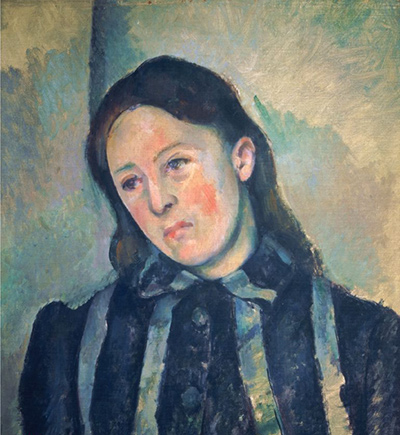
| Portrait of Madame Cezanne with Loosened Hair | 1885–86 | Painting |
| Portrait of the Artist Looking Over His Shoulder | 1883–84 | Painting |
| Portrait of the Gardener Vallier | 1906 | Painting |
| Portrait of Victor Chocquet | 1876–77 | Painting |
| Portrait Of Victor Chocquet Seated | 1877 | Painting |
| Provençal Manor | c.1885 | Painting |
| Pyramid of Skulls | 1898–1900 | Painting |
| Reclining Nude (Leda?) | c.1887 | Painting |
| Scipio | 1866–68 | Painting |
| Seated Man, Oslo | 1898–1900 | Painting |
| Seated Peasant | c.1892–96 | Painting |
| Seated Peasant, Hiroshima | c.1897 | Painting |
| Seated Peasant, Orsay | c.1900 | Painting |
| Self-Portrait | c. 1895 | Drawing |
| Self-Portrait in a Bowler Hat, Ny Carlsberg Glyptotek | 1885–86 | Painting |
| Self-Portrait in a Casquette | c.1875 | Painting |
| Self-Portrait with a Beret | 1898–1900 | Painting |
| Self-Portrait with a Hat, Artizon Museum | c.1890–94 | Painting |
| Self-Portrait with a Pink Background | c.1875 | Painting |
| Self-Portrait with Olive-Coloured Wallpaper | about 1880–81 | Painting |
| Self-Portrait with Palette | 1886–87 | Painting |
| Self-Portrait with White Turban | c.1878–80 | Painting |
| Self-Portrait, c.1895 | c.1895 | Painting |
| Self-Portrait, Pushkin Museum | c.1882 | Painting |
| Spanish Dancers | 1883/1886 | Drawing |
| Still Life with a Curtain | 1892–94 | Painting |
| Still Life with Apples | c.1890 | Painting |
| Still Life with Apples | 1893–94 | Painting |
| Still Life with Apples and a Pot of Primroses | about 1890 | Painting |
| Still Life with Milk Jug and Fruit | c.1900 | Painting |
| Still Life with Open Drawer | 1877–79 | Painting |
| Still Life with Plaster Cupid | about 1894 | Painting |
| Still Life with Skull | 1890–93 | Painting |
| Still Life with Soup Tureen | 1877 | Painting |
| Still Life, Pitcher and Fruit | 1893–94 | Painting |
| Studies Including a Straw Hat | 1895/1898 | Drawing |
| Studies Including Madame Cezanne | 1884/1887 | Drawing |
| Study for "The Judgement of Paris" or "The Amorous Shepherd" | 1883/1886 | Drawing |
| Study for Woman with a Coffee Pot | c.1895 | Painting |
| Study of "The Roman Orator (Germanicus)" | 1883/1886 | Drawing |
| Study of "Venus de Milo" | 1881/1884 | Drawing |
| Study of a Decorative Ornament | 1879/1882 | Drawing |
| Study of a Standing Male Figure after the Antique | c. 1895 | Drawing |
| Study of an Angel in Rubens' "The Prophet Elijah" | 1892/1895 | Drawing |
| Study of Desiderio da Settignano's "Bust of a Child" | c. 1895 | Drawing |
| Study of Houses | 1879/1882 | Drawing |
| Study of Puget's "Hercules Resting" | c. 1879 | Drawing |
| Study of Puget's "Milo of Crotona" | 1895/1898 | Drawing |
| Study of Puget's "Milo of Crotona" | 1880/1883 | Drawing |
| Study of the Allegorical Figure Bellona in Rubens' "The Apotheosis of Henri IV" | 1883/1886 | Drawing |
| Study of the Allegorical Figure Bellona in Rubens' "The Apotheosis of Henri IV" | 1879/1882 | Drawing |
| Study of the Allegorical Figure France in Rubens' "The Exchange of the Two Princesses" | 1882/1885 | Drawing |
| Study of the Allegorical Figure of Health in Rubens' "The Birth of Louis XIII" | 1880/1883 | Drawing |
| Study of the Allegorical Figure of the Genius of Health from Rubens' "The Birth of Louis XIII at Fontainbleau" | 1895/1898 | Drawing |
| Sugar Bowl, Pears and Blue Cup | 1865–66 | Painting |
| The Aqueduct, Pushkin Museum | Dating differs between museum records | Painting |
| The Artist's Father, Reading L'Evenement | autumn 1866 | Painting |
| The Artist's Son | c. 1887 | Drawing |
| The Artist's Son Leaning on his Elbow | c. 1887 | Drawing |
| The Artist's Son Reading | c. 1887 | Drawing |
| The Artist's Son Writing | c. 1887 | Drawing |
| The Artist’s Son, Paul | 1886–87 | Painting |
| The Avenue at Jas de Bouffan | 1868–70 (possibly later) | Painting |
| The Avenue at Jas de Bouffan, Geneva | c.1890 | Painting |
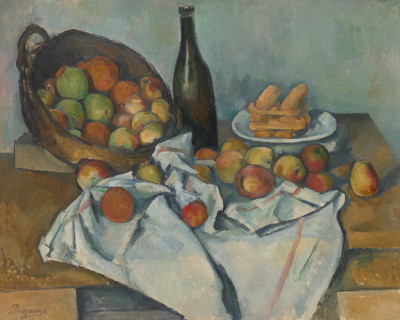
| The Basket of Apples | c.1893 | Painting |
| The Bather, Museum of Modern Art | c.1885 | Painting |
| The Bay of Marseille seen from L'Estaque | c.1885 | Painting |
| The Blue Vase | 1889–90 | Painting |
| The Boy in the Red Vest, Bührle | 1888–90 | Painting |
| The Buffet | 1877–79 | Painting |
| The Card Players, Barnes Foundation | 1890–92 | Painting |
| The Card Players, Courtauld Gallery | 1892–96 | Painting |
| The Card Players, Metropolitan Museum of Art | 1890–92 | Painting |
| The Card Players, Musée d’Orsay | 1893–96 | Painting |
| The Card Players, Qatar | 1892–96 | Painting |
| The Eternal Feminine | c.1877 | Painting |
| The Gardener Vallier | 1906 | Painting |
| The Gardener Vallier, Tate | 1905–06 | Painting |
| The Grounds of the Château Noir | c.1900–04 | Painting |
| The Gulf of Marseille Seen from L’Estaque | c.1885 | Painting |
| The Hanged Man's House in Auvers | c.1873 | Painting |
| The House of Doctor Gachet at Auvers | 1872–73 | Painting |
| The House with the Cracked Walls | 1892–94 | Painting |
| The Kiss of the Muse | c.1860 | Painting |
| The Large Bathers, Barnes Foundation | 1895–1906 | Painting |
| The Large Bathers, National Gallery | 1895–1905 | Painting |
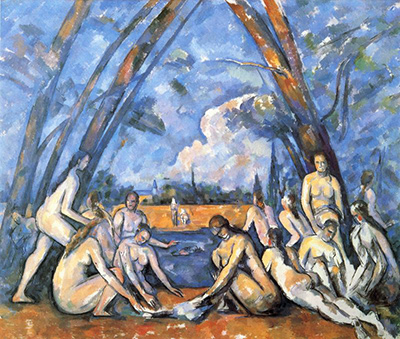
| The Large Bathers, Philadelphia Museum of Art | 1900–06 | Painting |
| The Mill | 1889/1892 | Drawing |
| The Painter’s Father, Louis-Auguste Cézanne | c.1865 | Painting |
| The Peasant | 1890–92 | Painting |
| The Plaster Mill (La Moulin à plâtre) | 1889/1892 | Drawing |
| The Smoker, Hermitage | c.1891 | Painting |
| The Smoker, Mannheim | c.1891 | Painting |
| The Stove in the Studio | c.1865 | Painting |
| The Vase of Tulips | c.1890 | Painting |
| Thistle | 1893/1896 | Drawing |
| Three Heads, One of Madame Cezanne | 1882/1885 | Drawing |
| Three Skulls | c.1898 | Painting |
| Three Skulls on a Patterned Carpet | 1904 | Painting |
| Trees and Shrubs | 1883/1887 | Drawing |
| Turning Road at Montgeroult | 1898 | Painting |
| Two Bathers | 1884/1887 | Drawing |
| Two Heads | 1888 | Drawing |
| Two Heads | 1890/1896 | Drawing |
| Two Heads of Women | 1890/1894 | Drawing |
| Two Studies for "The Judgement of Paris" or "The Amorous Shepherd" | 1883/1886 | Drawing |
| Uncle Dominique in a Tasseled Cap | 1866 | Painting |
| Uncle Dominique in a Turban | 1866–67 | Painting |
| Victor Chocquet and an Angel for "The Apotheosis of Delacroix" | 1878/1880 | Drawing |
| Woman in Blue | c.1904 | Painting |
| Woman Leaning Forward | 1888/1891 | Drawing |
| Woman Leaning Forward | 1890/1894 | Drawing |
| Woman Leaning Forward | 1890/1894 | Drawing |
| Woman with a Coffee Pot | c.1895 | Painting |
| Women Bathers and a Roll of Paper | 1882/1885 | Drawing |
| Young Girl with a Doll | c.1895 | Painting |
| Young Italian Woman at a Table | c.1895–1900 | Painting |
| Young Man and Skull | 1896–98 | Painting |
Frequently Asked Questions
It belongs to the Barnes Foundation in Philadelphia, accession BF929. [2]
Discussion
Look again at the images and ideas explored in Young Man and Skull by Paul Cézanne. These editorial prompts invite your observations.
Reader Insights
Begin with the distance between the boy’s face and the skull. Does his lowered gaze connect him to it, or draw him toward something else on the table?
Follow the blues from jacket to trousers and drapery, then the warm tones from skull to tabletop and face. Where does the colour make separate things feel related?
Consider the old titles The Apprentice Philosopher and Boy with a Skull. Which title changes your reading most, and which details of the painting resist it?
Join the Conversation
Share a detail, comparison or question about Young Man and Skull by Paul Cézanne below.
References
- The Paintings, Watercolors and Drawings of Paul Cezanne: An Online Catalogue Raisonné. “Jeune homme à la tête de mort,” FWN 693, catalogue entry. View source .
- Barnes Foundation. “Young Man and Skull (Jeune homme à la tête de mort),” collection record, BF929. View source .
- Joachim Gasquet. Cézanne (1921; 1926 edition), pp. 29–31, excerpt reproduced by Société Cézanne (in French). View source .
- Christie’s. “Paul Cézanne, Portrait de femme,” sale catalogue essay, reporting Cézanne’s son’s account through John Rewald. View source .
- Pavel Machotka. Cézanne: The Eye and the Mind (2008), excerpt reproduced by Société Cézanne in “Jeune homme à la tête de mort, 1896–1898” (2017; French and English). View source .
- Theodore Reff. “Painting and Theory in the Final Decade,” in Cézanne: The Late Work , Museum of Modern Art exhibition catalogue (1977), pp. 32–33 and plate 8. View source .
- National Gallery of Art. “Great French Paintings from the Barnes Foundation,” 1993 exhibition history. View source .
- Le Baiser de la muse, d'après Frillié (FWN 572). View source.
- Louis-Auguste Cezanne, père de l'artiste, lisant L'Événement (FWN 402). View source.
- La Maison du pendu, Auvers-sur-Oise (FWN 81). View source.
- Une moderne Olympia (FWN 628). View source.
- Le Pont de Maincy (FWN 143). View source.
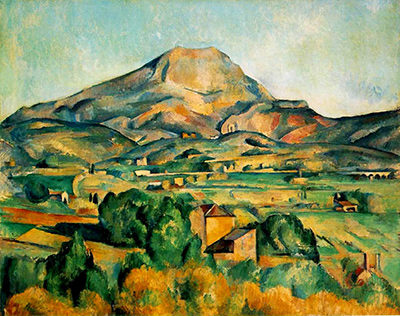
- La Montagne Sainte-Victoire vue de Montbriand (FWN 185). View source.
- Gardanne (vue horizontale) (FWN 224). View source.
- Le Vase bleu (FWN 823). View source.
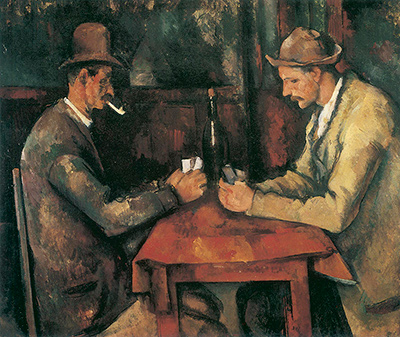
- Les Joueurs de cartes (FWN 681). View source.
- La Montagne Sainte-Victoire (FWN 296). View source.
- La Corbeille de pommes (FWN 860). View source.
- Pommes et oranges (FWN 871). View source.
- Portrait d'Ambroise Vollard (FWN 531). View source.
- Philadelphia Museum of Art,The Large Bathers,W1937-1-1. View source.
- Château Noir (FWN 360). View source.
- Société Paul Cezanne,online catalogue structure and objectidentification. View source.
- National Gallery of Art,Cezanne Sketchbook,1992.51.9. View source.
- Splash image, A seated young man rests his head on one hand beside a skull and books.