Qatar Paul Cezanne.jpg)
 by
Tom Gurney
Tom Gurney BSc (Hons) is an art history expert with over 20 years experience
Published on June 19, 2020 / Updated on October 22, 2026
Email:
tomgurney1@gmail.com
/ Phone:
+44 7429 011000
The Card Players: Cézanne’s Large Two-Player Canvas: Introduction
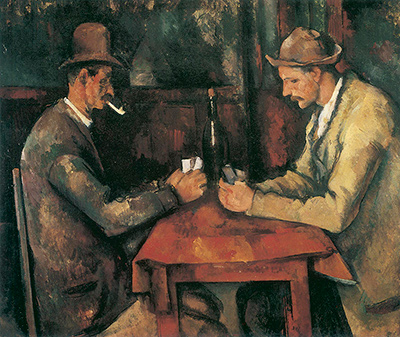
Two men sit close enough to share a narrow table, yet each remains absorbed in the cards in his own hand. Between them a dark bottle rises against the dark wall. This is the largest of Cézanne’s three paintings that reduce The Card Players to a pair of seated figures.
FWN 685 is catalogued in Qatar, dated 1892–96; Rewald preferred 1892–93. [1]
The picture rewards attention as a particular arrangement, rather than as a substitute for the better-known canvases in Paris or London. Here the players’ hats approach the upper edge, their bodies occupy almost the entire width, and the table presses toward us. Across that dense arrangement Cézanne sets the bright cards and faces against a room so dark that its divisions emerge slowly. The result is intimate in subject yet expansive in scale: a quiet game becomes an event that fills a broad canvas.
At a Glance
- Artist Paul Cézanne.
- Title Les Joueurs de cartes ( The Card Players ).
- Date 1892–96. [1]
- Medium and size Oil on canvas, 97 × 130 cm. [1]
- Catalogue identity FWN 685. [1]
- Collection Private, Qatar. [1]
This work across Paul Cézanne’s career
The Kiss of the Muse
c.1860The Artist’s Father, Reading L’Événement
autumn 1866The Hanged Man’s House
c.1873A Modern Olympia
1873–74Maincy Bridge
1879–80The Blue Vase
1889–90The Basket of Apples
c.1893Apples and Oranges
c.1899The Large Bathers (Philadelphia)
1900–1906 (Philadelphia Museum dating)Château Noir (MoMA)
1903–04Contents
- A Game Held Between Two Bodies
- The Table and the Dark Room
- One of Five, with Its Own Scale
- Models, Cards and a Constructed Encounter
- From Pellerin’s Collection
A Game Held Between Two Bodies
The left player occupies the foreground with his back and coat. His dark hat projects over his face, while a pale pipe cuts diagonally from his mouth into the space between the men. Opposite him, the right player is fully lit: a russet face, dark moustache and large light coat make his lowered gaze legible at once. Neither looks across the table. The dramatic line of sight runs instead from each face down to a small fan of cards. Their hands sit unusually close to the centre of the image, so the activity can be recognised before any card face can be read.
At left the few exposed cards flash red and blue marks against white. At right the pack is seen largely from behind as a pale, bluish bundle. This difference makes the players unequal to the viewer. We see a trace of one hand’s faces, but no complete account of the game; the other hand withholds even more. A spectator can inspect the arrangement without joining the players’ knowledge. Cézanne makes that gap between looking and knowing part of the ordinary scene.
The forearms form a loose frame around the bottle, yet its neck is not a tidy dividing rule. It rises from near the back of the table and nearly disappears into the wall before a pale stopper arrests it. The player at left leans inward through the pipe and cards; the figure at right gathers his arms and coat into a broad wedge. Their poses meet at the table but do not mirror one another. That imperfect balance gives the composition its stillness without freezing it into a diagram.
Nothing in the visible cards securely names the game or its stakes. There is no clear winning gesture, exchange of money or spectator to tell us how the hand ends. The men’s concentration is painted through their posture and downward looks, not through an illustrated episode. We can attend to a moment without claiming to know what happens next.
The Table and the Dark Room
The tabletop is a conspicuous patch of hot orange and red. It broadens toward the viewer, while its rear edge lies between the two hands. A darker front rail makes the structure feel weighty, but the surface also reads as a large, nearly flat field of colour. The table therefore does two jobs at once: it is a plausible place for cards and a shape that organises much of the canvas. Its projecting front corners pull our eyes outward even as the hands draw them back to the centre.
Behind the players, panels and vertical divisions are visible in browns, black and grey. A pale rectangular interruption near the bottle and a reddish horizontal strip keep the background from becoming a blank void. Yet the room is difficult to reconstruct. Dark coat meets dark wall at left; the right figure’s pale sleeve stands out so strongly that it seems to advance from the surrounding space. The players are seated somewhere, but Cézanne gives the setting fewer clues than the bodies and the table.
The colours also refuse a simple split into warm foreground and cool background. The left figure’s blue-grey coat carries small warm touches; the right coat, apparently cream, contains violet and grey strokes. Oranges return in both faces and across the table. These echoes knit the figures to the furniture while allowing each player a different visual weight. The cream coat carries enough cool colour to echo the darker jacket opposite, while their different brightness keeps the two bodies distinct.
The chairs nearly vanish beneath their occupants. At the lower edge, the table’s open support and the players’ legs compete for a tight space. That compression matters. A larger floor or a visible doorway would release the scene into a story about a place. Here almost every available area is claimed by a person, an object, or the dark plane directly behind them. The mundane pastime consequently has the scale and pressure of a formal encounter.
One of Five, with Its Own Scale
Of five major card-player canvases, the Barnes version has five figures and the Met’s has four. Orsay’s paired canvas measures 47 × 56.5 cm; the Courtauld’s, 60 × 73 cm. This one measures 97 × 130 cm. [2] [3] [4] [5]
That size change alters the experience of essentially the same subject. The two figures here approach life size and dominate the wide field. A sleeve becomes a large pale mass rather than a small tonal accent, and the table can expand across the lower centre while remaining within the reach of both hands.
The paired pictures should not be collapsed into interchangeable copies. In this version, the broad warm table and the right player’s pale coat hold their own against the dark interior. Its visible architecture is more assertive than a neutral backdrop, even though it remains hard to map as a real room. These are differences one can use to recognise the Qatar canvas; they do not, by themselves, prove whether it was painted before or after its smaller companions.
That order remains debated. Barnaby Wright reports a technical-research proposal in which the Orsay picture precedes the Courtauld and the larger private canvas follows. T. J. Clark proposes the former Pellerin picture—this canvas—as the first of the three paired works. He calls his wider sequence hypothetical and warns that his impression of this privately held painting depends on reproductions. [5] [6]
The disagreement matters because a progression from small to large is tempting to read directly from the canvases’ sizes. It may be right, but dimensions alone cannot supply a calendar. One can compare how Cézanne varied the arrangement without making any one painting the inevitable finish of an experiment.
Models, Cards and a Constructed Encounter
The subject grew from Cézanne’s sustained work with people from the Jas de Bouffan estate near Aix. The Courtauld’s account links the card-player series to studies of individual farm workers and notes a contemporary 1891 report from Paul Alexis that a worker was sitting for Cézanne. That report establishes activity around this subject, not the making date of this specific canvas or a complete list of its sitters. [5]
The online catalogue indexes Paulin Paulet and an unidentified sitter for this canvas. [1]
That record does not turn the two visible heads into a fully documented pair of named portraits. The distinction matters because these five paintings transform studied individuals into arrangements of bodies, cards and furniture. The models are part of the work’s history, while the painting’s exact social setting and the game being played remain harder to recover.
Art historian André Dombrowski has proposed that playing cards offered Cézanne a compact problem of picture making: flat printed objects handled in a space of bodies and depth. In this canvas that thought has a tangible foothold. The fanned cards are tiny painted planes, the hands give them thickness and use, and the broad tabletop offers another surface tilted toward our own view. This is an interpretive way to look, not evidence of a statement Cézanne made about his intention. [7]
The picture’s social charge is equally quiet. Work clothes, hats and pipe locate the men far from a fashionable salon, but the image offers no comic mishap, drunken flourish or moral verdict. Their labouring lives are not narrated through an invented incident. Instead the pose holds long enough for a viewer to see how two people occupy a shared piece of space while guarding different information in their hands.
From Pellerin’s Collection
The catalogue traces Vollard and Bernheim-Jeune, the Pellerins and George Embiricos before Qatar. It lists Paris exhibitions in 1907, 1910, 1926 and 1936. [1]
The 2010–11 Courtauld and Metropolitan Museum exhibition catalogued this painting without showing it. [1]
That distinction helps explain why scholars can compare the recorded dimensions and image closely while qualifying judgements that depend on seeing the actual painted surface. [6]
This version gives the two-player design room to expand: hands and cards remain a tiny centre of attention, while coats, hats, table and shadowed panels fill a canvas wider than a person’s reach. The ordinary game becomes a sustained negotiation between closeness and distance, shared action and separate thought.
Cézanne artworks directory
Browse 217 identified works in this researched selection, including paintings, drawings and watercolours. This is a bounded selection, not a complete catalogue of Cézanne’s surviving oeuvre. Unlinked titles have no confirmed article in this collection.
| Name | Date | Medium |
|---|---|---|
| A Head, a Cup, and a Bread Roll | 1891/1894 | Drawing |
| A Man seen from Behind | 1880/1883 | Drawing |
| A Modern Olympia | 1873–74 | Painting |
| A Nude and Foliage | 1879/1882 | Drawing |
| A Smoking Man | 1892–96 (catalogue); c.1890–92 (museum) | Drawing |
| Afternoon in Naples | 1876–77 | Painting |
| An Old Woman with a Rosary | about 1895–96 | Painting |
| Apples and Oranges | c.1899 | Painting |
| Auvers, Panoramic View | 1873–75 | Painting |
| Avenue at Chantilly | 1888 | Painting |
| Banks of the Marne | 1888–94 | Painting |
| Basket | 1877/1900 | Drawing |
| Bather with Outstretched Arms | 1877–78 | Painting |
| Bellows in Front of a Fireplace | 1887/1892 | Drawing |
| Bibémus Quarry | c.1895 | Painting |
| Boy in a Red Vest, Barnes Foundation | 1888–90 | Painting |
| Boy in a Red Vest, MoMA | 1888–90 | Painting |
| Boy in a Red Waistcoat, National Gallery of Art | 1888–90 | Painting |
| Branch in Flower | 1886/1889 | Drawing |
| Carnival Scene | 1885/1888 | Drawing |
| Chair and Dresser | 1880/1883 | Drawing |
| Chateau Noir | 1903–04 | Painting |
| Chestnut Trees and Farm at Jas de Bouffan | c.1885 | Painting |
| Chestnut Trees and Farm at Jas de Bouffan, Pushkin | c.1886 | Painting |
| Chestnut Trees at Jas de Bouffan in Winter | 1885–86 | Painting |
| Château Noir | 1900–04 | Painting |
| Cistern in the Park of Château Noir | c.1900 | Painting |
| Curtain, Jug and Fruit | 1893–94 | Painting |
| Cushion of an Armchair | 1886/1889 | Drawing |
| Draft Letter and Studies of Bathers | c.1878 | Drawing |
| Farmhouse and Chestnut Trees at Jas de Bouffan | 1884–85 | Painting |
| Figure Resting Head on Hand | c. 1889 | Drawing |
| Fireplace Tongs and Poker | 1887/1892 | Drawing |
| Forest Interior, San Francisco | c.1898–99 | Painting |
| Four Bathers | 1888–90 | Painting |
| Fruit and a Jug on a Table | 1893–94 | Painting |
| Gardanne | 1885–86 | Painting |
| Gardanne, Barnes Foundation | c.1885 | Painting |
| Hand and Shoulder of a Boy | c. 1885 | Drawing |
| Harlequin, National Gallery of Art | 1888–90 | Painting |
| Head of a Boy | 1887/1889 | Drawing |
| Head of a Boy Seen from Behind | c. 1885 | Drawing |
| Head of a Young Woman | c. 1880 | Drawing |
| Head of the Artist's Son | 1888/1889 | Drawing |
| Hillside in Provence | c.1890–92 | Painting |
| Horse Chestnut Trees at Jas de Bouffan | c.1885 | Painting |
| House and Farm at the Jas de Bouffan | c.1887 | Painting |
| House in a Park | 1883/1886 | Drawing |
| House in Provence | c.1885 | Painting |
| House of Père Lacroix | 1873 | Painting |
| House Surrounded by Vegetation | 1889/1892 | Drawing |
| Houses in Provence The Riaux Valley near L’Estaque | c.1883 | Painting |
| Jas de Bouffan, the Pool | c.1876 | Painting |
| Kerosene Lamp | 1878/1881 | Drawing |
| L'Estaque, Melting Snow | c.1870 | Painting |
| Lake Annecy | 1896 | Painting |
| Landscape in Provence, Pola Museum | 1879–82 | Painting |
| Landscape Near Aix-en-Provence | 1877/1880 | Drawing |
| Landscape Seen from the Inside of a Cave | 1889/1892 | Drawing |
| Landscape with Poplars | c.1885–87 | Painting |
| Landscape with Trees | 1895/1898 | Drawing |
| Leda and the Swan | c.1880 (possibly later) | Painting |
| Little Girl with a Doll | 1902–04 | Painting |
| Louis Guillaume | 1879–1890 | Painting |
| Madame Cezanne | 1888/1891 | Drawing |
| Madame Cezanne | 1886/1889 | Drawing |
| Madame Cezanne | 1882/1887 | Drawing |
| Madame Cezanne | 1897/1900 | Drawing |
| Madame Cezanne with her Head Lowered | 1893/1896 | Drawing |
| Madame Cézanne in a Red Armchair | c.1877 | Painting |
| Madame Cézanne in a Red Dress, Metropolitan Museum of Art | 1888–90 | Painting |
| Madame Cézanne in a Yellow Chair | 1888–90 | Painting |
| Madame Cézanne in a Yellow Chair, Fondation Beyeler | 1888–90 | Painting |
| Madame Cézanne in the Conservatory | 1891 | Painting |
| Maincy Bridge | 1879–80 | Painting |
| Maison Maria with a View of Château Noir | c.1895 | Painting |
| Man Bending Forward | 1883/1886 | Drawing |
| Man Smoking a Pipe, Pushkin | c.1891, possibly later | Painting |
| Man with a Pipe | 1891–96 | Painting |
| Man with a Pipe, Nelson-Atkins | 1890–92 | Painting |
| Man with a Straw Hat (Gustave Boyer) | c.1871 | Painting |
| Man with Crossed Arms | c.1899 | Painting |
| Man with Pipe, National Gallery of Art | 1892–96 | Painting |
| Mont Sainte-Victoire | c.1902–06 | Painting |
| Mont Sainte-Victoire | 1900–02 | Painting |
| Mont Sainte-Victoire (recto) | c.1895 | Watercolour |
| Mont Sainte-Victoire and the Viaduct of the Arc River Valley | 1882–85 | Painting |
| Mont Sainte-Victoire Seen beyond the Wall of the Jas de Bouffan | c.1885/1888 | Watercolour |
| Mont Sainte-Victoire Seen from Bibémus Quarry | c.1897 | Painting |
| Mont Sainte-Victoire, Barnes Foundation | 1892–95 | Painting |
| Near the Pool at Jas de Bouffan | 1883/1887 | Drawing |
| Pelicans | 1877/1880 | Drawing |
| Peonies | 1890/1893 | Drawing |
| Pierrot and Harlequin | 1888 | Painting |
| Pine Tree | 1882/1885 | Drawing |
| Pont des Trois Sautets | 1906 | Watercolour |
| Poplars | 1879–80 | Painting |
| Portrait of Ambroise Vollard | 1899 | Painting |
| Portrait of Gustave Geffroy | 1895–96 | Painting |
| Portrait of Madame Cezanne with Loosened Hair | 1885–86 | Painting |
| Portrait of the Artist Looking Over His Shoulder | 1883–84 | Painting |
| Portrait of the Gardener Vallier | 1906 | Painting |
| Portrait of Victor Chocquet | 1876–77 | Painting |
| Portrait Of Victor Chocquet Seated | 1877 | Painting |
| Provençal Manor | c.1885 | Painting |
| Pyramid of Skulls | 1898–1900 | Painting |
| Reclining Nude (Leda?) | c.1887 | Painting |
| Scipio | 1866–68 | Painting |
| Seated Man, Oslo | 1898–1900 | Painting |
| Seated Peasant | c.1892–96 | Painting |
| Seated Peasant, Hiroshima | c.1897 | Painting |
| Seated Peasant, Orsay | c.1900 | Painting |
| Self-Portrait | c. 1895 | Drawing |
| Self-Portrait in a Bowler Hat, Ny Carlsberg Glyptotek | 1885–86 | Painting |
| Self-Portrait in a Casquette | c.1875 | Painting |
| Self-Portrait with a Beret | 1898–1900 | Painting |
| Self-Portrait with a Hat, Artizon Museum | c.1890–94 | Painting |
| Self-Portrait with a Pink Background | c.1875 | Painting |
| Self-Portrait with Olive-Coloured Wallpaper | about 1880–81 | Painting |
| Self-Portrait with Palette | 1886–87 | Painting |
| Self-Portrait with White Turban | c.1878–80 | Painting |
| Self-Portrait, c.1895 | c.1895 | Painting |
| Self-Portrait, Pushkin Museum | c.1882 | Painting |
| Spanish Dancers | 1883/1886 | Drawing |
| Still Life with a Curtain | 1892–94 | Painting |
| Still Life with Apples | c.1890 | Painting |
| Still Life with Apples | 1893–94 | Painting |
| Still Life with Apples and a Pot of Primroses | about 1890 | Painting |
| Still Life with Milk Jug and Fruit | c.1900 | Painting |
| Still Life with Open Drawer | 1877–79 | Painting |
| Still Life with Plaster Cupid | about 1894 | Painting |
| Still Life with Skull | 1890–93 | Painting |
| Still Life with Soup Tureen | 1877 | Painting |
| Still Life, Pitcher and Fruit | 1893–94 | Painting |
| Studies Including a Straw Hat | 1895/1898 | Drawing |
| Studies Including Madame Cezanne | 1884/1887 | Drawing |
| Study for "The Judgement of Paris" or "The Amorous Shepherd" | 1883/1886 | Drawing |
| Study for Woman with a Coffee Pot | c.1895 | Painting |
| Study of "The Roman Orator (Germanicus)" | 1883/1886 | Drawing |
| Study of "Venus de Milo" | 1881/1884 | Drawing |
| Study of a Decorative Ornament | 1879/1882 | Drawing |
| Study of a Standing Male Figure after the Antique | c. 1895 | Drawing |
| Study of an Angel in Rubens' "The Prophet Elijah" | 1892/1895 | Drawing |
| Study of Desiderio da Settignano's "Bust of a Child" | c. 1895 | Drawing |
| Study of Houses | 1879/1882 | Drawing |
| Study of Puget's "Hercules Resting" | c. 1879 | Drawing |
| Study of Puget's "Milo of Crotona" | 1895/1898 | Drawing |
| Study of Puget's "Milo of Crotona" | 1880/1883 | Drawing |
| Study of the Allegorical Figure Bellona in Rubens' "The Apotheosis of Henri IV" | 1883/1886 | Drawing |
| Study of the Allegorical Figure Bellona in Rubens' "The Apotheosis of Henri IV" | 1879/1882 | Drawing |
| Study of the Allegorical Figure France in Rubens' "The Exchange of the Two Princesses" | 1882/1885 | Drawing |
| Study of the Allegorical Figure of Health in Rubens' "The Birth of Louis XIII" | 1880/1883 | Drawing |
| Study of the Allegorical Figure of the Genius of Health from Rubens' "The Birth of Louis XIII at Fontainbleau" | 1895/1898 | Drawing |
| Sugar Bowl, Pears and Blue Cup | 1865–66 | Painting |
| The Aqueduct, Pushkin Museum | Dating differs between museum records | Painting |
| The Artist's Father, Reading L'Evenement | autumn 1866 | Painting |
| The Artist's Son | c. 1887 | Drawing |
| The Artist's Son Leaning on his Elbow | c. 1887 | Drawing |
| The Artist's Son Reading | c. 1887 | Drawing |
| The Artist's Son Writing | c. 1887 | Drawing |
| The Artist’s Son, Paul | 1886–87 | Painting |
| The Avenue at Jas de Bouffan | 1868–70 (possibly later) | Painting |
| The Avenue at Jas de Bouffan, Geneva | c.1890 | Painting |
| The Basket of Apples | c.1893 | Painting |
| The Bather, Museum of Modern Art | c.1885 | Painting |
| The Bay of Marseille seen from L'Estaque | c.1885 | Painting |
| The Blue Vase | 1889–90 | Painting |
| The Boy in the Red Vest, Bührle | 1888–90 | Painting |
| The Buffet | 1877–79 | Painting |
| The Card Players, Barnes Foundation | 1890–92 | Painting |
| The Card Players, Courtauld Gallery | 1892–96 | Painting |
| The Card Players, Metropolitan Museum of Art | 1890–92 | Painting |
| The Card Players, Musée d’Orsay | 1893–96 | Painting |
| The Card Players, Qatar | 1892–96 | Painting |
| The Eternal Feminine | c.1877 | Painting |
| The Gardener Vallier | 1906 | Painting |
| The Gardener Vallier, Tate | 1905–06 | Painting |
| The Grounds of the Château Noir | c.1900–04 | Painting |
| The Gulf of Marseille Seen from L’Estaque | c.1885 | Painting |
| The Hanged Man's House in Auvers | c.1873 | Painting |
| The House of Doctor Gachet at Auvers | 1872–73 | Painting |
| The House with the Cracked Walls | 1892–94 | Painting |
| The Kiss of the Muse | c.1860 | Painting |
| The Large Bathers, Barnes Foundation | 1895–1906 | Painting |
| The Large Bathers, National Gallery | 1895–1905 | Painting |
| The Large Bathers, Philadelphia Museum of Art | 1900–06 | Painting |
| The Mill | 1889/1892 | Drawing |
| The Painter’s Father, Louis-Auguste Cézanne | c.1865 | Painting |
| The Peasant | 1890–92 | Painting |
| The Plaster Mill (La Moulin à plâtre) | 1889/1892 | Drawing |
| The Smoker, Hermitage | c.1891 | Painting |
| The Smoker, Mannheim | c.1891 | Painting |
| The Stove in the Studio | c.1865 | Painting |
| The Vase of Tulips | c.1890 | Painting |
| Thistle | 1893/1896 | Drawing |
| Three Heads, One of Madame Cezanne | 1882/1885 | Drawing |
| Three Skulls | c.1898 | Painting |
| Three Skulls on a Patterned Carpet | 1904 | Painting |
| Trees and Shrubs | 1883/1887 | Drawing |
| Turning Road at Montgeroult | 1898 | Painting |
| Two Bathers | 1884/1887 | Drawing |
| Two Heads | 1888 | Drawing |
| Two Heads | 1890/1896 | Drawing |
| Two Heads of Women | 1890/1894 | Drawing |
| Two Studies for "The Judgement of Paris" or "The Amorous Shepherd" | 1883/1886 | Drawing |
| Uncle Dominique in a Tasseled Cap | 1866 | Painting |
| Uncle Dominique in a Turban | 1866–67 | Painting |
| Victor Chocquet and an Angel for "The Apotheosis of Delacroix" | 1878/1880 | Drawing |
| Woman in Blue | c.1904 | Painting |
| Woman Leaning Forward | 1888/1891 | Drawing |
| Woman Leaning Forward | 1890/1894 | Drawing |
| Woman Leaning Forward | 1890/1894 | Drawing |
| Woman with a Coffee Pot | c.1895 | Painting |
| Women Bathers and a Roll of Paper | 1882/1885 | Drawing |
| Young Girl with a Doll | c.1895 | Painting |
| Young Italian Woman at a Table | c.1895–1900 | Painting |
| Young Man and Skull | 1896–98 | Painting |
Frequently Asked Questions
Paulin Paulet is indexed; the other sitter remains unidentified. [1]
Discussion
Look again at the images and ideas explored in The Card Players: Cézanne’s Large Two-Player Canvas. These editorial prompts invite your observations.
Reader Insights
Look first at the cards, then at the large areas of coat and table. How does the balance between such a small action and such large forms change the sense of time?
Where does the dark wall seem to end and the left player’s coat begin? Notice how the pale sleeve on the other side changes that spatial uncertainty.
Compare the bottle with the two sets of hands. Does it divide the men, hold them together, or do both at once?
Join the Conversation
Share a detail, comparison or question about The Card Players: Cézanne’s Large Two-Player Canvas below.
References
- Société Paul Cézanne , “Les Joueurs de cartes, 1892–96 (FWN 685),” The Paintings, Watercolors and Drawings of Paul Cezanne: An Online Catalogue Raisonné . View source .
- Société Paul Cézanne , “Les Joueurs de cartes, 1890–92 (FWN 681),” Online Catalogue Raisonné . View source .
- Société Paul Cézanne , “Les Joueurs de cartes, 1893–96 (FWN 684),” Online Catalogue Raisonné . View source .
- Société Paul Cézanne , “Les Joueurs de cartes, 1891–96 (FWN 686),” Online Catalogue Raisonné . View source .
- Barnaby Wright , “Paul Cézanne: The Card Players and Man with a Pipe ,” in The Courtauld Collection: A Vision for Impressionism (2019), pp. 212–19. View source .
- T. J. Clark , “A House of Cards,” in Satish Padiyar, ed., Modernist Games: Cézanne and His Card Players (Courtauld Books Online, 2013). View source .
- André Dombrowski , “The Cut and Shuffle: Card Playing in Cézanne’s Card Players,” in Satish Padiyar, ed., Modernist Games: Cézanne and His Card Players (Courtauld Books Online, 2013). View source .
- Le Baiser de la muse, d'après Frillié (FWN 572). View source.
- Louis-Auguste Cezanne, père de l'artiste, lisant L'Événement (FWN 402). View source.
- La Maison du pendu, Auvers-sur-Oise (FWN 81). View source.
- Une moderne Olympia (FWN 628). View source.
- Le Pont de Maincy (FWN 143). View source.
- La Montagne Sainte-Victoire vue de Montbriand (FWN 185). View source.
- Gardanne (vue horizontale) (FWN 224). View source.
- Le Vase bleu (FWN 823). View source.
- La Montagne Sainte-Victoire (FWN 296). View source.
- La Corbeille de pommes (FWN 860). View source.
- Pommes et oranges (FWN 871). View source.
- Portrait d'Ambroise Vollard (FWN 531). View source.
- Philadelphia Museum of Art,The Large Bathers,W1937-1-1. View source.
- Château Noir (FWN 360). View source.
- Société Paul Cezanne,online catalogue structure and objectidentification. View source.
- National Gallery of Art,Cezanne Sketchbook,1992.51.9. View source.
- Splash image, Paul Cézanne, The Card Players, 1892–96. Private collection, Qatar (FWN 685).