 by
Tom Gurney
Tom Gurney BSc (Hons) is an art history expert with over 20 years experience
Published on June 19, 2020 / Updated on October 22, 2026
Email:
tomgurney1@gmail.com
/ Phone:
+44 7429 011000
Cézanne’s Self-Portrait with a Hat: Introduction
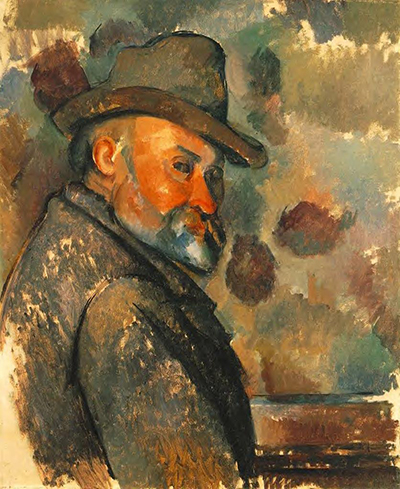
Paul Cézanne turns back towards us from the left edge of this portrait. His shoulders continue away, but his eye catches the viewer sideways beneath a soft, broad-brimmed hat. The face, beard and coat are built with different kinds of paint: warm, compact strokes across the cheek; cool blue-grey around the jaw; broken ochres and greens across the heavy sleeve.
The Artizon Museum calls the work Self-Portrait with a Hat and dates it to about 1890–94. The online catalogue raisonné identifies this particular canvas as FWN 511 and dates it 1894. [1] [2]
At a Glance
- Artist Paul Cézanne. [1]
- Title Self-Portrait with a Hat ; the catalogue also uses Cezanne coiffé d’un chapeau mou . [1] [2]
- Date About 1890–94 according to Artizon; 1894 in the catalogue raisonné. [1] [2]
- Medium and size Oil on canvas, 60 × 49 cm. [2]
- Collection Artizon Museum, Tokyo. [1]
- Catalogue number FWN 511; Rewald 774; Venturi 579. [2]
This work across Paul Cézanne’s career
The Kiss of the Muse
c.1860The Artist’s Father, Reading L’Événement
autumn 1866The Hanged Man’s House
c.1873A Modern Olympia
1873–74Maincy Bridge
1879–80The Blue Vase
1889–90Cézanne’s Self-Portrait with a Hat (current article)
Artizon c.1890–94; FWN1894The Basket of Apples
c.1893Apples and Oranges
c.1899The Large Bathers (Philadelphia)
1900–1906 (Philadelphia Museum dating)Château Noir (MoMA)
1903–04Contents
- A glance over the shoulder
- Hat, wall and painted surface
- Where it sits among the self-portraits
- From Vollard to the Armory Show
- An early Cézanne in Japan
A glance over the shoulder
The turn gives the portrait its immediate drama. The coat occupies almost the whole lower left of the canvas, a dark, sloping mass that implies the body faces away from us. Yet the head rotates far enough to bring the cheek into the light. Cézanne does not place two eyes evenly before the viewer: one is clearly visible under the brim, while the other side of the face recedes. That imbalance makes the act of looking feel momentary, as if the painter has paused during another movement.
At close range, the right edge of the beard does more than describe facial hair. Its blue-grey strokes lead down from the ear to the pointed lower jaw, then meet the raised coat collar. Warm orange paint across the nose and cheek lies against this cooler area. The eye itself is small, dark and sharply bounded; much of the expression comes from the tilt of the head and the contrast of light around it.
Pavel Machotka, writing specifically about this canvas, compares its viewpoint with earlier self-portraits and notices that the head turns farther away while the eye looks more obliquely back. He suggests suspicion as one possible impression, then cautions that the work need not be read chiefly as a disclosure of mood. His closer concern is how freely placed marks can still hold the head and torso together. [3]
The museum’s description proposes melancholy in the shadowed side and stern self-awareness in the lit one. [1] Both readings respond to the picture; neither is a documented statement by Cézanne.
Hat, wall and painted surface
The hat is irregular rather than smoothly outlined. A dark band and brim cut across the forehead; the crown rises in a muted green-grey, with a brown patch projecting at the far left. The outline seems to fold into the background near the top. Below it, the ear glows almost copper-orange, one of the strongest colour notes in the whole painting. These relationships keep the eye circulating between the hat and face, even though the coat takes up more space.
The wall is active too. Mauve-brown islands hang at the right of the head, while grey-green and yellowish areas spread between them. A horizontal dark band near the bottom briefly gives that shifting field a firm boundary. Near the left edge and in the coat, lighter flecks interrupt the dark paint. The surface looks worked and open at once: dense passages exist beside thin or unpainted ones. There is no need to decide whether each light patch is fabric, reflection or bare ground to notice the rhythm it gives the figure.
Machotka reads the dark marks around the hat and beard as a continuation of the jaw’s diagonal, helping to balance the weight of the torso; he also identifies the background pattern as wallpaper. [3] Seen independently, the patches do work as counterweights: the face projects into the relatively open right half, but the darker forms prevent that half becoming empty. The viewer is drawn back and forth across a deliberately uneven composition.
Artizon likewise notes green as an underlying colour and the coexistence of assertive brushwork with areas left unpainted. [1]
The picture thus has two different kinds of precision. The edges of the eye, nose and beard make the head legible; the loose surroundings stop it from becoming an isolated likeness pasted onto a neutral backdrop. The lower horizontal strip is especially useful in this regard. It locates a background plane behind the shoulder while the mottled upper field continues to unsettle easy depth. Cézanne lets the portrait be both a recognizable person and a negotiation among coloured shapes.
Where it sits among the self-portraits
Cézanne repeatedly used his own face as a subject, and the National Portrait Gallery’s survey makes the change in his approach visible across several decades. Its account moves from an early, dramatically lit likeness to a lighter portrait of the 1870s, then to more regularly placed strokes in an 1880–81 painting. It also distinguishes the bowler-hat portraits of the mid-1880s from a late self-portrait with a beret. [4] The Artizon painting belongs within this sequence, but its soft hat, turned torso and open, blotched background make it a distinct solution.
The current catalogue dates the canvas 1894 and notes a Vollard archival photograph annotated with that year. It also records earlier variations in Venturi’s and Rewald’s datings. [2]
From Vollard to the Armory Show
The catalogue traces the canvas through Vollard, Alphonse Kann, Bernheim-Jeune and back to Vollard. It lists the painting in Vollard’s Paris Cézanne exhibition of November–December 1895. [2]
In 1913 the work was exhibited in New York’s International Exhibition of Modern Art, the Armory Show, as Portrait de Cézanne , lent by Vollard. The original exhibition catalogue gives it number 215. [5]
The catalogue raisonné records its onward presentation in Chicago and Boston. [2]
An early Cézanne in Japan
The catalogue places the work with Moritatsu Hosokawa in Tokyo by December 1920, after an uncertain entry for Masanosuke Soma in Paris. It later passed to Shojiro Ishibashi and the Bridgestone Museum of Art. [2]
Shigemi Inaga identifies this self-portrait as one of two Cézanne oils in the first Shirakaba Museum exhibition in 1921. His article reproduces the painting alongside a photograph of writer Mushanokōji Saneatsu with it. He places that encounter within an earlier Japanese engagement with Cézanne through writing and reproduced images, followed by opportunities to see originals. [6] The portrait’s move to Japan therefore altered what it could offer: a canvas whose broken touches and reserved areas could be inspected directly, rather than inferred from a printed page.
A later record supplies another physical trace. The Tokyo National Research Institute for Cultural Properties lists a glass-plate photograph of the hat self-portrait made in June 1932, when the owner was Hosokawa; its present-owner field names the Bridgestone Museum. [7] That record does not tell us how visitors responded. It does show that the painting was being documented as an individual object within Japan, decades before the Artizon name appeared.
Artizon places the 1921 Shirakaba exhibition in Kyobashi, now the museum’s district. Its curator recalls that Kawakami Ryoka admired Cézanne but was too ill to see the works. [8]
Cézanne artworks directory
Browse 217 identified works in this researched selection, including paintings, drawings and watercolours. This is a bounded selection, not a complete catalogue of Cézanne’s surviving oeuvre. Unlinked titles have no confirmed article in this collection.
| Name | Date | Medium |
|---|---|---|
| A Head, a Cup, and a Bread Roll | 1891/1894 | Drawing |
| A Man seen from Behind | 1880/1883 | Drawing |
| A Modern Olympia | 1873–74 | Painting |
| A Nude and Foliage | 1879/1882 | Drawing |
| A Smoking Man | 1892–96 (catalogue); c.1890–92 (museum) | Drawing |
| Afternoon in Naples | 1876–77 | Painting |
| An Old Woman with a Rosary | about 1895–96 | Painting |
| Apples and Oranges | c.1899 | Painting |
| Auvers, Panoramic View | 1873–75 | Painting |
| Avenue at Chantilly | 1888 | Painting |
| Banks of the Marne | 1888–94 | Painting |
| Basket | 1877/1900 | Drawing |
| Bather with Outstretched Arms | 1877–78 | Painting |
| Bellows in Front of a Fireplace | 1887/1892 | Drawing |
| Bibémus Quarry | c.1895 | Painting |
| Boy in a Red Vest, Barnes Foundation | 1888–90 | Painting |
| Boy in a Red Vest, MoMA | 1888–90 | Painting |
| Boy in a Red Waistcoat, National Gallery of Art | 1888–90 | Painting |
| Branch in Flower | 1886/1889 | Drawing |
| Carnival Scene | 1885/1888 | Drawing |
| Chair and Dresser | 1880/1883 | Drawing |
| Chateau Noir | 1903–04 | Painting |
| Chestnut Trees and Farm at Jas de Bouffan | c.1885 | Painting |
| Chestnut Trees and Farm at Jas de Bouffan, Pushkin | c.1886 | Painting |
| Chestnut Trees at Jas de Bouffan in Winter | 1885–86 | Painting |
| Château Noir | 1900–04 | Painting |
| Cistern in the Park of Château Noir | c.1900 | Painting |
| Curtain, Jug and Fruit | 1893–94 | Painting |
| Cushion of an Armchair | 1886/1889 | Drawing |
| Draft Letter and Studies of Bathers | c.1878 | Drawing |
| Farmhouse and Chestnut Trees at Jas de Bouffan | 1884–85 | Painting |
| Figure Resting Head on Hand | c. 1889 | Drawing |
| Fireplace Tongs and Poker | 1887/1892 | Drawing |
| Forest Interior, San Francisco | c.1898–99 | Painting |
| Four Bathers | 1888–90 | Painting |
| Fruit and a Jug on a Table | 1893–94 | Painting |
| Gardanne | 1885–86 | Painting |
| Gardanne, Barnes Foundation | c.1885 | Painting |
| Hand and Shoulder of a Boy | c. 1885 | Drawing |
| Harlequin, National Gallery of Art | 1888–90 | Painting |
| Head of a Boy | 1887/1889 | Drawing |
| Head of a Boy Seen from Behind | c. 1885 | Drawing |
| Head of a Young Woman | c. 1880 | Drawing |
| Head of the Artist's Son | 1888/1889 | Drawing |
| Hillside in Provence | c.1890–92 | Painting |
| Horse Chestnut Trees at Jas de Bouffan | c.1885 | Painting |
| House and Farm at the Jas de Bouffan | c.1887 | Painting |
| House in a Park | 1883/1886 | Drawing |
| House in Provence | c.1885 | Painting |
| House of Père Lacroix | 1873 | Painting |
| House Surrounded by Vegetation | 1889/1892 | Drawing |
| Houses in Provence The Riaux Valley near L’Estaque | c.1883 | Painting |
| Jas de Bouffan, the Pool | c.1876 | Painting |
| Kerosene Lamp | 1878/1881 | Drawing |
| L'Estaque, Melting Snow | c.1870 | Painting |
| Lake Annecy | 1896 | Painting |
| Landscape in Provence, Pola Museum | 1879–82 | Painting |
| Landscape Near Aix-en-Provence | 1877/1880 | Drawing |
| Landscape Seen from the Inside of a Cave | 1889/1892 | Drawing |
| Landscape with Poplars | c.1885–87 | Painting |
| Landscape with Trees | 1895/1898 | Drawing |
| Leda and the Swan | c.1880 (possibly later) | Painting |
| Little Girl with a Doll | 1902–04 | Painting |
| Louis Guillaume | 1879–1890 | Painting |
| Madame Cezanne | 1888/1891 | Drawing |
| Madame Cezanne | 1886/1889 | Drawing |
| Madame Cezanne | 1882/1887 | Drawing |
| Madame Cezanne | 1897/1900 | Drawing |
| Madame Cezanne with her Head Lowered | 1893/1896 | Drawing |
| Madame Cézanne in a Red Armchair | c.1877 | Painting |
| Madame Cézanne in a Red Dress, Metropolitan Museum of Art | 1888–90 | Painting |
| Madame Cézanne in a Yellow Chair | 1888–90 | Painting |
| Madame Cézanne in a Yellow Chair, Fondation Beyeler | 1888–90 | Painting |
| Madame Cézanne in the Conservatory | 1891 | Painting |
| Maincy Bridge | 1879–80 | Painting |
| Maison Maria with a View of Château Noir | c.1895 | Painting |
| Man Bending Forward | 1883/1886 | Drawing |
| Man Smoking a Pipe, Pushkin | c.1891, possibly later | Painting |
| Man with a Pipe | 1891–96 | Painting |
| Man with a Pipe, Nelson-Atkins | 1890–92 | Painting |
| Man with a Straw Hat (Gustave Boyer) | c.1871 | Painting |
| Man with Crossed Arms | c.1899 | Painting |
| Man with Pipe, National Gallery of Art | 1892–96 | Painting |
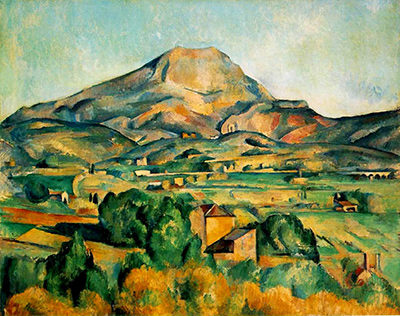
| Mont Sainte-Victoire | c.1902–06 | Painting |
| Mont Sainte-Victoire | 1900–02 | Painting |
| Mont Sainte-Victoire (recto) | c.1895 | Watercolour |
| Mont Sainte-Victoire and the Viaduct of the Arc River Valley | 1882–85 | Painting |
| Mont Sainte-Victoire Seen beyond the Wall of the Jas de Bouffan | c.1885/1888 | Watercolour |
| Mont Sainte-Victoire Seen from Bibémus Quarry | c.1897 | Painting |
| Mont Sainte-Victoire, Barnes Foundation | 1892–95 | Painting |
| Near the Pool at Jas de Bouffan | 1883/1887 | Drawing |
| Pelicans | 1877/1880 | Drawing |
| Peonies | 1890/1893 | Drawing |
| Pierrot and Harlequin | 1888 | Painting |
| Pine Tree | 1882/1885 | Drawing |
| Pont des Trois Sautets | 1906 | Watercolour |
| Poplars | 1879–80 | Painting |
| Portrait of Ambroise Vollard | 1899 | Painting |
| Portrait of Gustave Geffroy | 1895–96 | Painting |
| Portrait of Madame Cezanne with Loosened Hair | 1885–86 | Painting |
| Portrait of the Artist Looking Over His Shoulder | 1883–84 | Painting |
| Portrait of the Gardener Vallier | 1906 | Painting |
| Portrait of Victor Chocquet | 1876–77 | Painting |
| Portrait Of Victor Chocquet Seated | 1877 | Painting |
| Provençal Manor | c.1885 | Painting |
| Pyramid of Skulls | 1898–1900 | Painting |
| Reclining Nude (Leda?) | c.1887 | Painting |
| Scipio | 1866–68 | Painting |
| Seated Man, Oslo | 1898–1900 | Painting |
| Seated Peasant | c.1892–96 | Painting |
| Seated Peasant, Hiroshima | c.1897 | Painting |
| Seated Peasant, Orsay | c.1900 | Painting |
| Self-Portrait | c. 1895 | Drawing |
| Self-Portrait in a Bowler Hat, Ny Carlsberg Glyptotek | 1885–86 | Painting |
| Self-Portrait in a Casquette | c.1875 | Painting |
| Self-Portrait with a Beret | 1898–1900 | Painting |
| Self-Portrait with a Hat, Artizon Museum | c.1890–94 | Painting |
| Self-Portrait with a Pink Background | c.1875 | Painting |
| Self-Portrait with Olive-Coloured Wallpaper | about 1880–81 | Painting |
| Self-Portrait with Palette | 1886–87 | Painting |
| Self-Portrait with White Turban | c.1878–80 | Painting |
| Self-Portrait, c.1895 | c.1895 | Painting |
| Self-Portrait, Pushkin Museum | c.1882 | Painting |
| Spanish Dancers | 1883/1886 | Drawing |
| Still Life with a Curtain | 1892–94 | Painting |
| Still Life with Apples | c.1890 | Painting |
| Still Life with Apples | 1893–94 | Painting |
| Still Life with Apples and a Pot of Primroses | about 1890 | Painting |
| Still Life with Milk Jug and Fruit | c.1900 | Painting |
| Still Life with Open Drawer | 1877–79 | Painting |
| Still Life with Plaster Cupid | about 1894 | Painting |
| Still Life with Skull | 1890–93 | Painting |
| Still Life with Soup Tureen | 1877 | Painting |
| Still Life, Pitcher and Fruit | 1893–94 | Painting |
| Studies Including a Straw Hat | 1895/1898 | Drawing |
| Studies Including Madame Cezanne | 1884/1887 | Drawing |
| Study for "The Judgement of Paris" or "The Amorous Shepherd" | 1883/1886 | Drawing |
| Study for Woman with a Coffee Pot | c.1895 | Painting |
| Study of "The Roman Orator (Germanicus)" | 1883/1886 | Drawing |
| Study of "Venus de Milo" | 1881/1884 | Drawing |
| Study of a Decorative Ornament | 1879/1882 | Drawing |
| Study of a Standing Male Figure after the Antique | c. 1895 | Drawing |
| Study of an Angel in Rubens' "The Prophet Elijah" | 1892/1895 | Drawing |
| Study of Desiderio da Settignano's "Bust of a Child" | c. 1895 | Drawing |
| Study of Houses | 1879/1882 | Drawing |
| Study of Puget's "Hercules Resting" | c. 1879 | Drawing |
| Study of Puget's "Milo of Crotona" | 1895/1898 | Drawing |
| Study of Puget's "Milo of Crotona" | 1880/1883 | Drawing |
| Study of the Allegorical Figure Bellona in Rubens' "The Apotheosis of Henri IV" | 1883/1886 | Drawing |
| Study of the Allegorical Figure Bellona in Rubens' "The Apotheosis of Henri IV" | 1879/1882 | Drawing |
| Study of the Allegorical Figure France in Rubens' "The Exchange of the Two Princesses" | 1882/1885 | Drawing |
| Study of the Allegorical Figure of Health in Rubens' "The Birth of Louis XIII" | 1880/1883 | Drawing |
| Study of the Allegorical Figure of the Genius of Health from Rubens' "The Birth of Louis XIII at Fontainbleau" | 1895/1898 | Drawing |
| Sugar Bowl, Pears and Blue Cup | 1865–66 | Painting |
| The Aqueduct, Pushkin Museum | Dating differs between museum records | Painting |
| The Artist's Father, Reading L'Evenement | autumn 1866 | Painting |
| The Artist's Son | c. 1887 | Drawing |
| The Artist's Son Leaning on his Elbow | c. 1887 | Drawing |
| The Artist's Son Reading | c. 1887 | Drawing |
| The Artist's Son Writing | c. 1887 | Drawing |
| The Artist’s Son, Paul | 1886–87 | Painting |
| The Avenue at Jas de Bouffan | 1868–70 (possibly later) | Painting |
| The Avenue at Jas de Bouffan, Geneva | c.1890 | Painting |
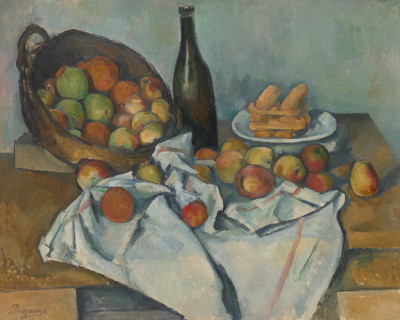
| The Basket of Apples | c.1893 | Painting |
| The Bather, Museum of Modern Art | c.1885 | Painting |
| The Bay of Marseille seen from L'Estaque | c.1885 | Painting |
| The Blue Vase | 1889–90 | Painting |
| The Boy in the Red Vest, Bührle | 1888–90 | Painting |
| The Buffet | 1877–79 | Painting |
| The Card Players, Barnes Foundation | 1890–92 | Painting |
| The Card Players, Courtauld Gallery | 1892–96 | Painting |
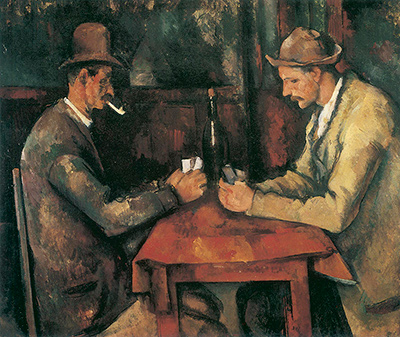
| The Card Players, Metropolitan Museum of Art | 1890–92 | Painting |
| The Card Players, Musée d’Orsay | 1893–96 | Painting |
| The Card Players, Qatar | 1892–96 | Painting |
| The Eternal Feminine | c.1877 | Painting |
| The Gardener Vallier | 1906 | Painting |
| The Gardener Vallier, Tate | 1905–06 | Painting |
| The Grounds of the Château Noir | c.1900–04 | Painting |
| The Gulf of Marseille Seen from L’Estaque | c.1885 | Painting |
| The Hanged Man's House in Auvers | c.1873 | Painting |
| The House of Doctor Gachet at Auvers | 1872–73 | Painting |
| The House with the Cracked Walls | 1892–94 | Painting |
| The Kiss of the Muse | c.1860 | Painting |
| The Large Bathers, Barnes Foundation | 1895–1906 | Painting |
| The Large Bathers, National Gallery | 1895–1905 | Painting |
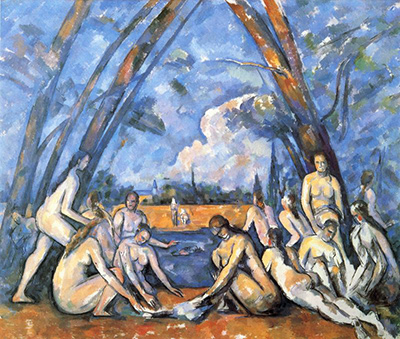
| The Large Bathers, Philadelphia Museum of Art | 1900–06 | Painting |
| The Mill | 1889/1892 | Drawing |
| The Painter’s Father, Louis-Auguste Cézanne | c.1865 | Painting |
| The Peasant | 1890–92 | Painting |
| The Plaster Mill (La Moulin à plâtre) | 1889/1892 | Drawing |
| The Smoker, Hermitage | c.1891 | Painting |
| The Smoker, Mannheim | c.1891 | Painting |
| The Stove in the Studio | c.1865 | Painting |
| The Vase of Tulips | c.1890 | Painting |
| Thistle | 1893/1896 | Drawing |
| Three Heads, One of Madame Cezanne | 1882/1885 | Drawing |
| Three Skulls | c.1898 | Painting |
| Three Skulls on a Patterned Carpet | 1904 | Painting |
| Trees and Shrubs | 1883/1887 | Drawing |
| Turning Road at Montgeroult | 1898 | Painting |
| Two Bathers | 1884/1887 | Drawing |
| Two Heads | 1888 | Drawing |
| Two Heads | 1890/1896 | Drawing |
| Two Heads of Women | 1890/1894 | Drawing |
| Two Studies for "The Judgement of Paris" or "The Amorous Shepherd" | 1883/1886 | Drawing |
| Uncle Dominique in a Tasseled Cap | 1866 | Painting |
| Uncle Dominique in a Turban | 1866–67 | Painting |
| Victor Chocquet and an Angel for "The Apotheosis of Delacroix" | 1878/1880 | Drawing |
| Woman in Blue | c.1904 | Painting |
| Woman Leaning Forward | 1888/1891 | Drawing |
| Woman Leaning Forward | 1890/1894 | Drawing |
| Woman Leaning Forward | 1890/1894 | Drawing |
| Woman with a Coffee Pot | c.1895 | Painting |
| Women Bathers and a Roll of Paper | 1882/1885 | Drawing |
| Young Girl with a Doll | c.1895 | Painting |
| Young Italian Woman at a Table | c.1895–1900 | Painting |
| Young Man and Skull | 1896–98 | Painting |
Frequently Asked Questions
It belongs to the Artizon Museum in Tokyo, within the Ishibashi Foundation collection. [1]
Yes. The 1913 New York catalogue lists Portrait de Cézanne as number 215, lent by Vollard. [5]
Artizon notes deliberately unpainted areas beside the worked passages. [1]
Discussion
Look again at the images and ideas explored in Cézanne’s Self-Portrait with a Hat. These editorial prompts invite your observations.
Reader Insights
Follow the brim from left to right, then look at the eye. How does that dark line change the direction of the glance?
Compare the tightly built cheek with the looser marks of the wall. At what point does the background begin to feel as active as the figure?
Imagine encountering this canvas first as a small reproduction, then in front of the original. Which details of surface would be hardest to carry between the two?
Join the Conversation
Share a detail, comparison or question about Cézanne’s Self-Portrait with a Hat below.
References
- Artizon Museum. “Paul CÉZANNE, Self-Portrait with a Hat ,” collection record, accessed 2026. View source .
- Société Paul Cezanne. “ Cezanne coiffé d’un chapeau mou , 1894 (FWN 511),” The Paintings, Watercolors and Drawings of Paul Cezanne: An Online Catalogue Raisonné , catalogue entry 751. View source .
- Pavel Machotka / Société Paul Cezanne. “ Cézanne coiffé d’un chapeau mou , 1894 (R774–FWN511),” excerpt from Cézanne: The Eye and the Mind , posted 13 May 2017. View source .
- National Portrait Gallery. Tanya Bentley, “Cézanne’s Self-Portraits,” 8 December 2017. View source .
- Association of American Painters and Sculptors. Catalogue of International Exhibition of Modern Art , New York, 1913, no. 215. View source .
- Japan Review. Shigemi Inaga, “Between Revolutionary and Oriental Sage: Paul Cézanne in Japan,” no. 28 (2015), pp. 133–172, esp. 149–50. View source .
- Tokyo National Research Institute for Cultural Properties. “00840_自画像[帽子をかぶった自画像],” glass-plate archive record. (in Japanese). View source .
- Artizon Museum. “Curators’ Selection — Hidden Masterpieces,” no. 5, on Kawakami Ryoka and the Shirakaba exhibition. View source .
- Le Baiser de la muse, d'après Frillié (FWN 572). View source.
- Louis-Auguste Cezanne, père de l'artiste, lisant L'Événement (FWN 402). View source.
- La Maison du pendu, Auvers-sur-Oise (FWN 81). View source.
- Une moderne Olympia (FWN 628). View source.
- Le Pont de Maincy (FWN 143). View source.
- La Montagne Sainte-Victoire vue de Montbriand (FWN 185). View source.
- Gardanne (vue horizontale) (FWN 224). View source.
- Le Vase bleu (FWN 823). View source.
- Les Joueurs de cartes (FWN 681). View source.
- La Montagne Sainte-Victoire (FWN 296). View source.
- La Corbeille de pommes (FWN 860). View source.
- Pommes et oranges (FWN 871). View source.
- Portrait d'Ambroise Vollard (FWN 531). View source.
- Philadelphia Museum of Art,The Large Bathers,W1937-1-1. View source.
- Château Noir (FWN 360). View source.
- Société Paul Cezanne,online catalogue structure and objectidentification. View source.
- National Gallery of Art,Cezanne Sketchbook,1992.51.9. View source.
- Splash image, Cézanne looks back over his shoulder, his warm cheek set against a mottled wall.