 by
Tom Gurney
Tom Gurney BSc (Hons) is an art history expert with over 20 years experience
Published on June 19, 2020 / Updated on October 22, 2026
Email:
tomgurney1@gmail.com
/ Phone:
+44 7429 011000
Pont des Trois Sautets by Paul Cézanne: Introduction
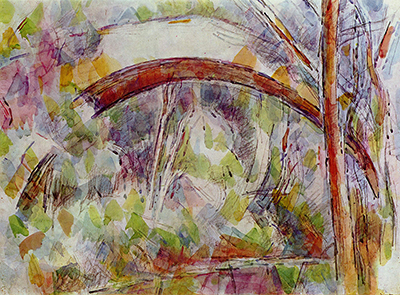
A pale bridge curves across the upper half of Cézanne’s Pont des Trois Sautets . Its underside is a strong brown arc, yet the bridge above it seems almost to disappear into the light. Below, small washes of green, rose and violet mingle with restless pencil lines. The water, banks and trees emerge from a mesh of marks.
Made around 1906 and now in the Cincinnati Art Museum, the sheet treats a familiar crossing near Aix-en-Provence as a problem of colour, line and space. [1]
At a Glance
- Artist Paul Cézanne (1839–1906). [1]
- Date About 1906; the online catalogue records a proposed, less certain date of August 1906. [2]
- Medium Graphite and watercolour on paper. [2]
- Size 40.8 × 54.3 cm (16 1/16 × 21 3/8 in.). [1]
- Collection Cincinnati Art Museum, gift of John J. Emery, accession 1951.298. [1]
- Catalogue identification FWN 1519; Rewald W644; Venturi 1076. [2]
This work across Paul Cézanne’s career
The Kiss of the Muse
c.1860The Artist’s Father, Reading L’Événement
autumn 1866The Hanged Man’s House
c.1873A Modern Olympia
1873–74Maincy Bridge
1879–80The Blue Vase
1889–90The Basket of Apples
c.1893Apples and Oranges
c.1899The Large Bathers (Philadelphia)
1900–1906 (Philadelphia Museum dating)Château Noir (MoMA)
1903–04Contents
- The arch and the view beneath it
- A working place beside the Arc
- Pencil, wash and changing relations
- One bridge, more than one solution
- From Cézanne’s studio to Cincinnati
The arch and the view beneath it
The bridge supplies the clearest single shape in the sheet. Its upper parapet passes behind the foliage at the left, rises gently, and falls toward a thick tree trunk on the right. A dark band immediately below it gives the white body of the bridge an edge. Cézanne has left much of that body as the paper’s own light tone, with only scattered marks crossing it. The span therefore reads at once as masonry and as an opening within the watercolour’s busy surface.
The right-hand tree has a different task. Its upright trunk cuts across the arch, interrupting the bridge’s easy sweep. Thin branches rise beyond it and spread towards the upper edge, while short diagonal strokes near its base link it to the foliage below. The trunk is never a uniform brown column: red and ochre passages mingle with exposed paper and darker graphite. It anchors the view without shutting out what lies behind it. At the left, foliage and slender trees partly veil the bridge, shifting its apparent distance.
At the bottom of the sheet, small angular washes accumulate in greens, dull oranges and purples. Several pencil marks run across or between them. Rather than tracing a neat riverbank and filling it with colour, Cézanne lets one patch answer another; a red accent low in the centre recurs higher in the foliage, and violet reappears in both shadow and water. The boundary between a tree, its reflection and the bank remains elusive, even as the drawing keeps the bridge legible.
A working place beside the Arc
The bridge crossed the Arc River near Aix. Cézanne’s correspondence places him at the Pont des Trois Sautets during the exceptional heat of August 1906: on 14 August he told his son Paul that a carriage would take him there in the late afternoon, when the riverside was cooler, and that he had already begun a watercolour. In September he continued describing trips to the river and the wealth of motifs he found along its banks. These letters establish a working routine at this place, although they do not prove that the watercolour mentioned on 14 August is precisely the Cincinnati sheet. [3]
The Cincinnati Art Museum’s extended object description places the artist immediately below the bridge and reports several tack holes in the paper’s corners, evidence of repeated attachment during work. It describes a pencil framework followed by transparent, overlapping colour washes. Those observations indicate work over more than one encounter. The museum also identifies red-violet touches in the water and a concentration of blue-violet in the shaded distance. [4]
John Rewald’s account of Cézanne’s last Aix motifs describes the shaded bank by the old, narrow bridge as a retreat from summer heat. He places it among several outdoor working places, including another stretch of the Arc on the route towards Les Milles. The river in a late letter is therefore not automatically the river in this particular view. The named bridge in the August letter provides the firmer connection. [5]
Pencil, wash and changing relations
The sheet is far from an architectural record of the crossing. Pencil lines repeatedly search through the vegetation; some tighten the outlines of trunks, while others remain visible beneath or beside transparent colour. On the bridge, those lines define an edge that pigment alone scarcely fixes. Elsewhere a brush mark may carry the form for a moment before a graphite stroke redirects it. This shifting partnership is why the arch can feel firm without becoming rigid, and why the surrounding vegetation can remain legible without being reduced to a map of individual leaves.
The exposed paper is just as active. White flecks break through the thicket at the left, broad light fills the bridge, and smaller untouched gaps flicker among the low colour patches. Each gap changes according to its neighbours: beside the dark underside of the arch it suggests strong illumination, while amid foliage it resembles light filtering through branches. The Museum of Modern Art’s account of Cézanne’s landscape drawings notes his use of transparent washes and unpainted paper to register light; here those methods can be followed across one small sheet, from the open bridge to the crowded river edge. [6]
The arch’s large curve gains force from the straight tree that crosses it, while scattered rose and violet touches connect foreground to background. Lawrence Gowing, writing about the late work, saw the bridge watercolour’s linear strength and mild luminosity as joined rather than competing effects. Geneviève Monnier likewise proposed that reflected light helps structure this particular view. Their readings bring attention back to the surface, where line and wash repeatedly exchange roles. [5]
One bridge, more than one solution
Cézanne had painted the same bridge decades earlier, in an oil landscape usually dated 1865–66. That early work approaches the crossing from a different angle and belongs to a very different use of paint; it should not be mistaken for a preliminary version of the Cincinnati watercolour. The long interval instead shows a return to a place whose shapes could support new pictorial questions. In the late sheet, the bridge is seen obliquely, partly screened by trees, its broad pale mass held in tension with a foreground of mobile marks. [7]
That mobility has prompted debate over how to read Cézanne’s revisions. Paul Smith identifies the Cincinnati sheet when discussing the notion that Cézanne combined successive physical viewpoints in a single image. He accepts that some pentimenti could correspond to slightly different views, but argues that such adjustments cannot by themselves prove a record of vision unfolding as the painter moved. It is a useful caution here. The multiple contours visible around the trees are evidence of searching and adjustment; their exact sequence or purpose cannot be reconstructed simply by looking at the reproduction. The bridge’s coherence comes from the relations built on the page, whatever movements may have preceded them. [8]
The Cincinnati sheet holds a particular balance: the arch remains recognisable, the tree blocks and reveals it, and the riverbank’s coloured fragments resist settling into a single depth. A viewer can return to the same few marks and see the crossing alternately as a structure in landscape and as a rhythm across paper.
From Cézanne’s studio to Cincinnati
The catalogue traces the sheet from Ambroise Vollard in Paris through his estate, then Rosenberg & Stiebel in New York and John J. Emery in Cincinnati. Emery’s gift brought it to the Cincinnati Art Museum in 1951. The same catalogue records its appearance in exhibitions of French drawings and Cézanne watercolours, including Cézanne: The Late Work in 1977–78, Cézanne in Provence in 2006, and Cézanne Drawing in 2021. Those appearances show how the work has been considered both as a study of a specific Provençal site and as an important example of drawing with colour. [2]
Its two media remain visible rather than dissolving into one another. The graphite can be followed as a sequence of decisions, and the watercolour as transparent pools and patches that modify those decisions. The bridge fixes the image’s centre even as the marks keep asking where one form ends and another begins.
Cézanne artworks directory
Browse 217 identified works in this researched selection, including paintings, drawings and watercolours. This is a bounded selection, not a complete catalogue of Cézanne’s surviving oeuvre. Unlinked titles have no confirmed article in this collection.
| Name | Date | Medium |
|---|---|---|
| A Head, a Cup, and a Bread Roll | 1891/1894 | Drawing |
| A Man seen from Behind | 1880/1883 | Drawing |
| A Modern Olympia | 1873–74 | Painting |
| A Nude and Foliage | 1879/1882 | Drawing |
| A Smoking Man | 1892–96 (catalogue); c.1890–92 (museum) | Drawing |
| Afternoon in Naples | 1876–77 | Painting |
| An Old Woman with a Rosary | about 1895–96 | Painting |
| Apples and Oranges | c.1899 | Painting |
| Auvers, Panoramic View | 1873–75 | Painting |
| Avenue at Chantilly | 1888 | Painting |
| Banks of the Marne | 1888–94 | Painting |
| Basket | 1877/1900 | Drawing |
| Bather with Outstretched Arms | 1877–78 | Painting |
| Bellows in Front of a Fireplace | 1887/1892 | Drawing |
| Bibémus Quarry | c.1895 | Painting |
| Boy in a Red Vest, Barnes Foundation | 1888–90 | Painting |
| Boy in a Red Vest, MoMA | 1888–90 | Painting |
| Boy in a Red Waistcoat, National Gallery of Art | 1888–90 | Painting |
| Branch in Flower | 1886/1889 | Drawing |
| Carnival Scene | 1885/1888 | Drawing |
| Chair and Dresser | 1880/1883 | Drawing |
| Chateau Noir | 1903–04 | Painting |
| Chestnut Trees and Farm at Jas de Bouffan | c.1885 | Painting |
| Chestnut Trees and Farm at Jas de Bouffan, Pushkin | c.1886 | Painting |
| Chestnut Trees at Jas de Bouffan in Winter | 1885–86 | Painting |
| Château Noir | 1900–04 | Painting |
| Cistern in the Park of Château Noir | c.1900 | Painting |
| Curtain, Jug and Fruit | 1893–94 | Painting |
| Cushion of an Armchair | 1886/1889 | Drawing |
| Draft Letter and Studies of Bathers | c.1878 | Drawing |
| Farmhouse and Chestnut Trees at Jas de Bouffan | 1884–85 | Painting |
| Figure Resting Head on Hand | c. 1889 | Drawing |
| Fireplace Tongs and Poker | 1887/1892 | Drawing |
| Forest Interior, San Francisco | c.1898–99 | Painting |
| Four Bathers | 1888–90 | Painting |
| Fruit and a Jug on a Table | 1893–94 | Painting |
| Gardanne | 1885–86 | Painting |
| Gardanne, Barnes Foundation | c.1885 | Painting |
| Hand and Shoulder of a Boy | c. 1885 | Drawing |
| Harlequin, National Gallery of Art | 1888–90 | Painting |
| Head of a Boy | 1887/1889 | Drawing |
| Head of a Boy Seen from Behind | c. 1885 | Drawing |
| Head of a Young Woman | c. 1880 | Drawing |
| Head of the Artist's Son | 1888/1889 | Drawing |
| Hillside in Provence | c.1890–92 | Painting |
| Horse Chestnut Trees at Jas de Bouffan | c.1885 | Painting |
| House and Farm at the Jas de Bouffan | c.1887 | Painting |
| House in a Park | 1883/1886 | Drawing |
| House in Provence | c.1885 | Painting |
| House of Père Lacroix | 1873 | Painting |
| House Surrounded by Vegetation | 1889/1892 | Drawing |
| Houses in Provence The Riaux Valley near L’Estaque | c.1883 | Painting |
| Jas de Bouffan, the Pool | c.1876 | Painting |
| Kerosene Lamp | 1878/1881 | Drawing |
| L'Estaque, Melting Snow | c.1870 | Painting |
| Lake Annecy | 1896 | Painting |
| Landscape in Provence, Pola Museum | 1879–82 | Painting |
| Landscape Near Aix-en-Provence | 1877/1880 | Drawing |
| Landscape Seen from the Inside of a Cave | 1889/1892 | Drawing |
| Landscape with Poplars | c.1885–87 | Painting |
| Landscape with Trees | 1895/1898 | Drawing |
| Leda and the Swan | c.1880 (possibly later) | Painting |
| Little Girl with a Doll | 1902–04 | Painting |
| Louis Guillaume | 1879–1890 | Painting |
| Madame Cezanne | 1888/1891 | Drawing |
| Madame Cezanne | 1886/1889 | Drawing |
| Madame Cezanne | 1882/1887 | Drawing |
| Madame Cezanne | 1897/1900 | Drawing |
| Madame Cezanne with her Head Lowered | 1893/1896 | Drawing |
| Madame Cézanne in a Red Armchair | c.1877 | Painting |
| Madame Cézanne in a Red Dress, Metropolitan Museum of Art | 1888–90 | Painting |
| Madame Cézanne in a Yellow Chair | 1888–90 | Painting |
| Madame Cézanne in a Yellow Chair, Fondation Beyeler | 1888–90 | Painting |
| Madame Cézanne in the Conservatory | 1891 | Painting |
| Maincy Bridge | 1879–80 | Painting |
| Maison Maria with a View of Château Noir | c.1895 | Painting |
| Man Bending Forward | 1883/1886 | Drawing |
| Man Smoking a Pipe, Pushkin | c.1891, possibly later | Painting |
| Man with a Pipe | 1891–96 | Painting |
| Man with a Pipe, Nelson-Atkins | 1890–92 | Painting |
| Man with a Straw Hat (Gustave Boyer) | c.1871 | Painting |
| Man with Crossed Arms | c.1899 | Painting |
| Man with Pipe, National Gallery of Art | 1892–96 | Painting |
| Mont Sainte-Victoire | c.1902–06 | Painting |
| Mont Sainte-Victoire | 1900–02 | Painting |
| Mont Sainte-Victoire (recto) | c.1895 | Watercolour |
| Mont Sainte-Victoire and the Viaduct of the Arc River Valley | 1882–85 | Painting |
| Mont Sainte-Victoire Seen beyond the Wall of the Jas de Bouffan | c.1885/1888 | Watercolour |
| Mont Sainte-Victoire Seen from Bibémus Quarry | c.1897 | Painting |
| Mont Sainte-Victoire, Barnes Foundation | 1892–95 | Painting |
| Near the Pool at Jas de Bouffan | 1883/1887 | Drawing |
| Pelicans | 1877/1880 | Drawing |
| Peonies | 1890/1893 | Drawing |
| Pierrot and Harlequin | 1888 | Painting |
| Pine Tree | 1882/1885 | Drawing |
| Pont des Trois Sautets | 1906 | Watercolour |
| Poplars | 1879–80 | Painting |
| Portrait of Ambroise Vollard | 1899 | Painting |
| Portrait of Gustave Geffroy | 1895–96 | Painting |
| Portrait of Madame Cezanne with Loosened Hair | 1885–86 | Painting |
| Portrait of the Artist Looking Over His Shoulder | 1883–84 | Painting |
| Portrait of the Gardener Vallier | 1906 | Painting |
| Portrait of Victor Chocquet | 1876–77 | Painting |
| Portrait Of Victor Chocquet Seated | 1877 | Painting |
| Provençal Manor | c.1885 | Painting |
| Pyramid of Skulls | 1898–1900 | Painting |
| Reclining Nude (Leda?) | c.1887 | Painting |
| Scipio | 1866–68 | Painting |
| Seated Man, Oslo | 1898–1900 | Painting |
| Seated Peasant | c.1892–96 | Painting |
| Seated Peasant, Hiroshima | c.1897 | Painting |
| Seated Peasant, Orsay | c.1900 | Painting |
| Self-Portrait | c. 1895 | Drawing |
| Self-Portrait in a Bowler Hat, Ny Carlsberg Glyptotek | 1885–86 | Painting |
| Self-Portrait in a Casquette | c.1875 | Painting |
| Self-Portrait with a Beret | 1898–1900 | Painting |
| Self-Portrait with a Hat, Artizon Museum | c.1890–94 | Painting |
| Self-Portrait with a Pink Background | c.1875 | Painting |
| Self-Portrait with Olive-Coloured Wallpaper | about 1880–81 | Painting |
| Self-Portrait with Palette | 1886–87 | Painting |
| Self-Portrait with White Turban | c.1878–80 | Painting |
| Self-Portrait, c.1895 | c.1895 | Painting |
| Self-Portrait, Pushkin Museum | c.1882 | Painting |
| Spanish Dancers | 1883/1886 | Drawing |
| Still Life with a Curtain | 1892–94 | Painting |
| Still Life with Apples | c.1890 | Painting |
| Still Life with Apples | 1893–94 | Painting |
| Still Life with Apples and a Pot of Primroses | about 1890 | Painting |
| Still Life with Milk Jug and Fruit | c.1900 | Painting |
| Still Life with Open Drawer | 1877–79 | Painting |
| Still Life with Plaster Cupid | about 1894 | Painting |
| Still Life with Skull | 1890–93 | Painting |
| Still Life with Soup Tureen | 1877 | Painting |
| Still Life, Pitcher and Fruit | 1893–94 | Painting |
| Studies Including a Straw Hat | 1895/1898 | Drawing |
| Studies Including Madame Cezanne | 1884/1887 | Drawing |
| Study for "The Judgement of Paris" or "The Amorous Shepherd" | 1883/1886 | Drawing |
| Study for Woman with a Coffee Pot | c.1895 | Painting |
| Study of "The Roman Orator (Germanicus)" | 1883/1886 | Drawing |
| Study of "Venus de Milo" | 1881/1884 | Drawing |
| Study of a Decorative Ornament | 1879/1882 | Drawing |
| Study of a Standing Male Figure after the Antique | c. 1895 | Drawing |
| Study of an Angel in Rubens' "The Prophet Elijah" | 1892/1895 | Drawing |
| Study of Desiderio da Settignano's "Bust of a Child" | c. 1895 | Drawing |
| Study of Houses | 1879/1882 | Drawing |
| Study of Puget's "Hercules Resting" | c. 1879 | Drawing |
| Study of Puget's "Milo of Crotona" | 1895/1898 | Drawing |
| Study of Puget's "Milo of Crotona" | 1880/1883 | Drawing |
| Study of the Allegorical Figure Bellona in Rubens' "The Apotheosis of Henri IV" | 1883/1886 | Drawing |
| Study of the Allegorical Figure Bellona in Rubens' "The Apotheosis of Henri IV" | 1879/1882 | Drawing |
| Study of the Allegorical Figure France in Rubens' "The Exchange of the Two Princesses" | 1882/1885 | Drawing |
| Study of the Allegorical Figure of Health in Rubens' "The Birth of Louis XIII" | 1880/1883 | Drawing |
| Study of the Allegorical Figure of the Genius of Health from Rubens' "The Birth of Louis XIII at Fontainbleau" | 1895/1898 | Drawing |
| Sugar Bowl, Pears and Blue Cup | 1865–66 | Painting |
| The Aqueduct, Pushkin Museum | Dating differs between museum records | Painting |
| The Artist's Father, Reading L'Evenement | autumn 1866 | Painting |
| The Artist's Son | c. 1887 | Drawing |
| The Artist's Son Leaning on his Elbow | c. 1887 | Drawing |
| The Artist's Son Reading | c. 1887 | Drawing |
| The Artist's Son Writing | c. 1887 | Drawing |
| The Artist’s Son, Paul | 1886–87 | Painting |
| The Avenue at Jas de Bouffan | 1868–70 (possibly later) | Painting |
| The Avenue at Jas de Bouffan, Geneva | c.1890 | Painting |
| The Basket of Apples | c.1893 | Painting |
| The Bather, Museum of Modern Art | c.1885 | Painting |
| The Bay of Marseille seen from L'Estaque | c.1885 | Painting |
| The Blue Vase | 1889–90 | Painting |
| The Boy in the Red Vest, Bührle | 1888–90 | Painting |
| The Buffet | 1877–79 | Painting |
| The Card Players, Barnes Foundation | 1890–92 | Painting |
| The Card Players, Courtauld Gallery | 1892–96 | Painting |
| The Card Players, Metropolitan Museum of Art | 1890–92 | Painting |
| The Card Players, Musée d’Orsay | 1893–96 | Painting |
| The Card Players, Qatar | 1892–96 | Painting |
| The Eternal Feminine | c.1877 | Painting |
| The Gardener Vallier | 1906 | Painting |
| The Gardener Vallier, Tate | 1905–06 | Painting |
| The Grounds of the Château Noir | c.1900–04 | Painting |
| The Gulf of Marseille Seen from L’Estaque | c.1885 | Painting |
| The Hanged Man's House in Auvers | c.1873 | Painting |
| The House of Doctor Gachet at Auvers | 1872–73 | Painting |
| The House with the Cracked Walls | 1892–94 | Painting |
| The Kiss of the Muse | c.1860 | Painting |
| The Large Bathers, Barnes Foundation | 1895–1906 | Painting |
| The Large Bathers, National Gallery | 1895–1905 | Painting |
| The Large Bathers, Philadelphia Museum of Art | 1900–06 | Painting |
| The Mill | 1889/1892 | Drawing |
| The Painter’s Father, Louis-Auguste Cézanne | c.1865 | Painting |
| The Peasant | 1890–92 | Painting |
| The Plaster Mill (La Moulin à plâtre) | 1889/1892 | Drawing |
| The Smoker, Hermitage | c.1891 | Painting |
| The Smoker, Mannheim | c.1891 | Painting |
| The Stove in the Studio | c.1865 | Painting |
| The Vase of Tulips | c.1890 | Painting |
| Thistle | 1893/1896 | Drawing |
| Three Heads, One of Madame Cezanne | 1882/1885 | Drawing |
| Three Skulls | c.1898 | Painting |
| Three Skulls on a Patterned Carpet | 1904 | Painting |
| Trees and Shrubs | 1883/1887 | Drawing |
| Turning Road at Montgeroult | 1898 | Painting |
| Two Bathers | 1884/1887 | Drawing |
| Two Heads | 1888 | Drawing |
| Two Heads | 1890/1896 | Drawing |
| Two Heads of Women | 1890/1894 | Drawing |
| Two Studies for "The Judgement of Paris" or "The Amorous Shepherd" | 1883/1886 | Drawing |
| Uncle Dominique in a Tasseled Cap | 1866 | Painting |
| Uncle Dominique in a Turban | 1866–67 | Painting |
| Victor Chocquet and an Angel for "The Apotheosis of Delacroix" | 1878/1880 | Drawing |
| Woman in Blue | c.1904 | Painting |
| Woman Leaning Forward | 1888/1891 | Drawing |
| Woman Leaning Forward | 1890/1894 | Drawing |
| Woman Leaning Forward | 1890/1894 | Drawing |
| Woman with a Coffee Pot | c.1895 | Painting |
| Women Bathers and a Roll of Paper | 1882/1885 | Drawing |
| Young Girl with a Doll | c.1895 | Painting |
| Young Italian Woman at a Table | c.1895–1900 | Painting |
| Young Man and Skull | 1896–98 | Painting |
Frequently Asked Questions
It is a bridge over the Arc River near Aix-en-Provence, France. Cézanne’s letter of 14 August 1906 names the bridge as a place to which he was travelling to work beside the river. [3]
The Cincinnati Art Museum classifies it among drawings, pastels and watercolours. It combines graphite lines with transparent watercolour washes on a sheet of paper. [1]
Discussion
Look again at the images and ideas explored in Pont des Trois Sautets by Paul Cézanne. These editorial prompts invite your observations.
Reader Insights
Start with the almost unpainted bridge, then look below it. At what point do the patches of colour begin to suggest water rather than foliage?
Follow the right-hand tree upwards. Notice how its straight trunk interrupts the arch but also helps locate the bridge behind it.
Return to the exposed white paper throughout the sheet. Its meaning changes with the surrounding marks: masonry, a flash among leaves, or simply the brightness of the page.
Join the Conversation
Share a detail, comparison or question about Pont des Trois Sautets by Paul Cézanne below.
References
- Cincinnati Art Museum , “The Bridge of Trois-Sautets (Le Pont des Trois-Sautets),” collection record, accession 1951.298. View source .
- The Paintings, Watercolors and Drawings of Paul Cezanne: An Online Catalogue Raisonné , “Le Pont des Trois Sautets,” FWN 1519, 1906. View source .
- Société Paul Cézanne , “1906,” chronology, transcriptions of Cézanne’s letters to his son Paul dated 14 August, 2 September and 8 September 1906 (in French). View source .
- Cincinnati Art Museum via Google Arts & Culture , “The Bridge of Trois-Sautets,” extended object description. View source .
- The Museum of Modern Art , Cézanne: The Late Work , edited by William Rubin, 1977; essays by John Rewald, Lawrence Gowing and Geneviève Monnier, and catalogue entry no. 115. View source .
- The Museum of Modern Art , Cézanne Drawing , exhibition wall texts, 2021, “Scenes Offered by Nature.”. View source .
- Société Paul Cézanne , “Paysage à l’oratoire et le pont des Trois Sautets 1865–1866,” commentary adapted from Pavel Machotka (in French and English). View source .
- Paul Smith , “Cézanne’s ‘Primitive’ Perspective, or the ‘View from Everywhere,’” The Art Bulletin 95, no. 1 (March 2013), pp. 102–119, especially pp. 103–104. View source .
- Le Baiser de la muse, d'après Frillié (FWN 572). View source.
- Louis-Auguste Cezanne, père de l'artiste, lisant L'Événement (FWN 402). View source.
- La Maison du pendu, Auvers-sur-Oise (FWN 81). View source.
- Une moderne Olympia (FWN 628). View source.
- Le Pont de Maincy (FWN 143). View source.
- La Montagne Sainte-Victoire vue de Montbriand (FWN 185). View source.
- Gardanne (vue horizontale) (FWN 224). View source.
- Le Vase bleu (FWN 823). View source.
- Les Joueurs de cartes (FWN 681). View source.
- La Montagne Sainte-Victoire (FWN 296). View source.
- La Corbeille de pommes (FWN 860). View source.
- Pommes et oranges (FWN 871). View source.
- Portrait d'Ambroise Vollard (FWN 531). View source.
- Philadelphia Museum of Art,The Large Bathers,W1937-1-1. View source.
- Château Noir (FWN 360). View source.
- Société Paul Cezanne,online catalogue structure and objectidentification. View source.
- National Gallery of Art,Cezanne Sketchbook,1992.51.9. View source.
- Splash image, A pale arch spans the coloured riverbank; a tall foreground trunk interrupts its curve.