 by
Tom Gurney
Tom Gurney BSc (Hons) is an art history expert with over 20 years experience
Published on June 19, 2020 / Updated on October 22, 2026
Email:
tomgurney1@gmail.com
/ Phone:
+44 7429 011000
Man with Crossed Arms by Paul Cézanne: Introduction
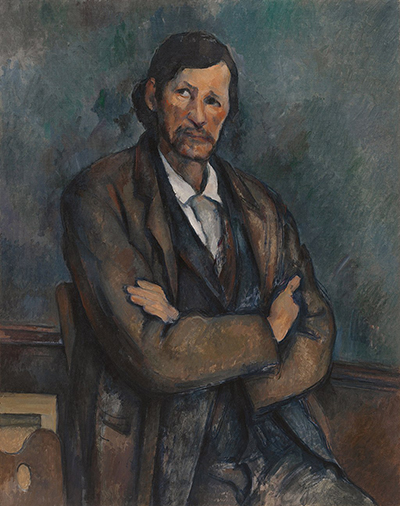
A seated man folds his arms across his chest and looks past us, while the paint around him seems reluctant to settle. His jacket is broad and weighty; his face is narrow, tilted and built from short shifts of ochre, blue and brown. Even at a distance, the pose feels forceful because the crossed sleeves hold the torso together while the face seems to pull away from that central knot.
Cézanne’s oil portrait dates from about 1899 and belongs to the Solomon R. Guggenheim Museum, New York. It is catalogued as FWN 528; a second canvas repeats the sitter’s pose. [1]
The crossed arms make the sitter’s posture immediately legible. His head is less settled: the line of the hair, the tilted eyes and the mouth pull attention away from that compact centre.
The Guggenheim calls the sitter unidentified. It suggests that his hair and dress might belong to an artist, while allowing that he may have been a labourer. [2]
At a Glance
- Artist Paul Cézanne. [1]
- Date c. 1899. [1]
- Medium Oil on canvas. [1]
- Size 92 × 72.7 cm. [1]
- Collection Solomon R. Guggenheim Museum, New York; accession 54.1387. [1]
- Catalogue identity FWN 528, distinct from FWN 527. [1] [3]
This work across Paul Cézanne’s career
The Kiss of the Muse
c.1860The Artist’s Father, Reading L’Événement
autumn 1866The Hanged Man’s House
c.1873A Modern Olympia
1873–74Maincy Bridge
1879–80The Blue Vase
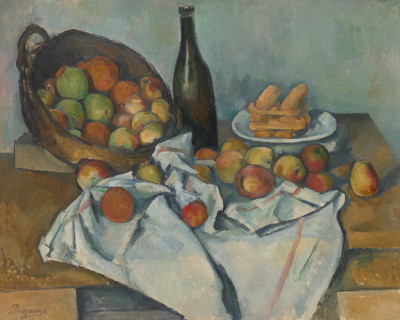
1889–90The Basket of Apples
c.1893Apples and Oranges
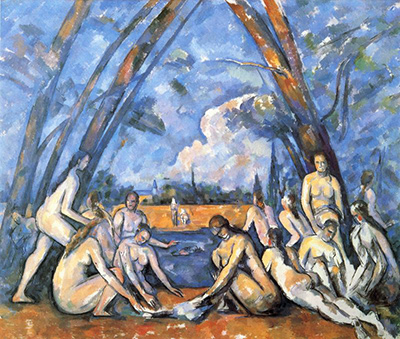
c.1899The Large Bathers (Philadelphia)
1900–1906 (Philadelphia Museum dating)Château Noir (MoMA)
1903–04Contents
- A body held in place
- The studio clue and the sitter's name
- Two portraits, two histories
- An image that stayed available to later artists
A body held in place
The folded arms make a low, blunt diagonal across the portrait. From the man's left shoulder, one sleeve drops toward the centre; the opposite forearm closes the shape from the other side. These overlapping forms occupy much more of the canvas than the comparatively small head. The jacket is painted in brown, grey and olive, but its wide sleeves carry cooler blue marks at their edges. The cuffs and hands interrupt the continuous mass with two pale, angular accents. Because the arms are so close to the viewer, they also make the man's restraint feel physical: he appears seated at a distance from us even though his body fills the frame.
His face resists the calm geometry of his posture. The dark hair curves around an uneven forehead, and the eyes seem to sit at slightly different angles. One cheek rises into light; the other drops into shadow near the moustache. The mouth is a short, sloping set of marks rather than a clearly fixed expression. We can read weariness or guarded attention into it, but neither reading is a fact about the sitter.
Theodore Reff, writing for the 1977 Cézanne: The Late Work exhibition, saw restlessness in the opposed movements of hair and features, checked by the immobility of the arms. That formal tension remains more demonstrable than any diagnosis of the man's feelings. [4]
The room gives little explanation. A blue-grey wall occupies the upper field, darkening around the hair and brightening in broken patches toward the right. A narrow horizontal band runs behind the elbows, but it does not open onto a developed interior. At lower left, wooden shapes sit beside the chair; their cropped appearance makes them easy to miss. The man's white shirt and small blue-grey neckwear supply the brightest area near the centre. They lead the eye from the crossed arms to his face, while the surrounding browns let coat, chair and wall approach one another without completely merging.
The studio clue and the sitter's name
At lower left, a curved brown shape overlaps a pale rectangular edge. Its small oval opening and rounded top contrast with the straight bands behind the sitter. These fragments introduce a second scale of shapes beside the much larger body, drawing attention into a corner that otherwise seems almost empty.
In the 1977 exhibition catalogue, John Rewald identified the back of a stretcher and a palette in this Guggenheim version, elements absent from the companion canvas. He did not establish which portrait was painted first. [4]
A National Gallery of Art exhibition text reports that Cézanne's son called the sitter from Aix “the clock maker.” It also argues that the waistcoat, long hair and suggestion of a tie might suit an artisan better than a farm labourer. [5]
Rewald's 1977 entry, by contrast, says the model was unidentified and that no evidence then supported the occupational nickname. He also could not determine whether the sittings took place in Paris or Aix. [4]
The son's reported name is evidence of a family association, and the clothing invites comparison; neither amounts to a documented trade. The painting can be called Man with Crossed Arms without promoting “clockmaker” into a verified identity.
Two portraits, two histories
The companion canvas, FWN 527, is separately catalogued and slightly shorter than the Guggenheim picture. [3] Rewald noted a changed viewpoint and a shift of the line across the wall. [4]
Repetition makes the wall line particularly revealing: its altered position shifts the balance between head, shoulders and background, even though the sitter holds the same pose.
Ambroise Vollard's records keep the paintings apart. The Guggenheim canvas appears under stockbook numbers 3451 and 4059; the companion is associated with number 3482. The descriptions move between “peasant” and “man,” and between grey-lilac and grey-blue grounds. [1] [3]
FWN 528 appeared at the 1904 Salon d'Automne as Portrait d'Homme . It later belonged to Gottlieb Friedrich Reber and entered the Guggenheim in 1954. The companion remains privately owned. [1] [3]
The generic early exhibition title is apt for a sitter whose name has stayed unknown. The Guggenheim says the 1954 acquisition brought the museum its first Cézanne. [2] Across those fifty years the portrait could be presented as an unnamed man, a supposed clockmaker, or simply a striking example of the painter's late work. Each name directs attention differently; none changes the visible folds of the jacket or the uncomfortable slant of the face.
An image that stayed available to later artists
Roy Lichtenstein made Man with Crossed Arms (Cézanne) in 1962; his catalogue raisonné records it as a work after Cézanne’s portrait. [6]
The response shows how readily another artist could take up this portrait's odd balance of recognisable person and unstable construction. It does not establish that Cézanne intended a future style. The source picture sets a firm crossed-arm silhouette against a face whose marks do not behave like a smooth anatomical diagram. The features offer a structure to quote and transform, while the sitter's name remains outside the image.
Look again at the sitter's two hands. One is pressed into the near sleeve and is relatively clear; the other nearly disappears where sleeve, jacket and chest converge. The shoulders seem solid, but the space behind them remains thin and changeable. The painting continually shifts between weight and uncertainty without losing the man's presence. Its lasting interest lies in how much a portrait can make us see while leaving its subject only partly known.
Cézanne artworks directory
Browse 217 identified works in this researched selection, including paintings, drawings and watercolours. This is a bounded selection, not a complete catalogue of Cézanne’s surviving oeuvre. Unlinked titles have no confirmed article in this collection.
| Name | Date | Medium |
|---|---|---|
| A Head, a Cup, and a Bread Roll | 1891/1894 | Drawing |
| A Man seen from Behind | 1880/1883 | Drawing |
| A Modern Olympia | 1873–74 | Painting |
| A Nude and Foliage | 1879/1882 | Drawing |
| A Smoking Man | 1892–96 (catalogue); c.1890–92 (museum) | Drawing |
| Afternoon in Naples | 1876–77 | Painting |
| An Old Woman with a Rosary | about 1895–96 | Painting |
| Apples and Oranges | c.1899 | Painting |
| Auvers, Panoramic View | 1873–75 | Painting |
| Avenue at Chantilly | 1888 | Painting |
| Banks of the Marne | 1888–94 | Painting |
| Basket | 1877/1900 | Drawing |
| Bather with Outstretched Arms | 1877–78 | Painting |
| Bellows in Front of a Fireplace | 1887/1892 | Drawing |
| Bibémus Quarry | c.1895 | Painting |
| Boy in a Red Vest, Barnes Foundation | 1888–90 | Painting |
| Boy in a Red Vest, MoMA | 1888–90 | Painting |
| Boy in a Red Waistcoat, National Gallery of Art | 1888–90 | Painting |
| Branch in Flower | 1886/1889 | Drawing |
| Carnival Scene | 1885/1888 | Drawing |
| Chair and Dresser | 1880/1883 | Drawing |
| Chateau Noir | 1903–04 | Painting |
| Chestnut Trees and Farm at Jas de Bouffan | c.1885 | Painting |
| Chestnut Trees and Farm at Jas de Bouffan, Pushkin | c.1886 | Painting |
| Chestnut Trees at Jas de Bouffan in Winter | 1885–86 | Painting |
| Château Noir | 1900–04 | Painting |
| Cistern in the Park of Château Noir | c.1900 | Painting |
| Curtain, Jug and Fruit | 1893–94 | Painting |
| Cushion of an Armchair | 1886/1889 | Drawing |
| Draft Letter and Studies of Bathers | c.1878 | Drawing |
| Farmhouse and Chestnut Trees at Jas de Bouffan | 1884–85 | Painting |
| Figure Resting Head on Hand | c. 1889 | Drawing |
| Fireplace Tongs and Poker | 1887/1892 | Drawing |
| Forest Interior, San Francisco | c.1898–99 | Painting |
| Four Bathers | 1888–90 | Painting |
| Fruit and a Jug on a Table | 1893–94 | Painting |
| Gardanne | 1885–86 | Painting |
| Gardanne, Barnes Foundation | c.1885 | Painting |
| Hand and Shoulder of a Boy | c. 1885 | Drawing |
| Harlequin, National Gallery of Art | 1888–90 | Painting |
| Head of a Boy | 1887/1889 | Drawing |
| Head of a Boy Seen from Behind | c. 1885 | Drawing |
| Head of a Young Woman | c. 1880 | Drawing |
| Head of the Artist's Son | 1888/1889 | Drawing |
| Hillside in Provence | c.1890–92 | Painting |
| Horse Chestnut Trees at Jas de Bouffan | c.1885 | Painting |
| House and Farm at the Jas de Bouffan | c.1887 | Painting |
| House in a Park | 1883/1886 | Drawing |
| House in Provence | c.1885 | Painting |
| House of Père Lacroix | 1873 | Painting |
| House Surrounded by Vegetation | 1889/1892 | Drawing |
| Houses in Provence The Riaux Valley near L’Estaque | c.1883 | Painting |
| Jas de Bouffan, the Pool | c.1876 | Painting |
| Kerosene Lamp | 1878/1881 | Drawing |
| L'Estaque, Melting Snow | c.1870 | Painting |
| Lake Annecy | 1896 | Painting |
| Landscape in Provence, Pola Museum | 1879–82 | Painting |
| Landscape Near Aix-en-Provence | 1877/1880 | Drawing |
| Landscape Seen from the Inside of a Cave | 1889/1892 | Drawing |
| Landscape with Poplars | c.1885–87 | Painting |
| Landscape with Trees | 1895/1898 | Drawing |
| Leda and the Swan | c.1880 (possibly later) | Painting |
| Little Girl with a Doll | 1902–04 | Painting |
| Louis Guillaume | 1879–1890 | Painting |
| Madame Cezanne | 1888/1891 | Drawing |
| Madame Cezanne | 1886/1889 | Drawing |
| Madame Cezanne | 1882/1887 | Drawing |
| Madame Cezanne | 1897/1900 | Drawing |
| Madame Cezanne with her Head Lowered | 1893/1896 | Drawing |
| Madame Cézanne in a Red Armchair | c.1877 | Painting |
| Madame Cézanne in a Red Dress, Metropolitan Museum of Art | 1888–90 | Painting |
| Madame Cézanne in a Yellow Chair | 1888–90 | Painting |
| Madame Cézanne in a Yellow Chair, Fondation Beyeler | 1888–90 | Painting |
| Madame Cézanne in the Conservatory | 1891 | Painting |
| Maincy Bridge | 1879–80 | Painting |
| Maison Maria with a View of Château Noir | c.1895 | Painting |
| Man Bending Forward | 1883/1886 | Drawing |
| Man Smoking a Pipe, Pushkin | c.1891, possibly later | Painting |
| Man with a Pipe | 1891–96 | Painting |
| Man with a Pipe, Nelson-Atkins | 1890–92 | Painting |
| Man with a Straw Hat (Gustave Boyer) | c.1871 | Painting |
| Man with Crossed Arms | c.1899 | Painting |
| Man with Pipe, National Gallery of Art | 1892–96 | Painting |
| Mont Sainte-Victoire | c.1902–06 | Painting |
| Mont Sainte-Victoire | 1900–02 | Painting |
| Mont Sainte-Victoire (recto) | c.1895 | Watercolour |
| Mont Sainte-Victoire and the Viaduct of the Arc River Valley | 1882–85 | Painting |
| Mont Sainte-Victoire Seen beyond the Wall of the Jas de Bouffan | c.1885/1888 | Watercolour |
| Mont Sainte-Victoire Seen from Bibémus Quarry | c.1897 | Painting |
| Mont Sainte-Victoire, Barnes Foundation | 1892–95 | Painting |
| Near the Pool at Jas de Bouffan | 1883/1887 | Drawing |
| Pelicans | 1877/1880 | Drawing |
| Peonies | 1890/1893 | Drawing |
| Pierrot and Harlequin | 1888 | Painting |
| Pine Tree | 1882/1885 | Drawing |
| Pont des Trois Sautets | 1906 | Watercolour |
| Poplars | 1879–80 | Painting |
| Portrait of Ambroise Vollard | 1899 | Painting |
| Portrait of Gustave Geffroy | 1895–96 | Painting |
| Portrait of Madame Cezanne with Loosened Hair | 1885–86 | Painting |
| Portrait of the Artist Looking Over His Shoulder | 1883–84 | Painting |
| Portrait of the Gardener Vallier | 1906 | Painting |
| Portrait of Victor Chocquet | 1876–77 | Painting |
| Portrait Of Victor Chocquet Seated | 1877 | Painting |
| Provençal Manor | c.1885 | Painting |
| Pyramid of Skulls | 1898–1900 | Painting |
| Reclining Nude (Leda?) | c.1887 | Painting |
| Scipio | 1866–68 | Painting |
| Seated Man, Oslo | 1898–1900 | Painting |
| Seated Peasant | c.1892–96 | Painting |
| Seated Peasant, Hiroshima | c.1897 | Painting |
| Seated Peasant, Orsay | c.1900 | Painting |
| Self-Portrait | c. 1895 | Drawing |
| Self-Portrait in a Bowler Hat, Ny Carlsberg Glyptotek | 1885–86 | Painting |
| Self-Portrait in a Casquette | c.1875 | Painting |
| Self-Portrait with a Beret | 1898–1900 | Painting |
| Self-Portrait with a Hat, Artizon Museum | c.1890–94 | Painting |
| Self-Portrait with a Pink Background | c.1875 | Painting |
| Self-Portrait with Olive-Coloured Wallpaper | about 1880–81 | Painting |
| Self-Portrait with Palette | 1886–87 | Painting |
| Self-Portrait with White Turban | c.1878–80 | Painting |
| Self-Portrait, c.1895 | c.1895 | Painting |
| Self-Portrait, Pushkin Museum | c.1882 | Painting |
| Spanish Dancers | 1883/1886 | Drawing |
| Still Life with a Curtain | 1892–94 | Painting |
| Still Life with Apples | c.1890 | Painting |
| Still Life with Apples | 1893–94 | Painting |
| Still Life with Apples and a Pot of Primroses | about 1890 | Painting |
| Still Life with Milk Jug and Fruit | c.1900 | Painting |
| Still Life with Open Drawer | 1877–79 | Painting |
| Still Life with Plaster Cupid | about 1894 | Painting |
| Still Life with Skull | 1890–93 | Painting |
| Still Life with Soup Tureen | 1877 | Painting |
| Still Life, Pitcher and Fruit | 1893–94 | Painting |
| Studies Including a Straw Hat | 1895/1898 | Drawing |
| Studies Including Madame Cezanne | 1884/1887 | Drawing |
| Study for "The Judgement of Paris" or "The Amorous Shepherd" | 1883/1886 | Drawing |
| Study for Woman with a Coffee Pot | c.1895 | Painting |
| Study of "The Roman Orator (Germanicus)" | 1883/1886 | Drawing |
| Study of "Venus de Milo" | 1881/1884 | Drawing |
| Study of a Decorative Ornament | 1879/1882 | Drawing |
| Study of a Standing Male Figure after the Antique | c. 1895 | Drawing |
| Study of an Angel in Rubens' "The Prophet Elijah" | 1892/1895 | Drawing |
| Study of Desiderio da Settignano's "Bust of a Child" | c. 1895 | Drawing |
| Study of Houses | 1879/1882 | Drawing |
| Study of Puget's "Hercules Resting" | c. 1879 | Drawing |
| Study of Puget's "Milo of Crotona" | 1895/1898 | Drawing |
| Study of Puget's "Milo of Crotona" | 1880/1883 | Drawing |
| Study of the Allegorical Figure Bellona in Rubens' "The Apotheosis of Henri IV" | 1883/1886 | Drawing |
| Study of the Allegorical Figure Bellona in Rubens' "The Apotheosis of Henri IV" | 1879/1882 | Drawing |
| Study of the Allegorical Figure France in Rubens' "The Exchange of the Two Princesses" | 1882/1885 | Drawing |
| Study of the Allegorical Figure of Health in Rubens' "The Birth of Louis XIII" | 1880/1883 | Drawing |
| Study of the Allegorical Figure of the Genius of Health from Rubens' "The Birth of Louis XIII at Fontainbleau" | 1895/1898 | Drawing |
| Sugar Bowl, Pears and Blue Cup | 1865–66 | Painting |
| The Aqueduct, Pushkin Museum | Dating differs between museum records | Painting |
| The Artist's Father, Reading L'Evenement | autumn 1866 | Painting |
| The Artist's Son | c. 1887 | Drawing |
| The Artist's Son Leaning on his Elbow | c. 1887 | Drawing |
| The Artist's Son Reading | c. 1887 | Drawing |
| The Artist's Son Writing | c. 1887 | Drawing |
| The Artist’s Son, Paul | 1886–87 | Painting |
| The Avenue at Jas de Bouffan | 1868–70 (possibly later) | Painting |
| The Avenue at Jas de Bouffan, Geneva | c.1890 | Painting |
| The Basket of Apples | c.1893 | Painting |
| The Bather, Museum of Modern Art | c.1885 | Painting |
| The Bay of Marseille seen from L'Estaque | c.1885 | Painting |
| The Blue Vase | 1889–90 | Painting |
| The Boy in the Red Vest, Bührle | 1888–90 | Painting |
| The Buffet | 1877–79 | Painting |
| The Card Players, Barnes Foundation | 1890–92 | Painting |
| The Card Players, Courtauld Gallery | 1892–96 | Painting |
| The Card Players, Metropolitan Museum of Art | 1890–92 | Painting |
| The Card Players, Musée d’Orsay | 1893–96 | Painting |
| The Card Players, Qatar | 1892–96 | Painting |
| The Eternal Feminine | c.1877 | Painting |
| The Gardener Vallier | 1906 | Painting |
| The Gardener Vallier, Tate | 1905–06 | Painting |
| The Grounds of the Château Noir | c.1900–04 | Painting |
| The Gulf of Marseille Seen from L’Estaque | c.1885 | Painting |
| The Hanged Man's House in Auvers | c.1873 | Painting |
| The House of Doctor Gachet at Auvers | 1872–73 | Painting |
| The House with the Cracked Walls | 1892–94 | Painting |
| The Kiss of the Muse | c.1860 | Painting |
| The Large Bathers, Barnes Foundation | 1895–1906 | Painting |
| The Large Bathers, National Gallery | 1895–1905 | Painting |
| The Large Bathers, Philadelphia Museum of Art | 1900–06 | Painting |
| The Mill | 1889/1892 | Drawing |
| The Painter’s Father, Louis-Auguste Cézanne | c.1865 | Painting |
| The Peasant | 1890–92 | Painting |
| The Plaster Mill (La Moulin à plâtre) | 1889/1892 | Drawing |
| The Smoker, Hermitage | c.1891 | Painting |
| The Smoker, Mannheim | c.1891 | Painting |
| The Stove in the Studio | c.1865 | Painting |
| The Vase of Tulips | c.1890 | Painting |
| Thistle | 1893/1896 | Drawing |
| Three Heads, One of Madame Cezanne | 1882/1885 | Drawing |
| Three Skulls | c.1898 | Painting |
| Three Skulls on a Patterned Carpet | 1904 | Painting |
| Trees and Shrubs | 1883/1887 | Drawing |
| Turning Road at Montgeroult | 1898 | Painting |
| Two Bathers | 1884/1887 | Drawing |
| Two Heads | 1888 | Drawing |
| Two Heads | 1890/1896 | Drawing |
| Two Heads of Women | 1890/1894 | Drawing |
| Two Studies for "The Judgement of Paris" or "The Amorous Shepherd" | 1883/1886 | Drawing |
| Uncle Dominique in a Tasseled Cap | 1866 | Painting |
| Uncle Dominique in a Turban | 1866–67 | Painting |
| Victor Chocquet and an Angel for "The Apotheosis of Delacroix" | 1878/1880 | Drawing |
| Woman in Blue | c.1904 | Painting |
| Woman Leaning Forward | 1888/1891 | Drawing |
| Woman Leaning Forward | 1890/1894 | Drawing |
| Woman Leaning Forward | 1890/1894 | Drawing |
| Woman with a Coffee Pot | c.1895 | Painting |
| Women Bathers and a Roll of Paper | 1882/1885 | Drawing |
| Young Girl with a Doll | c.1895 | Painting |
| Young Italian Woman at a Table | c.1895–1900 | Painting |
| Young Man and Skull | 1896–98 | Painting |
Frequently Asked Questions
His name has not been established. “The clock maker” is a reported nickname, not proof of his trade. [5]
Yes. Rewald describes another canvas with the sitter in the same pose, viewed from a different angle. [4]
The Solomon R. Guggenheim Museum in New York owns it, under accession number 54.1387. [2]
Discussion
Look again at the images and ideas explored in Man with Crossed Arms by Paul Cézanne. These editorial prompts invite your observations.
Reader Insights
Try following the arms before looking at the face. Does their compact shape make the sitter feel closed to the viewer, or does it simply give the portrait a strong centre?
At the lower left, the cropped wooden objects almost escape notice. How does the room change when you see them as possible studio equipment?
Compare the precise white opening of the shirt with the shifting marks around the eyes. Which part seems to tell you more about the person, and which part remains uncertain?
Join the Conversation
Share a detail, comparison or question about Man with Crossed Arms by Paul Cézanne below.
References
- Société Paul Cézanne , “L'Homme aux bras croisés, c. 1899 (FWN 528),” The Paintings, Watercolors and Drawings of Paul Cezanne: An Online Catalogue Raisonné . View source .
- Solomon R. Guggenheim Museum , “Paul Cézanne: Man with Crossed Arms,” Thannhauser Collection digital wall text , 2020. View source .
- Société Paul Cézanne , “L'Homme aux bras croisés, c. 1899 (FWN 527),” The Paintings, Watercolors and Drawings of Paul Cezanne: An Online Catalogue Raisonné . View source .
- The Museum of Modern Art , Theodore Reff, “Painting and Theory in the Final Decade,” and John Rewald, catalogue entries 5–6, in Cézanne: The Late Work , edited by William Rubin, 1977. View source .
- National Gallery of Art , “Man with Crossed Arms,” in Cézanne Portraits sitter features, 2018; archived 29 March 2025. View source .
- Roy Lichtenstein Foundation , Andrea Theil, “Man with Crossed Arms (Cézanne), 1962 (RLCR 710),” Roy Lichtenstein: A Catalogue Raisonné . View source .
- Le Baiser de la muse, d'après Frillié (FWN 572). View source.
- Louis-Auguste Cezanne, père de l'artiste, lisant L'Événement (FWN 402). View source.
- La Maison du pendu, Auvers-sur-Oise (FWN 81). View source.
- Une moderne Olympia (FWN 628). View source.
- Le Pont de Maincy (FWN 143). View source.
- La Montagne Sainte-Victoire vue de Montbriand (FWN 185). View source.
- Gardanne (vue horizontale) (FWN 224). View source.
- Le Vase bleu (FWN 823). View source.
- Les Joueurs de cartes (FWN 681). View source.
- La Montagne Sainte-Victoire (FWN 296). View source.
- La Corbeille de pommes (FWN 860). View source.
- Pommes et oranges (FWN 871). View source.
- Portrait d'Ambroise Vollard (FWN 531). View source.
- Philadelphia Museum of Art,The Large Bathers,W1937-1-1. View source.
- Château Noir (FWN 360). View source.
- Société Paul Cezanne,online catalogue structure and objectidentification. View source.
- National Gallery of Art,Cezanne Sketchbook,1992.51.9. View source.
- Splash image, The crossed sleeves form a broad central shape beneath the sitter’s tilted face.