



 by
Tom Gurney
Tom Gurney BSc (Hons) is an art history expert with over 20 years experience
Published on June 19, 2020 / Updated on October 22, 2026
Email:
tomgurney1@gmail.com
/ Phone:
+44 7429 011000
Gardanne: Cézanne’s Horizontal View: Introduction
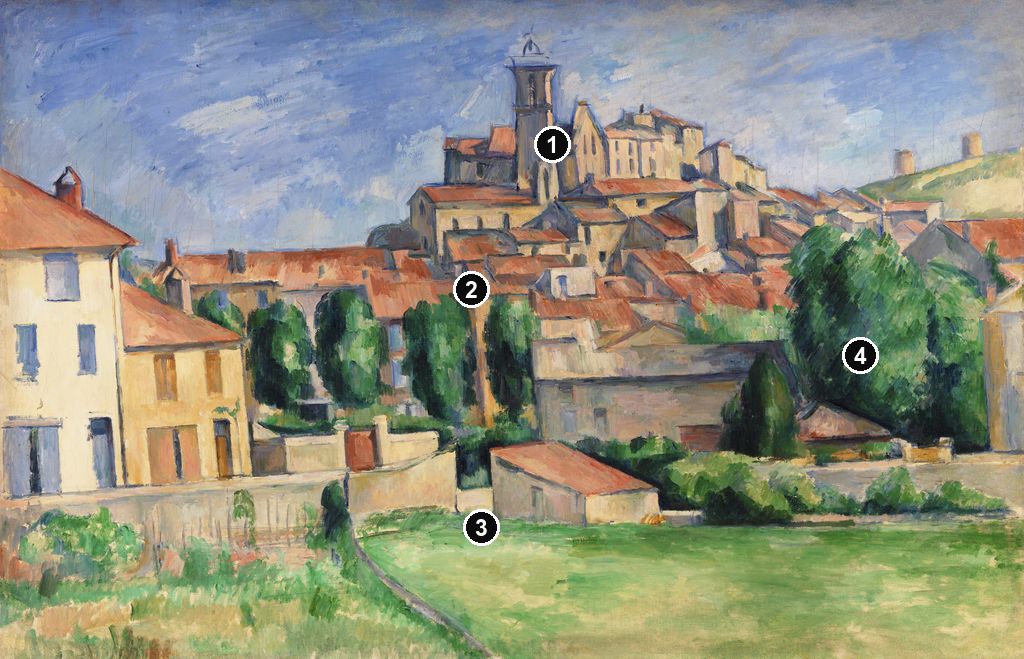
In Cézanne’s Gardanne , the village seems to rise one roof at a time. A pale house at the left anchors the near edge; behind it, red and ochre roofs climb towards a bell tower. At the right, a dark mass of trees interrupts the buildings, while a green field leaves the bottom of the canvas unexpectedly open. The view is recognisable as a place, yet its force comes from the way walls, roofs, foliage and intervals of air lock together across a wide canvas. This is the horizontal Gardanne in the Barnes Foundation, painted around 1885, rather than the taller view now at the Metropolitan Museum of Art. [1] [2]
The painting rewards a slow look because its apparent order is never quite fixed. The tower offers a centre, but the left-hand houses, curving boundary wall and low building in the field pull attention outward. Roofs overlap so closely that one shape becomes the edge of another. Cézanne made a settled town feel like a sequence of decisions about how to join what he saw.
At a Glance
- Artist Paul Cézanne. [1]
- Work Gardanne (Horizontal View) , also catalogued as Gardanne (vue horizontale) , c. 1885; oil on canvas. [1]
- Collection Barnes Foundation, Philadelphia, BF917; catalogue raisonné FWN 224, Rewald 569. [1] [2]
- Size The Barnes gives 65 × 100.3 cm on its public collection page; the catalogue raisonné also records a Barnes measurement of 64.8 × 100.3 cm. [1] [2]
- Place Gardanne, a hill town near Aix-en-Provence, where Cézanne stayed with Hortense Fiquet and their son from summer 1885 to spring 1886. [3]
This work across Paul Cézanne’s career
The Kiss of the Muse
c.1860The Artist’s Father, Reading L’Événement
autumn 1866The Hanged Man’s House
c.1873A Modern Olympia
1873–74Maincy Bridge
1879–80The Blue Vase
1889–90The Basket of Apples
c.1893Apples and Oranges
c.1899The Large Bathers (Philadelphia)
1900–1906 (Philadelphia Museum dating)Château Noir (MoMA)
1903–04Contents
- A town built upward and across
- Gardanne in the 1880s
- What the horizontal view makes possible
- A village seen and remembered
- From the dealer to the Barnes
- Annotated details
A town built upward and across
The Barnes describes a view taken from the east, with the old bell tower holding the centre of a panorama of staggered houses. [3] The width matters. It lets Cézanne set the steep climb of the village against a long sweep of foreground. The hill town occupies the upper middle of the canvas; the nearest field, wall and isolated shed hold the eye at a distance from it. We are made to approach the buildings visually, crossing several kinds of space rather than entering by a painted street.
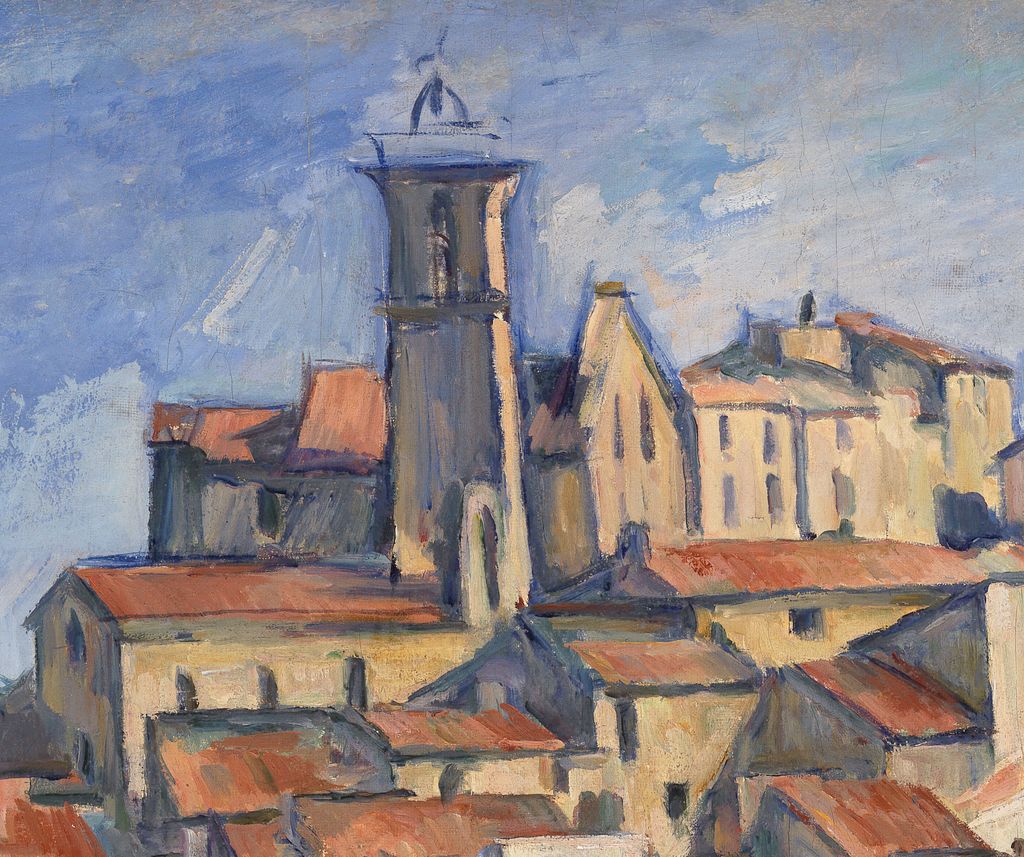
Begin at the tower. Its dark, narrow opening stands against the blue sky, and the masonry below it meets an accumulation of roofs. Some roof slopes are clear orange planes; others are broken into shorter strokes and changing tones. Behind the tower, pale façades catch light. Below it, darker wedges of roofing press against one another. This alternation makes the village legible without spelling out every lane and house. The church is a landmark, but it is also a hinge between vertical ascent and the roofs spreading sideways.
The left edge offers a second structure. A cream-coloured house, cut by the frame, has broad, calm wall planes and a red roof. Beside it a smaller building steps down into a wall, whose pale curve runs towards the green foreground. Farther back, the rounded cypresses or other dense evergreens form a dark rhythm in front of the roofs. Their near-black green makes the orange tiles more emphatic. On the right, the great rounded trees do the opposite of the tower: they conceal part of the settlement. The town is assembled through both disclosure and interruption.
The grass at the bottom is comparatively broad and lightly differentiated. Near the centre, a small red-roofed structure sits low against it, far below the church. That distance in height gives the village its hilltop character more effectively than a diagram of the slope would. It also prevents the rooftops from becoming a decorative pattern with no ground beneath them. As the eye moves from field to wall to trees to houses, depth emerges from overlapping forms and changes of colour, even where conventional perspective gives few firm directions.
Colour helps each part hold its place. The blues of the sky are brushed in broad, shifting passages, while the red roofs gather into a warmer, more densely divided band. Green appears first as the open field, then in the upright row of trees, then as a much heavier rounded shape at the right. Those greens do not simply repeat one another: they set different distances and densities against the masonry. A small pale shed in the lower middle makes the village above feel larger by giving the eye a modest nearby scale. Look from that shed to the church and the building shapes seem to climb, although no single street provides an uninterrupted path to the summit.
Gardanne in the 1880s
Cézanne’s stay belongs to a specific moment in the town’s history. Denis Coutagne describes Gardanne as both agricultural and mining country, close to Aix and connected to the Marseille–Aix railway, which opened through the village in 1877. He records farming and, by 1887, a coal mine employing hundreds of workers, alongside pottery, tile and lime production. [4] The canvas does not show that whole economy. Its chosen view gathers the older, clustered houses around the church and gives the foreground to vegetation and domestic buildings. Knowing the wider setting helps us read that selection as a framed view of Gardanne, not as a complete portrait of a place outside modern change.
The hill itself carried a long history. Coutagne notes medieval remains and a church on the Captivel height mentioned in a charter of 1098. He also observes that the church was later demolished, while its bell tower survived. [4] The tower in the painting therefore had a local identity beyond its usefulness as a compositional accent. Its presence gives the summit an address: this is a village organised around a recognisable structure, even while the painted architecture is compressed and rearranged for the eye.
The Barnes places Cézanne, Hortense Fiquet and their son in Gardanne from the summer of 1885 until spring 1886. [3] Coutagne locates their rented accommodation on the cours Forbin and says the boy attended the village school. [4] Those details establish residence rather than a motive for the painting. The canvas itself gives no domestic episode. Its absence of figures is striking precisely because it shows a lived-in arrangement of houses, boundary walls and cultivated ground. The village appears inhabited through its fabric, while its residents remain outside the scene.
Coutagne quotes a letter Cézanne sent to the collector Victor Chocquet on 11 May 1886, near the end of the Gardanne stay. Cézanne wrote of the pleasure of looking at sky and the unbounded things of nature, and of the richness he found in the country around him. [4] The letter speaks broadly about landscape, not about this canvas; it cannot supply a hidden programme for its roofs or tower. It does, however, put the painter’s attention to the place alongside his own words from the same period. The open sky and foreground vegetation in the picture belong to that attention as surely as the architecture does.
Annotated Details from Gardanne, Horizontal View
The numbered points identify visible features discussed in this article. Return from each detail to the whole composition. Each caption identifies the work shown.
Gardanne, Horizontal View
Paul Cézanne, Gardanne (Horizontal View), about 1885, oil on canvas, 64.8 × 100.3 cm, Barnes Foundation, Philadelphia (BF917; FWN224). Image source. CC0 / Public domain.
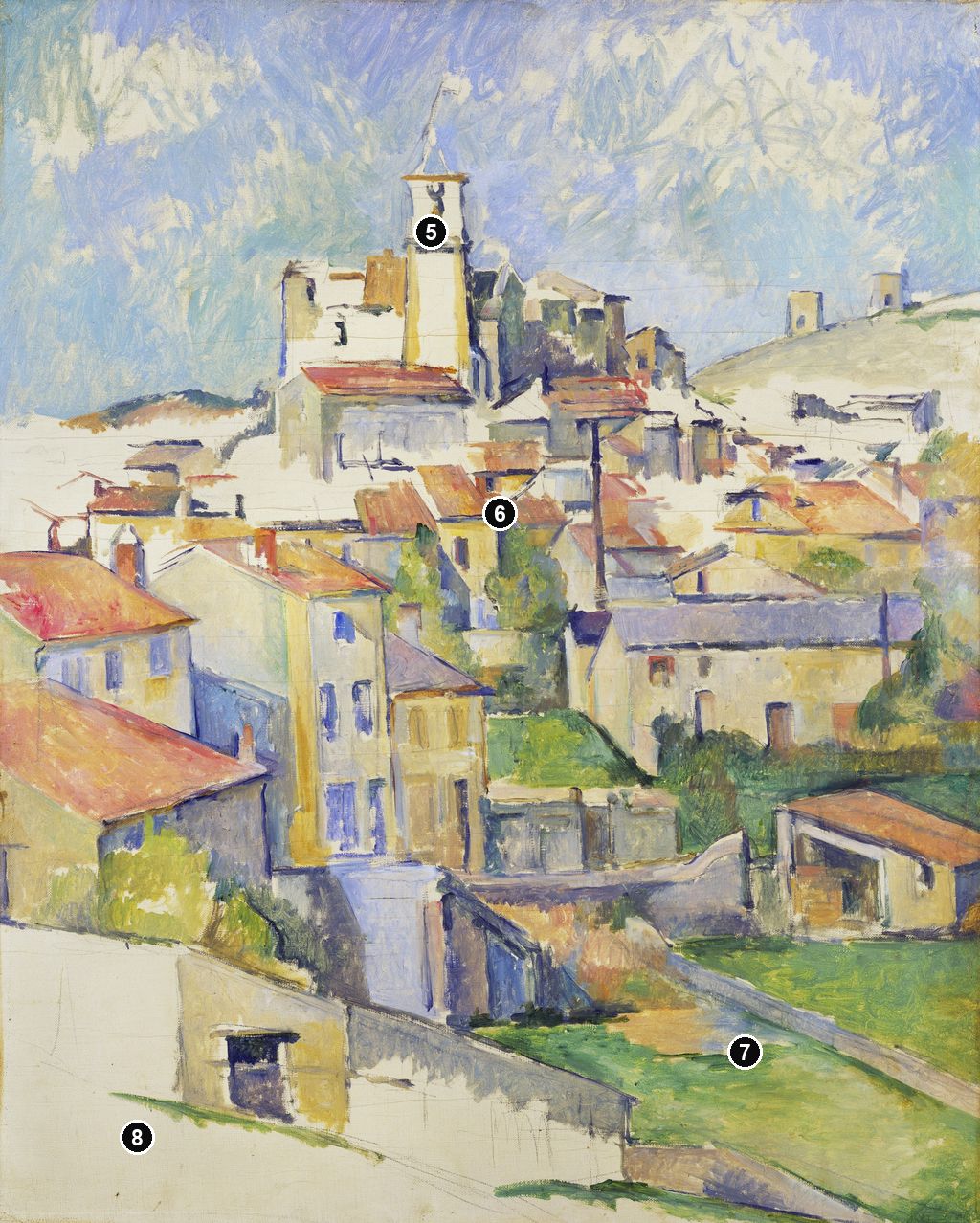
Gardanne — Met vertical view
Paul Cézanne, Gardanne, 1885–86, oil on canvas, 80 × 64.1 cm, Metropolitan Museum of Art, New York (57.181; FWN222). Image source. CC0 / Public domain.
Details from GARDANNE, HORIZONTAL VIEW
Compare the Barnes horizontal view with the Met vertical view. Each painting has its own arrangement of the town, roofs and foreground.
Gardanne, Horizontal View
The bell tower above the houses
The tower rises from the packed roofs and walls. Compare its narrow vertical with the broad horizontal bands below.
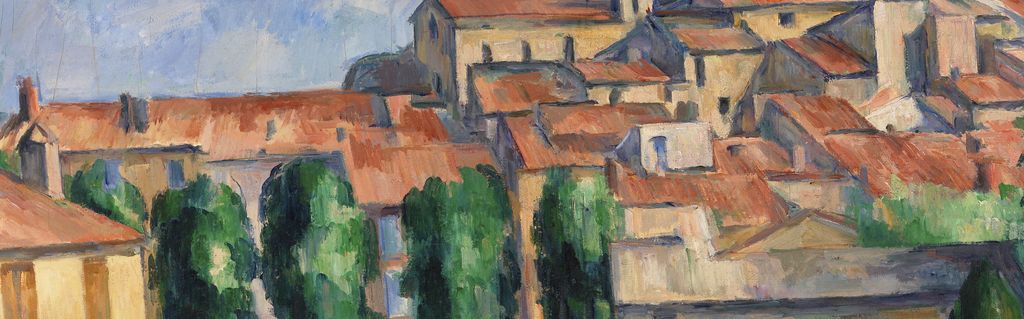
Overlapping roofs and walls
Warm roof planes overlap pale walls. Follow the short dark edges that separate one building from another.
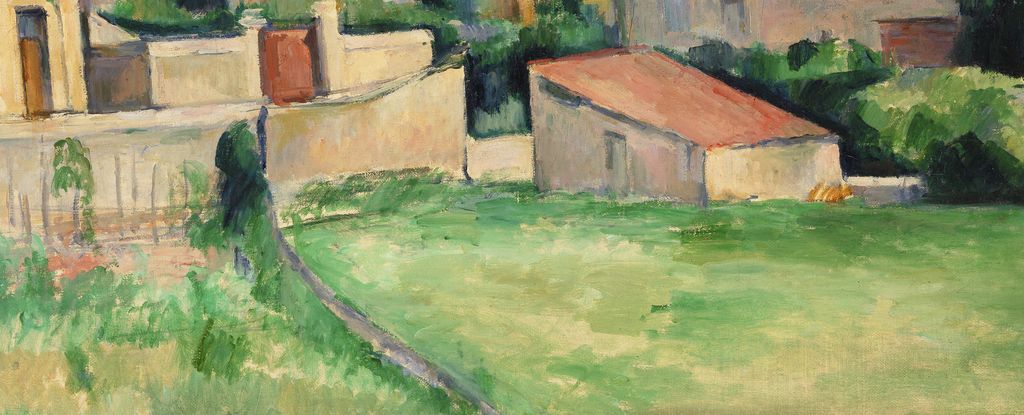
The wall and open foreground
The curving wall and low building border the open green field. Compare this space with the dense village above.
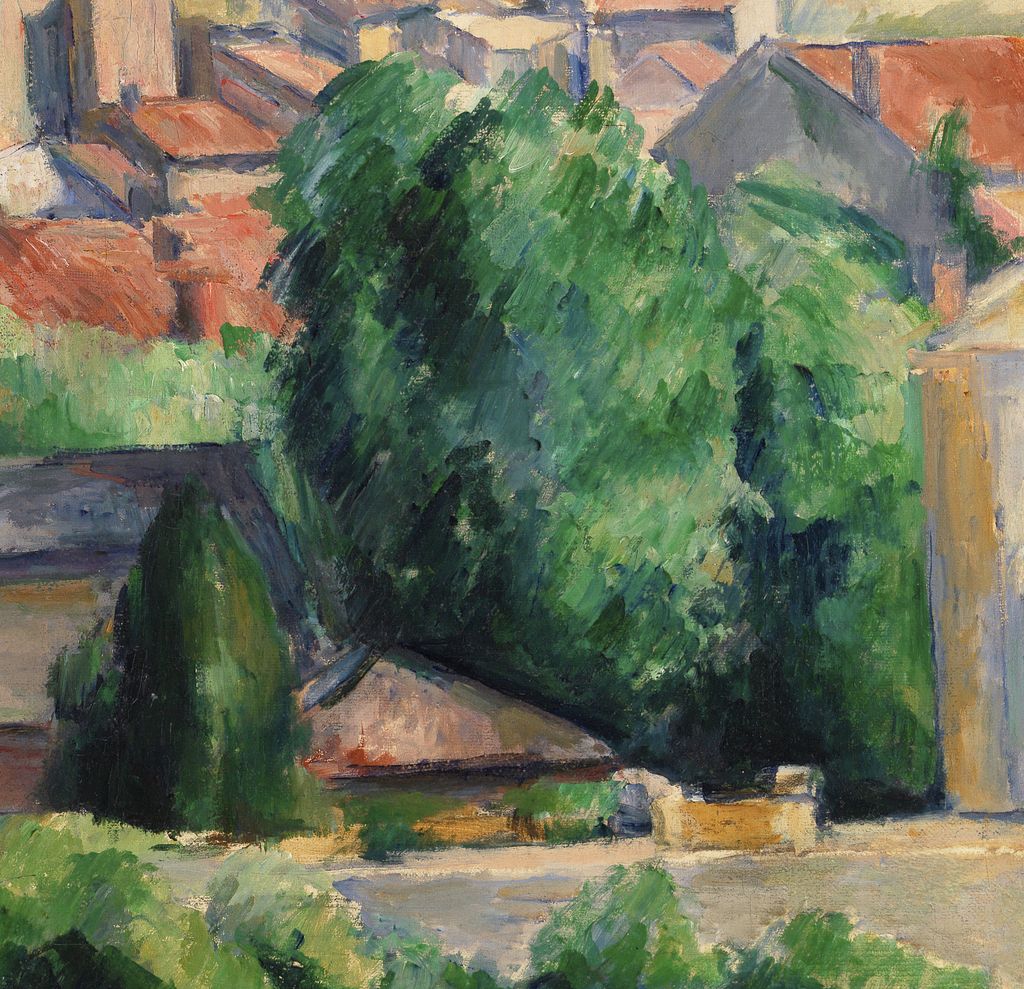
The large trees at right
Blue and green strokes gather into a large tree group. A small warm roof remains visible beneath the foliage.
Gardanne — Met vertical view
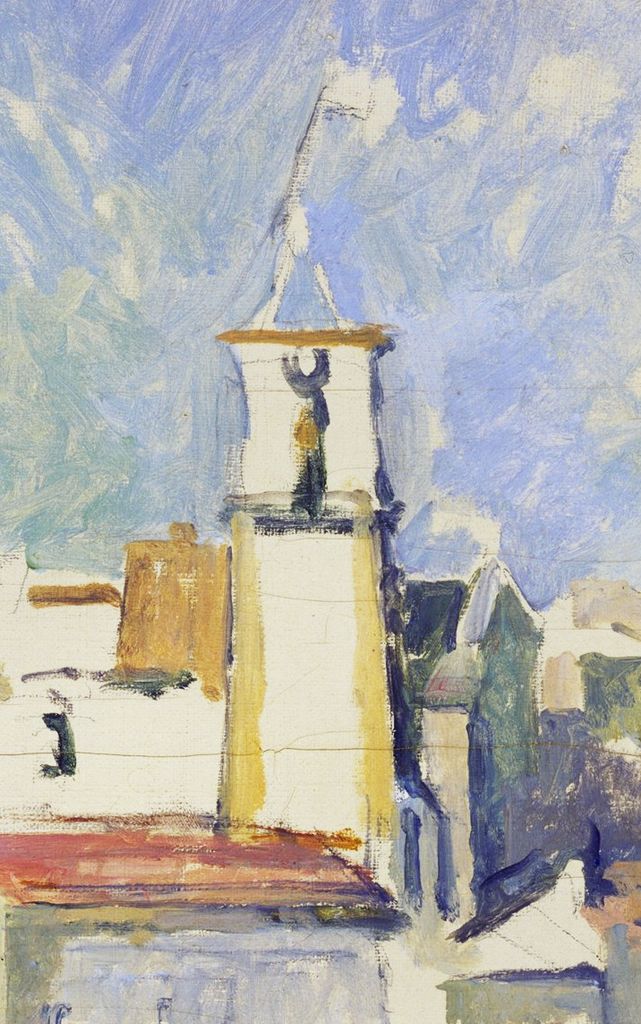
The church tower
The pale tower rises above the surrounding buildings. Its dark opening and thin upper structure interrupt the blue and cream sky.
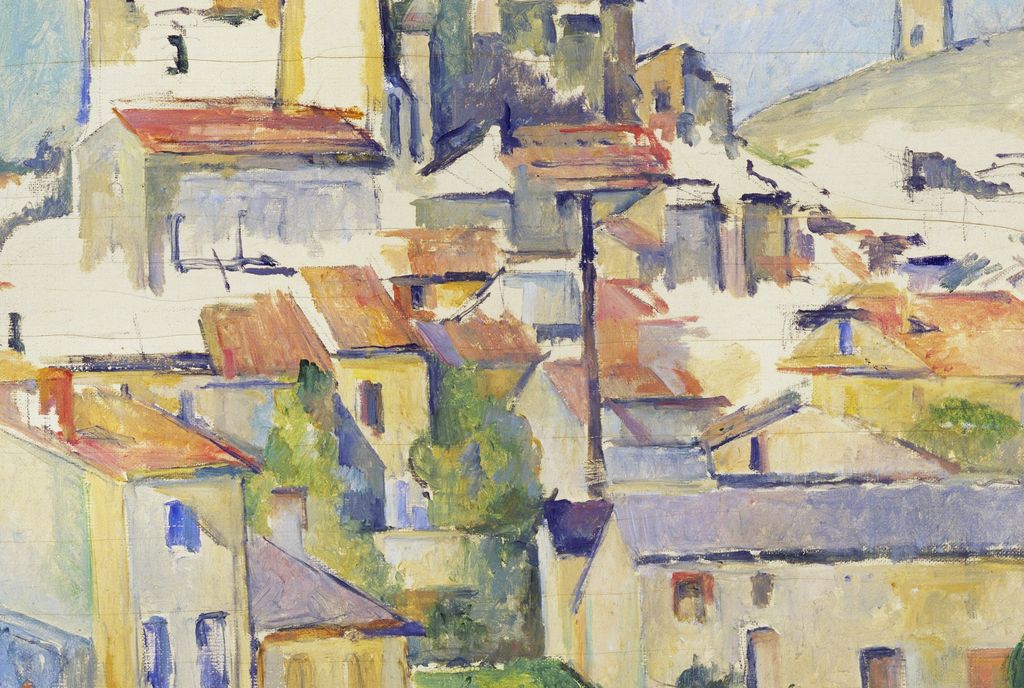
Stepped roofs and walls
Red and orange roof slopes overlap pale walls. Blue-violet edges and dark openings separate the small buildings.
Foreground walls and green ground
Low pale walls divide the foreground. Their diagonals run beside green areas and a warm patch beneath the higher buildings.
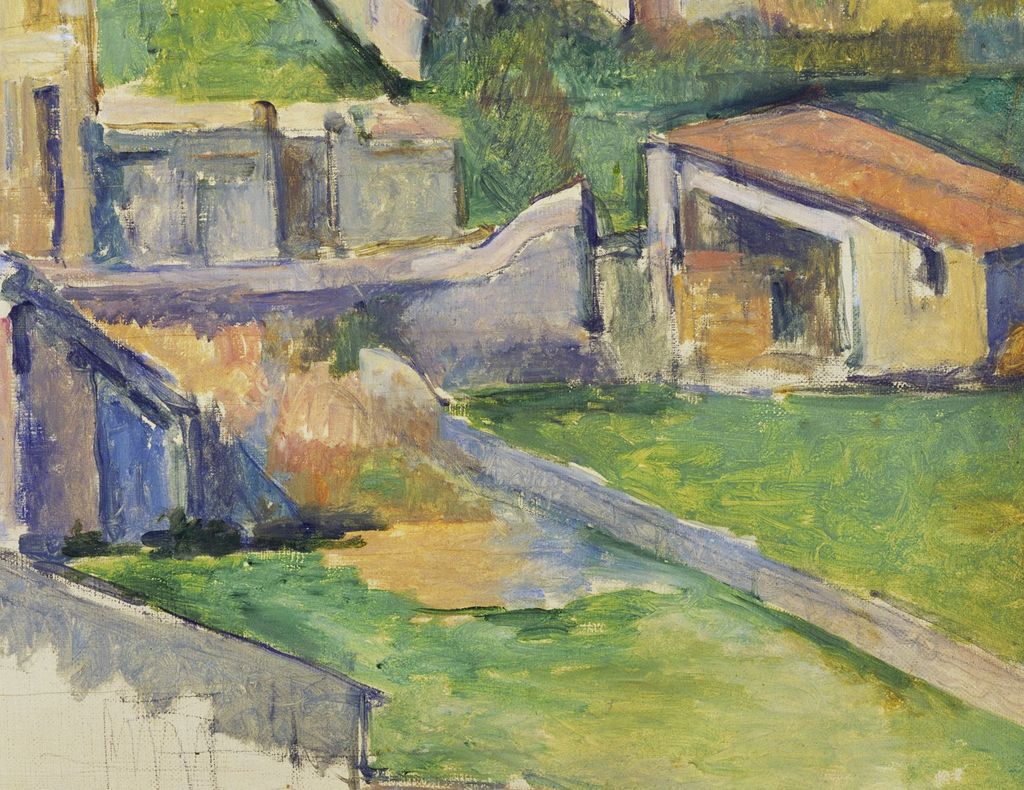
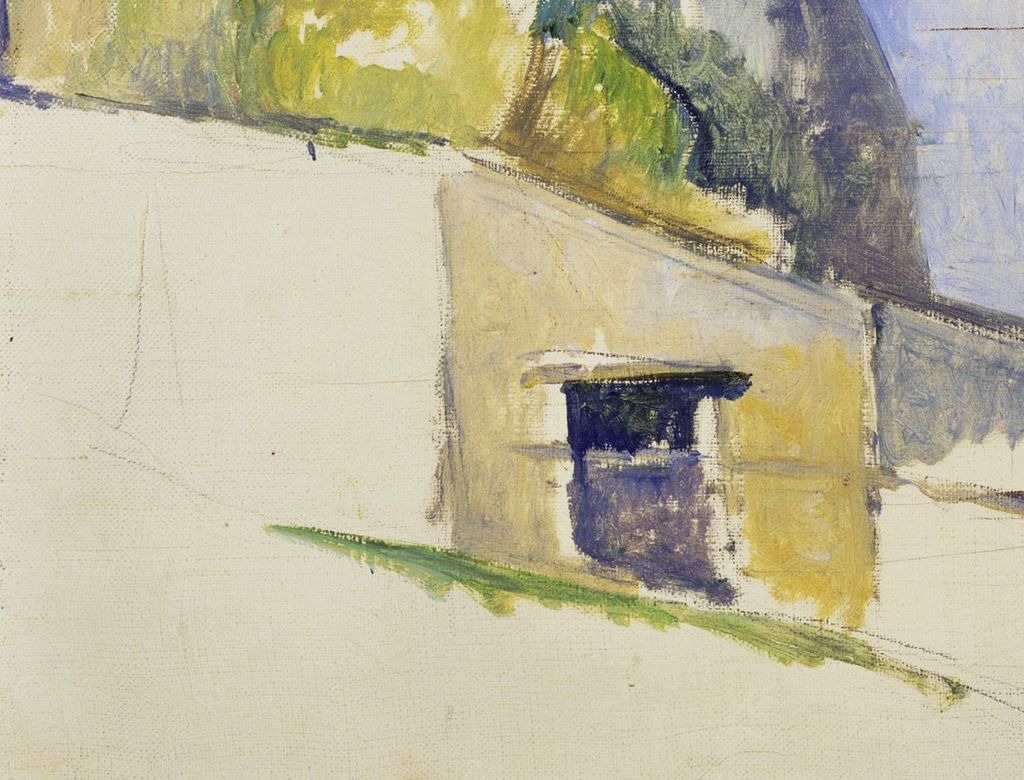
Pale foreground and fine lines
This part of the foreground remains much paler than the houses above. Fine lines cross the light area beside stronger painted edges.
What the horizontal view makes possible
Cézanne painted more than one canvas of the village. The Metropolitan Museum of Art holds a vertical Gardanne , dated 1885–86 by the museum and catalogued as FWN 222, Rewald 570. Its canvas is roughly 80 by 64 centimetres, a markedly different shape from the Barnes panorama. [5] [6] The Met painting brings foreground houses and a winding approach closer to us; pale, open passages remain conspicuous near its lower edge. Its church tower rises amid a steeper stack of architecture. In the Barnes picture the tower is smaller relative to the whole, and the field and trees have enough room to become major partners in the composition.
The comparison is useful because it shows that “Gardanne” is a motif, not a single formula. The two works share a hill town and its steeple, but changing the frame changes the experience of it. One picture asks us to negotiate a tall, close set of houses and roads; the other lets us scan across the settlement, seeing how a foreground field, a row of trees and a roofline meet. A third painted town view, Gardanne (l’après-midi) , is FWN 223, Rewald 571 in the current catalogue; it is a third distinct composition. [6]
Coutagne reads the Gardanne paintings as experiments with different light and times of day. He calls the Barnes view a morning image and contrasts its deliberate treatment of roofs and trees with the looser handling of another town view. [4] The morning attribution is his interpretation of the illumination, not a time written on the canvas. More securely visible is the difference in construction: the Barnes painting gives many roof edges, wall faces and tree masses firm places in a broad design. It uses their separation as carefully as their overlap.
That care does not make every form geometrically simple. Roofs turn at competing angles; a pale wall may merge into a sunlit façade, then break against a dark tree. The eye can trace one convincing piece of masonry and still be uncertain exactly where the next building begins. This is why the usual description of Cézanne as a painter of geometric structure needs looking at the whole surface. The picture remains responsive to foliage, uneven ground, changing colour and partial views. Its architecture provides a way to organise a complex site rather than a set of ready-made cubes.
A village seen and remembered
Gardanne’s old hilltop form has invited different readings. Coutagne emphasises the solid construction of the village and its relation to Cézanne’s surrounding landscapes. He also warns against the local shorthand that Cézanne “invented Cubism” here. [4] Later artists could find important precedents in Cézanne’s treatment of form, but the painting is most revealing when its own specific relationships of roof, wall, tree and field stay in view. An origin story for a later movement flattens those relationships.
Nina Athanassoglou-Kallmyer offers another perspective. In her 2023 study of Cézanne, nostalgia and memory, she places the Barnes Gardanne among images of Provençal “perched villages”: compact settlements of pale houses and red roofs climbing around a church. She relates that pattern to village views Cézanne made in northern France, arguing that familiar forms could call up a remembered homeland even away from Provence. [7] Gardanne is an especially clear point of reference in her larger argument because Cézanne actually lived and worked there. It gives a concrete Provençal example against which to consider the northern pictures.
Her reading and Coutagne’s illuminate different aspects of the same image. A remembered or culturally familiar type of village need not be vague: the Barnes canvas is full of particular edges and intervals. Conversely, a precise view need not exhaust what the place meant within Cézanne’s wider work. The canvas can be read as a studied arrangement of visible forms and as part of a repeated interest in hill towns and church towers. Neither reading establishes what Cézanne privately felt while making this particular picture.
The image itself resists being made timeless. There is no steam train, mine or worker in the scene, though these belonged to Gardanne’s wider nineteenth-century life. [4] There are also no anecdotal signs of a lost age. Its strongest evidence is visual: older buildings are given weight through accumulated planes of paint, and a wide green foreground holds them at a measured distance. The sense of permanence comes from how Cézanne has built the view, not from proof that the village stood outside history.
From the dealer to the Barnes
The painting’s later history shows how its identity travelled under changing names. The current catalogue traces it through Ambroise Vollard, the collector Egisto Fabbri, the dealer Paul Rosenberg and the Barnes Foundation, where it entered in January 1933. Both the Barnes provenance and the catalogue date Fabbri’s purchase to 21 March 1896. [1] The catalogue also lists the canvas in Vollard’s 1895 Cézanne exhibition with the note “Fabbri buys,” which does not sit neatly with that precise 1896 purchase date. It is safest to say that the work was shown by Vollard in 1895 and subsequently belonged to Fabbri, while the exact wording and timing of that transfer remain unsettled in the catalogue record. [1]
Its titles were unsettled too. At a Paris exhibition in 1910 it appeared as Une Bourgade provençale (“A Provençal small town”); at Venice in 1920 as Septemes ; and at Basel in 1921 as Septenne . The catalogue now identifies the site and title as Gardanne (vue horizontale) . [1] Those older labels are more than curiosities. A place name directs attention to a particular town, while a generic Provençal title invites the viewer to read the roofs and tower as a regional type. The painting has accommodated both ways of seeing, and its long exhibition history helps explain why clarity about the exact canvas matters.
What remains constant is the pressure of the composition. The tower is the highest clear marker, but it does not dominate alone. Houses rise toward it, trees partly screen them, and the field lets their weight register from afar. In this horizontal view Cézanne makes a town feel coherent without smoothing away its separate parts: a series of roofs, walls and green masses that the eye can continually put together anew.
Cézanne artworks directory
Browse 217 identified works in this researched selection, including paintings, drawings and watercolours. This is a bounded selection, not a complete catalogue of Cézanne’s surviving oeuvre. Unlinked titles have no confirmed article in this collection.
| Name | Date | Medium |
|---|---|---|
| A Head, a Cup, and a Bread Roll | 1891/1894 | Drawing |
| A Man seen from Behind | 1880/1883 | Drawing |
| A Modern Olympia | 1873–74 | Painting |
| A Nude and Foliage | 1879/1882 | Drawing |
| A Smoking Man | 1892–96 (catalogue); c.1890–92 (museum) | Drawing |
| Afternoon in Naples | 1876–77 | Painting |
| An Old Woman with a Rosary | about 1895–96 | Painting |
| Apples and Oranges | c.1899 | Painting |
| Auvers, Panoramic View | 1873–75 | Painting |
| Avenue at Chantilly | 1888 | Painting |
| Banks of the Marne | 1888–94 | Painting |
| Basket | 1877/1900 | Drawing |
| Bather with Outstretched Arms | 1877–78 | Painting |
| Bellows in Front of a Fireplace | 1887/1892 | Drawing |
| Bibémus Quarry | c.1895 | Painting |
| Boy in a Red Vest, Barnes Foundation | 1888–90 | Painting |
| Boy in a Red Vest, MoMA | 1888–90 | Painting |
| Boy in a Red Waistcoat, National Gallery of Art | 1888–90 | Painting |
| Branch in Flower | 1886/1889 | Drawing |
| Carnival Scene | 1885/1888 | Drawing |
| Chair and Dresser | 1880/1883 | Drawing |
| Chateau Noir | 1903–04 | Painting |
| Chestnut Trees and Farm at Jas de Bouffan | c.1885 | Painting |
| Chestnut Trees and Farm at Jas de Bouffan, Pushkin | c.1886 | Painting |
| Chestnut Trees at Jas de Bouffan in Winter | 1885–86 | Painting |
| Château Noir | 1900–04 | Painting |
| Cistern in the Park of Château Noir | c.1900 | Painting |
| Curtain, Jug and Fruit | 1893–94 | Painting |
| Cushion of an Armchair | 1886/1889 | Drawing |
| Draft Letter and Studies of Bathers | c.1878 | Drawing |
| Farmhouse and Chestnut Trees at Jas de Bouffan | 1884–85 | Painting |
| Figure Resting Head on Hand | c. 1889 | Drawing |
| Fireplace Tongs and Poker | 1887/1892 | Drawing |
| Forest Interior, San Francisco | c.1898–99 | Painting |
| Four Bathers | 1888–90 | Painting |
| Fruit and a Jug on a Table | 1893–94 | Painting |
| Gardanne | 1885–86 | Painting |
| Gardanne, Barnes Foundation | c.1885 | Painting |
| Hand and Shoulder of a Boy | c. 1885 | Drawing |
| Harlequin, National Gallery of Art | 1888–90 | Painting |
| Head of a Boy | 1887/1889 | Drawing |
| Head of a Boy Seen from Behind | c. 1885 | Drawing |
| Head of a Young Woman | c. 1880 | Drawing |
| Head of the Artist's Son | 1888/1889 | Drawing |
| Hillside in Provence | c.1890–92 | Painting |
| Horse Chestnut Trees at Jas de Bouffan | c.1885 | Painting |
| House and Farm at the Jas de Bouffan | c.1887 | Painting |
| House in a Park | 1883/1886 | Drawing |
| House in Provence | c.1885 | Painting |
| House of Père Lacroix | 1873 | Painting |
| House Surrounded by Vegetation | 1889/1892 | Drawing |
| Houses in Provence The Riaux Valley near L’Estaque | c.1883 | Painting |
| Jas de Bouffan, the Pool | c.1876 | Painting |
| Kerosene Lamp | 1878/1881 | Drawing |
| L'Estaque, Melting Snow | c.1870 | Painting |
| Lake Annecy | 1896 | Painting |
| Landscape in Provence, Pola Museum | 1879–82 | Painting |
| Landscape Near Aix-en-Provence | 1877/1880 | Drawing |
| Landscape Seen from the Inside of a Cave | 1889/1892 | Drawing |
| Landscape with Poplars | c.1885–87 | Painting |
| Landscape with Trees | 1895/1898 | Drawing |
| Leda and the Swan | c.1880 (possibly later) | Painting |
| Little Girl with a Doll | 1902–04 | Painting |
| Louis Guillaume | 1879–1890 | Painting |
| Madame Cezanne | 1888/1891 | Drawing |
| Madame Cezanne | 1886/1889 | Drawing |
| Madame Cezanne | 1882/1887 | Drawing |
| Madame Cezanne | 1897/1900 | Drawing |
| Madame Cezanne with her Head Lowered | 1893/1896 | Drawing |
| Madame Cézanne in a Red Armchair | c.1877 | Painting |
| Madame Cézanne in a Red Dress, Metropolitan Museum of Art | 1888–90 | Painting |
| Madame Cézanne in a Yellow Chair | 1888–90 | Painting |
| Madame Cézanne in a Yellow Chair, Fondation Beyeler | 1888–90 | Painting |
| Madame Cézanne in the Conservatory | 1891 | Painting |
| Maincy Bridge | 1879–80 | Painting |
| Maison Maria with a View of Château Noir | c.1895 | Painting |
| Man Bending Forward | 1883/1886 | Drawing |
| Man Smoking a Pipe, Pushkin | c.1891, possibly later | Painting |
| Man with a Pipe | 1891–96 | Painting |
| Man with a Pipe, Nelson-Atkins | 1890–92 | Painting |
| Man with a Straw Hat (Gustave Boyer) | c.1871 | Painting |
| Man with Crossed Arms | c.1899 | Painting |
| Man with Pipe, National Gallery of Art | 1892–96 | Painting |
| Mont Sainte-Victoire | c.1902–06 | Painting |
| Mont Sainte-Victoire | 1900–02 | Painting |
| Mont Sainte-Victoire (recto) | c.1895 | Watercolour |
| Mont Sainte-Victoire and the Viaduct of the Arc River Valley | 1882–85 | Painting |
| Mont Sainte-Victoire Seen beyond the Wall of the Jas de Bouffan | c.1885/1888 | Watercolour |
| Mont Sainte-Victoire Seen from Bibémus Quarry | c.1897 | Painting |
| Mont Sainte-Victoire, Barnes Foundation | 1892–95 | Painting |
| Near the Pool at Jas de Bouffan | 1883/1887 | Drawing |
| Pelicans | 1877/1880 | Drawing |
| Peonies | 1890/1893 | Drawing |
| Pierrot and Harlequin | 1888 | Painting |
| Pine Tree | 1882/1885 | Drawing |
| Pont des Trois Sautets | 1906 | Watercolour |
| Poplars | 1879–80 | Painting |
| Portrait of Ambroise Vollard | 1899 | Painting |
| Portrait of Gustave Geffroy | 1895–96 | Painting |
| Portrait of Madame Cezanne with Loosened Hair | 1885–86 | Painting |
| Portrait of the Artist Looking Over His Shoulder | 1883–84 | Painting |
| Portrait of the Gardener Vallier | 1906 | Painting |
| Portrait of Victor Chocquet | 1876–77 | Painting |
| Portrait Of Victor Chocquet Seated | 1877 | Painting |
| Provençal Manor | c.1885 | Painting |
| Pyramid of Skulls | 1898–1900 | Painting |
| Reclining Nude (Leda?) | c.1887 | Painting |
| Scipio | 1866–68 | Painting |
| Seated Man, Oslo | 1898–1900 | Painting |
| Seated Peasant | c.1892–96 | Painting |
| Seated Peasant, Hiroshima | c.1897 | Painting |
| Seated Peasant, Orsay | c.1900 | Painting |
| Self-Portrait | c. 1895 | Drawing |
| Self-Portrait in a Bowler Hat, Ny Carlsberg Glyptotek | 1885–86 | Painting |
| Self-Portrait in a Casquette | c.1875 | Painting |
| Self-Portrait with a Beret | 1898–1900 | Painting |
| Self-Portrait with a Hat, Artizon Museum | c.1890–94 | Painting |
| Self-Portrait with a Pink Background | c.1875 | Painting |
| Self-Portrait with Olive-Coloured Wallpaper | about 1880–81 | Painting |
| Self-Portrait with Palette | 1886–87 | Painting |
| Self-Portrait with White Turban | c.1878–80 | Painting |
| Self-Portrait, c.1895 | c.1895 | Painting |
| Self-Portrait, Pushkin Museum | c.1882 | Painting |
| Spanish Dancers | 1883/1886 | Drawing |
| Still Life with a Curtain | 1892–94 | Painting |
| Still Life with Apples | c.1890 | Painting |
| Still Life with Apples | 1893–94 | Painting |
| Still Life with Apples and a Pot of Primroses | about 1890 | Painting |
| Still Life with Milk Jug and Fruit | c.1900 | Painting |
| Still Life with Open Drawer | 1877–79 | Painting |
| Still Life with Plaster Cupid | about 1894 | Painting |
| Still Life with Skull | 1890–93 | Painting |
| Still Life with Soup Tureen | 1877 | Painting |
| Still Life, Pitcher and Fruit | 1893–94 | Painting |
| Studies Including a Straw Hat | 1895/1898 | Drawing |
| Studies Including Madame Cezanne | 1884/1887 | Drawing |
| Study for "The Judgement of Paris" or "The Amorous Shepherd" | 1883/1886 | Drawing |
| Study for Woman with a Coffee Pot | c.1895 | Painting |
| Study of "The Roman Orator (Germanicus)" | 1883/1886 | Drawing |
| Study of "Venus de Milo" | 1881/1884 | Drawing |
| Study of a Decorative Ornament | 1879/1882 | Drawing |
| Study of a Standing Male Figure after the Antique | c. 1895 | Drawing |
| Study of an Angel in Rubens' "The Prophet Elijah" | 1892/1895 | Drawing |
| Study of Desiderio da Settignano's "Bust of a Child" | c. 1895 | Drawing |
| Study of Houses | 1879/1882 | Drawing |
| Study of Puget's "Hercules Resting" | c. 1879 | Drawing |
| Study of Puget's "Milo of Crotona" | 1895/1898 | Drawing |
| Study of Puget's "Milo of Crotona" | 1880/1883 | Drawing |
| Study of the Allegorical Figure Bellona in Rubens' "The Apotheosis of Henri IV" | 1883/1886 | Drawing |
| Study of the Allegorical Figure Bellona in Rubens' "The Apotheosis of Henri IV" | 1879/1882 | Drawing |
| Study of the Allegorical Figure France in Rubens' "The Exchange of the Two Princesses" | 1882/1885 | Drawing |
| Study of the Allegorical Figure of Health in Rubens' "The Birth of Louis XIII" | 1880/1883 | Drawing |
| Study of the Allegorical Figure of the Genius of Health from Rubens' "The Birth of Louis XIII at Fontainbleau" | 1895/1898 | Drawing |
| Sugar Bowl, Pears and Blue Cup | 1865–66 | Painting |
| The Aqueduct, Pushkin Museum | Dating differs between museum records | Painting |
| The Artist's Father, Reading L'Evenement | autumn 1866 | Painting |
| The Artist's Son | c. 1887 | Drawing |
| The Artist's Son Leaning on his Elbow | c. 1887 | Drawing |
| The Artist's Son Reading | c. 1887 | Drawing |
| The Artist's Son Writing | c. 1887 | Drawing |
| The Artist’s Son, Paul | 1886–87 | Painting |
| The Avenue at Jas de Bouffan | 1868–70 (possibly later) | Painting |
| The Avenue at Jas de Bouffan, Geneva | c.1890 | Painting |
| The Basket of Apples | c.1893 | Painting |
| The Bather, Museum of Modern Art | c.1885 | Painting |
| The Bay of Marseille seen from L'Estaque | c.1885 | Painting |
| The Blue Vase | 1889–90 | Painting |
| The Boy in the Red Vest, Bührle | 1888–90 | Painting |
| The Buffet | 1877–79 | Painting |
| The Card Players, Barnes Foundation | 1890–92 | Painting |
| The Card Players, Courtauld Gallery | 1892–96 | Painting |
| The Card Players, Metropolitan Museum of Art | 1890–92 | Painting |
| The Card Players, Musée d’Orsay | 1893–96 | Painting |
| The Card Players, Qatar | 1892–96 | Painting |
| The Eternal Feminine | c.1877 | Painting |
| The Gardener Vallier | 1906 | Painting |
| The Gardener Vallier, Tate | 1905–06 | Painting |
| The Grounds of the Château Noir | c.1900–04 | Painting |
| The Gulf of Marseille Seen from L’Estaque | c.1885 | Painting |
| The Hanged Man's House in Auvers | c.1873 | Painting |
| The House of Doctor Gachet at Auvers | 1872–73 | Painting |
| The House with the Cracked Walls | 1892–94 | Painting |
| The Kiss of the Muse | c.1860 | Painting |
| The Large Bathers, Barnes Foundation | 1895–1906 | Painting |
| The Large Bathers, National Gallery | 1895–1905 | Painting |
| The Large Bathers, Philadelphia Museum of Art | 1900–06 | Painting |
| The Mill | 1889/1892 | Drawing |
| The Painter’s Father, Louis-Auguste Cézanne | c.1865 | Painting |
| The Peasant | 1890–92 | Painting |
| The Plaster Mill (La Moulin à plâtre) | 1889/1892 | Drawing |
| The Smoker, Hermitage | c.1891 | Painting |
| The Smoker, Mannheim | c.1891 | Painting |
| The Stove in the Studio | c.1865 | Painting |
| The Vase of Tulips | c.1890 | Painting |
| Thistle | 1893/1896 | Drawing |
| Three Heads, One of Madame Cezanne | 1882/1885 | Drawing |
| Three Skulls | c.1898 | Painting |
| Three Skulls on a Patterned Carpet | 1904 | Painting |
| Trees and Shrubs | 1883/1887 | Drawing |
| Turning Road at Montgeroult | 1898 | Painting |
| Two Bathers | 1884/1887 | Drawing |
| Two Heads | 1888 | Drawing |
| Two Heads | 1890/1896 | Drawing |
| Two Heads of Women | 1890/1894 | Drawing |
| Two Studies for "The Judgement of Paris" or "The Amorous Shepherd" | 1883/1886 | Drawing |
| Uncle Dominique in a Tasseled Cap | 1866 | Painting |
| Uncle Dominique in a Turban | 1866–67 | Painting |
| Victor Chocquet and an Angel for "The Apotheosis of Delacroix" | 1878/1880 | Drawing |
| Woman in Blue | c.1904 | Painting |
| Woman Leaning Forward | 1888/1891 | Drawing |
| Woman Leaning Forward | 1890/1894 | Drawing |
| Woman Leaning Forward | 1890/1894 | Drawing |
| Woman with a Coffee Pot | c.1895 | Painting |
| Women Bathers and a Roll of Paper | 1882/1885 | Drawing |
| Young Girl with a Doll | c.1895 | Painting |
| Young Italian Woman at a Table | c.1895–1900 | Painting |
| Young Man and Skull | 1896–98 | Painting |
Frequently Asked Questions
That phrase overstates what one painting or one visit can prove. Coutagne notes and questions the local claim. The roofs and walls make a fruitful study of Cézanne’s construction of form, but the picture also depends on trees, light, colour and the irregular shape of the town. [4]
Discussion
Look again at the images and ideas explored in Gardanne: Cézanne’s Horizontal View. These editorial prompts invite your observations.
Reader Insights
Follow the curve of the foreground wall before looking up at the tower. How does that route change your sense of the village’s height?
Compare the two largest green passages: the open field and the dense trees at right. One holds the town away from us; the other hides part of it. What would the view lose without either one?
Look at the roofs directly beneath the tower. Which edges belong clearly to one building, and where does Cézanne let adjacent structures share a shape?
Join the Conversation
Share a detail, comparison or question about Gardanne: Cézanne’s Horizontal View below.
References
- Société Paul Cezanne , “Gardanne (vue horizontale), c. 1885 (FWN 224),” The Paintings, Watercolors and Drawings of Paul Cezanne: An Online Catalogue Raisonné . View source .
- Barnes Foundation , “Gardanne (Horizontal View) (Gardanne [vue horizontale]),” collection record, c. 1885. View source .
- Barnes Foundation , “Gardanne (Horizontal View), c. 1885,” Barnes Custom Print Shop , “About the Artwork.”. View source .
- Denis Coutagne , “Gardanne,” Société Paul Cezanne , 7 October 2013 (in French). View source .
- Metropolitan Museum of Art , “Gardanne,” collection record, 1885–86, object 57.181. View source .
- Société Paul Cezanne , Catalogue Concordance , entries for FWN 222, 223 and 224. View source .
- Nina Athanassoglou-Kallmyer , “Cezanne nostalgique: Nostalgia, Memory, Illusion,” Nineteenth-Century Art Worldwide 22, no. 2 (Autumn 2023), reprinted by Société Paul Cezanne. View source .
- Le Baiser de la muse, d'après Frillié (FWN 572). View source.
- Louis-Auguste Cezanne, père de l'artiste, lisant L'Événement (FWN 402). View source.
- La Maison du pendu, Auvers-sur-Oise (FWN 81). View source.
- Une moderne Olympia (FWN 628). View source.
- Le Pont de Maincy (FWN 143). View source.
- La Montagne Sainte-Victoire vue de Montbriand (FWN 185). View source.
- Le Vase bleu (FWN 823). View source.
- Les Joueurs de cartes (FWN 681). View source.
- La Montagne Sainte-Victoire (FWN 296). View source.
- La Corbeille de pommes (FWN 860). View source.
- Pommes et oranges (FWN 871). View source.
- Portrait d'Ambroise Vollard (FWN 531). View source.
- Philadelphia Museum of Art,The Large Bathers,W1937-1-1. View source.
- Château Noir (FWN 360). View source.
- Société Paul Cezanne,online catalogue structure and objectidentification. View source.
- National Gallery of Art,Cezanne Sketchbook,1992.51.9. View source.
- Splash image, Paul Cézanne, Gardanne (Horizontal View), about 1885, oil on canvas, 65 × 100.3 cm in the current Barnes record, Barnes Foundation, Philadelphia (BF917; FWN 224).


