 by
Tom Gurney
Tom Gurney BSc (Hons) is an art history expert with over 20 years experience
Published on June 19, 2020 / Updated on October 22, 2026
Email:
tomgurney1@gmail.com
/ Phone:
+44 7429 011000
The Buffet by Paul Cézanne: Introduction
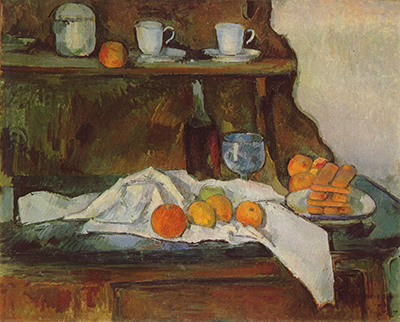
A white cloth tumbles across the dark front of a wooden buffet. Fruit rests in its folds; a bottle and a glass stand behind it; a plate of biscuits occupies the right edge. Above this crowded lower surface, two cups, a sugar bowl and a single piece of fruit sit on a narrow shelf. The familiar objects are easy to name, but the painting keeps shifting our attention between them and the furniture that holds them.
At a Glance
- Artist Paul Cézanne. [1]
- Title The Buffet ( Le Buffet ). [1]
- Date 1877 in the museum record. [1]
- Medium and size Oil on canvas, 65.5 × 81 cm. [1]
- Collection Museum of Fine Arts, Budapest, inventory 371.B. [1]
This work across Paul Cézanne’s career
The Kiss of the Muse
c.1860The Artist’s Father, Reading L’Événement
autumn 1866The Hanged Man’s House
c.1873A Modern Olympia
1873–74The Buffet by Paul Cézanne (current article)
1877 (museum); 1877–79 (catalogue)Maincy Bridge
1879–80The Blue Vase
1889–90The Basket of Apples
c.1893Apples and Oranges
c.1899The Large Bathers (Philadelphia)
1900–1906 (Philadelphia Museum dating)Château Noir (MoMA)
1903–04Contents
- A still life built on two levels
- The date and the place
- Seen and described in Cézanne’s lifetime
- From a private collection to Budapest
A still life built on two levels
The first division to notice is horizontal. A narrow upper shelf almost spans the painting, but the broad lower shelf carries most of its weight. Against the dark brown backing, the upper cups appear pale and comparatively isolated. Below, cloth, fruit, glass, bottle and biscuits form a much denser band. The eye rises to the cups, drops to the fruit, then returns to the shelf edge that divides the two groups. The buffet is an active part of the arrangement: its long dark lines give the scattered objects a framework.
The white cloth resists that framework. It bunches into a crest near the middle, snakes around the fruit and drops over the front at the right. Its lower corner points toward the viewer while the shelf behind it runs sideways. The cloth therefore gives the composition a direction that the furniture alone would lack. A fruit at the front left sits against one of its pale folds; more fruit stretches toward the glass. Small changes of colour and overlap make the group legible without turning it into a neat row.
At the far right, the plate of biscuits projects beyond the main cluster. It looks almost precariously close to the edge, yet its pale oval answers the pale folds farther left. Behind the plate, the buffet's right side turns sharply downward into a dark vertical border. Looking from one end of the painting to the other, one can follow alternating patches of white, orange and brown. The plate pulls that sequence to the very edge, where the painted furniture finally closes it.
Judit Geskó, writing for the Budapest museum, reads the picture as a balance of asymmetry and symmetry. She describes the bottle as a link between the levels and contrasts the apparent weights of porcelain, glass, cloth and biscuits. Her account names a tension between their casual placement and the arrangement that holds them together. [1]
The date and the place
The painting has acquired several dates. Venturi’s original catalogue placed it in 1873–77 and his revision around 1877. Cézanne’s son annotated a Vollard photograph with L’Estaque and 1883. Rewald and the current online catalogue favour 1877–79. The son's annotation and scholarly datings differ; the canvas itself carries no date. The work is FWN 746, corresponding to R 338 and V 208. [2]
The 1913 sale catalogue, meanwhile, assigned it an approximate date of 1880. [3]
The museum places the still life at L’Estaque, near Marseille, and situates it in Cézanne’s lighter work of the 1870s. Geskó connects such paintings with his study of Chardin and Spanish painting. That history gives the buffet context: an ordinary domestic setup becomes an exercise in arrangement. Its construction helps us read it despite the uncertain date. [1]
A useful comparison is Cézanne’s Still Life with Jar, Cup, and Apples at the Metropolitan Museum of Art, dated about 1877. The Met notes that its patterned background and white napkin shape that composition; the Budapest picture sets its objects against a substantial piece of dark furniture. Both canvases ask the eye to move between fruit, vessels and cloth, but their settings produce different rhythms. The Met picture lets pattern occupy the backdrop, whereas The Buffet uses the shelf itself to separate an upper and a lower register. [4]
Seen and described in Cézanne’s lifetime
The painting appeared in Ambroise Vollard’s Paris exhibition of 1899 as Buffet avec Fruits et Gateaux . [2]
Writing in Le Temps on 16 November 1899, François Thiébault-Sisson discussed Cézanne’s still lifes through examples of a bottle, a tilted cup and a pile of biscuits. Those details closely resemble this canvas, although the review’s discussion is not a secure description of this picture alone. The critic praised the force and colour of individual objects while questioning their perspective. Today the same uncertain alignments can be read as part of the composition’s restless visual order, rather than simply as an error to forgive. [5]
Vollard's stockbooks describe the work closely. One entry has fruit on a cloth and biscuits below, with cups and a sugar bowl above; a second records the buffet and apples. These inventories identify the arrangement across changes of owner and title. The two shelves and their contents give a more precise description than Still Life . [2]
From a private collection to Budapest
In 1913 the Nemes collection sale in Paris listed the painting as lot 86. Its description located apples and pears in a white napkin beside a bottle and stemmed glass, with biscuits on a plate to the right and cups and a sugar bowl on the shelf above. The sale catalogue dated it around 1880 and recorded earlier displays in Budapest and Düsseldorf. Reading that entry beside the painting is revealing: a commercial description could identify almost every object, yet it could not convey the long dark planes, the abrupt drop of cloth or the way the plate presses against the right edge. [3]
The catalogue traces an earlier route from Vollard to Denys Cochin, back to Vollard, then to Marczell de Nemes. [2]
A contemporary notice in Kunstchronik says Mór Lipót Herzog acquired the painting at the 1913 sale for 40,000 francs and that the painter Baron Ferenc Hatvany donated it to the museum in 1917. The notice treated the gift as filling a gap in the museum’s modern collection. Its language shows that the gift was understood as more than an addition to an already settled group of French pictures. [6]
A second Kunstchronik report that June named The Buffet alongside works by Corot, Delacroix, Manet and Monet in the museum's developing modern French holdings. It described director Elek Petrovics's interest in acquisitions significant to European art history. The painting's new public home belonged to a deliberate programme of collecting, with the gift adding a Cézanne to an emerging group. The two notices mark stages in its transition from private collection to public display. [6]
The museum included the picture in its 2012–13 Cézanne and the Past exhibition, which examined the artist's engagement with earlier art. [7]
A contemporary review reports that The Buffet had been restored for that exhibition and that its display helped prompt a reorganisation of the museum’s late nineteenth-century galleries. The same canvas that entered as a conspicuous addition to the modern collection became a point around which the museum reconsidered its presentation of that collection. The restoration and new display are specific events in the work's public history, long after the sales and gifts that brought it to Budapest. [8]
Cézanne artworks directory
Browse 217 identified works in this researched selection, including paintings, drawings and watercolours. This is a bounded selection, not a complete catalogue of Cézanne’s surviving oeuvre. Unlinked titles have no confirmed article in this collection.
| Name | Date | Medium |
|---|---|---|
| A Head, a Cup, and a Bread Roll | 1891/1894 | Drawing |
| A Man seen from Behind | 1880/1883 | Drawing |
| A Modern Olympia | 1873–74 | Painting |
| A Nude and Foliage | 1879/1882 | Drawing |
| A Smoking Man | 1892–96 (catalogue); c.1890–92 (museum) | Drawing |
| Afternoon in Naples | 1876–77 | Painting |
| An Old Woman with a Rosary | about 1895–96 | Painting |
| Apples and Oranges | c.1899 | Painting |
| Auvers, Panoramic View | 1873–75 | Painting |
| Avenue at Chantilly | 1888 | Painting |
| Banks of the Marne | 1888–94 | Painting |
| Basket | 1877/1900 | Drawing |
| Bather with Outstretched Arms | 1877–78 | Painting |
| Bellows in Front of a Fireplace | 1887/1892 | Drawing |
| Bibémus Quarry | c.1895 | Painting |
| Boy in a Red Vest, Barnes Foundation | 1888–90 | Painting |
| Boy in a Red Vest, MoMA | 1888–90 | Painting |
| Boy in a Red Waistcoat, National Gallery of Art | 1888–90 | Painting |
| Branch in Flower | 1886/1889 | Drawing |
| Carnival Scene | 1885/1888 | Drawing |
| Chair and Dresser | 1880/1883 | Drawing |
| Chateau Noir | 1903–04 | Painting |
| Chestnut Trees and Farm at Jas de Bouffan | c.1885 | Painting |
| Chestnut Trees and Farm at Jas de Bouffan, Pushkin | c.1886 | Painting |
| Chestnut Trees at Jas de Bouffan in Winter | 1885–86 | Painting |
| Château Noir | 1900–04 | Painting |
| Cistern in the Park of Château Noir | c.1900 | Painting |
| Curtain, Jug and Fruit | 1893–94 | Painting |
| Cushion of an Armchair | 1886/1889 | Drawing |
| Draft Letter and Studies of Bathers | c.1878 | Drawing |
| Farmhouse and Chestnut Trees at Jas de Bouffan | 1884–85 | Painting |
| Figure Resting Head on Hand | c. 1889 | Drawing |
| Fireplace Tongs and Poker | 1887/1892 | Drawing |
| Forest Interior, San Francisco | c.1898–99 | Painting |
| Four Bathers | 1888–90 | Painting |
| Fruit and a Jug on a Table | 1893–94 | Painting |
| Gardanne | 1885–86 | Painting |
| Gardanne, Barnes Foundation | c.1885 | Painting |
| Hand and Shoulder of a Boy | c. 1885 | Drawing |
| Harlequin, National Gallery of Art | 1888–90 | Painting |
| Head of a Boy | 1887/1889 | Drawing |
| Head of a Boy Seen from Behind | c. 1885 | Drawing |
| Head of a Young Woman | c. 1880 | Drawing |
| Head of the Artist's Son | 1888/1889 | Drawing |
| Hillside in Provence | c.1890–92 | Painting |
| Horse Chestnut Trees at Jas de Bouffan | c.1885 | Painting |
| House and Farm at the Jas de Bouffan | c.1887 | Painting |
| House in a Park | 1883/1886 | Drawing |
| House in Provence | c.1885 | Painting |
| House of Père Lacroix | 1873 | Painting |
| House Surrounded by Vegetation | 1889/1892 | Drawing |
| Houses in Provence The Riaux Valley near L’Estaque | c.1883 | Painting |
| Jas de Bouffan, the Pool | c.1876 | Painting |
| Kerosene Lamp | 1878/1881 | Drawing |
| L'Estaque, Melting Snow | c.1870 | Painting |
| Lake Annecy | 1896 | Painting |
| Landscape in Provence, Pola Museum | 1879–82 | Painting |
| Landscape Near Aix-en-Provence | 1877/1880 | Drawing |
| Landscape Seen from the Inside of a Cave | 1889/1892 | Drawing |
| Landscape with Poplars | c.1885–87 | Painting |
| Landscape with Trees | 1895/1898 | Drawing |
| Leda and the Swan | c.1880 (possibly later) | Painting |
| Little Girl with a Doll | 1902–04 | Painting |
| Louis Guillaume | 1879–1890 | Painting |
| Madame Cezanne | 1888/1891 | Drawing |
| Madame Cezanne | 1886/1889 | Drawing |
| Madame Cezanne | 1882/1887 | Drawing |
| Madame Cezanne | 1897/1900 | Drawing |
| Madame Cezanne with her Head Lowered | 1893/1896 | Drawing |
| Madame Cézanne in a Red Armchair | c.1877 | Painting |
| Madame Cézanne in a Red Dress, Metropolitan Museum of Art | 1888–90 | Painting |
| Madame Cézanne in a Yellow Chair | 1888–90 | Painting |
| Madame Cézanne in a Yellow Chair, Fondation Beyeler | 1888–90 | Painting |
| Madame Cézanne in the Conservatory | 1891 | Painting |
| Maincy Bridge | 1879–80 | Painting |
| Maison Maria with a View of Château Noir | c.1895 | Painting |
| Man Bending Forward | 1883/1886 | Drawing |
| Man Smoking a Pipe, Pushkin | c.1891, possibly later | Painting |
| Man with a Pipe | 1891–96 | Painting |
| Man with a Pipe, Nelson-Atkins | 1890–92 | Painting |
| Man with a Straw Hat (Gustave Boyer) | c.1871 | Painting |
| Man with Crossed Arms | c.1899 | Painting |
| Man with Pipe, National Gallery of Art | 1892–96 | Painting |
| Mont Sainte-Victoire | c.1902–06 | Painting |
| Mont Sainte-Victoire | 1900–02 | Painting |
| Mont Sainte-Victoire (recto) | c.1895 | Watercolour |
| Mont Sainte-Victoire and the Viaduct of the Arc River Valley | 1882–85 | Painting |
| Mont Sainte-Victoire Seen beyond the Wall of the Jas de Bouffan | c.1885/1888 | Watercolour |
| Mont Sainte-Victoire Seen from Bibémus Quarry | c.1897 | Painting |
| Mont Sainte-Victoire, Barnes Foundation | 1892–95 | Painting |
| Near the Pool at Jas de Bouffan | 1883/1887 | Drawing |
| Pelicans | 1877/1880 | Drawing |
| Peonies | 1890/1893 | Drawing |
| Pierrot and Harlequin | 1888 | Painting |
| Pine Tree | 1882/1885 | Drawing |
| Pont des Trois Sautets | 1906 | Watercolour |
| Poplars | 1879–80 | Painting |
| Portrait of Ambroise Vollard | 1899 | Painting |
| Portrait of Gustave Geffroy | 1895–96 | Painting |
| Portrait of Madame Cezanne with Loosened Hair | 1885–86 | Painting |
| Portrait of the Artist Looking Over His Shoulder | 1883–84 | Painting |
| Portrait of the Gardener Vallier | 1906 | Painting |
| Portrait of Victor Chocquet | 1876–77 | Painting |
| Portrait Of Victor Chocquet Seated | 1877 | Painting |
| Provençal Manor | c.1885 | Painting |
| Pyramid of Skulls | 1898–1900 | Painting |
| Reclining Nude (Leda?) | c.1887 | Painting |
| Scipio | 1866–68 | Painting |
| Seated Man, Oslo | 1898–1900 | Painting |
| Seated Peasant | c.1892–96 | Painting |
| Seated Peasant, Hiroshima | c.1897 | Painting |
| Seated Peasant, Orsay | c.1900 | Painting |
| Self-Portrait | c. 1895 | Drawing |
| Self-Portrait in a Bowler Hat, Ny Carlsberg Glyptotek | 1885–86 | Painting |
| Self-Portrait in a Casquette | c.1875 | Painting |
| Self-Portrait with a Beret | 1898–1900 | Painting |
| Self-Portrait with a Hat, Artizon Museum | c.1890–94 | Painting |
| Self-Portrait with a Pink Background | c.1875 | Painting |
| Self-Portrait with Olive-Coloured Wallpaper | about 1880–81 | Painting |
| Self-Portrait with Palette | 1886–87 | Painting |
| Self-Portrait with White Turban | c.1878–80 | Painting |
| Self-Portrait, c.1895 | c.1895 | Painting |
| Self-Portrait, Pushkin Museum | c.1882 | Painting |
| Spanish Dancers | 1883/1886 | Drawing |
| Still Life with a Curtain | 1892–94 | Painting |
| Still Life with Apples | c.1890 | Painting |
| Still Life with Apples | 1893–94 | Painting |
| Still Life with Apples and a Pot of Primroses | about 1890 | Painting |
| Still Life with Milk Jug and Fruit | c.1900 | Painting |
| Still Life with Open Drawer | 1877–79 | Painting |
| Still Life with Plaster Cupid | about 1894 | Painting |
| Still Life with Skull | 1890–93 | Painting |
| Still Life with Soup Tureen | 1877 | Painting |
| Still Life, Pitcher and Fruit | 1893–94 | Painting |
| Studies Including a Straw Hat | 1895/1898 | Drawing |
| Studies Including Madame Cezanne | 1884/1887 | Drawing |
| Study for "The Judgement of Paris" or "The Amorous Shepherd" | 1883/1886 | Drawing |
| Study for Woman with a Coffee Pot | c.1895 | Painting |
| Study of "The Roman Orator (Germanicus)" | 1883/1886 | Drawing |
| Study of "Venus de Milo" | 1881/1884 | Drawing |
| Study of a Decorative Ornament | 1879/1882 | Drawing |
| Study of a Standing Male Figure after the Antique | c. 1895 | Drawing |
| Study of an Angel in Rubens' "The Prophet Elijah" | 1892/1895 | Drawing |
| Study of Desiderio da Settignano's "Bust of a Child" | c. 1895 | Drawing |
| Study of Houses | 1879/1882 | Drawing |
| Study of Puget's "Hercules Resting" | c. 1879 | Drawing |
| Study of Puget's "Milo of Crotona" | 1895/1898 | Drawing |
| Study of Puget's "Milo of Crotona" | 1880/1883 | Drawing |
| Study of the Allegorical Figure Bellona in Rubens' "The Apotheosis of Henri IV" | 1883/1886 | Drawing |
| Study of the Allegorical Figure Bellona in Rubens' "The Apotheosis of Henri IV" | 1879/1882 | Drawing |
| Study of the Allegorical Figure France in Rubens' "The Exchange of the Two Princesses" | 1882/1885 | Drawing |
| Study of the Allegorical Figure of Health in Rubens' "The Birth of Louis XIII" | 1880/1883 | Drawing |
| Study of the Allegorical Figure of the Genius of Health from Rubens' "The Birth of Louis XIII at Fontainbleau" | 1895/1898 | Drawing |
| Sugar Bowl, Pears and Blue Cup | 1865–66 | Painting |
| The Aqueduct, Pushkin Museum | Dating differs between museum records | Painting |
| The Artist's Father, Reading L'Evenement | autumn 1866 | Painting |
| The Artist's Son | c. 1887 | Drawing |
| The Artist's Son Leaning on his Elbow | c. 1887 | Drawing |
| The Artist's Son Reading | c. 1887 | Drawing |
| The Artist's Son Writing | c. 1887 | Drawing |
| The Artist’s Son, Paul | 1886–87 | Painting |
| The Avenue at Jas de Bouffan | 1868–70 (possibly later) | Painting |
| The Avenue at Jas de Bouffan, Geneva | c.1890 | Painting |
| The Basket of Apples | c.1893 | Painting |
| The Bather, Museum of Modern Art | c.1885 | Painting |
| The Bay of Marseille seen from L'Estaque | c.1885 | Painting |
| The Blue Vase | 1889–90 | Painting |
| The Boy in the Red Vest, Bührle | 1888–90 | Painting |
| The Buffet | 1877–79 | Painting |
| The Card Players, Barnes Foundation | 1890–92 | Painting |
| The Card Players, Courtauld Gallery | 1892–96 | Painting |
| The Card Players, Metropolitan Museum of Art | 1890–92 | Painting |
| The Card Players, Musée d’Orsay | 1893–96 | Painting |
| The Card Players, Qatar | 1892–96 | Painting |
| The Eternal Feminine | c.1877 | Painting |
| The Gardener Vallier | 1906 | Painting |
| The Gardener Vallier, Tate | 1905–06 | Painting |
| The Grounds of the Château Noir | c.1900–04 | Painting |
| The Gulf of Marseille Seen from L’Estaque | c.1885 | Painting |
| The Hanged Man's House in Auvers | c.1873 | Painting |
| The House of Doctor Gachet at Auvers | 1872–73 | Painting |
| The House with the Cracked Walls | 1892–94 | Painting |
| The Kiss of the Muse | c.1860 | Painting |
| The Large Bathers, Barnes Foundation | 1895–1906 | Painting |
| The Large Bathers, National Gallery | 1895–1905 | Painting |
| The Large Bathers, Philadelphia Museum of Art | 1900–06 | Painting |
| The Mill | 1889/1892 | Drawing |
| The Painter’s Father, Louis-Auguste Cézanne | c.1865 | Painting |
| The Peasant | 1890–92 | Painting |
| The Plaster Mill (La Moulin à plâtre) | 1889/1892 | Drawing |
| The Smoker, Hermitage | c.1891 | Painting |
| The Smoker, Mannheim | c.1891 | Painting |
| The Stove in the Studio | c.1865 | Painting |
| The Vase of Tulips | c.1890 | Painting |
| Thistle | 1893/1896 | Drawing |
| Three Heads, One of Madame Cezanne | 1882/1885 | Drawing |
| Three Skulls | c.1898 | Painting |
| Three Skulls on a Patterned Carpet | 1904 | Painting |
| Trees and Shrubs | 1883/1887 | Drawing |
| Turning Road at Montgeroult | 1898 | Painting |
| Two Bathers | 1884/1887 | Drawing |
| Two Heads | 1888 | Drawing |
| Two Heads | 1890/1896 | Drawing |
| Two Heads of Women | 1890/1894 | Drawing |
| Two Studies for "The Judgement of Paris" or "The Amorous Shepherd" | 1883/1886 | Drawing |
| Uncle Dominique in a Tasseled Cap | 1866 | Painting |
| Uncle Dominique in a Turban | 1866–67 | Painting |
| Victor Chocquet and an Angel for "The Apotheosis of Delacroix" | 1878/1880 | Drawing |
| Woman in Blue | c.1904 | Painting |
| Woman Leaning Forward | 1888/1891 | Drawing |
| Woman Leaning Forward | 1890/1894 | Drawing |
| Woman Leaning Forward | 1890/1894 | Drawing |
| Woman with a Coffee Pot | c.1895 | Painting |
| Women Bathers and a Roll of Paper | 1882/1885 | Drawing |
| Young Girl with a Doll | c.1895 | Painting |
| Young Italian Woman at a Table | c.1895–1900 | Painting |
| Young Man and Skull | 1896–98 | Painting |
Frequently Asked Questions
It belongs to the Museum of Fine Arts, Budapest, where it is recorded as inventory 371.B. [2]
Fruit lies in a white cloth beside a bottle and glass; a plate of biscuits sits to the right. Cups, a sugar bowl and a piece of fruit occupy the upper shelf. The 1913 sale catalogue identifies the fruit as apples and pears. [3]
Discussion
Look again at the images and ideas explored in The Buffet by Paul Cézanne. These editorial prompts invite your observations.
Reader Insights
Begin with the shelf edges, then follow the cloth across them. The furniture appears firm until the fabric cuts across its orderly lines.
Compare the nearly empty upper shelf with the crowded lower one. How does the white cloth change the space occupied by the fruit?
Look at the plate on the right after studying the fruit at the centre. Its position makes the limits of the buffet feel unusually important.
Join the Conversation
Share a detail, comparison or question about The Buffet by Paul Cézanne below.
References
- Museum of Fine Arts, Budapest , Judit Geskó, “The Buffet,” museum object text and details, via Google Arts & Culture. View source .
- Société Paul Cezanne , “Le Buffet, 1877–79 (FWN 746),” The Paintings, Watercolors and Drawings of Paul Cezanne: An Online Catalogue Raisonné . View source .
- Galerie Manzi-Joyant , Collection Marczell de Nemes de Budapest , Paris sale catalogue, 18 June 1913, lot 86, p. 41 of digitised PDF (in French). View source .
- The Metropolitan Museum of Art , “Still Life with Jar, Cup, and Apples,” collection entry. View source .
- Le Temps , François Thiébault-Sisson, “Un isolé du groupe impressionniste, Cezanne,” 16 November 1899, p. 2, reproduced by Société Cézanne (in French). View source .
- Kunstchronik , “Sammlungen: Das Museum der bildenden Künste in Budapest,” new series 28, no. 29, 20 April 1917, col. 304; further museum collections notice, no. 38, 29 June 1917, col. 428 (in German). View source .
- Museum of Fine Arts, Budapest , “Cézanne and the Past: Tradition and Creativity,” exhibition account reproduced by Société Cézanne, 2012 (in English). View source .
- Hungarian Review , “Cézanne Did Not Make Mistakes: Notes on the Cézanne Exhibition in Budapest,” 2013. View source .
- Le Baiser de la muse, d'après Frillié (FWN 572). View source.
- Louis-Auguste Cezanne, père de l'artiste, lisant L'Événement (FWN 402). View source.
- La Maison du pendu, Auvers-sur-Oise (FWN 81). View source.
- Une moderne Olympia (FWN 628). View source.
- Le Pont de Maincy (FWN 143). View source.
- La Montagne Sainte-Victoire vue de Montbriand (FWN 185). View source.
- Gardanne (vue horizontale) (FWN 224). View source.
- Le Vase bleu (FWN 823). View source.
- Les Joueurs de cartes (FWN 681). View source.
- La Montagne Sainte-Victoire (FWN 296). View source.
- La Corbeille de pommes (FWN 860). View source.
- Pommes et oranges (FWN 871). View source.
- Portrait d'Ambroise Vollard (FWN 531). View source.
- Philadelphia Museum of Art,The Large Bathers,W1937-1-1. View source.
- Château Noir (FWN 360). View source.
- Société Paul Cezanne,online catalogue structure and objectidentification. View source.
- National Gallery of Art,Cezanne Sketchbook,1992.51.9. View source.
- Splash image, The Buffet. Museum of Fine Arts, Budapest.