 by
Tom Gurney
Tom Gurney BSc (Hons) is an art history expert with over 20 years experience
Published on June 19, 2020 / Updated on October 22, 2026
Email:
tomgurney1@gmail.com
/ Phone:
+44 7429 011000
Maison Maria with a View of Château Noir: Introduction
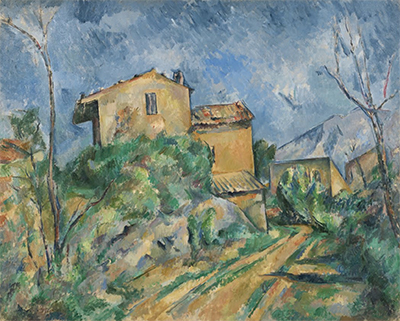
A pale ochre house rises above an uneven track, while another building and a pointed mountain appear beyond it. In Maison Maria with a View of Château Noir , Paul Cézanne lets the road carry the eye into the landscape, then sets the upright walls against a sky that seems almost as solid as the buildings.
The painting belongs to a place near Aix-en-Provence that he returned to repeatedly. The Kimbell Art Museum dates this canvas to about 1895 and identifies it as an oil painting measuring 65 by 81 centimetres. [1]
The online catalogue gives the French title La Maison Maria sur la route du Château Noir . [2]
At a Glance
- Artist Paul Cézanne. [1]
- Date about 1895. [1]
- Medium and size oil on canvas, 65 × 81 cm. [1]
- Collection Kimbell Art Museum, Fort Worth, accession AP 1982.05; catalogue number FWN 309. [2]
- Subject Maison Maria beside a road, with Château Noir and Mont Sainte-Victoire in the distance. [3]
This work across Paul Cézanne’s career
The Kiss of the Muse
c.1860The Artist’s Father, Reading L’Événement
autumn 1866The Hanged Man’s House
c.1873A Modern Olympia
1873–74Maincy Bridge
1879–80The Blue Vase
1889–90The Basket of Apples
c.1893Apples and Oranges
c.1899The Large Bathers (Philadelphia)
1900–1906 (Philadelphia Museum dating)Château Noir (MoMA)
1903–04Contents
- A road that does several things at once
- Two buildings, one mountain
- Sky, trees and the edges of forms
- A known site and a changing title
- From an earlier house picture to this one
A road that does several things at once
The track begins broadly at the lower edge, divided into warm bands by green and blue strokes. It narrows toward the right, but its direction is hardly a smooth invitation to walk away. A raised bank interrupts it on the left, and the right-hand vegetation presses into its bend. The eye follows one diagonal, then another, encountering the light wall of the house before it can settle on the opening beyond. Here Cézanne makes travel through space feel like a series of adjustments rather than a straight line toward a vanishing point.
Look at the lower centre: the ochre road and its green borders remain recognisable as earth and plants, yet their strokes also make a fan of slanting marks across the picture surface. The brushwork does not merely colour in a pre-existing path. It gives the foreground a rhythm that continues into the sloped bank, where cream, blue-grey and green patches turn rough ground into a succession of shallow planes. At a distance these touches join into a hillside; close up, each keeps its own edge.
The house answers those diagonals with near-vertical walls. Even this apparent anchor is slightly unsettled. Its front and side do not offer a simple box viewed from one fixed point, and the roof angles toward the upper left. A smaller orange block projects behind it. Seen together, the two warm masses rise out of vegetation that partly conceals their bases. The landscape does not provide a neat foundation for architecture; building and hillside overlap, each defining the other's outline.
Two buildings, one mountain
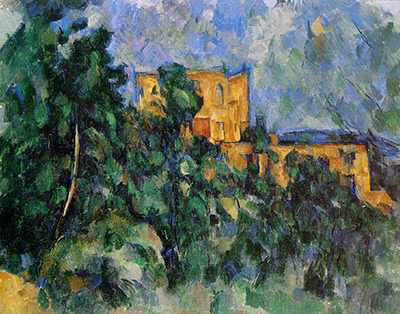
The smaller building at the right is Château Noir, not a second wing of Maison Maria. John Rewald described the approach through the trees to the wider path near Maison Maria, where the west wing of Château Noir came into view. His study also records a photograph of this motif when the painting was still in a Lausanne private collection. [4] That topography helps explain why the title combines a nearby house with a distant one. Cézanne chose a position from which the structures could be seen together, although their physical separation remains legible in the painted gap between them.
Farther back, Mont Sainte-Victoire appears as a cool triangular ridge, partly absorbed into the blue of the sky. It is easy to overlook because the large ochre house carries more immediate weight. Once noticed, the mountain changes the scale of the scene: the little building at right becomes an intermediate step between the foreground dwelling and a much longer horizon.
Pavel Machotka, writing specifically about this canvas, points to the visual continuity between road and mountain and to the contrast of ochre walls with blue sky. [3]
Sky, trees and the edges of forms
The blue sky is crossed by pale, short marks and darker passages. Against it the yellow walls look bright, although grey and green strokes interrupt the façade. This high contrast counterweights the earthy diagonal below.
Machotka reads this exchange of warm and cool colours as part of the canvas's sustained tension; his account is an interpretation of the design, not a claim about a measured pigment recipe. [3]
The bare trunks at either edge act differently from the buildings. The left one rises almost the full height of the frame, thin enough to let the bank and house remain visible through its branches. On the right, another trunk forks across the sky beside the distant view. They mark the picture's edges without closing it like a curtain. The branching marks also echo the fractured strokes in the bushes below, so that the top and bottom of the painting share a restless texture.
Colour crosses several boundaries without sealing each object inside a tidy contour. Here a blue-grey touch can belong to sky, shadow, or foliage depending on its neighbours. The wall's outline is firmer, yet green strokes climb into it and the roof tiles are broken into small shifts of red and blue. These local ambiguities matter because they keep the scene observed and constructed at the same time: the viewer can identify a house immediately, then spend much longer following how its painted edges are made.
A known site and a changing title
Château Noir was a nineteenth-century complex near the road between Aix and Le Tholonet, with the building that appears in this view only one part of the larger site. Rewald described its Gothic details and unfinished features, and later recalled working with the painter Léo Marchutz to locate Cézanne's viewpoints around the estate. He also noted that Marchutz subsequently lived in Maison Maria. [4] These later investigations help locate the motif; they cannot tell us exactly what Cézanne intended every passage of colour to mean.
The title has a history of its own. The catalogue lists Landscape , The Road to Château Noir and Houses at a Turn in the Road among its alternatives. Rewald dated the canvas to about 1895; Venturi proposed later ranges, while Rivière assigned an earlier year. [2] The present circa 1895 date remains an estimate.
Vollard's stockbook described a southern landscape in green and red with a château-like form above; an archival photograph carries Cézanne's son's note “Tholonet 1892–97.” [2] These records preserve earlier ways of locating and naming the work, without fixing a precise year of execution.
From an earlier house picture to this one
The Kimbell compares the composition with Cézanne's The Hanged Man's House , painted at Auvers-sur-Oise and shown at the first Impressionist exhibition in 1874. [1] The Musée d'Orsay describes that earlier picture as a network of paths, bank and branches converging around closely packed planes. [5] Both pictures make a modest dwelling the centre of a difficult landscape route, yet the comparison becomes more useful when we attend to what has changed.
The work's ownership and exhibition record gives another kind of movement. The catalogue traces it from Vollard through Marczell de Nemes, the Pellerin family and George Embiricos to the Kimbell in 1982. It also records its showing in the Philadelphia stop of the 1995–96 Cézanne retrospective. [2]
Cézanne artworks directory
Browse 217 identified works in this researched selection, including paintings, drawings and watercolours. This is a bounded selection, not a complete catalogue of Cézanne’s surviving oeuvre. Unlinked titles have no confirmed article in this collection.
| Name | Date | Medium |
|---|---|---|
| A Head, a Cup, and a Bread Roll | 1891/1894 | Drawing |
| A Man seen from Behind | 1880/1883 | Drawing |
| A Modern Olympia | 1873–74 | Painting |
| A Nude and Foliage | 1879/1882 | Drawing |
| A Smoking Man | 1892–96 (catalogue); c.1890–92 (museum) | Drawing |
| Afternoon in Naples | 1876–77 | Painting |
| An Old Woman with a Rosary | about 1895–96 | Painting |
| Apples and Oranges | c.1899 | Painting |
| Auvers, Panoramic View | 1873–75 | Painting |
| Avenue at Chantilly | 1888 | Painting |
| Banks of the Marne | 1888–94 | Painting |
| Basket | 1877/1900 | Drawing |
| Bather with Outstretched Arms | 1877–78 | Painting |
| Bellows in Front of a Fireplace | 1887/1892 | Drawing |
| Bibémus Quarry | c.1895 | Painting |
| Boy in a Red Vest, Barnes Foundation | 1888–90 | Painting |
| Boy in a Red Vest, MoMA | 1888–90 | Painting |
| Boy in a Red Waistcoat, National Gallery of Art | 1888–90 | Painting |
| Branch in Flower | 1886/1889 | Drawing |
| Carnival Scene | 1885/1888 | Drawing |
| Chair and Dresser | 1880/1883 | Drawing |
| Chateau Noir | 1903–04 | Painting |
| Chestnut Trees and Farm at Jas de Bouffan | c.1885 | Painting |
| Chestnut Trees and Farm at Jas de Bouffan, Pushkin | c.1886 | Painting |
| Chestnut Trees at Jas de Bouffan in Winter | 1885–86 | Painting |
| Château Noir | 1900–04 | Painting |
| Cistern in the Park of Château Noir | c.1900 | Painting |
| Curtain, Jug and Fruit | 1893–94 | Painting |
| Cushion of an Armchair | 1886/1889 | Drawing |
| Draft Letter and Studies of Bathers | c.1878 | Drawing |
| Farmhouse and Chestnut Trees at Jas de Bouffan | 1884–85 | Painting |
| Figure Resting Head on Hand | c. 1889 | Drawing |
| Fireplace Tongs and Poker | 1887/1892 | Drawing |
| Forest Interior, San Francisco | c.1898–99 | Painting |
| Four Bathers | 1888–90 | Painting |
| Fruit and a Jug on a Table | 1893–94 | Painting |
| Gardanne | 1885–86 | Painting |
| Gardanne, Barnes Foundation | c.1885 | Painting |
| Hand and Shoulder of a Boy | c. 1885 | Drawing |
| Harlequin, National Gallery of Art | 1888–90 | Painting |
| Head of a Boy | 1887/1889 | Drawing |
| Head of a Boy Seen from Behind | c. 1885 | Drawing |
| Head of a Young Woman | c. 1880 | Drawing |
| Head of the Artist's Son | 1888/1889 | Drawing |
| Hillside in Provence | c.1890–92 | Painting |
| Horse Chestnut Trees at Jas de Bouffan | c.1885 | Painting |
| House and Farm at the Jas de Bouffan | c.1887 | Painting |
| House in a Park | 1883/1886 | Drawing |
| House in Provence | c.1885 | Painting |
| House of Père Lacroix | 1873 | Painting |
| House Surrounded by Vegetation | 1889/1892 | Drawing |
| Houses in Provence The Riaux Valley near L’Estaque | c.1883 | Painting |
| Jas de Bouffan, the Pool | c.1876 | Painting |
| Kerosene Lamp | 1878/1881 | Drawing |
| L'Estaque, Melting Snow | c.1870 | Painting |
| Lake Annecy | 1896 | Painting |
| Landscape in Provence, Pola Museum | 1879–82 | Painting |
| Landscape Near Aix-en-Provence | 1877/1880 | Drawing |
| Landscape Seen from the Inside of a Cave | 1889/1892 | Drawing |
| Landscape with Poplars | c.1885–87 | Painting |
| Landscape with Trees | 1895/1898 | Drawing |
| Leda and the Swan | c.1880 (possibly later) | Painting |
| Little Girl with a Doll | 1902–04 | Painting |
| Louis Guillaume | 1879–1890 | Painting |
| Madame Cezanne | 1888/1891 | Drawing |
| Madame Cezanne | 1886/1889 | Drawing |
| Madame Cezanne | 1882/1887 | Drawing |
| Madame Cezanne | 1897/1900 | Drawing |
| Madame Cezanne with her Head Lowered | 1893/1896 | Drawing |
| Madame Cézanne in a Red Armchair | c.1877 | Painting |
| Madame Cézanne in a Red Dress, Metropolitan Museum of Art | 1888–90 | Painting |
| Madame Cézanne in a Yellow Chair | 1888–90 | Painting |
| Madame Cézanne in a Yellow Chair, Fondation Beyeler | 1888–90 | Painting |
| Madame Cézanne in the Conservatory | 1891 | Painting |
| Maincy Bridge | 1879–80 | Painting |
| Maison Maria with a View of Château Noir | c.1895 | Painting |
| Man Bending Forward | 1883/1886 | Drawing |
| Man Smoking a Pipe, Pushkin | c.1891, possibly later | Painting |
| Man with a Pipe | 1891–96 | Painting |
| Man with a Pipe, Nelson-Atkins | 1890–92 | Painting |
| Man with a Straw Hat (Gustave Boyer) | c.1871 | Painting |
| Man with Crossed Arms | c.1899 | Painting |
| Man with Pipe, National Gallery of Art | 1892–96 | Painting |
| Mont Sainte-Victoire | c.1902–06 | Painting |
| Mont Sainte-Victoire | 1900–02 | Painting |
| Mont Sainte-Victoire (recto) | c.1895 | Watercolour |
| Mont Sainte-Victoire and the Viaduct of the Arc River Valley | 1882–85 | Painting |
| Mont Sainte-Victoire Seen beyond the Wall of the Jas de Bouffan | c.1885/1888 | Watercolour |
| Mont Sainte-Victoire Seen from Bibémus Quarry | c.1897 | Painting |
| Mont Sainte-Victoire, Barnes Foundation | 1892–95 | Painting |
| Near the Pool at Jas de Bouffan | 1883/1887 | Drawing |
| Pelicans | 1877/1880 | Drawing |
| Peonies | 1890/1893 | Drawing |
| Pierrot and Harlequin | 1888 | Painting |
| Pine Tree | 1882/1885 | Drawing |
| Pont des Trois Sautets | 1906 | Watercolour |
| Poplars | 1879–80 | Painting |
| Portrait of Ambroise Vollard | 1899 | Painting |
| Portrait of Gustave Geffroy | 1895–96 | Painting |
| Portrait of Madame Cezanne with Loosened Hair | 1885–86 | Painting |
| Portrait of the Artist Looking Over His Shoulder | 1883–84 | Painting |
| Portrait of the Gardener Vallier | 1906 | Painting |
| Portrait of Victor Chocquet | 1876–77 | Painting |
| Portrait Of Victor Chocquet Seated | 1877 | Painting |
| Provençal Manor | c.1885 | Painting |
| Pyramid of Skulls | 1898–1900 | Painting |
| Reclining Nude (Leda?) | c.1887 | Painting |
| Scipio | 1866–68 | Painting |
| Seated Man, Oslo | 1898–1900 | Painting |
| Seated Peasant | c.1892–96 | Painting |
| Seated Peasant, Hiroshima | c.1897 | Painting |
| Seated Peasant, Orsay | c.1900 | Painting |
| Self-Portrait | c. 1895 | Drawing |
| Self-Portrait in a Bowler Hat, Ny Carlsberg Glyptotek | 1885–86 | Painting |
| Self-Portrait in a Casquette | c.1875 | Painting |
| Self-Portrait with a Beret | 1898–1900 | Painting |
| Self-Portrait with a Hat, Artizon Museum | c.1890–94 | Painting |
| Self-Portrait with a Pink Background | c.1875 | Painting |
| Self-Portrait with Olive-Coloured Wallpaper | about 1880–81 | Painting |
| Self-Portrait with Palette | 1886–87 | Painting |
| Self-Portrait with White Turban | c.1878–80 | Painting |
| Self-Portrait, c.1895 | c.1895 | Painting |
| Self-Portrait, Pushkin Museum | c.1882 | Painting |
| Spanish Dancers | 1883/1886 | Drawing |
| Still Life with a Curtain | 1892–94 | Painting |
| Still Life with Apples | c.1890 | Painting |
| Still Life with Apples | 1893–94 | Painting |
| Still Life with Apples and a Pot of Primroses | about 1890 | Painting |
| Still Life with Milk Jug and Fruit | c.1900 | Painting |
| Still Life with Open Drawer | 1877–79 | Painting |
| Still Life with Plaster Cupid | about 1894 | Painting |
| Still Life with Skull | 1890–93 | Painting |
| Still Life with Soup Tureen | 1877 | Painting |
| Still Life, Pitcher and Fruit | 1893–94 | Painting |
| Studies Including a Straw Hat | 1895/1898 | Drawing |
| Studies Including Madame Cezanne | 1884/1887 | Drawing |
| Study for "The Judgement of Paris" or "The Amorous Shepherd" | 1883/1886 | Drawing |
| Study for Woman with a Coffee Pot | c.1895 | Painting |
| Study of "The Roman Orator (Germanicus)" | 1883/1886 | Drawing |
| Study of "Venus de Milo" | 1881/1884 | Drawing |
| Study of a Decorative Ornament | 1879/1882 | Drawing |
| Study of a Standing Male Figure after the Antique | c. 1895 | Drawing |
| Study of an Angel in Rubens' "The Prophet Elijah" | 1892/1895 | Drawing |
| Study of Desiderio da Settignano's "Bust of a Child" | c. 1895 | Drawing |
| Study of Houses | 1879/1882 | Drawing |
| Study of Puget's "Hercules Resting" | c. 1879 | Drawing |
| Study of Puget's "Milo of Crotona" | 1895/1898 | Drawing |
| Study of Puget's "Milo of Crotona" | 1880/1883 | Drawing |
| Study of the Allegorical Figure Bellona in Rubens' "The Apotheosis of Henri IV" | 1883/1886 | Drawing |
| Study of the Allegorical Figure Bellona in Rubens' "The Apotheosis of Henri IV" | 1879/1882 | Drawing |
| Study of the Allegorical Figure France in Rubens' "The Exchange of the Two Princesses" | 1882/1885 | Drawing |
| Study of the Allegorical Figure of Health in Rubens' "The Birth of Louis XIII" | 1880/1883 | Drawing |
| Study of the Allegorical Figure of the Genius of Health from Rubens' "The Birth of Louis XIII at Fontainbleau" | 1895/1898 | Drawing |
| Sugar Bowl, Pears and Blue Cup | 1865–66 | Painting |
| The Aqueduct, Pushkin Museum | Dating differs between museum records | Painting |
| The Artist's Father, Reading L'Evenement | autumn 1866 | Painting |
| The Artist's Son | c. 1887 | Drawing |
| The Artist's Son Leaning on his Elbow | c. 1887 | Drawing |
| The Artist's Son Reading | c. 1887 | Drawing |
| The Artist's Son Writing | c. 1887 | Drawing |
| The Artist’s Son, Paul | 1886–87 | Painting |
| The Avenue at Jas de Bouffan | 1868–70 (possibly later) | Painting |
| The Avenue at Jas de Bouffan, Geneva | c.1890 | Painting |
| The Basket of Apples | c.1893 | Painting |
| The Bather, Museum of Modern Art | c.1885 | Painting |
| The Bay of Marseille seen from L'Estaque | c.1885 | Painting |
| The Blue Vase | 1889–90 | Painting |
| The Boy in the Red Vest, Bührle | 1888–90 | Painting |
| The Buffet | 1877–79 | Painting |
| The Card Players, Barnes Foundation | 1890–92 | Painting |
| The Card Players, Courtauld Gallery | 1892–96 | Painting |
| The Card Players, Metropolitan Museum of Art | 1890–92 | Painting |
| The Card Players, Musée d’Orsay | 1893–96 | Painting |
| The Card Players, Qatar | 1892–96 | Painting |
| The Eternal Feminine | c.1877 | Painting |
| The Gardener Vallier | 1906 | Painting |
| The Gardener Vallier, Tate | 1905–06 | Painting |
| The Grounds of the Château Noir | c.1900–04 | Painting |
| The Gulf of Marseille Seen from L’Estaque | c.1885 | Painting |
| The Hanged Man's House in Auvers | c.1873 | Painting |
| The House of Doctor Gachet at Auvers | 1872–73 | Painting |
| The House with the Cracked Walls | 1892–94 | Painting |
| The Kiss of the Muse | c.1860 | Painting |
| The Large Bathers, Barnes Foundation | 1895–1906 | Painting |
| The Large Bathers, National Gallery | 1895–1905 | Painting |
| The Large Bathers, Philadelphia Museum of Art | 1900–06 | Painting |
| The Mill | 1889/1892 | Drawing |
| The Painter’s Father, Louis-Auguste Cézanne | c.1865 | Painting |
| The Peasant | 1890–92 | Painting |
| The Plaster Mill (La Moulin à plâtre) | 1889/1892 | Drawing |
| The Smoker, Hermitage | c.1891 | Painting |
| The Smoker, Mannheim | c.1891 | Painting |
| The Stove in the Studio | c.1865 | Painting |
| The Vase of Tulips | c.1890 | Painting |
| Thistle | 1893/1896 | Drawing |
| Three Heads, One of Madame Cezanne | 1882/1885 | Drawing |
| Three Skulls | c.1898 | Painting |
| Three Skulls on a Patterned Carpet | 1904 | Painting |
| Trees and Shrubs | 1883/1887 | Drawing |
| Turning Road at Montgeroult | 1898 | Painting |
| Two Bathers | 1884/1887 | Drawing |
| Two Heads | 1888 | Drawing |
| Two Heads | 1890/1896 | Drawing |
| Two Heads of Women | 1890/1894 | Drawing |
| Two Studies for "The Judgement of Paris" or "The Amorous Shepherd" | 1883/1886 | Drawing |
| Uncle Dominique in a Tasseled Cap | 1866 | Painting |
| Uncle Dominique in a Turban | 1866–67 | Painting |
| Victor Chocquet and an Angel for "The Apotheosis of Delacroix" | 1878/1880 | Drawing |
| Woman in Blue | c.1904 | Painting |
| Woman Leaning Forward | 1888/1891 | Drawing |
| Woman Leaning Forward | 1890/1894 | Drawing |
| Woman Leaning Forward | 1890/1894 | Drawing |
| Woman with a Coffee Pot | c.1895 | Painting |
| Women Bathers and a Roll of Paper | 1882/1885 | Drawing |
| Young Girl with a Doll | c.1895 | Painting |
| Young Italian Woman at a Table | c.1895–1900 | Painting |
| Young Man and Skull | 1896–98 | Painting |
Frequently Asked Questions
It is the prominent ochre house beside the road. The Kimbell notes that the identity of the Maria for whom it was named remains unknown. [1]
Yes. Château Noir appears at the right behind the foreground house; Mont Sainte-Victoire is farther beyond. Machotka's object-specific account identifies all three landmarks. [3]
The Kimbell dates it to about 1895; the precise year is uncertain. [1]
Discussion
Look again at the images and ideas explored in Maison Maria with a View of Château Noir. These editorial prompts invite your observations.
Reader Insights
Start with the road and notice each point at which a bank, bush or wall changes its course for your eye. Does the painting make that route feel passable or compressed?
Compare the large house with the small distant building. How much of their apparent difference in size comes from perspective, and how much from colour and placement?
Finally, look at the sky as a painted surface rather than empty air. Which strokes seem to connect it to the walls and trees below?
Join the Conversation
Share a detail, comparison or question about Maison Maria with a View of Château Noir below.
References
- Kimbell Art Museum. “Maison Maria with a View of Château Noir,” collection record, accession AP 1982.05. View source .
- Société Paul Cézanne. “La Maison Maria sur la route du Château Noir, c. 1895 (FWN 309),” The Paintings, Watercolors and Drawings of Paul Cezanne: An Online Catalogue Raisonné . View source .
- Pavel Machotka / Société Paul Cézanne. “La Maison Maria sur la route du Château Noir, vers 1895 (R792–FWN309),” published 12 January 2017; text credited to Cézanne: The Eye and the Mind (2008). View source .
- John Rewald. “Cézanne's Last Motifs at Aix,” in Cézanne: The Late Work , Museum of Modern Art exhibition catalogue, 1977, especially pp. 85–92 and 105. View source .
- Musée d'Orsay. “La Maison du pendu, Auvers-sur-Oise,” collection record and essay. View source .
- Le Baiser de la muse, d'après Frillié (FWN 572). View source.
- Louis-Auguste Cezanne, père de l'artiste, lisant L'Événement (FWN 402). View source.
- La Maison du pendu, Auvers-sur-Oise (FWN 81). View source.
- Une moderne Olympia (FWN 628). View source.
- Le Pont de Maincy (FWN 143). View source.
- La Montagne Sainte-Victoire vue de Montbriand (FWN 185). View source.
- Gardanne (vue horizontale) (FWN 224). View source.
- Le Vase bleu (FWN 823). View source.
- Les Joueurs de cartes (FWN 681). View source.
- La Montagne Sainte-Victoire (FWN 296). View source.
- La Corbeille de pommes (FWN 860). View source.
- Pommes et oranges (FWN 871). View source.
- Portrait d'Ambroise Vollard (FWN 531). View source.
- Philadelphia Museum of Art,The Large Bathers,W1937-1-1. View source.
- Château Noir (FWN 360). View source.
- Société Paul Cezanne,online catalogue structure and objectidentification. View source.
- National Gallery of Art,Cezanne Sketchbook,1992.51.9. View source.
- Splash image, An ochre house rises above the slanting track, framed by thin trunks and a broken blue sky.