 by
Tom Gurney
Tom Gurney BSc (Hons) is an art history expert with over 20 years experience
Published on June 19, 2020 / Updated on October 22, 2026
Email:
tomgurney1@gmail.com
/ Phone:
+44 7429 011000
Still Life with Plaster Cupid by Paul Cézanne: Introduction
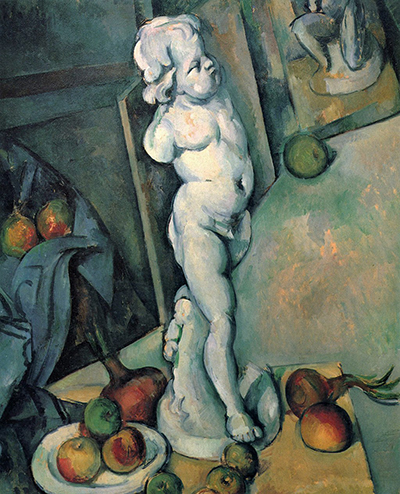
A little white figure rises from a table crowded with apples and onions. The plaster child seems almost to step out of the painting, yet the space around him refuses to settle. A green fruit hangs strangely large in the distance; the floor climbs behind the table; a piece of blue cloth may be draped in the room, painted on a canvas, or both. In Still Life with Plaster Cupid , Cézanne made a studio arrangement in which the everyday objects and the works of art continually exchange places.
The painting belongs to the Courtauld Gallery in London. Its current collection record dates it to about 1894 and identifies the support as oil-painted paper mounted on board. The online catalogue raisonné, which lists it as FWN 692, gives a slightly later date, about 1895, possibly earlier. That difference is a reminder that even a familiar painting need not have an exact year attached to it. [1] [2]
At a Glance
- Artist Paul Cézanne. [1]
- Date About 1894 in the Courtauld record; about 1895, possibly earlier, in FWN 692. [1] [2]
- Medium and size Oil on paper on board, 70.6 × 57.3 cm. [1]
- Collection Courtauld Gallery, London; P.1948.SC.59. [1]
- Nested pictures The Peppermint Bottle and a flayed figure. [3]
This work across Paul Cézanne’s career
The Kiss of the Muse
c.1860The Artist’s Father, Reading L’Événement
autumn 1866The Hanged Man’s House
c.1873A Modern Olympia
1873–74Maincy Bridge
1879–80The Blue Vase
1889–90The Basket of Apples
c.1893Apples and Oranges
c.1899The Large Bathers (Philadelphia)
1900–1906 (Philadelphia Museum dating)Château Noir (MoMA)
1903–04Contents
- A still life large enough to contain a studio
- The cast, the fruit and the older art
- A painting inside the painting
- How the space is held together
- Oil on paper, then a London collection
A still life large enough to contain a studio
Begin at the bottom. A pale plate holds brightly coloured fruit, and more apples and onions lie close to the statue's circular base. The table is abruptly cut by the bottom edge of the picture; a red onion at right sends its green shoots sideways, nearly beyond the frame. These objects give us familiar measures of weight and size. One fruit rests against another; the plate catches their weight; the plaster figure stands on a solid base. The arrangement could almost be lifted apart by hand.
Then look above the table. The child turns slightly, with one arm raised towards his face and the other lowered against his body. Curving contours make the white plaster appear round, but blue and green shadows also tie it to the surrounding paint. Behind his head, the edge of a leaning canvas outlines him like a frame. This creates a brief uncertainty: are we seeing a sculpture in front of a painting, or a figure that somehow belongs within the painted canvas behind it? The answer is clear enough when we trace the edges, but the visual hesitation is part of the experience.
The room widens in improbable directions. A dark dado line runs across the left wall, apparently offering a stable horizontal. Below it, tilted canvases and drapery break that stability. At right, a wide pale plane rises steeply behind the table. If it is floor, it behaves unlike the floor of a conventional interior: it presents objects almost frontally instead of carrying them away from us. The solitary green fruit near its upper edge appears scarcely smaller than the fruit at the front. Cézanne has supplied enough clues to make a studio recognizable while leaving its distances difficult to calculate.
The colour makes this dislocation more engaging than a simple puzzle in perspective. Warm red and yellow fruit punctuates a field of blue-green and ochre. The chalky white cast gathers cooler shadow on its back and legs, then meets the ochre tabletop around its base. Dark blue cloth at left holds two warmer pieces of fruit like a pocket. Across the picture, round objects echo one another without occupying a single convincing scale. The viewer can follow a colour or a curve before deciding where any one thing sits in the room.
Try following the contours instead of the objects. The curve of the plate turns upward into the round base of the cast. From there the eye can travel along a shin, through the bend of a knee and into the swell of the torso. At left, the cloth makes a much darker, more angular course, folding around the warm fruit before dropping towards the table's edge. These two paths do different work: one makes the central figure seem continuous and upright; the other pulls the surrounding arrangement sideways. Their meeting near the statue's feet gives the crowded foreground a centre without arranging every object symmetrically around it.
The cast, the fruit and the older art
The central figure is a plaster cast traditionally called Cupid. The object is about 46 centimetres high, yet dominates the painting. Once associated with Pierre Puget, its model is now thought by the Courtauld's 2019 catalogue to follow François Duquesnoy. That change alters the cast's historical identity, though its painted presence needs no certain sculptor's name. [3]
Nothing in this painted view clearly announces Cupid's familiar bow or wings. The title supplies an identity that the eye might not discover on its own. Even the catalogue raisonné preserves names that emphasize different things: the plaster material, the childlike figure, or the still life around it. [2] Look back at the painted cast without the name in mind and its shape takes precedence over mythology: a raised arm, a turned face and one long leg occupy the narrow central column.
The plaster figure puts a human form among perishable things. The apples and onions are rounded too, but their coloured skins differ from the cast's pale continuity. Its base nearly joins the plate and fruit in a chain of circles. Art historian Carol Armstrong reads humble vegetables beside a classical body as a meeting of domestic space with the studio. The onions remain particular things beside a figure copied from art. [4]
The cast's apparent whiteness is not blank. A cool blue edge runs along the shadowed side of the head and torso; warmer cream gathers at the chest and thigh. The raised hand brings a small, tight curve near the face, while the long descending leg draws attention down to the broad base. Those shifts help the figure feel volumetric even as parts of it nearly dissolve into adjacent patches. The base is especially curious: it ought to anchor the statue on the table, yet its light rim competes with the plate below. At that point the likeness between fruit display and sculptural display becomes a visual fact rather than an abstract comparison.
A graphite study of the cast now in the British Museum dates from about 1890; later drawings show it from other sides. Armstrong observes that Cézanne kept drawing it after making the Courtauld painting. The Morgan Library's account of one later sheet confirms that studies predate and postdate the oil. This painting belongs to an extended encounter with the model. [4] [5]
At upper right, another canvas shows part of a flayed man, painted after a cast once attributed to Michelangelo. Its exposed anatomy counters Cupid's soft contours. The two bodies share the studio with apples and onions. [3]
A painting inside the painting
The leaning canvas at left is Cézanne's The Peppermint Bottle , now in Washington. That work includes fruit, glassware and blue drapery. Its cloth and fruit seem to enter the new arrangement. [3] [6]
Look closely at the place where the blue descends. There is a real fold of cloth on the nearer table, yet the painted drapery on the leaning canvas seems to continue into it. The eye moves along the blue before it recognizes a boundary. This is no longer merely a painting showing a studio with another picture in it. Cézanne has made one artwork interfere with our reading of the other, and with our reading of the studio itself.
The left canvas can be read in two rhythms. Its straight edge belongs to a rigid, leaning rectangle. Inside that edge, the rounded fruit and soft blue folds have a life like the objects before it. Moving between those rhythms makes a flat painted image seem briefly as tangible as the table, while the nearby cloth becomes almost as image-like as the canvas. The two areas do not merge completely: dark seams and changes of angle remain available to the attentive eye. Cézanne gives us enough separation to find the trick, then enough continuity to make us experience it again.
The right-hand sprouting onion sharpens the effect. Its bulb sits among the foreground objects, but its shoots run across an area where a leaning canvas and the apparently rising floor are hard to separate. The Courtauld's detailed study points out that a fine reddish line and an indistinct contour help connect the onion to the painted structure behind it. Infrared examination, according to that study, found reworking in this small area. The ambiguity has a material history in the painting's making; it is more than a clever illusion discovered by later viewers. [7]
Both nested pictures are cropped and angled. Their edges are as present as their subjects. Armstrong stresses that the canvases are studio objects one could handle. Their painted contents also press into the larger picture, making each an object and an image. [4]
How the space is held together
Despite the painting's unstable perspective, its parts are closely related. The child's vertical body links tabletop to upper edge. The slanting sides of the canvases push across that vertical. One diagonal leads from the cloth at left towards the figure's feet; another climbs from the onion at right into the pale rising plane. A small green fruit near the back repeats the roundness of apples below. These returns offer a way through the picture even when conventional depth falters.
The table is especially important. Its front edge is visible near the bottom, yet its surface seems to pitch toward us. The white plate reads as an ellipse viewed from above, while the standing figure asks to be considered at something closer to eye level. Our attention shifts from a nearby apple to the cast and then to the canvases behind it.
Theodore Reff, writing in the Museum of Modern Art's 1977 Cézanne: The Late Work , proposed a different and earlier date of about 1892 on the basis of colour and comparisons with other studio still lifes. He also noticed the matching of the foreground fruit and cast with a distant fruit and painted sculptural study. The current Courtauld date is later, and the catalogue raisonné preserves several older proposals rather than treating the chronology as certain. Reff's comparison remains useful for seeing how foreground and background are knit together, even if his date is not the one used by the holding museum. [8] [2]
Reff also suggested a connection with Cézanne's copy of a putto in Nicolas Poussin's Concert . That is a scholarly proposal about a visual source, not proof of a preparatory plan. What can be seen directly is the Cupid's placement between angled edges and the way the studio contains multiple levels of copying: plaster after sculpture, drawing after plaster, painted sculpture, and a painted version of Cézanne's own still life. Each copy becomes another object available for study. [8]
Oil on paper, then a London collection
The support is easy to miss when looking at a reproduction. This is oil paint on paper mounted on board, rather than Cézanne's more familiar oil on canvas. The Courtauld gives the panel's dimensions as 70.6 by 57.3 centimetres. The medium matters because it makes the work materially close to the drawings through which Cézanne examined the cast, while the scale and complex arrangement belong to a fully developed painting. A published technical discussion notes visible underdrawing in the apples through thin passages of paint; it does not establish a complete drawing beneath every part of this picture. [1] [9]
The work left Cézanne's possession and passed through dealers and collectors including Ambroise Vollard, Bernheim-Jeune, Gustav Jebsen, Paul Rosenberg and Alexander Reid. The catalogue raisonné records a fuller sequence, including Baron Denys Cochin and a brief Manchester ownership. [2] Samuel Courtauld acquired the picture in May 1923 for £2,850. [3] It entered the gallery through his 1948 bequest. [1] These transactions carried an intimate studio subject into an international market and eventually a public collection.
Vollard's stockbook described a plaster child on a table between two still lifes, with blue drapery at left and a fragment of sculpture high at right. That practical dealer's description is strikingly attentive to the works within the work. It records the composition as a group of pictures and objects, rather than as a single isolated Cupid. [2]
Its exhibition history has also shaped the way it is named and viewed. It appeared in Copenhagen in 1914 as Amor i Gips and in New York in 1916 as Still Life with Figure of Cupid . By 1925 Samuel Courtauld was lending it to a London Cézanne exhibition. It has continued to travel, including the 2022–23 Cézanne exhibition in Chicago and London. In 2015 the Courtauld displayed the actual plaster cast alongside the painting, allowing viewers to compare the modest object with the much larger presence Cézanne gave it on paper. [2] [1] [10]
The Cupid's upright form organizes the scene, while the leaning pictures keep reopening its boundaries. Fruit, cloth, sculpture and images of other objects share the studio without settling into a single measure of distance.
Cézanne artworks directory
Browse 217 identified works in this researched selection, including paintings, drawings and watercolours. This is a bounded selection, not a complete catalogue of Cézanne’s surviving oeuvre. Unlinked titles have no confirmed article in this collection.
| Name | Date | Medium |
|---|---|---|
| A Head, a Cup, and a Bread Roll | 1891/1894 | Drawing |
| A Man seen from Behind | 1880/1883 | Drawing |
| A Modern Olympia | 1873–74 | Painting |
| A Nude and Foliage | 1879/1882 | Drawing |
| A Smoking Man | 1892–96 (catalogue); c.1890–92 (museum) | Drawing |
| Afternoon in Naples | 1876–77 | Painting |
| An Old Woman with a Rosary | about 1895–96 | Painting |
| Apples and Oranges | c.1899 | Painting |
| Auvers, Panoramic View | 1873–75 | Painting |
| Avenue at Chantilly | 1888 | Painting |
| Banks of the Marne | 1888–94 | Painting |
| Basket | 1877/1900 | Drawing |
| Bather with Outstretched Arms | 1877–78 | Painting |
| Bellows in Front of a Fireplace | 1887/1892 | Drawing |
| Bibémus Quarry | c.1895 | Painting |
| Boy in a Red Vest, Barnes Foundation | 1888–90 | Painting |
| Boy in a Red Vest, MoMA | 1888–90 | Painting |
| Boy in a Red Waistcoat, National Gallery of Art | 1888–90 | Painting |
| Branch in Flower | 1886/1889 | Drawing |
| Carnival Scene | 1885/1888 | Drawing |
| Chair and Dresser | 1880/1883 | Drawing |
| Chateau Noir | 1903–04 | Painting |
| Chestnut Trees and Farm at Jas de Bouffan | c.1885 | Painting |
| Chestnut Trees and Farm at Jas de Bouffan, Pushkin | c.1886 | Painting |
| Chestnut Trees at Jas de Bouffan in Winter | 1885–86 | Painting |
| Château Noir | 1900–04 | Painting |
| Cistern in the Park of Château Noir | c.1900 | Painting |
| Curtain, Jug and Fruit | 1893–94 | Painting |
| Cushion of an Armchair | 1886/1889 | Drawing |
| Draft Letter and Studies of Bathers | c.1878 | Drawing |
| Farmhouse and Chestnut Trees at Jas de Bouffan | 1884–85 | Painting |
| Figure Resting Head on Hand | c. 1889 | Drawing |
| Fireplace Tongs and Poker | 1887/1892 | Drawing |
| Forest Interior, San Francisco | c.1898–99 | Painting |
| Four Bathers | 1888–90 | Painting |
| Fruit and a Jug on a Table | 1893–94 | Painting |
| Gardanne | 1885–86 | Painting |
| Gardanne, Barnes Foundation | c.1885 | Painting |
| Hand and Shoulder of a Boy | c. 1885 | Drawing |
| Harlequin, National Gallery of Art | 1888–90 | Painting |
| Head of a Boy | 1887/1889 | Drawing |
| Head of a Boy Seen from Behind | c. 1885 | Drawing |
| Head of a Young Woman | c. 1880 | Drawing |
| Head of the Artist's Son | 1888/1889 | Drawing |
| Hillside in Provence | c.1890–92 | Painting |
| Horse Chestnut Trees at Jas de Bouffan | c.1885 | Painting |
| House and Farm at the Jas de Bouffan | c.1887 | Painting |
| House in a Park | 1883/1886 | Drawing |
| House in Provence | c.1885 | Painting |
| House of Père Lacroix | 1873 | Painting |
| House Surrounded by Vegetation | 1889/1892 | Drawing |
| Houses in Provence The Riaux Valley near L’Estaque | c.1883 | Painting |
| Jas de Bouffan, the Pool | c.1876 | Painting |
| Kerosene Lamp | 1878/1881 | Drawing |
| L'Estaque, Melting Snow | c.1870 | Painting |
| Lake Annecy | 1896 | Painting |
| Landscape in Provence, Pola Museum | 1879–82 | Painting |
| Landscape Near Aix-en-Provence | 1877/1880 | Drawing |
| Landscape Seen from the Inside of a Cave | 1889/1892 | Drawing |
| Landscape with Poplars | c.1885–87 | Painting |
| Landscape with Trees | 1895/1898 | Drawing |
| Leda and the Swan | c.1880 (possibly later) | Painting |
| Little Girl with a Doll | 1902–04 | Painting |
| Louis Guillaume | 1879–1890 | Painting |
| Madame Cezanne | 1888/1891 | Drawing |
| Madame Cezanne | 1886/1889 | Drawing |
| Madame Cezanne | 1882/1887 | Drawing |
| Madame Cezanne | 1897/1900 | Drawing |
| Madame Cezanne with her Head Lowered | 1893/1896 | Drawing |
| Madame Cézanne in a Red Armchair | c.1877 | Painting |
| Madame Cézanne in a Red Dress, Metropolitan Museum of Art | 1888–90 | Painting |
| Madame Cézanne in a Yellow Chair | 1888–90 | Painting |
| Madame Cézanne in a Yellow Chair, Fondation Beyeler | 1888–90 | Painting |
| Madame Cézanne in the Conservatory | 1891 | Painting |
| Maincy Bridge | 1879–80 | Painting |
| Maison Maria with a View of Château Noir | c.1895 | Painting |
| Man Bending Forward | 1883/1886 | Drawing |
| Man Smoking a Pipe, Pushkin | c.1891, possibly later | Painting |
| Man with a Pipe | 1891–96 | Painting |
| Man with a Pipe, Nelson-Atkins | 1890–92 | Painting |
| Man with a Straw Hat (Gustave Boyer) | c.1871 | Painting |
| Man with Crossed Arms | c.1899 | Painting |
| Man with Pipe, National Gallery of Art | 1892–96 | Painting |
| Mont Sainte-Victoire | c.1902–06 | Painting |
| Mont Sainte-Victoire | 1900–02 | Painting |
| Mont Sainte-Victoire (recto) | c.1895 | Watercolour |
| Mont Sainte-Victoire and the Viaduct of the Arc River Valley | 1882–85 | Painting |
| Mont Sainte-Victoire Seen beyond the Wall of the Jas de Bouffan | c.1885/1888 | Watercolour |
| Mont Sainte-Victoire Seen from Bibémus Quarry | c.1897 | Painting |
| Mont Sainte-Victoire, Barnes Foundation | 1892–95 | Painting |
| Near the Pool at Jas de Bouffan | 1883/1887 | Drawing |
| Pelicans | 1877/1880 | Drawing |
| Peonies | 1890/1893 | Drawing |
| Pierrot and Harlequin | 1888 | Painting |
| Pine Tree | 1882/1885 | Drawing |
| Pont des Trois Sautets | 1906 | Watercolour |
| Poplars | 1879–80 | Painting |
| Portrait of Ambroise Vollard | 1899 | Painting |
| Portrait of Gustave Geffroy | 1895–96 | Painting |
| Portrait of Madame Cezanne with Loosened Hair | 1885–86 | Painting |
| Portrait of the Artist Looking Over His Shoulder | 1883–84 | Painting |
| Portrait of the Gardener Vallier | 1906 | Painting |
| Portrait of Victor Chocquet | 1876–77 | Painting |
| Portrait Of Victor Chocquet Seated | 1877 | Painting |
| Provençal Manor | c.1885 | Painting |
| Pyramid of Skulls | 1898–1900 | Painting |
| Reclining Nude (Leda?) | c.1887 | Painting |
| Scipio | 1866–68 | Painting |
| Seated Man, Oslo | 1898–1900 | Painting |
| Seated Peasant | c.1892–96 | Painting |
| Seated Peasant, Hiroshima | c.1897 | Painting |
| Seated Peasant, Orsay | c.1900 | Painting |
| Self-Portrait | c. 1895 | Drawing |
| Self-Portrait in a Bowler Hat, Ny Carlsberg Glyptotek | 1885–86 | Painting |
| Self-Portrait in a Casquette | c.1875 | Painting |
| Self-Portrait with a Beret | 1898–1900 | Painting |
| Self-Portrait with a Hat, Artizon Museum | c.1890–94 | Painting |
| Self-Portrait with a Pink Background | c.1875 | Painting |
| Self-Portrait with Olive-Coloured Wallpaper | about 1880–81 | Painting |
| Self-Portrait with Palette | 1886–87 | Painting |
| Self-Portrait with White Turban | c.1878–80 | Painting |
| Self-Portrait, c.1895 | c.1895 | Painting |
| Self-Portrait, Pushkin Museum | c.1882 | Painting |
| Spanish Dancers | 1883/1886 | Drawing |
| Still Life with a Curtain | 1892–94 | Painting |
| Still Life with Apples | c.1890 | Painting |
| Still Life with Apples | 1893–94 | Painting |
| Still Life with Apples and a Pot of Primroses | about 1890 | Painting |
| Still Life with Milk Jug and Fruit | c.1900 | Painting |
| Still Life with Open Drawer | 1877–79 | Painting |
| Still Life with Plaster Cupid | about 1894 | Painting |
| Still Life with Skull | 1890–93 | Painting |
| Still Life with Soup Tureen | 1877 | Painting |
| Still Life, Pitcher and Fruit | 1893–94 | Painting |
| Studies Including a Straw Hat | 1895/1898 | Drawing |
| Studies Including Madame Cezanne | 1884/1887 | Drawing |
| Study for "The Judgement of Paris" or "The Amorous Shepherd" | 1883/1886 | Drawing |
| Study for Woman with a Coffee Pot | c.1895 | Painting |
| Study of "The Roman Orator (Germanicus)" | 1883/1886 | Drawing |
| Study of "Venus de Milo" | 1881/1884 | Drawing |
| Study of a Decorative Ornament | 1879/1882 | Drawing |
| Study of a Standing Male Figure after the Antique | c. 1895 | Drawing |
| Study of an Angel in Rubens' "The Prophet Elijah" | 1892/1895 | Drawing |
| Study of Desiderio da Settignano's "Bust of a Child" | c. 1895 | Drawing |
| Study of Houses | 1879/1882 | Drawing |
| Study of Puget's "Hercules Resting" | c. 1879 | Drawing |
| Study of Puget's "Milo of Crotona" | 1895/1898 | Drawing |
| Study of Puget's "Milo of Crotona" | 1880/1883 | Drawing |
| Study of the Allegorical Figure Bellona in Rubens' "The Apotheosis of Henri IV" | 1883/1886 | Drawing |
| Study of the Allegorical Figure Bellona in Rubens' "The Apotheosis of Henri IV" | 1879/1882 | Drawing |
| Study of the Allegorical Figure France in Rubens' "The Exchange of the Two Princesses" | 1882/1885 | Drawing |
| Study of the Allegorical Figure of Health in Rubens' "The Birth of Louis XIII" | 1880/1883 | Drawing |
| Study of the Allegorical Figure of the Genius of Health from Rubens' "The Birth of Louis XIII at Fontainbleau" | 1895/1898 | Drawing |
| Sugar Bowl, Pears and Blue Cup | 1865–66 | Painting |
| The Aqueduct, Pushkin Museum | Dating differs between museum records | Painting |
| The Artist's Father, Reading L'Evenement | autumn 1866 | Painting |
| The Artist's Son | c. 1887 | Drawing |
| The Artist's Son Leaning on his Elbow | c. 1887 | Drawing |
| The Artist's Son Reading | c. 1887 | Drawing |
| The Artist's Son Writing | c. 1887 | Drawing |
| The Artist’s Son, Paul | 1886–87 | Painting |
| The Avenue at Jas de Bouffan | 1868–70 (possibly later) | Painting |
| The Avenue at Jas de Bouffan, Geneva | c.1890 | Painting |
| The Basket of Apples | c.1893 | Painting |
| The Bather, Museum of Modern Art | c.1885 | Painting |
| The Bay of Marseille seen from L'Estaque | c.1885 | Painting |
| The Blue Vase | 1889–90 | Painting |
| The Boy in the Red Vest, Bührle | 1888–90 | Painting |
| The Buffet | 1877–79 | Painting |
| The Card Players, Barnes Foundation | 1890–92 | Painting |
| The Card Players, Courtauld Gallery | 1892–96 | Painting |
| The Card Players, Metropolitan Museum of Art | 1890–92 | Painting |
| The Card Players, Musée d’Orsay | 1893–96 | Painting |
| The Card Players, Qatar | 1892–96 | Painting |
| The Eternal Feminine | c.1877 | Painting |
| The Gardener Vallier | 1906 | Painting |
| The Gardener Vallier, Tate | 1905–06 | Painting |
| The Grounds of the Château Noir | c.1900–04 | Painting |
| The Gulf of Marseille Seen from L’Estaque | c.1885 | Painting |
| The Hanged Man's House in Auvers | c.1873 | Painting |
| The House of Doctor Gachet at Auvers | 1872–73 | Painting |
| The House with the Cracked Walls | 1892–94 | Painting |
| The Kiss of the Muse | c.1860 | Painting |
| The Large Bathers, Barnes Foundation | 1895–1906 | Painting |
| The Large Bathers, National Gallery | 1895–1905 | Painting |
| The Large Bathers, Philadelphia Museum of Art | 1900–06 | Painting |
| The Mill | 1889/1892 | Drawing |
| The Painter’s Father, Louis-Auguste Cézanne | c.1865 | Painting |
| The Peasant | 1890–92 | Painting |
| The Plaster Mill (La Moulin à plâtre) | 1889/1892 | Drawing |
| The Smoker, Hermitage | c.1891 | Painting |
| The Smoker, Mannheim | c.1891 | Painting |
| The Stove in the Studio | c.1865 | Painting |
| The Vase of Tulips | c.1890 | Painting |
| Thistle | 1893/1896 | Drawing |
| Three Heads, One of Madame Cezanne | 1882/1885 | Drawing |
| Three Skulls | c.1898 | Painting |
| Three Skulls on a Patterned Carpet | 1904 | Painting |
| Trees and Shrubs | 1883/1887 | Drawing |
| Turning Road at Montgeroult | 1898 | Painting |
| Two Bathers | 1884/1887 | Drawing |
| Two Heads | 1888 | Drawing |
| Two Heads | 1890/1896 | Drawing |
| Two Heads of Women | 1890/1894 | Drawing |
| Two Studies for "The Judgement of Paris" or "The Amorous Shepherd" | 1883/1886 | Drawing |
| Uncle Dominique in a Tasseled Cap | 1866 | Painting |
| Uncle Dominique in a Turban | 1866–67 | Painting |
| Victor Chocquet and an Angel for "The Apotheosis of Delacroix" | 1878/1880 | Drawing |
| Woman in Blue | c.1904 | Painting |
| Woman Leaning Forward | 1888/1891 | Drawing |
| Woman Leaning Forward | 1890/1894 | Drawing |
| Woman Leaning Forward | 1890/1894 | Drawing |
| Woman with a Coffee Pot | c.1895 | Painting |
| Women Bathers and a Roll of Paper | 1882/1885 | Drawing |
| Young Girl with a Doll | c.1895 | Painting |
| Young Italian Woman at a Table | c.1895–1900 | Painting |
| Young Man and Skull | 1896–98 | Painting |
Frequently Asked Questions
The rising floor makes depth difficult to read and lets the background objects remain visually close to the tabletop arrangement. It is one of several spatial shifts, alongside the large distant fruit and the merging of painted and studio drapery. [1]
The Courtauld's 2019 catalogue associates the model with François Duquesnoy after a historical attribution to Puget. [3]
It is oil on paper mounted on board, 70.6 × 57.3 cm, in the Courtauld Gallery, London. Its collection number is P.1948.SC.59. [1]
Discussion
Look again at the images and ideas explored in Still Life with Plaster Cupid by Paul Cézanne. These editorial prompts invite your observations.
Reader Insights
Follow the blue drapery from the leaning canvas into the foreground. At which point do you feel sure that one pictured object ends and another begins?
Compare the Cupid's pale curves with the apples and onions around his base. What kinds of body or weight does each seem to have?
Look from the plate at the bottom to the green fruit near the top. How does the difference in position affect your sense of their relative size?
Join the Conversation
Share a detail, comparison or question about Still Life with Plaster Cupid by Paul Cézanne below.
References
- The Courtauld Gallery , “Still life with Plaster Cupid,” current collection record, accessed 2026. View source .
- The Paintings, Watercolors and Drawings of Paul Cezanne: An Online Catalogue Raisonné , “Nature morte avec l'Amour en plâtre,” FWN 692, current catalogue entry. View source .
- Fondation Louis Vuitton and Paul Holberton Publishing , The Courtauld Collection: A Vision for Impressionism , edited by Karen Serres, 2019, cat. 40, p. 210. View source .
- Carol Armstrong , Cézanne in the Studio: Still Life in Watercolors , J. Paul Getty Museum, 2004, pp. 14–15, 59–62, 85–87. View source .
- The Morgan Library & Museum , “The Plaster Cupid,” drawing record and curatorial note. View source .
- National Gallery of Art , “The Peppermint Bottle,” collection record, 1893/1895. View source .
- The Courtauld Institute of Art , “Vision and Distortion in Cézanne's ‘Still Life with Plaster Cupid’,” online visual study. View source .
- The Museum of Modern Art , Cézanne: The Late Work , 1977, Theodore Reff, “Painting and Theory in the Final Decade,” pp. 30–31. View source .
- The Art Institute of Chicago , Kim Muir et al., “‘A Harmony Parallel to Nature’: Color, Form, and Space in Cézanne's Watercolors and Oil Paintings,” first published 2022, note 18. View source .
- The Courtauld Gallery , “Cupid Darts to London,” 2015. View source .
- Le Baiser de la muse, d'après Frillié (FWN 572). View source.
- Louis-Auguste Cezanne, père de l'artiste, lisant L'Événement (FWN 402). View source.
- La Maison du pendu, Auvers-sur-Oise (FWN 81). View source.
- Une moderne Olympia (FWN 628). View source.
- Le Pont de Maincy (FWN 143). View source.
- La Montagne Sainte-Victoire vue de Montbriand (FWN 185). View source.
- Gardanne (vue horizontale) (FWN 224). View source.
- Le Vase bleu (FWN 823). View source.
- Les Joueurs de cartes (FWN 681). View source.
- La Montagne Sainte-Victoire (FWN 296). View source.
- La Corbeille de pommes (FWN 860). View source.
- Pommes et oranges (FWN 871). View source.
- Portrait d'Ambroise Vollard (FWN 531). View source.
- Philadelphia Museum of Art,The Large Bathers,W1937-1-1. View source.
- Château Noir (FWN 360). View source.
- Société Paul Cezanne,online catalogue structure and objectidentification. View source.
- National Gallery of Art,Cezanne Sketchbook,1992.51.9. View source.
- Splash image, Paul Cézanne, Still Life with Plaster Cupid.