



 by
Tom Gurney
Tom Gurney BSc (Hons) is an art history expert with over 20 years experience
Published on June 19, 2020 / Updated on October 22, 2026
Email:
tomgurney1@gmail.com
/ Phone:
+44 7429 011000
Portrait of Victor Chocquet Seated: Cézanne Paints a Collector Among His Pictures: Introduction
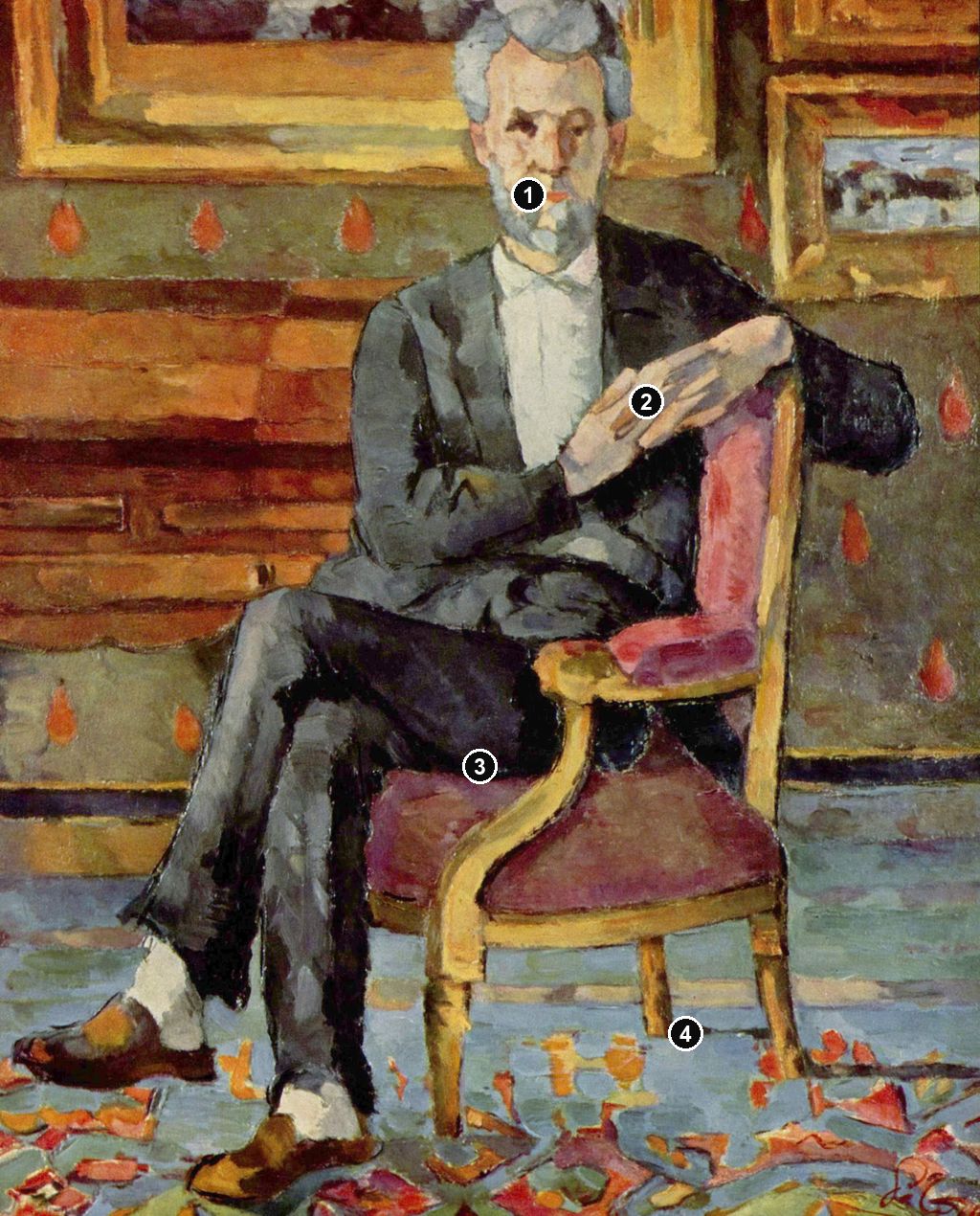
Victor Chocquet sits with one leg crossed over the other and his hands joined above the back of a rose-coloured chair. Pictures crowd the wall behind him. A patterned carpet fills the foreground, while small red forms punctuate the wallpaper. Cézanne gives us a recognisable man in a recognisable room, yet the eye keeps moving between face, furniture, frames and floor. The collector appears among the things he chose to live with, and the painting asks us to look at all of them together. The canvas, painted in 1877 and now at the Columbus Museum of Art, is catalogued as Portrait de Victor Chocquet assis (FWN 439). [1]
Cézanne signed the canvas in red at the lower right, where his name joins the warm notes scattered across the floor. The signature is a small detail in a painting that rewards attention to every part of its surface. [1]
At a Glance
- Artist Paul Cézanne. [1]
- Title Portrait de Victor Chocquet assis ( Portrait of Victor Chocquet Seated ). [1]
- Date 1877 in the current catalogue; earlier writers proposed dates as late as 1879–82. [1]
- Medium and size Oil on canvas, 46 × 38 cm. [1]
- Collection Columbus Museum of Art, Ohio; purchased with the Howald Fund in 1950. [1]
- Catalogue numbers FWN 439; Rewald 296; Venturi 373. [1]
This work across Paul Cézanne’s career
The Kiss of the Muse
c.1860The Artist’s Father, Reading L’Événement
autumn 1866The Hanged Man’s House
c.1873A Modern Olympia
1873–74Portrait of Victor Chocquet Seated: Cézanne Paints a Collector Among His Pictures (current article)
1877Maincy Bridge
1879–80The Blue Vase
1889–90The Basket of Apples
c.1893Apples and Oranges
c.1899The Large Bathers (Philadelphia)
1900–1906 (Philadelphia Museum dating)Château Noir (MoMA)
1903–04Contents
- The Man, the Chair and the Room
- How Chocquet Came to Sit for Cézanne
- One Chocquet Portrait Among Several
- Support at the Impressionist Exhibition
- A Small Canvas with an Active Surface
- From Chocquet's Apartment to Columbus
- Annotated details
The Man, the Chair and the Room
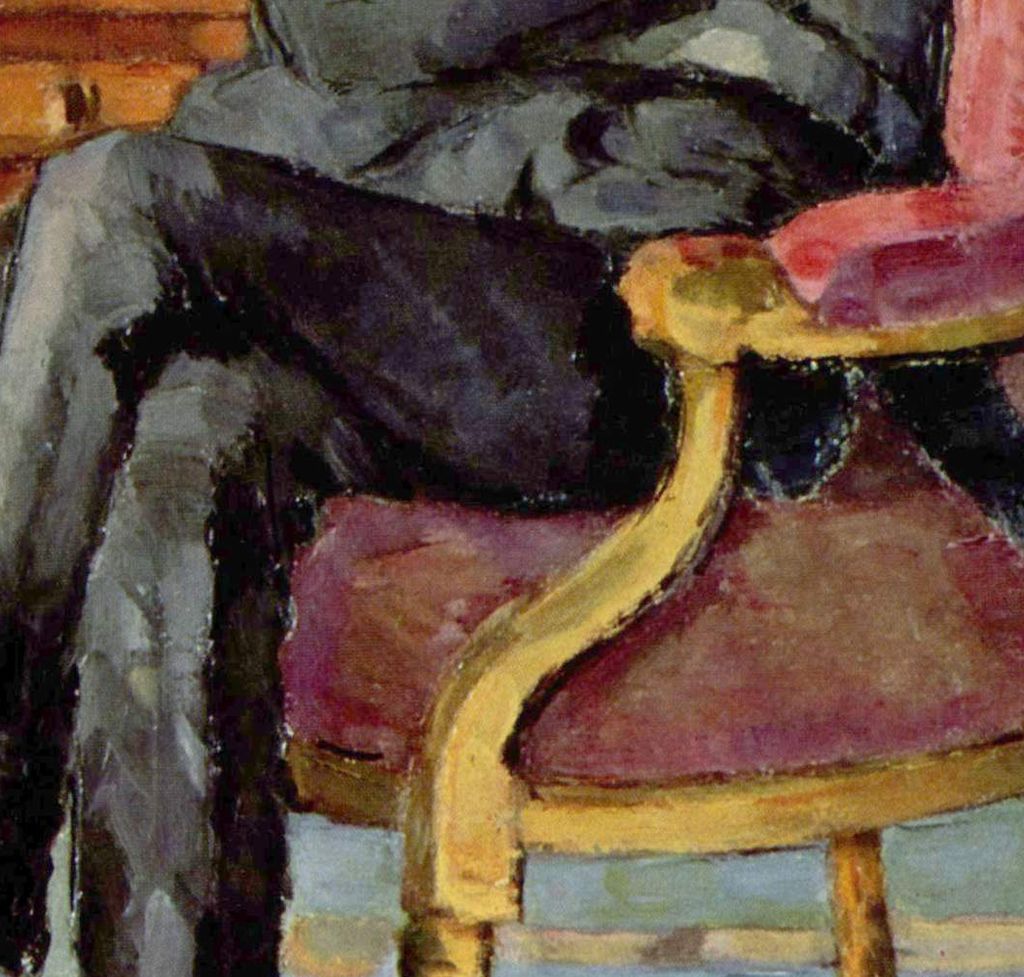
Chocquet is almost square to the viewer, although his crossed legs tilt across the lower half of the composition. His dark jacket and trousers form a compact grey-black shape. A pale shirt brings light into the centre, and a narrow line of white stocking separates trouser hem from brown shoe. The head is small compared with the room that surrounds it. One forearm rests across the top of the chair; his fingers meet those of his other hand, gathering the pose into a single point of contact. The chair's curved yellow arm leads the eye down to its rose seat and legs.
Cézanne painted Chocquet in the dining room of his apartment on the rue de Rivoli in Paris, according to the catalogue raisonné. It notes that Renoir had placed him in a similar pose in a portrait of about 1875, now at Harvard. The two artists portrayed the same collector in his armchair, yet Cézanne gave the room and its framed pictures a far greater share of his small canvas. [1]
Look at the upper edge of the painting. The framed pictures are partly cut by the canvas, as though Chocquet has been seated in the middle of an already crowded interior. A large horizontal frame crosses above his head, while a smaller framed landscape occupies the right side. Below, the warm orange of the cabinet answers the gold of the picture frames and chair. The carpet's blue field, speckled with orange and red, moves toward the viewer instead of receding quietly beneath Chocquet. Cézanne makes the room legible through overlapping objects but refuses to let it become a neutral backdrop.
The red marks on the wallpaper echo warmer notes in the carpet and chair. They appear beside Chocquet's head and shoulders, then recur near the floor. Their repetition binds widely separated parts of a small canvas. Pavel Machotka, writing specifically about this painting, argues that the picture's parallel lines, similarly sized blocks of paint and scattered red accents make the surface cohere. He sees the body and its setting arranged close to the plane of the canvas: even the crossed legs pull toward a vertical rather than opening deep space. His reading helps explain why the face never entirely monopolises attention. [2]
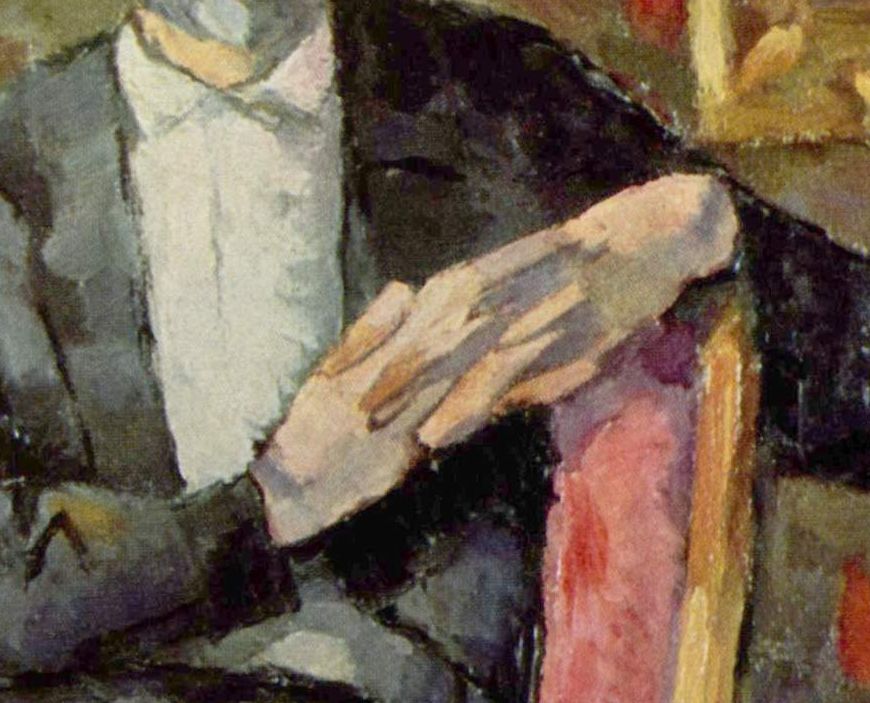
The hands offer a telling exception to that upright order. Their slant cuts across the torso and chair; the receding chair rail answers with a second diagonal. Machotka identifies this opposition as part of the composition's structure. It is possible to follow the joined fingers as a human gesture and, at the same time, as a line that holds together the painting's forms. Neither way of seeing cancels the other. [2]
How Chocquet Came to Sit for Cézanne
Chocquet worked in the French customs administration and collected art before he knew Cézanne. According to Hyewon Yoon's research for the Metropolitan Museum of Art, he acquired works by Eugène Delacroix as well as Courbet and Daumier. He met Renoir after attending the Impressionists' 1875 sale, then encountered Cézanne's paintings through Renoir and the paint supplier Julien-François Tanguy. Chocquet began buying and commissioning Cézanne's work. The Met identifies two portraits and a landscape among these early commissions. [3]
That path into Cézanne's art matters for the interior portrait. Chocquet was a working civil servant with a long-standing appetite for painting, especially Delacroix, and a personal connection to the Impressionist circle. The frames around him evoke his collecting life, though the individual works cannot be identified. They place Cézanne's portrait inside a culture of looking, buying, comparing and living with art. [3]
The two men also shared a serious interest in Delacroix. Fondation Custodia, which owns a letter Cézanne sent to Chocquet from Gardanne on 11 May 1886, dates their meeting to late 1875 or early 1876 and argues that their common admiration for Delacroix was a substantial bond. The letter shows the friendship continuing: Cézanne wrote about the landscape around Gardanne and expressed admiration for Chocquet's intellectual steadiness. He wished, in the foundation's transcription, to possess the "équilibre intellectuel" that characterised his friend. The phrase is Cézanne's own. [4]
In a later memoir, Georges Rivière recalled Cézanne visiting Chocquet's rue de Rivoli apartment for dinner and looking through portfolios of Delacroix drawings with Chocquet and Renoir. The remembered evenings give the painted dining room a social and artistic setting. [5]
Annotated Details from Portrait of Victor Chocquet Seated
The numbered points identify visible features discussed in this article. Return from each detail to the whole composition. Paul Cézanne, Portrait of Victor Chocquet Seated Image source. Public domain.
Details from PORTRAIT OF VICTOR CHOCQUET SEATED
Compare the cropped details with the complete images above. Notice how their colours, shapes and positions contribute to the larger compositions.
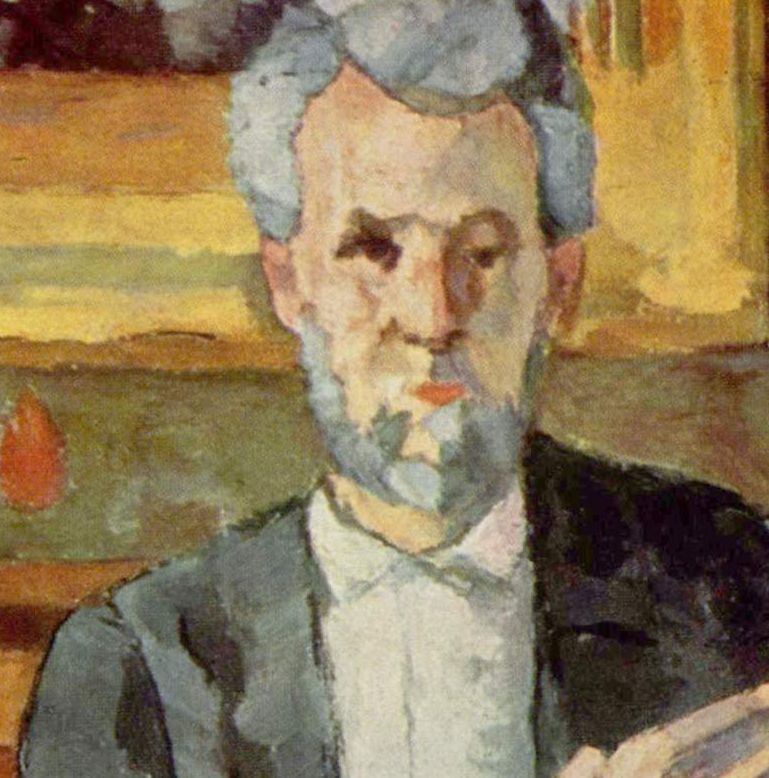
The face among picture frames
Chocquet’s grey hair and beard meet the warm frames behind him. The small head shares attention with the surrounding room.
Joined hands and chair back
The slant of the fingers crosses the dark coat and rose chair back. Follow that diagonal against the more upright edges of the furniture.
Crossed legs and curved chair arm
Dark folded trousers cross beside the yellow curve of the chair. Their contrasting directions give the seated pose its structure.
The patterned carpet
Red and orange accents break up the blue carpet beneath the chair. Compare their repeated colour with the small warm marks on the wallpaper in the whole painting.
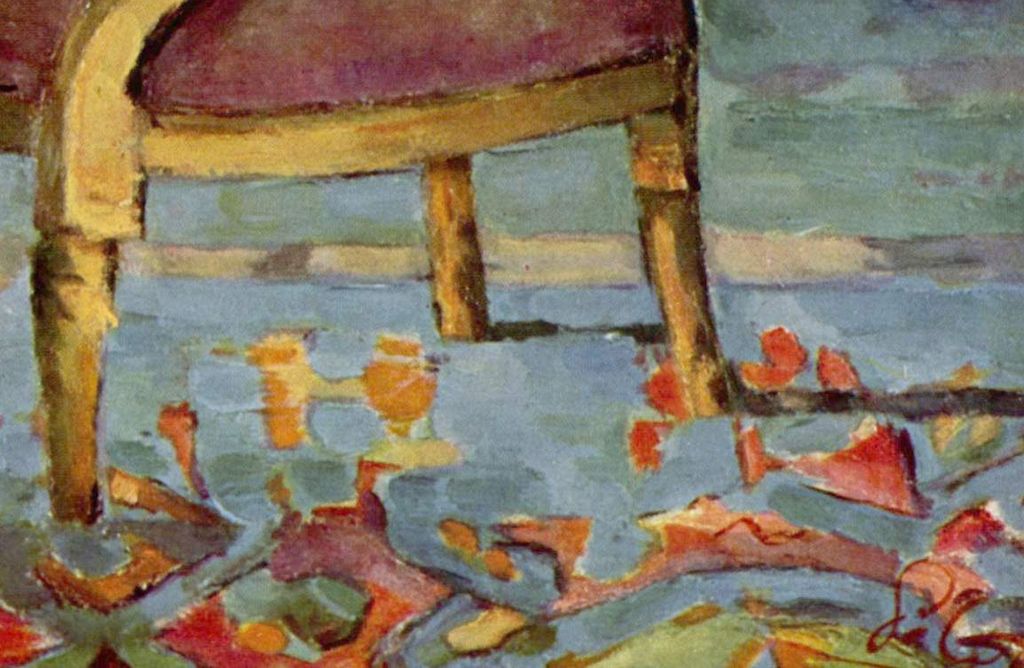
One Chocquet Portrait Among Several
Cézanne made more than one image of Chocquet, and their similar titles can cause confusion. The Columbus canvas is the seated figure with crossed legs, an upholstered chair, framed pictures, wallpaper and carpet: FWN 439. A different portrait, Portrait de Victor Chocquet (FWN 437), painted in 1876–77, concentrates on his head and upper body. Its catalogue records an appearance at the third Impressionist exhibition in 1877 under the title Tête d'homme; Étude . The seated Columbus canvas has no corresponding entry in that exhibition. [6]
The distinction changes how we read each work. In the earlier head portrait, Cézanne tested a dense weave of colour across the sitter's face. John Elderfield relates that handling to Delacroix, whom both artist and collector admired. Elderfield's argument concerns the head portrait specifically. In the Columbus painting the face remains important, but the wall, cabinet, chair and carpet are worked into an encompassing arrangement. Its striking effect lies less in a close-up confrontation with a face than in a whole room held together by repeated touches and shapes. [7] [2]
Cézanne returned to Chocquet in later pictures as well. Elderfield discusses comparative portraits of about 1880 and 1880–85, one painted from life and another after a photograph; these are separate works with their own dates and catalogue numbers. Across these portraits, the same sitter offered Cézanne different problems of likeness and composition. In the Columbus picture he brings the person, chair and collecting interior into one painted order. [7] [1]
Support at the Impressionist Exhibition
The date 1877 puts the portrait close to a public test of Cézanne's work during his Impressionist years . At the third Impressionist exhibition that April, Chocquet lent Cézanne's The Seat at L'Estaque . The Met's account says he visited almost daily and defended the painter against ridicule from visitors and the press. The seated Columbus portrait has no recorded appearance in that exhibition. Chocquet's activity there gives the private sitting a public counterpart. [3] [1]
Chocquet's support was significant because Cézanne's paintings still met sharp resistance. The collector made a decision to acquire the work and stand by it in public. He also had financial limits. He retired from his customs post in 1877; the Société Cezanne's chronology quotes a letter of 20 June from his wife Marie to her sister describing a period of strained household finances before his pension began. The letter places his advocacy alongside the financial pressures of his household. Later, an inheritance enlarged his means: the Met records thirty-two Cézannes in the collection dispersed after the Chocquets' deaths, along with paintings by Renoir, Monet, Pissarro and Sisley. [5] [3]
A Small Canvas with an Active Surface
The small composition is packed. Chocquet's shoes touch the lower region of the image; his head rises close to the upper frame; the chair runs from the middle of the canvas almost to its foot. The carpet is not a thin strip of floor. It occupies enough space for its blue and orange pattern to insist on its own visual life. The red wallpaper drops repeat that insistence at eye level. A viewer moving from face to fingers to frame to carpet encounters a picture with few empty intervals. [1]
Machotka compares this canvas with Cézanne's portrait of Madame Cézanne in a striped skirt, another work in which strokes across figure and surroundings create a consistent painted surface. His formulation is sharp: Chocquet seems positioned on the canvas as much as in a room. Cabinet, frames and wallpaper describe that interior while their lines and patches keep returning our attention to the painted surface. [2]
Elderfield's wider account of Cézanne's portraits describes the mid-1870s as a period of rapid experiment. He traces a tension between the shaping of solid human figures and the changing visual field Cézanne explored after working with Pissarro. The seated Chocquet makes that tension visible. The dark folded legs and jacket give the body weight, while colours in the surrounding room press forward rather than dissolve into atmosphere. [7]
From Chocquet's Apartment to Columbus
The picture first belonged to Chocquet, then to his widow, Marie Buisson Chocquet. The catalogue raisonné places it in the context of the Chocquet collection's 1899 sale at Galerie Georges Petit but marks it hors catalogue : outside the numbered sale catalogue. It subsequently passed through the Durand-Ruel galleries, the New York collector Lillie P. Bliss and the Museum of Modern Art as part of her bequest. The catalogue then records Paul Rosenberg, Marius de Zayas and Rosenberg again before the Columbus Museum of Art acquired it in 1950 through its Howald Fund. The hors catalogue notation leaves the details of that 1899 transfer open. [1]
Its exhibition history tracks changing audiences and labels. Durand-Ruel lent it in Berlin in 1900–01, Vienna in 1903 and the Paris Salon d'Automne's Cézanne room in 1904. In 1929 it appeared in the Museum of Modern Art's first loan exhibition as Chocquet in his Study , dated around 1885. The catalogue raisonné now dates the canvas 1877, but records earlier published opinions ranging into the early 1880s. The shifting dates and titles show how its identification developed across exhibitions. [1]
Later exhibitions carried the portrait well beyond the early dealer circuit, including Cézanne shows in Europe, Japan and the United States. It appeared in the 2017–18 Cézanne Portraits exhibition, where it was catalogued as item 6.2 alongside the distinct head portrait, item 6.1. Their pairing made Cézanne's different approaches to the same sitter visible to visitors. [1] [6]
Cézanne artworks directory
Browse 217 identified works in this researched selection, including paintings, drawings and watercolours. This is a bounded selection, not a complete catalogue of Cézanne’s surviving oeuvre. Unlinked titles have no confirmed article in this collection.
| Name | Date | Medium |
|---|---|---|
| A Head, a Cup, and a Bread Roll | 1891/1894 | Drawing |
| A Man seen from Behind | 1880/1883 | Drawing |
| A Modern Olympia | 1873–74 | Painting |
| A Nude and Foliage | 1879/1882 | Drawing |
| A Smoking Man | 1892–96 (catalogue); c.1890–92 (museum) | Drawing |
| Afternoon in Naples | 1876–77 | Painting |
| An Old Woman with a Rosary | about 1895–96 | Painting |
| Apples and Oranges | c.1899 | Painting |
| Auvers, Panoramic View | 1873–75 | Painting |
| Avenue at Chantilly | 1888 | Painting |
| Banks of the Marne | 1888–94 | Painting |
| Basket | 1877/1900 | Drawing |
| Bather with Outstretched Arms | 1877–78 | Painting |
| Bellows in Front of a Fireplace | 1887/1892 | Drawing |
| Bibémus Quarry | c.1895 | Painting |
| Boy in a Red Vest, Barnes Foundation | 1888–90 | Painting |
| Boy in a Red Vest, MoMA | 1888–90 | Painting |
| Boy in a Red Waistcoat, National Gallery of Art | 1888–90 | Painting |
| Branch in Flower | 1886/1889 | Drawing |
| Carnival Scene | 1885/1888 | Drawing |
| Chair and Dresser | 1880/1883 | Drawing |
| Chateau Noir | 1903–04 | Painting |
| Chestnut Trees and Farm at Jas de Bouffan | c.1885 | Painting |
| Chestnut Trees and Farm at Jas de Bouffan, Pushkin | c.1886 | Painting |
| Chestnut Trees at Jas de Bouffan in Winter | 1885–86 | Painting |
| Château Noir | 1900–04 | Painting |
| Cistern in the Park of Château Noir | c.1900 | Painting |
| Curtain, Jug and Fruit | 1893–94 | Painting |
| Cushion of an Armchair | 1886/1889 | Drawing |
| Draft Letter and Studies of Bathers | c.1878 | Drawing |
| Farmhouse and Chestnut Trees at Jas de Bouffan | 1884–85 | Painting |
| Figure Resting Head on Hand | c. 1889 | Drawing |
| Fireplace Tongs and Poker | 1887/1892 | Drawing |
| Forest Interior, San Francisco | c.1898–99 | Painting |
| Four Bathers | 1888–90 | Painting |
| Fruit and a Jug on a Table | 1893–94 | Painting |
| Gardanne | 1885–86 | Painting |
| Gardanne, Barnes Foundation | c.1885 | Painting |
| Hand and Shoulder of a Boy | c. 1885 | Drawing |
| Harlequin, National Gallery of Art | 1888–90 | Painting |
| Head of a Boy | 1887/1889 | Drawing |
| Head of a Boy Seen from Behind | c. 1885 | Drawing |
| Head of a Young Woman | c. 1880 | Drawing |
| Head of the Artist's Son | 1888/1889 | Drawing |
| Hillside in Provence | c.1890–92 | Painting |
| Horse Chestnut Trees at Jas de Bouffan | c.1885 | Painting |
| House and Farm at the Jas de Bouffan | c.1887 | Painting |
| House in a Park | 1883/1886 | Drawing |
| House in Provence | c.1885 | Painting |
| House of Père Lacroix | 1873 | Painting |
| House Surrounded by Vegetation | 1889/1892 | Drawing |
| Houses in Provence The Riaux Valley near L’Estaque | c.1883 | Painting |
| Jas de Bouffan, the Pool | c.1876 | Painting |
| Kerosene Lamp | 1878/1881 | Drawing |
| L'Estaque, Melting Snow | c.1870 | Painting |
| Lake Annecy | 1896 | Painting |
| Landscape in Provence, Pola Museum | 1879–82 | Painting |
| Landscape Near Aix-en-Provence | 1877/1880 | Drawing |
| Landscape Seen from the Inside of a Cave | 1889/1892 | Drawing |
| Landscape with Poplars | c.1885–87 | Painting |
| Landscape with Trees | 1895/1898 | Drawing |
| Leda and the Swan | c.1880 (possibly later) | Painting |
| Little Girl with a Doll | 1902–04 | Painting |
| Louis Guillaume | 1879–1890 | Painting |
| Madame Cezanne | 1888/1891 | Drawing |
| Madame Cezanne | 1886/1889 | Drawing |
| Madame Cezanne | 1882/1887 | Drawing |
| Madame Cezanne | 1897/1900 | Drawing |
| Madame Cezanne with her Head Lowered | 1893/1896 | Drawing |
| Madame Cézanne in a Red Armchair | c.1877 | Painting |
| Madame Cézanne in a Red Dress, Metropolitan Museum of Art | 1888–90 | Painting |
| Madame Cézanne in a Yellow Chair | 1888–90 | Painting |
| Madame Cézanne in a Yellow Chair, Fondation Beyeler | 1888–90 | Painting |
| Madame Cézanne in the Conservatory | 1891 | Painting |
| Maincy Bridge | 1879–80 | Painting |
| Maison Maria with a View of Château Noir | c.1895 | Painting |
| Man Bending Forward | 1883/1886 | Drawing |
| Man Smoking a Pipe, Pushkin | c.1891, possibly later | Painting |
| Man with a Pipe | 1891–96 | Painting |
| Man with a Pipe, Nelson-Atkins | 1890–92 | Painting |
| Man with a Straw Hat (Gustave Boyer) | c.1871 | Painting |
| Man with Crossed Arms | c.1899 | Painting |
| Man with Pipe, National Gallery of Art | 1892–96 | Painting |
| Mont Sainte-Victoire | c.1902–06 | Painting |
| Mont Sainte-Victoire | 1900–02 | Painting |
| Mont Sainte-Victoire (recto) | c.1895 | Watercolour |
| Mont Sainte-Victoire and the Viaduct of the Arc River Valley | 1882–85 | Painting |
| Mont Sainte-Victoire Seen beyond the Wall of the Jas de Bouffan | c.1885/1888 | Watercolour |
| Mont Sainte-Victoire Seen from Bibémus Quarry | c.1897 | Painting |
| Mont Sainte-Victoire, Barnes Foundation | 1892–95 | Painting |
| Near the Pool at Jas de Bouffan | 1883/1887 | Drawing |
| Pelicans | 1877/1880 | Drawing |
| Peonies | 1890/1893 | Drawing |
| Pierrot and Harlequin | 1888 | Painting |
| Pine Tree | 1882/1885 | Drawing |
| Pont des Trois Sautets | 1906 | Watercolour |
| Poplars | 1879–80 | Painting |
| Portrait of Ambroise Vollard | 1899 | Painting |
| Portrait of Gustave Geffroy | 1895–96 | Painting |
| Portrait of Madame Cezanne with Loosened Hair | 1885–86 | Painting |
| Portrait of the Artist Looking Over His Shoulder | 1883–84 | Painting |
| Portrait of the Gardener Vallier | 1906 | Painting |
| Portrait of Victor Chocquet | 1876–77 | Painting |
| Portrait Of Victor Chocquet Seated | 1877 | Painting |
| Provençal Manor | c.1885 | Painting |
| Pyramid of Skulls | 1898–1900 | Painting |
| Reclining Nude (Leda?) | c.1887 | Painting |
| Scipio | 1866–68 | Painting |
| Seated Man, Oslo | 1898–1900 | Painting |
| Seated Peasant | c.1892–96 | Painting |
| Seated Peasant, Hiroshima | c.1897 | Painting |
| Seated Peasant, Orsay | c.1900 | Painting |
| Self-Portrait | c. 1895 | Drawing |
| Self-Portrait in a Bowler Hat, Ny Carlsberg Glyptotek | 1885–86 | Painting |
| Self-Portrait in a Casquette | c.1875 | Painting |
| Self-Portrait with a Beret | 1898–1900 | Painting |
| Self-Portrait with a Hat, Artizon Museum | c.1890–94 | Painting |
| Self-Portrait with a Pink Background | c.1875 | Painting |
| Self-Portrait with Olive-Coloured Wallpaper | about 1880–81 | Painting |
| Self-Portrait with Palette | 1886–87 | Painting |
| Self-Portrait with White Turban | c.1878–80 | Painting |
| Self-Portrait, c.1895 | c.1895 | Painting |
| Self-Portrait, Pushkin Museum | c.1882 | Painting |
| Spanish Dancers | 1883/1886 | Drawing |
| Still Life with a Curtain | 1892–94 | Painting |
| Still Life with Apples | c.1890 | Painting |
| Still Life with Apples | 1893–94 | Painting |
| Still Life with Apples and a Pot of Primroses | about 1890 | Painting |
| Still Life with Milk Jug and Fruit | c.1900 | Painting |
| Still Life with Open Drawer | 1877–79 | Painting |
| Still Life with Plaster Cupid | about 1894 | Painting |
| Still Life with Skull | 1890–93 | Painting |
| Still Life with Soup Tureen | 1877 | Painting |
| Still Life, Pitcher and Fruit | 1893–94 | Painting |
| Studies Including a Straw Hat | 1895/1898 | Drawing |
| Studies Including Madame Cezanne | 1884/1887 | Drawing |
| Study for "The Judgement of Paris" or "The Amorous Shepherd" | 1883/1886 | Drawing |
| Study for Woman with a Coffee Pot | c.1895 | Painting |
| Study of "The Roman Orator (Germanicus)" | 1883/1886 | Drawing |
| Study of "Venus de Milo" | 1881/1884 | Drawing |
| Study of a Decorative Ornament | 1879/1882 | Drawing |
| Study of a Standing Male Figure after the Antique | c. 1895 | Drawing |
| Study of an Angel in Rubens' "The Prophet Elijah" | 1892/1895 | Drawing |
| Study of Desiderio da Settignano's "Bust of a Child" | c. 1895 | Drawing |
| Study of Houses | 1879/1882 | Drawing |
| Study of Puget's "Hercules Resting" | c. 1879 | Drawing |
| Study of Puget's "Milo of Crotona" | 1895/1898 | Drawing |
| Study of Puget's "Milo of Crotona" | 1880/1883 | Drawing |
| Study of the Allegorical Figure Bellona in Rubens' "The Apotheosis of Henri IV" | 1883/1886 | Drawing |
| Study of the Allegorical Figure Bellona in Rubens' "The Apotheosis of Henri IV" | 1879/1882 | Drawing |
| Study of the Allegorical Figure France in Rubens' "The Exchange of the Two Princesses" | 1882/1885 | Drawing |
| Study of the Allegorical Figure of Health in Rubens' "The Birth of Louis XIII" | 1880/1883 | Drawing |
| Study of the Allegorical Figure of the Genius of Health from Rubens' "The Birth of Louis XIII at Fontainbleau" | 1895/1898 | Drawing |
| Sugar Bowl, Pears and Blue Cup | 1865–66 | Painting |
| The Aqueduct, Pushkin Museum | Dating differs between museum records | Painting |
| The Artist's Father, Reading L'Evenement | autumn 1866 | Painting |
| The Artist's Son | c. 1887 | Drawing |
| The Artist's Son Leaning on his Elbow | c. 1887 | Drawing |
| The Artist's Son Reading | c. 1887 | Drawing |
| The Artist's Son Writing | c. 1887 | Drawing |
| The Artist’s Son, Paul | 1886–87 | Painting |
| The Avenue at Jas de Bouffan | 1868–70 (possibly later) | Painting |
| The Avenue at Jas de Bouffan, Geneva | c.1890 | Painting |
| The Basket of Apples | c.1893 | Painting |
| The Bather, Museum of Modern Art | c.1885 | Painting |
| The Bay of Marseille seen from L'Estaque | c.1885 | Painting |
| The Blue Vase | 1889–90 | Painting |
| The Boy in the Red Vest, Bührle | 1888–90 | Painting |
| The Buffet | 1877–79 | Painting |
| The Card Players, Barnes Foundation | 1890–92 | Painting |
| The Card Players, Courtauld Gallery | 1892–96 | Painting |
| The Card Players, Metropolitan Museum of Art | 1890–92 | Painting |
| The Card Players, Musée d’Orsay | 1893–96 | Painting |
| The Card Players, Qatar | 1892–96 | Painting |
| The Eternal Feminine | c.1877 | Painting |
| The Gardener Vallier | 1906 | Painting |
| The Gardener Vallier, Tate | 1905–06 | Painting |
| The Grounds of the Château Noir | c.1900–04 | Painting |
| The Gulf of Marseille Seen from L’Estaque | c.1885 | Painting |
| The Hanged Man's House in Auvers | c.1873 | Painting |
| The House of Doctor Gachet at Auvers | 1872–73 | Painting |
| The House with the Cracked Walls | 1892–94 | Painting |
| The Kiss of the Muse | c.1860 | Painting |
| The Large Bathers, Barnes Foundation | 1895–1906 | Painting |
| The Large Bathers, National Gallery | 1895–1905 | Painting |
| The Large Bathers, Philadelphia Museum of Art | 1900–06 | Painting |
| The Mill | 1889/1892 | Drawing |
| The Painter’s Father, Louis-Auguste Cézanne | c.1865 | Painting |
| The Peasant | 1890–92 | Painting |
| The Plaster Mill (La Moulin à plâtre) | 1889/1892 | Drawing |
| The Smoker, Hermitage | c.1891 | Painting |
| The Smoker, Mannheim | c.1891 | Painting |
| The Stove in the Studio | c.1865 | Painting |
| The Vase of Tulips | c.1890 | Painting |
| Thistle | 1893/1896 | Drawing |
| Three Heads, One of Madame Cezanne | 1882/1885 | Drawing |
| Three Skulls | c.1898 | Painting |
| Three Skulls on a Patterned Carpet | 1904 | Painting |
| Trees and Shrubs | 1883/1887 | Drawing |
| Turning Road at Montgeroult | 1898 | Painting |
| Two Bathers | 1884/1887 | Drawing |
| Two Heads | 1888 | Drawing |
| Two Heads | 1890/1896 | Drawing |
| Two Heads of Women | 1890/1894 | Drawing |
| Two Studies for "The Judgement of Paris" or "The Amorous Shepherd" | 1883/1886 | Drawing |
| Uncle Dominique in a Tasseled Cap | 1866 | Painting |
| Uncle Dominique in a Turban | 1866–67 | Painting |
| Victor Chocquet and an Angel for "The Apotheosis of Delacroix" | 1878/1880 | Drawing |
| Woman in Blue | c.1904 | Painting |
| Woman Leaning Forward | 1888/1891 | Drawing |
| Woman Leaning Forward | 1890/1894 | Drawing |
| Woman Leaning Forward | 1890/1894 | Drawing |
| Woman with a Coffee Pot | c.1895 | Painting |
| Women Bathers and a Roll of Paper | 1882/1885 | Drawing |
| Young Girl with a Doll | c.1895 | Painting |
| Young Italian Woman at a Table | c.1895–1900 | Painting |
| Young Man and Skull | 1896–98 | Painting |
Frequently Asked Questions
He was a French customs official and art collector who bought and defended Impressionist work, including Cézanne's, at a time when it was often mocked. He had previously collected Delacroix. [3]
It is in the Columbus Museum of Art, Ohio, which purchased it in 1950 with the Howald Fund. [1]
Chocquet's face shares attention with joined hands, the chair, wallpaper, picture frames and patterned carpet. Machotka reads their repeated lines and coloured touches as an organising structure across the whole canvas. [2]
Discussion
Look again at the images and ideas explored in Portrait of Victor Chocquet Seated: Cézanne Paints a Collector Among His Pictures. These editorial prompts invite your observations.
Reader Insights
Start with the joined hands, then follow the slant of the fingers toward the chair. Where does your eye go next: to Chocquet's face, to a frame, or to the carpet?
Compare the warm frame and cabinet with the small red notes across wall and floor. How do those repeated colours change your sense of depth in the room?
Chocquet collected art and was portrayed among pictures. What can the painted interior tell us about his life, and which details remain beyond what the image can establish?
Join the Conversation
Share a detail, comparison or question about Portrait of Victor Chocquet Seated: Cézanne Paints a Collector Among His Pictures below.
References
- Société Paul Cezanne, Online Catalogue Raisonné. “Portrait de Victor Chocquet assis, 1877 (FWN 439),” record updated 20 December 2021. View source .
- Société Cezanne / Pavel Machotka. “Portrait de Victor Chocquet assis, vers 1877 (R296–FWN439),” 29 April 2017, excerpt from Cézanne: The Eye and the Mind . View source .
- The Metropolitan Museum of Art / Hyewon Yoon. “Victor Chocquet,” Modern Art Index Project, September 2022. View source .
- Fondation Custodia / Marie-Claire Nathan. “150. Paul Cézanne: Lettre à Victor Chocquet, Gardanne, 11 mai 1886,” collection entry and commentary. (in French). View source .
- Société Cezanne. “1877,” chronology, including transcriptions of Marie Chocquet's letter of 20 June 1877 and later recollections by Georges Rivière. (in French). View source .
- Société Paul Cezanne, Online Catalogue Raisonné. “Portrait de Victor Chocquet, 1876–77 (FWN 437),” record updated 24 March 2022. View source .
- John Elderfield / National Portrait Gallery and Princeton University Press. “Introduction: The Reading of the Model,” in Cézanne Portraits (2017), pp. 11–39. View source .
- Le Baiser de la muse, d'après Frillié (FWN 572). View source.
- Louis-Auguste Cezanne, père de l'artiste, lisant L'Événement (FWN 402). View source.
- La Maison du pendu, Auvers-sur-Oise (FWN 81). View source.
- Une moderne Olympia (FWN 628). View source.
- Le Pont de Maincy (FWN 143). View source.
- La Montagne Sainte-Victoire vue de Montbriand (FWN 185). View source.
- Gardanne (vue horizontale) (FWN 224). View source.
- Le Vase bleu (FWN 823). View source.
- Les Joueurs de cartes (FWN 681). View source.
- La Montagne Sainte-Victoire (FWN 296). View source.
- La Corbeille de pommes (FWN 860). View source.
- Pommes et oranges (FWN 871). View source.
- Portrait d'Ambroise Vollard (FWN 531). View source.
- Philadelphia Museum of Art,The Large Bathers,W1937-1-1. View source.
- Château Noir (FWN 360). View source.
- Société Paul Cezanne,online catalogue structure and objectidentification. View source.
- National Gallery of Art,Cezanne Sketchbook,1992.51.9. View source.
- Splash image, Paul Cézanne, Portrait of Victor Chocquet Seated,1877,oil on canvas,46×38cm,Columbus Museum of Art,Howald Fund;FWN439.


