 by
Tom Gurney
Tom Gurney BSc (Hons) is an art history expert with over 20 years experience
Published on June 19, 2020 / Updated on October 22, 2026
Email:
tomgurney1@gmail.com
/ Phone:
+44 7429 011000
Leda and the Swan by Paul Cézanne: Introduction
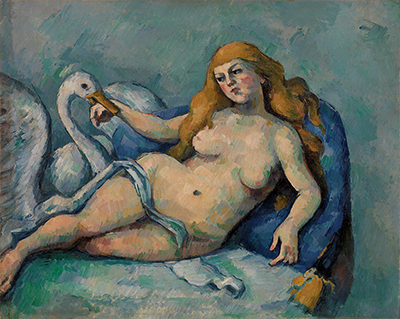
A swan bends toward a reclining woman, but their encounter is strangely hard to fix in time. Its beak touches the hand she holds up, while her eyes seem to drift downward, away from the bird. The woman has a body made of warm, broken patches of colour and the swan a neck that loops through the same crowded space. The painting brings a famous myth close enough to examine, then withholds the clear gesture or expression that would settle what is happening between its two figures.
At a Glance
- Artist Paul Cézanne. [1]
- Work Leda and the Swan ( Léda au cygne ), FWN 660; about 1880, possibly later. [1]
- Medium and size Oil on canvas, 59.7 × 74.9 cm. [1]
- Collection Barnes Foundation, Philadelphia, accession BF36. [1]
This work across Paul Cézanne’s career
The Kiss of the Muse
c.1860The Artist’s Father, Reading L’Événement
autumn 1866The Hanged Man’s House
c.1873A Modern Olympia
1873–74Maincy Bridge
1879–80Leda and the Swan by Paul Cézanne (current article)
c.1880 (possibly later)The Blue Vase
1889–90The Basket of Apples
c.1893Apples and Oranges
c.1899The Large Bathers (Philadelphia)
1900–1906 (Philadelphia Museum dating)Château Noir (MoMA)
1903–04Contents
- A myth brought close
- Body, bird and painted surface
- From a champagne label to Leda
- An older painting in the background
- The date and the painting's later life
A myth brought close
In the classical story, Zeus takes the form of a swan to approach Leda, and their encounter leads to children. The painting supplies no aftermath: no children or identifiable landscape. The myth explains the bird's presence without telling us how Leda experiences this encounter. [2]
The figure fills almost the full width of the canvas. Her legs run toward the left edge; her torso rises to meet the ochre head near its top; a dark blue support curves behind her shoulder and hip. Even the white cloth at her waist offers little empty ground. These observed features compress mythic bodies into a tangible arrangement of weight and contact. The swan's pale neck doubles back between her forearm and bent knee, so that its approach is also a curve holding the composition together.
Look at the raised hand at the upper left. It is lifted toward the swan, yet the bill seems to catch its fingers. That contact carries more narrative force than her downcast eyes and tilted head, which resist a decisive emotional reading. The painting can seem intimate or uneasy. Neither her pose nor the visible contact establishes consent, desire, or a single instant from the myth. A familiar title does not tell us what the woman wants. [2]
Body, bird and painted surface
Across Leda's chest and abdomen, Cézanne lets pinks, blue-greys, cream and greenish tones interrupt one another. The contours of the body become firmer in some places and diffuse in others. Her left thigh is a broad diagonal, but the lower leg nearly merges with the dark strip beneath it. The swan is easier to name than to separate cleanly from these adjoining forms: its back and wing appear as pale shapes at the left, while its head and curved throat draw a compact loop close to Leda's hand.
Colour establishes a second set of relationships. The blue behind her reappears in smaller cool marks across flesh and cloth; warm orange in the hair returns near the lower right edge. The green foreground and grey-green wall press the whole scene forward. Rather than opening a distant setting, these colour fields keep the eye moving across the woman, bird and surrounding space. The diagonal of her body remains legible, yet no single outline can carry it alone. It is built through adjacent strokes and changing tones.
The result is an unusually direct way to study a mythological nude. We recognize the characters immediately, then discover how much of the image depends on looking at particular patches and joins. The forehead is marked with cool colour, the hair splays into the blue behind it, and a light strip of fabric cuts across the belly before falling onto the green below. Such details do not illustrate the myth's later consequences. They make the physical closeness of these two bodies the present subject of the painting.
From a champagne label to Leda
André Dombrowski discusses Jean-Claude Lebensztejn's identification of a Champagne Nana bottle label as a source for Cézanne's Leda imagery. The label showed a reclining nude holding a champagne glass. Dombrowski reads this borrowing as an encounter with popular commercial imagery: a figure already made for display is shifted into a mythological painting. This is a useful account of the painting's visual starting point, though the label alone cannot explain every form Cézanne gave the finished canvas. [3] [4]
The shift changes what we see. A bottle label invites quick recognition; this figure demands slower attention because her outlines and expression do not resolve at a glance. The white at her waist, exposed belly and rising arm still make a posed nude unmistakable. Yet the swan introduces an encounter where the commercial image offered a woman alone. Its head reaches the hand, turning a display pose into an event with no secure outcome. The printed source and ancient title frame the body differently.
A related drawing adds another stage. Christie's describes a pencil study for Leda and the Swan in Cézanne's CP II sketchbook. It also notes another reclining nude without a swan, holding a champagne glass. These are distinct works. Their different companions for the reclining figure—the bird in one, the glass in another—clarify the distinction between a mythological scene and a modern display image. [5]
An older painting in the background
Christie's also records Ambroise Vollard's story that Courbet's Woman with a Parrot prompted Cézanne to imagine a woman with a swan; the auction text calls the account romanticised. The Courbet painting is a real point of comparison, but the anecdote is not documentary proof of Cézanne's decision. The Metropolitan Museum notes that Courbet exhibited his reclining nude in 1866 and that Cézanne apparently carried a small photograph of it. Together, those accounts establish an accessible comparison while leaving the precise route from Courbet's parrot to Cézanne's swan open. [5] [6]
Both pictures place a bird near a reclining nude, but the difference in scale and action is striking. Courbet's parrot is held aloft at a distance from the woman's body; Cézanne's swan occupies the same shallow zone as Leda's hand, arm and legs. The creature's long neck can reach her without her having to extend fully upward. This makes the encounter harder to treat as a decorative pairing of woman and animal. The bird has entered the figure's immediate physical space, even as the painting leaves the meaning of that entry undecided.
Takanori Nagaï points to another possible prompt: a relief of Leda and the swan at the Jas de Bouffan, Cézanne's family property. He also proposes that memories of Hortense Fiquet may lie behind some of Cézanne's imagined female nudes. The relief is a suggested local visual source; the Hortense connection remains a biographical hypothesis. The canvas gives no way to identify Leda as Hortense. [4]
The date and the painting's later life
The catalogue raisonné dates the Barnes painting to about 1880, possibly later. Earlier authorities placed it at quite different moments, including 1868 and the late 1880s. Cézanne's son annotated a photograph with the date 1868, but that is historical testimony rather than a date written on the canvas. The evidence supports a working date; a more exact year would suggest a certainty the records do not provide. [1]
The painting passed from Vollard through the Pellerin family and Paul Rosenberg before reaching the Barnes Foundation in January 1937. It appeared in Vollard's Cézanne exhibitions of 1895 and 1898; in the latter it was listed as Le Cygne et Leda . It was shown again at the 1907 Salon d'Automne retrospective, lent by Pellerin. These records show a work presented under titles identifying the myth, although the canvas offers an encounter rather than a complete story. [1]
Cézanne artworks directory
Browse 217 identified works in this researched selection, including paintings, drawings and watercolours. This is a bounded selection, not a complete catalogue of Cézanne’s surviving oeuvre. Unlinked titles have no confirmed article in this collection.
| Name | Date | Medium |
|---|---|---|
| A Head, a Cup, and a Bread Roll | 1891/1894 | Drawing |
| A Man seen from Behind | 1880/1883 | Drawing |
| A Modern Olympia | 1873–74 | Painting |
| A Nude and Foliage | 1879/1882 | Drawing |
| A Smoking Man | 1892–96 (catalogue); c.1890–92 (museum) | Drawing |
| Afternoon in Naples | 1876–77 | Painting |
| An Old Woman with a Rosary | about 1895–96 | Painting |
| Apples and Oranges | c.1899 | Painting |
| Auvers, Panoramic View | 1873–75 | Painting |
| Avenue at Chantilly | 1888 | Painting |
| Banks of the Marne | 1888–94 | Painting |
| Basket | 1877/1900 | Drawing |
| Bather with Outstretched Arms | 1877–78 | Painting |
| Bellows in Front of a Fireplace | 1887/1892 | Drawing |
| Bibémus Quarry | c.1895 | Painting |
| Boy in a Red Vest, Barnes Foundation | 1888–90 | Painting |
| Boy in a Red Vest, MoMA | 1888–90 | Painting |
| Boy in a Red Waistcoat, National Gallery of Art | 1888–90 | Painting |
| Branch in Flower | 1886/1889 | Drawing |
| Carnival Scene | 1885/1888 | Drawing |
| Chair and Dresser | 1880/1883 | Drawing |
| Chateau Noir | 1903–04 | Painting |
| Chestnut Trees and Farm at Jas de Bouffan | c.1885 | Painting |
| Chestnut Trees and Farm at Jas de Bouffan, Pushkin | c.1886 | Painting |
| Chestnut Trees at Jas de Bouffan in Winter | 1885–86 | Painting |
| Château Noir | 1900–04 | Painting |
| Cistern in the Park of Château Noir | c.1900 | Painting |
| Curtain, Jug and Fruit | 1893–94 | Painting |
| Cushion of an Armchair | 1886/1889 | Drawing |
| Draft Letter and Studies of Bathers | c.1878 | Drawing |
| Farmhouse and Chestnut Trees at Jas de Bouffan | 1884–85 | Painting |
| Figure Resting Head on Hand | c. 1889 | Drawing |
| Fireplace Tongs and Poker | 1887/1892 | Drawing |
| Forest Interior, San Francisco | c.1898–99 | Painting |
| Four Bathers | 1888–90 | Painting |
| Fruit and a Jug on a Table | 1893–94 | Painting |
| Gardanne | 1885–86 | Painting |
| Gardanne, Barnes Foundation | c.1885 | Painting |
| Hand and Shoulder of a Boy | c. 1885 | Drawing |
| Harlequin, National Gallery of Art | 1888–90 | Painting |
| Head of a Boy | 1887/1889 | Drawing |
| Head of a Boy Seen from Behind | c. 1885 | Drawing |
| Head of a Young Woman | c. 1880 | Drawing |
| Head of the Artist's Son | 1888/1889 | Drawing |
| Hillside in Provence | c.1890–92 | Painting |
| Horse Chestnut Trees at Jas de Bouffan | c.1885 | Painting |
| House and Farm at the Jas de Bouffan | c.1887 | Painting |
| House in a Park | 1883/1886 | Drawing |
| House in Provence | c.1885 | Painting |
| House of Père Lacroix | 1873 | Painting |
| House Surrounded by Vegetation | 1889/1892 | Drawing |
| Houses in Provence The Riaux Valley near L’Estaque | c.1883 | Painting |
| Jas de Bouffan, the Pool | c.1876 | Painting |
| Kerosene Lamp | 1878/1881 | Drawing |
| L'Estaque, Melting Snow | c.1870 | Painting |
| Lake Annecy | 1896 | Painting |
| Landscape in Provence, Pola Museum | 1879–82 | Painting |
| Landscape Near Aix-en-Provence | 1877/1880 | Drawing |
| Landscape Seen from the Inside of a Cave | 1889/1892 | Drawing |
| Landscape with Poplars | c.1885–87 | Painting |
| Landscape with Trees | 1895/1898 | Drawing |
| Leda and the Swan | c.1880 (possibly later) | Painting |
| Little Girl with a Doll | 1902–04 | Painting |
| Louis Guillaume | 1879–1890 | Painting |
| Madame Cezanne | 1888/1891 | Drawing |
| Madame Cezanne | 1886/1889 | Drawing |
| Madame Cezanne | 1882/1887 | Drawing |
| Madame Cezanne | 1897/1900 | Drawing |
| Madame Cezanne with her Head Lowered | 1893/1896 | Drawing |
| Madame Cézanne in a Red Armchair | c.1877 | Painting |
| Madame Cézanne in a Red Dress, Metropolitan Museum of Art | 1888–90 | Painting |
| Madame Cézanne in a Yellow Chair | 1888–90 | Painting |
| Madame Cézanne in a Yellow Chair, Fondation Beyeler | 1888–90 | Painting |
| Madame Cézanne in the Conservatory | 1891 | Painting |
| Maincy Bridge | 1879–80 | Painting |
| Maison Maria with a View of Château Noir | c.1895 | Painting |
| Man Bending Forward | 1883/1886 | Drawing |
| Man Smoking a Pipe, Pushkin | c.1891, possibly later | Painting |
| Man with a Pipe | 1891–96 | Painting |
| Man with a Pipe, Nelson-Atkins | 1890–92 | Painting |
| Man with a Straw Hat (Gustave Boyer) | c.1871 | Painting |
| Man with Crossed Arms | c.1899 | Painting |
| Man with Pipe, National Gallery of Art | 1892–96 | Painting |
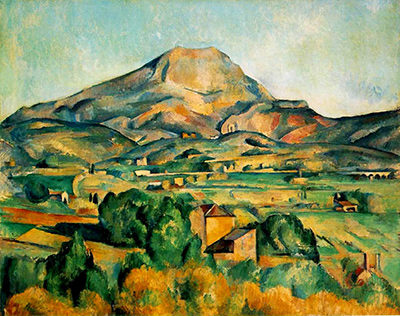
| Mont Sainte-Victoire | c.1902–06 | Painting |
| Mont Sainte-Victoire | 1900–02 | Painting |
| Mont Sainte-Victoire (recto) | c.1895 | Watercolour |
| Mont Sainte-Victoire and the Viaduct of the Arc River Valley | 1882–85 | Painting |
| Mont Sainte-Victoire Seen beyond the Wall of the Jas de Bouffan | c.1885/1888 | Watercolour |
| Mont Sainte-Victoire Seen from Bibémus Quarry | c.1897 | Painting |
| Mont Sainte-Victoire, Barnes Foundation | 1892–95 | Painting |
| Near the Pool at Jas de Bouffan | 1883/1887 | Drawing |
| Pelicans | 1877/1880 | Drawing |
| Peonies | 1890/1893 | Drawing |
| Pierrot and Harlequin | 1888 | Painting |
| Pine Tree | 1882/1885 | Drawing |
| Pont des Trois Sautets | 1906 | Watercolour |
| Poplars | 1879–80 | Painting |
| Portrait of Ambroise Vollard | 1899 | Painting |
| Portrait of Gustave Geffroy | 1895–96 | Painting |
| Portrait of Madame Cezanne with Loosened Hair | 1885–86 | Painting |
| Portrait of the Artist Looking Over His Shoulder | 1883–84 | Painting |
| Portrait of the Gardener Vallier | 1906 | Painting |
| Portrait of Victor Chocquet | 1876–77 | Painting |
| Portrait Of Victor Chocquet Seated | 1877 | Painting |
| Provençal Manor | c.1885 | Painting |
| Pyramid of Skulls | 1898–1900 | Painting |
| Reclining Nude (Leda?) | c.1887 | Painting |
| Scipio | 1866–68 | Painting |
| Seated Man, Oslo | 1898–1900 | Painting |
| Seated Peasant | c.1892–96 | Painting |
| Seated Peasant, Hiroshima | c.1897 | Painting |
| Seated Peasant, Orsay | c.1900 | Painting |
| Self-Portrait | c. 1895 | Drawing |
| Self-Portrait in a Bowler Hat, Ny Carlsberg Glyptotek | 1885–86 | Painting |
| Self-Portrait in a Casquette | c.1875 | Painting |
| Self-Portrait with a Beret | 1898–1900 | Painting |
| Self-Portrait with a Hat, Artizon Museum | c.1890–94 | Painting |
| Self-Portrait with a Pink Background | c.1875 | Painting |
| Self-Portrait with Olive-Coloured Wallpaper | about 1880–81 | Painting |
| Self-Portrait with Palette | 1886–87 | Painting |
| Self-Portrait with White Turban | c.1878–80 | Painting |
| Self-Portrait, c.1895 | c.1895 | Painting |
| Self-Portrait, Pushkin Museum | c.1882 | Painting |
| Spanish Dancers | 1883/1886 | Drawing |
| Still Life with a Curtain | 1892–94 | Painting |
| Still Life with Apples | c.1890 | Painting |
| Still Life with Apples | 1893–94 | Painting |
| Still Life with Apples and a Pot of Primroses | about 1890 | Painting |
| Still Life with Milk Jug and Fruit | c.1900 | Painting |
| Still Life with Open Drawer | 1877–79 | Painting |
| Still Life with Plaster Cupid | about 1894 | Painting |
| Still Life with Skull | 1890–93 | Painting |
| Still Life with Soup Tureen | 1877 | Painting |
| Still Life, Pitcher and Fruit | 1893–94 | Painting |
| Studies Including a Straw Hat | 1895/1898 | Drawing |
| Studies Including Madame Cezanne | 1884/1887 | Drawing |
| Study for "The Judgement of Paris" or "The Amorous Shepherd" | 1883/1886 | Drawing |
| Study for Woman with a Coffee Pot | c.1895 | Painting |
| Study of "The Roman Orator (Germanicus)" | 1883/1886 | Drawing |
| Study of "Venus de Milo" | 1881/1884 | Drawing |
| Study of a Decorative Ornament | 1879/1882 | Drawing |
| Study of a Standing Male Figure after the Antique | c. 1895 | Drawing |
| Study of an Angel in Rubens' "The Prophet Elijah" | 1892/1895 | Drawing |
| Study of Desiderio da Settignano's "Bust of a Child" | c. 1895 | Drawing |
| Study of Houses | 1879/1882 | Drawing |
| Study of Puget's "Hercules Resting" | c. 1879 | Drawing |
| Study of Puget's "Milo of Crotona" | 1895/1898 | Drawing |
| Study of Puget's "Milo of Crotona" | 1880/1883 | Drawing |
| Study of the Allegorical Figure Bellona in Rubens' "The Apotheosis of Henri IV" | 1883/1886 | Drawing |
| Study of the Allegorical Figure Bellona in Rubens' "The Apotheosis of Henri IV" | 1879/1882 | Drawing |
| Study of the Allegorical Figure France in Rubens' "The Exchange of the Two Princesses" | 1882/1885 | Drawing |
| Study of the Allegorical Figure of Health in Rubens' "The Birth of Louis XIII" | 1880/1883 | Drawing |
| Study of the Allegorical Figure of the Genius of Health from Rubens' "The Birth of Louis XIII at Fontainbleau" | 1895/1898 | Drawing |
| Sugar Bowl, Pears and Blue Cup | 1865–66 | Painting |
| The Aqueduct, Pushkin Museum | Dating differs between museum records | Painting |
| The Artist's Father, Reading L'Evenement | autumn 1866 | Painting |
| The Artist's Son | c. 1887 | Drawing |
| The Artist's Son Leaning on his Elbow | c. 1887 | Drawing |
| The Artist's Son Reading | c. 1887 | Drawing |
| The Artist's Son Writing | c. 1887 | Drawing |
| The Artist’s Son, Paul | 1886–87 | Painting |
| The Avenue at Jas de Bouffan | 1868–70 (possibly later) | Painting |
| The Avenue at Jas de Bouffan, Geneva | c.1890 | Painting |
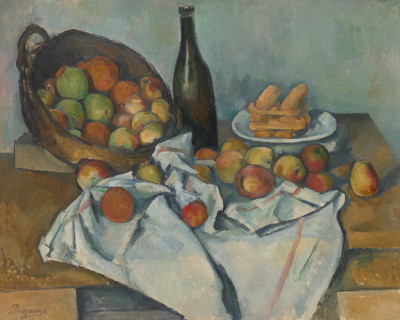
| The Basket of Apples | c.1893 | Painting |
| The Bather, Museum of Modern Art | c.1885 | Painting |
| The Bay of Marseille seen from L'Estaque | c.1885 | Painting |
| The Blue Vase | 1889–90 | Painting |
| The Boy in the Red Vest, Bührle | 1888–90 | Painting |
| The Buffet | 1877–79 | Painting |
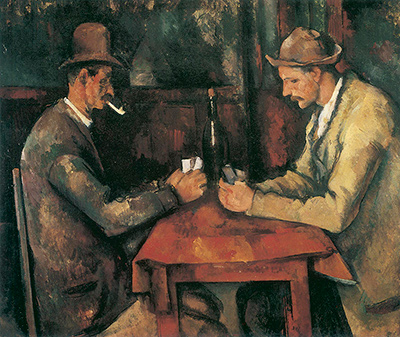
| The Card Players, Barnes Foundation | 1890–92 | Painting |
| The Card Players, Courtauld Gallery | 1892–96 | Painting |
| The Card Players, Metropolitan Museum of Art | 1890–92 | Painting |
| The Card Players, Musée d’Orsay | 1893–96 | Painting |
| The Card Players, Qatar | 1892–96 | Painting |
| The Eternal Feminine | c.1877 | Painting |
| The Gardener Vallier | 1906 | Painting |
| The Gardener Vallier, Tate | 1905–06 | Painting |
| The Grounds of the Château Noir | c.1900–04 | Painting |
| The Gulf of Marseille Seen from L’Estaque | c.1885 | Painting |
| The Hanged Man's House in Auvers | c.1873 | Painting |
| The House of Doctor Gachet at Auvers | 1872–73 | Painting |
| The House with the Cracked Walls | 1892–94 | Painting |
| The Kiss of the Muse | c.1860 | Painting |
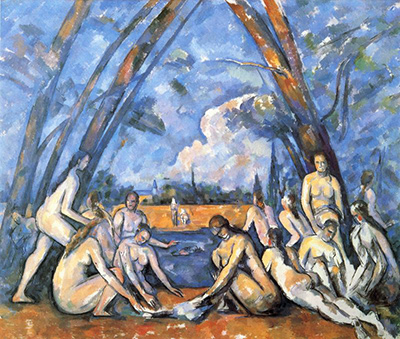
| The Large Bathers, Barnes Foundation | 1895–1906 | Painting |
| The Large Bathers, National Gallery | 1895–1905 | Painting |
| The Large Bathers, Philadelphia Museum of Art | 1900–06 | Painting |
| The Mill | 1889/1892 | Drawing |
| The Painter’s Father, Louis-Auguste Cézanne | c.1865 | Painting |
| The Peasant | 1890–92 | Painting |
| The Plaster Mill (La Moulin à plâtre) | 1889/1892 | Drawing |
| The Smoker, Hermitage | c.1891 | Painting |
| The Smoker, Mannheim | c.1891 | Painting |
| The Stove in the Studio | c.1865 | Painting |
| The Vase of Tulips | c.1890 | Painting |
| Thistle | 1893/1896 | Drawing |
| Three Heads, One of Madame Cezanne | 1882/1885 | Drawing |
| Three Skulls | c.1898 | Painting |
| Three Skulls on a Patterned Carpet | 1904 | Painting |
| Trees and Shrubs | 1883/1887 | Drawing |
| Turning Road at Montgeroult | 1898 | Painting |
| Two Bathers | 1884/1887 | Drawing |
| Two Heads | 1888 | Drawing |
| Two Heads | 1890/1896 | Drawing |
| Two Heads of Women | 1890/1894 | Drawing |
| Two Studies for "The Judgement of Paris" or "The Amorous Shepherd" | 1883/1886 | Drawing |
| Uncle Dominique in a Tasseled Cap | 1866 | Painting |
| Uncle Dominique in a Turban | 1866–67 | Painting |
| Victor Chocquet and an Angel for "The Apotheosis of Delacroix" | 1878/1880 | Drawing |
| Woman in Blue | c.1904 | Painting |
| Woman Leaning Forward | 1888/1891 | Drawing |
| Woman Leaning Forward | 1890/1894 | Drawing |
| Woman Leaning Forward | 1890/1894 | Drawing |
| Woman with a Coffee Pot | c.1895 | Painting |
| Women Bathers and a Roll of Paper | 1882/1885 | Drawing |
| Young Girl with a Doll | c.1895 | Painting |
| Young Italian Woman at a Table | c.1895–1900 | Painting |
| Young Man and Skull | 1896–98 | Painting |
Frequently Asked Questions
In the myth, Zeus takes a swan's form to approach Leda. The bird identifies the subject even though the painting shows none of the story's later events. [2]
André Dombrowski discusses Jean-Claude Lebensztejn's identification of a Champagne Nana label as a source for Cézanne's Leda imagery. The painting transforms its reclining nude into a mythological encounter. [3]
Christie's describes a separate study of a nude without a swan, holding a glass. Its details should not be read into the Barnes canvas. [5]
Discussion
Look again at the images and ideas explored in Leda and the Swan by Paul Cézanne. These editorial prompts invite your observations.
Reader Insights
The raised hand deserves a second look: does it read to you as an invitation, a pause, or simply the point where the two shapes meet?
Compare the blue behind Leda with the blue marks inside her figure. Where does the body seem most solid, and where does its edge open into the surrounding paint?
The title provides a myth, while the painting supplies only this close encounter. What changes when you begin with the visible hand and swan rather than with the story's familiar ending?
Join the Conversation
Share a detail, comparison or question about Leda and the Swan by Paul Cézanne below.
References
- Société Paul Cézanne , “Léda au cygne, c. 1880 (possibly later) (FWN 660),” and related catalogue entries FWN 3008-36b and FWN 661, The Paintings, Watercolors and Drawings of Paul Cézanne: An Online Catalogue Raisonné . ; related sketch; related nude. View source 1 . View source 2 . View source 3 .
- Cleveland Museum of Art , “Leda and the Swan,” collection entry for Adolphe Yvon. View source .
- Société Paul Cézanne / André Dombrowski , “Cezanne, l’année terrible and The Eternal Feminine,” 2013. View source .
- Société Paul Cézanne / Takanori Nagaï , “Cézanne et Jas de Bouffan—Représentation de l’intimité,” 2020 (in French). View source .
- Christie's , “Étude pour Léda et Étude de tête,” lot essay, 2003. View source .
- The Metropolitan Museum of Art , “Woman with a Parrot,” collection entry for Gustave Courbet. View source .
- Le Baiser de la muse, d'après Frillié (FWN 572). View source.
- Louis-Auguste Cezanne, père de l'artiste, lisant L'Événement (FWN 402). View source.
- La Maison du pendu, Auvers-sur-Oise (FWN 81). View source.
- Une moderne Olympia (FWN 628). View source.
- Le Pont de Maincy (FWN 143). View source.
- La Montagne Sainte-Victoire vue de Montbriand (FWN 185). View source.
- Gardanne (vue horizontale) (FWN 224). View source.
- Le Vase bleu (FWN 823). View source.
- Les Joueurs de cartes (FWN 681). View source.
- La Montagne Sainte-Victoire (FWN 296). View source.
- La Corbeille de pommes (FWN 860). View source.
- Pommes et oranges (FWN 871). View source.
- Portrait d'Ambroise Vollard (FWN 531). View source.
- Philadelphia Museum of Art,The Large Bathers,W1937-1-1. View source.
- Château Noir (FWN 360). View source.
- Société Paul Cezanne,online catalogue structure and objectidentification. View source.
- National Gallery of Art,Cezanne Sketchbook,1992.51.9. View source.
- Splash image, Leda and the Swan. Barnes Foundation.