 by
Tom Gurney
Tom Gurney BSc (Hons) is an art history expert with over 20 years experience
Published on June 19, 2020 / Updated on October 22, 2026
Email:
tomgurney1@gmail.com
/ Phone:
+44 7429 011000
Self-Portrait with Palette by Paul Cézanne: Introduction
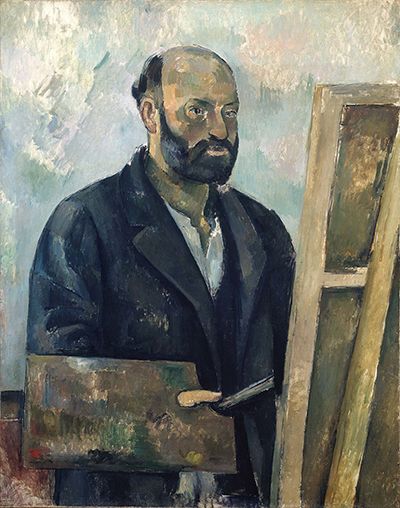
Cézanne stands beside a tall easel, a broad palette held across the lower part of the picture. His body turns towards us, but his eyes travel to the right, towards the narrow, dark rectangle of a canvas seen from behind. The result is a self-portrait with an unusual centre of attention: the painter is present, yet the act of looking from one surface to another seems to be the real subject.
At a Glance
- Artist Paul Cézanne. [1]
- Title Self-Portrait with Palette ; the catalogue title is Portrait de l'artiste à la palette . [1]
- Date 1886–87 in the online catalogue raisonné; about 1890 in the Kunsthaus Zürich record. [1] [2]
- Medium and size Oil on canvas, 92 × 73 cm. [1]
- Collection Emil Bührle Collection, long-term loan to Kunsthaus Zürich; Kunsthaus inventory number BU 0017. [2]
This work across Paul Cézanne’s career
The Kiss of the Muse
c.1860The Artist’s Father, Reading L’Événement
autumn 1866The Hanged Man’s House
c.1873A Modern Olympia
1873–74Maincy Bridge
1879–80Self-Portrait with Palette by Paul Cézanne (current article)
FWN1886–87; Kunsthausc.1890The Blue Vase
1889–90The Basket of Apples
c.1893Apples and Oranges
c.1899The Large Bathers (Philadelphia)
1900–1906 (Philadelphia Museum dating)Château Noir (MoMA)
1903–04Contents
- A face between two painting surfaces
- The painter looking at himself
- Colour, scale and the uncertain date
- From the family to a public collection
A face between two painting surfaces
The first large shape we meet is Cézanne's dark jacket. It fills much of the centre, its shoulders spreading beneath a head that appears almost compressed between the pale wall and the vertical easel. A white shirt opens at the neck. Rather than outlining the coat smoothly, Cézanne allows dark blue and black passages to break into changes of tone. Small pale touches catch its front and sleeve. The figure looks heavy and solid, though its edges never become mechanically sharp.
At the lower left, the palette cuts a nearly level bar across the body. Its outer shape is plain and broad, but the painted face of it is restless: patches of brown, grey, ochre and a little red interrupt one another. A thumb projects through the opening near its right edge. This small bodily detail makes the object credible as something held, even as its broad plane functions like another picture within the picture. We can look at it as a painter's implement and as a small field of colour at the same time.
The easel at the right supplies a very different plane. Its pale wooden uprights frame the brown reverse of a canvas, shutting out any view of the painting Cézanne is supposedly making. Our view of his work stops precisely where his own attention seems to begin. The crossed relation is striking: the palette faces us while the canvas faces him. His gaze links the two, but it does not tell us what image might be developing on the hidden side. A viewer can follow the direction of the eyes without gaining access to their destination.
The pale background is far from empty. White, blue, green and warm pinkish marks move unevenly across it. Around the head, these marks prevent the wall from settling into a neutral studio backdrop. The beard and face contain related dark browns and cooler notes. Looking from one area to another, we can see colour carried across the supposed boundaries between skin, clothing, implement and room. The apparent calm of the pose depends on this active surface.
The painter looking at himself
Fondation Beyeler's guide to its 2026 Cézanne exhibition proposes that his glance may pass between the canvas on the easel and a mirror outside the painted scene. That is a plausible way to understand the practical problem of making a self-portrait, but no mirror is visible here. The guide also reads the palette, set parallel to the picture surface, as an invitation to imagine the painter's work. [3]
The stance has a certain formality, yet it is an odd sort of professional portrait. There is no flourish with a brush, no displayed finished masterpiece, and no open invitation to admire the sitter's expression. John Elderfield, discussing Cézanne's portraits, singles out this work as an example of a characteristic refusal to pose for the beholder. That observation helps explain why the palette can be so conspicuous while the man remains psychologically difficult to pin down. [4]
One can still read a great deal in the face without deciding on a fixed emotion. The bald crown catches light; darker paint gathers around the brows, eyes, beard and side of the head. The nose projects strongly, while one eye appears slightly more open to us than the other. These differences keep the face from becoming a symmetrical emblem. Looking closely, one senses successive adjustments to planes and colour rather than a polished mask.
Pavel Machotka compares this work with Cézanne's portrait of his wife holding a fan, suggesting a companion in gravity and scale without claiming that the pair was planned as such. He sees the handling here as comparatively unified, perhaps made in one stage; that is his visual interpretation, rather than a reported technical examination of the canvas. His comparison directs attention away from a simple likeness towards the large, stable arrangement of figure and implements. [5]
Colour, scale and the uncertain date
This is a comparatively large self-portrait, tall enough to accommodate more than a head and shoulders. That extra space matters. If the picture were cropped near the neck, the eyes might dominate it as an exercise in likeness. With the lower palette and the right-hand easel retained, the encounter becomes spatial and procedural. The body occupies a working position; the tools determine the way we move through the canvas. The large area of dark coat gives the head weight, while the horizontal palette stops the figure from dissolving into the pale room.
Dating remains difficult. The online catalogue raisonné gives 1886–87, while Kunsthaus Zürich uses circa 1890. Machotka argues for an earlier date from the beard's appearance in an 1889 photograph, though his essay's heading retains 1888–90. These are competing judgements rather than a date written on the painting. [1] [2] [5]
The disagreement changes how confidently we can place the work among Cézanne's other self-images. The National Portrait Gallery describes his self-portraits as a repeated practice, with changes in pose and handling across the decades. This one may be compared with the more closely framed studies of his head and with self-portraits in hats, but its combination of full working kit and withheld canvas gives it a distinct problem. Its purpose is not settled by choosing one year from the range. [6]
From the family to a public collection
The later history begins with Cézanne's son Paul, who held the painting until 1947. It passed to his widow Renée Rivière. Kunsthaus Zürich records the 1953 sale to Emil Bührle through Galerie Renou et Poyet and Walter Feilchenfeldt for $100,000. The painting entered the foundation collection in 1960 and came to the Kunsthaus on long-term loan in 2021. [2]
The exhibition record shows changing names and dates. Berlin's Secession listed it simply as a portrait in 1903. A Paris exhibition of 1930 called it a portrait of Cézanne at his easel and dated it 1888. The catalogue records this work in the Paris presentation of Cézanne Portraits in 2017, explicitly marking it as shown there only, and in Fondation Beyeler's 2026 exhibition. [1]
Cézanne artworks directory
Browse 217 identified works in this researched selection, including paintings, drawings and watercolours. This is a bounded selection, not a complete catalogue of Cézanne’s surviving oeuvre. Unlinked titles have no confirmed article in this collection.
| Name | Date | Medium |
|---|---|---|
| A Head, a Cup, and a Bread Roll | 1891/1894 | Drawing |
| A Man seen from Behind | 1880/1883 | Drawing |
| A Modern Olympia | 1873–74 | Painting |
| A Nude and Foliage | 1879/1882 | Drawing |
| A Smoking Man | 1892–96 (catalogue); c.1890–92 (museum) | Drawing |
| Afternoon in Naples | 1876–77 | Painting |
| An Old Woman with a Rosary | about 1895–96 | Painting |
| Apples and Oranges | c.1899 | Painting |
| Auvers, Panoramic View | 1873–75 | Painting |
| Avenue at Chantilly | 1888 | Painting |
| Banks of the Marne | 1888–94 | Painting |
| Basket | 1877/1900 | Drawing |
| Bather with Outstretched Arms | 1877–78 | Painting |
| Bellows in Front of a Fireplace | 1887/1892 | Drawing |
| Bibémus Quarry | c.1895 | Painting |
| Boy in a Red Vest, Barnes Foundation | 1888–90 | Painting |
| Boy in a Red Vest, MoMA | 1888–90 | Painting |
| Boy in a Red Waistcoat, National Gallery of Art | 1888–90 | Painting |
| Branch in Flower | 1886/1889 | Drawing |
| Carnival Scene | 1885/1888 | Drawing |
| Chair and Dresser | 1880/1883 | Drawing |
| Chateau Noir | 1903–04 | Painting |
| Chestnut Trees and Farm at Jas de Bouffan | c.1885 | Painting |
| Chestnut Trees and Farm at Jas de Bouffan, Pushkin | c.1886 | Painting |
| Chestnut Trees at Jas de Bouffan in Winter | 1885–86 | Painting |
| Château Noir | 1900–04 | Painting |
| Cistern in the Park of Château Noir | c.1900 | Painting |
| Curtain, Jug and Fruit | 1893–94 | Painting |
| Cushion of an Armchair | 1886/1889 | Drawing |
| Draft Letter and Studies of Bathers | c.1878 | Drawing |
| Farmhouse and Chestnut Trees at Jas de Bouffan | 1884–85 | Painting |
| Figure Resting Head on Hand | c. 1889 | Drawing |
| Fireplace Tongs and Poker | 1887/1892 | Drawing |
| Forest Interior, San Francisco | c.1898–99 | Painting |
| Four Bathers | 1888–90 | Painting |
| Fruit and a Jug on a Table | 1893–94 | Painting |
| Gardanne | 1885–86 | Painting |
| Gardanne, Barnes Foundation | c.1885 | Painting |
| Hand and Shoulder of a Boy | c. 1885 | Drawing |
| Harlequin, National Gallery of Art | 1888–90 | Painting |
| Head of a Boy | 1887/1889 | Drawing |
| Head of a Boy Seen from Behind | c. 1885 | Drawing |
| Head of a Young Woman | c. 1880 | Drawing |
| Head of the Artist's Son | 1888/1889 | Drawing |
| Hillside in Provence | c.1890–92 | Painting |
| Horse Chestnut Trees at Jas de Bouffan | c.1885 | Painting |
| House and Farm at the Jas de Bouffan | c.1887 | Painting |
| House in a Park | 1883/1886 | Drawing |
| House in Provence | c.1885 | Painting |
| House of Père Lacroix | 1873 | Painting |
| House Surrounded by Vegetation | 1889/1892 | Drawing |
| Houses in Provence The Riaux Valley near L’Estaque | c.1883 | Painting |
| Jas de Bouffan, the Pool | c.1876 | Painting |
| Kerosene Lamp | 1878/1881 | Drawing |
| L'Estaque, Melting Snow | c.1870 | Painting |
| Lake Annecy | 1896 | Painting |
| Landscape in Provence, Pola Museum | 1879–82 | Painting |
| Landscape Near Aix-en-Provence | 1877/1880 | Drawing |
| Landscape Seen from the Inside of a Cave | 1889/1892 | Drawing |
| Landscape with Poplars | c.1885–87 | Painting |
| Landscape with Trees | 1895/1898 | Drawing |
| Leda and the Swan | c.1880 (possibly later) | Painting |
| Little Girl with a Doll | 1902–04 | Painting |
| Louis Guillaume | 1879–1890 | Painting |
| Madame Cezanne | 1888/1891 | Drawing |
| Madame Cezanne | 1886/1889 | Drawing |
| Madame Cezanne | 1882/1887 | Drawing |
| Madame Cezanne | 1897/1900 | Drawing |
| Madame Cezanne with her Head Lowered | 1893/1896 | Drawing |
| Madame Cézanne in a Red Armchair | c.1877 | Painting |
| Madame Cézanne in a Red Dress, Metropolitan Museum of Art | 1888–90 | Painting |
| Madame Cézanne in a Yellow Chair | 1888–90 | Painting |
| Madame Cézanne in a Yellow Chair, Fondation Beyeler | 1888–90 | Painting |
| Madame Cézanne in the Conservatory | 1891 | Painting |
| Maincy Bridge | 1879–80 | Painting |
| Maison Maria with a View of Château Noir | c.1895 | Painting |
| Man Bending Forward | 1883/1886 | Drawing |
| Man Smoking a Pipe, Pushkin | c.1891, possibly later | Painting |
| Man with a Pipe | 1891–96 | Painting |
| Man with a Pipe, Nelson-Atkins | 1890–92 | Painting |
| Man with a Straw Hat (Gustave Boyer) | c.1871 | Painting |
| Man with Crossed Arms | c.1899 | Painting |
| Man with Pipe, National Gallery of Art | 1892–96 | Painting |
| Mont Sainte-Victoire | c.1902–06 | Painting |
| Mont Sainte-Victoire | 1900–02 | Painting |
| Mont Sainte-Victoire (recto) | c.1895 | Watercolour |
| Mont Sainte-Victoire and the Viaduct of the Arc River Valley | 1882–85 | Painting |
| Mont Sainte-Victoire Seen beyond the Wall of the Jas de Bouffan | c.1885/1888 | Watercolour |
| Mont Sainte-Victoire Seen from Bibémus Quarry | c.1897 | Painting |
| Mont Sainte-Victoire, Barnes Foundation | 1892–95 | Painting |
| Near the Pool at Jas de Bouffan | 1883/1887 | Drawing |
| Pelicans | 1877/1880 | Drawing |
| Peonies | 1890/1893 | Drawing |
| Pierrot and Harlequin | 1888 | Painting |
| Pine Tree | 1882/1885 | Drawing |
| Pont des Trois Sautets | 1906 | Watercolour |
| Poplars | 1879–80 | Painting |
| Portrait of Ambroise Vollard | 1899 | Painting |
| Portrait of Gustave Geffroy | 1895–96 | Painting |
| Portrait of Madame Cezanne with Loosened Hair | 1885–86 | Painting |
| Portrait of the Artist Looking Over His Shoulder | 1883–84 | Painting |
| Portrait of the Gardener Vallier | 1906 | Painting |
| Portrait of Victor Chocquet | 1876–77 | Painting |
| Portrait Of Victor Chocquet Seated | 1877 | Painting |
| Provençal Manor | c.1885 | Painting |
| Pyramid of Skulls | 1898–1900 | Painting |
| Reclining Nude (Leda?) | c.1887 | Painting |
| Scipio | 1866–68 | Painting |
| Seated Man, Oslo | 1898–1900 | Painting |
| Seated Peasant | c.1892–96 | Painting |
| Seated Peasant, Hiroshima | c.1897 | Painting |
| Seated Peasant, Orsay | c.1900 | Painting |
| Self-Portrait | c. 1895 | Drawing |
| Self-Portrait in a Bowler Hat, Ny Carlsberg Glyptotek | 1885–86 | Painting |
| Self-Portrait in a Casquette | c.1875 | Painting |
| Self-Portrait with a Beret | 1898–1900 | Painting |
| Self-Portrait with a Hat, Artizon Museum | c.1890–94 | Painting |
| Self-Portrait with a Pink Background | c.1875 | Painting |
| Self-Portrait with Olive-Coloured Wallpaper | about 1880–81 | Painting |
| Self-Portrait with Palette | 1886–87 | Painting |
| Self-Portrait with White Turban | c.1878–80 | Painting |
| Self-Portrait, c.1895 | c.1895 | Painting |
| Self-Portrait, Pushkin Museum | c.1882 | Painting |
| Spanish Dancers | 1883/1886 | Drawing |
| Still Life with a Curtain | 1892–94 | Painting |
| Still Life with Apples | c.1890 | Painting |
| Still Life with Apples | 1893–94 | Painting |
| Still Life with Apples and a Pot of Primroses | about 1890 | Painting |
| Still Life with Milk Jug and Fruit | c.1900 | Painting |
| Still Life with Open Drawer | 1877–79 | Painting |
| Still Life with Plaster Cupid | about 1894 | Painting |
| Still Life with Skull | 1890–93 | Painting |
| Still Life with Soup Tureen | 1877 | Painting |
| Still Life, Pitcher and Fruit | 1893–94 | Painting |
| Studies Including a Straw Hat | 1895/1898 | Drawing |
| Studies Including Madame Cezanne | 1884/1887 | Drawing |
| Study for "The Judgement of Paris" or "The Amorous Shepherd" | 1883/1886 | Drawing |
| Study for Woman with a Coffee Pot | c.1895 | Painting |
| Study of "The Roman Orator (Germanicus)" | 1883/1886 | Drawing |
| Study of "Venus de Milo" | 1881/1884 | Drawing |
| Study of a Decorative Ornament | 1879/1882 | Drawing |
| Study of a Standing Male Figure after the Antique | c. 1895 | Drawing |
| Study of an Angel in Rubens' "The Prophet Elijah" | 1892/1895 | Drawing |
| Study of Desiderio da Settignano's "Bust of a Child" | c. 1895 | Drawing |
| Study of Houses | 1879/1882 | Drawing |
| Study of Puget's "Hercules Resting" | c. 1879 | Drawing |
| Study of Puget's "Milo of Crotona" | 1895/1898 | Drawing |
| Study of Puget's "Milo of Crotona" | 1880/1883 | Drawing |
| Study of the Allegorical Figure Bellona in Rubens' "The Apotheosis of Henri IV" | 1883/1886 | Drawing |
| Study of the Allegorical Figure Bellona in Rubens' "The Apotheosis of Henri IV" | 1879/1882 | Drawing |
| Study of the Allegorical Figure France in Rubens' "The Exchange of the Two Princesses" | 1882/1885 | Drawing |
| Study of the Allegorical Figure of Health in Rubens' "The Birth of Louis XIII" | 1880/1883 | Drawing |
| Study of the Allegorical Figure of the Genius of Health from Rubens' "The Birth of Louis XIII at Fontainbleau" | 1895/1898 | Drawing |
| Sugar Bowl, Pears and Blue Cup | 1865–66 | Painting |
| The Aqueduct, Pushkin Museum | Dating differs between museum records | Painting |
| The Artist's Father, Reading L'Evenement | autumn 1866 | Painting |
| The Artist's Son | c. 1887 | Drawing |
| The Artist's Son Leaning on his Elbow | c. 1887 | Drawing |
| The Artist's Son Reading | c. 1887 | Drawing |
| The Artist's Son Writing | c. 1887 | Drawing |
| The Artist’s Son, Paul | 1886–87 | Painting |
| The Avenue at Jas de Bouffan | 1868–70 (possibly later) | Painting |
| The Avenue at Jas de Bouffan, Geneva | c.1890 | Painting |
| The Basket of Apples | c.1893 | Painting |
| The Bather, Museum of Modern Art | c.1885 | Painting |
| The Bay of Marseille seen from L'Estaque | c.1885 | Painting |
| The Blue Vase | 1889–90 | Painting |
| The Boy in the Red Vest, Bührle | 1888–90 | Painting |
| The Buffet | 1877–79 | Painting |
| The Card Players, Barnes Foundation | 1890–92 | Painting |
| The Card Players, Courtauld Gallery | 1892–96 | Painting |
| The Card Players, Metropolitan Museum of Art | 1890–92 | Painting |
| The Card Players, Musée d’Orsay | 1893–96 | Painting |
| The Card Players, Qatar | 1892–96 | Painting |
| The Eternal Feminine | c.1877 | Painting |
| The Gardener Vallier | 1906 | Painting |
| The Gardener Vallier, Tate | 1905–06 | Painting |
| The Grounds of the Château Noir | c.1900–04 | Painting |
| The Gulf of Marseille Seen from L’Estaque | c.1885 | Painting |
| The Hanged Man's House in Auvers | c.1873 | Painting |
| The House of Doctor Gachet at Auvers | 1872–73 | Painting |
| The House with the Cracked Walls | 1892–94 | Painting |
| The Kiss of the Muse | c.1860 | Painting |
| The Large Bathers, Barnes Foundation | 1895–1906 | Painting |
| The Large Bathers, National Gallery | 1895–1905 | Painting |
| The Large Bathers, Philadelphia Museum of Art | 1900–06 | Painting |
| The Mill | 1889/1892 | Drawing |
| The Painter’s Father, Louis-Auguste Cézanne | c.1865 | Painting |
| The Peasant | 1890–92 | Painting |
| The Plaster Mill (La Moulin à plâtre) | 1889/1892 | Drawing |
| The Smoker, Hermitage | c.1891 | Painting |
| The Smoker, Mannheim | c.1891 | Painting |
| The Stove in the Studio | c.1865 | Painting |
| The Vase of Tulips | c.1890 | Painting |
| Thistle | 1893/1896 | Drawing |
| Three Heads, One of Madame Cezanne | 1882/1885 | Drawing |
| Three Skulls | c.1898 | Painting |
| Three Skulls on a Patterned Carpet | 1904 | Painting |
| Trees and Shrubs | 1883/1887 | Drawing |
| Turning Road at Montgeroult | 1898 | Painting |
| Two Bathers | 1884/1887 | Drawing |
| Two Heads | 1888 | Drawing |
| Two Heads | 1890/1896 | Drawing |
| Two Heads of Women | 1890/1894 | Drawing |
| Two Studies for "The Judgement of Paris" or "The Amorous Shepherd" | 1883/1886 | Drawing |
| Uncle Dominique in a Tasseled Cap | 1866 | Painting |
| Uncle Dominique in a Turban | 1866–67 | Painting |
| Victor Chocquet and an Angel for "The Apotheosis of Delacroix" | 1878/1880 | Drawing |
| Woman in Blue | c.1904 | Painting |
| Woman Leaning Forward | 1888/1891 | Drawing |
| Woman Leaning Forward | 1890/1894 | Drawing |
| Woman Leaning Forward | 1890/1894 | Drawing |
| Woman with a Coffee Pot | c.1895 | Painting |
| Women Bathers and a Roll of Paper | 1882/1885 | Drawing |
| Young Girl with a Doll | c.1895 | Painting |
| Young Italian Woman at a Table | c.1895–1900 | Painting |
| Young Man and Skull | 1896–98 | Painting |
Frequently Asked Questions
His eyes turn toward the canvas on the easel. A 2026 Fondation Beyeler guide suggests he may also have been using a mirror outside the composition, but the mirror itself is not pictured. [3]
It belongs to the Emil Bührle Collection and is recorded as a long-term loan to Kunsthaus Zürich, inventory number BU 0017. [2]
Discussion
Look again at the images and ideas explored in Self-Portrait with Palette by Paul Cézanne. These editorial prompts invite your observations.
Reader Insights
The palette presents colour to us, while the reversed canvas hides the picture from us. Which surface holds your attention longer?
Follow the line of Cézanne's eyes and then return to the marks around his head. Does the background feel like a room, a painted surface, or both?
Imagine the portrait cropped just below the shoulders. How much of its account of a painter at work would remain?
Join the Conversation
Share a detail, comparison or question about Self-Portrait with Palette by Paul Cézanne below.
References
- The Paintings, Watercolors and Drawings of Paul Cezanne: An Online Catalogue Raisonné , “Portrait de l'artiste à la palette,” FWN 499, current online entry. View source .
- Kunsthaus Zürich , “Portrait de l’artiste à la palette,” online collection record, BU 0017. View source .
- Fondation Beyeler , Cezanne , exhibition room guide, 2026, Room 1, no. 1. View source .
- John Elderfield , Cézanne Portraits , introduction preview, 2017, pp. 31–32. View source .
- Pavel Machotka / Société Paul Cezanne , “Portrait de l’artiste à la palette, 1888–1890 (R670-FWN499),” 12 May 2017; excerpt from Cézanne: The Eye and the Mind (in French and English). View source .
- National Portrait Gallery , “Cézanne's Self-Portraits,” 2017. View source .
- Le Baiser de la muse, d'après Frillié (FWN 572). View source.
- Louis-Auguste Cezanne, père de l'artiste, lisant L'Événement (FWN 402). View source.
- La Maison du pendu, Auvers-sur-Oise (FWN 81). View source.
- Une moderne Olympia (FWN 628). View source.
- Le Pont de Maincy (FWN 143). View source.
- La Montagne Sainte-Victoire vue de Montbriand (FWN 185). View source.
- Gardanne (vue horizontale) (FWN 224). View source.
- Le Vase bleu (FWN 823). View source.
- Les Joueurs de cartes (FWN 681). View source.
- La Montagne Sainte-Victoire (FWN 296). View source.
- La Corbeille de pommes (FWN 860). View source.
- Pommes et oranges (FWN 871). View source.
- Portrait d'Ambroise Vollard (FWN 531). View source.
- Philadelphia Museum of Art,The Large Bathers,W1937-1-1. View source.
- Château Noir (FWN 360). View source.
- Société Paul Cezanne,online catalogue structure and objectidentification. View source.
- National Gallery of Art,Cezanne Sketchbook,1992.51.9. View source.
- Splash image, Cézanne turns toward an easel while holding a paint-marked palette across his body.