Paul Cezanne.jpg)
 by
Tom Gurney
Tom Gurney BSc (Hons) is an art history expert with over 20 years experience
Published on June 19, 2020 / Updated on October 22, 2026
Email:
tomgurney1@gmail.com
/ Phone:
+44 7429 011000
The Smoker: Cézanne’s Man with a Pipe at the Hermitage: Introduction
A man sits close to the picture plane, his cheek supported by one hand and a short pipe held between his lips. His other hand rests low, near the bottom edge. Behind him, a dark bottle and fruit seem to occupy the room, yet they belong to another Cézanne painting set against the wall. The portrait makes this small uncertainty—where the man ends and the painted things around him begin—part of the experience of looking.
The catalogue calls it Le Fumeur accoudé (FWN 506), c. 1891; the Hermitage dates it 1890–92. [1] [2]
At a Glance
- Artist Paul Cézanne. [2]
- Title Le Fumeur accoudé ( The Smoker ); also called Man with a Pipe . [1]
- Date c. 1891 (catalogue); 1890–92 (Hermitage). [1] [2]
- Medium oil on canvas. [2]
- Size 91 × 72 cm (catalogue); 92.5 × 73.5 cm (Hermitage). [1] [2]
- Collection State Hermitage Museum, St Petersburg; FWN 506. [2] [1]
- Suggested sitter Paulin Paulet, a gardener connected with the Jas de Bouffan estate. [3]
This work across Paul Cézanne’s career
The Kiss of the Muse
c.1860The Artist’s Father, Reading L’Événement
autumn 1866The Hanged Man’s House
c.1873A Modern Olympia
1873–74Maincy Bridge
1879–80The Blue Vase
1889–90The Smoker: Cézanne’s Man with a Pipe at the Hermitage (current article)
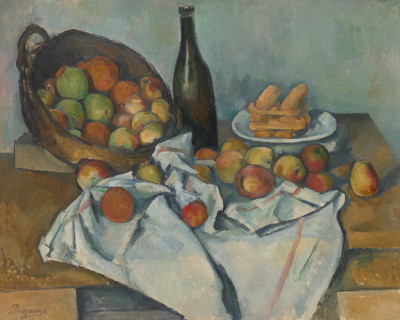
c.1891; Hermitage1890–92The Basket of Apples
c.1893Apples and Oranges
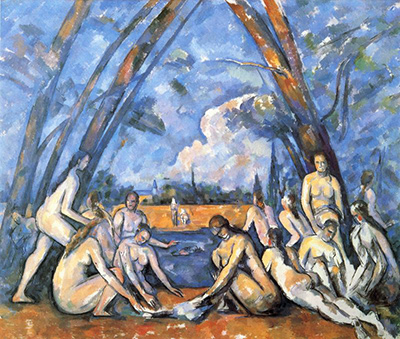
c.1899The Large Bathers (Philadelphia)
1900–1906 (Philadelphia Museum dating)Château Noir (MoMA)
1903–04Contents
- A seated figure that fills the canvas
- A portrait surrounded by paintings
- A worker, a model, and a recurring pose
- Which smoker, and when?
- From Paris to St Petersburg
A seated figure that fills the canvas
The man is nearly as wide as the available space. His hat presses against the pale horizontal band behind it; his right shoulder pushes toward the ochre area at the edge. The body makes a broad diagonal from the propped elbow at left through the chest to the sleeve descending on the right. Even the pipe continues a slant, sending the eye back toward the face. These lines give the pose a firmness that a simple description—someone taking a break—would miss.
Look at how little of the chair or floor is available to establish his position. The large brown surface at lower left offers a support for the elbow, but its front slopes and changes colour without a tidy contour. His low hand has a pale, heavily marked back; it is one of the brightest passages in the lower half. The picture gives the sitter an impressive physical presence while leaving the arrangement of furniture oddly compressed.
The face is built from contrasting patches rather than smoothed flesh. A reddish ear answers a red cheek, while muted blue-grey passages collect beneath the eye and around the jaw. The dark moustache, pipe and hat brim gather around the centre of attention, but they do not turn the face into an easily readable expression. One can see the weight of the head on the hand and the alert eyes without claiming to know what the man is thinking.
A portrait surrounded by paintings
The catalogue identifies two background canvases: Pots, bouteille, tasse et fruits (1867–69) and Baigneurs en plein air (c. 1890–91). [1]
The first confusion is spatial. The black bottle stands upright as emphatically as the sitter’s pipe stem points outward. Fruit overlaps the dark opening by the elbow. Yet a thin boundary above the bottle declares that this is painted space inside painted space. The sitter’s arm appears to cut in front of it, but the eye has already granted those objects the same reality as his sleeve. A still life has been made to share the portrait’s room without occupying it in the usual way.
The upper painting works differently. Its pale blue and green area is interrupted by the top edge of the portrait, so that only a slice is visible. The broad ochre shape at right descends toward the man’s shoulder and makes the studio feel close around him. Together, the cropped canvases prevent the setting from behaving like a neutral backdrop. The eye moves from person to still life to picture edge, then back again, continually testing which plane is nearest.
Theodore Reff argued that the older still life appears to rest on the table in front of it. He understood this as part of Cézanne’s recurring use of pictures within pictures in the 1890s. [4]
Colour makes the encounter more than a visual puzzle. Warm orange and yellow collect in the table, the right-hand plane and the sitter’s skin. The coat is a cooler, broken blue, crossed by small warm marks rather than filled as a single dark block. From a distance the figure remains cohesive; near the surface, short strokes let the room and the jacket share a way of being painted. His human scale is unmistakable, but no part of the picture is exempt from the same slow construction.
A worker, a model, and a recurring pose
Michel Fraisset identifies the Hermitage sitter as Paulin Paulet, a gardener at the Jas de Bouffan. He separates Paulet from père Alexandre and traces a confusion of names in earlier accounts. [3]
The portrait records a particular build, face and moustache, while the hat, coat and pipe establish an everyday presence. Cézanne gives little anecdotal detail about an individual day or job. The carefully held pose makes us conscious of a person also serving as a model.
John Elderfield points out how a farmworker painted individually could reappear in a Card Players composition. He situates that exchange within Cézanne’s sustained practice of painting sitters he knew. [5]
Fraisset links Paulet to the related Mannheim Smoker and to a watercolour of the leaning man. [3]
The comparison helps us see the elbow as a hinge. Here it anchors one large body to the tabletop; in a group, poised arms help make the compact space between players. The same bodily structure can serve a quite different composition.
The paintings also differ in what they ask us to watch. A card game directs attention toward hands, cards and the relation between people. In this canvas the hands are separated, and no other person is present. The close crop lets the sitter’s weight, the edge of the table and the surrounding canvases carry the tension. The pipe is conspicuous, but no curling smoke turns it into a narrative of reverie. It is a small object held by a person whose body is doing most of the pictorial work.
Satish Padiyar connects this Smoker with Cézanne’s bathers and card players through its cropped background canvases, interpreting the linked motifs as an exploration of male solidarity and desire. [6]
Which smoker, and when?
Several Cézanne paintings carry similar English titles. The Pushkin Museum’s FWN 507 has a different background and Shchukin provenance; the Courtauld’s FWN 504 is another distinct pipe portrait. [7] [3]
The catalogue’s c. 1891 date differs from earlier scholars’ later datings; it also records an “1890” annotation by Cézanne’s son on a Vollard photograph. The Hermitage gives 1890–92. [1] [2]
From Paris to St Petersburg
The painting passed from dealer Vollard to Ivan Morozov by October 1909. For its Hermitage entry, the catalogue gives 1948 and the museum gives 1931. [1] [2]
It appeared in the 1904 Salon d’Automne; a 1973 exhibition dated it 1896–98. [1]
Cézanne artworks directory
Browse 217 identified works in this researched selection, including paintings, drawings and watercolours. This is a bounded selection, not a complete catalogue of Cézanne’s surviving oeuvre. Unlinked titles have no confirmed article in this collection.
| Name | Date | Medium |
|---|---|---|
| A Head, a Cup, and a Bread Roll | 1891/1894 | Drawing |
| A Man seen from Behind | 1880/1883 | Drawing |
| A Modern Olympia | 1873–74 | Painting |
| A Nude and Foliage | 1879/1882 | Drawing |
| A Smoking Man | 1892–96 (catalogue); c.1890–92 (museum) | Drawing |
| Afternoon in Naples | 1876–77 | Painting |
| An Old Woman with a Rosary | about 1895–96 | Painting |
| Apples and Oranges | c.1899 | Painting |
| Auvers, Panoramic View | 1873–75 | Painting |
| Avenue at Chantilly | 1888 | Painting |
| Banks of the Marne | 1888–94 | Painting |
| Basket | 1877/1900 | Drawing |
| Bather with Outstretched Arms | 1877–78 | Painting |
| Bellows in Front of a Fireplace | 1887/1892 | Drawing |
| Bibémus Quarry | c.1895 | Painting |
| Boy in a Red Vest, Barnes Foundation | 1888–90 | Painting |
| Boy in a Red Vest, MoMA | 1888–90 | Painting |
| Boy in a Red Waistcoat, National Gallery of Art | 1888–90 | Painting |
| Branch in Flower | 1886/1889 | Drawing |
| Carnival Scene | 1885/1888 | Drawing |
| Chair and Dresser | 1880/1883 | Drawing |
| Chateau Noir | 1903–04 | Painting |
| Chestnut Trees and Farm at Jas de Bouffan | c.1885 | Painting |
| Chestnut Trees and Farm at Jas de Bouffan, Pushkin | c.1886 | Painting |
| Chestnut Trees at Jas de Bouffan in Winter | 1885–86 | Painting |
| Château Noir | 1900–04 | Painting |
| Cistern in the Park of Château Noir | c.1900 | Painting |
| Curtain, Jug and Fruit | 1893–94 | Painting |
| Cushion of an Armchair | 1886/1889 | Drawing |
| Draft Letter and Studies of Bathers | c.1878 | Drawing |
| Farmhouse and Chestnut Trees at Jas de Bouffan | 1884–85 | Painting |
| Figure Resting Head on Hand | c. 1889 | Drawing |
| Fireplace Tongs and Poker | 1887/1892 | Drawing |
| Forest Interior, San Francisco | c.1898–99 | Painting |
| Four Bathers | 1888–90 | Painting |
| Fruit and a Jug on a Table | 1893–94 | Painting |
| Gardanne | 1885–86 | Painting |
| Gardanne, Barnes Foundation | c.1885 | Painting |
| Hand and Shoulder of a Boy | c. 1885 | Drawing |
| Harlequin, National Gallery of Art | 1888–90 | Painting |
| Head of a Boy | 1887/1889 | Drawing |
| Head of a Boy Seen from Behind | c. 1885 | Drawing |
| Head of a Young Woman | c. 1880 | Drawing |
| Head of the Artist's Son | 1888/1889 | Drawing |
| Hillside in Provence | c.1890–92 | Painting |
| Horse Chestnut Trees at Jas de Bouffan | c.1885 | Painting |
| House and Farm at the Jas de Bouffan | c.1887 | Painting |
| House in a Park | 1883/1886 | Drawing |
| House in Provence | c.1885 | Painting |
| House of Père Lacroix | 1873 | Painting |
| House Surrounded by Vegetation | 1889/1892 | Drawing |
| Houses in Provence The Riaux Valley near L’Estaque | c.1883 | Painting |
| Jas de Bouffan, the Pool | c.1876 | Painting |
| Kerosene Lamp | 1878/1881 | Drawing |
| L'Estaque, Melting Snow | c.1870 | Painting |
| Lake Annecy | 1896 | Painting |
| Landscape in Provence, Pola Museum | 1879–82 | Painting |
| Landscape Near Aix-en-Provence | 1877/1880 | Drawing |
| Landscape Seen from the Inside of a Cave | 1889/1892 | Drawing |
| Landscape with Poplars | c.1885–87 | Painting |
| Landscape with Trees | 1895/1898 | Drawing |
| Leda and the Swan | c.1880 (possibly later) | Painting |
| Little Girl with a Doll | 1902–04 | Painting |
| Louis Guillaume | 1879–1890 | Painting |
| Madame Cezanne | 1888/1891 | Drawing |
| Madame Cezanne | 1886/1889 | Drawing |
| Madame Cezanne | 1882/1887 | Drawing |
| Madame Cezanne | 1897/1900 | Drawing |
| Madame Cezanne with her Head Lowered | 1893/1896 | Drawing |
| Madame Cézanne in a Red Armchair | c.1877 | Painting |
| Madame Cézanne in a Red Dress, Metropolitan Museum of Art | 1888–90 | Painting |
| Madame Cézanne in a Yellow Chair | 1888–90 | Painting |
| Madame Cézanne in a Yellow Chair, Fondation Beyeler | 1888–90 | Painting |
| Madame Cézanne in the Conservatory | 1891 | Painting |
| Maincy Bridge | 1879–80 | Painting |
| Maison Maria with a View of Château Noir | c.1895 | Painting |
| Man Bending Forward | 1883/1886 | Drawing |
| Man Smoking a Pipe, Pushkin | c.1891, possibly later | Painting |
| Man with a Pipe | 1891–96 | Painting |
| Man with a Pipe, Nelson-Atkins | 1890–92 | Painting |
| Man with a Straw Hat (Gustave Boyer) | c.1871 | Painting |
| Man with Crossed Arms | c.1899 | Painting |
| Man with Pipe, National Gallery of Art | 1892–96 | Painting |
| Mont Sainte-Victoire | c.1902–06 | Painting |
| Mont Sainte-Victoire | 1900–02 | Painting |
| Mont Sainte-Victoire (recto) | c.1895 | Watercolour |
| Mont Sainte-Victoire and the Viaduct of the Arc River Valley | 1882–85 | Painting |
| Mont Sainte-Victoire Seen beyond the Wall of the Jas de Bouffan | c.1885/1888 | Watercolour |
| Mont Sainte-Victoire Seen from Bibémus Quarry | c.1897 | Painting |
| Mont Sainte-Victoire, Barnes Foundation | 1892–95 | Painting |
| Near the Pool at Jas de Bouffan | 1883/1887 | Drawing |
| Pelicans | 1877/1880 | Drawing |
| Peonies | 1890/1893 | Drawing |
| Pierrot and Harlequin | 1888 | Painting |
| Pine Tree | 1882/1885 | Drawing |
| Pont des Trois Sautets | 1906 | Watercolour |
| Poplars | 1879–80 | Painting |
| Portrait of Ambroise Vollard | 1899 | Painting |
| Portrait of Gustave Geffroy | 1895–96 | Painting |
| Portrait of Madame Cezanne with Loosened Hair | 1885–86 | Painting |
| Portrait of the Artist Looking Over His Shoulder | 1883–84 | Painting |
| Portrait of the Gardener Vallier | 1906 | Painting |
| Portrait of Victor Chocquet | 1876–77 | Painting |
| Portrait Of Victor Chocquet Seated | 1877 | Painting |
| Provençal Manor | c.1885 | Painting |
| Pyramid of Skulls | 1898–1900 | Painting |
| Reclining Nude (Leda?) | c.1887 | Painting |
| Scipio | 1866–68 | Painting |
| Seated Man, Oslo | 1898–1900 | Painting |
| Seated Peasant | c.1892–96 | Painting |
| Seated Peasant, Hiroshima | c.1897 | Painting |
| Seated Peasant, Orsay | c.1900 | Painting |
| Self-Portrait | c. 1895 | Drawing |
| Self-Portrait in a Bowler Hat, Ny Carlsberg Glyptotek | 1885–86 | Painting |
| Self-Portrait in a Casquette | c.1875 | Painting |
| Self-Portrait with a Beret | 1898–1900 | Painting |
| Self-Portrait with a Hat, Artizon Museum | c.1890–94 | Painting |
| Self-Portrait with a Pink Background | c.1875 | Painting |
| Self-Portrait with Olive-Coloured Wallpaper | about 1880–81 | Painting |
| Self-Portrait with Palette | 1886–87 | Painting |
| Self-Portrait with White Turban | c.1878–80 | Painting |
| Self-Portrait, c.1895 | c.1895 | Painting |
| Self-Portrait, Pushkin Museum | c.1882 | Painting |
| Spanish Dancers | 1883/1886 | Drawing |
| Still Life with a Curtain | 1892–94 | Painting |
| Still Life with Apples | c.1890 | Painting |
| Still Life with Apples | 1893–94 | Painting |
| Still Life with Apples and a Pot of Primroses | about 1890 | Painting |
| Still Life with Milk Jug and Fruit | c.1900 | Painting |
| Still Life with Open Drawer | 1877–79 | Painting |
| Still Life with Plaster Cupid | about 1894 | Painting |
| Still Life with Skull | 1890–93 | Painting |
| Still Life with Soup Tureen | 1877 | Painting |
| Still Life, Pitcher and Fruit | 1893–94 | Painting |
| Studies Including a Straw Hat | 1895/1898 | Drawing |
| Studies Including Madame Cezanne | 1884/1887 | Drawing |
| Study for "The Judgement of Paris" or "The Amorous Shepherd" | 1883/1886 | Drawing |
| Study for Woman with a Coffee Pot | c.1895 | Painting |
| Study of "The Roman Orator (Germanicus)" | 1883/1886 | Drawing |
| Study of "Venus de Milo" | 1881/1884 | Drawing |
| Study of a Decorative Ornament | 1879/1882 | Drawing |
| Study of a Standing Male Figure after the Antique | c. 1895 | Drawing |
| Study of an Angel in Rubens' "The Prophet Elijah" | 1892/1895 | Drawing |
| Study of Desiderio da Settignano's "Bust of a Child" | c. 1895 | Drawing |
| Study of Houses | 1879/1882 | Drawing |
| Study of Puget's "Hercules Resting" | c. 1879 | Drawing |
| Study of Puget's "Milo of Crotona" | 1895/1898 | Drawing |
| Study of Puget's "Milo of Crotona" | 1880/1883 | Drawing |
| Study of the Allegorical Figure Bellona in Rubens' "The Apotheosis of Henri IV" | 1883/1886 | Drawing |
| Study of the Allegorical Figure Bellona in Rubens' "The Apotheosis of Henri IV" | 1879/1882 | Drawing |
| Study of the Allegorical Figure France in Rubens' "The Exchange of the Two Princesses" | 1882/1885 | Drawing |
| Study of the Allegorical Figure of Health in Rubens' "The Birth of Louis XIII" | 1880/1883 | Drawing |
| Study of the Allegorical Figure of the Genius of Health from Rubens' "The Birth of Louis XIII at Fontainbleau" | 1895/1898 | Drawing |
| Sugar Bowl, Pears and Blue Cup | 1865–66 | Painting |
| The Aqueduct, Pushkin Museum | Dating differs between museum records | Painting |
| The Artist's Father, Reading L'Evenement | autumn 1866 | Painting |
| The Artist's Son | c. 1887 | Drawing |
| The Artist's Son Leaning on his Elbow | c. 1887 | Drawing |
| The Artist's Son Reading | c. 1887 | Drawing |
| The Artist's Son Writing | c. 1887 | Drawing |
| The Artist’s Son, Paul | 1886–87 | Painting |
| The Avenue at Jas de Bouffan | 1868–70 (possibly later) | Painting |
| The Avenue at Jas de Bouffan, Geneva | c.1890 | Painting |
| The Basket of Apples | c.1893 | Painting |
| The Bather, Museum of Modern Art | c.1885 | Painting |
| The Bay of Marseille seen from L'Estaque | c.1885 | Painting |
| The Blue Vase | 1889–90 | Painting |
| The Boy in the Red Vest, Bührle | 1888–90 | Painting |
| The Buffet | 1877–79 | Painting |
| The Card Players, Barnes Foundation | 1890–92 | Painting |
| The Card Players, Courtauld Gallery | 1892–96 | Painting |
| The Card Players, Metropolitan Museum of Art | 1890–92 | Painting |
| The Card Players, Musée d’Orsay | 1893–96 | Painting |
| The Card Players, Qatar | 1892–96 | Painting |
| The Eternal Feminine | c.1877 | Painting |
| The Gardener Vallier | 1906 | Painting |
| The Gardener Vallier, Tate | 1905–06 | Painting |
| The Grounds of the Château Noir | c.1900–04 | Painting |
| The Gulf of Marseille Seen from L’Estaque | c.1885 | Painting |
| The Hanged Man's House in Auvers | c.1873 | Painting |
| The House of Doctor Gachet at Auvers | 1872–73 | Painting |
| The House with the Cracked Walls | 1892–94 | Painting |
| The Kiss of the Muse | c.1860 | Painting |
| The Large Bathers, Barnes Foundation | 1895–1906 | Painting |
| The Large Bathers, National Gallery | 1895–1905 | Painting |
| The Large Bathers, Philadelphia Museum of Art | 1900–06 | Painting |
| The Mill | 1889/1892 | Drawing |
| The Painter’s Father, Louis-Auguste Cézanne | c.1865 | Painting |
| The Peasant | 1890–92 | Painting |
| The Plaster Mill (La Moulin à plâtre) | 1889/1892 | Drawing |
| The Smoker, Hermitage | c.1891 | Painting |
| The Smoker, Mannheim | c.1891 | Painting |
| The Stove in the Studio | c.1865 | Painting |
| The Vase of Tulips | c.1890 | Painting |
| Thistle | 1893/1896 | Drawing |
| Three Heads, One of Madame Cezanne | 1882/1885 | Drawing |
| Three Skulls | c.1898 | Painting |
| Three Skulls on a Patterned Carpet | 1904 | Painting |
| Trees and Shrubs | 1883/1887 | Drawing |
| Turning Road at Montgeroult | 1898 | Painting |
| Two Bathers | 1884/1887 | Drawing |
| Two Heads | 1888 | Drawing |
| Two Heads | 1890/1896 | Drawing |
| Two Heads of Women | 1890/1894 | Drawing |
| Two Studies for "The Judgement of Paris" or "The Amorous Shepherd" | 1883/1886 | Drawing |
| Uncle Dominique in a Tasseled Cap | 1866 | Painting |
| Uncle Dominique in a Turban | 1866–67 | Painting |
| Victor Chocquet and an Angel for "The Apotheosis of Delacroix" | 1878/1880 | Drawing |
| Woman in Blue | c.1904 | Painting |
| Woman Leaning Forward | 1888/1891 | Drawing |
| Woman Leaning Forward | 1890/1894 | Drawing |
| Woman Leaning Forward | 1890/1894 | Drawing |
| Woman with a Coffee Pot | c.1895 | Painting |
| Women Bathers and a Roll of Paper | 1882/1885 | Drawing |
| Young Girl with a Doll | c.1895 | Painting |
| Young Italian Woman at a Table | c.1895–1900 | Painting |
| Young Man and Skull | 1896–98 | Painting |
Frequently Asked Questions
Yes. The leaning smoker with bottle and fruit at left is the Hermitage work. Its date is given as 1890–92 by the museum. [2]
He is commonly identified as Paulin Paulet, a gardener at the Jas de Bouffan; historical naming is disputed. [3]
They appear in a cropped Cézanne still life behind the sitter. [2]
Discussion
Look again at the images and ideas explored in The Smoker: Cézanne’s Man with a Pipe at the Hermitage. These editorial prompts invite your observations.
Reader Insights
The left side can be read twice: first as a tabletop with fruit, then as a painting standing behind the model. Where does that switch happen for you?
The sitter’s upper hand supports his head, while the lower hand sits near the canvas edge. How do those two hands change the sense of his weight?
Try following the blue strokes of the coat into the cooler colours behind it. Does the figure stay separate from the room, or begin to join its painted surfaces?
Join the Conversation
Share a detail, comparison or question about The Smoker: Cézanne’s Man with a Pipe at the Hermitage below.
References
- The Paintings, Watercolors and Drawings of Paul Cézanne: An Online Catalogue Raisonné. “Le Fumeur accoudé,” c. 1891, FWN 506, catalogue entry. View source .
- State Hermitage Museum. “Курильщик” ( The Smoker ), collection record, inv. ГЭ-6561. (in Russian). View source .
- Société Cézanne. Michel Fraisset, “Joueurs de cartes et fumeurs dans l’oeuvre de Cezanne,” 21 May 2020. (in French). View source .
- The Museum of Modern Art. Theodore Reff, “Painting and Theory in the Final Decade,” in Cézanne: The Late Work , 1977, pp. 19–20. View source .
- National Portrait Gallery and Princeton University Press. John Elderfield, “Introduction: The Reading of the Model,” in Cézanne Portraits , 2017. View source .
- The Courtauld Institute of Art. Satish Padiyar, “Building a World Between Men (or Cézanne with Arendt),” in Modernist Games: Cézanne and His Card Players , 2013, pp. 124–27. View source .
- The Paintings, Watercolors and Drawings of Paul Cézanne: An Online Catalogue Raisonné. “Le Fumeur,” c. 1891, possibly later, FWN 507, catalogue entry. View source .
- Le Baiser de la muse, d'après Frillié (FWN 572). View source.
- Louis-Auguste Cezanne, père de l'artiste, lisant L'Événement (FWN 402). View source.
- La Maison du pendu, Auvers-sur-Oise (FWN 81). View source.
- Une moderne Olympia (FWN 628). View source.
- Le Pont de Maincy (FWN 143). View source.
- La Montagne Sainte-Victoire vue de Montbriand (FWN 185). View source.
- Gardanne (vue horizontale) (FWN 224). View source.
- Le Vase bleu (FWN 823). View source.
- Les Joueurs de cartes (FWN 681). View source.
- La Montagne Sainte-Victoire (FWN 296). View source.
- La Corbeille de pommes (FWN 860). View source.
- Pommes et oranges (FWN 871). View source.
- Portrait d'Ambroise Vollard (FWN 531). View source.
- Philadelphia Museum of Art,The Large Bathers,W1937-1-1. View source.
- Château Noir (FWN 360). View source.
- Société Paul Cezanne,online catalogue structure and objectidentification. View source.
- National Gallery of Art,Cezanne Sketchbook,1992.51.9. View source.
- Splash image, A man in a blue coat supports his head beside a painted bottle and fruit.