 by Tom Gurney
Tom Gurney BSc (Hons) is an art history expert with over 20 years experience
Published on June 19, 2020 / Updated on July 26, 2026
Email: tomgurney1@gmail.com / Phone: +44 7429 011000
Woman Holding a Balance by Johannes Vermeer: Introduction
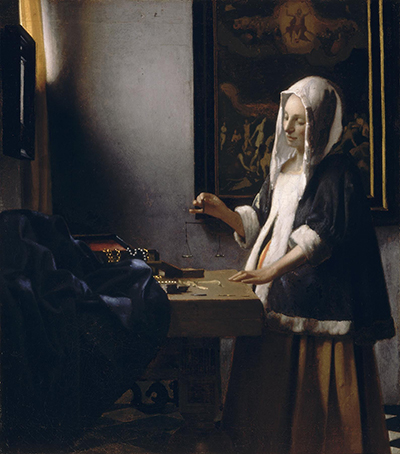
Johannes Vermeer’s Woman Holding a Balance is one of his most controlled images of inward attention. A woman stands before a table with jewellery and pearls, holding a small balance between her fingers. Behind her hangs a painting of the Last Judgment. Light enters from the left, touching her face, hands and blue jacket, while much of the room remains subdued.
The National Gallery of Art in Washington records the painting as Woman Holding a Balance, about 1664, oil on canvas, 39.7 by 35.5 cm, accession number 1942.9.97. [1] The title matters. The balance is empty. Older references sometimes describe the woman as weighing gold or pearls, but the NGA’s record and modern interpretation focus on the equilibrium of the balance itself. [1]
At a Glance
- ArtistJohannes Vermeer
- TitleWoman Holding a Balance
- DateAbout 1664
- MediumOil on canvas
- Dimensions39.7 x 35.5 cm
- CollectionNational Gallery of Art, Washington
- Accession number1942.9.97
- Key themesBalance, judgement, moderation, pearls, inwardness, light
Contents
- Introduction
- At a Glance
- What the Painting Shows
- The Empty Balance
- Last Judgment and Daily Life
- The Geometry of Stillness
- Pearls, Gold and Material Temptation
- The Woman’s Inwardness
- Mirror, Curtain and Window
- Light and Composition
- Technical Revision and Meaning
- The Last Judgment as Scale
What the Painting Shows
The woman stands at a table near a window. On the table are boxes, cloth, pearls and gold-coloured objects. She holds a delicate balance in her right hand. Her left hand rests near her body. She appears pregnant to some viewers, though that impression should be treated cautiously; Vermeer’s costumes and draperies often create ambiguous shapes.
The room is not crowded, but every element is charged. The mirror on the left, the jewels on the table, the balance in the woman’s hand and the Last Judgment behind her all invite interpretation. Vermeer arranges them with remarkable calm. The painting does not shout its meaning. It asks the viewer to weigh it.
The woman’s face is turned downward. She does not look at the viewer, the jewels or the painting behind her. Her attention is held in a private act. The balance is at the centre of the scene, but it is also almost weightless. This contrast between material richness and spiritual stillness gives the painting much of its force.
The Empty Balance
The empty balance is the key to the picture. If the woman were weighing gold or pearls, the painting would be easier to read as a scene of wealth, vanity or household management. Instead, the balance is poised without visible contents. The gesture becomes symbolic before it becomes practical.
The National Gallery of Art relates the image to ideas of temperance, moderation and judgement. [1] That reading is strengthened by the Last Judgment painting on the back wall. The woman’s small balance is set against the ultimate weighing of souls. Vermeer brings together domestic interior and cosmic judgement without breaking the quiet of the room.
The balance also affects the structure of the painting. The woman’s hand, the corner of the frame behind her and the lines of the table create a carefully measured geometry. NGA technical material records that infrared imaging shows Vermeer first painted the scale at an angle before changing it to a position more parallel with the picture plane. [2] The final pose feels inevitable, but it was refined.
Last Judgment and Daily Life
The painting-within-the-painting is essential. Behind the woman, Christ appears in judgement, surrounded by figures rising and falling. The scale of that image is large compared with the small domestic act in front of it. Vermeer does not separate the two worlds. He places judgement directly behind daily life.
This does not make the woman a simple warning against vanity. The jewels and pearls may suggest material temptation, but the mood is too meditative for a blunt moral lesson. The woman is not shown greedily handling treasure. She is still, balanced and absorbed. The painting can be read as an image of self-knowledge: worldly goods are present, but they are placed under the sign of judgement and moderation.
The mirror at the left may also suggest self-examination. In Dutch painting, mirrors can carry moral meanings, but Vermeer’s use is restrained. It does not dominate the scene. Like the balance, it belongs to a network of objects that point toward reflection in both the physical and spiritual senses.
The Geometry of Stillness
The painting’s emotional calm is supported by a very strict geometry. The woman stands near the centre, but the composition is not static in a dull sense. Her body, the table, the picture frame, the curtain and the balance create a set of measured relationships. The small scale in her hand becomes the point at which these relationships gather.
The National Gallery of Art’s technical material is important here because it shows that this equilibrium was refined. Infrared study indicates that Vermeer changed the position of the scale, making it more parallel to the picture plane. [2] That adjustment is not merely technical housekeeping. It affects the meaning of the image. A more angled scale would have introduced a different kind of movement. The final balance feels poised, suspended and exact.
The geometry also links the woman’s private action to the painting behind her. Her head and hand occupy the zone between the domestic table and the Last Judgment. She is neither swallowed by the religious image nor detached from it. Vermeer makes moral reflection part of the room’s structure.
Pearls, Gold and Material Temptation
The objects on the table are deliberately seductive. Pearls, boxes, cloth and gold-coloured objects create a small field of wealth. They catch the light, but Vermeer keeps their shine controlled. The objects are present as temptations, possessions and signs of value, yet they are not painted with gaudy emphasis.
This restraint is why the painting avoids a crude moral lesson. A simpler image might oppose spiritual judgement to worldly luxury in a direct warning. Vermeer’s room is quieter. The jewels remain beautiful. The woman remains calm. The moral pressure comes from relation rather than denunciation: earthly valuables lie on the table while the Last Judgment rises behind them and the empty balance pauses between.
The emptiness of the scale is therefore essential. If the woman were visibly weighing pearls or coins, the message would become more literal. Because the balance holds nothing, the gesture becomes inward. The question is not only what objects weigh, but how value itself is measured.
The Woman’s Inwardness
The woman’s expression is not dramatic. She does not show fear, greed, piety or surprise in any obvious way. Her face is lowered and absorbed. This gives the painting its psychological delicacy. Vermeer does not tell the viewer exactly what she thinks; he creates the conditions for reflection.
Her apparent pregnancy has often been noticed, but it should be handled carefully. The painting’s clothing and silhouette can suggest pregnancy to modern viewers, yet Vermeer’s costume forms are not always reliable biological evidence. The safer reading is that her rounded form adds to the painting’s sense of fullness and stillness without needing to settle the question.
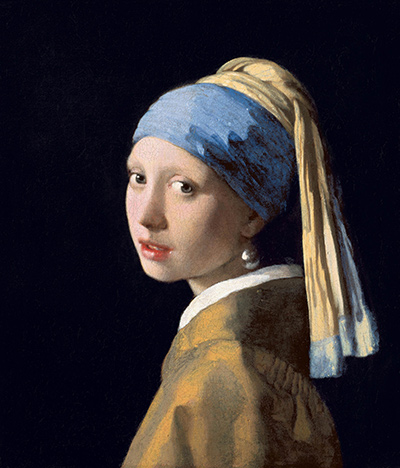
The woman’s inwardness also distinguishes the work from Vermeer’s more direct viewer-facing images. In A Lady Writing or Girl with a Pearl Earring, the gaze establishes an encounter with us. In Woman Holding a Balance, the viewer witnesses a private suspension of thought. We are present, but not addressed.
Mirror, Curtain and Window
The left side of the painting is quiet but active. The mirror, curtain and implied window create a zone of light and reflection. The window is the source of illumination, while the mirror suggests another kind of seeing: self-knowledge, vanity, examination or moral reflection. Vermeer does not force one meaning, but he lets the objects resonate.
The curtain is also important because it controls the incoming light and adds a vertical note to the composition. It is not a decorative afterthought. It helps frame the woman and makes the domestic space feel enclosed. The room becomes a chamber of judgement, not because it is grand, but because Vermeer arranges ordinary objects with symbolic pressure.
This is one of the painting’s most Vermeer-like qualities. Nothing appears theatrical at first glance. The room seems quiet, even plain. But the longer one looks, the more every object appears to have been placed in relation to every other object.
Light and Composition
Vermeer’s light gives the painting its quiet authority. It enters from the left, touches the woman’s face and hands, and then falls across the table. The blue of her jacket, the pale wall and the yellow curtain create a restrained harmony. The pearls and gold do not glitter loudly. They are absorbed into the room’s stillness.
The composition is built around vertical and horizontal stability. The woman stands at the centre, framed by the Last Judgment and the table. Her head is just below the painting behind her, linking her private act to the larger religious image. The balance is tiny, but it occupies the exact area where the painting’s meanings converge.
This is one of Vermeer’s great achievements: he can make a small object govern a whole painting. The balance is not visually large, yet everything turns around it.
Technical Revision and Meaning
The NGA’s infrared evidence that Vermeer altered the angle of the scale is more than a technical curiosity. [2] It shows that the painting’s equilibrium was deliberately refined. The final scale is not merely an object held by the woman; it is the exact visual and symbolic centre of the picture.
That revision also helps explain the painting’s calm. Vermeer’s interiors can look effortless, but technical study often reveals adjustment and correction. In this case, the correction strengthens the central metaphor. The scale becomes more stable, more frontal and more available to contemplation.
The change also cautions against reading Vermeer as a purely observational painter. He did not simply record a scene. He built a moral and visual structure, testing the relation between hand, object, table, wall and painting-within-the-painting until the balance carried the right force.
The Last Judgment as Scale
The Last Judgment picture behind the woman is not only a religious backdrop. It is a second system of weighing. Christian imagery of judgement often involves the weighing of souls, and Vermeer places the woman’s small domestic balance before that larger spiritual horizon.
This relation gives the painting its unusual depth. A household scene becomes a meditation on ultimate value. The jewels and pearls on the table are measured against the unseen measure of judgement. The woman stands between both systems, neither rejecting the world nor surrendering to it.
Vermeer’s restraint is crucial. He does not show a dramatic conversion, a warning gesture or an obvious moral failure. The painting’s seriousness lies in suspension. The balance is empty; the woman is still; judgement is present but silent.
How to Look at Woman Holding a Balance
Begin with the small scale in the woman’s hand. It is easy to miss because it is delicate, but it governs the painting. From there, move outward to the hand, the face, the jewels on the table and the Last Judgment behind her.
This sequence reveals the painting’s logic. The material objects below, the inward figure at the centre and the religious image behind her are all linked by the idea of measure. Vermeer makes that connection visually before it becomes verbal.
The mirror and window should also be noticed. They sit quietly at the left, but they support the painting’s themes of reflection, light and self-examination. Like the balance, they are ordinary objects with more than one kind of meaning.
Place in Vermeer’s Work
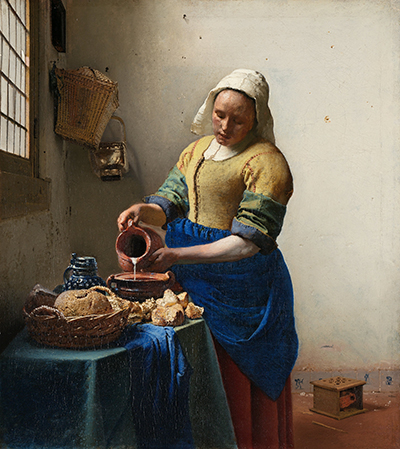
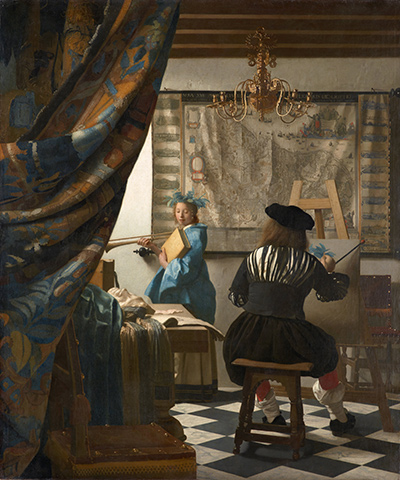
Woman Holding a Balance belongs with Vermeer’s most introspective interiors. It relates to A Lady Writing, Woman with a Pearl Necklace and Girl with a Pearl Earring through its attention to pearls, light and private presentation. It also connects with The Art of Painting through the use of a painting-within-a-painting and with the letter paintings through its sense of suspended thought.
The work is also important because it shows how Vermeer can make symbolism feel natural. He does not remove the viewer from the room into an abstract moral allegory. He lets objects remain objects: a balance, a mirror, pearls, a table, a painting on the wall. Their meanings emerge through placement, light and stillness.
It is also one of the strongest examples of Vermeer’s ability to make a tiny action carry large consequences. The woman’s fingers hold a small balance, yet the painting opens onto questions of judgement, value, self-knowledge and spiritual measure. The scale is physically light, but conceptually heavy.
Frequently Asked Questions
Woman Holding a Balance is in the National Gallery of Art in Washington. [1]
The balance is empty. The painting is therefore better understood as an image of equilibrium, judgement and reflection than as a literal weighing of gold or pearls. [1]
The painting behind her shows the Last Judgment, which connects the domestic scene to themes of moral and spiritual judgement.
It is important because Vermeer brings together domestic quiet, material objects and religious meaning with extraordinary restraint.
Discussion
What feels most revealing about Woman Holding a Balance: Vermeer's handling of light, the silence of the scene, the object details, the attribution history, or the way the painting fits within Dutch Golden Age art?
Reader Insights
Vermeer rewards slow attention. Begin with the main action, then move outward to light, edges, objects and the quiet spaces that hold the composition together.
Many of these paintings are small, but their meanings open through Delft, collecting history, technical study and comparison with related Dutch interiors.
Pair this article with the biography and one neighbouring Vermeer work to see how subject, light and attention shift across the artist's compact oeuvre.
Join the Conversation
Have a thought or observation about Woman Holding a Balance? Share it below. Thoughtful responses may be added to this section as the Vermeer pages develop.
References
- National Gallery of Art, Woman Holding a Balance, 1942.9.97.
- National Gallery of Art, technical material on Vermeer and infrared study.