by Tom Gurney
Tom Gurney BSc (Hons) is an art history expert with over 20 years experience
Page created on September 2, 2026 / Page updated on September 13, 2026
Email: tomgurney1@gmail.com / Phone: +44 7429 011000
How Visual Intervals Create Pace
Rhythm in art is the visual pace or beat produced when elements recur and their intervals, groupings or variations organise how a still artwork unfolds. A shape, figure, mark, band, direction or colour relationship returns; the distances and changes between those returns affect whether the pace seems even, alternating, clustered, gradual or interrupted.[1][2][3]
Recurrence is necessary to this working definition, but it need not mean exact copying. A form can turn, grow, shrink or gather with others and still remain recognisably related to what came before. Interval means the gap or distance between returns.[5] A broad interval may feel like a pause; a series of close intervals may make the recurrence seem more insistent. These are visual relationships, not literal sound.
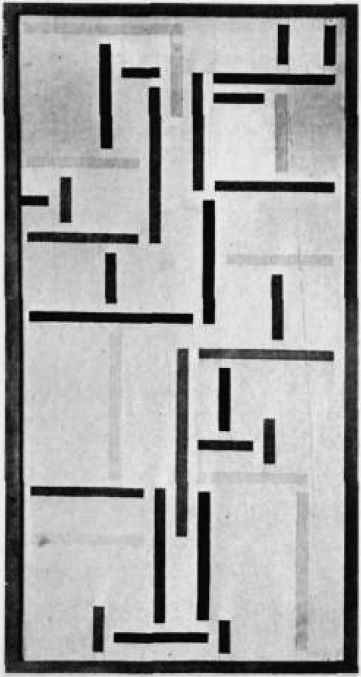
Theo van Doesburg, Rhythm of a Russian Dance, 1918. Offset vertical and horizontal units create changing intervals, allowing the eye to follow pace without requiring a literal dancer. Image: Wikimedia Commons, public domain.
At a Glance
- Core ideavisual pace created through recurrence, interval and change.
- Look forspacing, grouping, alternation, acceleration and pause.
- Not identical to patternpattern describes organised recurrence; rhythm describes the pace experienced through it.
- Not literal motiona static work can establish a strong rhythm.
- Close neighbourmovement concerns implied action and viewer path.
Contents
Rhythm, repetition, pattern and movement
The four ideas overlap, but they ask different questions. Repetition is the mechanism: an element appears again. It can help create both pattern and rhythm, but it is not a separate tenth principle here. Pattern is the recognisable arrangement or structure created by recurring motifs or elements. Rhythm concerns the pace produced as those recurrences are spaced, grouped and varied.[1][4][6]
Movement concerns the impression of action and the direction or path through which a still artwork may invite attention to travel. Rhythm can suggest movement, yet the two are not synonyms. A textile can establish a strong rhythm without depicting action, while a single plunging figure can imply movement without recurring at intervals. An arrangement may invite attention to continue, return or pause, but it does not force every viewer along one measurable route.[1][3]
Four questions for recognising rhythm
To examine rhythm in an unfamiliar artwork, ask four questions:
- 1
What recurs, and how closely related are its returns? Look for shapes, figures, marks, directions, colours or intervals that appear again without assuming they must be identical.
- 2
What are the intervals? Are the gaps broadly even, alternating, clustered or widely spaced?
- 3
What changes while recurrence remains legible? Notice shifts in scale, direction, orientation or grouping.
- 4
Where does the pace continue, pause or become interrupted, and what visible evidence supports that reading? Point to the particular gap, cluster or change rather than naming an effect in the abstract.
Together, the questions turn a loose impression of “rhythm” into close looking grounded in visible recurrence and intervals.
Intervals and variation
Art institutions do not use one universal list of rhythm types. Some teaching resources use terms such as regular, alternating and progressive, but those words are most useful here as qualified descriptions.[7] Regular or even recurrence has broadly consistent intervals. Alternating recurrence moves between related units or gaps. Progressive recurrence changes step by step in scale, spacing, direction or another visible relationship.
Recurrences may also gather into groups, vary without a simple progression or return at irregular intervals. Irregular does not mean random: the relationship still has to be recognisable. No description is automatically calm, lively, harmonious, successful or superior. The useful question is what returns, what changes and how the intervals shape the pace.
Even and alternating returns
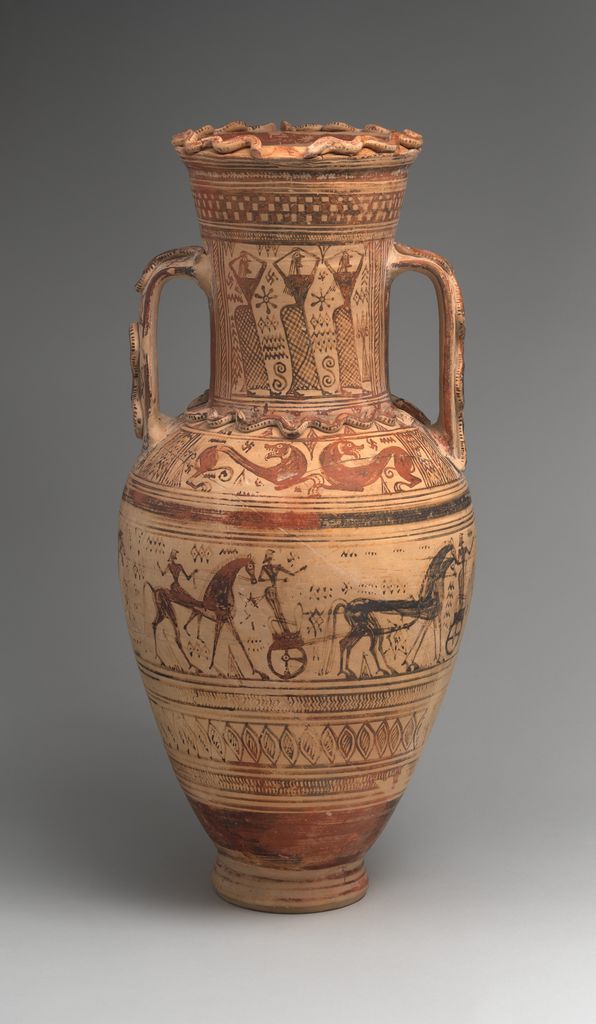
A Greek amphora: several beats around one object
The Greek, Attic Terracotta neck-amphora, ca. 700 BCE, is in The Metropolitan Museum of Art (accession 10.210.8).[9] Across the complete vessel, narrow geometric bands recur above and below a broader procession of figures.
The bands do not all move at the same pace. Closely repeated marks create a tighter visual beat, while larger figures and wider gaps slow the sequence around the body. The object therefore shows how one organised surface can contain several related rhythms. Its recurring structures are patterns; the changing intervals within and between them are what give those structures pace.
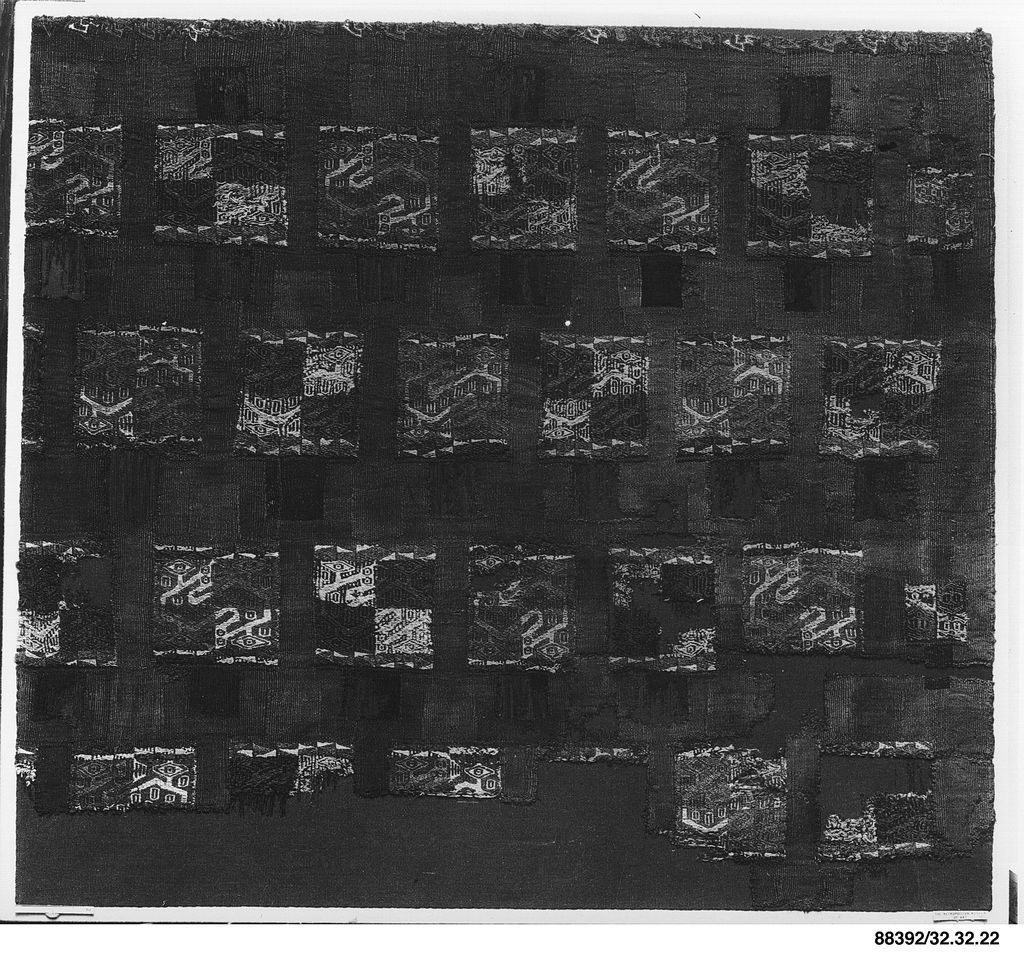
An Inca panel: pattern supplying a measured pace
The Inca Panel with Birds, 15th–16th century, is a camelid-hair textile in The Metropolitan Museum of Art (accession 32.32.22).[11] Angular bird forms recur across the complete rectangular field.
The motif establishes an organised pattern, but rhythm becomes clearer when we compare one return with the next. The birds occupy repeated units, while their directions and the intervals between forms keep the field from reading as one undifferentiated block. Pattern describes the recurring structure; rhythm describes the measured visual pace that structure makes possible.
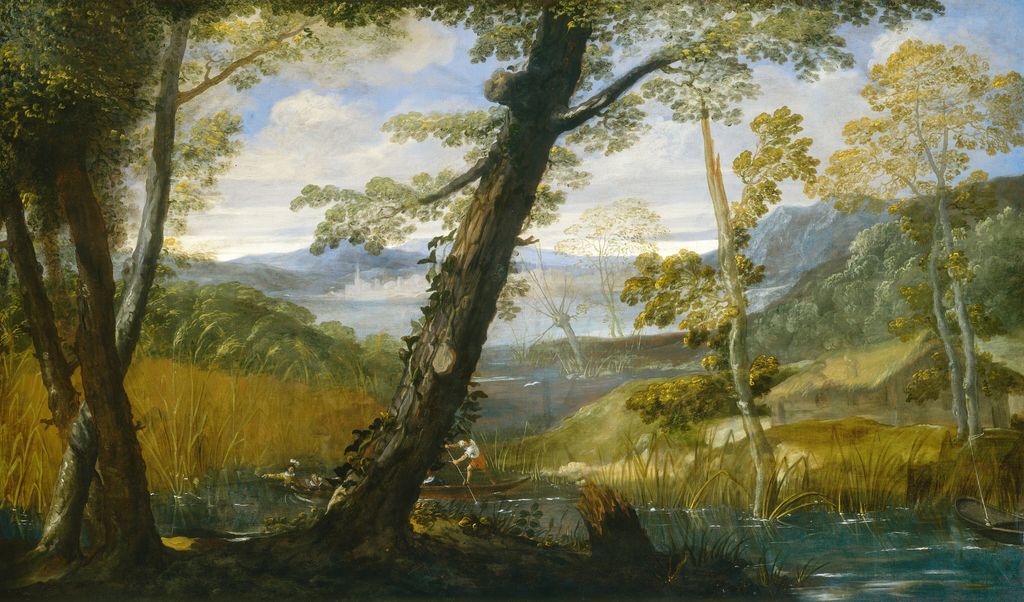
Carracci: alternating banks through a landscape
Annibale Carracci's River Landscape, c. 1590, belongs to the National Gallery of Art, Washington (accession 1952.5.58).[15] The museum describes projecting riverbanks as an alternating rhythm of triangular forms.
In the full painting, one bank reaches towards the water and another answers farther back. Repeated trees mark changing intervals across the breadth of the scene. The alternation contributes to recession, but this is not a lesson on space: the immediate rhythm lies in the return of related banks and verticals at shifting distances.
Groups, gaps and pauses
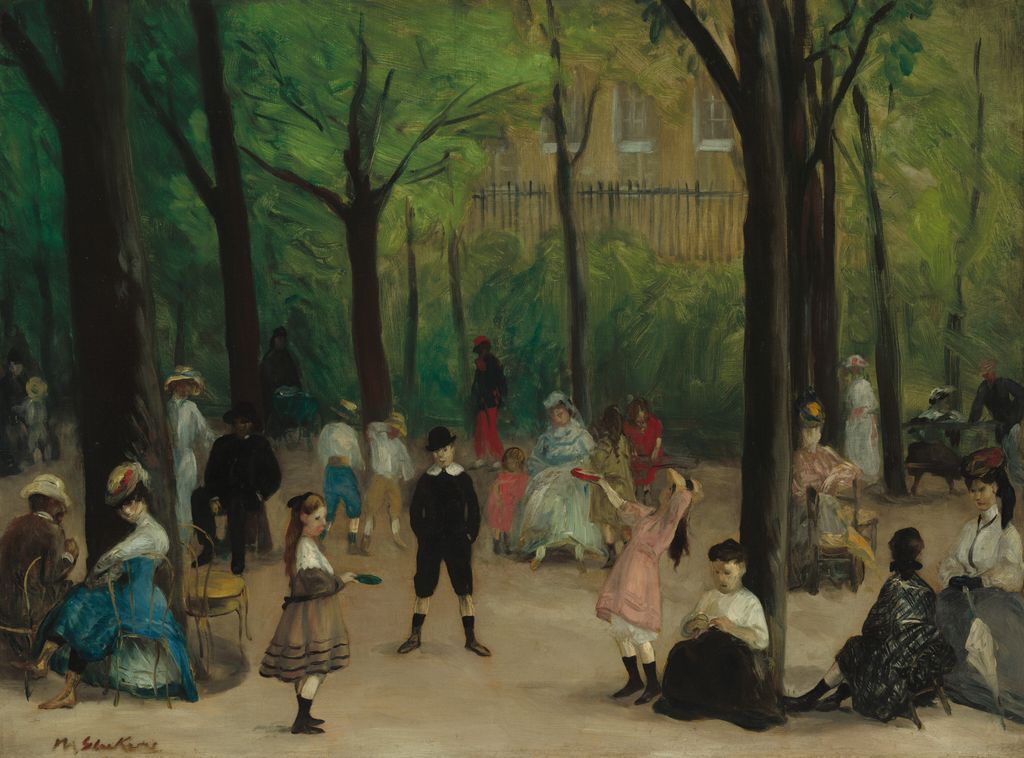
Glackens: tree trunks across a crowded garden
William James Glackens's Luxembourg Gardens, 1906, is in the National Gallery of Art, Washington (accession 2014.79.47).[8] Dark tree trunks repeat across a park filled with strolling figures and scattered chairs.
The trunks divide the crowded scene, but their intervals are not mechanical. Some stand close together; others leave wider openings around people or paths. That change lets the recurrence connect the field without turning it into a rigid grid. The pace comes from comparing one trunk, gap and cluster with the next.
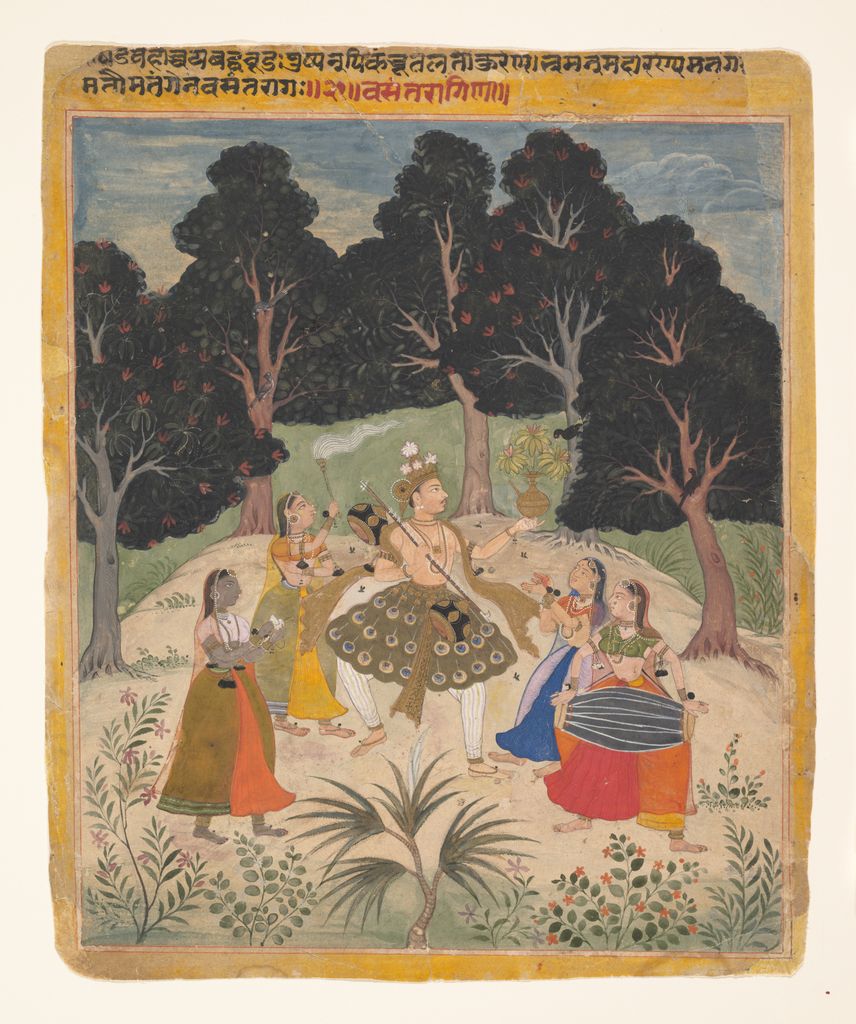
Vasant Ragini: figures gathering into clusters
Vasant Ragini, Page from a Ragamala Series (Garland of Musical Modes), made in India (Rajasthan, Amber) in the early 17th century, is in The Metropolitan Museum of Art (accession 1999.148).[12] The complete page groups musicians and attendants around a central figure within an architectural setting.
Repeated bodies, instruments and gestures do not form a single even row. They gather into clusters separated by architectural edges and open intervals. Those groupings produce a varied visual pace across the page. The represented music belongs to the subject; the rhythm discussed here is visible in the recurrence and spacing of forms.
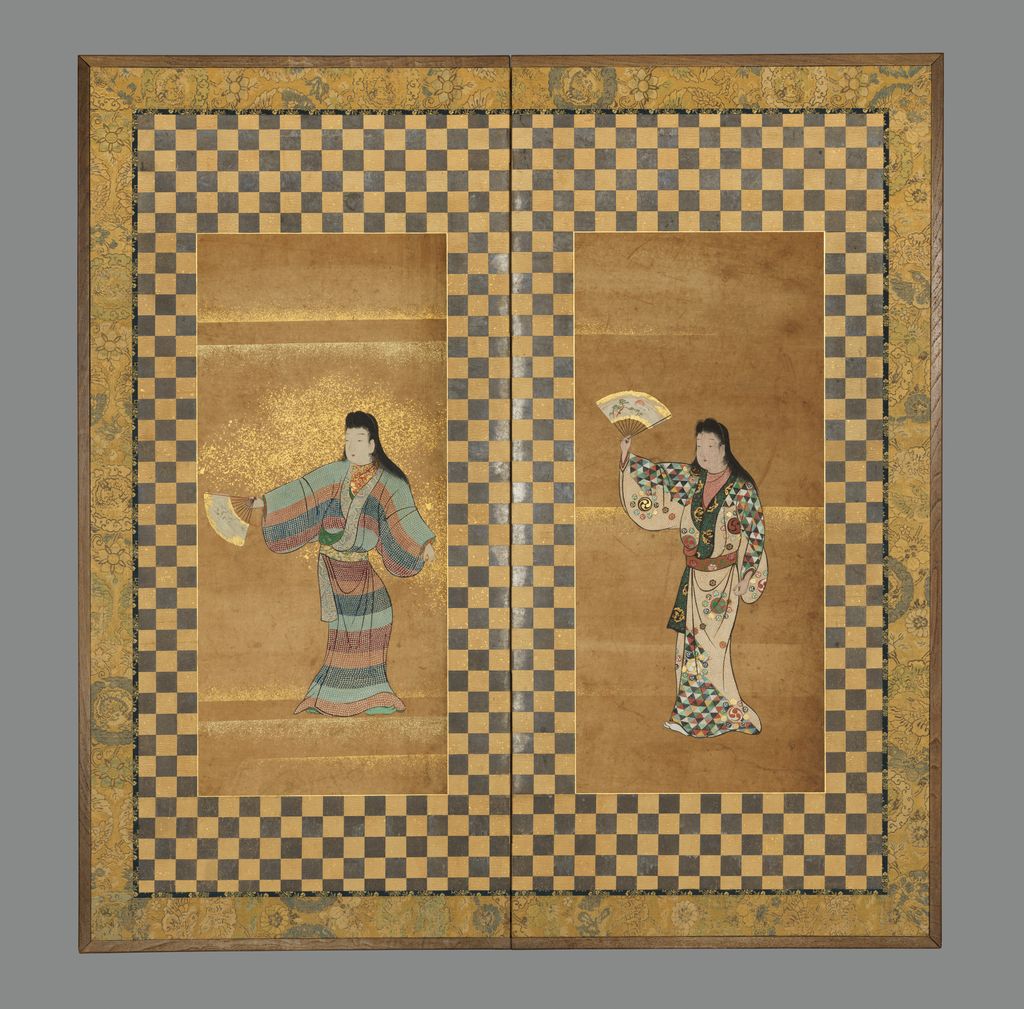
A Japanese screen: two returns and a broad pause
The Screen of Two Dancers (Bugi zu byōbu), made by an unidentified artist in Japan during the Edo period in the 18th century, belongs to The Metropolitan Museum of Art (accession 2019.420.18).[13] Two costumed dancers occupy the complete two-panel screen.
Their related poses and gestures create a sparse recurrence rather than a crowded sequence. The broad gap between them matters as much as the figures themselves: it separates one return from the other and can be described as a visual pause. The figures imply action, but the rhythm depends on their relationship across the full screen, not simply on the fact that they dance.
Sequences and varied recurrence
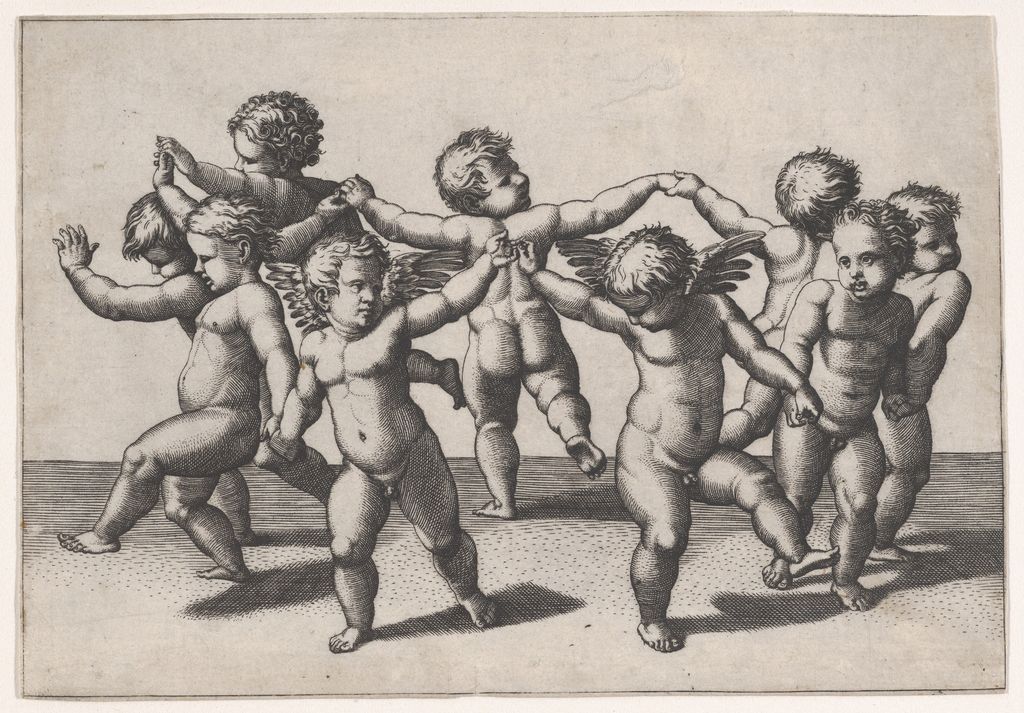
Raimondi after Raphael: a linked circular sequence
Marcantonio Raimondi's Putti dancing in a circle, after Raphael, ca. 1517–20, is a print in The Metropolitan Museum of Art (accession 17.50.89).[10] Across the full sheet, linked bodies and gestures recur around an open centre.
Each figure is related to the next without being an exact duplicate. Limbs change direction, bodies turn and the chain continues. The circle organises the sequence, but the rhythm lies in the recurring bodies and intervals around it. Radial organisation may also affect balance; that separate question does not replace the visible pace.
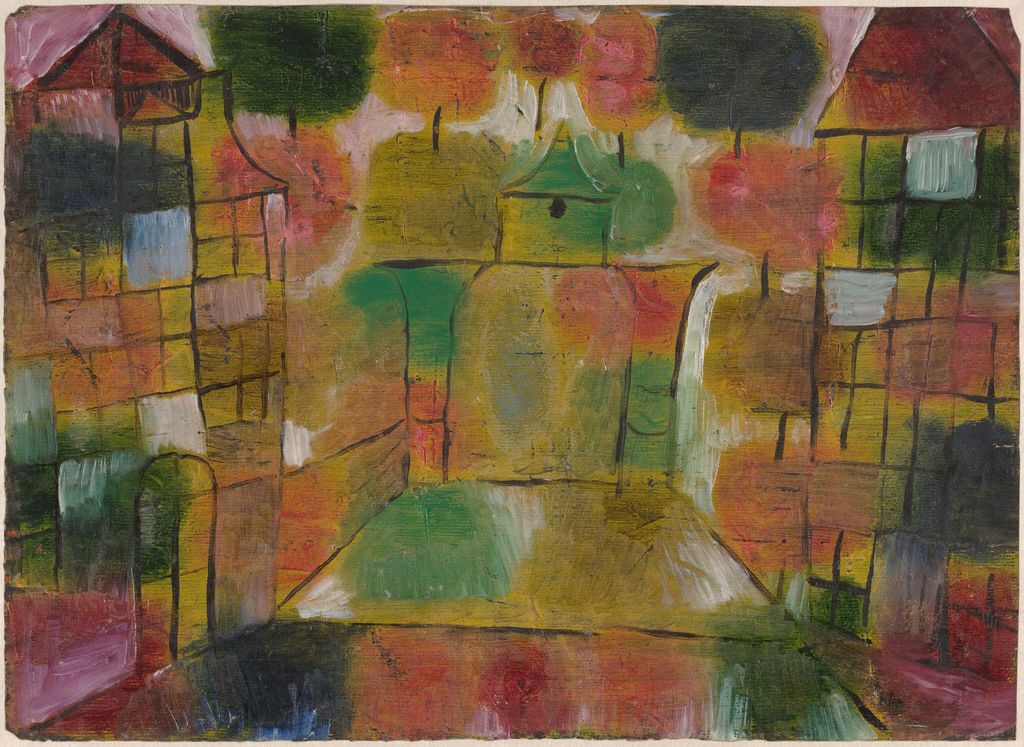
Klee: recurrence without depicted action
Paul Klee's Baum und Architektur--Rhythmen (Tree and Architecture--Rhythms), 1920, is in the National Gallery of Art, Washington (accession 2004.140.41.a).[14] Coloured blocks, verticals and branching lines return at changing scales and intervals across the work.
There is no need to infer rhythm from the title. The visible relationships supply the evidence: rectangular units echo one another, narrow uprights recur, and branching forms interrupt or bend those returns. The recurrence is varied and at points irregular, yet the related forms remain legible. This is rhythm without a depicted dance, procession or bodily action.
Rhythm and its neighbours
Rhythm is one relationship within an artwork, not a complete account of how the whole is organised. Balance concerns the distribution of visual weight; unity concerns coherence; emphasis concerns priority; and contrast concerns perceptible difference. Recurrence may contribute to any of them without making the concepts interchangeable.
Variation can change a rhythm, while Variety in Art will examine sustained diversity more fully. Changes in relative size may affect recurrence, while Proportion in Art concerns part-to-part and part-to-whole size relationships. Composition considers the complete realised organisation to which rhythm can contribute.
The Principles of Art places rhythm beside other organising relationships. Pattern, movement, balance and composition offer useful comparisons, while rhythm keeps attention on recurrence, interval and visual pace.
Related topics
Look for rhythm yourself
Choose an artwork and find one element that returns. Follow it across the complete work, then compare the intervals. Are they broadly even, alternating, clustered or widely spaced? Notice what changes while the relationship remains recognisable.
Now look for a conspicuous gap, gathering or interruption. Describe the visible evidence before deciding that the pace feels steady, gradual, sparse or irregular. If the work also suggests action or directs attention, ask whether that effect depends on recurrence or comes from another relationship.
Rhythm becomes easier to recognise when you stop searching for a fixed list of types and start comparing returns. What comes back, how far apart it appears and how it changes can make a still artwork unfold with a pace of its own.
Watch: Rhythm through Formal Analysis
Choose a museum-led whole-work analysis, a close reading, or a foundations overview for considering rhythm.
Introducing Formal Analysis: Landscape
Follow how recurring shapes, colours and intervals contribute to a larger visual organisation.
Watch on YouTubeFrequently Asked Questions
Rhythm is the visual pace created as elements recur, change and occupy intervals across a work.
No. Alternation, variation, grouping and changing gaps can all establish rhythm.
Pattern describes an organised recurrence; rhythm describes the pace or flow experienced while following recurrence and variation.
Yes. A static artwork can guide attention through repeated shapes, lines, colours, figures or spaces.
Trace a recurring element, compare the intervals between appearances, and note where grouping or variation speeds, slows or interrupts the sequence.
Discussion
Which example on this page creates the clearest change of pace, and which intervals produce it?
Reader Insights
Follow one shape, line, colour or figure through the work.
Compare gaps and groupings before assigning a rhythm label.
A pause, compression or altered unit often makes the pace most visible.
Join the Conversation
Share one precise observation or a useful museum example below.
References
- J. Paul Getty Museum, “Vocabulary for Describing an Artwork”
- Massachusetts College of Art and Design, Principles and Elements
- Neuberger Museum of Art / Purchase College, “Activity: Principles of Art — Rhythm”
- Open University OpenLearn, “Design thinking: Repetition”
- National Gallery of Art, Teaching Art Since 1950
- J. Paul Getty Museum, Understanding Formal Analysis — Principles of Design
- Neuberger Museum of Art / Purchase College, Principles of Art: Rhythm vocabulary worksheet
- National Gallery of Art, William James Glackens, Luxembourg Gardens, 1906
- The Metropolitan Museum of Art, Terracotta neck-amphora, ca. 700 BCE
- The Metropolitan Museum of Art, Marcantonio Raimondi after Raphael, Putti dancing in a circle, ca. 1517–20
- The Metropolitan Museum of Art, Panel with Birds, 15th–16th century
- The Metropolitan Museum of Art, Vasant Ragini, Page from a Ragamala Series, early 17th century
- The Metropolitan Museum of Art, Screen of Two Dancers, 18th century
- National Gallery of Art, Paul Klee, Baum und Architektur--Rhythmen, 1920
- National Gallery of Art, Annibale Carracci, River Landscape, c. 1590