by Tom Gurney
Tom Gurney BSc (Hons) is an art history expert with over 20 years experience
Page created on September 2, 2026 / Page updated on September 13, 2026
Email: tomgurney1@gmail.com / Phone: +44 7429 011000
When Size Relationships Shape Meaning
Proportion in art is the relationship of size among parts and between parts and the whole. It becomes visible when we compare: a head with a body, a handle with a vessel, one figure with another, or an architectural opening with the structure around it. Proportion is therefore relational. A single measurement by itself does not tell us how a work's parts belong together.[1][2]
Artists do not have to make those relationships naturalistic, mathematically regular or familiar. A stretched body, a compact figure or an unusually large central person is not automatically a mistake.[5] The useful question is not whether a work has the “correct” proportions, but which sizes are related and what that relationship makes visible.
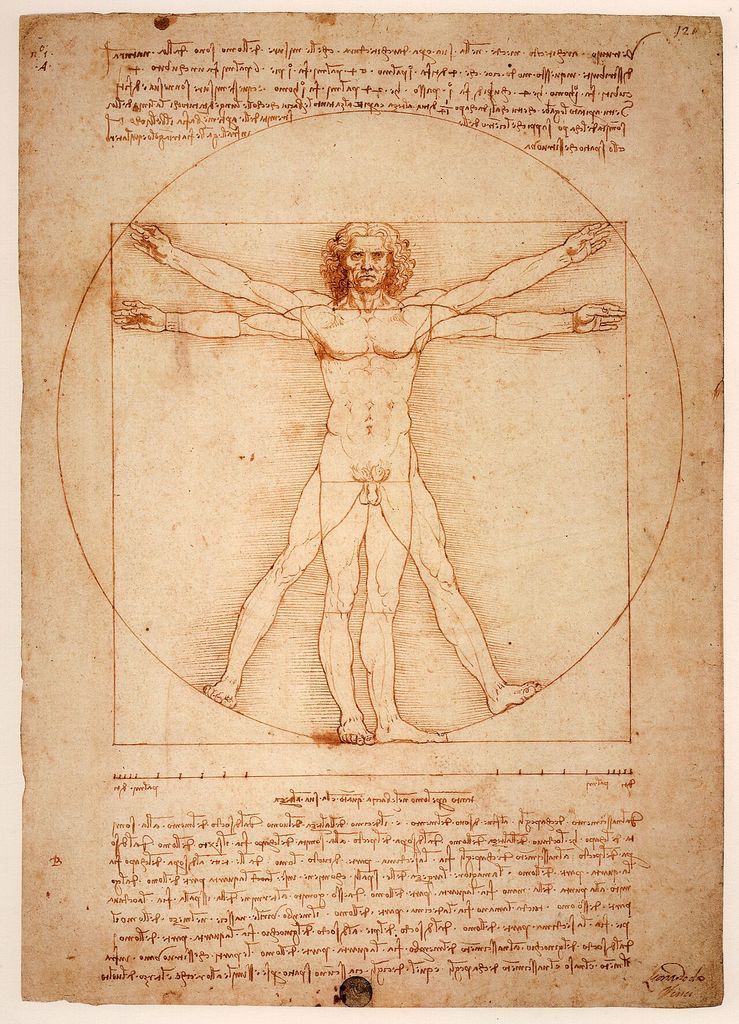
Leonardo da Vinci, Vitruvian Man, c. 1490. The sheet connects bodily parts to a complete figure and surrounding geometry, but it represents one historically specific investigation rather than a universal test for every artwork. Image: Wikimedia Commons, public domain.
At a Glance
- Core ideasize relationships among parts and wholes.
- Useful languagelarger, smaller, longer, wider, compact or elongated.
- Evidence ruledo not infer numerical ratios or conventions from appearance alone.
- Not a quality testproportion can be naturalistic, stylised or abstract.
- Close neighbouremphasis concerns priority, while proportion concerns relative size.
Contents
Proportion, relative size, ratio and scale
Relative size is the plainest way to describe one part as larger, smaller, longer, wider or more compact than another. It does not require a ruler. Ratio is more exact: it names a numerical relationship, so it should be used only when reliable evidence establishes one rather than inferred from a reproduction.
Art institutions use proportion and scale with some overlap. A helpful working distinction is that proportion usually concerns internal relationships—from part to part or part to whole—while scale often compares a work or figure with another object, a setting, a viewer or some external reference.[3] This is a guide for looking, not a universal classification.
The same caution applies to claims about perfect systems. A retrospective golden-ratio overlay does not prove an artist intended that ratio, and no single ratio guarantees beauty or quality.[6][7]
Four questions for recognising proportion
When you look at an unfamiliar artwork, ask:
- 1
What whole are you considering? It might be a body, object, sheet, building project, scene or framed work.
- 2
Which parts are you comparing? Notice what is larger, smaller, longer, wider or more compact in relation to another part and to the whole.
- 3
Is there contextual evidence for a convention or hierarchy? Appearance alone does not prove a canon, numerical ratio, rank or artistic intention.
- 4
What does the relationship make visible? Describe the exact part-to-part or part-to-whole evidence without grading it against naturalism or a universal ideal.
The questions keep attention on visible relationships while leaving room for the historical and cultural evidence that gives some comparisons their fuller meaning.
Conventions belong to particular histories
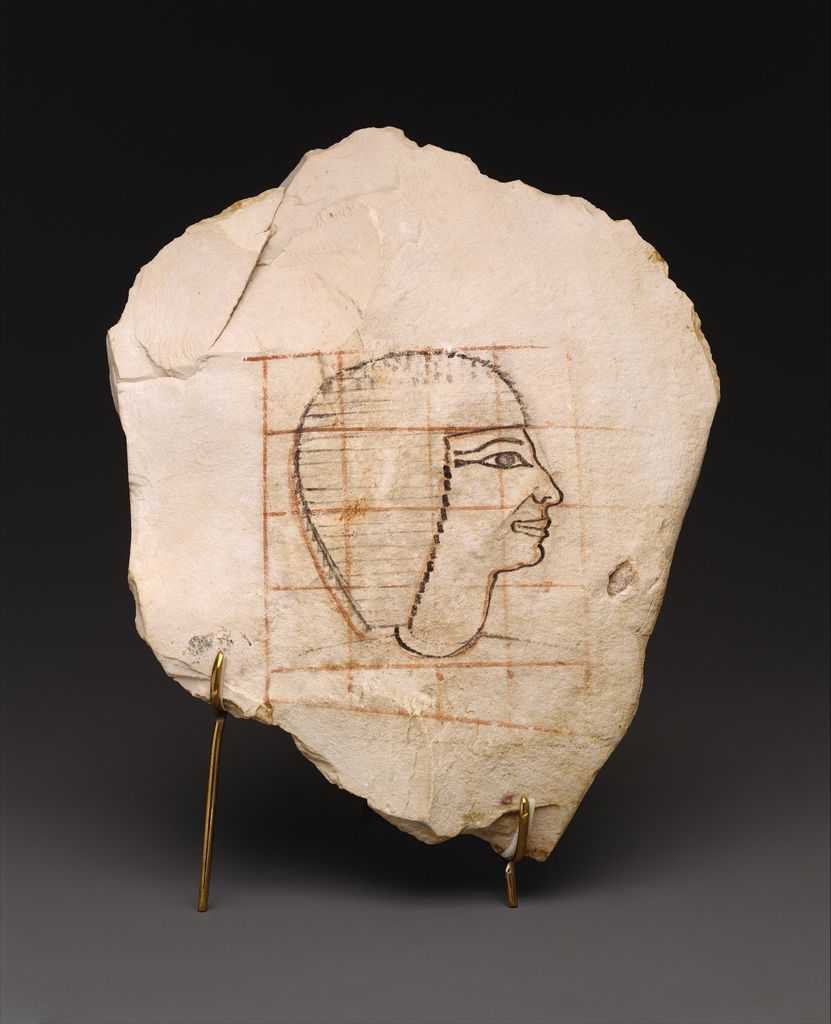
Senenmut: a grid in context
The Egyptian Artist's Gridded Sketch of Senenmut, ca. 1473–1458 BCE, is drawn in ink on limestone and belongs to The Metropolitan Museum of Art (accession 36.3.252).[4][8] A profile head appears across a red square grid, all contained by the irregular edge of the stone.
The grid is evidence of a historically situated working convention, not an invitation to extract a timeless formula. Look at how the brow, eye, mouth, ear and neck occupy parts of the gridded whole. The relationship is legible because the complete object preserves both the head and the divisions around it. Removing the grid as a detail would also remove the context that makes the comparison useful.
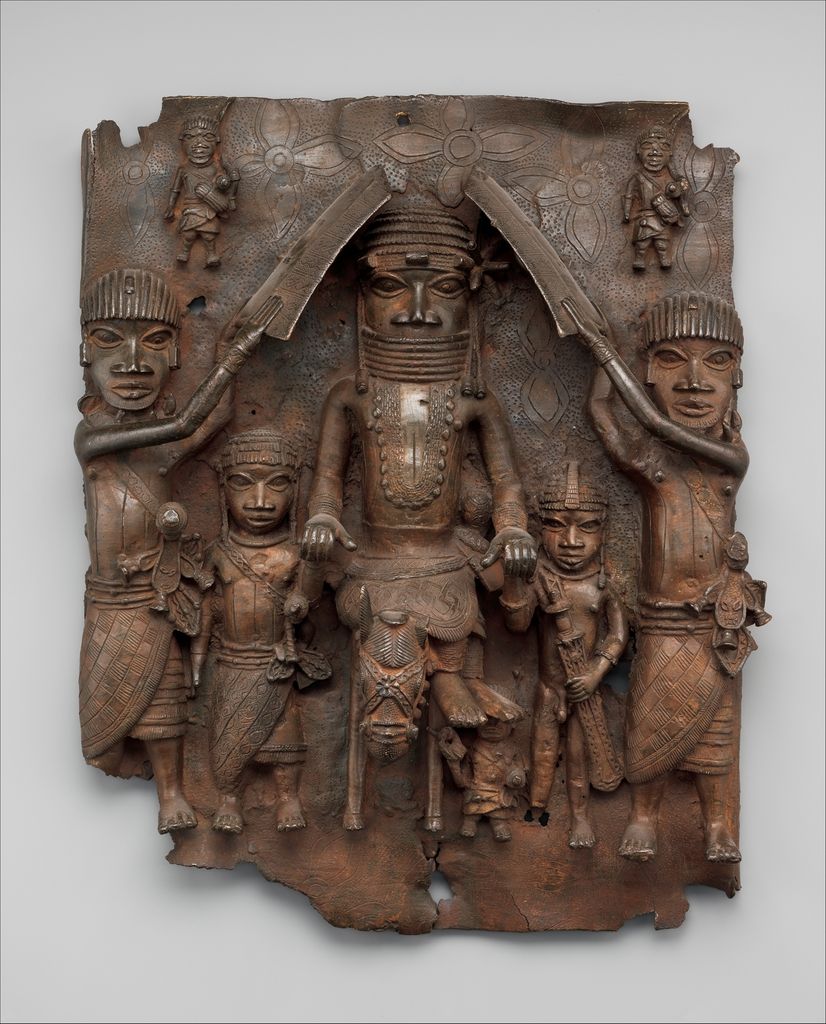
An Edo plaque: size and royal hierarchy
Artists of the Edo peoples' Ìgùn Ẹ́rọ̀nwwọ̀n brass-casting guild made the Plaque with equestrian ọ́bà (king) and attendants, ca. 1540–70. It is held by The Metropolitan Museum of Art (accession 1978.412.309).[9] The mounted ọ́bà occupies the centre and is visibly larger than the attendants and other figures around him.
Here the museum's royal context supports the qualified description hierarchical, or hieratic, scale: unequal size helps make rank legible. The phrase should not be applied whenever one figure happens to be larger. Nor does greater size alone explain emphasis; the proportion lesson is the evidenced relationship among the central ruler, attendants and complete plaque.
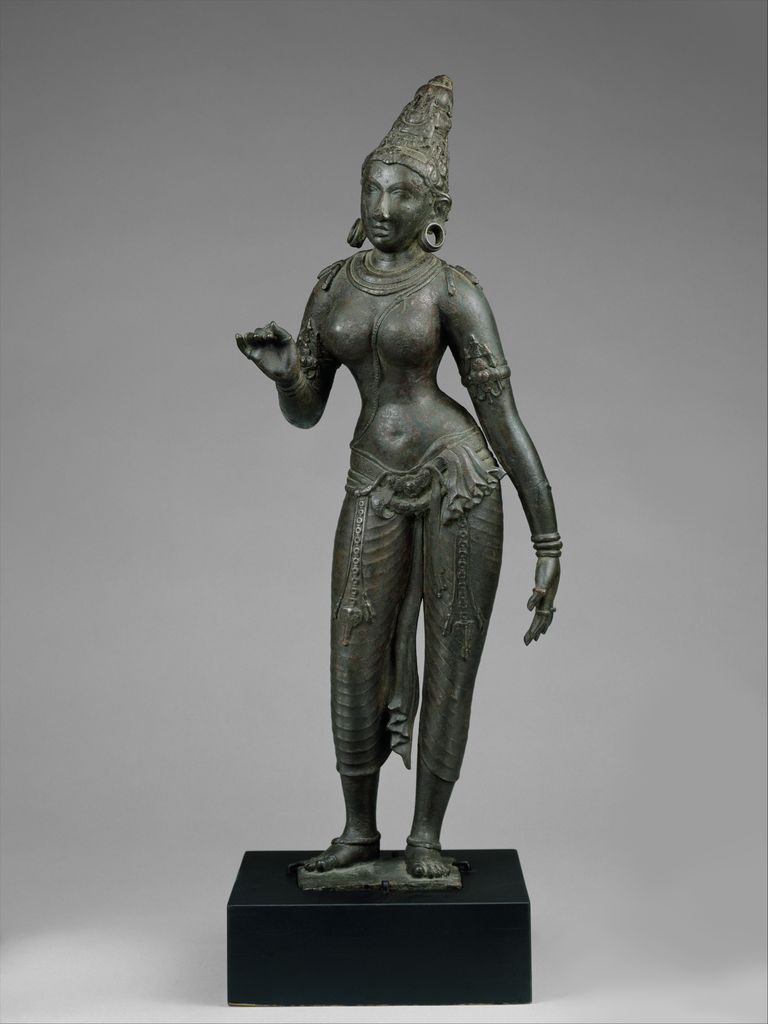
Parvati: a body without a universal ideal
Standing Parvati, made by an unrecorded artist in Tamil Nadu during the Chola period, ca. the first quarter of the 10th century, is a copper-alloy sculpture in The Metropolitan Museum of Art (accession 57.51.3).[10] The complete figure brings a tall headdress, narrow waist, long arms, torso, legs, pedestal and overall height into one continuous relationship.
Those relationships can be described without converting the sculpture into a fixed body formula. Compare the headdress with the head, the arms with the torso, and the figure with its pedestal. The result is a culturally and historically specific sculptural body, not a test against a universal standard of realism.
Bodies can be simplified or abstracted
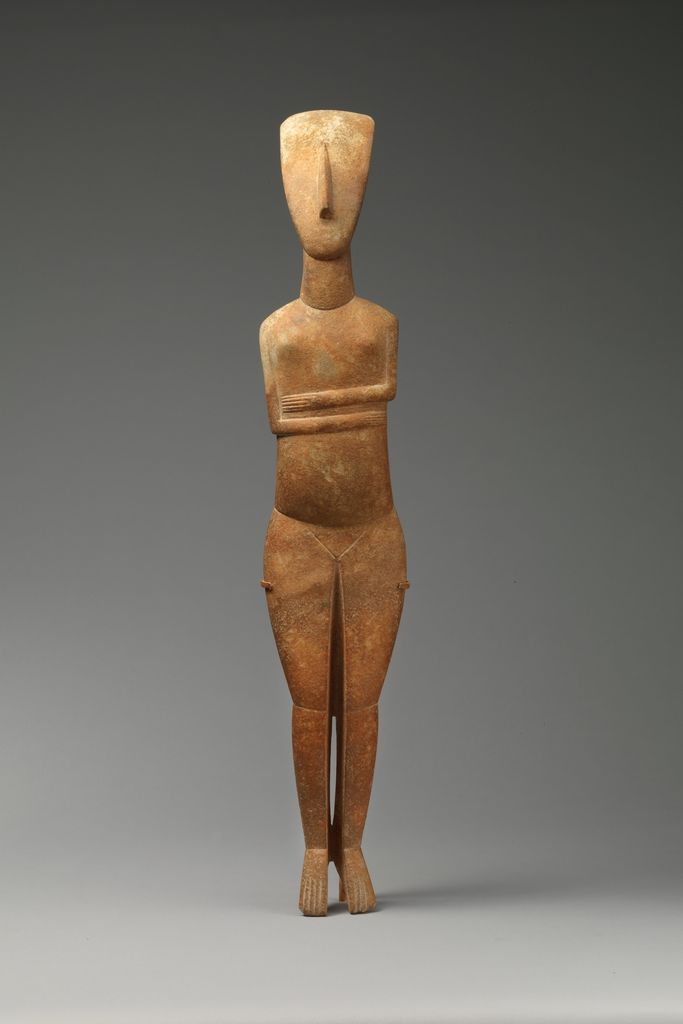
A Cycladic figure: unequal parts, connected whole
The Marble female figure, 2600–2400 BCE, is attributed to the Cycladic sculptor known as the Bastis Master and belongs to The Metropolitan Museum of Art (accession 68.148).[12] Its small tilted head, long torso, folded arms and joined legs are simplified into clearly related parts.
Nothing is gained by calling those relations wrong because they do not closely imitate a living body. The small head matters in relation to the length below it; the folded arms form a compact band across the torso; the legs extend the narrow whole. Proportion gives us a precise way to describe the abstraction without treating naturalism as a measure of quality.
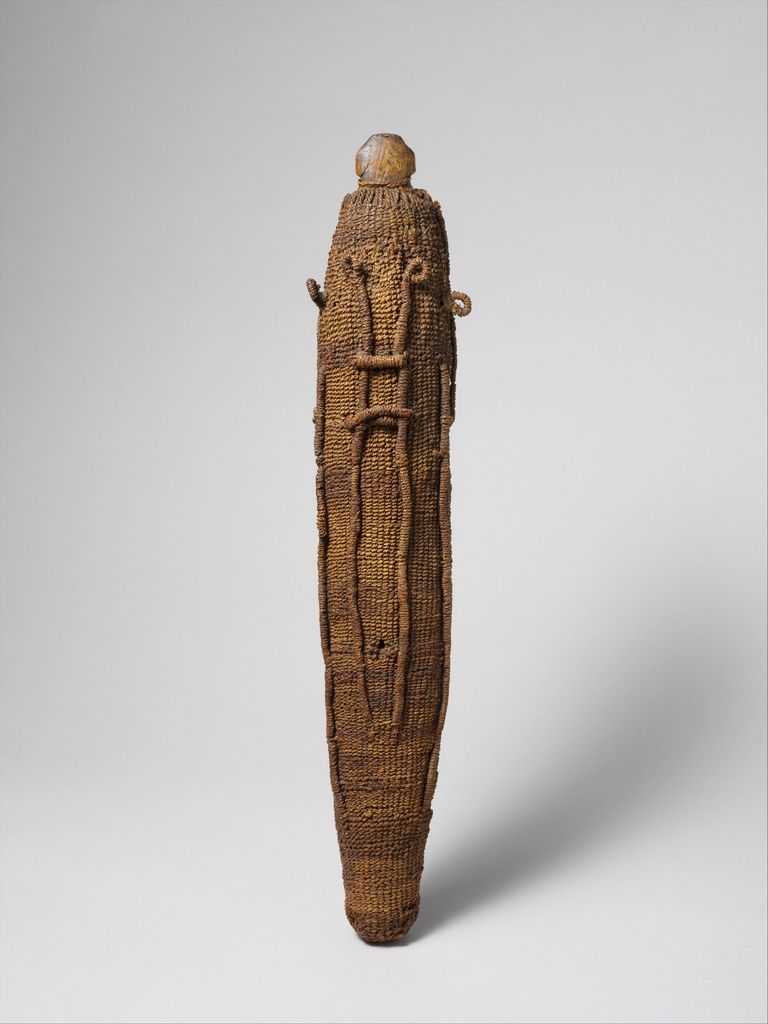
A Mā'ohi To'o: body markers within a wrapped whole
The 18th-century To'o (ritual image) was made by a Mā'ohi artist in Tahiti from wood, coconut fibre and feathers. It is in The Metropolitan Museum of Art (accession 1979.206.1481).[15] The museum identifies features marked by loops and projections within the tall, tightly wrapped object.
The lesson is not that the object resembles a naturalistic body. It lies in how a few body-related markers are proportioned within an abstract whole: small loops against the long wrapped volume, subtle projections against the narrow silhouette. Careful proportion language can acknowledge those visible relationships while avoiding speculation about ritual meaning beyond the collection record.
Objects, sheets and nested wholes
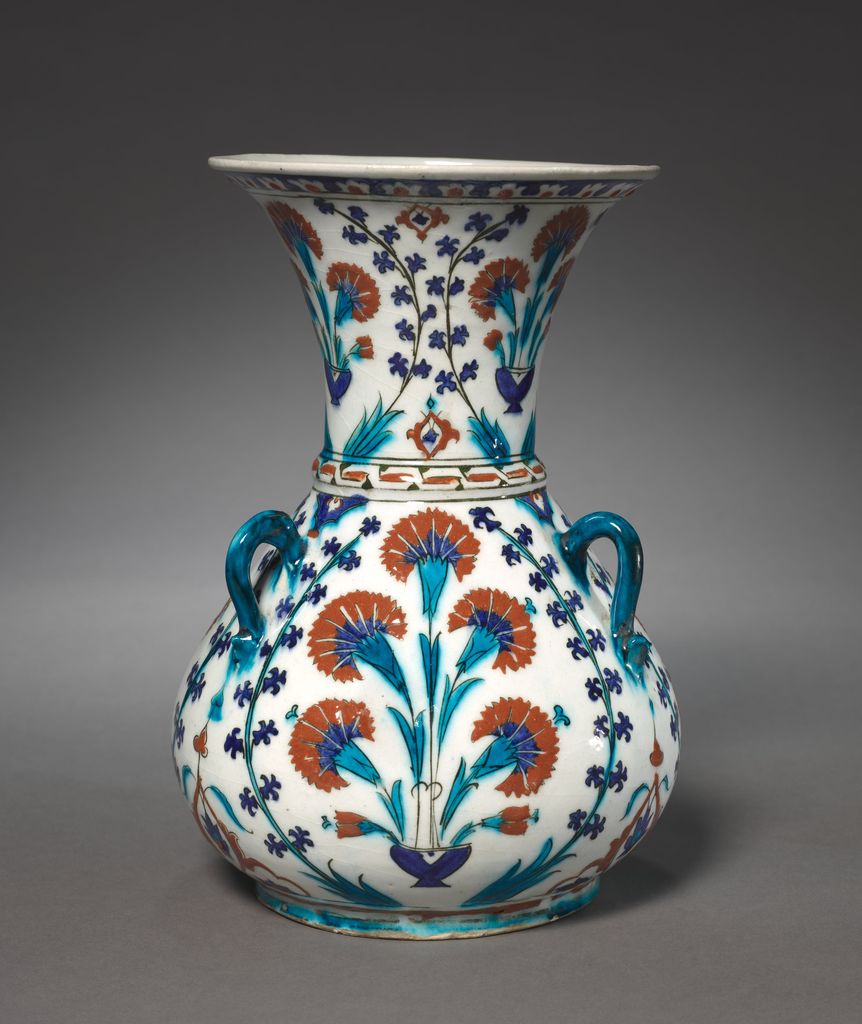
An Ottoman mosque lamp: proportion without a figure
The maker-unrecorded Ottoman Iznik Mosque Lamp, 1585–95, belongs to the Cleveland Museum of Art (accession 1944.236).[14] Its narrow neck rises from a rounded body; projecting handles interrupt the sides; a small foot supports the complete ceramic object.
Here proportion is entirely non-figural. Compare the width of the opening with the body, the handles with the silhouette, and the foot with the vessel it carries. These internal relationships help us describe the lamp as an organised object without turning it into a geometry lesson or judging whether any part follows an ideal ratio.
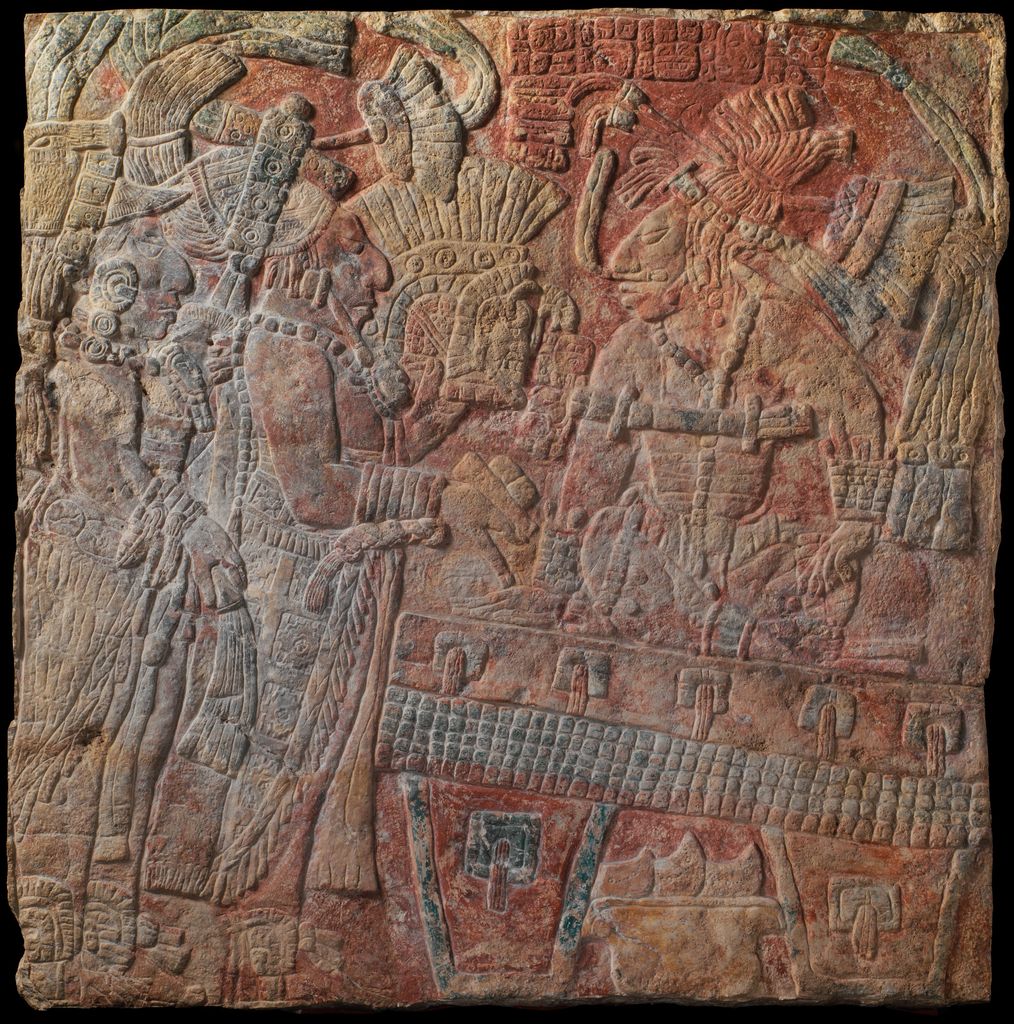
A Maya relief: parts nested inside parts
Chakalte's Relief with enthroned ruler, dated 770 CE, is a Maya limestone relief with traces of paint in The Metropolitan Museum of Art (accession 1979.206.1047).[13] The ruler, throne, surrounding carved bands, smaller forms and nearly square stone establish several nested wholes.
Begin with the entire relief, then compare the figure with the throne and that central grouping with the bands around it. This is different from the Edo plaque's source-supported hierarchy lesson. The useful observation here is structural: parts belong to a central unit, and that unit belongs to the larger carved field.
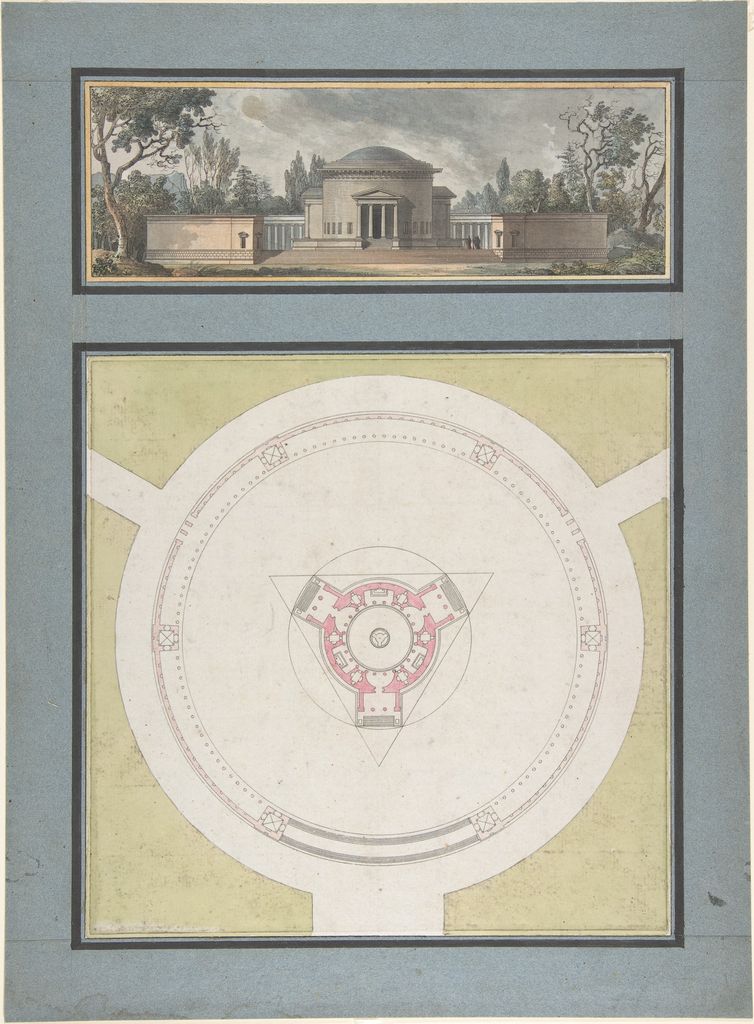
Sobre's temple project: two views of one proposal
Jean Nicolas Sobre's Project for a Temple Dedicated to the Trinity, Elevation and Plan, ca. 1783, is preserved by The Metropolitan Museum of Art as a paired elevation and plan (accessions 2008.538.5 and .6).[11] The complete image keeps the frontal elevation above and the circular plan below.
In the elevation, openings and supports can be compared with the central mass and full façade. In the plan, curved sections and interior divisions sit within the circular whole. Seeing both projections together reveals how part-to-whole relationships can remain the subject even when the representation changes. No calculation is needed, and the example does not become an architectural design exercise.
Proportion and its neighbours
Proportion does not account for every effect produced by relative size. Balance concerns the distribution of visual weight; emphasis concerns priority; and composition concerns the complete realised organisation of a work. Form addresses three-dimensional volume, whether actual or represented. Space addresses areas, distances and depth. A size relationship can contribute to any of these without becoming identical to them.
Likewise, changing sizes can recur in a rhythm, proportionally related motifs can form a pattern, and related sizes can contribute to unity. Rhythm concerns pace and interval, pattern concerns organised recurrence, and unity concerns coherence. Variety in Art will examine sustained diversity; Shape in Art, Line in Art and Colour in Art will address those elements in their own right.
The Principles of Art places proportion among other organising relationships. Balance, composition, form and space offer useful comparisons, while proportion keeps attention on size relations among parts and wholes.
Related topics
Look for proportion yourself
Choose one whole: a figure, object, sheet or scene. Name two parts and compare them without measuring. Which is longer, broader, smaller or more compact? Then compare one of those parts with the whole. Use ordinary relative language unless the artwork's documentation gives you a numerical ratio.
Next, ask whether you have historical evidence for a convention or hierarchy, or only a visible relationship. If a body seems elongated or simplified, describe precisely where that happens before reaching for a judgement. If one figure is larger, consider whether the source establishes rank or whether another concept, such as emphasis or space, better explains the difference.
Proportion becomes clearer when “correct” gives way to “related”. The sizes of parts can follow a convention, mark hierarchy, simplify a body, organise an object or connect smaller structures to a larger whole. Close looking begins by naming those relationships and letting the artwork—not a universal formula—set the terms of comparison.
Watch: Proportion through Formal Analysis
Choose a museum-led whole-work analysis, a close reading of figure relationships, or a foundations overview.
Introducing Formal Analysis: Landscape
Follow how relative sizes and spatial intervals contribute to a larger visual organisation.
Watch on YouTubeFrequently Asked Questions
Proportion is the relationship of size among parts and between parts and a whole.
Proportion usually describes internal size relationships, while scale often compares a work or figure with an external reference, setting or viewer.
No. Artists can elongate, compress, simplify or abstract parts while sustaining deliberate and legible relationships.
No. A ratio should be claimed only when reliable evidence supports it, and no single numerical system guarantees artistic quality.
Choose a whole, compare two named parts, then compare one part with the whole using precise relative language such as longer, broader or more compact.
Discussion
Which artwork on this page uses relative size most clearly, and what relationship carries the meaning?
Reader Insights
Name the complete figure, object, sheet or scene before comparing its parts.
Use relative language before assuming a numerical ratio or ideal system.
Historical evidence determines whether size signals convention, rank or another idea.
Join the Conversation
Share one precise proportion observation or a useful museum example below.
References
- J. Paul Getty Museum, “Vocabulary for Describing an Artwork”
- J. Paul Getty Museum, Understanding Formal Analysis — Principles of Design
- Smarthistory, “Proportion and Scale”
- The Metropolitan Museum of Art, The Art of Ancient Egypt: A Resource for Educators
- The Metropolitan Museum of Art, The Art of Africa: A Resource for Educators
- George Markowsky, “Misconceptions about the Golden Ratio”, ERIC / The College Mathematics Journal
- Mathematical Association of America, “The Golden Ratio and Fibonacci Numbers” historical review
- The Metropolitan Museum of Art, Artist's Gridded Sketch of Senenmut, ca. 1473–1458 BCE
- The Metropolitan Museum of Art, Ìgùn Ẹ́rọ̀nwwọ̀n brass-casting guild artists, Plaque with equestrian ọ́bà (king) and attendants, ca. 1540–70
- The Metropolitan Museum of Art, Standing Parvati, ca. first quarter of the 10th century
- The Metropolitan Museum of Art, Jean Nicolas Sobre, Project for a Temple Dedicated to the Trinity, Elevation and Plan, ca. 1783
- The Metropolitan Museum of Art, Bastis Master, Marble female figure, 2600–2400 BCE
- The Metropolitan Museum of Art, Chakalte', Relief with enthroned ruler, 770 CE
- Cleveland Museum of Art, Mosque Lamp, 1585–95
- The Metropolitan Museum of Art, Mā'ohi artist, To'o (ritual image), 18th century