by Tom Gurney
Tom Gurney BSc (Hons) is an art history expert with over 20 years experience
Page created on September 2, 2026 / Page updated on September 13, 2026
Email: tomgurney1@gmail.com / Phone: +44 7429 011000
How Recurrence Becomes a Visual Structure
Pattern in art is an organised visual structure created when a motif or another element recurs in a recognisable arrangement. The returning unit might be a leaf, animal, line, colour, figure or geometric mark. What matters is not the subject of the unit but the relationship formed as it appears again.[1][2]
This makes pattern more specific than repetition. Repetition is the mechanism—the act of using something again—while pattern is the larger structure that the recurrence allows you to recognise. A motif is the unit that returns. One flower may be a motif; a field of flowers arranged across a textile may form a pattern.[1][2]
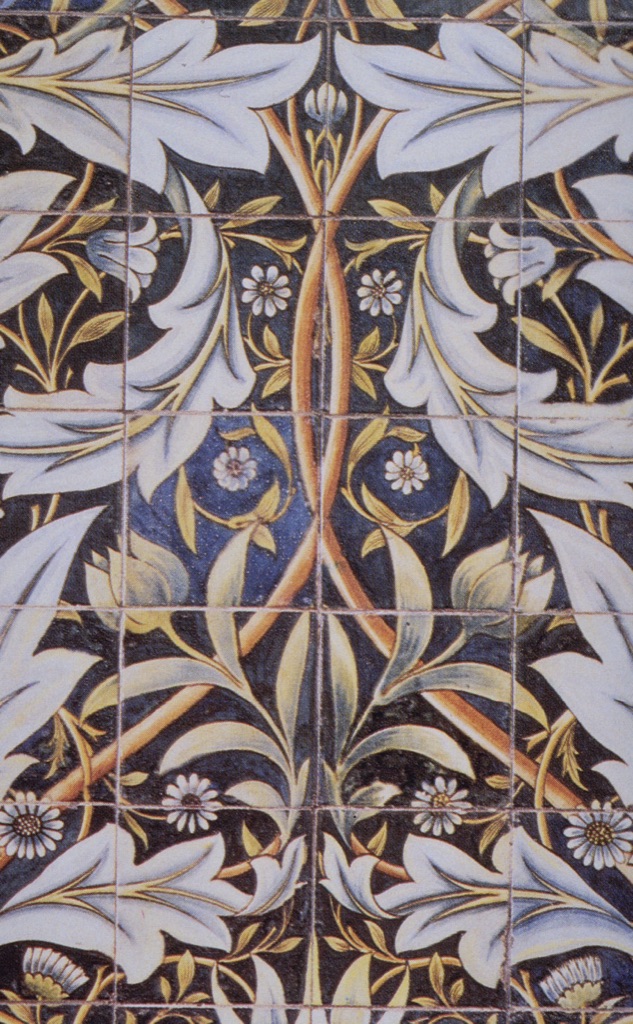
William Morris (design) and William De Morgan (production), tile panel for Membland Hall, 1876. Flowers, leaves, stems and the tile grid recur with small changes, showing how pattern can be organised without mechanical sameness. Image: Wikimedia Commons, dedicated to the public domain.
At a Glance
- Core ideaorganised recurrence across part or all of a work.
- Recurring qualitiesmotif, colour, shape, direction, interval or surface.
- Variationa pattern can change without losing its underlying order.
- Scalepattern may be local, bordered or spread across a whole field.
- Close neighbourrhythm concerns pace and interval.
Contents
Pattern can be exact or flexible, dense or widely spaced, immediately obvious or woven into a larger scene. It appears in paintings as well as carpets, ceramics, wallpaper and tapestry. Learning to see it means asking what returns, how the returns are organised, and where the order changes.
Pattern, repetition and rhythm
Repetition does not automatically produce a fully developed pattern. Two similar marks may simply recur; as their placement establishes a recognisable order, the relationship becomes pattern. Repetition can also help separate parts of a work feel connected, although recurrence alone does not guarantee that every part will read as a unified whole.[1][2]
Rhythm concerns the pace or flow created by recurrence, interval and change. A pattern tells you how units are organised; rhythm describes the experience of following them. Evenly spaced bands may feel steady, while compressed, alternating or interrupted intervals may quicken, slow or disturb that pace. The same passage can therefore carry both pattern and rhythm without making the terms interchangeable.[1][2][3]
How to recognise pattern
Begin by finding the smallest unit that appears more than once. It may be a complete figure, a cluster of leaves, a short angled line or a pair of colours. Then look beyond the unit and trace its arrangement.
- What returns? Identify the motif or visual element rather than naming the whole surface as “patterned.”
- Where does it return? Follow rows, bands, grids, mirrored pairs or a looser field.
- What happens between units? Compare spacing, direction, size and colour.
- Does the order continue at the edge? A cropped or bounded object may imply that the recurrence extends beyond the visible area.
- Where does it change? A reversal, missing unit, figure or altered interval may interrupt the order without destroying it.
- What effect follows? Ask separately whether the recurrence creates a pace, guides the eye or changes how the surface seems to feel.
These questions work better than forcing every artwork into a fixed list of pattern types. Museums and art schools group the relevant terms differently, and no single numbered taxonomy is needed to recognise what is happening.[1][2][3]
Four ways to follow recurrence
The structures below are practical ways of looking, not four universal categories. A single artwork may use more than one.
Even recurrence
Similar units can return at broadly consistent intervals. The repeated marks around a vessel or the small ground beneath a textile's larger flowers can make an order readable before any individual motif is studied closely. “Even” does not mean machine-perfect: handmade units may differ while their spacing still establishes continuity.
Alternation and reversal
A sequence can repeat by changing direction or switching between units. A left-facing form may be followed by a right-facing one, or one colour may alternate with another. The contrast between successive units becomes part of the pattern rather than a break from it.
Bands and grids
Rows, horizontal bands and repeated compartments give recurrence a visible framework. On a three-dimensional object, a band can wrap around the form; in a textile, rows can spread across a flat field. The framework organises the motifs but is not itself proof of pattern unless something recognisably returns within it.
Variation and interruption
A pattern can remain legible when colours, sizes, directions or intervals change. It can also be interrupted by a figure or architectural feature. Variation keeps recurrence from becoming mechanical; interruption makes the underlying order especially noticeable because the eye can compare the changed area with what surrounds it.
Geometric and organic are useful descriptions of motifs—the first built from measured shapes, the second resembling plants, bodies or other living forms—but they are not treated here as universal pattern types. Likewise, “irregular” is most useful as a description of uneven or varied recurrence, not as a compulsory category.
Pattern across eight artworks
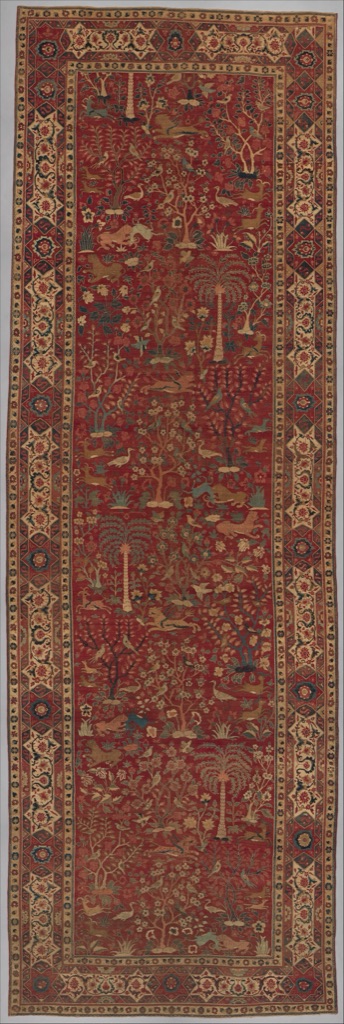
A carpet of alternating trees and animals
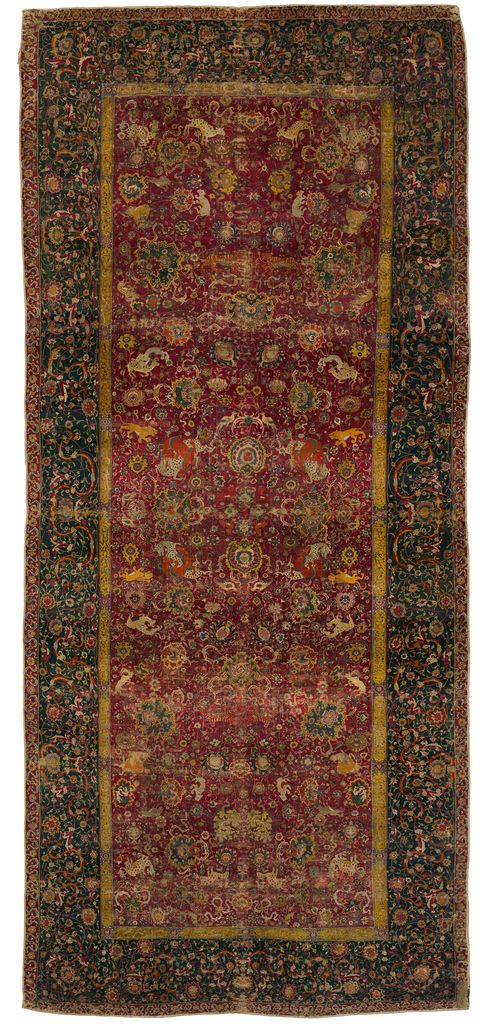
Carpet with Palm Trees, Ibexes, and Birds, made probably in Lahore in present-day Pakistan in the late sixteenth or early seventeenth century, is held by The Metropolitan Museum of Art, accession 17.190.858; its maker is not identified in the collection record.[4] The long red field repeats palm trees, birds and paired animals inside a patterned border.
Look from one pictorial unit to the next and the direction reverses: a form that faces one way is answered by a related form facing the other. The reversal keeps the field balanced without making it static. Border and central field also work at different scales, so the eye can recognise a broad enclosing repeat and a more intricate sequence within it.
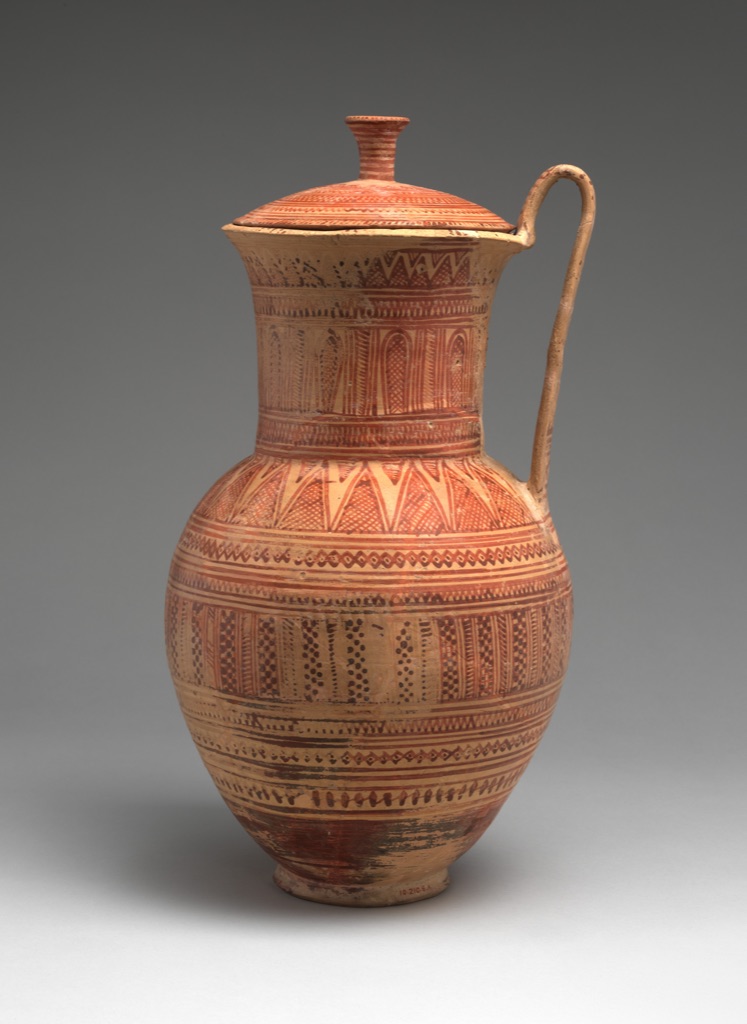
Geometric bands around a Greek pitcher
The Greek, Attic Terracotta pitcher with lid, attributed in the Met's description to the Workshop of Athens 706 and dated to about 730 BCE, belongs to The Metropolitan Museum of Art, accession 10.210.6a, b.[5] Narrow red-brown bands encircle its tall neck, shoulder and rounded body.
Here pattern is inseparable from the vessel's three-dimensional shape. Small geometric marks return within horizontal zones, but the widening body changes the circumference on which they sit. Instead of treating the decoration as a flat strip, follow how each band helps articulate the transition from lid to neck, shoulder, body and foot.
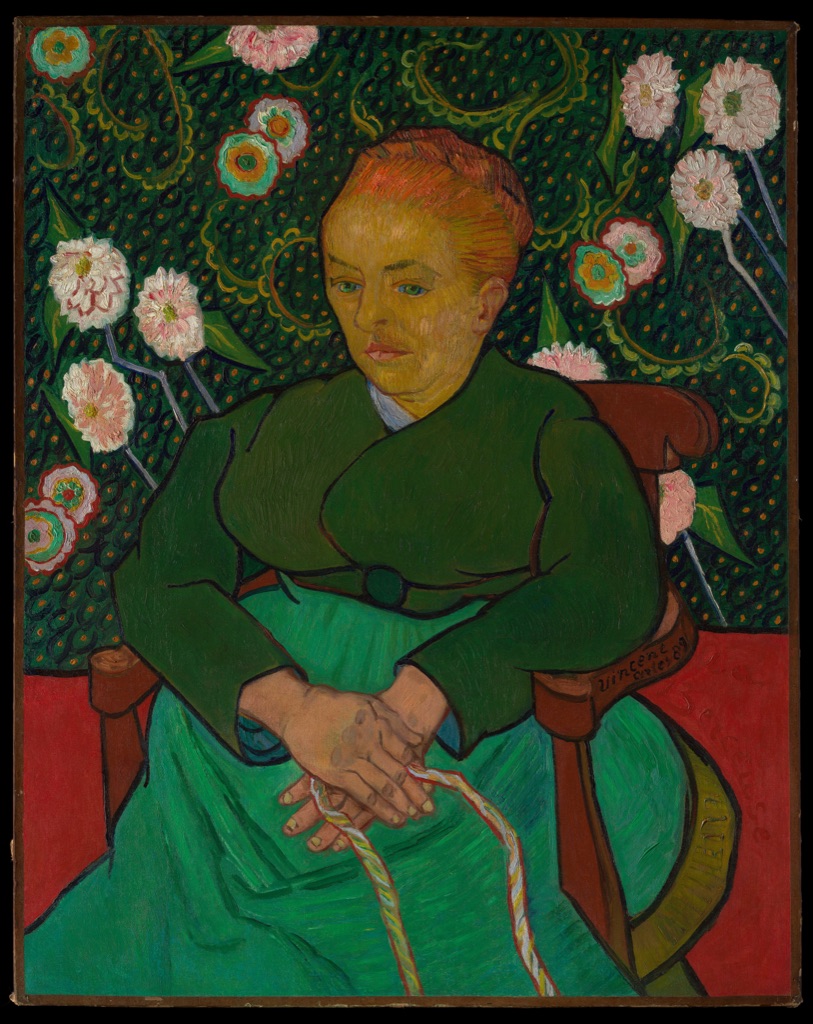
A figure interrupting Van Gogh's floral field
Vincent van Gogh's La Berceuse, formally titled La Berceuse (Woman Rocking a Cradle; Augustine-Alix Pellicot Roulin, 1851–1930), 1889, is in The Metropolitan Museum of Art, accession 1996.435.[6] Augustine Roulin sits before green wallpaper filled with curling leaves and pink flowers.
The floral motif recurs densely enough to read as a continuous field, yet the seated figure cuts decisively through it. Her dark outline, green dress and solid chair give the eye a large interruption against the smaller repeated units. The pattern remains visible around her, which makes both the figure and the surrounding recurrence easier to perceive.
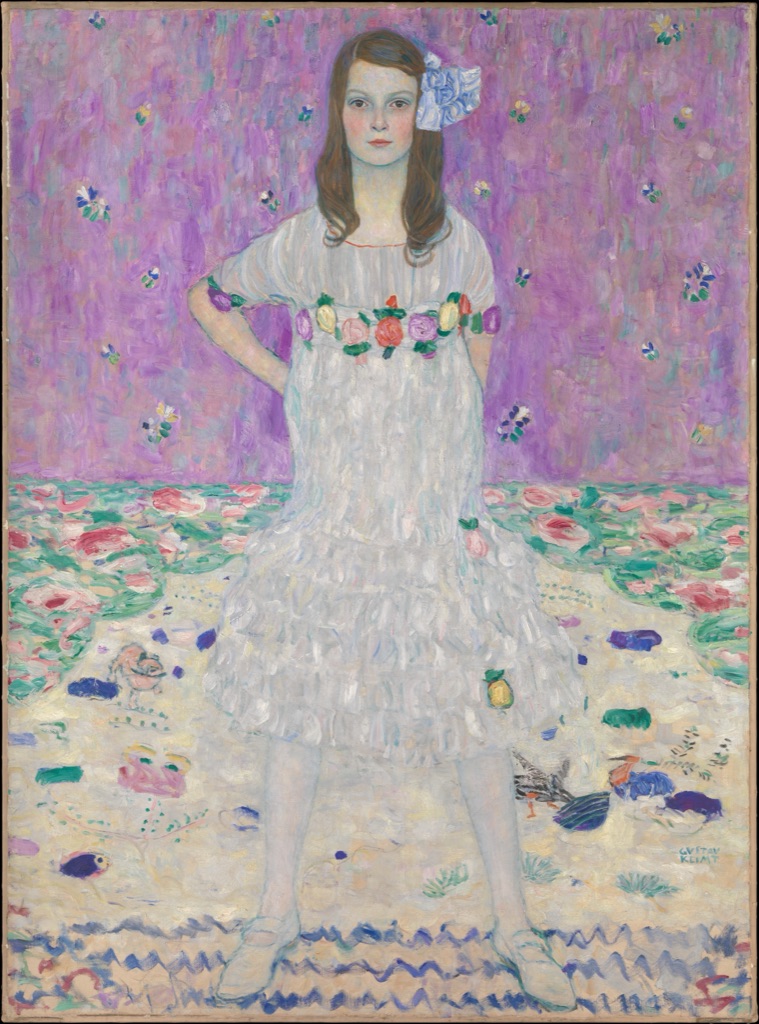
Variation around Klimt's Mäda Primavesi
Gustav Klimt's Mäda Primavesi (1903–2000), 1912–13, is held by The Metropolitan Museum of Art, accession 64.148.[7] The standing figure wears a white dress crossed by coloured bands and scattered motifs, while flowers and repeated shapes spread across the pale ground.
No single unit controls the whole painting. Flowers recur, coloured marks return and banded passages answer one another, but their sizes and spacing continually change. The result shows how pattern can be recognisable without becoming a strict tile: recurrence supplies connection while variation keeps dress, figure and ground visually active.
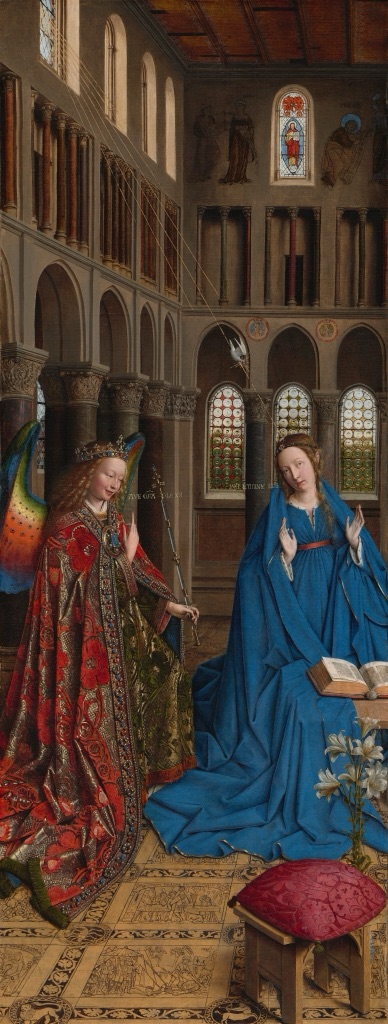
Pattern inside Van Eyck's Annunciation
Jan van Eyck's The Annunciation, about 1434/1436, is in the National Gallery of Art, Washington, accession 1937.1.39.[8] Gabriel and Mary occupy a tall church interior in which patterned brocade, decorated floor tiles, windows and repeated arches belong to a much larger narrative image.
Pattern is not merely a decorative backdrop here. Repeated architectural bays lead upward through the narrow space, while the floor and textiles carry smaller, denser orders. Seeing those recurrences should not flatten the painting's figures or religious subject into ornament; it reveals how several scales of organisation can coexist within the complete scene.
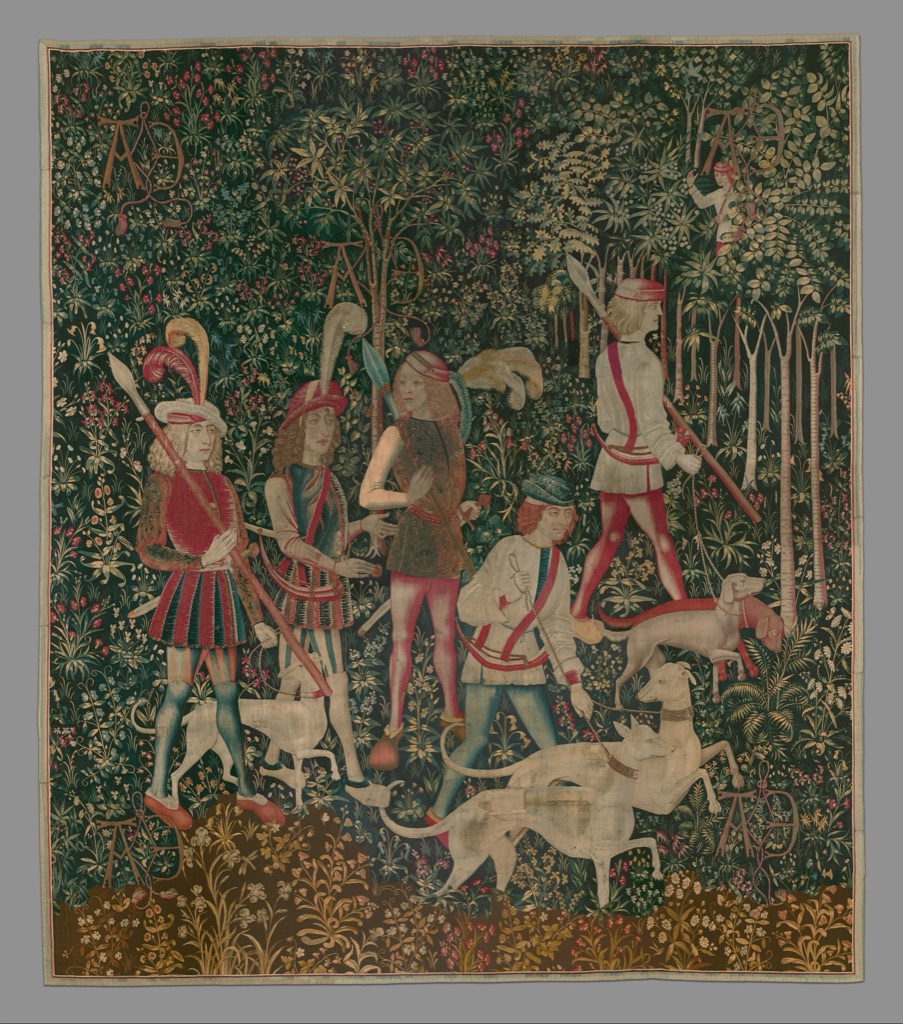
Dense recurrence in the Unicorn Tapestries
The Hunters Enter the Woods (from the Unicorn Tapestries), 1495–1505, is in The Metropolitan Museum of Art, accession 37.80.1. The Met identifies the cartoon as made in Paris and the weaving as South Netherlandish; the individual makers are not known.[9]
Hunters and hounds move through a green millefleurs field crowded with recurring plants. The repeated AE cipher supplies a clearer unit, but the flowers are varied in kind, scale and placement rather than laid out as a rigid tile. This is organised recurrence with a dense, uneven character: the field feels continuous even though its individual plants do not repeat mechanically.
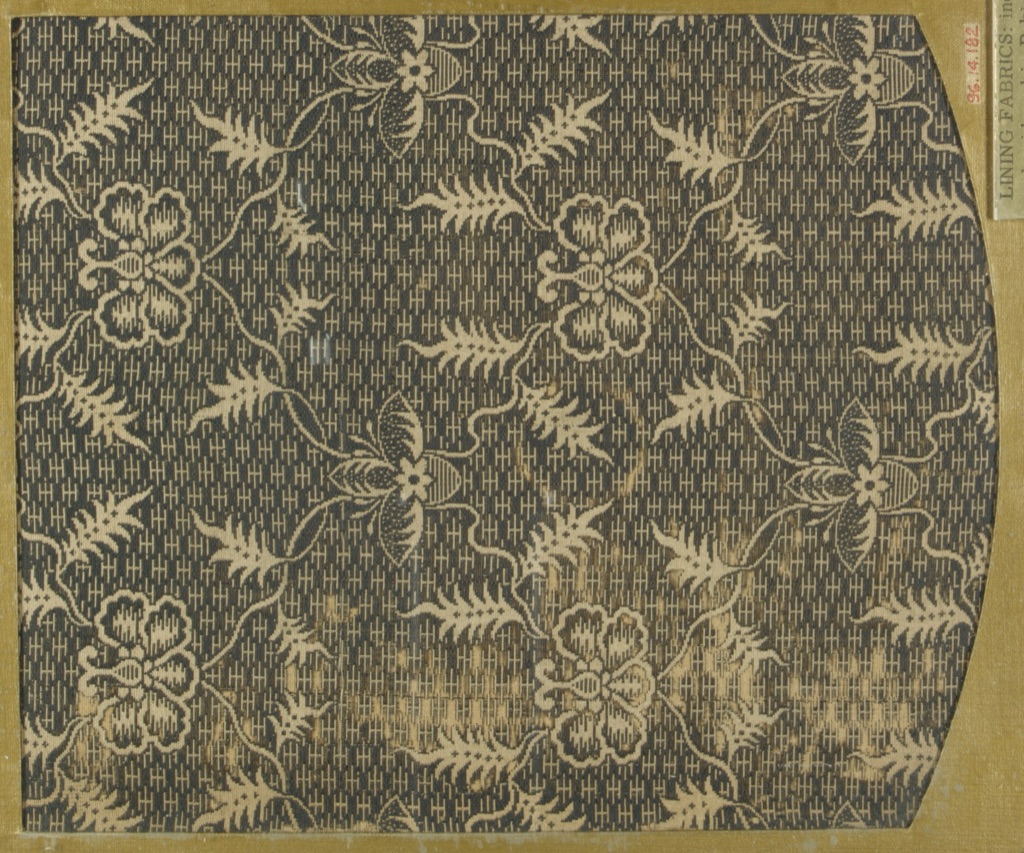
Pattern layered over pattern in a Japanese textile
The Textile fragment with repeating floral pattern on geometric diaper ground, made in Japan during the Edo period and dated to the eighteenth or nineteenth century, is held by The Metropolitan Museum of Art, accession 96.14.182; its maker is not identified.[10]
Pale flowers and serrated leaves form the larger recurring motifs. Beneath them, a much smaller geometric ground establishes a second, tighter order. Looking between these two scales clarifies the difference between motif and pattern: each flower-and-leaf unit can be followed across the fragment, while the ground makes recurrence present even in the spaces between those larger units.
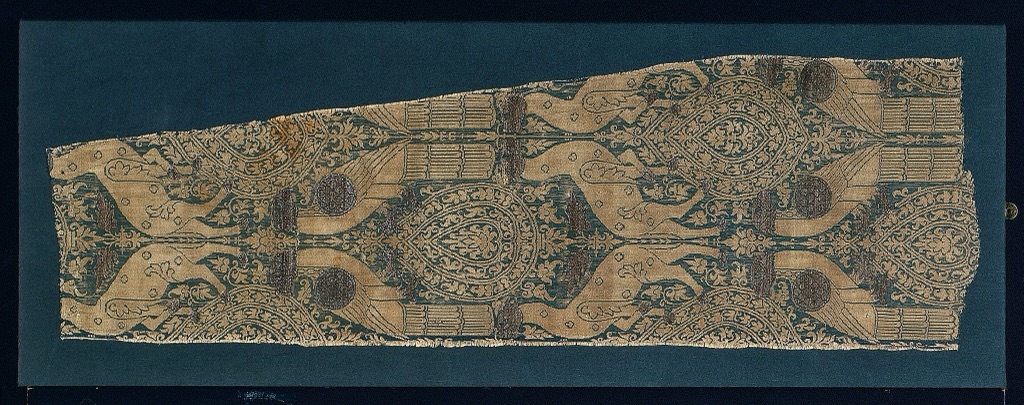
Paired motifs in Parrots and Animals
Parrots and Animals, an Italian silk textile fragment from the 1300s, is in the Cleveland Museum of Art, accession 1926.507; its maker is not identified.[11] Gold birds and animals face one another around oval plant forms on a dark teal ground.
The paired figures create compact motifs, and those motifs return in horizontal rows. Small differences survive across the worn, irregular fragment, but the repeated confrontation—animal answering animal, bird answering bird—keeps the structure legible. The work shows how a pattern can depend as much on relationships within a unit as on the interval between units.
Pattern, movement and texture
Pattern can help direct the eye, but movement is the action or visual path that results, not the recurrence itself. The pitcher encourages the gaze to circle its body, and the carpet's reversals may pull attention from one unit to the next; those are movement effects produced by particular arrangements, not a definition of pattern.[1][2]
Texture concerns how a surface looks or feels. Woven silk, knotted carpet, painted wallpaper and terracotta each have material or implied surface qualities, while their motifs form separate recurring structures. A patch of repeated marks may contribute to both texture and pattern, but the useful questions differ: for pattern, ask what returns and how it is arranged; for texture, ask what kind of surface is suggested or physically present.[1]
Related looking
The Principles of Art introduces pattern alongside other organising relationships. Comparing it with rhythm, unity or composition can sharpen a reading, while pattern itself remains the recognisable structure formed by recurrence.
Related concepts remain focused subjects in their own right: Rhythm in Art; Movement in Art; Texture in Art; Emphasis in Art; Unity in Art. Repetition is a mechanism within pattern and rhythm, not a separate principle or destination in this guide.
Look for pattern yourself
Choose an unfamiliar artwork and resist naming its style at first. Find one unit that appears again, then trace three or four occurrences. Are they spaced evenly, reversed, grouped in rows or allowed to vary? Look at the edge of the object or frame and decide whether the arrangement seems complete or could continue beyond it.
Next, find the exception. Perhaps a figure interrupts a repeated field, one colour changes, a motif turns around or an interval opens. The exception often makes the underlying order easier to see. Only then ask what the recurrence does: whether it gives the eye a pace, carries attention across the work, connects distant areas or sharpens the prominence of one changed part.
Pattern becomes useful as a way of looking when it leads from “this repeats” to a more exact description of the structure: what the motif is, how it returns, and how the artwork keeps order and change in view at the same time.
Watch: Pattern through Formal Analysis
Choose a museum-led whole-work analysis, a close reading of recurrence and attention, or a foundations overview.
Introducing Formal Analysis: Landscape
Follow how recurring shapes, colours and intervals contribute to a larger visual organisation.
Watch on YouTubeFrequently Asked Questions
Pattern is organised recurrence across part or all of an artwork.
No. Motifs, colours, intervals or directions can vary while the recurrence remains legible.
Repetition is the recurrence of something; pattern is the larger organisation that recurrence creates.
Pattern concerns organised recurrence, while rhythm concerns the pace and interval produced through recurrence and variation.
Yes. Pattern can organise paintings, prints, ceramics, architecture, manuscripts, textiles and many other forms.
Discussion
Which example on this page changes a repeated unit most effectively without losing its pattern?
Reader Insights
Name the smallest motif, mark or colour relationship that visibly returns.
Follow spacing, direction and grouping rather than counting repetitions alone.
Variation and interruption can make an underlying pattern easier to recognise.
Join the Conversation
Share one precise pattern observation or a useful museum example below.
References
- J. Paul Getty Museum, “Vocabulary for Describing an Artwork”
- J. Paul Getty Museum, “Understanding Formal Analysis — Principles of Design”
- Museum of Modern Art, “A Vocabulary for Discussing Art — Principles of Design”
- The Metropolitan Museum of Art, Carpet with Palm Trees, Ibexes, and Birds, late 16th–early 17th century
- The Metropolitan Museum of Art, Terracotta pitcher with lid, ca. 730 BCE
- The Metropolitan Museum of Art, Vincent van Gogh, La Berceuse, 1889
- The Metropolitan Museum of Art, Gustav Klimt, Mäda Primavesi (1903–2000), 1912–13
- National Gallery of Art, Jan van Eyck, The Annunciation, c. 1434/1436
- The Metropolitan Museum of Art, The Hunters Enter the Woods (from the Unicorn Tapestries), 1495–1505
- The Metropolitan Museum of Art, Textile fragment with repeating floral pattern on geometric diaper ground, 18th–19th century
- Cleveland Museum of Art, Parrots and Animals, 1300s