Winslow Homer.jpg)
 by Tom Gurney
Tom Gurney BSc (Hons) is an art history expert with over 20 years experience
Published on June 19, 2020 / Updated on August 2, 2026
Email: tomgurney1@gmail.com / Phone: +44 7429 011000
Contents
- Introduction
- What the Painting Shows
- Gloucester, Sailing And Homer's 1870s World
- The Flirt And Homer's Revision
- Centennial Reception And Postwar Optimism
- Provenance, Titles And Public Fame
- Related Homer Works
- Why Breezing Up Still Works
- Annotated Details
Introduction
Winslow Homer's Breezing Up (A Fair Wind) is one of the clearest and most loved images of his 1870s career. A small sailboat moves across choppy water. A young man and three boys ride low in the boat. The sail rises out of the frame, the hull tilts, and the water around them is lively without becoming dangerous. The youngest boy sits at the stern with the tiller in his hands, looking outward across the water as if he has been trusted with the future of the boat. [1]
The painting was made between 1873 and 1876 and is now in the National Gallery of Art in Washington, D.C. It is an oil on canvas measuring 61.5 x 97 centimeters, or 24 3/16 x 38 3/16 inches. The NGA lists the credit line as the Gift of the W. L. and May T. Mellon Foundation and the accession number as 1943.13.1. The Gallery's object page also marks the work's media as free and in the public domain, making it a strong image candidate for a future build after the final image gate. [2]
Those object facts matter, but they do not explain the painting's unusual staying power. Breezing Up is not only a pleasant boating picture. Homer made it after the Civil War, at a moment when American audiences were still looking for images that could feel fresh, national and forward-moving without ignoring the recent past too bluntly. In 1876, the year of the United States Centennial Exposition in Philadelphia, the painting's image of youth, skill and steady motion could be read as a hopeful picture of the country after conflict. That reading is best handled carefully. The painting is not a simple patriotic poster. Its strength comes from the way Homer turns a small crew in a small boat into a larger meditation on balance, trust and movement. [3]
The painting also sits at an important point in Homer's career. He had already built a reputation as an illustrator and painter of American subjects. He had worked through Civil War images, rural scenes, shore subjects and paintings of children at play. In Breezing Up, those interests meet the sea. The boat is not yet the harsh marine world of The Fog Warning, The Herring Net or The Gulf Stream, but it already shows Homer's ability to make water carry feeling. The sea is active, the figures are alert, and the composition turns ordinary movement into meaning. [4]
This is why the article deserves a full rescue manuscript rather than a short description. Breezing Up introduces many readers to Homer's public language of clarity, air and youth. It connects naturally to Snap the Whip, Dad's Coming!, Croquet Scene, Long Branch, New Jersey, the Paintings hub and the artist's biography. At the same time, it points ahead to the marine paintings in which water, work and risk become more severe. In this earlier work, the mood is lighter, but Homer's discipline is already serious. [5]
What the Painting Shows
The first thing a viewer notices is the boat's tilt. Homer places the craft close to us, angled across the lower part of the canvas and pushed by wind across dark green water. The sail rises high and cuts beyond the upper edge of the composition, making the scene feel larger than the canvas. The water is choppy but not chaotic. Its motion gives the boat life, while the crew's bodies show that they know how to sit, lean and work with that motion. [6]
There are four figures in the boat: a young man and three boys. They do not pose for the viewer like a formal portrait group. They are arranged by the action of sailing. One figure reclines near the bow. Another sits along the edge of the boat and holds on. The older youth in a red shirt works with the sail. At the stern, the youngest boy sits with his feet forward and his hand on the tiller. He looks away from the viewer and toward the open water. [7]
That last figure is crucial. He is small, but he holds the direction of the boat. Homer does not make a full adult the obvious master of the scene. The painting's authority is transferred, at least visually, to a boy. This makes the image feel both tender and charged. The crew is young, but the boat is not drifting. The figures are relaxed enough to suggest pleasure, yet coordinated enough to suggest competence. [8]
The sail gives the painting much of its energy. Because it extends out of the frame, the viewer senses wind without needing to see the whole mechanism. The canvas does not describe every line and surface of the rig. It gives enough information to make the boat's movement believable. The hull, the sail, the water and the leaning bodies form one system. The painting's pleasure comes from watching that system hold together. [1]
The horizon sits low enough to give the sky breadth, but the sea remains active in the foreground. Far in the distance, another vessel is visible. It is not a rescue ship or a source of danger. Instead, it helps give scale to the scene. The small boat in the foreground belongs to a wider marine world. The boys are close to us, but they are also part of an open water culture in which boats, wind and skill matter. [2]
Homer's color helps make the scene memorable. The water is darker and more substantial than a decorative blue. The sky opens above it with light and cloud. The red shirt inside the boat draws attention to the working figure near the sail. The younger boy at the tiller is quieter in color but more important in meaning. Homer balances visual emphasis and narrative emphasis in different ways. The red shirt catches the eye, while the tiller boy changes the interpretation. [3]
The scene looks natural, almost effortless, but that is part of Homer's craft. The figures are distributed so the boat feels full but not crowded. The diagonal of the boat gives the composition motion. The sail gives vertical force. The low horizon gives air. The visible crew gives human scale. Nothing feels overloaded. A scene that might have become anecdotal remains clean and open. [4]
This openness is central to the painting's appeal. Homer does not surround the boys with comic incident, detailed dialogue or sentimental explanation. He does not need a dramatic storm. He does not need a moralizing caption. The painting works through posture, direction and atmosphere. A fair wind fills the sail, and the boat moves forward. [5]
Annotated Details from Breezing Up (A Fair Wind)
 Winslow Homer.jpg)
Details from BREEZING UP (A FAIR WIND)
Close looking follows the composition through figure, setting, foreground and surrounding visual pressure.
Central Action
The central passage carries the first act of close looking, where pose, spacing and surrounding detail establish the main visual problem.
 Detail 01 central-action.jpg)
Left-Hand Structure
The left side helps frame the composition and shows how Homer balances incident against the broader setting.
 Detail 02 left-hand-structure.jpg)
Right-Hand Structure
The right side answers the central group with a second visual pressure, often through movement, distance or environmental force.
 Detail 03 right-hand-structure.jpg)
Foreground Detail
The foreground gives the viewer a threshold into the image and often contains the practical evidence of work, risk or play.
 Detail 04 foreground-detail.jpg)
Background Distance
The background opens the picture into weather, landscape or social space, making the scene larger than the immediate figures.
 Detail 05 background-distance.jpg)
Edge Rhythm
A detail near the edge shows how the composition keeps the eye moving instead of closing around a single motif.
 Detail 06 edge-rhythm.jpg)
Gloucester, Sailing And Homer's 1870s World
Breezing Up belongs to Homer's 1870s coastal imagination. During this period he repeatedly painted subjects of shore, leisure, childhood and everyday American life. He was not simply escaping into pleasant scenes. He was finding visual forms that could register a country after war through ordinary activity: play, work, looking, movement, weather and shared space. [6]
The painting is often associated with Gloucester and with the world of small craft on the New England coast. Gloucester mattered to Homer because it offered the visual life of the sea without requiring him to stage grand naval drama. Small boats, working harbors, beaches and children gave him subjects that could be local and national at the same time. A boat on water could be a specific observation and a broader image of confidence. [7]
This is an important distinction. Breezing Up is not a generic sailing lesson. Homer does not paint the boat to display technical knowledge for its own sake. Nor does he use the figures merely as decorative passengers. The painting's maritime details serve a human and symbolic purpose. The wind, sail, rudder and balance of bodies create a scene of shared dependence. The crew has to respond together for the boat to move well. [8]
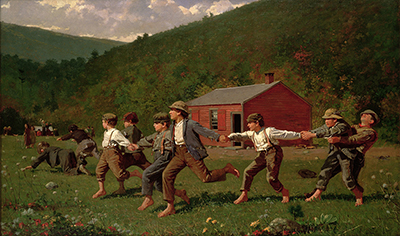
That kind of shared motion helps connect Breezing Up to Homer's other 1870s images of young people. Snap the Whip also shows children moving as a group, with a line of bodies stretched by force and play. Croquet Scene turns leisure into social arrangement. Dad's Coming! uses shore life and childhood expectation to build a quiet emotional scene. Long Branch, New Jersey places figures in the modern world of beachgoing and public recreation. Across these works, Homer treats childhood and leisure seriously, not as trivial subjects but as ways of looking at American life. [1]
In Breezing Up, that seriousness is hidden inside charm. The painting feels fresh because the boys are outdoors, the air is moving and the light is clear. But it also asks how freedom is learned. The young figures are not only being carried by the boat. They are learning how to handle it. They lean with the vessel, trust the wind, and accept the risk that motion always involves. [2]
This makes the painting different from a simple image of innocence. The boys are young, but they are not insulated from the world. They are on water, and water requires attention. The boat's tilt makes that attention visible. The viewer senses that joy and discipline are not opposites. The pleasure of the painting depends on the fact that the crew knows something. [3]
Homer's own training helps explain that balance. As an illustrator, he knew how to make images that could be read quickly. As a painter, he increasingly learned how to keep those images from becoming too easy. Breezing Up is immediately legible: boys in a sailboat, wind, movement, open water. But the painting continues to deepen because each detail participates in an argument about direction, trust and youth. [4]
The 1870s context also matters because Homer was developing a public identity as a painter of American subjects. He did not need mythological heroes or imported historical costumes. He could paint boys in a boat and still make an ambitious image. That confidence is one reason Breezing Up feels so important within the Paintings hub. It shows Homer proving that a modern American scene could carry artistic weight. [5]
The Flirt And Homer's Revision
The National Gallery of Art links Breezing Up to Homer's earlier painting The Flirt, noting two compositional changes that help explain the final work. In the earlier arrangement, the bow included a figure where Breezing Up now places an anchor. The control of the tiller also shifts: instead of the man in red holding that responsibility, the young boy at the stern takes it in the final painting. [6]
These changes matter because they alter the painting's meaning without making it less natural. If another figure occupied the bow, the boat would feel more crowded and more anecdotal. By replacing that figure with an anchor, Homer gives the foreground a symbolic object and simplifies the crew. The anchor belongs to the language of maritime security, hope and holding ground, even when the boat itself is moving. It does not turn the painting into an allegory by itself, but it adds weight to the scene. [7]
The shift of the tiller is even more important. When the young boy controls the direction of the boat, the painting becomes more than a picture of adults supervising children. The youngest or smallest figure is not only present; he participates in steering. This decision gives the work much of its optimistic charge. The future is not described in words. It is placed in the hands of a child looking ahead. [8]
Homer's revision also improves the composition visually. A figure in the bow would have competed with the other bodies and narrowed the painting's rhythm. The anchor creates a pause and a counterweight. The boat can feel full without becoming cluttered. The viewer's eye can move from the bow to the sail, along the figures, and finally to the boy at the stern. The composition becomes a sequence of attention. [1]
The change also gives the title more force. Breezing Up and A Fair Wind both emphasize motion under favorable conditions. A fair wind is not a guarantee of arrival, but it is an advantage. The boys still need to guide the boat. The sail still needs to be managed. The water is still uneven. Homer's revision makes that balance more meaningful. The wind may be favorable, but someone must use it. [2]
This is why the painting does not need to be described as passive optimism. Homer does not show a boat drifting easily toward a promised future. He shows a crew handling movement. The optimism of the picture comes from skill, not from fantasy. The figures are young, but the boat is real. The water moves. The sail pulls. The tiller matters. [3]
Revision is sometimes hard for viewers to see because a finished Homer can look so direct. Breezing Up seems spontaneous, full of wind and ease. The NGA's record reminds us that the painting's ease was constructed. Homer made decisions that sharpened the image's public meaning while preserving its naturalness. That combination is one of his signatures: clarity that has been earned rather than merely found. [4]
Centennial Reception And Postwar Optimism
Homer exhibited Breezing Up in Philadelphia at the Centennial Exposition of 1876. That context shaped how the painting could be understood. The Centennial was not only an art event. It was a national occasion, staged one hundred years after the Declaration of Independence and only a little more than a decade after the Civil War. Public images shown there could carry unusually heavy expectations about identity, recovery and national direction. [5]
The NGA notes that critics at the time read the anchor and the boy's forward gaze in relation to hope and the nation's future after the Civil War. That does not mean every viewer saw the painting in exactly the same way, or that Homer painted a simple political message. It means the painting's composition was open to public meanings that went beyond boating. In 1876, a child steering into a fair wind could feel like more than a charming detail. [6]
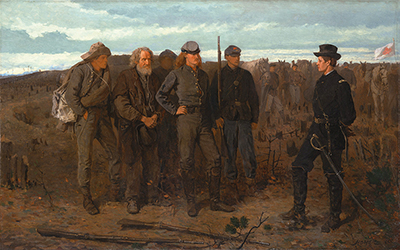
This is the most delicate part of the painting's interpretation. It is easy to flatten Breezing Up into a slogan about American optimism. That would make the painting less interesting. Homer had seen and depicted the Civil War. His postwar art often understands that national life is complicated, strained and unresolved. Prisoners from the Front and A Visit from the Old Mistress show him working with conflict, aftermath and social tension. Breezing Up is lighter in mood, but it belongs to the same historical world. [7]
The better reading is that the painting offers a hopeful image without erasing the need for balance and work. The wind is fair, but not still. The boat moves, but must be steered. The crew is young, but already responsible. The sea is open, but not empty. This is a hope built from action and coordination rather than from easy reassurance. [8]
That helps explain why the painting became so durable. It allows viewers to enjoy the sunlight, wind and youthful confidence while also sensing a larger structure. The boat is a miniature community. Each figure has a relation to the movement of the whole. The youngest boy's control of the tiller suggests trust in the next generation, but the trust is practical. He holds a working object, not a symbolic wand. [1]
The painting's postwar optimism is also different from nostalgia. Some of Homer's 1870s subjects can look backward toward rural or childhood scenes that seem removed from industrial and political change. But Breezing Up is full of movement. It is not a retreat into stillness. The boys are not frozen in an idealized childhood. They are crossing water. Their bodies are angled by wind. Their direction matters. [2]
This sense of active hope gives the painting its public force. It suited the Centennial moment because it could be read as American without being ceremonial. There are no flags, soldiers, monuments or official personifications. The nation, if it is present, is present through boys in a boat, a fair wind, an anchor, a horizon and the work of steering. Homer makes national feeling informal, physical and local. [3]
That informality is part of his originality. He trusts ordinary scenes to carry large meanings. He does not need to announce the theme. The painting's objects and bodies do the work. For modern readers, this means the article explains the Centennial context while protecting the painting's open character. Breezing Up can be hopeful without being simplistic. It can belong to postwar national recovery without becoming propaganda. [4]
The painting also shows how Homer could make absence meaningful. The Civil War is not visible in the boat. There are no ruins, uniforms or battle memories. Yet the postwar context surrounds the painting's reception. After years of national fracture, an image of coordinated movement across open water could seem newly important. The lack of explicit historical content made the painting available for a different kind of feeling: not memory of conflict, but the possibility of moving beyond it. [5]
Even so, the work's optimism remains conditional. The boat must still be handled. The wind must still be read. The water still changes beneath the hull. That is what keeps the painting alive. It is not an easy promise. It is a scene of capability. [6]
Provenance, Titles And Public Fame
The National Gallery of Art records the painting's early ownership route with useful precision. It was purchased from Homer by Charles Stewart Smith of New York by 1878, although the exact path may have involved either direct purchase or an early 1877 auction route. The work later passed by inheritance to Smith's son, Howard Caswell Smith of Oyster Bay, New York. It was sold in 1943 to Wildenstein & Co. and purchased by the National Gallery of Art on December 31, 1943. [7]
The painting also has a title history. It appeared in some early exhibition contexts as A Fair Wind, later as Breezing Up, and often with both titles joined. The current page title, Breezing Up (A Fair Wind), is therefore appropriate. It preserves the familiar modern title while keeping the historical alternate title visible. The title pairing also captures the painting's central idea: the moment when wind rises favorably and movement becomes possible. [8]
The exhibition history reinforces the painting's long public life. It was shown at the National Academy of Design in 1876 as A Fair Wind, then at Kurtz Art Gallery in New York in 1877. Later exhibitions used variations of the title, including Breezing Up. Over time the painting became a recurring marker of Homer's achievement in American painting, appearing in retrospectives, marine-painting contexts and broader exhibitions of American art. [1]
This history matters because Breezing Up is not famous only through reproduction. It has had a long institutional and exhibition life. The painting has been repeatedly used to represent Homer at moments when museums and critics wanted to explain his place in American art. Its fame comes partly from how well it condenses him: the clear composition, the American subject, the young figures, the water, the outdoor air, and the absence of grand academic machinery. [2]
The painting's fame can also create a problem for modern readers. Familiar images are easy to under-read. Breezing Up can become a postcard of freshness, reduced to boys, boat and breeze. A careful reading restores the work's structure. It shows why the anchor matters, why the tiller matters, why the Centennial context matters, and why the painting sits between Homer's images of childhood and his later marine severity. [3]
Provenance also helps remove the painting from vague internet repetition. Many short online pages name the title and artist but do not explain the object as an object: where it is, how it entered the collection, what the museum's record says about date, medium, dimensions, credit and accession. The rescue guide makes those facts visible, not because they are decorative metadata, but because they give the article authority. [4]
Related Homer Works
Breezing Up belongs first with Homer's 1870s paintings of childhood, play and open-air leisure. Snap the Whip is the most obvious comparison. Both paintings use young figures in motion. Both can feel optimistic. Both have been read in relation to postwar American feeling. But their structures differ. Snap the Whip is about a chain of children stretched across land, with the risk of breaking apart built into the game. Breezing Up is about a crew inside a vessel, using wind and balance to move together. [5]
Dad's Coming! offers a quieter shore-life comparison. That painting centers on expectation and looking, with figures oriented toward an absent or approaching arrival. Breezing Up also includes looking outward, especially through the boy at the tiller, but its mood is more active. The boat is already underway. The future is not simply awaited; it is steered toward. [6]
Croquet Scene connects through leisure, social arrangement and the 1870s world of outdoor recreation. Homer often used leisure to study behavior. People playing, waiting or moving together reveal their relationships through posture and spacing. In Breezing Up, the recreational or youthful surface is tied to real maritime action, which gives the painting a stronger sense of purpose. [7]
Long Branch, New Jersey adds another coastal and modern-life context. Homer was attentive to the ways Americans occupied beaches, resorts and shorelines. These were not neutral settings. They were places where modern leisure, class, looking and public display took shape. Breezing Up is less socially crowded than a beach scene, but it belongs to the same broad movement of Homer's art toward modern American life outside formal interiors. [8]
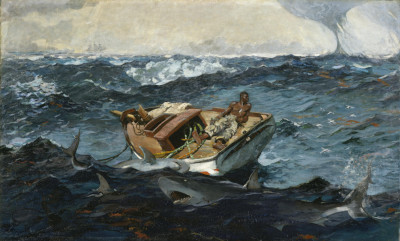
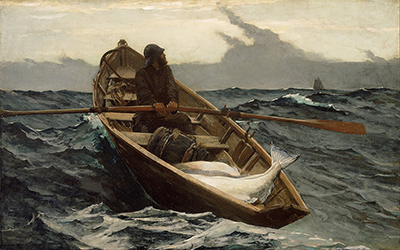
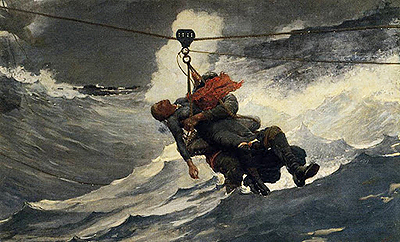
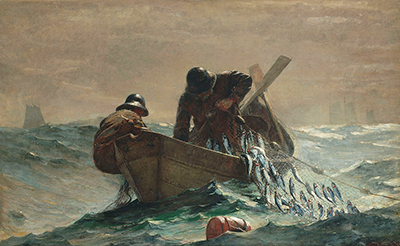
The painting also points forward. Later works such as The Fog Warning, The Herring Net, The Life Line and The Gulf Stream make water more dangerous and adult labor more intense. In The Fog Warning, a fisherman turns toward safety while weather threatens. In The Herring Net, men work on the sea under pressure. In The Life Line, rescue technology carries bodies through surf. In The Gulf Stream, a broken boat, sharks and Caribbean history create a severe late vision of isolation. [1]
Compared with those later marine paintings, Breezing Up is gentle. But it is not unrelated. It shows Homer learning how to make the sea a field of meaning. Here the water tests coordination and promise. Later, it tests labor, rescue, endurance and survival. The difference in mood does not need to hide the continuity. Homer understands water as a place where human intention meets forces larger than itself. [2]
This is why Breezing Up is a useful gateway page for the whole artist cluster. A reader who arrives through the painting's charm can be guided toward Homer's deeper subjects. The article links to the Paintings hub for broader navigation, to the Biography page for chronology, to Snap the Whip for childhood and public optimism, and to later marine works for the transformation of water into a more difficult subject. [3]
It also helps keep Homer from being reduced to a single identity. He was not only a Civil War painter, not only a painter of children, not only a watercolorist, and not only a late marine painter. Breezing Up shows how these categories overlap. It has the clarity of the illustrator, the observational discipline of the realist, the public reach of the American painter, and the marine intelligence that would become central later. [4]
Why Breezing Up Still Works
The painting still works because its hope is embodied. Homer does not tell the viewer to feel optimistic. He shows a boy with the tiller, a boat catching wind and a group of figures moving together. The scene is specific enough to remain believable and open enough to carry larger meaning. [5]
The central tension is between smallness and scale. The boat is small. The boys are young. The task is ordinary. Yet the painting opens onto sky, sea and national memory. That expansion happens quietly. Homer does not enlarge the figures into heroes. He lets the world around them do the enlarging. The wind, water and horizon make their action feel consequential. [6]
The painting also trusts the intelligence of looking. A viewer can notice the anchor before knowing its interpretive history. A viewer can sense the importance of the tiller before reading about The Flirt. A viewer can enjoy the breeze before thinking about the Centennial. The rescue manuscript should support that process rather than overwhelm it. The goal is to help readers see more, not to flatten the painting under explanation. [7]
Breezing Up also avoids the trap of sweetness. The boys are appealing, but Homer does not sentimentalize them into harmless decoration. Their bodies have weight. Their positions respond to the boat. The water is active. The sail is powerful. The boy at the stern is not merely cute; he has a job. That practical seriousness keeps the painting fresh. [8]
The painting's modernity lies partly in that understatement. Homer gives no grand allegorical figures, yet the image can speak about a nation. He gives no explicit war memory, yet the postwar context matters. He gives no written lesson about youth, yet the transfer of control to the young boy is unmistakable. He gives no dramatic storm, yet the boat's balance depends on attention. The painting lets meaning arise from structure. [1]
For many readers, Breezing Up will remain one of Homer's most approachable works. That accessibility is best treated as a strength. Some famous paintings become accessible because they simplify their subject. This one becomes accessible because Homer makes a complex idea visually clear. A small crew uses a fair wind. A child steers. The boat moves. Everything else grows from that. [2]
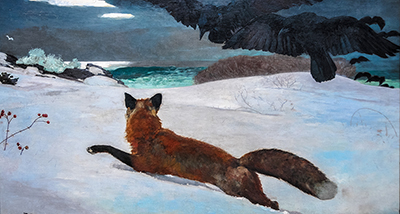
This is also why the painting belongs among the approved Famous Artworks for the Winslow Homer rescue. It offers a bright counterpoint to darker or more severe pages such as The Gulf Stream, Prisoners from the Front, The Fox Hunt and The Fog Warning. It shows the same artist capable of tension through lightness. The sea can threaten, but it can also carry. Youth can be vulnerable, but it can also be trusted. [3]
The final effect is one of confidence without complacency. The fair wind is favorable, but not magic. The future is suggested, but not guaranteed. The young boy looks outward, and the boat moves on. [4]
Discussion
Winslow Homer rewards close looking because his strongest images rarely close down into one easy meaning. Use the prompts below to test how the work changes as you move between subject, place, medium and history.
Reader Insights
First Look
What detail in Breezing Up (A Fair Wind) changes how the whole work feels?
Homer's Method
Where do you see Homer's balance between clear observation and unresolved meaning?
Cluster Context
Which related Homer work helps you read this page more carefully?
Join the Conversation
Share a thoughtful observation below, especially if a detail, source connection or related Homer page changed the way you read the work.
References
- National Gallery of Art, object record
1943.13.1, Breezing Up (A Fair Wind), 1873-1876. - National Gallery of Art, visual description and artwork notes for Breezing Up (A Fair Wind), including discussion of The Flirt, compositional changes and Centennial Exposition reception.
- The Metropolitan Museum of Art, Heilbrunn Timeline of Art History essay on Winslow Homer.
- National Gallery, London, Introduction to Winslow Homer, Winslow Homer: Force of Nature.
- Winslow Homer Phase 1A Green-Route Flagship Source Packets, 2026-07-20.
- Winslow Homer Phase 1A Green-Route Manuscript Briefs, 2026-07-20.
- Winslow Homer Phase 1A Green-Route Feature Support Pack, 2026-07-20.
- Winslow Homer internal-link, quote and image ledgers, 2026-07-20.