 by Tom Gurney
Tom Gurney BSc (Hons) is an art history expert with over 20 years experience
Published on June 19, 2020 / Updated on August 2, 2026
Email: tomgurney1@gmail.com / Phone: +44 7429 011000
Contents
- Introduction
- What the Painting Shows
- Late Homer And The Natural World
- The Reversal Of Predator And Prey
- Winter, Hunger And Survival
- Japanese Print Influence And The Flattened Snowfield
- PAFA And Public-Collection Significance
- A Hunting Picture Without The Hunter
- Related Works And Where To Go Next
- Annotated Details
Introduction
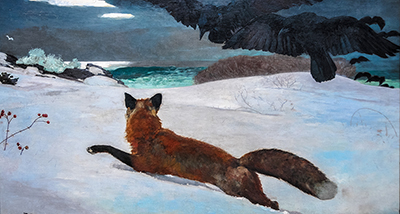
Winslow Homer's Fox Hunt is one of his great late paintings because it turns a familiar hunting subject inside out. The title sounds as though it will belong to sport, pursuit and human control. Instead, Homer gives the viewer a fox struggling through deep winter snow while black crows descend around it. The hunter is absent. The chase has moved out of human hands. What remains is a severe natural drama in which the usual predator is suddenly the pursued. [1]
Painted in 1893, Fox Hunt is an oil on canvas now in the collection of the Pennsylvania Academy of the Fine Arts. PAFA records the work as measuring 38 x 68 1/2 inches, or 96.52 x 173.99 centimeters, with accession number 1894.4 and credit to the Joseph E. Temple Fund. Those object facts place the painting securely, but the painting's emotional force comes from the way Homer stages survival as a matter of weather, hunger, movement and viewpoint. [2]
The fox is not shown as a decorative animal in a winter landscape. It is the painting's pressured body. The crows are not picturesque accents. They are part of the threat. The snowfield is not empty space. It is the terrain that slows the animal, flattens the world and makes every leap feel costly. Homer's late naturalism is at its most concentrated here: nature is not sentimental, but neither is it treated as empty cruelty. The painting studies a moment in which life continues under conditions that give nothing away. [3]
This is why Fox Hunt belongs among Homer's flagship works. It is less internationally familiar than The Gulf Stream or Breezing Up, but it shows another crucial side of the artist: the late Homer who had moved beyond illustration, beyond easy anecdote and beyond simple marine spectacle into stark encounters between living bodies and their environments. It belongs near his Maine and winter subjects, near Northeaster, and near hunting or animal subjects such as A Huntsman and Dogs, Hound and Hunter, Below Zero and Shark Fishing. [4] It also belongs near the late marine paintings because it shares their basic problem: how does a living being endure when nature cannot be negotiated?
The painting is often described through reversal. A fox is usually imagined as cunning, predatory and difficult to catch. In Homer's painting, that same animal becomes vulnerable. The crows, often scavengers at the edge of a scene, become active pursuers. Human hunting culture is still present in the title, but it has vanished from the visible action. The result is a work that feels at once simple and unsettling. It shows an animal in snow, but it also changes the moral balance of the hunt. [5]
What the Painting Shows
Fox Hunt places the viewer low and close to the action. A fox moves across a snow-covered field or slope, lifting itself through the difficult surface. The animal's body is extended in effort. Its movement is forward, but not easy. The deep snow resists it. Above and around the fox, black crows gather in flight. Their dark shapes cut across the pale field and make the winter space feel suddenly alive with pressure. [6]
The painting does not need a visible hunter, rifle, dog or human figure to create pursuit. Homer builds the hunt through the relation between fox, birds and snow. The animal's leap tells the viewer that staying still is not an option. The crows' descending forms tell the viewer that the danger is organized around weakness. The snow tells the viewer why the fox is exposed. Everything in the painting contributes to the same physical fact: survival has become hard work. [1]
The fox's position matters. Homer gives the viewer enough proximity to feel the strain of movement, yet he does not turn the animal into a pet or a sentimental character. The fox remains wild. Its vulnerability does not erase its animal nature. That balance is one of the painting's strengths. Homer asks the viewer to feel with the fox without making the fox human. [2]
The crows also resist simplification. They may look ominous, but Homer does not need to make them symbolic villains. They are hungry creatures inside the same winter system. Their pressure on the fox is part of natural life. This makes the painting more powerful than a straightforward moral scene. The viewer may sympathize with the fox, but the crows are not outside nature's logic. Homer shows a world in which every living thing is driven by need. [3]
The snowfield is the painting's largest visual field, and it carries much of the drama. Snow might have become a peaceful setting, a white screen against which the animals are displayed. Instead, Homer makes it the condition of the event. It flattens the space, reduces shelter and turns movement into labor. The fox is not running through open summer ground. It is pushing through resistance. [4]
The horizon and surrounding landscape are also restrained. Homer does not load the scene with anecdotal detail. He gives the viewer the essential terms of the encounter. There is weather. There is snow. There is flight. There is a body trying to move. There are birds closing in. The absence of extra narrative makes the moment feel more severe. [5]
This severity is part of late Homer. Earlier in his career, he had often used clear storytelling, human gesture and social setting to make an image immediately legible. By the 1890s, he could make an image just as readable while stripping away ordinary explanation. In Fox Hunt, the viewer understands the situation almost instantly, but the painting does not tell the viewer how to settle it. Is this a hunting picture, a survival picture, a winter landscape, a naturalist observation or an image of reversal? It is all of those at once. [6]
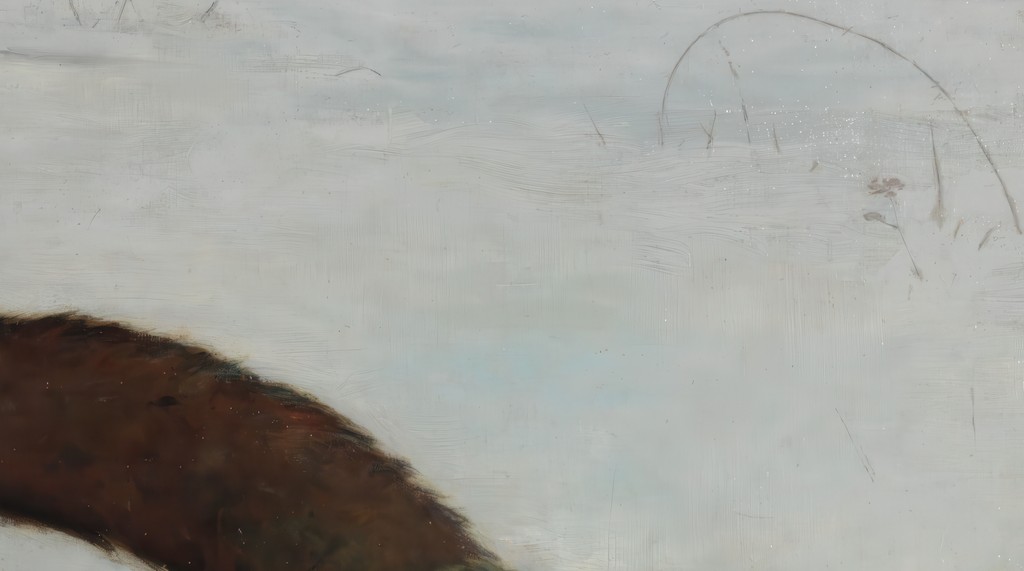
Annotated Details from Fox Hunt
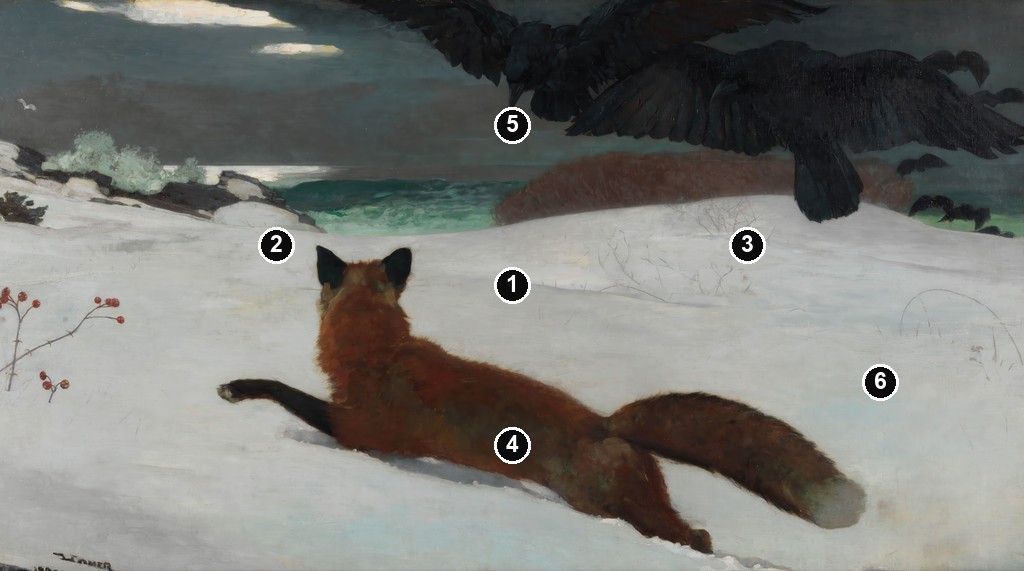
Details from FOX HUNT
Close looking follows the composition through figure, setting, foreground and surrounding visual pressure.
Central Action
The central passage carries the first act of close looking, where pose, spacing and surrounding detail establish the main visual problem.
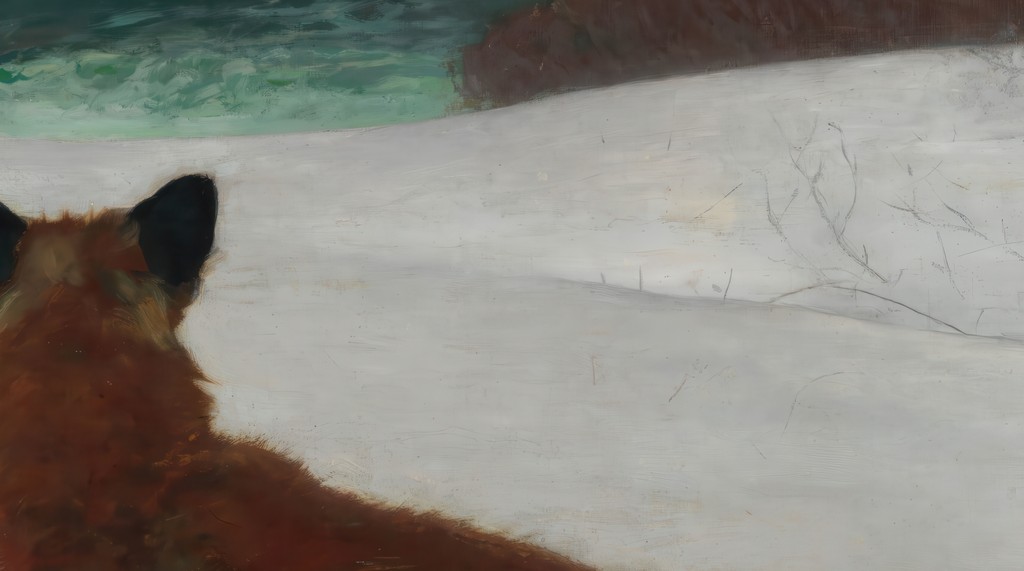
Left-Hand Structure
The left side helps frame the composition and shows how Homer balances incident against the broader setting.
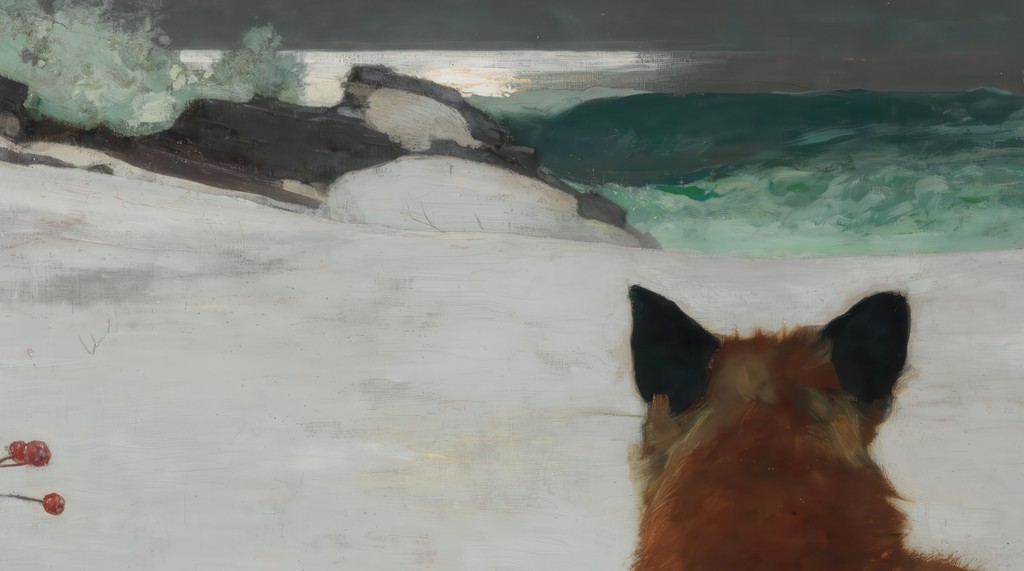
Right-Hand Structure
The right side answers the central group with a second visual pressure, often through movement, distance or environmental force.
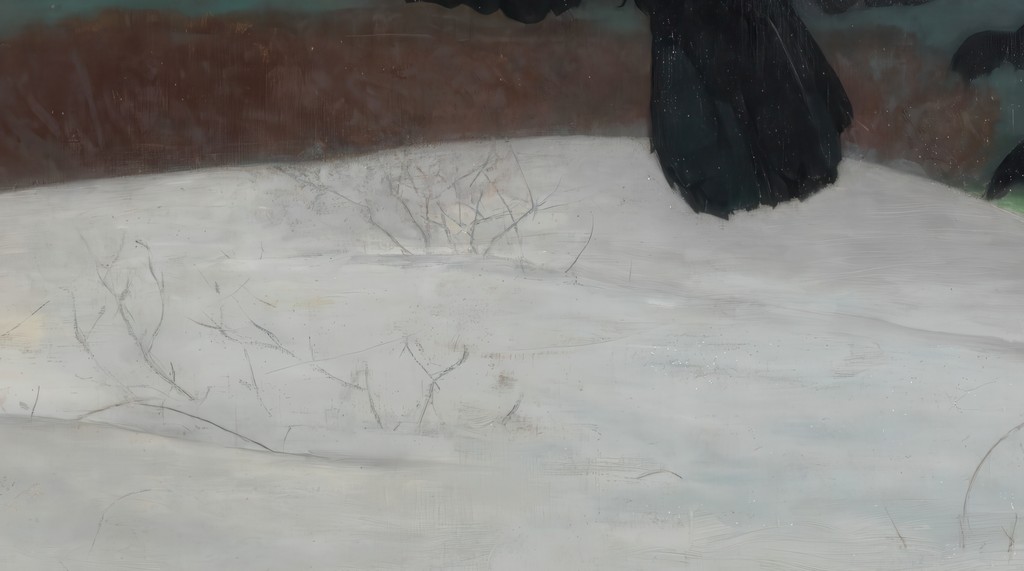
Foreground Detail
The foreground gives the viewer a threshold into the image and often contains the practical evidence of work, risk or play.
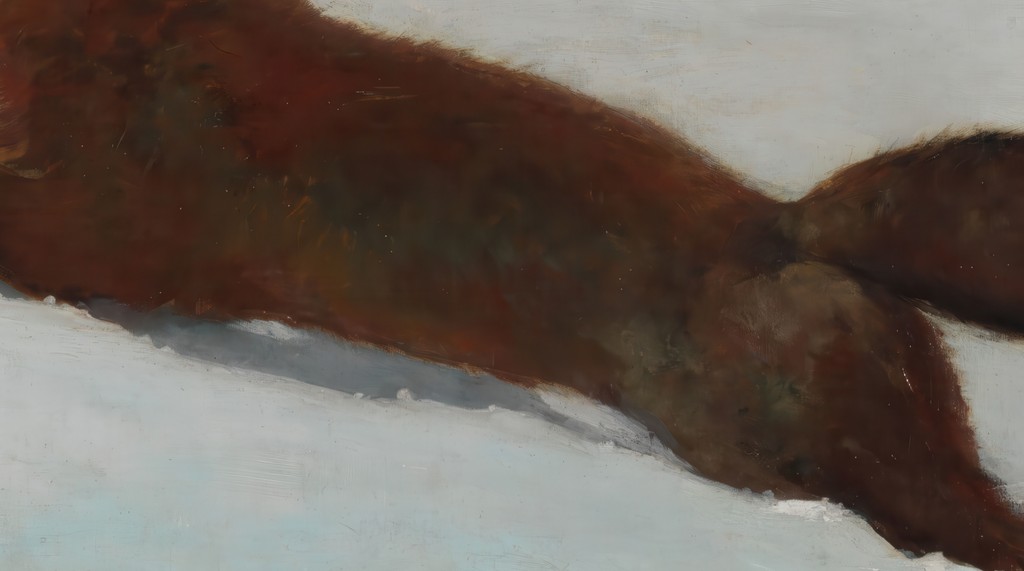
Background Distance
The background opens the picture into weather, landscape or social space, making the scene larger than the immediate figures.
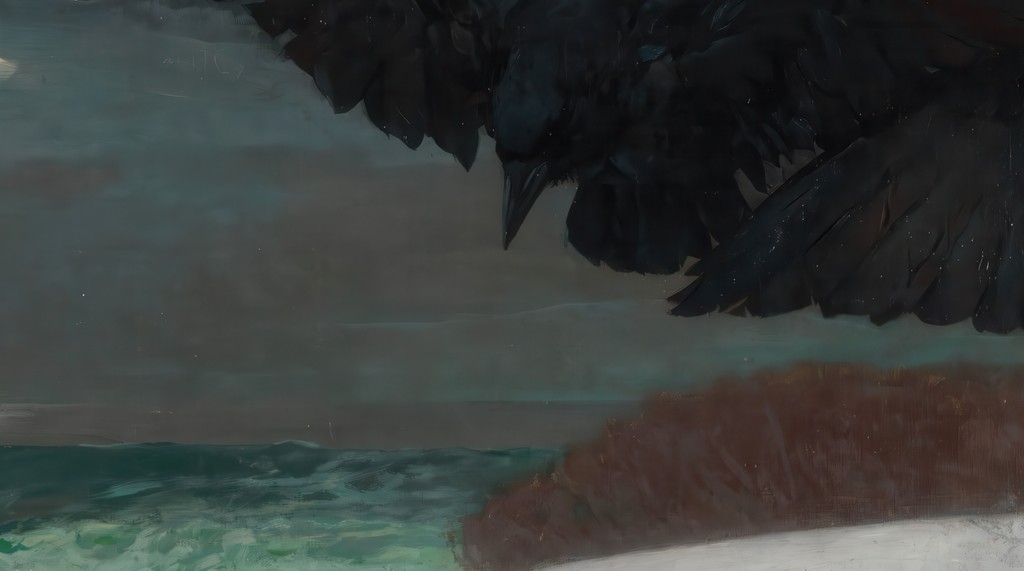
Edge Rhythm
A detail near the edge shows how the composition keeps the eye moving instead of closing around a single motif.
Late Homer And The Natural World
Fox Hunt was painted in 1893, after Homer had settled into the late phase of his career. By then, he had lived through his apprenticeship as an illustrator, his Civil War work, his postwar scenes of rural life and childhood, his English coastal period, his increasingly ambitious marine paintings and his repeated engagement with Maine, the Adirondacks and other places where hunting, fishing and weather shaped daily experience. [1]
The painting belongs to that late world of observation and compression. Homer no longer needed to explain every human action through a busy narrative. He could build meaning through pressure, scale and silence. The fox's effort in snow becomes enough. The crows' descent becomes enough. The title becomes a quiet irony because the visible hunt is not the one a viewer might expect. [2]
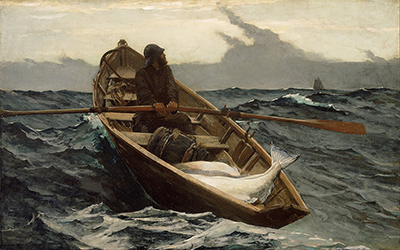
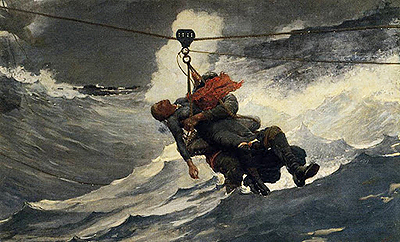
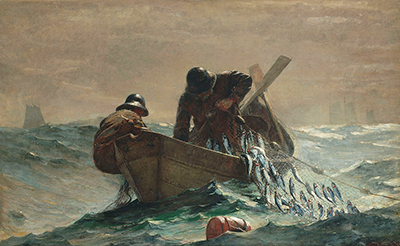
Late Homer is often associated with the sea, especially the coast around Prouts Neck, Maine. Works such as The Fog Warning, The Life Line, The Gulf Stream and Northeaster show people, boats or waves under conditions of danger or force. Fox Hunt is not a marine painting, but it shares the same late sensibility. Nature is not scenery. It is an active field that presses on the subject. [3]
This is also why the painting connects naturally to Homer's hunting and animal subjects. In A Huntsman and Dogs, the human world of hunting remains closer to the surface. In Hound and Hunter, the relation between human pursuit, animal body and water becomes more direct. In Below Zero, winter conditions shape the meaning of the scene. Fox Hunt draws on this broader field but removes the human actor, allowing the animal drama to stand alone. [4]
The absence of people is not a lack. It is a decision. Homer had spent much of his career studying how people behave under pressure, whether in war, labor, leisure or weather. In Fox Hunt, he lets an animal carry that pressure. The painting does not become less serious because it is not centered on a human figure. If anything, the absence of people makes the scene harder to dismiss as anecdote. The viewer cannot reduce it to a hunter's story or a sporting memory. The fox must be seen on its own terms. [5]
The late date also matters because the painting comes after a period when Homer had become increasingly interested in elemental conflict. He was not simply illustrating dramatic subjects. He was testing how little narrative was needed for a painting to feel complete. In Northeaster, wave and rock doesminate. In Fox Hunt, snow and birds press against an animal body. Both works show Homer's ability to make nature feel immediate without turning it into a theatrical backdrop. [6]
Naturalism in this painting does not need to be confused with passive recording. Homer is not merely reporting that crows sometimes harass a fox in winter. He shapes the experience through composition, viewpoint and surface. He chooses the low, tense angle. He chooses the pale field and dark birds. He chooses to keep the human hunter out of sight. The result is an image that feels observed but also deeply constructed. [1]
The Reversal Of Predator And Prey
The most striking idea in Fox Hunt is reversal. A fox is traditionally the animal hunted by humans, pursued by hounds and riders in a ritualized sporting culture. A fox is also commonly associated with cleverness and predation. Homer takes that charged animal and places it in a situation where its own survival is uncertain. The fox is still wild, but it is not in command. [2]
The crows intensify the reversal. They are smaller than the fox, but they have the advantage of air, numbers and timing. They do not need to overpower the fox in a heroic confrontation. They need only close in while winter does some of the work. Their presence suggests hunger and opportunism. The snow slows the fox; the birds read that weakness. [3]
This is one reason the painting generates empathy without becoming sentimental. Homer does not ask the viewer to love the fox because it is innocent. He asks the viewer to notice what happens when a creature associated with cunning is caught in a moment of exposure. The fox's dignity comes from effort, not purity. [4]
The reversal also alters the meaning of the title. Fox Hunt can be read as a familiar phrase from human sporting life, but the painting denies the expected cast. There are no riders. There are no hounds. There is no display of human skill. The hunt is now a winter event among animals. The title almost lures the viewer into one expectation, then the picture corrects it. [5]
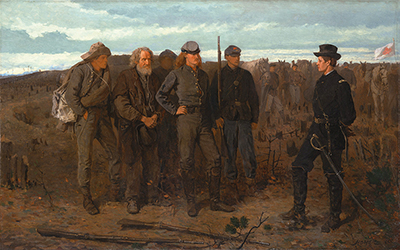
Homer had a long interest in subjects where conventional roles become unstable. In Prisoners from the Front, the viewer sees winners and losers after war, but the social and psychological encounter is more complex than triumph. In A Visit from the Old Mistress, an old social order meets people whose posture and silence change the meaning of power. In The Gulf Stream, a lone man is caught between natural peril and historical pressure without a clear rescue narrative. Fox Hunt belongs to that habit of reversal and withheld certainty, even though its subject is animal rather than human. [6]
The painting's sympathy is therefore serious but limited. Homer does not create a rescue fantasy for the fox. He does not show a safe den nearby or a hunter intervening. He keeps the fox inside the moment of pursuit. That refusal is part of the work's harshness. The viewer is allowed to care, but not allowed to solve. [1]
The crows, too, remain within the painting's natural order. A simpler picture might make them emblems of death or evil. Homer keeps them as birds, driven by hunger. Their black forms are visually ominous, but the painting's meaning does not require supernatural menace. The drama is enough because winter, hunger and vulnerability are enough. [2]
This restraint gives Fox Hunt its unsettling dignity. It is not an animal fable with a clear moral. It is not a sporting illustration. It is a late naturalist painting in which roles shift under pressure. Predator becomes prey. Scavenger becomes pursuer. Snow becomes antagonist. The viewer becomes witness. [3]
Winter, Hunger And Survival
Winter in Fox Hunt is not a season of decoration. It is the painting's governing force. Snow covers the ground, alters movement and reduces the world to a pale expanse where the fox has little concealment. The fox's leap is beautiful, but beauty does not make it easy. The animal's body shows the effort of getting through the field. [4]
Homer's snow is important because it makes the scene both open and claustrophobic. Visually, the white ground expands the painting. There is space everywhere. Physically, that same space traps the fox in difficulty. The animal can see and be seen, but the surface beneath it is resistant. The viewer senses that distance alone is not freedom if every step costs too much. [5]
The crows depend on that condition. They are able to move through the air while the fox must push through snow. Homer sets one form of movement against another. Flight becomes advantage. Leaping becomes labor. The painting's tension comes from this unequal relation rather than from a single dramatic attack. [6]
The source packet describes the crows as half-starved, a detail that changes how the viewer understands them. They are not merely decorative black shapes. They belong to a winter economy of hunger. The fox's vulnerability and the crows' aggression come from the same seasonal pressure. The painting is harsh because it gives no creature an easy place outside need. [1]
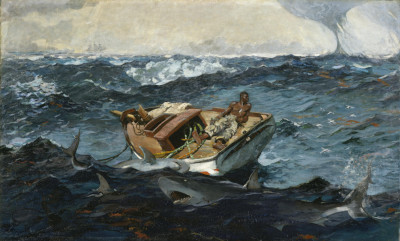
This is a different kind of drama from the open sea works, but the underlying logic is similar. In The Fog Warning, weather and distance threaten a fisherman returning with his catch. In The Gulf Stream, a broken boat, sharks and storm surround a lone figure. In Northeaster, the sea's force becomes nearly the whole subject. In Fox Hunt, snow replaces surf as the medium of pressure. It is quieter than a breaking wave, but it is just as decisive. [2]
Homer's late art often works through this kind of physical truth. He does not have to state that nature is indifferent. He shows conditions in which indifference becomes visible. The sea does not hate the fisherman. The storm does not moralize. The snow does not choose the fox. Yet each force changes what survival means. That is the severity of the painting. [3]
At the same time, Fox Hunt does not need to be flattened into bleakness. The painting is full of energy. The fox moves. The birds fly. The snowfield has visual rhythm. Homer is not painting death as a finished fact. He is painting the struggle before any conclusion. That interval matters. The animal is still alive, still moving and still more than a victim. [4]
The viewer's empathy comes from that unfinished interval. We are not looking at a trophy, a carcass or a final outcome. We are looking at effort. Homer makes the effort visible enough that the viewer feels its urgency, but he does not push the scene into melodrama. The painting remains composed, even elegant, while the subject remains severe. [5]
Japanese Print Influence And The Flattened Snowfield
The source packet records the composition of Fox Hunt as indebted to Japanese woodblock prints. That influence helps explain why the painting feels so compressed and striking. Rather than opening a deep, traditionally European landscape with a clear recession into distance, Homer gives the viewer a flattened snowfield, strong shapes and a sense that the surface of the painting matters as much as illusionistic depth. [6]
The pale ground and dark birds create a pattern across the canvas. The fox's body cuts through that field as a moving form, while the crows punctuate the space above and around it. The painting's drama is not only narrative. It is graphic. The viewer reads the picture through shape, spacing and contrast. [1]
Japanese prints offered Western artists different ways to think about cropping, asymmetry, flattened space and the relationship between figure and surface. Homer did not need to imitate those prints mechanically for their influence to matter. In Fox Hunt, the lesson is absorbed into the structure of the image. The snowfield becomes an active visual plane. The birds become dark marks that direct attention. The fox becomes both animal and compositional force. [2]
This matters because the painting's severity depends on its design. If Homer had surrounded the fox with a conventional picturesque landscape, the scene might feel like an anecdote within a larger view. Instead, the reduced setting keeps attention on the encounter. Snow, fox and crows become the essential terms of the image. [3]
The flattened field also affects the viewer's emotional position. Deep perspective can give the viewer a sense of retreat or overview. Here, the space is more immediate. The fox is close, the birds are close and the snow presses forward. The viewer is not invited to stand back comfortably and admire a winter panorama. The viewer is pulled into the field of pursuit. [4]
This is one reason Fox Hunt feels different from a conventional sporting picture. A sporting image often organizes space around human mastery: the hunter's view, the route of the hounds, the landscape as arena. Homer's design removes that human command. The field is not arranged for sport. It is arranged around survival. [5]
The Japanese-print connection also helps place Homer in a broader modern visual culture. He is often admired for directness and natural observation, but Fox Hunt shows that his directness could be formally adventurous. He could use simplified structure, strong silhouette and unusual viewpoint without losing the force of observed life. The painting is modern not because it rejects nature, but because it rethinks how nature can be composed. [6]
PAFA And Public-Collection Significance
Fox Hunt also has institutional importance. The Phase 1A source packet records PAFA's purchase of the painting in 1893 as the first Homer work to enter a public collection. That point matters because it shows how the painting stood at a threshold between Homer's late production and his public reputation. [1]
Homer was already a major American artist by the 1890s, but public museum collections were still shaping the way American art would be preserved and interpreted. An institutional acquisition of a major late work did more than move an object into a collection. It helped establish what kinds of Homer paintings were worth long-term public attention. [2]
PAFA's connection is especially meaningful because the institution occupies an important place in American art history. Housing Fox Hunt there links the painting not only to Homer's career but to the broader development of American public art collections. The painting's accession number, credit line and object record are therefore not merely administrative details. They are part of the painting's public life. [3]
The public-collection point also helps explain why this article does not need to be treated as a short caption. Fox Hunt is not only a strong image. It is a work whose acquisition history helps mark Homer's status. The painting represents late Homer at a moment when American institutions were deciding which works would become part of the national artistic record. [4]
A Hunting Picture Without The Hunter
One of the most effective things about Fox Hunt is that it keeps the human hunter outside the frame. That absence changes everything. The title evokes a human tradition, but the visible world belongs to animals, weather and terrain. The viewer may bring expectations of sport, chase and human superiority, but Homer makes those expectations feel irrelevant. [5]
The missing hunter also changes the painting's ethics. In many hunting images, the viewer is invited to share the hunter's position. The animal is quarry, and the landscape becomes the stage for skill or triumph. In Homer's painting, the viewer's sympathy moves toward the pursued animal because there is no human figure to anchor mastery. The fox is not an object in a sport; it is a living body in danger. [6]
This does not mean the painting is an anti-hunting poster in a simple modern sense. Homer rarely works that way. He does not insert a direct moral statement. He rearranges the terms of looking. By removing human actors and emphasizing the fox's struggle, he makes conventional hunting imagery feel unstable. The viewer has to ask who is hunting whom, what counts as pursuit and why the title no longer matches the expected scene. [1]
The absence of the hunter also makes the painting less anecdotal. A visible hunter might bring story, costume, social class or sporting culture into the foreground. Homer chooses a more elemental arrangement. Animal, birds, snow, motion. That is enough. The painting's spareness gives it staying power. [2]
At the same time, the title keeps human culture nearby. The phrase Fox Hunt is not neutral. It carries traditions of sport and representation. Homer does not erase that association; he bends it. The painting becomes a hunting picture in which the human world has lost its central place. That is part of its late naturalist intelligence. [3]
In this sense, Fox Hunt can be read alongside Homer's marine works that remove or diminish human control. In The Fog Warning, the fisherman still has agency, but fog and distance threaten his return. In The Life Line, technology offers a possible rescue, but wave and weather dominate the scene. In The Gulf Stream, ordinary control has already failed. In Fox Hunt, human control is simply absent. Nature has the field. [4]
Related Works And Where To Go Next
Readers interested in Fox Hunt should next look at Homer's late nature and marine works. Northeaster is the most direct comparison within the late elemental group, because it shows water and rock as primary forces. There, the human figure recedes or disappears; here, the human figure is absent and the animal body carries the drama. [5]
Below Zero offers another winter route through the Homer cluster. It helps readers think about how cold weather changes the meaning of subject matter. Winter in Homer is rarely only decorative. It can become a condition that shapes action, vulnerability and interpretation. [6]
A Huntsman and Dogs and Hound and Hunter connect Fox Hunt to Homer's hunting imagery. Those works keep human pursuit and animal relation closer to the surface. Fox Hunt is different because it turns the chase away from human sport and toward natural survival, but the shared subject area helps readers see how Homer returned to hunting, dogs, water, animals and field conditions across different compositions. [1]
Shark Fishing may seem distant from Fox Hunt, but it belongs to the same broader interest in pursuit and danger among living creatures. Homer repeatedly studied situations in which the line between hunter and hunted is unstable. Sometimes the subject is human labor. Sometimes it is sport. Sometimes it is marine peril. Sometimes, as here, it is an animal in winter. [2]
The article should also link readers back to the main Winslow Homer biography and paintings hub. Fox Hunt makes the most sense when seen as part of the full arc of Homer's career: illustrator, Civil War observer, painter of postwar life, student of coastal labor, master of watercolor and late painter of severe natural encounters. The painting is not an isolated animal scene. It is a late work by an artist who had spent decades refining how much meaning could be carried by posture, weather, space and the pressure of a moment. [3]
That is the lasting power of Fox Hunt. It begins with a simple sight: a fox moving through snow as crows close in. But the more one looks, the more the scene changes. The expected hunt is reversed. The hunter disappears. The snow becomes a force. The birds become hunger made visible. The fox remains wild and vulnerable at once. Homer gives the viewer no rescue, no moral caption and no final outcome. He gives the viewer a winter field where survival is still in motion. [4]
Discussion
Winslow Homer rewards close looking because his strongest images rarely close down into one easy meaning. Use the prompts below to test how the work changes as you move between subject, place, medium and history.
Reader Insights
First Look
What detail in The Fox Hunt changes how the whole work feels?
Homer's Method
Where do you see Homer's balance between clear observation and unresolved meaning?
Cluster Context
Which related Homer work helps you read this page more carefully?
Join the Conversation
Share a thoughtful observation below, especially if a detail, source connection or related Homer page changed the way you read the work.
References
- Pennsylvania Academy of the Fine Arts, object record
1894.4, Fox Hunt, 1893. - Pennsylvania Academy of the Fine Arts legal/copyright page, as captured in the Winslow Homer image-rights review.
- Winslow Homer Phase 1A Conditional-Route Flagship Source Packets, Packet J: The Fox Hunt, 2026-07-20.
- Winslow Homer Approved Eight Image Rights Review, 2026-07-20.
- Winslow Homer Tom Image Policy - Issue-Bearing PD Assets, 2026-07-20.
- Winslow Homer Internal-Link Ledger, Quote Ledger and Glossary Ledger, 2026-07-20.
 Winslow Homer.jpg)