 by Tom Gurney
Tom Gurney BSc (Hons) is an art history expert with over 20 years experience
Published on June 19, 2020 / Updated on August 2, 2026
Email: tomgurney1@gmail.com / Phone: +44 7429 011000
Contents
- Introduction
- Gloucester, Children And Daily Chores
- The Basket And The Boys
- Shark, Sailboat And Future Risk
- Why This Watercolor Belongs In The Cluster
Introduction
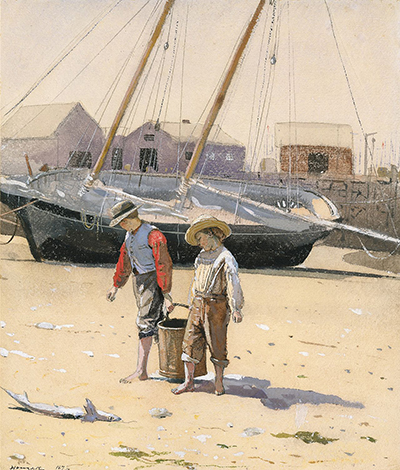
Winslow Homer's A Basket of Clams is an 1873 Gloucester watercolor that turns a small shoreline task into a compact study of childhood, work and future risk. The Metropolitan Museum of Art records the work as watercolor on wove paper, measuring 11 1/2 x 9 3/4 inches, or 29.2 x 24.8 cm. It entered the Met as the Gift of Arthur G. Altschul in 1995 and carries object number 1995.378. The Met object page marks the image as Public Domain, making it a green candidate for later Open Access image work after final asset, credit, crop and quality verification. [1]
The subject is direct: two boys carry a basket of clams across the beach. The scene belongs to Homer's Gloucester watercolors, a group in which children appear near boats, wharves, dunes, chores and play. At first glance, the image may seem lighter than Homer's later marine paintings. There is no storm breaking over rocks, no adult fisherman fighting fog, no broken boat at sea. Yet Homer lets two background details deepen the picture. A sailboat behind the boys and a dead shark ahead of them point beyond the immediate chore to the larger maritime world waiting around childhood. [2]
That double register gives the article its value. A Basket of Clams is not a major flagship like The Gulf Stream, The Fog Warning or The Herring Net. It is smaller, earlier and more restrained. But it helps readers see how Homer began attaching coastal life to work, skill and danger long before the late sea paintings became severe. The basket is a child's burden. The shore is bright. The labor looks local and ordinary. Still, the sea is already present as a place of boats, food, animals, future employment and risk. [3]
Gloucester, Children And Daily Chores
Gloucester mattered to Homer because it gave him a coastal world that was active without needing to be spectacular. Children at the shore could be shown as figures in light, but they were not simply decorative. They moved through a working environment. Boats, tides, baskets, clams, beaches and harbor traffic were part of the same visual field. [1]
In A Basket of Clams, the boys' task is simple enough for a viewer to understand immediately. They have gathered or are carrying a haul. The basket gives the image its title, and it also gives the boys a shared physical action. Their bodies are organized around the weight between them. Homer does not turn the task into sentimental childhood play. He keeps it close to work. [2]
The small scale of the watercolor helps. On paper, Homer can keep the scene open, quick and breathable. The boys are not monumental laborers. They are children in a coastal place where useful tasks and play might sit very close together. This is one reason the work belongs naturally in the Watercolours route. It shows watercolor handling a precise local observation without requiring the density of oil paint. [3]
The local Watercolours hub packet frames Homer's watercolor practice as central to his career rather than secondary. A Basket of Clams supports that argument. It is early, portable, place-based and alert to outdoor light. It also shows why Gloucester belongs in the medium story: the coast gave Homer subjects that could be modest in action and large in implication. [1]
The Basket And The Boys
The basket is the painting's plainest fact, but it carries much of the meaning. Clams connect the boys to tide, beach, food and local economy. They are not props brought in to make the scene charming. They identify a shore where children participate in useful labor and learn the practical rhythms of a fishing community. [2]
Homer's choice of two boys matters as well. The figures create relationship rather than isolation. They carry the burden together, and the viewer reads the action through their coordination. One boy is smaller, the other older. That difference helps the image feel like a moment of learning: younger and older child, shared task, beach, basket, sea. [3]
The boys also face different directions. Their attention is not locked in one narrative line. One seems connected visually to the shark ahead, while the other looks back toward the sailboat. The result is a small but effective triangle of attention: child, animal, boat. Homer uses the boys' glances to pull the immediate scene outward. The basket stays at the center, but the world around it becomes more complicated. [1]
This is close looking at a very small drama. Homer does not need a dramatic gesture or a moral lesson. He lets posture, direction, scale and setting do the work. The viewer understands that the boys are young, but the coast they inhabit is not childish. It is a working shore with boats and marine life already shaping their field of vision. [2]
Shark, Sailboat And Future Risk
The Met's interpretive note gives the key to the watercolor's darker pressure: the shark and the sailboat complicate an otherwise bright Gloucester scene. Those details does not need to be inflated into melodrama. The shark is dead, and the boat is not shown in crisis. But together they suggest what the boys may someday confront as members of a fishing village. [3]
The dead shark is especially important because it interrupts the safety of the beach. It brings open-water danger onto the sand, close to the boys' path. The smaller child appears to notice it. That glance matters because it turns the animal into more than background detail. The shark becomes an object of attention, a sign of a world the child can see but cannot yet fully enter. [1]
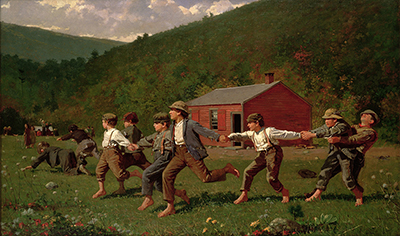
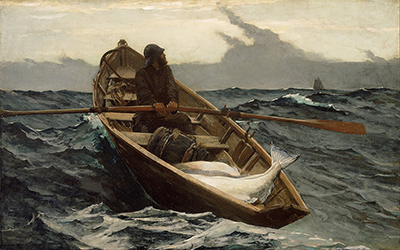
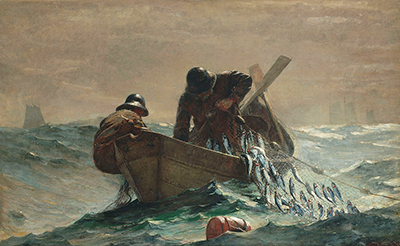
The sailboat behind the boys points in the opposite direction. It stands for movement away from shore, for the adult maritime activity beyond the child's chore. In later Homer, boats often carry heavier uncertainty. In Breezing Up, a small crew and a boat still feel confident, energetic and outward-looking. In The Fog Warning, a dory and a catch become part of a dangerous return. In The Herring Net, fishing labor happens under more urgent pressure. A Basket of Clams is quieter than all of those works, but it prepares the reader for the same larger problem: the sea gives livelihood and threat at once. [2]
That is why the image does not need to be dismissed as a small genre scene. Homer is already working with one of his lasting themes. Coastal life is bright, practical, youthful and communal, but it is also organized around forces that can become dangerous. The watercolor does not show disaster. It shows the early education of looking toward it. [3]
Why This Watercolor Belongs In The Cluster
A Basket of Clams is a support page, and that is a strength. It gives the Winslow Homer cluster a way to show development rather than only reputation. Readers who know the famous late marine works can move backward to this 1873 sheet and see the seeds of later concerns: children near water, work on the shore, small boats, food gathering, animal danger and the coastal economy. [1]
It also pairs naturally with Boys in a Dory, another active watercolor-related page in the protected Watercolours module. Together, the two subjects help define the Gloucester route. One places boys with a basket on land; the other places boys with a small boat. Both keep childhood close to water and work. Neither needs to be treated as a full marine epic. Their value is in showing how Homer made ordinary coastal moments alert and consequential. [2]
The article links carefully to the cluster spine: Biography for Homer's 1870s career, Watercolours for the medium route and Paintings only as a broader browse path. Theme links points readers toward Breezing Up, The Herring Net and The Fog Warning where useful, because those pages extend the movement from childhood shore life to adult maritime labor and risk. [3]
For Homer, the beach was never just scenery. In A Basket of Clams, it is a place where children carry work, notice animals, look toward boats and stand at the edge of a larger life. The watercolor is modest, but it is not slight. It shows the sea entering childhood before the boys have fully entered the sea. [1]
Discussion
Winslow Homer rewards close looking because his strongest images rarely close down into one easy meaning. Use the prompts below to test how the work changes as you move between subject, place, medium and history.
Reader Insights
First Look
What detail in A Basket of Clams changes how the whole work feels?
Homer's Method
Where do you see Homer's balance between clear observation and unresolved meaning?
Cluster Context
Which related Homer work helps you read this page more carefully?
Join the Conversation
Share a thoughtful observation below, especially if a detail, source connection or related Homer page changed the way you read the work.
References
- Metropolitan Museum of Art object record, A Basket of Clams, Winslow Homer, 1873, object number
1995.378: https://www.metmuseum.org/art/collection/search/12388 - Met Open Access information on public-domain images and data, as presented from the object record research resources.
- Local Winslow Homer Phase 1 approval brief, provisional URL decision matrix, medium-hub source packet, homepage/biography source packet, internal-link ledger, quote ledger, glossary ledger and Tom image-policy ledger dated 2026-07-20.
 Winslow Homer.jpg)