 by Tom Gurney
Tom Gurney BSc (Hons) is an art history expert with over 20 years experience
Published on June 19, 2020 / Updated on August 2, 2026
Email: tomgurney1@gmail.com / Phone: +44 7429 011000
Contents
- Introduction
- What The Painting Shows
- Cullercoats, Prouts Neck And A New Marine Language
- Fishing Work And Human Scale
- Mist, Distance And The Mother Schooners
- Relationship To The Fog Warning And The Life Line
- Why This Painting Matters
- Annotated Details
Introduction
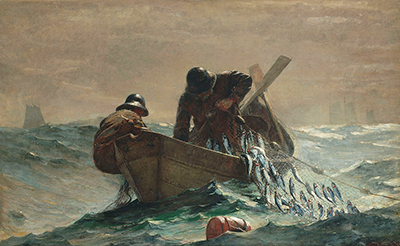
Winslow Homer's The Herring Net is one of the clearest statements of the marine world he built after settling at Prouts Neck, Maine. Painted in 1885, it shows two fishermen in a small dory working a loaded net in rough water. The subject is ordinary labor, but Homer makes it feel monumental. The men are not placed safely on shore or comfortably aboard a large vessel. They are low in the sea, close to the waterline, with the weight of the catch and the movement of the boat joined in one hard physical task. [1]
The painting belongs to the Art Institute of Chicago, which records it as an oil on canvas from 1885, measuring 76.5 x 122.9 cm, or 30 1/8 x 48 3/8 inches. It is part of the Mr. and Mrs. Martin A. Ryerson Collection, with reference number 1937.1039. The AIC archive also records that the work was signed and dated at the lower right and that it later appeared under the alternate title Banks Fishermen. [2]
The article is best read as a bridge between several Homer worlds. It comes after his 1881-82 stay in Cullercoats, a fishing community on the northeast coast of England, and after his 1883 move to Prouts Neck. It shares the open-water anxiety of The Fog Warning, the human-risk theme of The Life Line, and the fishing-community context that runs through Homer's Watercolours material. Yet The Herring Net has its own mood. It is not a rescue picture and not a scene of solitary dread. It is a picture of shared work, precarious balance and survival through practiced cooperation. [3]
Homer does not sentimentalize that cooperation. The two figures are absorbed in the task. One hauls the heavy net, bright with fish, while the other manages the catch and helps stabilize the boat. In the distance, larger schooners are partly lost in mist. They explain the fishing system without taking over the image: the dory is the immediate arena, while the mother vessels sit back as pale signs of a larger working fleet. The painting's drama lies in the small boat, where human effort meets the sea at close range. [4]
What The Painting Shows
The composition is built around a compact triangle of boat, bodies and net. The dory rises and tilts in the water, forcing the viewer to feel its instability. Homer gives the boat enough form to make the work legible, but he does not turn it into a neat stage. The gunwale, the net and the bodies are all caught in the same weather. The fishermen are part of the boat's balance, not separate actors posed on top of it. [5]
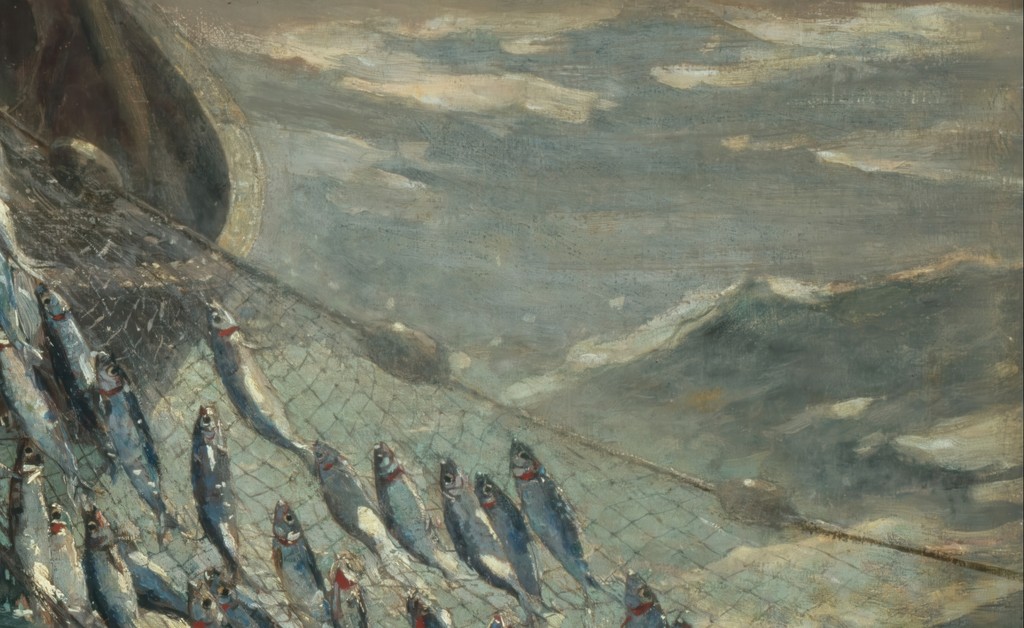
The herring themselves matter because they make labor visible. They are not only a subject in the title. They appear as the burden of the scene, the reason the men must lean, pull, sort and steady themselves. The catch promises food, income and return, but it also makes the dory more difficult to handle. Homer lets success carry danger inside it. The more abundant the catch, the more urgent the problem of weight, timing and balance becomes. [1]
The two figures are close enough to read as a team, but Homer avoids individualized portraiture. Their hats, clothing and working postures identify them through occupation more than personality. That choice does not make them generic. Instead, it shifts attention from biography to action. The viewer watches the coordination of bodies under pressure: one figure reaches into the net, another bends into the boat, and both must keep the dory alive in the water. [2]
The horizon is misty and low. The distant sails are there, but they are dim rather than commanding. This matters because the painting is not simply about a boat at sea; it is about degrees of distance and safety. The schooners suggest organization, routine and return. The dory shows the exposed human edge of that system. Homer holds those two scales together: the fishing fleet as a working structure, and the small craft as the place where risk becomes bodily. [3]
The sea is not a decorative setting. It presses upward around the boat, breaking the horizontal stability that a calmer water scene might offer. Homer does not need a spectacular storm to make the water dangerous. The swells are enough. The dory is small enough that every movement of the sea has consequence. That is why the painting feels tense even though the task is familiar to the fishermen. Their expertise does not remove danger; it is what allows them to keep working inside it. [4]
Annotated Details from The Herring Net
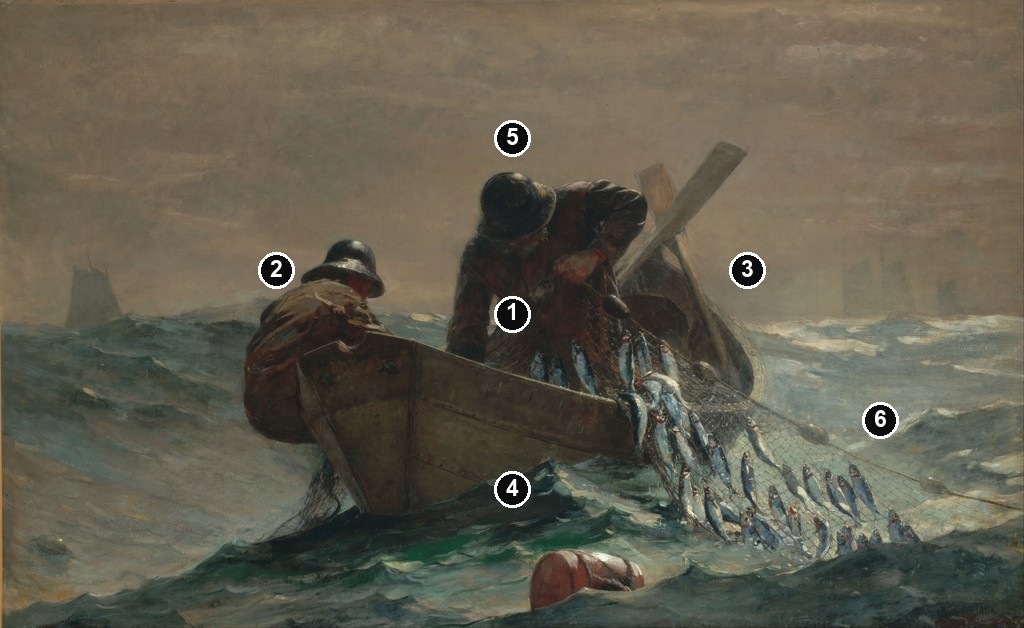
Details from THE HERRING NET
Close looking follows the composition through figure, setting, foreground and surrounding visual pressure.
Central Action
The central passage carries the first act of close looking, where pose, spacing and surrounding detail establish the main visual problem.
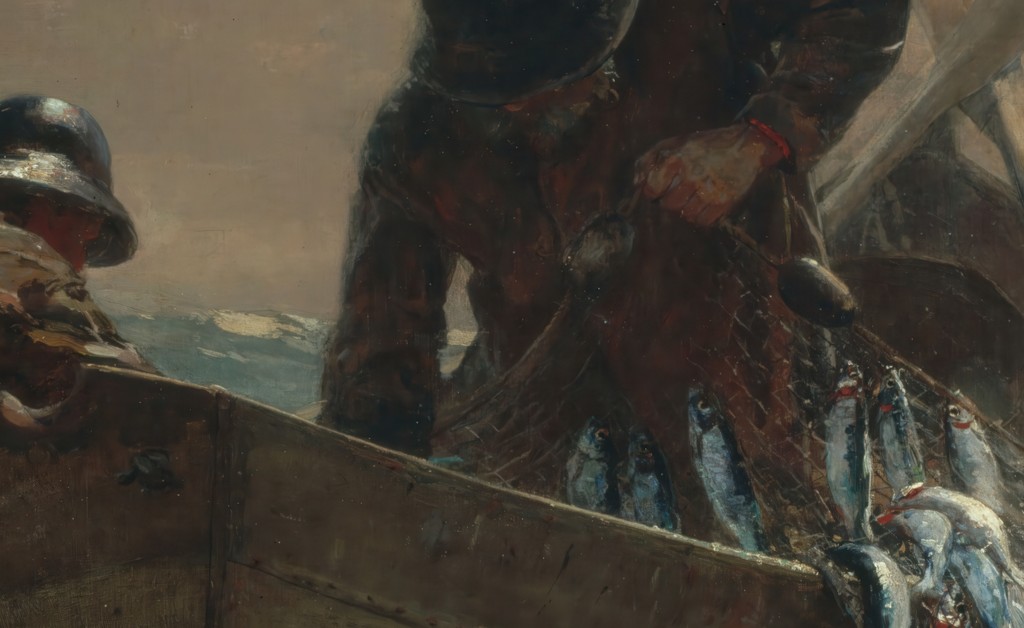
Left-Hand Structure
The left side helps frame the composition and shows how Homer balances incident against the broader setting.
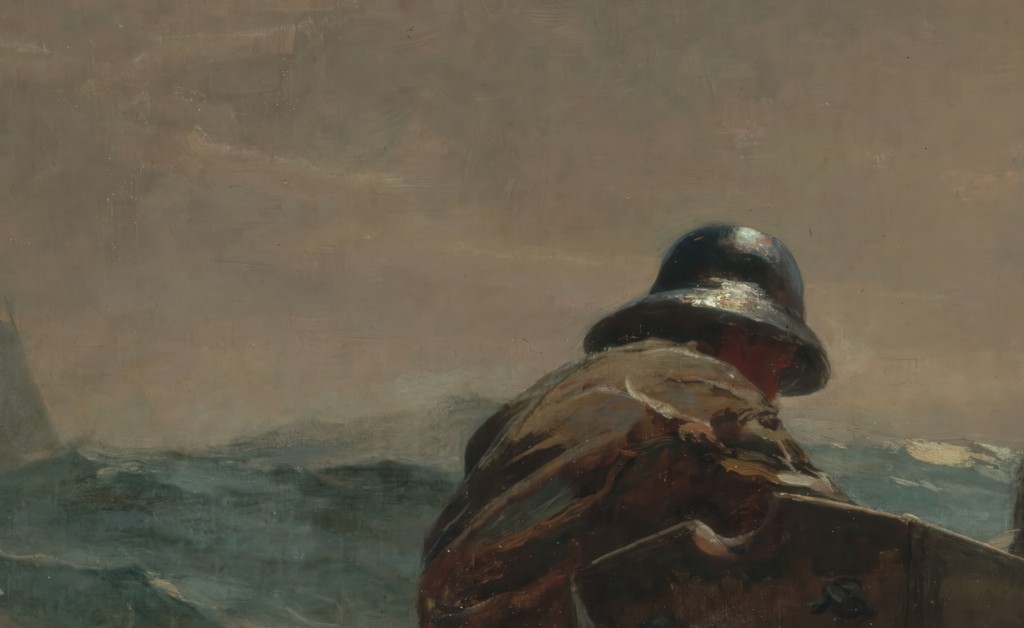
Right-Hand Structure
The right side answers the central group with a second visual pressure, often through movement, distance or environmental force.
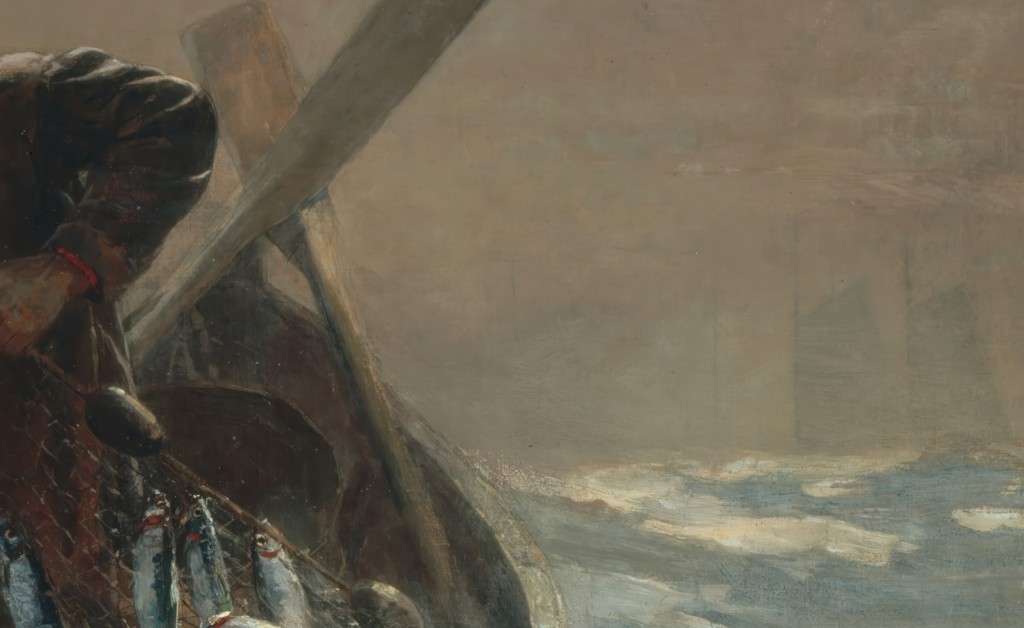
Foreground Detail
The foreground gives the viewer a threshold into the image and often contains the practical evidence of work, risk or play.
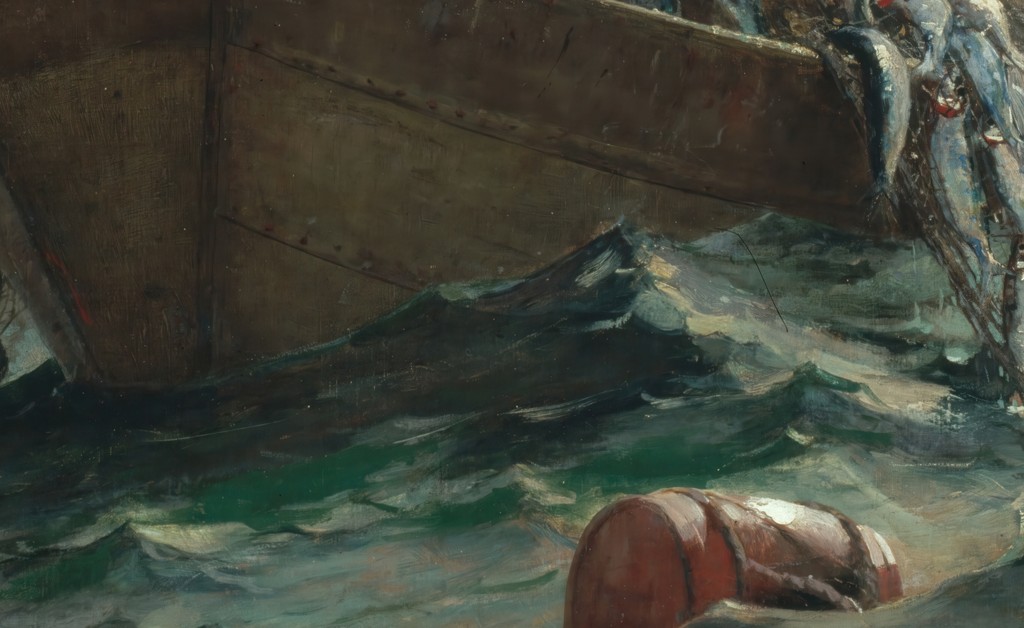
Background Distance
The background opens the picture into weather, landscape or social space, making the scene larger than the immediate figures.
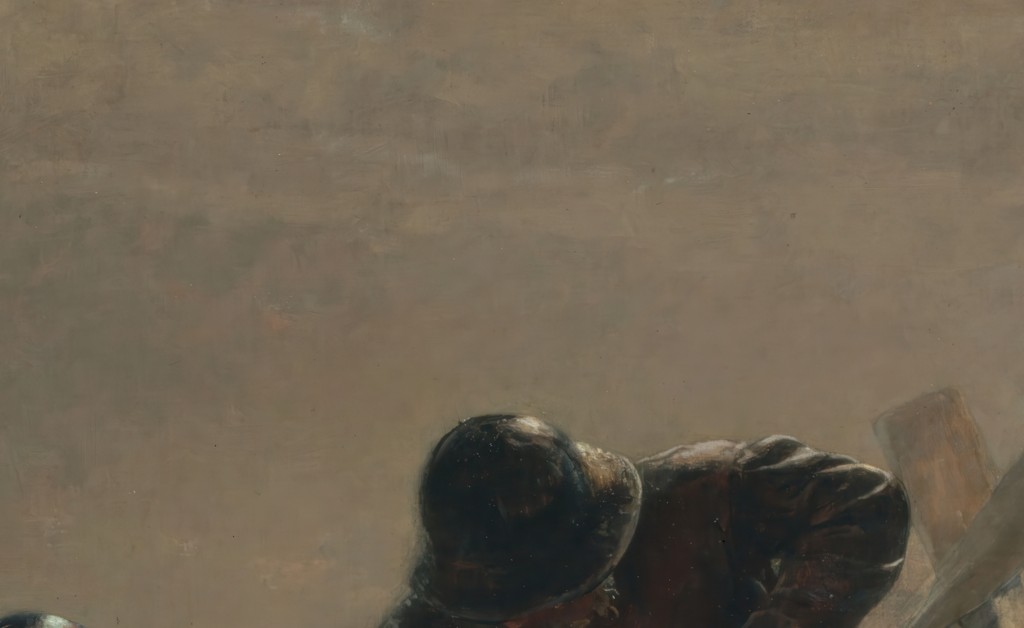
Edge Rhythm
A detail near the edge shows how the composition keeps the eye moving instead of closing around a single motif.
Cullercoats, Prouts Neck And A New Marine Language
The Herring Net belongs to the turning point in Homer's career after Cullercoats and Prouts Neck. During the 1870s he had already made coastal and fishing subjects in New England. The Cullercoats stay, however, gave him a concentrated encounter with a working fishing community whose routines, weather and social structures reshaped his art. The local packets identify Cullercoats as a necessary term for this article because it helps explain why Homer's later sea pictures are not simply scenic coast views. [5]
In Cullercoats, Homer studied fishermen, women, nets, boats, children and the shore life around the fishing economy. He also worked intensively in watercolor, which sharpened his ability to observe weather, light and figures under changing conditions. When he returned to the United States and moved to Prouts Neck in 1883, he brought that experience into a new landscape. The Maine coast gave him a permanent base from which to look at the Atlantic, but Cullercoats had already changed the kinds of human subjects he found there. [1]
The Art Institute archive connects The Herring Net directly to this sequence: earlier New England fishing villages, the English fishing-community experience, and the 1883 move to Prouts Neck. The current AIC object route likewise places the painting at Prouts Neck and stresses the work's relation to Homer's mature concern with human effort against nature. For manuscript purposes, the key point is not that Homer simply copied one place into another. It is that he translated the discipline of Cullercoats observation into the harder, larger oil paintings of his Maine years. [2]
This helps explain the painting's scale of feeling. The scene is practical and specific: herring, net, dory, schooners, mist. But Homer gives those practical details a severity that exceeds anecdote. The fishermen become large because their task becomes large. The dory is not only a small boat; it is a measure of human vulnerability. The sea is not only weather; it is the condition that gives the work meaning. [3]
That combination is central to Homer's late reputation. He moved away from the more anecdotal figure scenes and leisure subjects of earlier decades toward images in which people, animals or coastlines are tested by forces beyond easy control. The Herring Net is one of the most accessible entries into that mature language because its narrative remains readable. We can understand what the men are doing, even if we cannot know the outcome of the next wave. [4]
Fishing Work And Human Scale
The painting's power depends on how carefully Homer treats work. He does not turn fishing into rustic charm. He shows a task that requires knowledge, timing and strength. The fishermen have to pull the loaded net, manage the fish, keep the boat trimmed and remain aware of the sea around them. Each part of the action affects the others. A shift in weight, a bad wave, a tangled net or a sudden overload could change the scene quickly. [5]
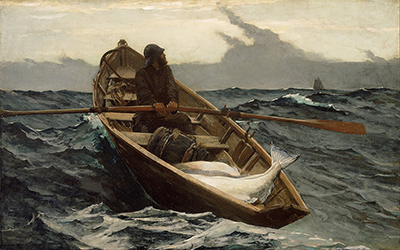
That is why the dory is so important. A dory is a small fishing boat, useful but exposed. In Homer's marine paintings it often becomes a stage for human judgment under pressure. In The Fog Warning, a dory holds a single fisherman who must judge distance, weather and return. In The Herring Net, the dory holds two workers whose success depends on coordinated movement. The boat makes the body visible as a working instrument: knees, shoulders, arms and balance matter because the water gives no fixed ground. [1]
Homer's fishermen are not heroic because they are grandly posed. They are heroic because the painting respects the difficulty of their labor. Their bodies are bent into the practical demands of the catch. Their faces are not the center of the picture. What matters is the pressure of the action. The viewer can almost feel the wet drag of the net and the awkward shifting weight of the herring as they come over the side. [2]
This is also why the painting avoids theatrical rescue. No one is drowning. No lifeline has been thrown. No dramatic alarm organizes the scene. Instead, Homer locates danger in ordinary practice. The work is dangerous because it is normal. A fishing economy depends on repeating such tasks, and each repetition asks the sea for permission that the sea is never obliged to give. [3]
The painting's title keeps the focus on the equipment and the catch rather than on a named individual. A herring net is a tool, but in the painting it also becomes a line between human order and marine abundance. The men pull life from the water, but the act binds them to the water's instability. Homer is alert to both sides of that exchange. The sea provides and threatens at the same time. [4]
Mist, Distance And The Mother Schooners
One of Homer's strongest decisions is to keep the larger vessels in the background. The mother schooners are important because they show that the dory is part of an offshore fishing operation rather than an isolated pleasure boat. They also sharpen the emotional distance in the scene. Safety, storage and return are visible but not immediately available. The fishermen still have to complete the dangerous part of the work where they are. [5]
The mist makes that distance unstable. It softens the horizon and prevents the viewer from reading the space as a clear path home. The schooners appear as partial forms, not solid guarantees. This is a quieter kind of uncertainty than the fog in The Fog Warning, where the lone fisherman looks toward a darkening horizon. In The Herring Net, the men are too busy to look anxiously outward. Their problem is at hand. The mist still matters because it surrounds the work with a world that is difficult to measure. [1]
Homer uses this atmosphere to avoid a simple celebration of success. The catch is abundant, but the setting is not triumphant in an easy way. The water continues to move. The boat remains small. The horizon remains uncertain. The viewer sees both achievement and exposure at once. [2]
The painting's color and tonal restraint support that balance. The scene does not rely on bright picturesque effects. The subdued marine atmosphere lets the flashes of fish and the activity of the net become more important. The eye moves between the glistening catch, the dark bodies, the hull and the pale distance. Everything is tied to the same working weather. [3]
This is part of Homer's mature realism. He does not merely record the visible facts of a job. He arranges those facts so the viewer understands the conditions under which the job must happen. The mist, the dory, the schooners and the fish form a system. Human labor sits inside that system, capable and vulnerable. [4]
Relationship To The Fog Warning And The Life Line
The Herring Net should sit close to The Fog Warning in the Homer cluster. Both paintings involve fishermen, dories, open water and the distance between small craft and larger vessels. The difference is equally important. The Fog Warning centers on a solitary figure whose success is shadowed by weather and return. The Herring Net centers on teamwork at the moment of harvest. It is more active, more cooperative and, in the AIC resource tradition, often treated as the more hopeful of the related fishing pictures. [5]
The comparison helps readers see that Homer did not repeat a single marine formula. He returned to similar materials in order to ask different questions. What does a lone fisherman know when fog begins to gather? What do two fishermen do when the catch itself threatens the balance of the boat? How close can a person be to livelihood and danger at the same time? These works answer through posture and setting rather than explanatory drama. [1]
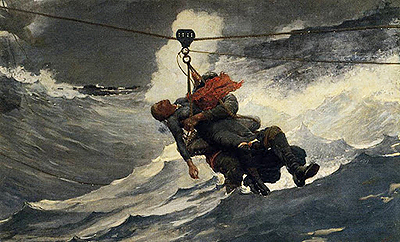
The Life Line adds another nearby theme. That painting is a rescue image built around modern lifesaving technology and a body suspended between wreck and shore. The Herring Net is not about rescue, but it belongs to the same broader field of marine peril. Both paintings depend on human coordination under dangerous conditions. Both refuse to make the sea merely scenic. Both show that survival around water is social as well as individual: it relies on tools, skill, timing and other people. [2]
The article also belongs near Watercolours because Homer's fishing-community subjects cannot be separated from his watercolor practice. Cullercoats strengthened his attention to working coastal figures, and watercolor gave him a way to study weather, clothing, boats and shore routines with speed and sensitivity. The Herring Net is an oil painting, but it benefits from that earlier observational training. [3]
Why This Painting Matters
The Herring Net matters because it turns practical fishing labor into one of Homer's great images of human scale. The painting does not need a disaster to show danger. It finds drama in the moment when the catch is coming in, the boat is moving, the men are working and the sea remains larger than any human plan. [4]
It also matters because it clarifies what changed in Homer after Cullercoats and Prouts Neck. The subject is no longer coastal life as anecdote. It is work under elemental pressure. The fishermen are not picturesque accessories to a marine view. They are the center of a system that includes net, fish, dory, schooners, mist and swell. [5]
The painting's emotional power comes from balance. The catch is successful, but the scene is not secure. The men are capable, but they are not in control of the whole environment. The schooners are visible, but distant. The dory floats, but precariously. Homer makes the viewer hold all of those facts together. [1]
For a modern reader, The Herring Net is a strong entry point into Homer's mature marine art because it is readable without being simple. We can see the action immediately: two fishermen hauling herring in rough water. The longer we look, the more the image becomes about dependence, risk and the intelligence of shared labor. Homer gives the fishermen dignity by taking their work seriously. He gives the sea its force by refusing to tame it into background scenery. [2]
That is the achievement of the painting. It shows livelihood at the instant it becomes struggle. It shows teamwork without sentiment. And it shows the sea as both provider and test, the condition that makes the catch possible and the force that can undo it. [3]
Discussion
Winslow Homer rewards close looking because his strongest images rarely close down into one easy meaning. Use the prompts below to test how the work changes as you move between subject, place, medium and history.
Reader Insights
First Look
What detail in The Herring Net changes how the whole work feels?
Homer's Method
Where do you see Homer's balance between clear observation and unresolved meaning?
Cluster Context
Which related Homer work helps you read this page more carefully?
Join the Conversation
Share a thoughtful observation below, especially if a detail, source connection or related Homer page changed the way you read the work.
References
- Art Institute of Chicago archive/exhibition object entry, The Herring Net, Winslow Homer, 1885, reference number
1937.1039. - Art Institute of Chicago current object route for The Herring Net, used as a verification lead for date, medium, dimensions, place/context, on-view status and image-rights follow-up.
- Art Institute of Chicago resource overview for The Herring Net, from American Arts at the Art Institute of Chicago: From Colonial Times to World War I.
- National Gallery of Art artist record and 1995 Winslow Homer catalogue route, used through the local packet for Cullercoats, Prouts Neck and career context.
- Winslow Homer Phase 1 local source packets, URL decision matrix, internal-link ledger, quote ledger, glossary ledger and Tom image-policy ledger, 2026-07-20.
 Winslow Homer.jpg)