 by Tom Gurney
Tom Gurney BSc (Hons) is an art history expert with over 20 years experience
Published on June 19, 2020 / Updated on August 2, 2026
Email: tomgurney1@gmail.com / Phone: +44 7429 011000
Contents
- Introduction
- Gloucester And The Early Watercolors
- A Small Boat Before The Later Sea Paintings
- Object Identity And Image Caution
Introduction
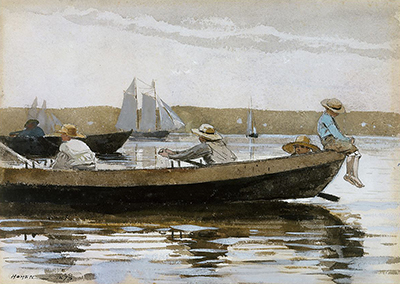
Winslow Homer's Boys in a Dory belongs to the first strong phase of his watercolor practice. The Metropolitan Museum of Art records its version of the work as an 1873 watercolor with gouache over graphite underdrawing on white wove paper, measuring 9 3/4 x 13 7/8 inches, or 24.8 x 35.2 cm. It entered the Met as the Bequest of Molly Flagg Knudtsen in 2001 and carries object number 2001.608.1. [1]
The object facts are modest, but they open a useful route into Homer. In the summer of 1873 he worked in Gloucester, Massachusetts, a fishing port on Cape Ann. There he made small watercolors of children near boats, wharves, beaches and everyday coastal tasks. Boys in a Dory sits in that world. It shows childhood close to the water, but not detached from the labor and training that made the shore meaningful. [2]
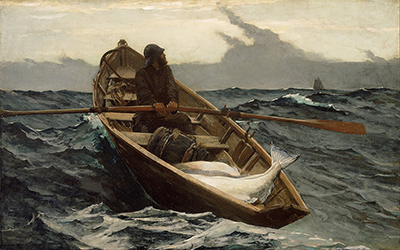
A dory is a small boat, practical and exposed. In later Homer paintings, the dory often becomes a place of adult risk: a fisherman rows against fog, or men work a heavy net in rough water. Here the tone is lighter. The figures are boys, the scale is intimate and the scene belongs to early Gloucester rather than to the severe Prouts Neck marine pictures. Still, the boat matters. It is not a toy-like prop. It is a vessel that asks for balance, attention and local knowledge. [3]
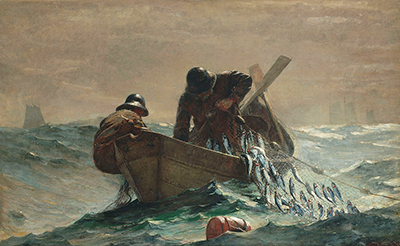
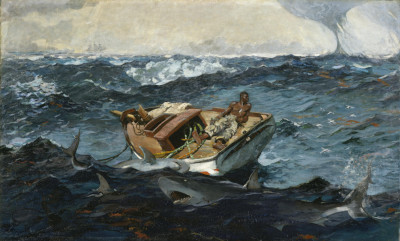
That makes this article a natural support article for the Watercolours hub. The watercolor is not a major flagship like The Gulf Stream, The Fog Warning or The Herring Net. Its value is quieter. It helps readers see how Homer learned to join children, boats, sunlight, harbor air and coastal work before the sea became one of his most powerful late subjects. [4]
Gloucester And The Early Watercolors
Gloucester gave Homer a coastal setting that was active without needing to be dramatic. Children could row, wait, play, help, watch or move through the harbor edge. The subjects were small enough for watercolor, but they were not trivial. Boats, oars, tides, wharves and beach chores placed childhood inside a working fishing environment. [1]
The Met record places Boys in a Dory within this group of early Gloucester sheets. That context matters because Homer had only recently begun to use watercolor as a serious professional medium. The local medium-hub packet frames watercolor as central to his career rather than secondary. This article supports that argument at a small scale. The picture shows watercolor being used for open air, reflected light, pale drawing, controlled washes and quick coastal observation. [2]
The boys are important because Homer treats them as participants in a place, not merely as charming figures. A child in a dory learns the shore through the body: how the boat sits in water, how oars change direction, how balance shifts, how harbor weather alters the surface. Even if the image does not show hard labor, it belongs to a community where maritime knowledge begins early. [3]
That is why Boys in a Dory is best linked carefully to A Basket of Clams. Both pages show boys in the 1873 Gloucester world. One keeps the children on the beach with a basket; the other places them in a small boat. Together they show childhood at the threshold of adult maritime life. The scenes are bright and readable, but they point toward skills and risks that become stronger elsewhere in Homer. [4]
A Small Boat Before The Later Sea Paintings
The dory gives the article its best interpretive thread. In this early watercolor, the boat carries youthful activity and harbor light. In later works, similar small craft carry heavier pressure. The Fog Warning turns the dory into a test of distance, weather and return. The Herring Net makes it the workplace for coordinated fishing labor. Breezing Up offers a related but more buoyant boating image, where young figures and skill become a broad public image of motion and confidence. [1]
Boys in a Dory does not need to be forced into the same emotional register as those later works. It is earlier, smaller and less severe. The point is development, not equivalence. Homer is already interested in what a small boat does inside a picture: organize figures, create direction, place human bodies against water and suggest a way of life beyond the immediate moment. [2]
The watercolor also belongs near Boys in a Pasture, if that page is later sourced and refreshed, because both subjects use childhood as serious artistic material. Homer did not need adult drama to make a work meaningful. He could study boys at play, boys in fields, boys carrying clams or boys in boats and still point toward wider questions of place, responsibility and American life after the Civil War. [3]
For readers, the best way into this work is to look for restraint. There is no wreck, no visible rescue, no threatening weather. Instead, Homer makes a clear coastal subject carry the first signs of a larger marine intelligence. The water is a surface of light, but also a training ground. The boys are young, but the dory belongs to a working world. The scene is modest, but it helps explain why watercolor became such a flexible instrument for Homer. [4]
Object Identity And Image Caution
For now, the safest treatment is to keep Boys in a Dory as a concise Gloucester watercolor support page, with image replacement held. The text explains why the active URL has value without pretending that every production detail is settled. It belongs in the Watercolours route because it shows Homer using paper, wash, graphite and coastal observation to make childhood and sea training part of the same visual world. [1]
Discussion
Winslow Homer rewards close looking because his strongest images rarely close down into one easy meaning. Use the prompts below to test how the work changes as you move between subject, place, medium and history.
Reader Insights
First Look
What detail in Boys in a Dory changes how the whole work feels?
Homer's Method
Where do you see Homer's balance between clear observation and unresolved meaning?
Cluster Context
Which related Homer work helps you read this page more carefully?
Join the Conversation
Share a thoughtful observation below, especially if a detail, source connection or related Homer page changed the way you read the work.
References
- Metropolitan Museum of Art object record, Boys in a Dory, Winslow Homer, 1873, object number
2001.608.1: https://www.metmuseum.org/art/collection/search/17053 - Smithsonian American Art Museum object record, Boys in a Dory, Winslow Homer, 1880, object number
2004.30.2: https://americanart.si.edu/artwork/boys-dory-73938 - Smithsonian Institution object aggregation record for SAAM Boys in a Dory: https://www.si.edu/object/boys-dory%3Asaam_2004.30.2
- Local Winslow Homer Phase 1 approval brief, provisional URL decision matrix, medium-hub source packet, homepage/biography source packet, internal-link ledger, quote ledger, glossary ledger and Tom image-policy ledger dated 2026-07-20.
 Winslow Homer.jpg)