by Tom Gurney
Tom Gurney BSc (Hons) is an art history expert with over 20 years experience
Page created on September 3, 2026 / Page updated on September 13, 2026
Email: tomgurney1@gmail.com / Phone: +44 7429 011000
How Formal Analysis Turns Looking into an Argument
Formal analysis explains how an artwork's visible and material features work together. It begins with close description, but it does not end with a list of line, colour, shape and texture. The aim is to select important relationships, explain their effects and combine them into an argument that another viewer can test against the work.
This approach is narrower than art criticism. Criticism may consider historical context, iconography, reception and evaluation. Formal analysis holds those questions back long enough to ask what the object's construction itself can show: its scale and format, the distribution of forms, its viewpoint, light, colour, surface, space and material.
At a Glance
- Begin with the objectVerify title, maker, date, medium, dimensions, collection and viewing conditions before interpreting.
- Locate exact featuresName a contour, interval, colour, value, surface, mass, viewpoint or spatial cue that another viewer can find.
- Connect relationshipsExplain how features repeat, contrast, overlap, align, enclose or interrupt one another.
- State the effectShow what the relationship does to attention, depth, rhythm, stability, tension, scale or pace.
- Test the claimBuild a thesis from several supporting relationships, then try a competing explanation and preserve uncertainty.
Contents
- What counts as formal evidence?
- The four-link method
- Books for Learning Formal and Visual Analysis
- A step-by-step formal analysis
- Worked example: Rembrandt's The Night Watch
- Annotated Close Reading: Six Forces in The Night Watch
- Three comparison tests
- Common mistakes
- Formal analysis checklist
- Watch Formal Analysis in Practice
What counts as formal evidence?
Formal evidence is a locatable feature or relationship. It might be the interval between two figures, a repeated curve, a sharp value contrast, a shallow field of space, the weight of a stone mass or the difference between a smooth passage and an exposed brushstroke. The Getty describes the elements of art as components of a work and the principles of art as ways artists organise those components. [1][2]
Vocabulary alone is not analysis. “The painting uses blue” names a colour. “Large blue chair backs repeat across the room, joining separate areas while making the child's pale dress conspicuous” identifies a relationship and an effect. The second sentence gives a reader evidence to find and reasoning to question.
Smarthistory defines formal analysis as description of visual features followed by analysis of their effects. [3] That distinction is useful, but the two operations often alternate. A new effect can make you notice a feature you missed; a closer description may force you to change the effect you first proposed.
The four-link method
- FeatureLocate an exact visual or material detail.
- RelationshipConnect it to another part of the work.
- EffectExplain what changes for the viewer.
- ClaimCombine the strongest evidence into an argument.
Use this chain to prevent a formal analysis from becoming a checklist:
- Feature: locate something exact—a contour, mass, edge, colour, value, texture, interval or spatial cue.
- Relationship: explain how it aligns, repeats, overlaps, contrasts, encloses or interrupts another part.
- Effect: state what the relationship does to attention, depth, rhythm, weight, stability, tension or visual pace.
- Claim: connect the strongest relationships into an arguable account of the whole work.
For example: a bright figure is not automatically “the focal point”. Show that it also sits near converging diagonals, is surrounded by darker values and interrupts a repeated row. Several mutually supporting features make the claim stronger than one label.
The chain is not a recipe for certainty. Smarthistory notes that formal effects were once treated as more universal than they are now understood to be. [3] A vertical can feel stable in one configuration and precarious in another. Write “the contrast concentrates attention” when the arrangement supports it, not “red always means danger”.
A step-by-step formal analysis
1. Establish the object and viewing conditions
Record the exact title, artist or maker if known, date, medium, dimensions and collection. Then note how you are seeing it. An original sculpture in a gallery, a painting behind glass and a compressed screen image offer different evidence. The digital image may reveal detail while concealing physical scale, surface reflectivity and the relation to a viewer's body.
Format is the first relationship: vertical, horizontal, square, circular, irregular or three-dimensional. Measure or verify scale rather than guessing it from the image. Ask whether the work surrounds, confronts, fits within or sits below an imagined viewer.
2. Scan the whole before naming parts
Look for the largest divisions. Where are the lightest and darkest areas? Which masses dominate? Is the field crowded or open? Where does the eye enter and where does it pause? Does the composition gather around a centre, pull towards an edge or distribute attention unevenly?
Make a quick map in words. “A low band of bright figures crosses a mostly dark horizontal field” is more useful at this stage than naming every face. The broad pattern gives individual details a structure. The same method can be applied to buildings through the guide to reading architectural elements.
3. Select relationships, not a vocabulary quota
Choose two to four relationships that genuinely shape the encounter. These may involve:
- line and edge: directions, contours, hard or soft transitions;
- shape and form: flat silhouettes, modelled volumes, positive and negative areas;
- value and colour: contrast, temperature, saturation and local accents;
- texture and material: actual surface, depicted surface and marks of making;
- space and viewpoint: overlap, scale change, perspective, compression and access;
- rhythm, balance and emphasis: repetition, visual weight and concentrated attention.
Do not force every category into the paper. A monochrome print may demand value and edge; an installation may require scale, interval and bodily movement. The perspective guide can help when constructed depth or viewpoint is central.
4. Turn observations into a thesis
Agnes Scott College's writing guidance describes formal analysis as an argument based on visual evidence, not description alone. [4] A thesis should therefore name a visual consequence and the principal relationships producing it.
Weak: “Rembrandt uses light, colour, line and movement in The Night Watch.”
Stronger: “Rembrandt turns a commissioned group portrait into an unfolding public action by concentrating light around an offset pair, sending diagonals through the crowd and allowing repeated figures to emerge unevenly from darkness.”
The stronger version can organise paragraphs. Each paragraph tests one part of the claim with exact evidence and then reconnects it to the whole.
5. Build paragraphs from feature to effect
A reliable paragraph pattern is:
Locate the feature precisely. Relate it to another part. Explain the visual effect. Return to the thesis and qualify anything uncertain.
Avoid attributing intention when the evidence only demonstrates structure. “The diagonal pike carries attention towards the right” can be checked. “Rembrandt wanted every viewer to feel heroic” requires different evidence and is not established by the diagonal alone.
6. Test the analysis
Try a competing explanation. If the bright figure is removed from your reasoning, do the diagonals still organise the work? Is an apparent symmetry actually offset? Are you mistaking the subject's identity for a formal effect? Read the draft with every technical noun removed; the causal reasoning should still be clear.
Worked example: Rembrandt's The Night Watch
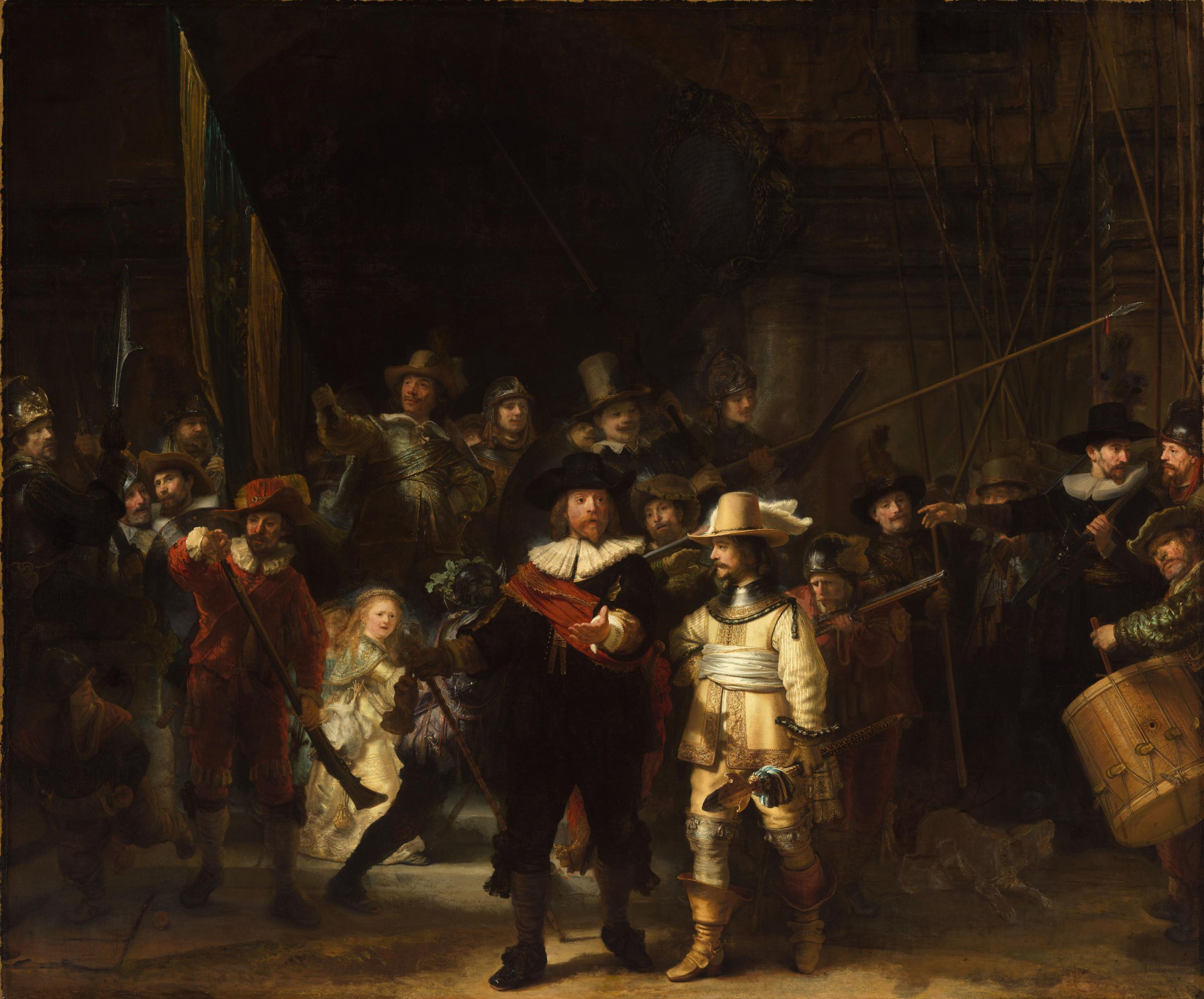
The Rijksmuseum identifies Rembrandt's The Night Watch as a monumental oil-on-canvas painting from 1642, object SK-C-5. It was made for Amsterdam's Arquebusiers guild hall and presents the company forming into action. [5] Those facts establish the object. The formal analysis starts with what its surviving painted field does.
Whole structure and scale
The work is wider than it is tall and vastly larger than a domestic picture. A dense band of life occupies the lower portion beneath a dark architectural setting. Figures overlap, weapons rise and recede, and open darkness prevents the upper field from carrying equal detail. The size allows bodies to approach life scale while the crowd extends laterally beyond one easy glance.
The group is not arranged as a single calm row. The two central officers step forward, slightly right of the canvas's midpoint. A captain in black and red extends his pale hand; a lieutenant in yellow catches a much larger area of light. Their offset pairing creates an anchor without making the painting bilaterally symmetrical.
Value, colour and emphasis
Large passages of brown-black shadow surround concentrated lights. The Rijksmuseum notes that Rembrandt uses light to draw attention to details including the captain's gesture and the young girl in the background. [5] The brightest zones do not simply coincide with social rank: the lieutenant, the girl's pale dress and selected faces flash at different depths.
Red and yellow accents recur among quieter earth colours. The captain's red sash crosses his dark costume, while the lieutenant's pale yellow clothing makes a more continuous vertical mass. Their contrast separates the pair but also binds them: dark/light and red/yellow act together rather than as independent colour labels.
Diagonals, overlap and movement
Pikes, muskets, flagstaffs and the captain's arm produce several diagonals. Some rise towards the right; others cross or recede into the crowd. Overlapping bodies make depth without opening a clear corridor. The drum at the far right presses against the edge, while cropped or partially obscured guards imply activity continuing beyond the most legible centre.
This structure makes “movement” specific. The canvas does not move, and not every figure marches in the same direction. Instead, interrupted diagonals, unequal gaps, advancing feet and shifting light keep attention circulating. The formal effect is organised instability: a group coheres at the moment it is still assembling.
A formal thesis
The strongest claim is not that the painting is dramatic because it is dark. Rembrandt creates a public action by opposing a concentrated illuminated pair with a dispersed, partially visible company. Scale makes the assembly bodily; value establishes uneven attention; diagonals and overlaps prevent a static rank; edge pressure keeps the event apparently larger than the framed field. Each relationship contributes to the same account.
Historical questions can deepen that reading, and the work's later trimming affects the field we now see. But the formal claim remains inspectable in the present object. It does not depend on guessing a private intention or decoding every figure.
Annotated Close Reading: Six Forces in The Night Watch
The numbered overlay turns six statements from the worked example into locatable evidence. Use it as a map, then return to the unmarked image above so the labels do not replace looking.
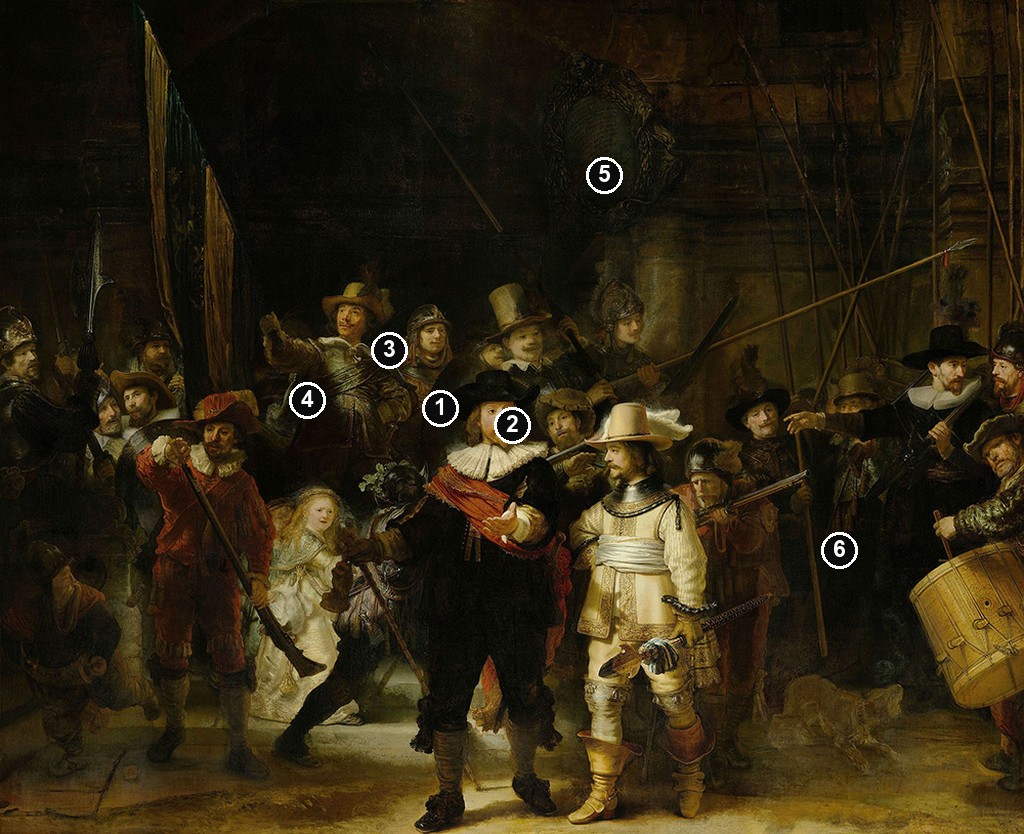
- Captain's handA pale projecting gesture starts the forward action.
- LieutenantA broad yellow-lit mass anchors the offset pair.
- Illuminated girlA separate flash of light complicates rank and depth.
- Muskets and pikesCrossing diagonals interrupt any static portrait row.
- Raised bannerThe upper movement expands the company vertically.
- Drummer at the edgePressure at the boundary implies action beyond the frame.
Three comparison tests
Cassatt: interval and asymmetry
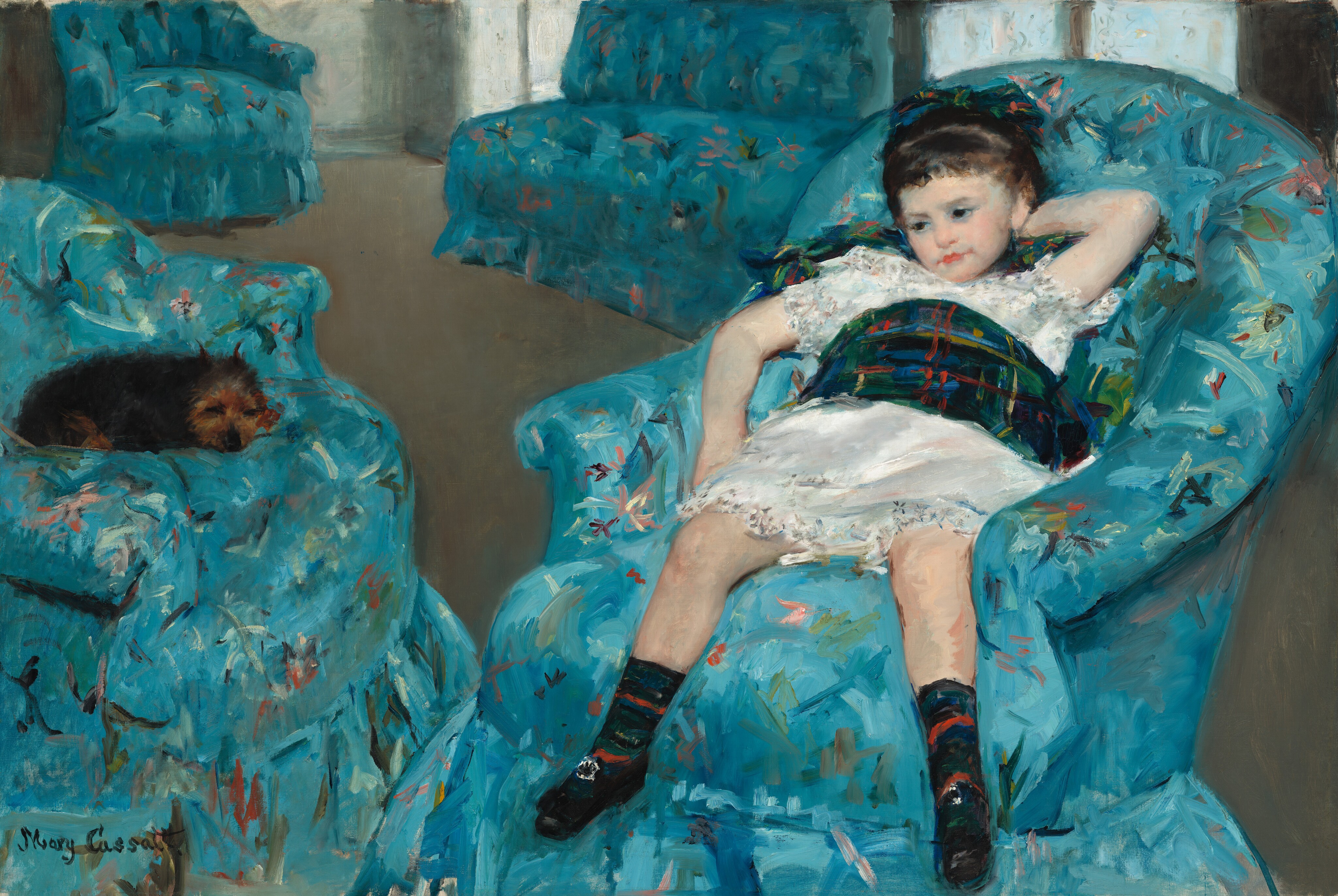
Mary Cassatt's Little Girl in a Blue Armchair is an oil painting of 1878, NGA accession 1983.1.18. [6] A child reclines in a large chair at the right while a small dog rests on another chair at the left. Further blue seats repeat across the back. The furniture links the field through colour and rounded shapes, but broad floor intervals keep the grouping uneven. The child's relaxed diagonal pose resists the chairs' bulky upright structure. A formal paragraph could argue that repetition makes the room coherent while asymmetry preserves the child's separateness.
Renoir: physical scale and painted surface
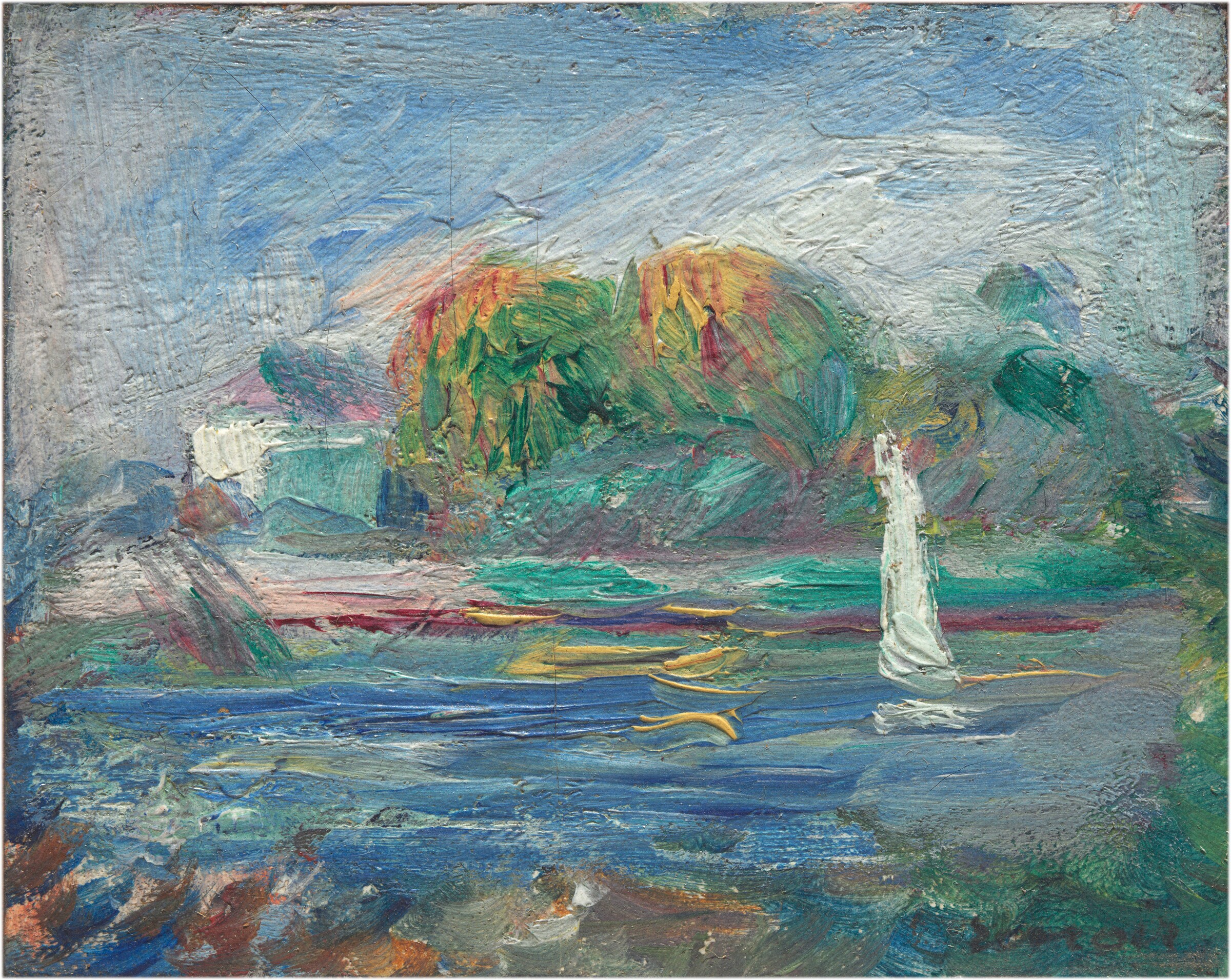
Renoir's The Blue River is easy to misread online because an enlarged reproduction fills the screen. The NGA records an overall size of only 7.7 by 9.6 centimetres, including taped edges, and dates the oil painting to about 1890/1900. [7] Broad ridges and directional touches therefore operate across a tiny support. Blue horizontal strokes spread through the water while green, red and yellow marks compact the bank. Scale changes the analysis: marks that look landscape-sized on screen are physically small, dense acts of paint.
Kouros: form beyond one viewpoint

The Met's Attic marble kouros dates to about 590–580 BCE and is accession 32.11.1. [8] From the frontal institutional view, the standing youth is organised around a strong bilateral axis. Arms hang close to the sides, one foot advances, and the block-like mass narrows at joints and waist. These are formal observations, but a photograph cannot show the body's full volume, the changing contour around its sides or the viewer's movement in real space. Sculpture analysis must treat the image as one viewpoint, not the whole object.
Common mistakes
- Listing without linking: name only those elements whose relationships support the thesis.
- Mood without evidence: replace “it feels tense” with the contrasts, intervals or directions producing tension.
- Ignoring scale: verify dimensions and distinguish pixels from physical size.
- Flattening material: say whether texture is actual, depicted or inferred from a photograph.
- Confusing subject with form: “a civic guard” identifies a subject; “overlapping figures compress the lower field” analyses form.
- Inventing intention: describe what the arrangement does before claiming why it was made.
- Treating effects as universal: qualify responses and test another reading.
Formal analysis checklist
- Is the exact object and viewing condition clear?
- Does the thesis explain a visual consequence rather than list terms?
- Can every main claim be located in the work?
- Do paragraphs connect feature, relationship and effect?
- Have scale, medium, format and viewpoint been considered?
- Are only the most important elements and principles discussed?
- Does the analysis distinguish an observed structure from historical or symbolic context?
- Has a competing formal explanation been tested?
Formal analysis is disciplined close looking expressed as an argument. Its vocabulary matters because it lets observations become precise; its reasoning matters because precision alone is not enough. Select, connect, explain and test. The result should help a reader see the work's construction more clearly, even when that reader reaches a different interpretation.
Watch Formal Analysis in Practice
Choose a complete method demonstration or test the same reasoning across still life and landscape.
How to Do Visual (Formal) Analysis in Art History
Follow the speakers as they separate formal evidence from iconography and context while looking at Bellini's Madonna of the Meadow.
Watch on YouTubeFrequently Asked Questions
Formal analysis is an evidence-led account of how visible and material features work together. It moves from exact description to relationships, effects and a claim that another viewer can test against the object.
Formal analysis deliberately concentrates on an artwork's construction. Art criticism may combine that close looking with context, iconography, reception, theory and evaluation. The two overlap, but they do not have identical scope.
No. Select the two to four relationships that genuinely organise the work. A quota of line, colour, shape and texture usually produces description without argument.
Yes, with limits stated clearly. A reproduction can support observations about composition and many visible relationships, but it may distort scale, colour, surface, reflectivity and three-dimensional viewpoint.
A strong thesis names a visual consequence and the principal relationships that produce it. Each paragraph should locate evidence, explain its effect and return to that central claim.
Discussion
Which visible relationship in a familiar artwork becomes more precise when you move from naming a feature to explaining its effect?
Reader Insights
A claim is stronger when another viewer can find the feature you describe.
Relationships among features matter more than ticking off vocabulary.
A competing explanation reveals where evidence is strong, limited or ambiguous.
Join the Conversation
Share one precise observation or a useful museum example below.
References
- Getty — Understanding Formal Analysis: Elements of Art
- Getty — Understanding Formal Analysis: Principles of Design
- Smarthistory — Understanding art, an introduction
- Agnes Scott College — Describing Art: Writing a Formal Analysis
- Rijksmuseum — Rembrandt, The Night Watch
- National Gallery of Art — Mary Cassatt, Little Girl in a Blue Armchair
- National Gallery of Art — Auguste Renoir, The Blue River
- The Metropolitan Museum of Art — Marble statue of a kouros