


 by Tom Gurney
Tom Gurney BSc (Hons) is an art history expert with over 20 years experience
Page created on September 3, 2026 / Page updated on September 13, 2026
Email: tomgurney1@gmail.com / Phone: +44 7429 011000
How Sculpture Occupies Space, Takes Form and Meets Its Viewer
A visual classification guide
Sculpture is art made as an object, a surface in relief or an intervention in space. It can be carved from a block, modelled in a soft material, cast in metal, assembled from separate parts or built around a particular place. Some sculpture invites a walk around it; some remains physically tied to a wall; some moves, changes or asks the viewer to enter its space.
This variety explains why lists of the “main types of sculpture” seldom agree. A marble statue, a bronze bust and a carved wooden figure are not three equivalent categories. “Statue” and “bust” describe formats, while marble, bronze and wood name materials, and carving or casting describe processes. The clearest way to understand sculpture is to sort these labels into separate questions: How does the work occupy space? How was it made? What form or subject does it take? How does it represent the world? And how does it involve its setting and viewer?
At a Glance
- Spacebegin with the distinction between a freestanding object and relief bound to a continuous ground.
- Processcarving, modelling, casting and construction describe how form is made, not what it depicts.
- Formatstatue, bust, group and monument identify forms or purposes that can overlap with any material.
- Representationfigurative and abstract are positions on a spectrum rather than mutually exclusive boxes.
- Viewer and siteviewpoint, movement, duration and setting can be essential parts of the sculptural work.
Contents
- How Sculpture Occupies Space, Takes Form and Meets Its Viewer
- Five questions, not one flat list
- Sculpture in the round and relief
- Four broad ways sculpture is made
- Statues, busts, groups and monuments
- Figurative, abstract and kinetic sculpture
- Materials rarely tell the whole story
- How to recognise a sculpture's type
- Sculpture reference pages
- Watch Sculpture Move from Model to Finished Object
Five questions, not one flat list
Sculpture in the round and relief
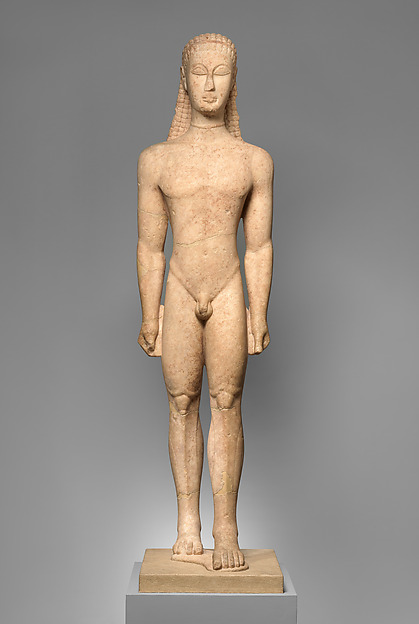
The most useful first distinction concerns the work's relationship to its surrounding space. Sculpture in the round is carved or modelled around its full circumference rather than projecting from a continuous background.[2] The body of the work is physically independent, even when it needs a base, support or display case. The viewer can usually move around it, and each change of position alters the silhouette, the overlap of forms and the path of light across its surface.
Museum-led introductions often begin with the same practical division between works in the round and reliefs, because it directs attention to how a sculpture meets both space and viewer.[4]
The Greek Marble statue of a kouros (youth), carved in Attica around 590–580 BCE, makes this kind of viewing especially clear. The figure stands frontally with one foot advanced and his arms close to his sides. From the front, the pose seems almost diagrammatically balanced; from an angle, the depth of the chest, the fall of the hair and the relationship between the legs become more apparent. The statue marked the grave of a young Athenian aristocrat, so it was not simply an exercise in anatomy: it occupied a place of memory and address.[7]
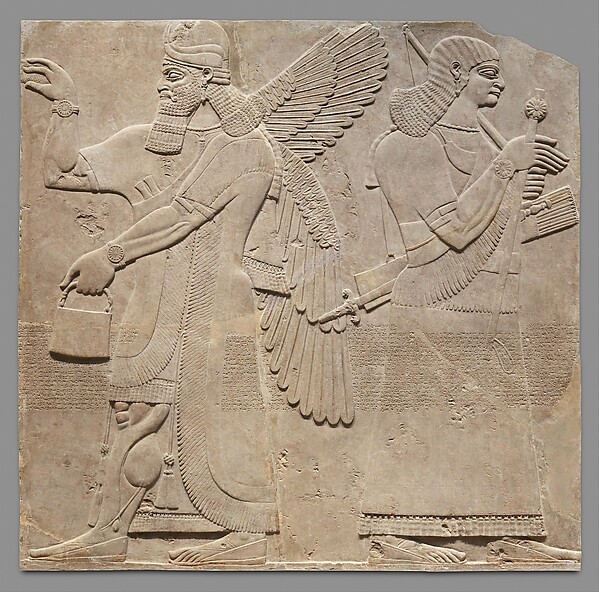
Relief sculpture, by contrast, remains attached to a background. Figures and ornament may stand out only slightly or project so strongly that parts appear almost free of the surface. Relief has often served buildings, monuments and narrative because a broad ground can hold successive figures, actions and inscriptions.[3]
An Assyrian Relief panel from the palace of Ashurnasirpal II, made about 883–859 BCE, places a winged protective figure beside a courtier. Both are larger than life yet carved into a gypsum-alabaster slab only a little over ten centimetres deep. Incised patterns sharpen hair, feathers, jewellery and clothing, while the continuous ground keeps the figures within the palace wall and its ordered programme.[8] Relief is therefore not a lesser attempt at sculpture in the round. It is a different use of depth, one that can make a surface carry bodies, text, pattern and story together.
Low relief, high relief and sunken relief describe different relationships between figure and ground. They deserve close comparison in their own right, but the basic recognition question is simple: can the work be circled as an independent volume, or does its form remain materially bound to a continuous surface?
Four broad ways sculpture is made
Spatial type tells us how a sculpture exists. Process tells us how its form came into being. Four broad families—carving, modelling, casting and construction—cover much historical practice, though individual works often combine them.
Carving: finding form by removal
Carving is a subtractive process. The sculptor removes material from stone, wood or another solid, gradually establishing mass, contour and surface. Different materials encourage different decisions. Fine stone can hold crisp edges or polish into a light-responsive skin; wood grain can guide long folds, curls and ridges, while joined sections may extend a form beyond the width of a trunk. The V&A's account of historical practice also stresses that tool marks, smoothing and finishing are part of what viewers see, not invisible preliminaries.[1]
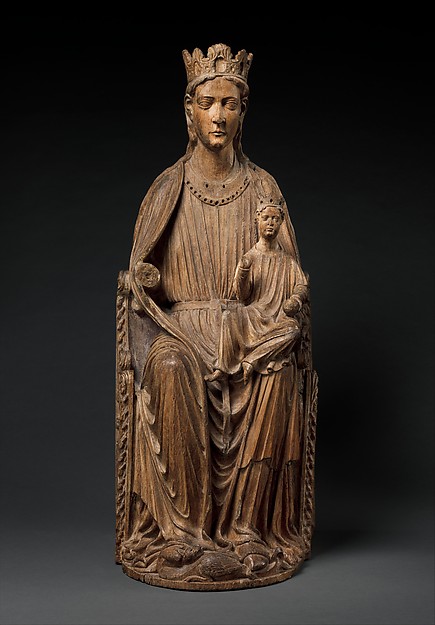
The North French Enthroned Virgin and Child, made about 1210–20, was carved from oak and still bears traces of polychromy. Its crowned figures, throne and dragon were shaped as a three-dimensional devotional object, but carving was only part of its original appearance.[11] Paint, gilding and inlay once transformed many sculptures that now seem primarily brown, grey or white. Ancient marble could also be richly painted or selectively coloured; burial, cleaning and later taste removed much of that evidence.[5] Material is never merely the neutral substance beneath “pure form”.
Modelling: building and pressing
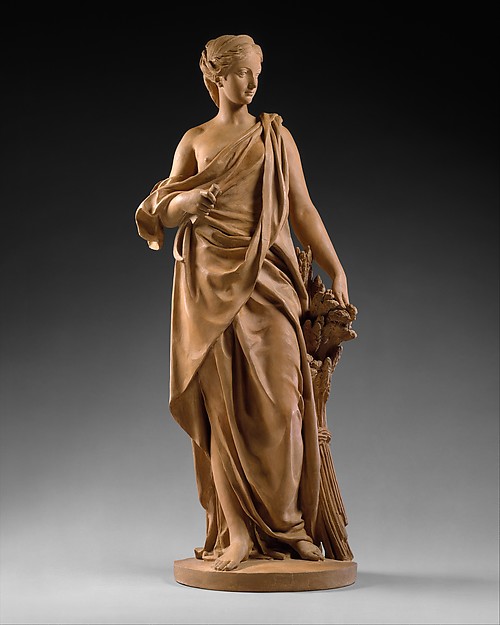
Modelling is additive and responsive. Clay or wax can be pushed, pinched, smoothed, joined and reshaped. A model may be a quick study, a presentation object, a mould-making stage or a finished work. Augustin Pajou's terracotta Ceres, made around 1768–70, is a model for a marble statuette. Its buff clay carries a reddish patination and records a fully considered standing figure, yet its material and purpose differ from the later stone version.[12]
The distinction matters because a sculpture's familiar bronze or marble state may be several translations away from the artist's first model. Modelling can preserve the immediacy of touch, but it can also begin a collaborative sequence involving mould makers, founders, carvers and finishers.
Casting: translating a model
Casting produces form by pouring or pressing material into a mould or prepared cavity. Bronze casting is especially associated with sculpture, but “bronze” names a copper-based alloy rather than a single unchanging recipe. Lost-wax processes begin with a model and create a space that receives molten metal. Direct casting consumes the wax model, while indirect methods use moulds and intermediary models, allowing further versions to be made.[6]
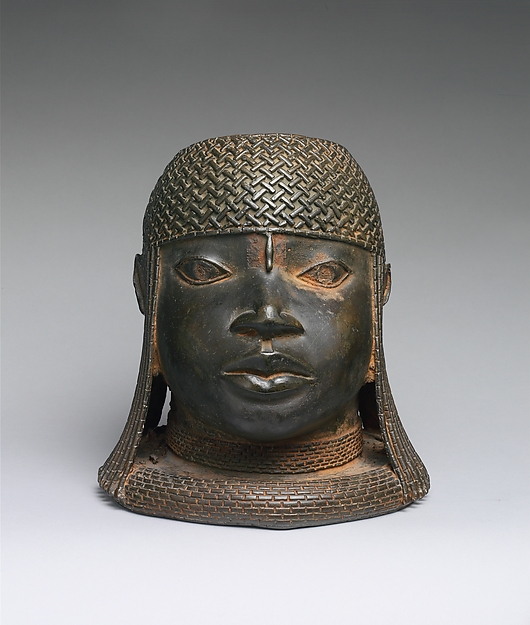
The head of an oba from the Court of Benin, dated from the early fifteenth to the mid-sixteenth century, was made by artists of the Ìgùn Ẹ́rọ̀nwwọ̀n brass-casting guild. Its idealised face, high beaded collar and patterned cap belong to a court tradition in which cast metal joined technical authority to ancestry and royal memory.[15] Naming the guild matters: “African bronze” would erase both the Edo context and the organised artistic community responsible for the work.
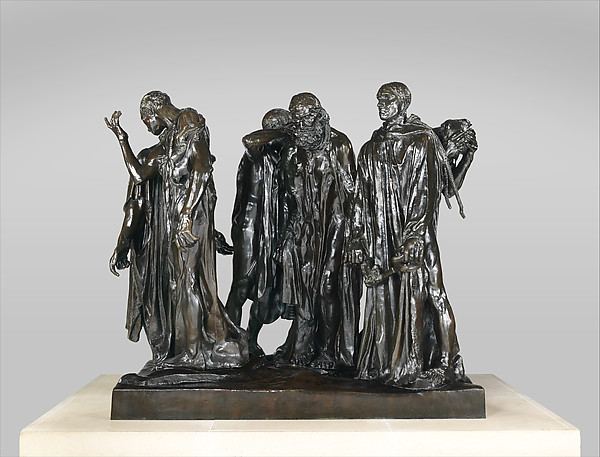
Casting also complicates the date of a sculpture. Umberto Boccioni conceived Unique Forms of Continuity in Space in 1913, but the Met's bronze was cast in 1950.[16] Auguste Rodin modelled The Burghers of Calais between 1884 and 1895, while the large Met bronze was cast in 1985.[13] The design date, model date and cast date answer different questions. A careful label keeps them separate.
Construction and assemblage: joining parts
Constructed sculpture is made by joining components rather than chiefly carving a block or filling a mould. Assemblage narrows that idea towards works built from found or already existing things. Welding, fastening, tying, stacking and balancing can all create sculptural structure, but the technique alone does not determine the meaning.
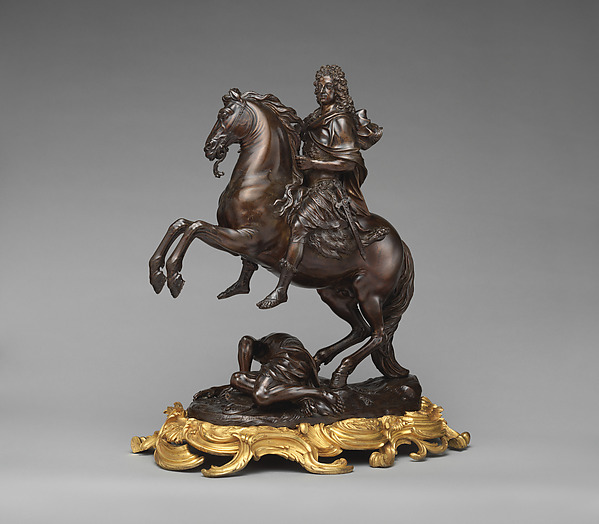
Even apparently traditional bronzes may be assemblies. Roger Schabol's Elector Maximilian II Emanuel of Bavaria on Horseback, cast in 1707, is an equestrian group made from multiple parts, with a gilt-bronze base added roughly two decades later. Rider, rearing horse, fallen figure and base combine into an image of military triumph.[10] It is simultaneously cast, assembled, figurative, equestrian and commemorative. That overlap is exactly why one flat list of sculpture types is misleading.
Statues, busts, groups and monuments
A statue represents a complete figure—human, animal, divine or imaginary—rather than naming every possible sculpture. A bust normally concentrates on the head and upper torso. An equestrian sculpture places a rider on horseback, while a figure group organises several bodies as one composition. A monument is defined partly by public or commemorative purpose and site. These terms help describe format, but they do not reveal whether a work was carved, modelled, cast or assembled.
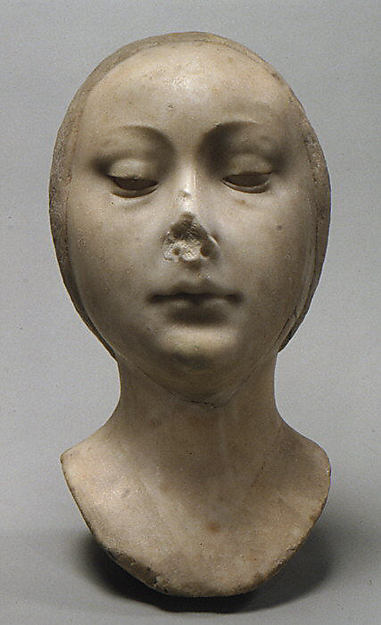
Francesco Laurana's marble Young Woman of about 1475 demonstrates the need for care even with familiar labels. Its smooth oval face and downcast eyes resemble Laurana's portrait busts, but the Met describes it as one of a group of female masks whose original function remains disputed. It may have belonged to a tomb effigy or a wall decoration.[9] Visible form offers clues; the object record sets the limit of certainty.
Rodin's The Burghers of Calais is a figure group and a monument. Six citizens stand together, yet each turns, leans or withdraws in a different way. Walking around the bronze continually changes who appears isolated and who seems connected. The group shows why three-dimensional composition unfolds in time: no single frontal view contains the whole emotional structure.[13]
Figurative, abstract and kinetic sculpture
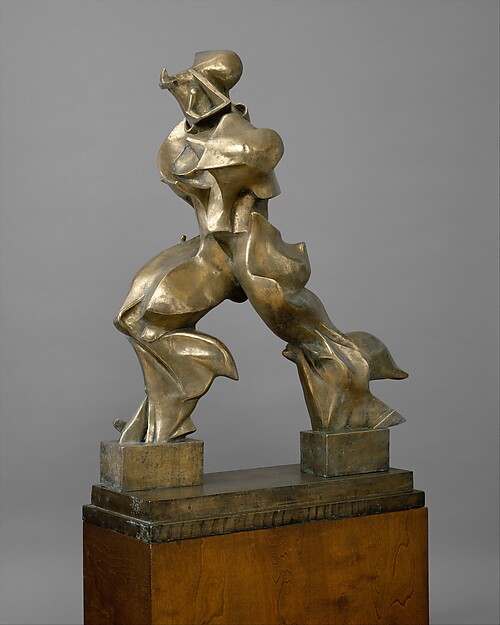
Representation and movement
Boccioni starts from a recognisable stride, then uses swelling and flaring planes to make the surrounding air seem part of the body. The work can be both figurative and abstract.
Figurative sculpture refers recognisably to bodies, creatures or things in the world. Abstract sculpture gives greater independence to mass, void, line, geometry, texture or material. The distinction is a spectrum rather than a wall. Boccioni's Unique Forms of Continuity in Space begins with a striding human figure, but its flaring bronze planes turn the body into an image of pressure, speed and surrounding air.[16]
Kinetic sculpture includes actual movement, whether driven by air, touch, motors or changing balance. Installation and environmental sculpture shift attention towards the relationship between objects, architecture, landscape and the viewer's movement through a site. Land art can use earth, rock, vegetation or large-scale interventions; ephemeral work may be designed to alter or disappear. These expanded forms are crucial to modern and contemporary sculpture, yet they are not extra items in the same sequence as “bust” and “bronze”. They answer different questions about behaviour, duration and place.
Materials rarely tell the whole story
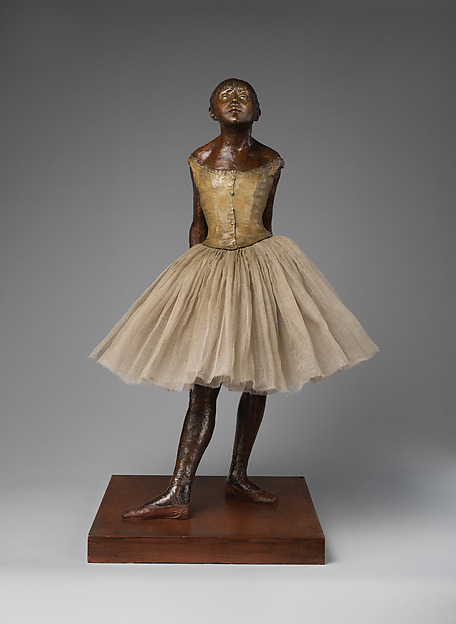
Mixed materials
Bronze, fabric, ribbon and wood work together. Reducing the object to “bronze” would hide the deliberately uneasy meeting of a durable cast body and real clothing.
Stone, wood, clay, metal, plaster, wax, glass, textiles and many other substances can all become sculpture. Material affects weight, scale, edge, colour, texture and survival, but works are often mixed. Edgar Degas's The Little Fourteen-Year-Old Dancer was modelled in 1881 and cast in 1922. The Met version combines partially tinted bronze with cotton tarlatan, silk satin and wood, including a modern tutu.[14] Calling it simply “a bronze” hides the tension between durable metal and real clothing that unsettled its first viewers.
Materials also move between roles. Clay can be a temporary model or fired terracotta; wax can remain visible or disappear during casting; wood can form a finished carving, an internal support or a later base. The useful question is not only “what is it made of?” but “what is each material doing?”
How to recognise a sculpture's type
When facing an unfamiliar sculpture, begin with observation rather than a label.
- Test its relationship to space. Can you move around a complete volume, or do figures remain tied to a background?
- Look for process evidence. Do you see chisel cuts, modelled ridges, seams, joins, repeated cast forms or deliberately assembled parts?
- Separate format from technique. “Bust”, “statue”, “group” and “monument” describe form or purpose; they do not tell you how the object was made.
- Notice material combinations. Paint on wood, cloth on bronze or a later base may be central rather than incidental.
- Ask what changes with viewpoint. Silhouette, voids, balance, reflection and the spacing between figures often reveal the work's structure.
- Read the object label closely. Model and cast dates, workshop participation, cultural attribution and uncertain function can transform an apparently simple category.
The most accurate answer may contain several terms. A sculpture can be freestanding, modelled, cast, figurative, mixed-media and commemorative at once. Types are most useful as tools for looking—not as boxes into which every work must fit.
Watch: From Model to Finished Sculpture
Choose a full translation from clay to marble, a direct lost-wax bronze casting, or a close view of clay modelling.
Recreating Canova's Venus: From Clay to Marble
Follow the staged translation of a sculptural idea through clay, plaster and marble rather than treating the finished stone as a single-step object.
Watch on YouTubeFrequently Asked Questions
The broadest spatial distinction is between sculpture in the round and relief. Process adds carving, modelling, casting and construction; format, representation, movement and site provide further overlapping labels.
Bronze is a material family, not a spatial type or format. A bronze can also be cast, freestanding, figurative, equestrian, monumental or several of these at once.
Carving establishes form mainly by removing solid material. Modelling builds and reshapes a pliable material such as clay or wax, often before moulding or casting.
Relief remains materially attached to a continuous ground, whereas sculpture in the round forms an independent volume that can usually be viewed from multiple sides.
Yes. A single work may be freestanding, modelled, cast, figurative, mixed-media and commemorative at the same time because those words answer different classification questions.
Discussion
Which description would most change how you read a familiar sculpture: its spatial type, making process, material, cast date, original site or intended viewer?
Reader Insights
Space, process, format, representation and site describe different properties; keep useful labels in parallel.
Model dates, cast dates, workshop roles, cultural attribution and later materials can overturn a quick visual label.
Silhouette, voids, balance and relationships between figures often become clear only as viewpoint changes.
Join the Conversation
Share one precise observation or a useful museum example below.
References
- Victoria and Albert Museum, “Sculpture techniques.” https://www.vam.ac.uk/articles/sculpture-techniques
- Getty Research Institute, Art & Architecture Thesaurus, “sculpture in the round.” https://www.getty.edu/vow/AATFullDisplay?find=cameo&logic=AND¬e=&page=1&subjectid=300047264
- Getty Research Institute, Art & Architecture Thesaurus, “reliefs (sculptures).” https://www.getty.edu/vow/AATFullDisplay?find=&logic=¬e=&subjectid=300047230
- Smarthistory, “Sculpture.” https://smarthistory.org/artwork-type/sculpture/
- Metropolitan Museum of Art, “Polychromy of Roman Marble Sculpture.” https://www.metmuseum.org/essays/polychromy-of-roman-marble-sculpture
- Metropolitan Museum of Art, “Direct versus Indirect Casting of Small Bronzes in the Italian Renaissance.” https://www.metmuseum.org/essays/direct-versus-indirect-casting-of-small-bronzes-in-the-italian-renaissance
- Metropolitan Museum of Art, “Marble statue of a kouros (youth),” object 32.11.1. https://www.metmuseum.org/art/collection/search/253370
- Metropolitan Museum of Art, “Relief panel,” object 32.143.6. https://www.metmuseum.org/art/collection/search/322613
- Metropolitan Museum of Art, “Young Woman,” object 13.9. https://www.metmuseum.org/art/collection/search/192028
- Metropolitan Museum of Art, “Elector Maximilian II Emanuel of Bavaria on Horseback,” object 2019.283.26. https://www.metmuseum.org/art/collection/search/825990
- Metropolitan Museum of Art, “Enthroned Virgin and Child,” object 41.190.283. https://www.metmuseum.org/art/collection/search/467997
- Metropolitan Museum of Art, “Ceres,” object 1978.2. https://www.metmuseum.org/art/collection/search/206711
- Metropolitan Museum of Art, “The Burghers of Calais,” object 1989.407. https://www.metmuseum.org/art/collection/search/207812
- Metropolitan Museum of Art, “The Little Fourteen-Year-Old Dancer,” object 29.100.370. https://www.metmuseum.org/art/collection/search/196439
- Metropolitan Museum of Art, “Ùhúnmwèlaò (head of an ọ́bà),” object 1979.206.86. https://www.metmuseum.org/art/collection/search/312290
- Metropolitan Museum of Art, “Unique Forms of Continuity in Space,” object 1990.38.3. https://www.metmuseum.org/art/collection/search/485540