by Tom Gurney
Tom Gurney BSc (Hons) is an art history expert with over 20 years experience
Page created on September 3, 2026 / Page updated on September 13, 2026
Email: tomgurney1@gmail.com / Phone: +44 7429 011000
How Relief Turns a Flat Surface into Projecting Space
Surface becomes space
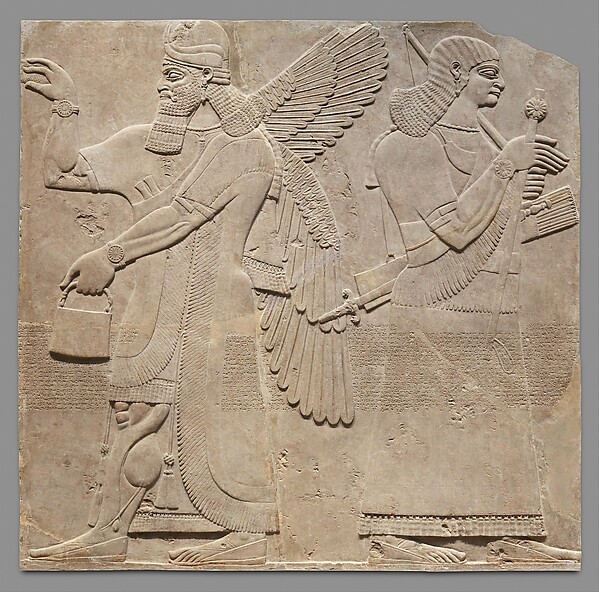
Relief sculpture is sculpture that remains physically attached to a continuous background. Instead of asking the viewer to walk around an independent object, it turns a surface into a field of projected, recessed and incised forms. A relief may rise only a few millimetres, push figures almost into the round or cut an image below the original face of a wall. What holds these possibilities together is the continuing relationship between figure and ground.[1]
The familiar labels low relief, high relief and sunken relief are useful, but they should not be treated as measurements that always divide cleanly. One work can move between shallow lines, rounded bodies and deeply undercut edges. The clearest approach is to look first: which plane is highest, how far does the image project, where do shadows gather, and what remains structurally tied to the field?
At a Glance
- Groundthe continuous field remains structurally present even when forms project strongly or sink below its face.
- Low reliefuses compressed projection, contour and overlap; it is not defined by one universal fractional depth.
- High reliefpushes forms forward and may undercut edges so changing light produces deep shadow.
- Sunken reliefcuts the image below the original surface plane and can combine incision with shallow modelling.
- Contextmaterial, colour, architecture, viewing height and illumination all change how relief depth is read.
Contents
- How Relief Turns a Flat Surface into Projecting Space
- Three depth relationships to look for
- Low, high and sunken relief
- A field can hold several depths
- Projection, shadow and the edge of the round
- Relief as architecture and narrative
- Portable reliefs: stone, clay and bronze
- Colour, surface and changing light
- How to recognise and describe relief sculpture
- Sculpture reference pages
- Watch Relief, Carving and Casting in Practice
Three depth relationships to look for
Low, high and sunken relief
In low relief, also called bas-relief, forms project only slightly from the background. Depth is compressed, so artists often use overlap, changes of scale, crisp contour and fine surface cutting to make spatial relationships legible. The result is not simply a flattened statue. It is a mode designed for frontal or oblique viewing, sensitive to the direction of light.
High relief pushes forms further forward. Heads, limbs, drapery or objects may be strongly rounded or undercut so that they cast deep shadows, while other parts remain shallow. This can make a scene appear to emerge from architecture. The shift between levels is often more important than any attempt to decide whether a precise fraction of a figure is exposed.
In sunken relief, the original face of the material remains the highest plane and the image is cut below it. Incised outlines may define a figure whose interior is lightly modelled within the recessed area. Egyptian terminology is especially important here: incised, sunk and raised systems were all used, and their surfaces could be painted, gilded or inlaid.[3] “Sunken” therefore describes the relationship of the carving to its field, not a monochrome style.
A field can hold several depths
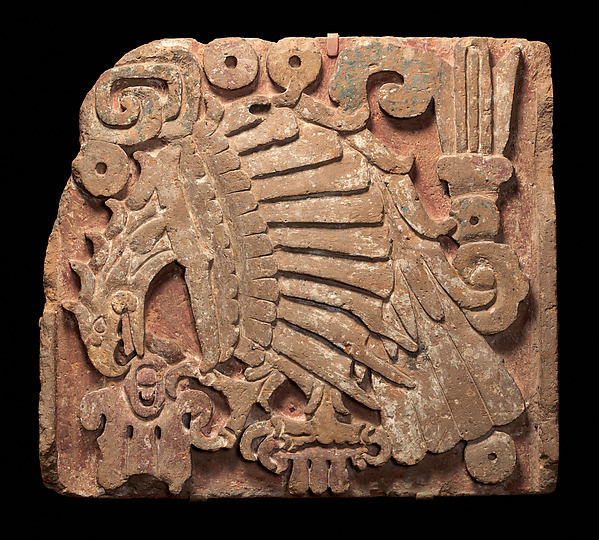
The Toltec Eagle relief, made between 900 and 1200 CE, demonstrates how much spatial force can be drawn from a panel only about six centimetres deep. An eagle bends over a stylised human heart. Its back and tail make a broad arc, while scrolls, shells and other signs fill the remaining field. Each row of feathers rises to a slightly different level, and their angled edges create shadow that suggests further overlap.[4]
The panel was not necessarily an isolated museum object. The Met relates it to reliefs on sacred architecture at Tula and other Mesoamerican centres. Traces of blue and red, together with plaster layers discovered during conservation, show that it was painted more than once. Its present stone tones preserve evidence of a changing coloured surface rather than an original absence of colour.[4]
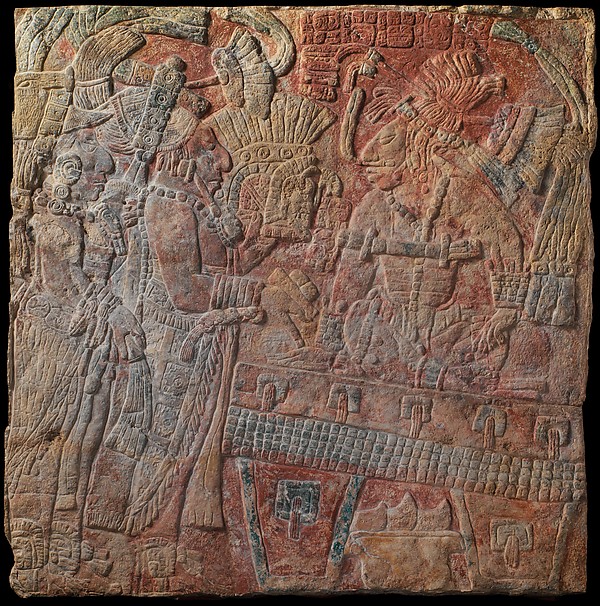
Chakalte's Relief with enthroned ruler, dated 770 CE, uses an almost opposite strategy. Its Maya figures and hieroglyphic text are carved in very low relief. The small shifts of plane become clearer when light passes across them; Smarthistory notes that torchlight may once have animated the shallow figures.[7][8] The relief asks for close, changing attention even though the slab itself presents a frontal field.
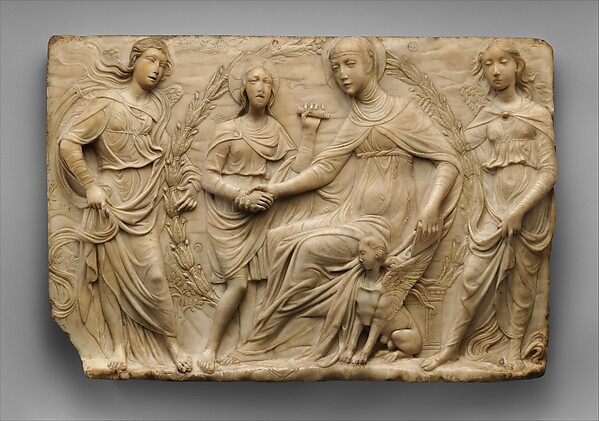
Agostino d'Antonio di Duccio's marble Saint Bridget of Sweden Receiving the Rule of Her Order, made in 1459, is similarly dependent on line and slight changes of level. Drapery, floor, architecture and kneeling bodies are compressed into a narrow depth. Rather than modelling each figure as a separate volume, the sculptor makes contour travel across the marble, allowing the scene to approach drawing without ceasing to be sculpture.[13]
These examples show why low relief is not a lesser technical achievement than high relief. Its challenge is to make very small physical differences carry legible bodies, spaces and hierarchies.
Projection, shadow and the edge of the round
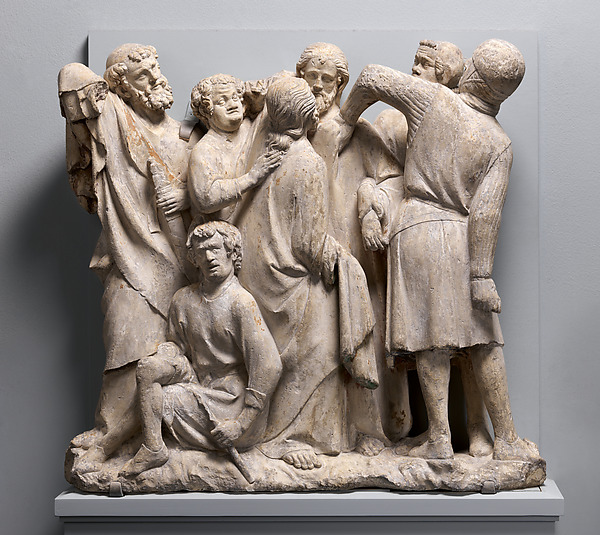
The medieval French Relief of the Betrayal and Arrest of Jesus, dated 1264–88, presses numerous figures into a dense limestone scene. Heads and shoulders project strongly; bodies overlap; weapons and gestures create a jagged upper rhythm. The work probably came from a choir screen, where it belonged to an architectural sequence rather than standing alone. Traces of colour and gilding remind us that projection and shadow were originally joined by painted distinctions.[12]
High relief can approach sculpture in the round, but attachment still matters. A head may be carved almost fully around while its back, shoulders or surrounding drapery remain joined to the field. The background supplies support, defines the limits of the scene and controls the primary viewpoint. Deep projection does not cancel that relationship.
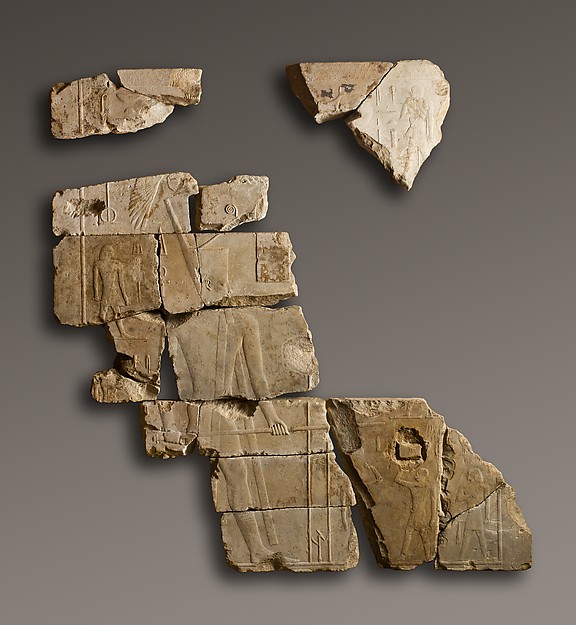
The Relief from the Palace of Apries in Memphis, dated 589–570 BCE, survives as assembled limestone blocks from a dismantled monumental gateway. A large king and smaller officials belonged to a scene of the Festival of the White Hippopotamus. The raised forms are broad and voluminous, while much interior detail remains restrained.[5] Their imposing effect depends on the contrast between swelling bodies, cut outlines and the surrounding plane—and on an original gateway scale that a museum display can only partly reconstruct.
Relief as architecture and narrative
Relief has often joined pictures to buildings. A wall, screen, gateway, frieze, drum or base can carry a scene without surrendering its structural identity. The background becomes both a physical support and a continuous pictorial world.
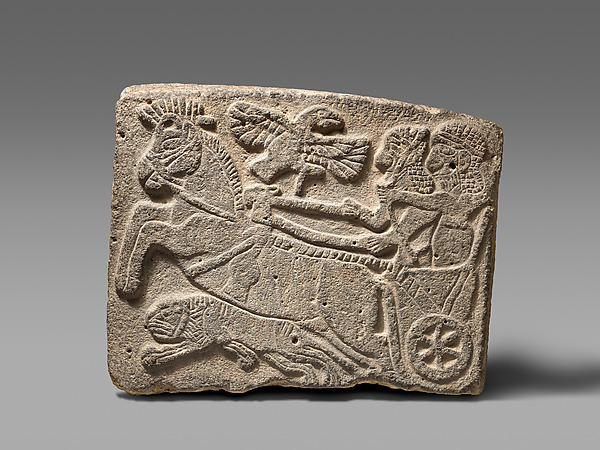
The Neo-Hittite Orthostat relief: lion-hunt scene, made around the tenth to ninth century BCE, was carved on a basalt slab intended for the lower part of a wall. A mounted hunter turns to draw a bow as a lion advances. The action reads laterally across the block, and the slab's rectangular boundary remains visible as part of the register.[11] Removing such a work to a museum protects and isolates it, but also changes its scale relationship to the architecture and adjacent panels.
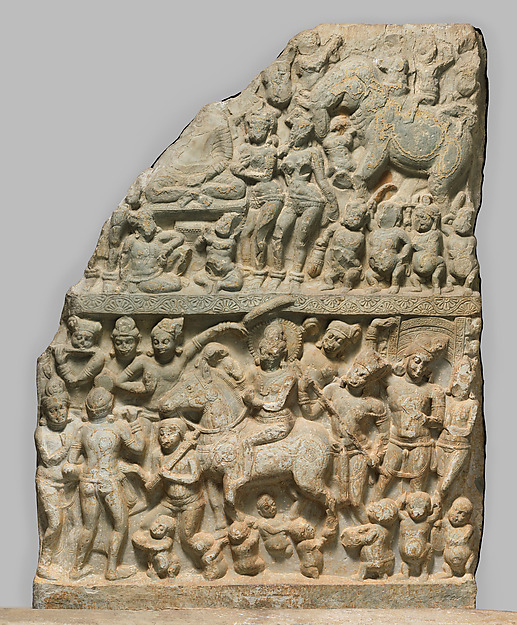
A limestone Drum panel with scenes of the Great Departure and Temptation of the Buddha, made at Nagarjunakonda in the first half of the third century CE, originally belonged to a curved architectural element. Crowded figures, horses and repeated bodies carry episodes around the surface.[10] Relief makes this narrative continuity possible: a viewer can follow events along a field whose physical form already guides movement.
The original setting also controls light, height and distance. Shallow carving near the eye behaves differently from strongly projecting figures mounted above a doorway. A damaged fragment may retain exquisite carving but lose the neighbouring scenes, painted ground or ritual movement that once organised its meaning.
Portable reliefs: stone, clay and bronze
Relief is not confined to architecture. Plaques, devotional images, memorial panels, medals and furniture mounts retain a designed background while moving between settings.
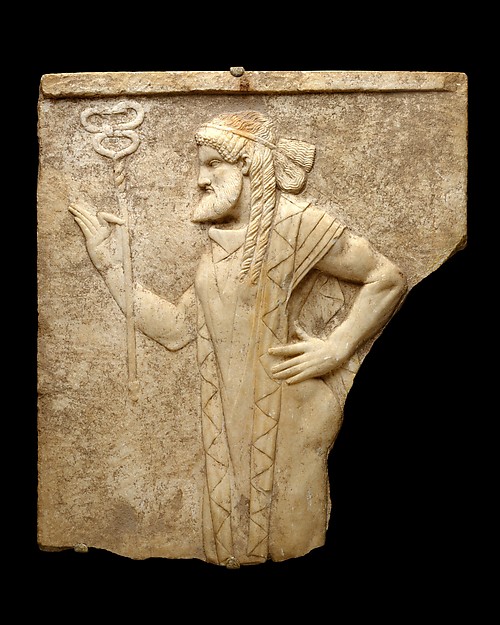
The Roman Marble relief with Hermes, made between 27 BCE and 68 CE, presents the god in an intentionally archaistic style. Spiral hair, rigid posture and patterned drapery recall Greek Archaic sculpture made centuries earlier. The retrospective style could lend sacred authority while also suiting the display culture of a Roman villa.[6] Its shallow, self-contained slab is portable, but the figure still depends on the marble field and a frontal view.
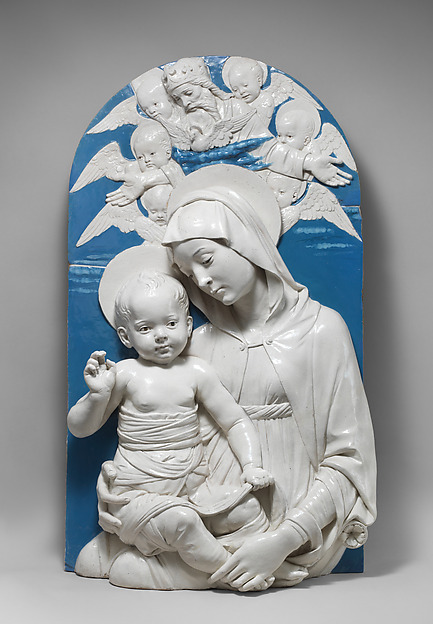
Andrea della Robbia's Madonna and Child (The Lehman Madonna), about 1470–75, expands relief through glazed terracotta. White figures project against a blue ground within a circular frame.[9] The glaze is not an optional coat hiding the sculpture: colour, shine, framing and depth form a single designed object. Modelling in clay, firing and glazing produce a surface character quite unlike cut marble even when both works organise figures against a field.[2]
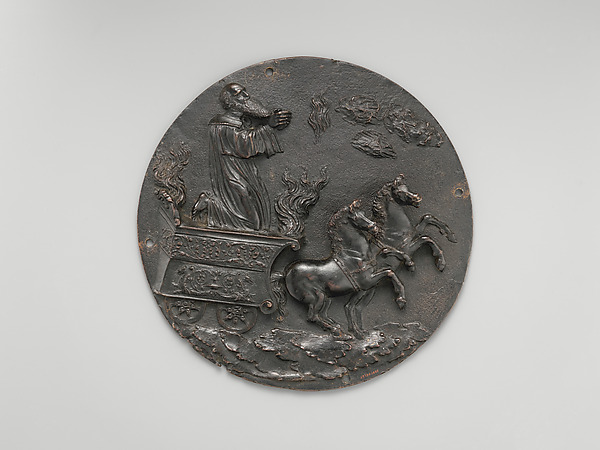
Relief can also be cast. The Master of the Barbarigo Reliefs' Elijah in the Fiery Chariot, made about 1520, is bronze with partial oil gilding. Elijah rises in a horse-drawn chariot while Elisha remains below, so vertical movement is compressed into a small metal panel.[14] Casting translates a model into metal and can preserve intricate changes of level. Calling every relief a “carving” would therefore confuse spatial type with manufacturing process.
Colour, surface and changing light
Modern photographs often light a relief evenly from the front, making it easy to read but reducing the shadows that reveal depth. In a gallery, move slightly if permitted. Raking light may expose fine incisions; an oblique view can show undercut edges and the thickness of a projected head. A direct view clarifies the composition and inscriptions. None is automatically the one correct angle.
Surface finishes alter those effects. Paint separates figures from ground, gilding catches light, glaze pools or shines, and weathering softens edges. On the Toltec eagle, surviving pigment and multiple plaster layers record renewed use. On the French Betrayal relief, small traces point to a once more colourful ensemble. The current appearance is historical evidence, but it is not always the complete original design.
How to recognise and describe relief sculpture
- Find the continuous field. Identify the wall, slab, plaque, vessel or architectural element to which the forms remain attached.
- Locate the highest plane. Raised forms stand above a lowered ground; sunken images stay beneath the original surface.
- Compare depths within the work. Do not force a mixed relief into one label when heads, bodies and background use different projections.
- Follow the shadows. Fine lines, angled cuts and deep undercutting reveal how light completes the modelling.
- Name material and process separately. A relief may be carved marble, modelled stucco, glazed terracotta or cast bronze.[2]
- Reconstruct the setting cautiously. Ask whether the object belonged to a gateway, screen, wall register, drum, tomb or portable frame.
- Look for colour evidence. Pigment, gilding, glaze and inlay may be central even when little survives.
- Use qualified labels. “Very shallow raised relief” or “high relief with low-relief background” is often more informative than an unsupported percentage.
Relief sculpture makes depth out of constraint. Because the figure cannot abandon its field, every change of plane, edge, overlap and shadow matters. The most useful classification is the one that sharpens looking: not a rigid formula, but an account of how surface becomes space.
That account should also remain open to uncertainty. A broken edge can hide the former depth of a figure, restoration can alter a surface, and photographs can exaggerate or suppress shadow. Object labels, physical observation and evidence about the original setting work best together.
Watch: Relief, Carving and Casting
Choose a Getty definition through one marble relief, a V&A demonstration of marble carving, or a Getty direct lost-wax casting sequence.
What Is a Relief Sculpture?
See projection, ground and viewing position explained through John Deare's marble relief.
Watch on YouTubeFrequently Asked Questions
Relief sculpture remains physically attached to a continuous ground, whether its forms project above that field or are cut below the original surface.
Low relief uses slight projection and compressed depth; high relief projects more strongly and may include deep undercutting. Many works combine both.
In sunken relief, the original face remains the highest plane while outlines and modelled forms are cut below it.
No. Relief can be carved, modelled, pressed, hammered or cast. Glazed terracotta and cast bronze are relief media as surely as marble and limestone.
Raking or changing light makes small shifts of plane visible, while flat frontal light can suppress shallow carving and undercut shadow.
Discussion
Which feature most changes your reading of a relief: the depth of projection, original light, painted surface, architectural setting or viewing distance?
Reader Insights
State which plane is highest, where forms project and where shadows gather before choosing a relief label.
Wall, monument, vessel or portable panel can determine scale, sequence, light and movement.
Surviving stone or metal may once have been painted, gilded, glazed or inlaid.
Join the Conversation
Share one precise observation or a useful museum example below.
References
- Getty Research Institute, Art & Architecture Thesaurus, “reliefs (sculptures).” https://www.getty.edu/vow/AATFullDisplay?find=&logic=¬e=&subjectid=300047230
- Victoria and Albert Museum, “Sculpture techniques.” https://www.vam.ac.uk/articles/sculpture-techniques
- Global Egyptian Museum, “Relief.” https://www.globalegyptianmuseum.org/glossary.aspx?id=317
- Metropolitan Museum of Art, “Eagle relief,” object 93.27.2. https://www.metmuseum.org/art/collection/search/307599
- Metropolitan Museum of Art, “Relief from the Palace of Apries in Memphis,” object 09.183.1a1–23. https://www.metmuseum.org/art/collection/search/547705
- Metropolitan Museum of Art, “Marble relief with Hermes,” object 1991.11.8. https://www.metmuseum.org/art/collection/search/255983
- Metropolitan Museum of Art, “Relief with enthroned ruler,” object 1979.206.112. https://www.metmuseum.org/art/collection/search/313240
- Smarthistory, “Chakalte’, Relief with Enthroned Ruler.” https://smarthistory.org/chakalte-ruler/
- Metropolitan Museum of Art, “Madonna and Child (The Lehman Madonna),” object 1975.1.132. https://www.metmuseum.org/art/collection/search/205116
- Metropolitan Museum of Art, “Drum panel with scenes of the Great Departure and Temptation of the Buddha,” object 28.31. https://www.metmuseum.org/art/collection/search/38239
- Metropolitan Museum of Art, “Orthostat relief: lion-hunt scene,” object 55.1.1. https://www.metmuseum.org/art/collection/search/324008
- Metropolitan Museum of Art, “Relief of the Betrayal and Arrest of Jesus,” object 2006.217. https://www.metmuseum.org/art/collection/search/463973
- Metropolitan Museum of Art, “Saint Bridget of Sweden Receiving the Rule of Her Order,” object 1999.7. https://www.metmuseum.org/art/collection/search/192770
- Metropolitan Museum of Art, “Elijah in the Fiery Chariot,” object 25.120.284. https://www.metmuseum.org/art/collection/search/194000