by Tom Gurney
Tom Gurney BSc (Hons) is an art history expert with over 20 years experience
Page created on September 3, 2026 / Page updated on September 13, 2026
Email: tomgurney1@gmail.com / Phone: +44 7429 011000
From Responsive Earth to Durable Sculptural Form
From plastic earth to fired form
Clay sculpture begins in a condition of change. While damp, clay can receive pressure, hold a fingerprint, join another piece or take the shape of a mould. It may remain an unfired study, pass into plaster or bronze through moulding and casting, or be fired so that clay itself becomes the enduring sculpture. That range makes “clay” both a material and a stage within larger sculptural processes.[1][2][3]
This page uses historical objects to explain what viewers can recognise: added and pressed form, hollow construction, repeated types, fired bodies, coloured surfaces and different social functions. It is not a workshop guide. Firing schedules, equipment, recipes, repair methods and other professional procedures fall outside its purpose.
At a Glance
- Statedistinguish an unfired study or model from a fired ceramic object.
- Constructionlook for direct modelling, coils, joined parts, hollow bodies and mould-related repetition.
- Bodyuse recorded terms such as terracotta, earthenware and stoneware rather than treating every clay object alike.
- Surfaceslip, paint, coating, patina and glaze can be integral to colour, light and meaning.
- Purposetomb, shrine, home, collector and studio settings produce different kinds of sculptural object.
Contents
- From Responsive Earth to Durable Sculptural Form
- Five questions for a clay sculpture
- Clay before and after firing
- Building form: coils, joins and hollow bodies
- Moulds, repetition and singular presence
- Modelling touch, posture and emotion
- Models and finished terracotta
- Slip, paint, coating and glaze
- Sculpture in tomb, shrine, home and studio
- How to read clay sculpture
- Sculpture reference pages
- Watch Clay Sculpture Take Form
Five questions for a clay sculpture
Clay before and after firing
Modelling is additive and revisable. Material can be pushed outwards, attached, compressed or cut back, allowing a sculptor to alter volume from moment to moment. Carving begins with a resistant mass and removes it; clay modelling can build a form as well as reduce one. Moulding introduces another possibility by pressing or casting clay into a prepared negative, so related forms can be repeated.[1][2]
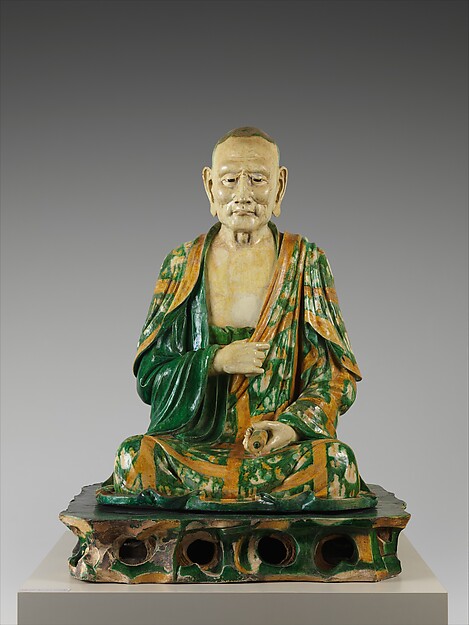
Firing changes workable clay into a ceramic body. “Terracotta” usually identifies a fired clay object, but museum records may instead specify earthenware or stoneware, terms that carry their own material histories. They should not be exchanged casually. The Chinese Arhat (Luohan), made about 1000, is recorded as stoneware with three-colour glaze, while the Japanese haniwa head is earthenware with painted, incised and applied decoration.[4][5]
The distinction is visible as well as technical. The life-size luohan has a dense, reflective glazed presence. Colour pools and shifts across robe and flesh, making the surface respond to light. The haniwa head presents a more open, matte body: apertures form the eyes and mouth, applied elements build the features, and traces of paint complicate its present earth-coloured appearance.
Building form: coils, joins and hollow bodies
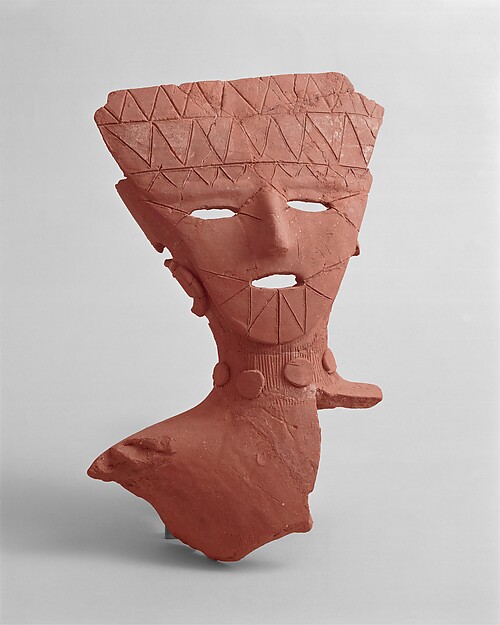
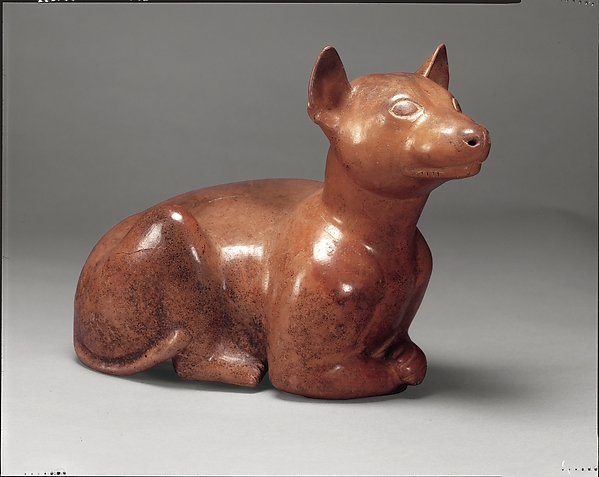
Clay's flexibility permits sculpture to grow from separate masses. A figure may be built around an empty interior, assembled from sections or strengthened through broad walls and compact projections. These are historical construction ideas, not a single universal sequence. Technique must follow evidence from the specific object rather than assumptions based on colour or texture.[3]
The Head of a Clay Tomb Sculpture (Haniwa) dates from the fifth to early sixth century in Japan's Kofun period. The Met identifies haniwa sculpture as coil-built, and this head preserves incision and applied decoration as well as paint.[5] Its openings are positive decisions within the form: emptiness helps create the face rather than merely revealing damage.
The Colima Seated dog, dated 200 BCE–300 CE, is also hollow, but belongs to the ceramic mortuary art of ancient western Mexico.[9] Rounded body volumes, upright ears and alert posture are unified by a polished reddish slip. Incised and modelled details sharpen eyes, nostrils and muzzle without breaking the large, continuous silhouette. Similar construction principles therefore serve a distinct image, surface and funerary setting.
Moulds, repetition and singular presence
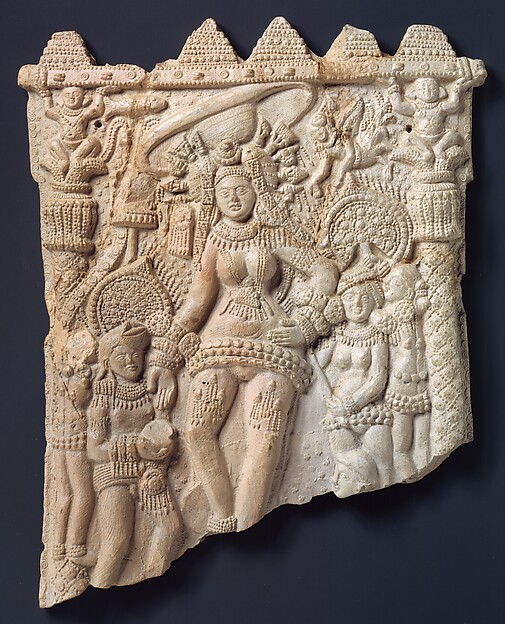
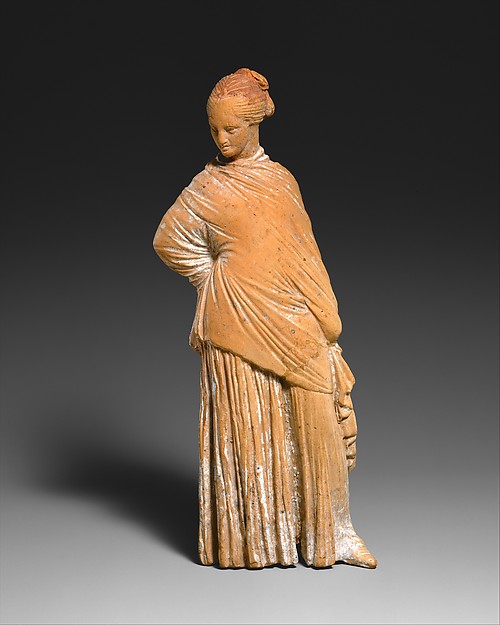
A mould can carry a designed form across more than one impression. Repetition does not make a clay figure artistically empty; it changes where variation may occur. Joining, finishing, added details, colour, firing and use can differentiate objects that share a moulded starting point.[2][3]
The first-century BCE Goddess who bestows riches, probably Sri Lakshmi from Chandraketugarh in West Bengal is identified as moulded terracotta.[6] Its shallow, frontal body, elaborate jewellery and densely patterned headdress concentrate detail within a plaque-like plane. The probable identification should remain qualified: the collection title preserves uncertainty rather than presenting the figure's identity as settled.
The Greek Terracotta statuette of a standing woman, made in the late fourth or early third century BCE, belongs to a tradition often associated with Tanagra.[7] Its small scale, turning pose and layered drapery differ from the frontal West Bengal figure. Such figurines circulated through domestic, sacred and funerary settings. “Repeated” and “personal” are not opposites here; a familiar type could enter a particular household, sanctuary or grave.
Modelling touch, posture and emotion
Direct modelling can make pressure and revision legible, but apparent spontaneity should not be confused with a lack of planning. A compact pose can be organised through carefully balanced masses, while incisions and applied motifs redirect attention across the surface.[1][3]
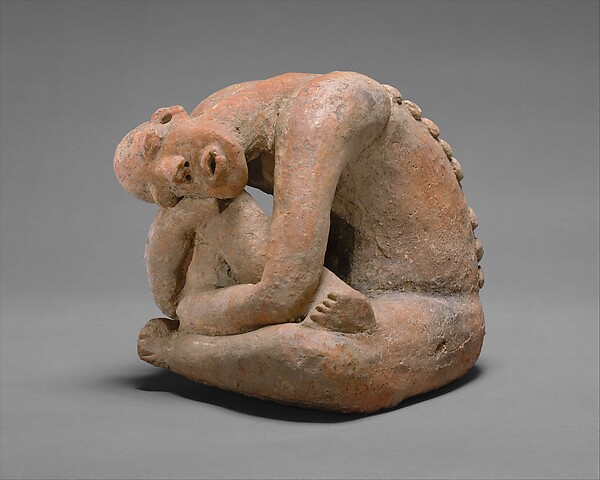
The thirteenth-century Middle Niger Seated figure folds around one raised knee.[8] Back, bent limb and lowered head create a continuous arc around the open space at the body's centre. Raised and impressed details animate the skin. The pose has invited readings of anxiety, illness or absorbed prayer, yet the figure's original significance is not securely known. Its intensity is real; a single modern emotional label would be too certain.
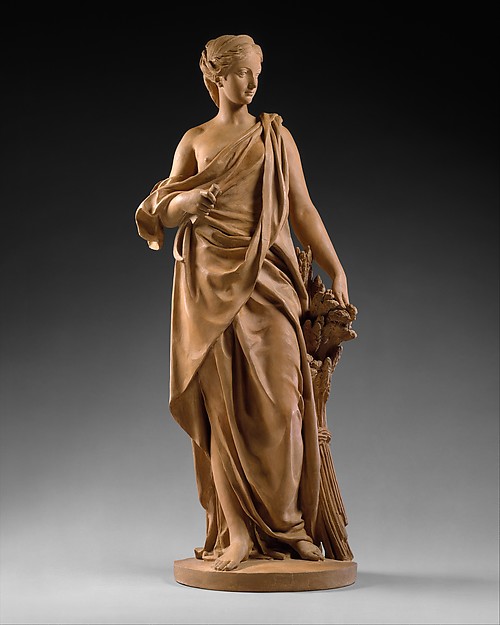
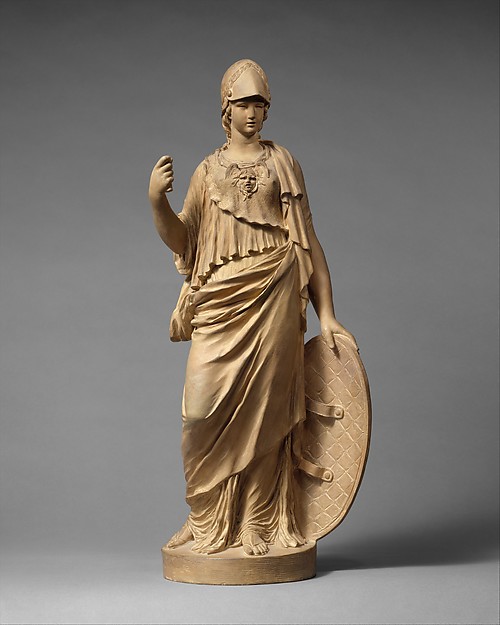
Clodion's Minerva of 1766 presents another kind of modelled presence.[10] Armour, drapery, shield and owl are gathered into an independent terracotta sculpture. Clay allows fine transitions between soft cloth, hard attributes and the figure's stance. It should not be demoted automatically to “preparation” simply because European sculptors also used clay for studies.
Models and finished terracotta
In European sculptural practice, a small clay work might test an idea, communicate a design or guide a later translation into another material. The Italian term bozzetto is often used for a three-dimensional sketch. Yet purpose cannot be diagnosed from roughness alone: a lively surface may be intentional, and a carefully finished terracotta may still have served a larger project.[3]
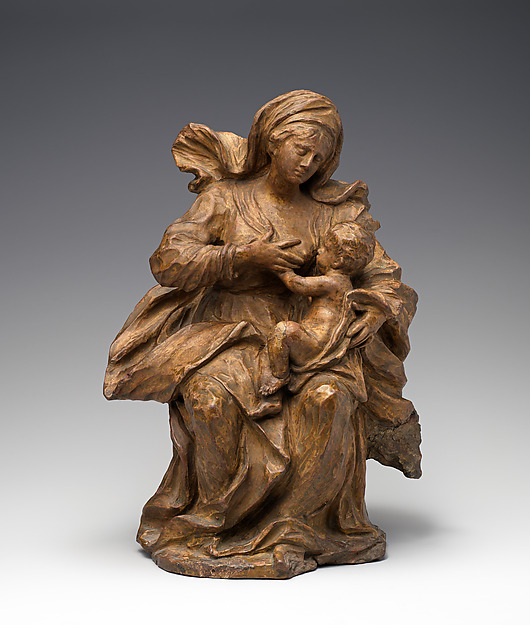
Giovanni Giuliani's Virgin and Child, dated 1736, is documented as a bozzetto.[11] At only 22.2 centimetres high, it compresses an architectural or monumental idea into a figure group that can be examined in the round. Traces of metallic patina show that even a design-stage object could receive a visually active surface.
Placed beside Minerva, the bozzetto clarifies why “clay model” and “terracotta sculpture” are not interchangeable labels. Giuliani's object records a design process; Clodion's work stands as the collected sculpture. Both retain modelling's capacity for quick transitions and small adjustments, but their historical roles differ.[10][11]
Slip, paint, coating and glaze
Colour belongs to the object
The luohan's three-colour glaze transforms modelled stoneware into a reflective monumental presence; surface is not a detachable afterthought.
Fired clay is rarely only the colour of its body. The selected works include three-colour glaze, painted traces, slip, applied coating and metallic patina.[4][5][8][9][11] These layers can organise detail, change reflection, unify joined areas or distinguish flesh, cloth and ornament.
The Akan and other West African terracotta traditions represented elsewhere in the group underscore the importance of coatings and social setting, but the Middle Niger figure must be described on its own evidence. Likewise, the Colima dog's polished slip belongs to that work's material and mortuary history, not to a universal ceramic finish. The luohan's glaze is inseparable from its monumental presence, while the haniwa's surviving paint is fragmentary evidence of a formerly different visual state.
Loss can encourage a misleading taste for bare clay. Abraded pigment, missing glaze, breaks and old restorations may reveal the ceramic body without proving that makers intended it to dominate. Close looking should separate what is visible now from what the record establishes about earlier surfaces.
Sculpture in tomb, shrine, home and studio
Clay's availability and responsiveness supported very different forms of sculpture. Haniwa stood within elite burial landscapes; Colima ceramic figures entered shaft-tomb traditions; Greek figurines appeared in houses, sanctuaries and graves; the probable Sri Lakshmi carried another religious image tradition; Giuliani's bozzetto belonged to a sculptor's design process.[5][6][7][9][11]
These contexts must not be collapsed into a story that clay naturally means intimacy, ritual or modest cost. The life-size luohan demonstrates ceramic monumentality, and Clodion's Minerva shows terracotta cultivated for collectors.[4][10] The Middle Niger figure survives from a sophisticated urban region but without a fully recoverable original function.[8] Material creates possibilities; communities give those possibilities meaning.
How to read clay sculpture
- Use the museum's medium line. Terracotta, earthenware and stoneware name different recorded bodies.
- Look for added and pressed form. Applied features, seams, incisions and repeated patterns can indicate how volume developed.
- Notice openings and thickness. A hollow body or pierced feature may be structural and expressive.
- Read colour as material. Slip, paint, coating, patina and glaze can belong to the sculpture rather than decorate it afterwards.
- Distinguish model from finished object. Documentary purpose is stronger evidence than a surface that merely looks rough or quick.
- Keep repetition nuanced. Mould-related figures can differ through assembly, finish and use.
- Qualify function. Tomb, shrine, household, memorial and studio contexts are not interchangeable.
- Treat damage as history, not instruction. Breaks and losses reveal construction while also changing the intended image.
Clay sculpture is best understood as a chain of decisions rather than a beginner's list of techniques. Modelling establishes mass; building and moulding organise the body; firing fixes a ceramic state; surface changes light and colour; context determines what the object was for. Exact works keep those decisions visible without turning historical interpretation into workshop advice.
Watch: Clay Sculpture Take Form
Choose a V&A reconstruction of Donatello's modelling, a National Gallery translation from clay to marble, or a MoMA demonstration of hand-building and relief.
Donatello's Clay Modelling Technique
Watch a sculptor recreate a fifteenth-century terracotta panel so pressure, addition, joining and tool marks remain visible as stages of modelling.
Watch on YouTubeFrequently Asked Questions
No. Clay may remain unfired or serve as a temporary model. Fired records may specify terracotta, earthenware or stoneware, and those terms should follow the object evidence.
Historical works can combine direct modelling, coiling, joining, pressing and mould-related production. Identify only the processes supported by the object record.
No. Slip, paint, applied coating, patina and glaze can be integral to a clay sculpture's intended surface.
A clay model can be an exploratory or translation stage, while fired terracotta can be the intended finished sculpture. Date, firing evidence and collection records help distinguish their roles.
Yes. Moulds can support repetition, but assembly, modelling, surface treatment, firing and use may make each surviving object materially and socially distinct.
Discussion
Which clue most changes your reading of a clay sculpture: fingerprints, joined sections, mould repetition, a fired body, surviving colour or its original tomb, shrine, home or studio setting?
Reader Insights
Unfired model, fired terracotta, earthenware and stoneware name different material histories.
Hand modelling, coils, joins and moulds can coexist; repetition does not erase later individual work.
Slip, paint and glaze change light, while tomb, shrine, home and studio contexts change meaning.
Join the Conversation
Share one precise observation or a useful museum example below.
References
- Victoria and Albert Museum, “Sculpture techniques.” https://www.vam.ac.uk/articles/sculpture-techniques/
- National Gallery of Art, “Explore the Basics of Sculpture.” https://www.nga.gov/educational-resources/explore-basics-sculpture
- Metropolitan Museum of Art, European Terracottas from the Arthur M. Sackler Collections. https://resources.metmuseum.org/resources/metpublications/pdf/European_Terracottas_from_the_Arthur_M_Sackler_Collections.pdf
- Metropolitan Museum of Art, “Arhat (Luohan),” object 21.76. https://www.metmuseum.org/art/collection/search/44799
- Metropolitan Museum of Art, “Head of a Clay Tomb Sculpture (Haniwa),” object 1975.268.413. https://www.metmuseum.org/art/collection/search/44832
- Metropolitan Museum of Art, “Goddess who bestows riches, probably Sri Lakshmi,” object 1990.281. https://www.metmuseum.org/art/collection/search/38518
- Metropolitan Museum of Art, “Terracotta statuette of a standing woman,” object 09.221.28. https://www.metmuseum.org/art/collection/search/248166
- Metropolitan Museum of Art, “Seated figure,” object 1981.218. https://www.metmuseum.org/art/collection/search/314362
- Metropolitan Museum of Art, “Seated dog,” object 2007.345.1. https://www.metmuseum.org/art/collection/search/318964
- Metropolitan Museum of Art, “Minerva,” object 1975.312.8. https://www.metmuseum.org/art/collection/search/206339
- Metropolitan Museum of Art, “Virgin and Child,” object 1987.94. https://www.metmuseum.org/art/collection/search/207684