by Tom Gurney
Tom Gurney BSc (Hons) is an art history expert with over 20 years experience
Page created on September 3, 2026 / Page updated on September 13, 2026
Email: tomgurney1@gmail.com / Phone: +44 7429 011000
How Substance, Structure and Surface Work Together in Sculpture
Substance shapes appearance
Sculpture can be carved from stone or wood, modelled in clay or wax, cast in metal or plaster, and assembled from materials that were never intended to behave alike. A useful guide to sculpture materials therefore asks more than “what is it made of?” It asks what gives the work structure, what records touch, what carries colour, which parts are visible, and whether the material was a model, a mould-making stage or the intended final object.
Material and process are related but not interchangeable. Bronze is a material family; casting is one way it can be formed. Terracotta is fired clay, while an unfired clay model may survive only by accident. Wood can be both a carved surface and an internal support. Museum guidance groups sculpture across organic and inorganic materials precisely because each combination behaves and survives differently.[3]
At a Glance
- Structureidentify what carries weight, holds the form or acts as an armature.
- Surfacerecord what receives light, colour, texture and the final traces of tools or touch.
- Processseparate the material family from carving, modelling, casting, firing, joining or finishing.
- Stageask whether an object is a study, mould-making model, translation, cast, copy or intended final work.
- Changedistinguish original combinations from losses, replacements, corrosion, cleaning and later display materials.
Contents
- How Substance, Structure and Surface Work Together in Sculpture
- Read material by its role
- Stone: mass, edge and surface
- Wood: grain beneath colour
- Clay and terracotta: touch made durable
- Bronze and other metals: casting, joining and surface
- Plaster: model, cast or final sculpture
- Wax: immediacy and translation
- Ivory and ethical context
- Mixed media: materials as a designed system
- Surface is part of material
- How to read a sculpture's materials
- Sculpture reference pages
- Watch Sculpture Materials and Processes
Read material by its role
Stone: mass, edge and surface
Marble, limestone, sandstone, alabaster, basalt, granite and many other stones have different grain, hardness, colour and structural behaviour. Carving removes material, so each cut narrows the remaining possibilities. A sculptor can leave tool marks, refine a sharp edge, soften a transition or polish a surface until light seems to enter it. These effects belong to a particular stone and finish, not to “stone” in the abstract.[2]
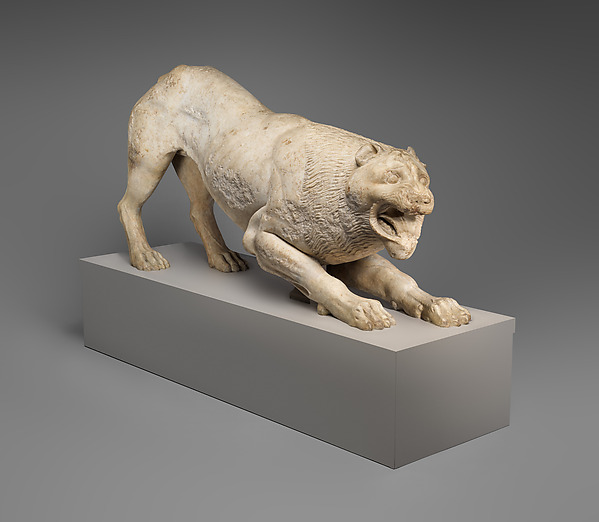
The Greek Marble statue of a lion, made about 400–390 BCE from Parian marble, keeps its body compact while turning its head sharply to one side.[5] The surviving surface and broken elements also show the limits of durability: stone can outlast organic materials, but it can still weather, fracture, lose attachments and be separated from its setting.
Stone's prominence in museums can create a survival bias. Durable fragments are more likely to reach us than unfired models, textiles or wooden components, so the historical record should not be mistaken for a complete census of what sculptors made.
Wood: grain beneath colour
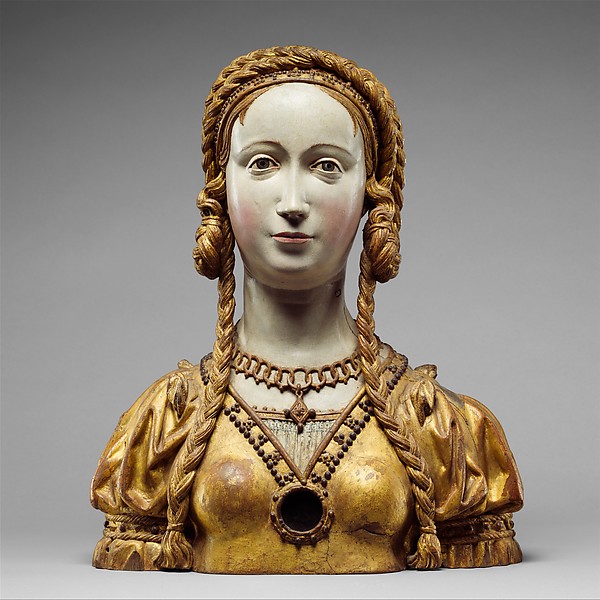
Wood is lighter than many stones and can support deep carving, projecting forms and joined construction. It is also directional: grain runs through the material rather than behaving identically in every direction. Species, seasoning, joins, damage and later coatings affect what can be seen.[1][2]
The Reliquary bust of a companion of Saint Ursula, made around 1520–30, is carved from oak, but “oak” alone does not describe its intended appearance. Polychromy and gilding sit on a plaster ground, and a glass opening once revealed a relic.[6] Structure, sacred function and coloured surface were conceived together. Where paint has been lost from wooden sculpture, the exposed grain may be beautiful but historically incomplete.
Wood can also disappear from view. It may reinforce a mixed figure, carry applied ornament or form the core beneath metal, textile or paint. The material line must be read as a system.
Clay and terracotta: touch made durable
Soft clay can be pressed, pinched, added, cut and smoothed. That responsiveness allows rapid change and can preserve fingerprints or modelling ridges. Firing transforms clay into ceramic; terracotta generally identifies a fired, iron-rich clay body, though museum terminology depends on the object and context.[1][2]
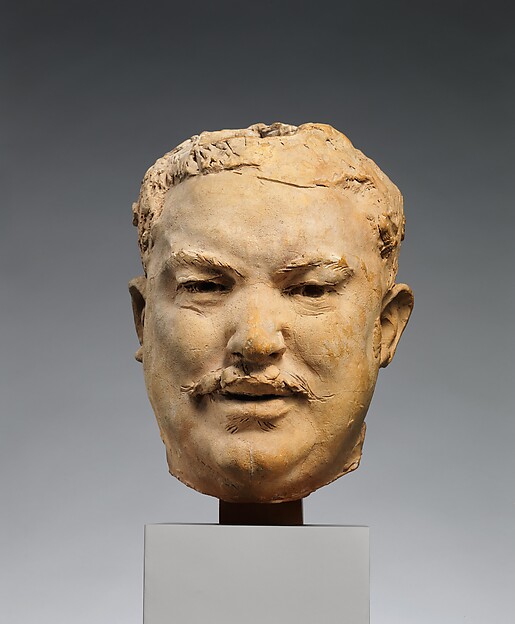
Auguste Rodin's terracotta Honoré de Balzac, dated 1891, shows modelling as sustained investigation rather than casual preparation. The compact bust builds hair, face and shoulders through rough, active surfaces.[7] A terracotta can be a study for another work, a version within a longer project or a finished object in its own right. It should not automatically be demoted beneath a later bronze.
Clay is also central to moulds and casting sequences, but the material route needs no recipe. Its historical importance lies in how easily form can be revised and translated.
Bronze and other metals: casting, joining and surface
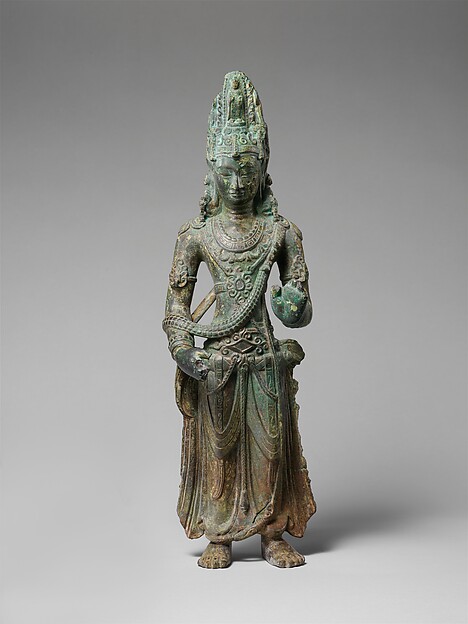
Bronze is a copper-based alloy whose composition varies. A bronze sculpture may be cast in sections, joined, chased, polished, gilded or patinated. Its familiar colour is not fixed: surface treatment, burial, weathering and cleaning all alter what the metal reflects.[4]
The Vietnamese Standing Avalokiteshvara, the Bodhisattva of Infinite Compassion, made about the seventh century, is gilt bronze.[8] Its small scale, thin projections and brilliant surface differ sharply from the mass of the marble lion, yet both are durable museum objects. Gilding changes how contours catch light and should be named alongside the metal rather than treated as incidental decoration.
Metal also complicates authorship and date. The artist who creates a model may work with founders and finishers; a cast can be made after the model's date. Exact object records matter more than the generic word “bronze”.
Plaster: model, cast or final sculpture
Plaster is often associated with casts, studio models and teaching collections. It can register fine detail and reproduce a form, but not every plaster is merely a disposable step. It may be painted, exhibited and intended to remain visible.[1]
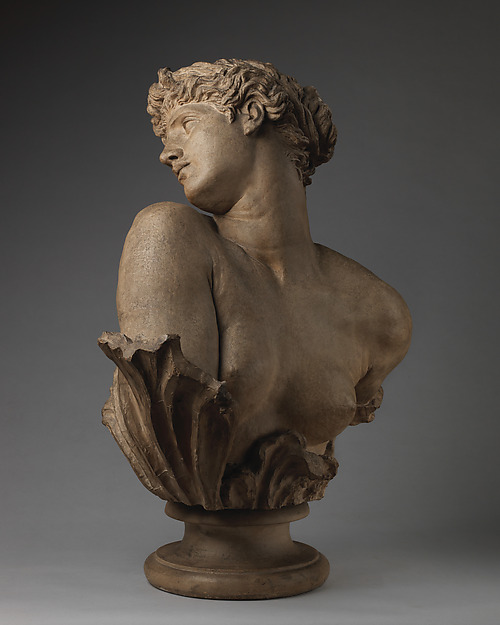
George Frederic Watts's Clytie, made around 1868–75, is painted plaster.[9] Colour modifies the bust's surface while the upward twist of the head creates a strong silhouette. Describing it only as a model would ignore the object that survives. Conversely, another plaster may document an intermediate state before carving or casting. Function has to be established case by case.
Wax: immediacy and translation
Wax can hold minute impressions, accept colour and be remodelled. It has served portrait models, small figures, anatomical objects and stages in metal casting. Because it responds to heat and pressure, its survival is less assured than stone or bronze.[2]
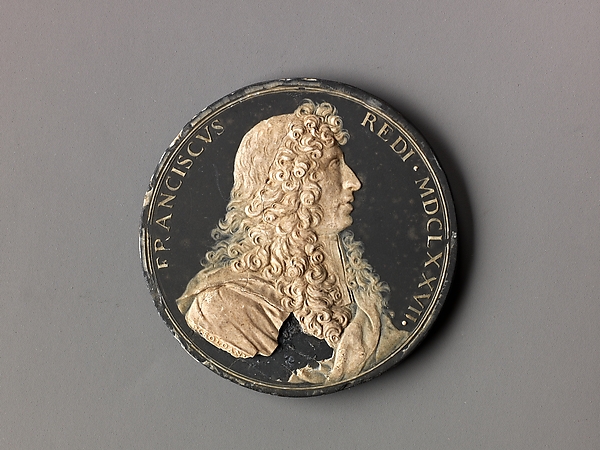
Massimiliano Soldani's 1677 Model for a portrait medal of Francesco Redi is wax on slate.[12] The reddish profile remains the visible work, its slight projection and fine modelling prepared for translation into a medal. The object lets viewers study a material stage that can vanish from other production histories.
Ivory and ethical context
Ivory has historically supported minute carving and polished detail, but it now requires serious ethical and legal context. Discussing a museum object does not endorse current trade, collecting or new use.
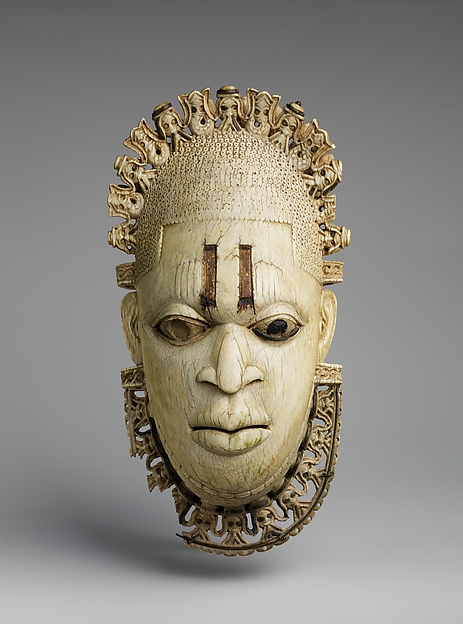
The sixteenth-century Pendant mask of Ìyọ́bà Idià is attributed to artists of the Edo Ìgbèsànmwà ivory- and wood-carving guild.[10] Its material record includes ivory, iron, brass, coal and traces of iron oxides. Metal inlays and dark details articulate the pale carved surface. Naming the guild, court context and composite construction is more accurate than treating it as an anonymous “ivory mask”.
Mixed media: materials as a designed system
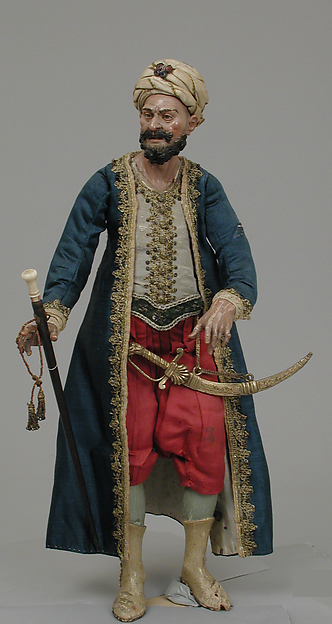
Mixed-media sculpture makes the limits of single-material labels obvious. Giuseppe Gori's King's attendant, made in the second half of the eighteenth century, combines a polychromed terracotta head, wooden limbs, wire wrapped in tow, textiles, metallic thread, leather, brass, glass, ivory and other components.[11]
Each substance performs a different task. Wire and tow build a body; wood supports limbs; terracotta carries modelled facial detail; fabric creates real rather than carved clothing; metal and glass add hard reflections. “Terracotta figure” would erase most of the design. The correct description is not the longest possible list in every sentence, but an account of which materials shape the viewer's experience.
Surface is part of material
Paint, gilding, glaze, patina, polish and tool marks are not afterthoughts. They regulate colour, reflection, texture and legibility. A wooden sculpture with plaster ground and gilding behaves visually as a layered object. A gilt bronze presents metal through another metal surface. Painted plaster can imitate, transform or refuse the appearance associated with a white cast.
Material can also be hidden. Armatures, pins, joins and bases may carry loads without declaring themselves. Technical examination can reveal them, but a public guide should not infer a structure that the object record does not support.
Scale changes material decisions without creating a simple hierarchy. A small wax profile can hold minute impressions that would vanish on a monument, while a stone animal can depend on mass and silhouette. A dressed figure may use real cloth because carving every fold would produce a different object, not merely a more expensive version. Materials establish what kind of detail, weight, movement and reflection a work can sustain. They also guide how closely it asks to be viewed: polished inlay rewards near attention, whereas a broad cut or gilded contour may remain legible from across an architectural space.
How to read a sculpture's materials
- Start with the exact medium line. Separate primary body, coating, inlay, textile, base and later additions.
- Name process separately. Carved oak, modelled terracotta and cast bronze combine a material with evidence about making.
- Ask whether the material is final or transitional. Wax, clay and plaster can occupy either role.
- Look for surface systems. Paint, gilding, glaze and patina affect form by changing light and colour.
- Notice joins and support. A sculpture may be assembled even when it looks like one mass.
- Allow for loss. Missing colour or organic parts can make the present object look materially simpler than it was.
- Keep ethics and safety in scope. Historic ivory requires context, and damaged or unfamiliar materials require qualified professional care rather than improvised treatment.
There is no universally best sculpture material. The significant choice is the relationship between substance, process, purpose and appearance. A strong description explains what each material allows, records or conceals—and what history has removed.
Watch: Sculpture Materials in Process
Choose a translation from clay to marble, a direct lost-wax bronze casting, or a close demonstration of additive clay modelling.
Recreating Canova's Venus: From Clay to Marble
Follow the staged translation of a sculptural idea through clay, plaster and marble rather than treating the finished stone as a single-step object.
Watch on YouTubeFrequently Asked Questions
Stone, wood, clay and terracotta, metals, plaster and wax are major historical families, while glass, textiles, found objects and mixed constructions also matter.
No. Clay can remain unfired, be fired as ceramic, or serve as a model within a moulding and casting sequence.
No. Plaster can record a model or cast, but it can also be painted, exhibited and treated as the visible sculpture.
Bronze names a copper-based alloy family; casting, hammering, joining and finishing describe processes that may shape it.
Describe the historic object accurately while separating interpretation from acquisition advice and recognising current legal, ethical and conservation concerns.
Discussion
Which material property most changes the way you read a sculpture: weight, translucency, grain, surface colour, tool marks or evidence of assembly?
Reader Insights
Separate structural core, model, cast, coating, inlay, clothing and later support.
Cuts, seams, fingerprints, grain and patina can record different stages of making and ageing.
Material history includes extraction, trade, cultural ownership, current law and conservation—not only appearance.
Join the Conversation
Share one precise observation or a useful museum example below.
References
- National Gallery of Art, “Explore the Basics of Sculpture.” https://www.nga.gov/educational-resources/explore-basics-sculpture
- Victoria and Albert Museum, “Sculpture techniques.” https://www.vam.ac.uk/articles/sculpture-techniques
- Metropolitan Museum of Art, The Care and Handling of Art Objects: Practices in The Metropolitan Museum of Art. https://resources.metmuseum.org/resources/metpublications/pdf/The_Care_and_Handling_of_Art_Objects_Practices_in_The_Metropolitan_Museum_of_Art_2019.pdf
- Metropolitan Museum of Art, “Bronze Sculpture in the Renaissance.” https://www.metmuseum.org/essays/bronze-sculpture-in-the-renaissance
- Metropolitan Museum of Art, “Marble statue of a lion,” object 2000.214. https://www.metmuseum.org/art/collection/search/248140
- Metropolitan Museum of Art, “Reliquary bust of a companion of Saint Ursula,” object 1988.159. https://www.metmuseum.org/art/collection/search/193612
- Metropolitan Museum of Art, “Honoré de Balzac,” object 1986.273. https://www.metmuseum.org/art/collection/search/191843
- Metropolitan Museum of Art, “Standing Avalokiteshvara, the Bodhisattva of Infinite Compassion,” object 1991.74. https://www.metmuseum.org/art/collection/search/51170
- Metropolitan Museum of Art, “Clytie,” object 2014.284. https://www.metmuseum.org/art/collection/search/190739
- Metropolitan Museum of Art, “Pendant mask of Ìyọ́bà Idià,” object 1978.412.323. https://www.metmuseum.org/art/collection/search/318622
- Metropolitan Museum of Art, “King's attendant,” object 64.164.84a–c. https://www.metmuseum.org/art/collection/search/204185
- Metropolitan Museum of Art, “Model for a portrait medal of Francesco Redi,” object 2013.459. https://www.metmuseum.org/art/collection/search/461152