by Tom Gurney
Tom Gurney BSc (Hons) is an art history expert with over 20 years experience
Page created on September 3, 2026 / Page updated on September 13, 2026
Email: tomgurney1@gmail.com / Phone: +44 7429 011000
How Process Transforms Material into Sculptural Form
Read the chain of making
Sculpture techniques describe how material is transformed into form. Carving removes material; modelling adds and reshapes it; moulding and casting translate a model through a negative space; construction and assemblage join separate parts. Hammering, repoussé, chasing, polishing, painting, gilding and patination can shape or finish the surface. Many sculptures combine several of these processes, so the most accurate description is often a sequence rather than a single verb.[1][2]
This is different from a list of materials. Marble and wood can both be carved, clay can be modelled or pressed into a mould, and bronze can be cast, hammered, joined and finished. Technique answers “what happened to the material?” rather than simply “what is present?”
At a Glance
- Carvingremoves material from a solid while tool sequence and finishing remain visible in mass, edge and surface.
- Modellingadds and reshapes clay, wax or another pliable material, either as a finished object or an intermediate model.
- Castingtranslates a positive form through moulds and negative space; model date and cast date may differ.
- Constructionjoins separately formed parts by fastening, welding, binding, stacking or other assembly methods.
- Finishingpainting, gilding, chasing, polishing and patination are material stages, not merely decoration after making.
Contents
- How Process Transforms Material into Sculptural Form
- Six transformations to distinguish
- Carving: form through removal
- Modelling: form through addition and pressure
- Moulding and casting: translating positive and negative
- Repoussé and worked metal
- Construction and assemblage
- Finishing: the stage viewers often see first
- How technique changes appearance
- How to recognise process evidence
- Sculpture reference pages
- Watch Sculpture Processes in Practice
Six transformations to distinguish
Carving: form through removal
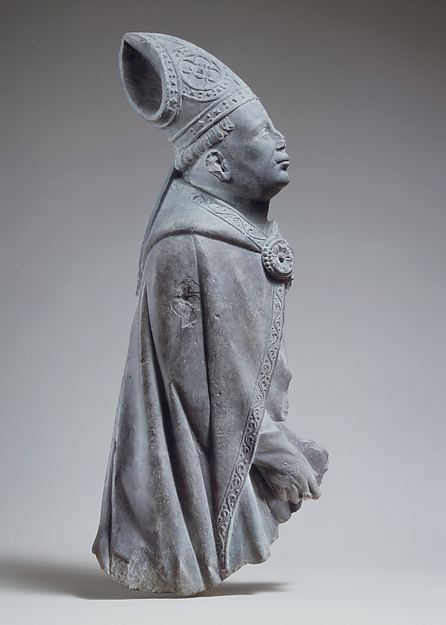
Carving is principally subtractive. A sculptor reduces stone, wood or another solid, first establishing broad masses and then refining planes, edges, hollows and textures. Removed material cannot simply be pressed back into place, so the process continually redefines the block's remaining structure.[1]
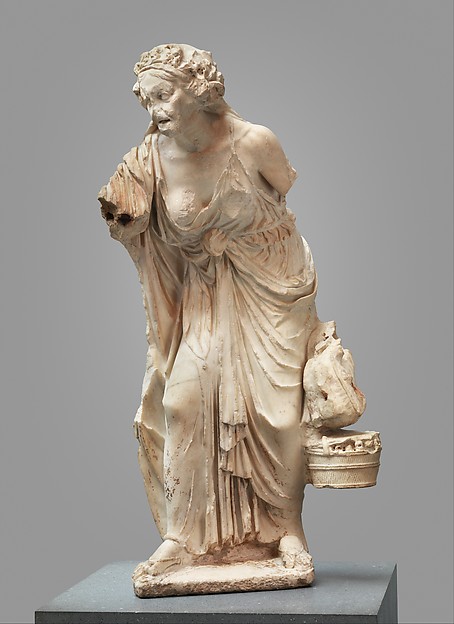
The Roman Marble statue of an old woman, dated 14–68 CE, shows how carving can separate layers within one mass.[4] Deep folds create dark channels across the clothing; the basket and body retain weight; undercut edges sharpen the silhouette. Breaks and restoration remind us that a carved object also has a physical history after leaving the workshop.
Relief carving keeps a continuous field. The South Netherlandish Relief of a Bishop, made about 1400–1440, places the standing figure beneath a pointed canopy.[5] The surrounding limestone remains both support and pictorial ground. Carving is the process; relief is the spatial type.
Tool marks can be valuable evidence, but no single texture proves an entire method. Abrasion, polishing, paint, weathering and later cleaning may obscure earlier stages, while a deliberately rough finish may imitate immediacy.
Modelling: form through addition and pressure
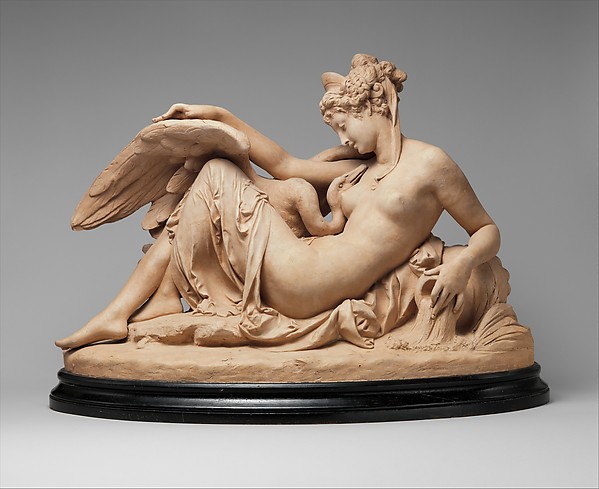
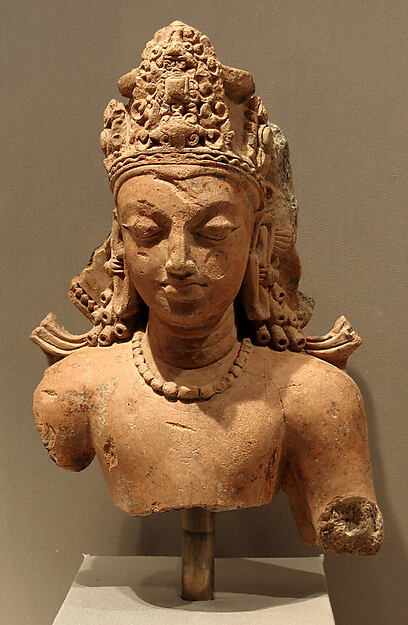
Modelling builds and revises form in a soft material such as clay or wax. Material can be added, pushed, drawn, pinched, cut or smoothed. The surface may preserve energetic marks or be refined until the handwork becomes difficult to see.[1][2]
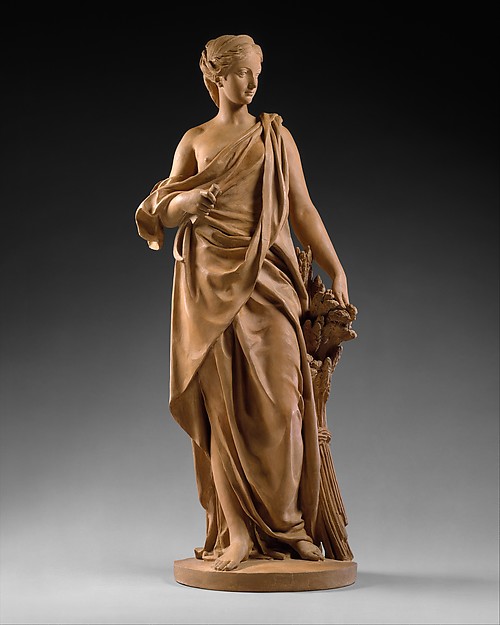
Albert-Ernest Carrier-Belleuse's Leda and the Swan, about 1870, is cast terracotta.[6] The fluid turn of the figure derives from modelling, yet the Met's medium line also records casting. This distinction matters: a modelled-looking surface can be reproduced through a mould rather than being the unique direct clay state.
The fifth- to sixth-century Bengal Bust of Vishnu is terracotta with crisply ordered jewellery and a tall crown.[10] Terracotta traditions can include hand modelling, mould use and finishing in combinations specific to their place and production system. A public label should not invent a sequence the record does not document.
Moulding and casting: translating positive and negative
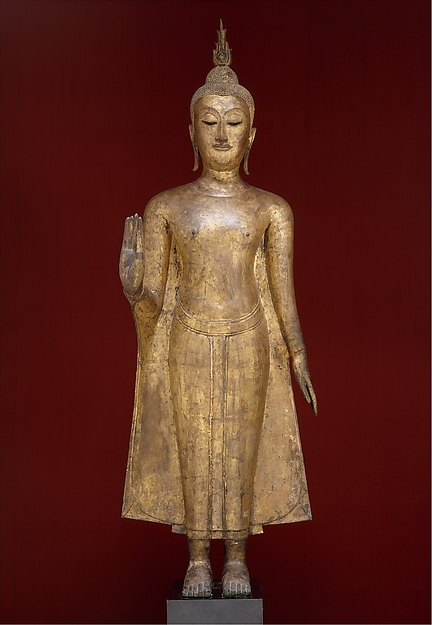
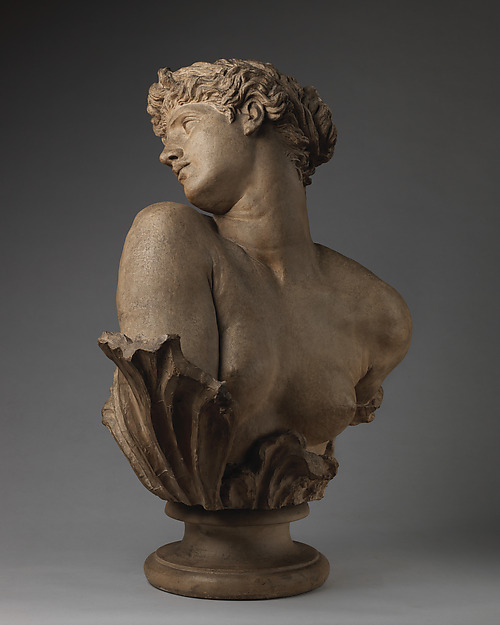
A mould records a negative space around a model or existing form. Casting fills that space to create a new positive. Plaster, terracotta and metals can all be cast, but their processes and workshop conditions differ. The useful historical principle is translation: form passes through stages, and each may alter seams, thickness, detail and surface.[1]
Bronze casting is particularly complex. In lost-wax work, the metal occupies a space related to a wax model. Direct methods sacrifice a unique wax, while indirect systems use moulds and intermediary models that can support further casts.[3] This does not mean every bronze exists in an unlimited edition; object records must establish the particular sequence.
The fifteenth-century Thai Standing Buddha is gilt bronze.[7] Casting made the metal form, while finishing and gilding shaped its final reflective surface. The raised hands, thin garment edges and lotus base cannot be understood through “bronze” alone.
Plaster complicates the hierarchy between stage and finish. George Frederic Watts's Clytie, about 1868–75, is painted plaster.[11] It may carry the associations of modelling and casting, but the surviving coloured object deserves to be described as visible sculpture rather than dismissed as an incomplete marble.
Repoussé and worked metal
Formed sheet, core and ornament
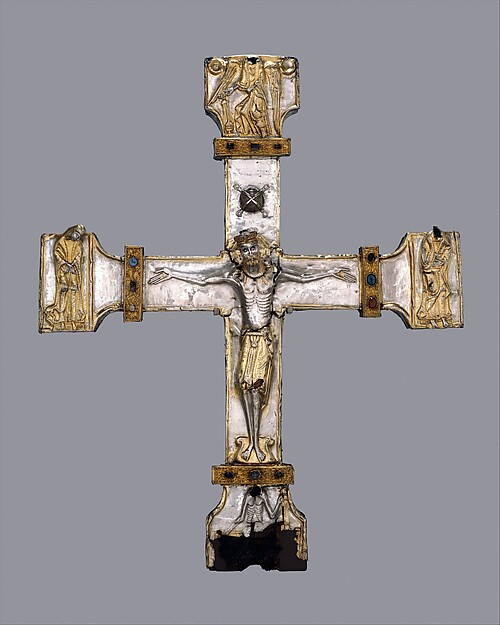
The cross joins repoussé silver, gilding, niello, gems and a wood core; technique is a coordinated sequence rather than one action.
Not all metal sculpture is poured into a mould. Repoussé creates raised form in sheet metal by working from the reverse; chasing and engraving can refine the front. Hammered pieces may be joined to cores, frames or separately made components.[2]
The Spanish Processional Cross, made about 1150–75, combines silver and gilded silver with niello repoussé over a wood core, together with pearls, stones, glass and an antique intaglio.[8] It is simultaneously formed, assembled, inlaid and finished. The technique cannot be reduced to the central figure alone because the object's brilliance comes from a coordinated material system.
Construction and assemblage
Many crafts, one object
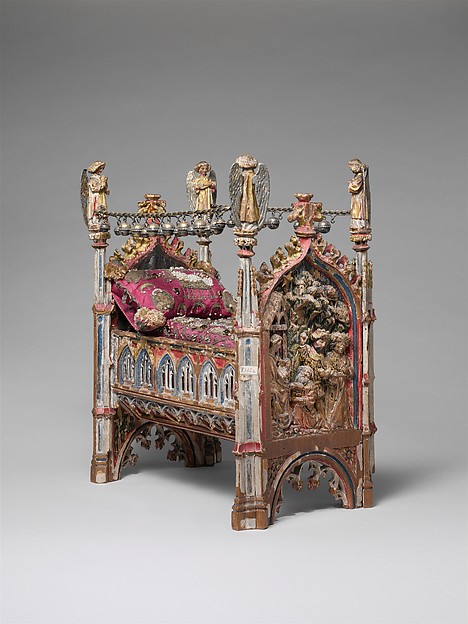
Carving, metalwork, painting, embroidery, enamel and assembly converge in a miniature devotional structure.
Construction joins already formed parts through fastening, fitting, sewing, tying, riveting, welding or other systems. Assemblage is often used more narrowly for sculpture built from found or pre-existing objects. Both differ from carving a single block, although a constructed work may contain carved and cast components.
The fifteenth-century South Netherlandish Crib of the Infant Jesus combines wood, polychromy, lead, gilded silver, painted parchment, silk embroidery, seed pearls, gold thread and translucent enamels.[9] Its form emerges from collaboration among carving, metalwork, painting, embroidery and assembly. Looking only for the “main” sculpture technique would erase the object's designed complexity.
Construction also makes voids active. Rods, sheets and joined planes can frame empty space instead of enclosing a solid mass. This became especially important in modern sculpture, but the principle of composite making is much older.
Finishing: the stage viewers often see first
Finishing may include smoothing, abrasion, chasing, polishing, painting, gilding, inlay and applied patina. These operations can clarify detail, hide joins, unite different components or deliberately preserve evidence of process.[2]
The gilt surface of the Thai Buddha intensifies light on the cast form. The painted plaster of Clytie changes the visual temperature of the bust. Polychromy on the processional cross and crib coordinates several substances. Finishing is not automatically cosmetic: it can be the means by which separate stages become one readable object.
Later change must be distinguished from original finish. Oxidation, burial, weathering, cleaning and restoration can all alter colour and texture. A green bronze surface, bare wooden grain or white stone appearance may be historically significant without matching the artist's first presentation.
How technique changes appearance
Process is visible not because every stage leaves a simple fingerprint, but because it creates families of decisions. Carving makes the remaining block carry every projection, encouraging attention to support, grain and the depth of each hollow. Modelling permits revision by addition as well as removal, so a surface can accumulate small pressures or be swept smooth. Casting can preserve those marks while translating them into a material with different weight, colour and reflection. Construction makes the join, interval and balance between parts central to the form.
Scale magnifies these differences. The deep stone folds of the Roman old woman create shadows that remain legible across a gallery. The small terracotta Bust of Vishnu concentrates detail in crown, face and jewellery. On the Processional Cross, repoussé and applied ornament create a surface that flashes rather than reads as one solid mass. The Crib depends on contrast between soft embroidery, reflective metal, carved wood and translucent enamel. Technique therefore affects not only how an object was produced, but also how quickly its image can be read, how the eye moves over it and how light changes it.[4][8][9][10]
A photograph can conceal this evidence. Frontal lighting may flatten carving; a single viewpoint can hide joins; digital colour can exaggerate a patina. When possible, compare several museum views and read the medium line before deciding that a visible texture was directly made by the named artist. The most convincing account joins close looking to the documented production history.
How to recognise process evidence
- Separate material from action. “Marble” is a substance; “carved and polished” describes transformation.
- Look for reduction. Cut channels, drilled hollows and facets may record carving, but consider later wear and finishing.
- Look for addition. Finger-like ridges, pressed edges and joined clay masses can suggest modelling.
- Check for translation. Seams, repeated versions and thin-walled metal may relate to moulding or casting, but labels and technical study should confirm them.
- Find joins and cores. Composite works may rely on hidden wood, wire or fasteners as well as visible pieces.
- Treat colour as process evidence. Paint, gilding and patina affect how the form is read.
- Keep sequence and authorship open. Modellers, mould makers, founders, carvers, metalworkers and finishers may all contribute.
Technique is most useful when it connects observation to evidence. The question is not which single process “made” a sculpture, but how a chain of transformations produced the mass, surface, colour and space now in front of us.
Watch: Sculpture Techniques in Sequence
Choose a translation from clay to marble, a direct lost-wax bronze casting, or a close demonstration of additive clay modelling.
Recreating Canova's Venus: From Clay to Marble
Follow the staged translation of a sculptural idea through clay, plaster and marble rather than treating the finished stone as a single-step object.
Watch on YouTubeFrequently Asked Questions
Carving, modelling, moulding and casting, construction or assemblage, worked-metal techniques and surface finishing are major process families.
No. Bronze is a material family. Casting, joining, chasing, polishing, gilding and patination are techniques that may shape a bronze sculpture.
Yes. A composite work may include carving, casting, repoussé, painting, textile work and assembly in one designed object.
Carving removes material from a solid; modelling adds and reshapes a pliable material such as clay or wax.
A model, mould, cast, enlargement, finish or later edition may have been made at different times, so a careful record distinguishes those stages.
Discussion
Which visible clue most reliably identifies a sculptural process: tool marks, seams, repeated forms, joins, modelled touch or surface finish?
Reader Insights
Model, mould, cast, join and finish may all belong to one object history.
Stone and wood can be carved; clay can be modelled or pressed; metal can be cast, hammered and joined.
Design, model, cast and later edition dates answer different questions.
Join the Conversation
Share one precise observation or a useful museum example below.
References
- National Gallery of Art, “Explore the Basics of Sculpture.” https://www.nga.gov/educational-resources/explore-basics-sculpture
- Victoria and Albert Museum, “Sculpture techniques.” https://www.vam.ac.uk/articles/sculpture-techniques
- Metropolitan Museum of Art, “Direct versus Indirect Casting of Small Bronzes in the Italian Renaissance.” https://www.metmuseum.org/essays/direct-versus-indirect-casting-of-small-bronzes-in-the-italian-renaissance
- Metropolitan Museum of Art, “Marble statue of an old woman,” object 09.39. https://www.metmuseum.org/art/collection/search/248132
- Metropolitan Museum of Art, “Relief of a Bishop,” object 09.152.2. https://www.metmuseum.org/art/collection/search/474395
- Metropolitan Museum of Art, “Leda and the Swan,” object 2016.112. https://www.metmuseum.org/art/collection/search/206819
- Metropolitan Museum of Art, “Standing Buddha,” object 1982.220.3. https://www.metmuseum.org/art/collection/search/39175
- Metropolitan Museum of Art, “Processional Cross,” object 17.190.819. https://www.metmuseum.org/art/collection/search/464023
- Metropolitan Museum of Art, “Crib of the Infant Jesus,” object 17.190.582. https://www.metmuseum.org/art/collection/search/465966
- Metropolitan Museum of Art, “Bust of Vishnu,” object 2000.82. https://www.metmuseum.org/art/collection/search/53472
- Metropolitan Museum of Art, “Clytie,” object 2014.284. https://www.metmuseum.org/art/collection/search/190739