by Tom Gurney
Tom Gurney BSc (Hons) is an art history expert with over 20 years experience
Page created on September 3, 2026 / Page updated on September 13, 2026
Email: tomgurney1@gmail.com / Phone: +44 7429 011000
How Line, Interval and Movement Become Sculpture
When line occupies space
Wire can make sculpture almost disappear. A line crosses the air, turns around an empty interval and returns as a profile; a network catches light without becoming a solid wall. Yet wire can also vanish inside a figure, hold separate materials together or bind found objects into a dense mass. “Wire sculpture” therefore describes several visual and structural roles, not one method.[1][4][5]
This historical guide asks what wire is doing in exact works. It follows visible contour, open network, hidden armature, attachment, articulation, wrapping and suspension. It does not explain how to cut, join, hang or support wire. Those operations require material-specific skills and safety judgements beyond close looking.
At a Glance
- Linecontour can cross open air and make a figure or direction legible without solid mass.
- Networkrepeated strands enclose volume while leaving light and surrounding space active.
- Armaturewire may disappear inside wax, clay, fibre or fabric as a structural framework.
- Assemblyattachments, articulated parts and wrapped bundles join several materials into one object.
- Suspensionlinked elements can turn balance, interval and changing movement into visible form.
Contents
- How Line, Interval and Movement Become Sculpture
- Five functions of wire in sculpture
- Five ways wire can act in sculpture
- Hidden armatures and flexible bodies
- Attachment, articulation and composite figures
- Wire with glass: figure and assembled world
- Calder and line in three dimensions
- Networks, intervals and wrapped bundles
- Wire inside devotional ensembles
- How to read wire in a sculpture
- Sculpture reference pages
- Watch Wire, Space and Motion
Five functions of wire in sculpture
Five ways wire can act in sculpture
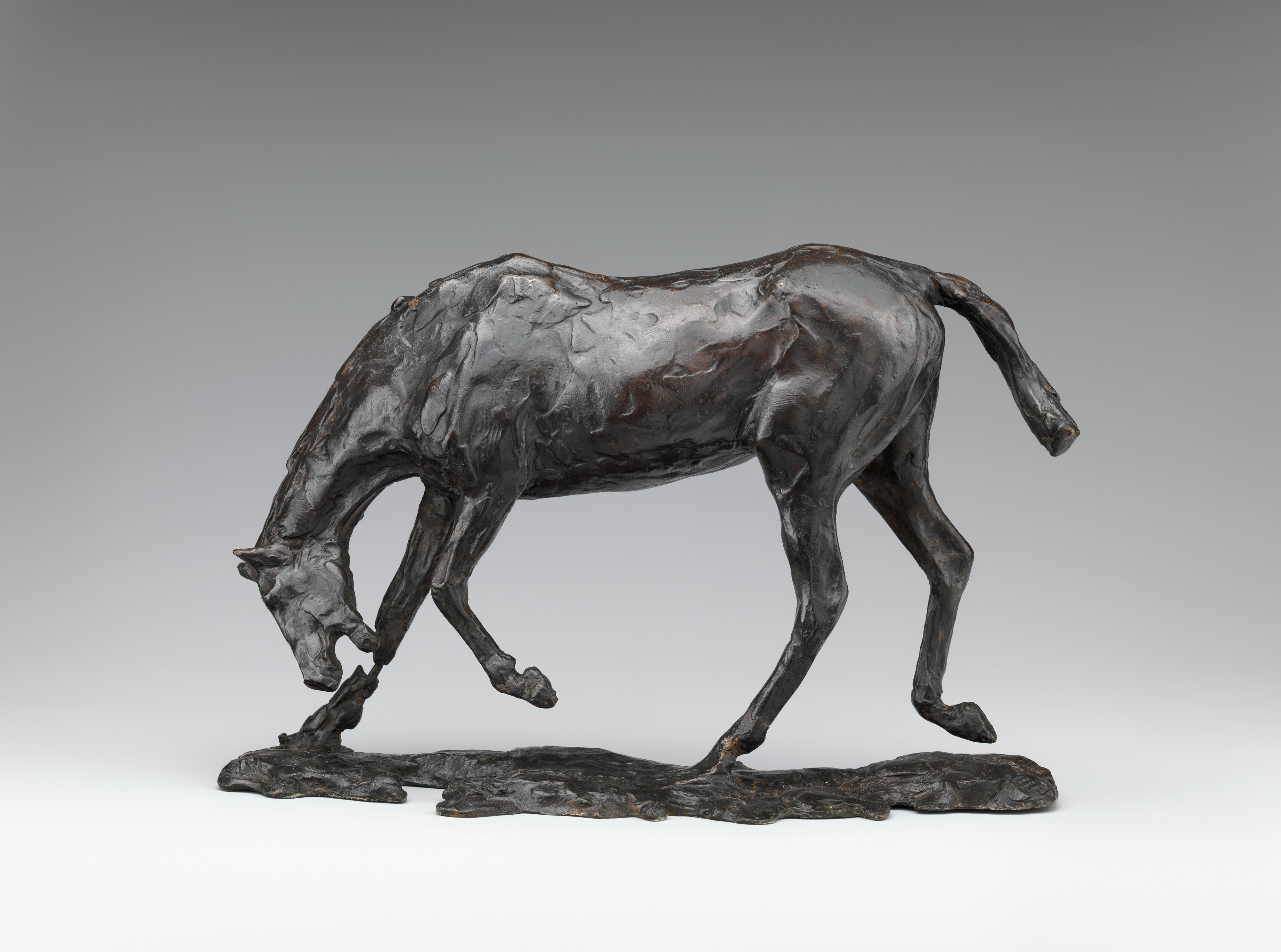
The first distinction is between carrying an image and helping another material carry it. In Alexander Calder's Rearing Stallion, wire describes the horse directly: the viewer follows a dark line as it rises, crosses and turns through space.[1][2] In Edgar Degas's Horse with Head Lowered, the visible bronze preserves a wax model that needed an internal wire support. The armature belonged to the making and survival of the model rather than to its intended outer appearance.[6]
A second distinction concerns density. One wire can trace a contour. Repeated strands can make a lattice or cloud of lines. Tightly wrapped wire can enclose other matter and build a compact bundle. Separate wires can also connect parts, allowing a composite object to behave as a single sculpture. Finally, wire may participate in suspension, making balance and changing position part of the work's appearance.[3][4][5]
These categories overlap. A single sculpture might use line, attachment and movement at once. The useful question is not “Which technique is this?” but “Where does the wire remain visible, what does it connect, and how does it shape the surrounding space?”
Hidden armatures and flexible bodies
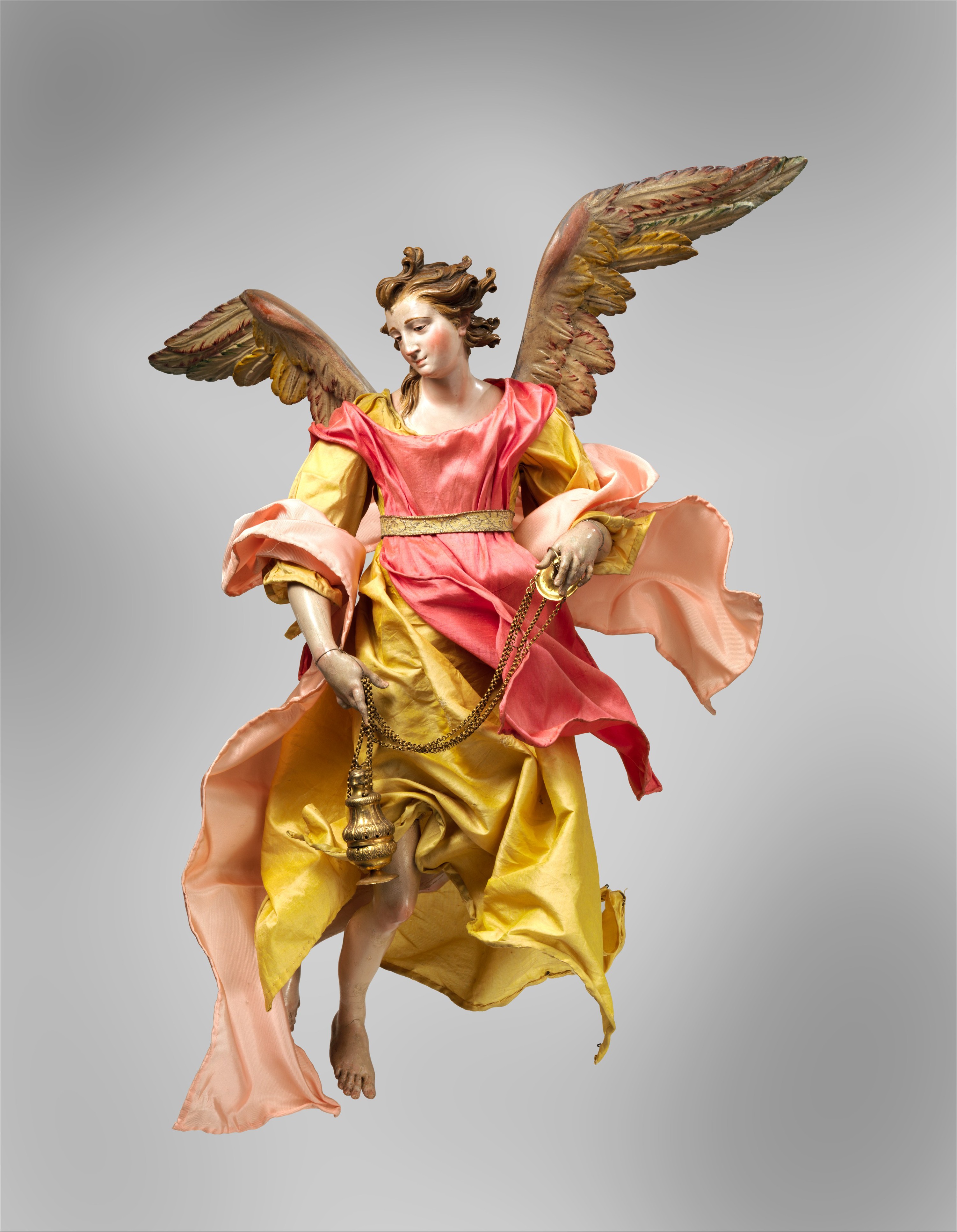
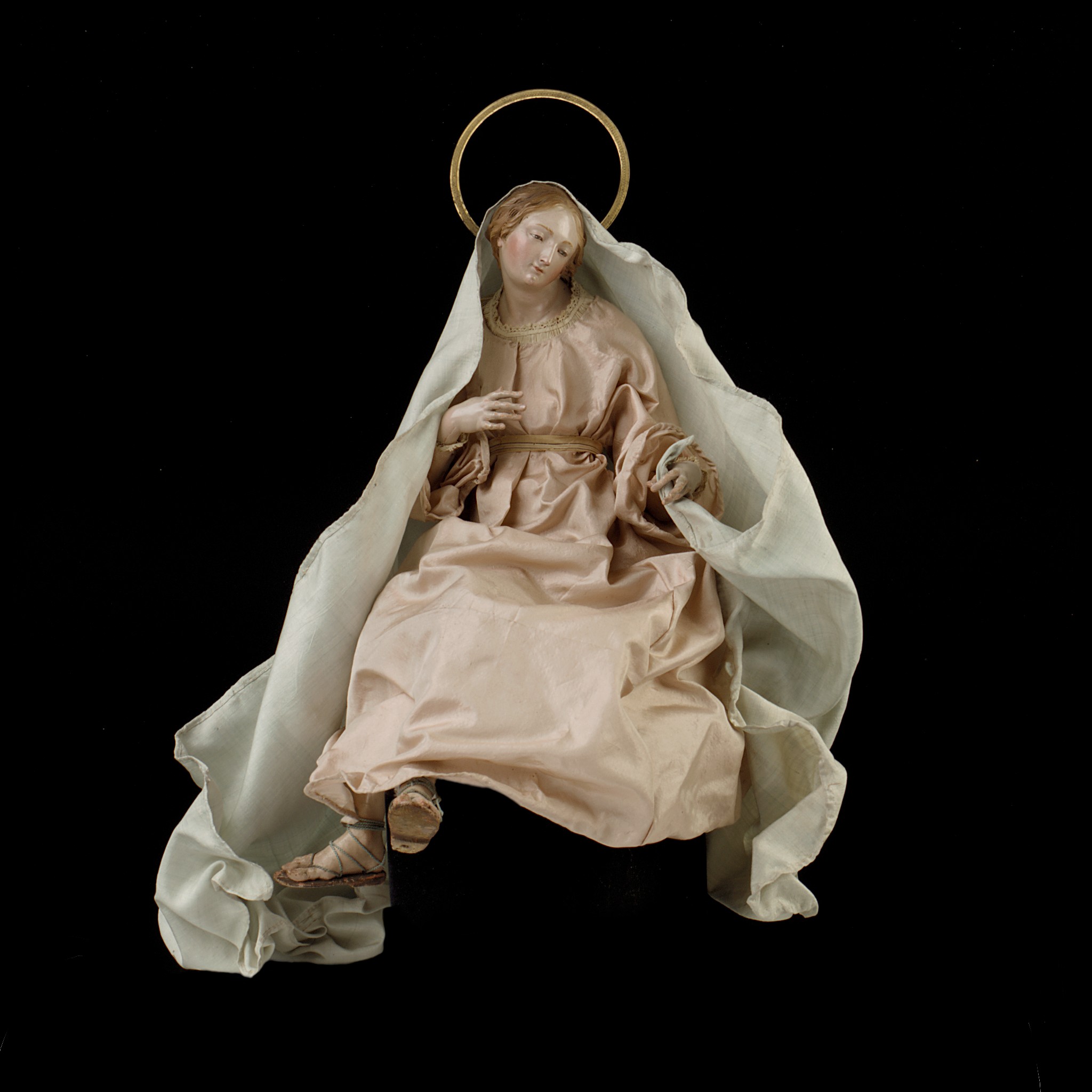
An armature is a supporting framework within modelling or composite construction. It can make an extended pose possible while clay, wax, fibre or fabric supplies the visible body. Because the support may be concealed, a museum's medium line or a documented break can be more reliable than the photograph alone.
Degas probably modelled Horse with Head Lowered around 1883–90; the selected bronze was cast in 1920. The Met explains that damage to the original wax sculpture exposed the wire armature in its right front leg, and the bronze records that damage.[6] The cast is not itself a wire sculpture in the obvious sense. It is valuable evidence of how a hidden line could support a fragile, repeatedly revised wax form.
Two eighteenth-century Neapolitan crèche figures make the relationship between core and surface clearer. Giuseppe Sanmartino's Angel combines a polychromed terracotta head, wooden limbs and wings, a body of wire wrapped in tow, and fabrics.[7] Salvatore di Franco's Virgin similarly joins a terracotta head and wooden limbs to a wire-and-tow body beneath silk and linen garments.[8] Their sleeves, mantles and gestures create the visible volumes, while the flexible composite body coordinates the parts.
These figures should not be treated as diagrams of a universal armature. They belong to a particular devotional display tradition and bring several specialists, materials and kinds of finish into one object. Wire is essential, but it is only one participant in the sculptural result.
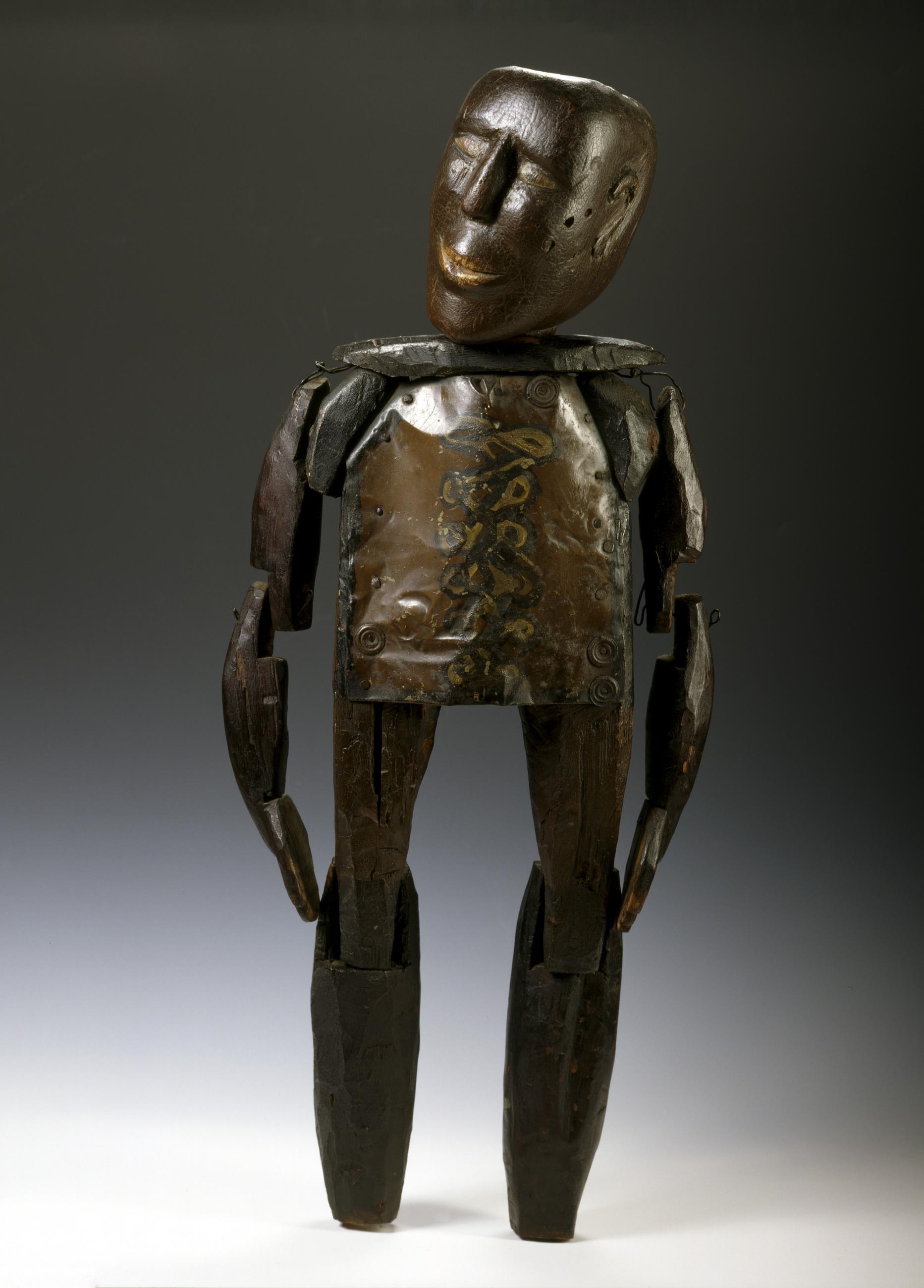
Attachment, articulation and composite figures
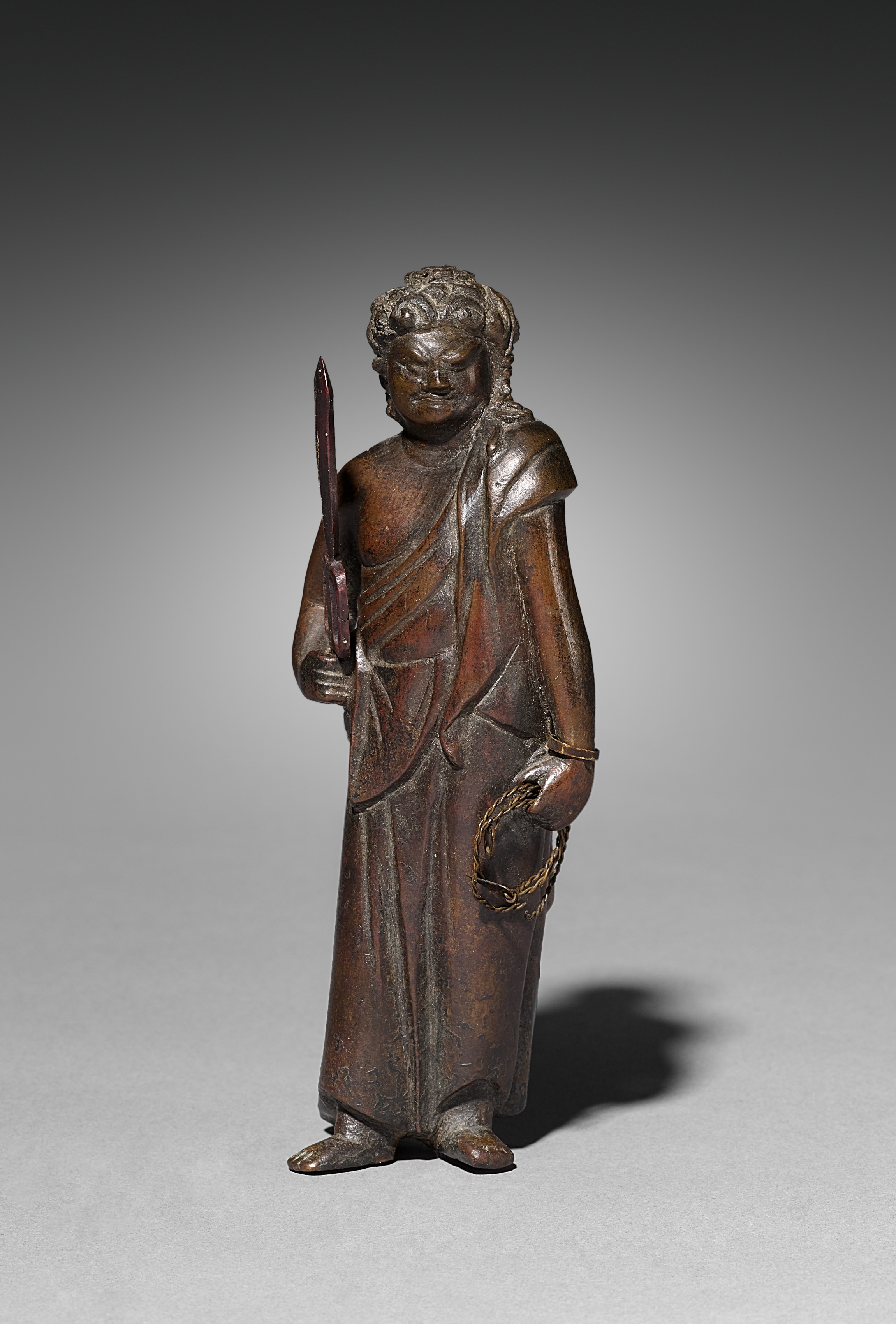
Wire may also remain visible at the points where a sculpture changes direction or one component meets another. In the early-fourteenth-century Japanese Fudō Myōō, the Cleveland Museum of Art records bronze with wire attachments.[11] The compact standing figure holds a sword and a looped chain. Fine wire at the hand and wrist is visually different from the broad cast planes of robe and body: it belongs to an attached system rather than to the main mass.
The unidentified Standing Articulated Figure, made about 1920, uses carved and painted sequoia and black ash, painted metal, wire and metal hardware.[13] Its long wooden limbs are divided into sections, and visible connections matter to the figure's identity as an articulated object. Wire here neither traces a continuous silhouette nor hides completely. It mediates between separate rigid parts.
Placed together, these works show why “wire attachment” is not a complete interpretation. The Japanese Buddhist figure and the later American articulated figure differ in date, culture, material organisation and purpose. A similar material can solve unlike sculptural relationships. Description should begin with the exact object rather than leap from one visible connection to a shared meaning.
Wire with glass: figure and assembled world
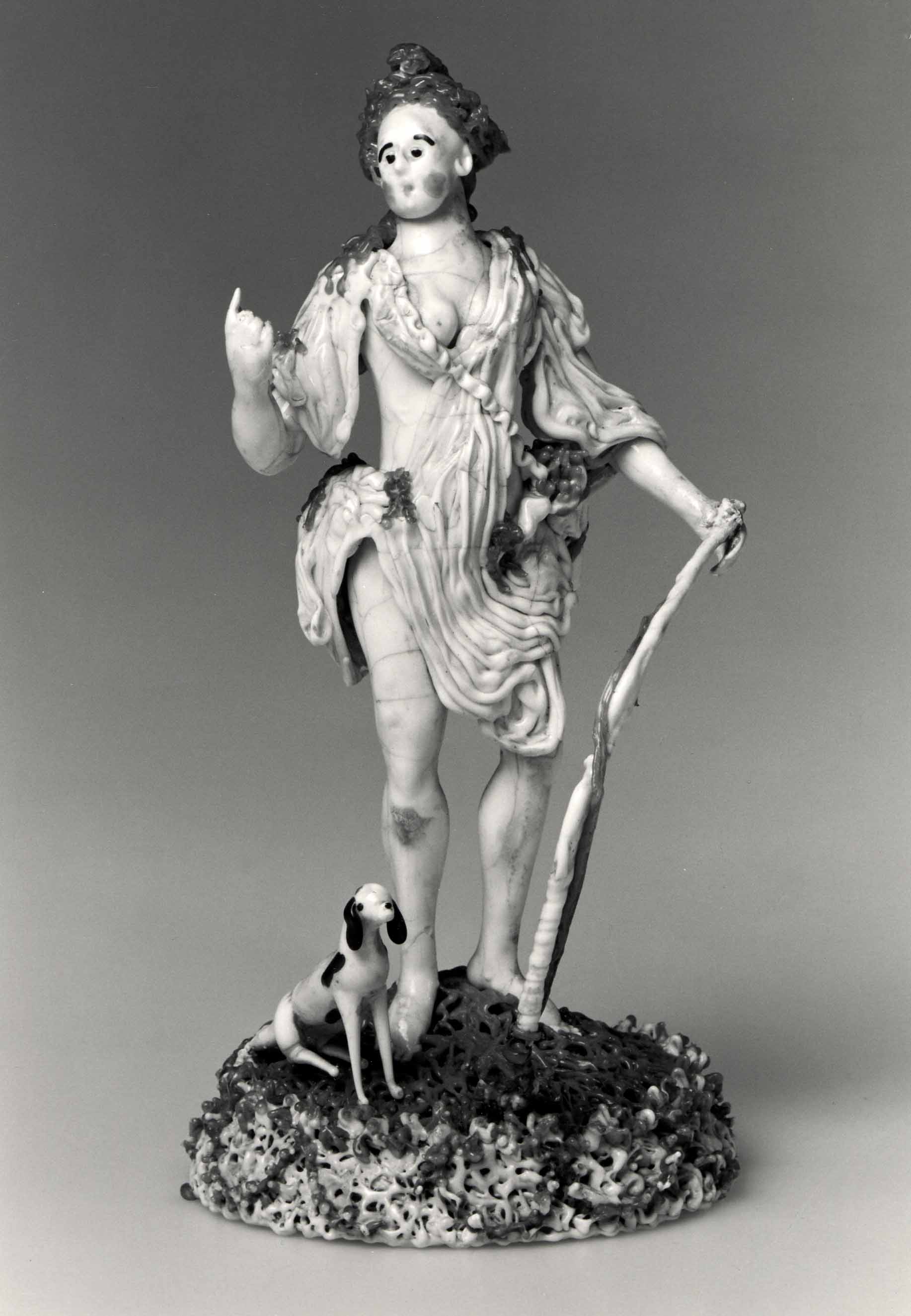
The Haly workshop's Diana, made in the last half of the eighteenth century, is a small lampworked-glass figure incorporating copper and iron wire.[9] Opaque glass builds the standing goddess, drapery, bow, dog and textured base. Wire is part of a delicate mixed construction whose open projections would be difficult to understand as a single solid material.
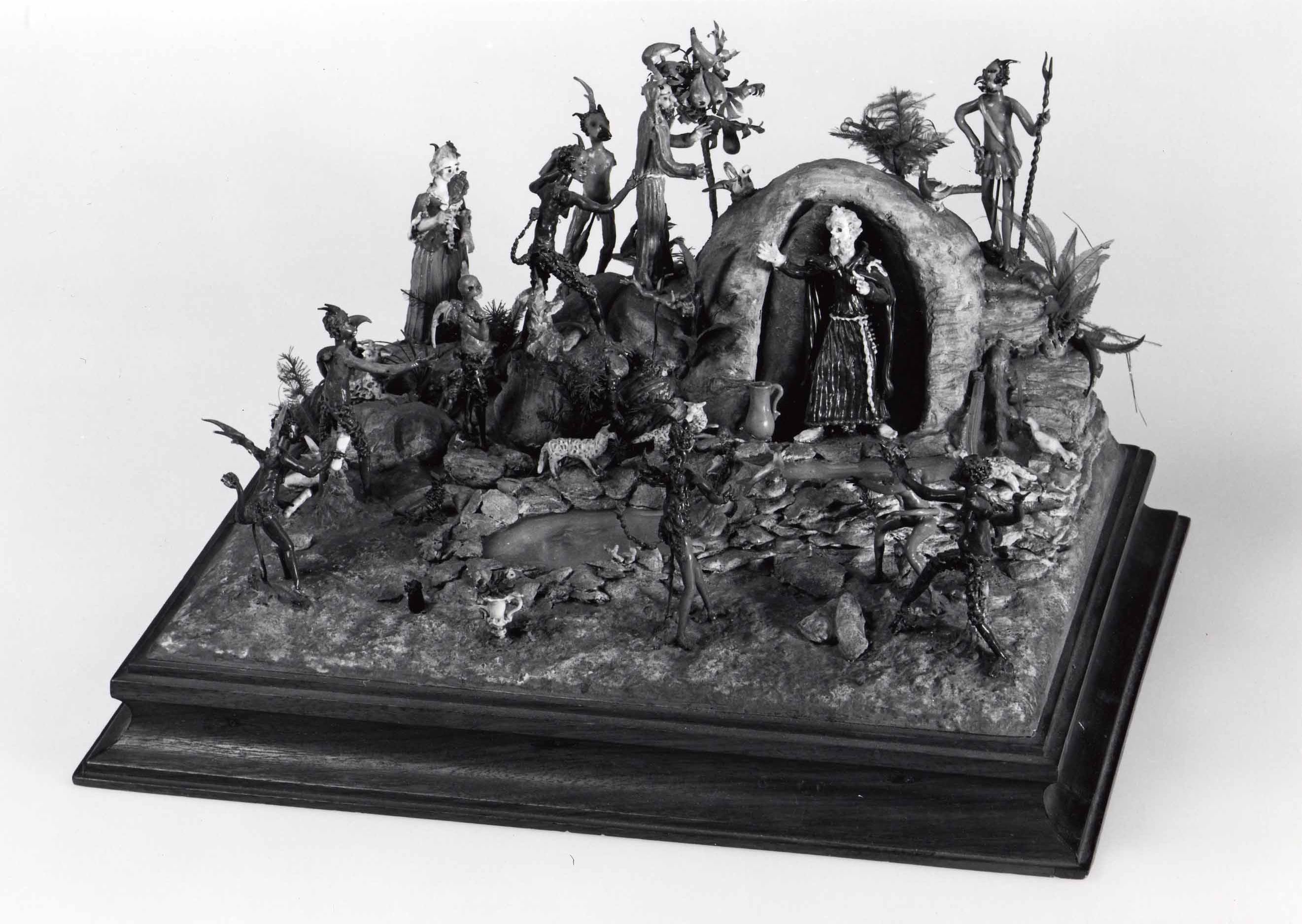
The probably Nevers Temptation of St. Anthony expands glass figures into an entire assembled tableau.[10] Its rocky stage gathers the saint, fantastic tempters, animals, plants and objects from lampworked glass, composition material, mirror, wood, wire, shells, feathers, paper and paint. Here wire belongs to the organisation of a miniature environment. The eye moves among many verticals, chains, limbs and fine extensions rather than settling on one isolated figure.
The comparison separates two scales of assembly. Diana concentrates attention on one body and its attributes; The Temptation of St. Anthony distributes attention through a populated scene. Neither work supports a claim that the wire alone produced its form. The recorded material list is evidence of cooperation among parts.
Calder and line in three dimensions
Wire became newly conspicuous within twentieth-century sculpture. Calder's Rearing Stallion of about 1928 is wire, wood and paint. The National Gallery of Art connects his wire practice to continuous-line drawing: contour leaves the sheet and occupies real space.[1][2] A profile can be readable from one angle and then break into overlapping arcs when the viewer moves. Empty air is not a background added later; it enters the sculpture between the lines.
Calder's Mobile of 1941 extends that openness into a linked system of painted aluminium, steel, steel rod and wire. The Met describes flat elements connected so that they can move in response to air.[3] Wire now helps establish relation, distance and balance among separate shapes. Movement alters the intervals and silhouettes, so no single view exhausts the composition.
This shift should not become a practical hanging lesson. The historical point is perceptual: line can define a figure, and a wire-linked structure can make changing relationships into sculpture. Calder's exact works give those ideas dates and material form.
Networks, intervals and wrapped bundles
Claire Falkenstein's Envelope of 1958 uses a different open logic. The Smithsonian American Art Museum identifies it as a steel-wire assemblage and emphasises how its contours define space without filling it.[4] From different viewpoints, overlaps thicken and thin. Voids can appear enclosed, then open again as the viewer moves. The work is neither a drawn outline of one subject nor a mobile of separate flat plates; it is a spatial network.
The artist known only by the assigned name Philadelphia Wireman made another kind of wire density. The selected Untitled object, dated about 1970–75, combines tin foil, plastic, rubber, steel and wire in a palm-sized form.[5] The Smithsonian describes a larger body of individual wrapped bundles discovered in a South Philadelphia alley and carefully qualifies what is known about their unidentified maker. For this object, enclosure matters more than airy interval: wire gathers disparate fragments into a compact, many-sided sculpture.
Comparing Envelope with Untitled reveals opposite uses of accumulation. Falkenstein's open network makes surrounding air legible; the Philadelphia Wireman's wrapping conceals and compresses other materials. Both resist a single privileged front, but their scale, authorship and historical circumstances remain distinct. Suggestive cultural interpretations around the bundles should stay attributed and qualified, not converted into certainty about an unidentified person.
Wire inside devotional ensembles
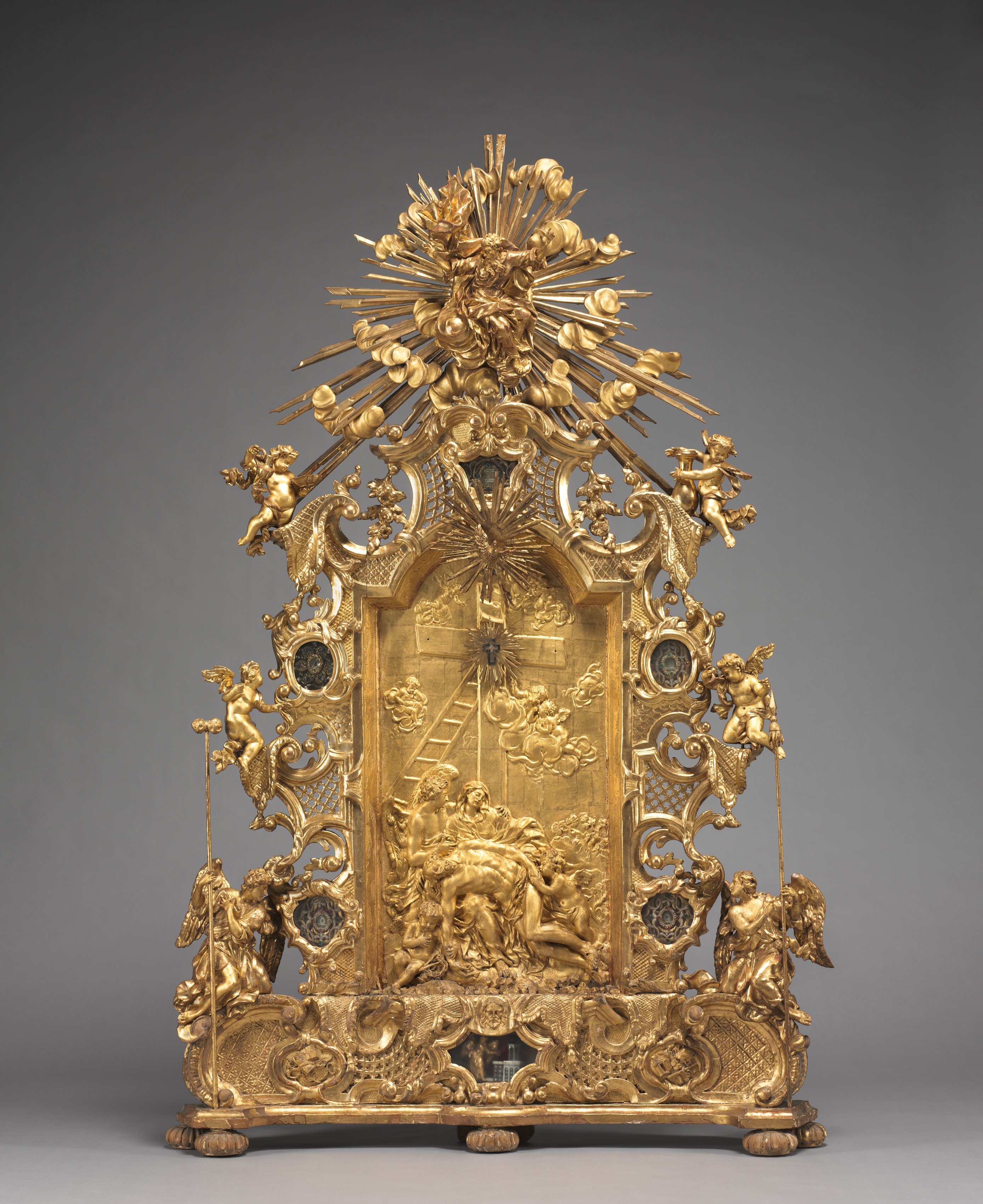
Joseph Matthias Götz and his workshop's Altarpiece with Relics, made about 1735–40, integrates gold wire with gilded wood, mother-of-pearl, ebony, red silk, seed pearls, rock crystal, paper and relics.[12] The towering Bavarian ensemble layers carved figures, relief scenes, niches, rays and ornamental scrolls. Gold wire participates in a deliberately rich surface system rather than announcing a separate wire-sculpture category.
The work provides a useful caution. Material importance is not measured only by how much of it a photograph reveals. Fine wire can organise, attach or enrich a composite while larger carved and gilded forms dominate from a distance. The exact record prevents the viewer from mistaking the whole object for carved wood alone.
How to read wire in a sculpture
- Start with visibility. Decide whether wire forms the outer image, appears at joins or disappears beneath another material.
- Follow the line. Notice where it outlines, crosses, loops, repeats or stops.
- Read the intervals. Open spaces, overlaps and shadows can carry as much visual weight as the metal.
- Distinguish network from bundle. Repetition may open a volume to air or compress materials into a dense core.
- Locate attachments. Ask what is connected, articulated or suspended without assuming how the connection was made.
- Check the object record. A photograph may hide an armature or make a minor component look dominant.
- Separate structure from subject. Similar wire functions can serve a Buddhist figure, Christian display, mythological glass figurine or abstract assemblage without giving them a common meaning.
- Allow for movement and viewpoint. A contour or interval may change as the sculpture or viewer changes position.
Wire sculpture is best understood as a set of relationships. It can turn line into volume, give empty space an edge, carry another material, connect separate parts, wrap a found core or let shapes change position. Exact works keep those relationships historical and specific. They also make clear why close looking is more useful here than a generic list of craft techniques.
Watch: Wire, Space and Motion
Choose a MoMA introduction to Calder's spatial experiments, a Met close reading of a moving mobile, or the Whitney's film of Calder animating his wire circus.
Alexander Calder: Modern from the Start
See how Calder overturned assumptions that sculpture must be static, grounded and dense by treating line, balance and surrounding space as active material.
Watch on YouTubeFrequently Asked Questions
Not necessarily. An armature may be a hidden support beneath wax, clay, fibre or fabric, while an exposed wire work makes line or network part of its intended appearance.
No. Wire can outline figures, connect composite objects, form open abstract networks, bind bundles or participate in suspended structures.
The intervals between suspended elements are part of the composition. Movement continually changes those gaps, overlaps, shadows and relationships to the surrounding room.
If an original wax or model contained an armature, casting or later damage can sometimes preserve or reveal that internal structure. The collection record is stronger evidence than visual guesswork.
Authoritative object records support the historical discussion, but this page only reproduces works whose images carry affirmative public-domain, CC0 or free-to-use status.
Discussion
Which role most changes your understanding of wire in sculpture: exposed contour, open network, hidden armature, attachment, wrapped bundle or moving suspension?
Reader Insights
Line, support, binding, articulation and suspension describe different structural and visual roles.
Open gaps, overlaps and shadows can carry as much compositional force as the metal itself.
Use object records to confirm hidden armatures, joins, dates and mixed materials; do not infer them from appearance alone.
Join the Conversation
Share one precise observation or a useful museum example below.
References
- National Gallery of Art, “The Elements of Art: Form.” https://www.nga.gov/educational-resources/elements-art/elements-art-form
- National Gallery of Art, “Rearing Stallion,” object 1996.120.22. https://www.nga.gov/artworks/92726-rearing-stallion
- Metropolitan Museum of Art, “Mobile,” object 42.176a, b. https://www.metmuseum.org/art/collection/search/488051
- Smithsonian American Art Museum, “Envelope,” object 1981.109.6. https://americanart.si.edu/artwork/envelope-8155
- Smithsonian American Art Museum, “Untitled,” Philadelphia Wireman, object 2016.38.53. https://americanart.si.edu/artwork/untitled-111133
- Metropolitan Museum of Art, “Horse with Head Lowered,” object 29.100.430. https://www.metmuseum.org/art/collection/search/196499
- Metropolitan Museum of Art, “Angel,” object 64.164.8a–c. https://www.metmuseum.org/art/collection/search/204109
- Metropolitan Museum of Art, “Virgin,” object 64.164.1a, b. https://www.metmuseum.org/art/collection/search/204102
- Metropolitan Museum of Art, “Diana,” object 1975.1.1563. https://www.metmuseum.org/art/collection/search/460547
- Metropolitan Museum of Art, “The Temptation of St. Anthony,” object 1975.1.1577. https://www.metmuseum.org/art/collection/search/460554
- Cleveland Museum of Art, “Fudō Myōō,” object 1989.267. https://clevelandart.org/art/1989.267
- Cleveland Museum of Art, “Altarpiece with Relics,” object 1964.357. https://clevelandart.org/art/1964.357
- Smithsonian American Art Museum, “Standing Articulated Figure,” object 1986.65.278. https://americanart.si.edu/artwork/standing-articulated-figure-24482